oil KIA Sedona 2007 2.G Owner's Guide
[x] Cancel search | Manufacturer: KIA, Model Year: 2007, Model line: Sedona, Model: KIA Sedona 2007 2.GPages: 344, PDF Size: 3.76 MB
Page 307 of 344

617
Maintenance
POWER STEERING Checking the power steering fluid
level With the vehicle on level ground, check
the fluid level in the power steering reser-
voir periodically. The fluid should be
between MAX and MIN marks on the
side of the reservoir at the normal tem-
perature.
Before adding power steering fluid, thor-
oughly clean the area around the reser-
voir cap to prevent power steering fluid
contamination.
If the level is low, add fluid to the MAX
level.
In the event the power steering system
requires frequent addition of fluid, the
vehicle should be inspected by an
Authorized Kia Dealer.
Use only the specified power steeringfluid. (Refer to "RecommendedLubricants" later in this section.)Power steering hosesCheck the connections for oil leaks,
severe damage and twists in the power
steering hose before driving. The climate control air filter installed
behind the glove box filters the dust or
other pollutants that come into the vehi-
cle from the outside through the heating
and air conditioning system. If dust or
other pollutants accumulate in the filter
over a period of time, the air flow from the
air vents may decrease, resulting in
moisture accumulation on the inside of
the windshield even when the outside
(fresh) air position is selected. If this hap-
pens, have the climate control air filter
replaced by an Authorized Kia Dealer.
CAUTION
To avoid damage to the power
steering pump, do not operate thevehicle for prolonged periodswith a low power steering fluid level.
Never start the engine when the reservoir tank is empty.
When adding fluid, be careful that dirt does not get into the tank.
Too little fluid can result in increased steering effort and/ornoise from the power steering sys- tem.
The use of the non-specified fluid could reduce the effectiveness ofthe power steering system and cause damage to it.
OVQ066012N
CLIMATE CONTROL AIR FILTER
1LDA5047
Outside air
Recirculatedair
Climate control
air filter Blower
Evaporator
coreHeater core
Page 316 of 344

Maintenance26
6
Description Fuse rating Protected component
P/TRAIN 7.5A Theft alarm relay, Main relay,
TCM, Generator, ECM, Injector
15A, ECU 2 15A, ECU 1 10A,
Air conditioner compressor relay,
Inlet metering valve, EGR sole-
noid valve, Air flow sensor,
Diesel box, Immobilizer module
FUEL PUMP 15A Fuel pump motor
SP 7.5A Spare fuse
SP 10A Spare fuse
SP 15A Spare fuse
SP 20A Spare fuse
SP 25A Spare fuse
ABS 1 40A ABS control module,
ESC control module
ABS 2 20A ABS control module,
ESC control module
FRT WIPER 30A Front wiper ON relay
KEY SW 2 30A Start relay, IG2 Load(Variable
rack stroke, ECM mirror, Rain
sensor, Seat warmer)
RAM 1 50A Rear area module
RAM 2 50A Rear area module
RAM 3 50A Rear area module
Engine compartment
Description Fuse rating Protected component
FRT/RR WASHER 10A Front washer motor relay,
Rear washer motor relay
IG 2 7.5A AQS sensor, fuel filter
STOP LAMP 20A Stop lamp, High mounted stop lamp
FUEL HEATER 20A Fuel filter heater
KEY SW 1 25A Instrument panel module
STOP SIGNAL 7.5A TCU, PCU/ECU, ABS/ESC Unit
A/C COMP 7.5A Air conditioner compressor relay
ATM 15A ATM solenoid
FRT DEICER 15A Front deicer
HORN 15A Horn relay
ECU 1 10A PCU/ECU, A/C comp relay, Mass air flow sensor, Immobilizer unit
O2 DN 10A O2 sensor(RL, RR)
ECU 2 15A PCU/ECU, Oil control valve 1/2, Variable intake manifold valve 1/2,
Canister purge solenoid valve,
Canister close valve,
Pulse width modulation relay
O2 UP 10A O2 sensor(FL, FR)
IGN COIL 20A Ignition coil 1/2/3/4/5/6, Condensor
INJECTOR 15A PCU/ECU, Injector 1/2/3/4/5/6,
Glow relay 1/2, Intake manifold
valve, EGR Solenoid valve,
Cooling fan relay, Air flow sen-
sor, Intake throttle valve
Page 320 of 344
Maintenance30
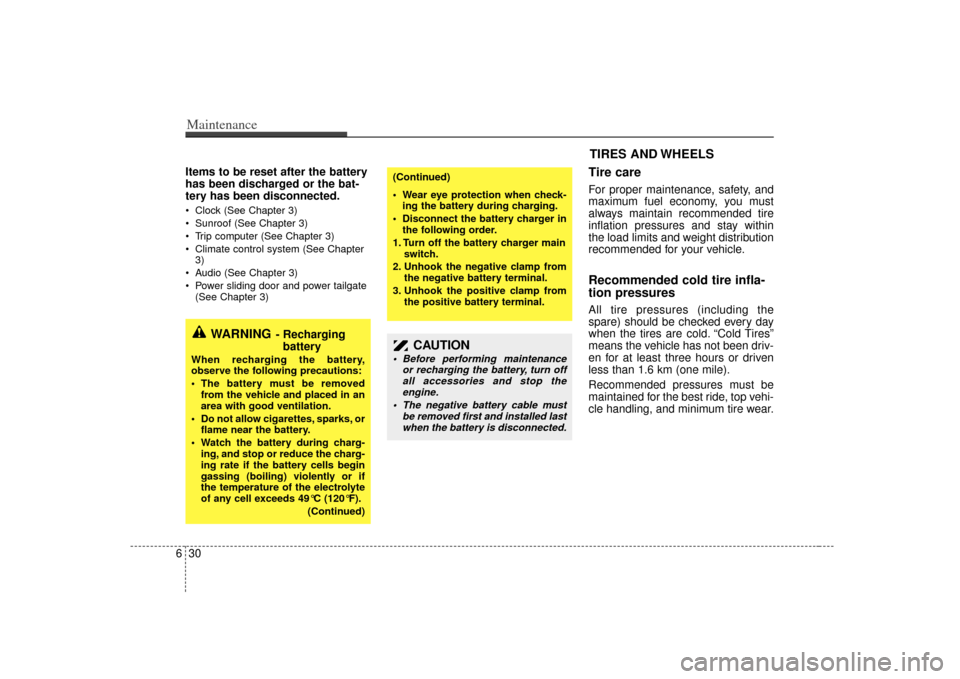
6Items to be reset after the battery
has been discharged or the bat-
tery has been disconnected. Clock (See Chapter 3)
Sunroof (See Chapter 3)
Trip computer (See Chapter 3)
Climate control system (See Chapter
3)
Audio (See Chapter 3)
Power sliding door and power tailgate (See Chapter 3)
Tire care For proper maintenance, safety, and
maximum fuel economy, you must
always maintain recommended tire
inflation pressures and stay within
the load limits and weight distribution
recommended for your vehicle.Recommended cold tire infla-
tion pressures All tire pressures (including the
spare) should be checked every day
when the tires are cold. “Cold Tires”
means the vehicle has not been driv-
en for at least three hours or driven
less than 1.6 km (one mile).
Recommended pressures must be
maintained for the best ride, top vehi-
cle handling, and minimum tire wear.
CAUTION
Before performing maintenance or recharging the battery, turn offall accessories and stop theengine.
The negative battery cable must be removed first and installed lastwhen the battery is disconnected.
WARNING
- Recharging battery
When recharging the battery,
observe the following precautions:
The battery must be removed
from the vehicle and placed in an
area with good ventilation.
Do not allow cigarettes, sparks, or flame near the battery.
Watch the battery during charg- ing, and stop or reduce the charg-
ing rate if the battery cells begin
gassing (boiling) violently or if
the temperature of the electrolyte
of any cell exceeds 49°C (120°F).
(Continued)
(Continued)
Wear eye protection when check-ing the battery during charging.
Disconnect the battery charger in the following order.
1. Turn off the battery charger main switch.
2. Unhook the negative clamp from the negative battery terminal.
3. Unhook the positive clamp from the positive battery terminal.
TIRES AND WHEELS
Page 330 of 344

Maintenance40
6Cold Tire Pressure: The amount of
air pressure in a tire, measured in
kilopascals (kPa) or pounds per
square inch (psi) before a tire has
built up heat from driving.
Curb Weight: This means the weight
of a motor vehicle with standard and
optional equipment including the
maximum capacity of fuel, oil and
coolant, but without passengers and
cargo.
DOT Markings: The DOT code
includes the Tire Identification
Number (TIN), an alphanumeric des-
ignator which can also identify the
tire manufacturer, production plant,
brand and date of production.
GVWR: Gross Vehicle Weight Rating
GAWR FRT: Gross Axle Weight
Rating for the front Axle.
GAWR RR: Gross Axle Weight
Rating for the rear axle. Intended Outboard Sidewall
: The
side of an asymmetrical tire, that
must always face outward when
mounted on a vehicle.
Kilopascal (kPa): The metric unit for
air pressure.
Load Index: An assigned number
ranging from 1 to 279 that corre-
sponds to the load carrying capacity
of a tire.
Maximum Inflation Pressure : The
maximum air pressure to which a
cold tire may be inflated. The maxi-
mum air pressure is molded onto the
sidewall.
Maximum Load Rating : The load
rating for a tire at the maximum per-
missible inflation pressure for that
tire.
Maximum Loaded Vehicle Weight:
The sum of curb weight; accessory
weight; vehicle capacity weight; and
production options weight.
Normal Occupant Weight:The
number of occupants a vehicle is
designed to seat multiplied by 68 kg
(150 pounds). Occupant Distribution
: Designated
seating positions.
Outward Facing Sidewall: The side
of a asymmetrical tire that has a par-
ticular side that faces outward when
mounted on a vehicle. The outward
facing sidewall bears white lettering
or bears manufacturer, brand, and/or
model name molding that is higher or
deeper than the same moldings on
the inner facing sidewall.
Passenger (P-Metric) Tire : A tire
used on passenger cars and some
light duty trucks and multipurpose
vehicles.
Recommended Inflation Pressure :
Vehicle manufacturer's recommend-
ed tire inflation pressure and shown
on the tire placard.
Radial Ply tire: A pneumatic tire in
which the ply cords that extend to the
beads are laid at 90 degrees to the
centerline of the tread.
Rim: A metal support for a tire and
upon which the tire beads are seat-
ed.
Sidewall: The portion of a tire
between the tread and the bead.
Page 332 of 344

Maintenance42
6LUBRICANT
Recommended lubricants To help achieve proper engine and powertrain performance and
durability, use only lubricants of the proper quality. The correct
lubricants also help promote engine efficiency that results in
improved fuel economy.
Engine oils labeled Energy Conserving Oil are now available.
Along with other additional benefits, they contribute to fuel
economy by reducing the amount of fuel necessary to over-
come engine friction. Often, these improvements are difficult to
measure in everyday driving, but in a year’s time, they can offer
significant cost and energy savings.
These lubricants and fluids are recommended for use in your
vehicle.
Recommended SAE viscosity number Engine oil viscosity (thickness) has an effect on fuel economy
and cold weather operating (starting and oil flow). Lower viscos-
ity engine oils can provide better fuel economy and cold weath-
er performance, however, higher viscosity engine oils are
required for satisfactory lubrication in hot weather. Using oils of
any viscosity other than those recommended could result in
engine damage.
When choosing an oil, consider the range of temperature your
vehicle will be operated in before the next oil change. Proceed to
select the recommended oil viscosity from the chart.
CAUTION
Always be sure to clean the area around any filler plug, drain plug, or dipstick before checking or draining anylubricant. This is especially important in dusty or sandy areas and when the vehicle is used on unpaved roads.Cleaning the plug and dipstick areas will prevent dirt and grit from entering the engine and other mechanisms thatcould be damaged.
*¹ Refer to the recommended SAE viscosity numbers.
Lubricant Classification
API Service SJ, SL or above,
ILSAC GF-3 or above
Automatic transaxle fluid
DIAMOND ATF SP-III or SK ATF SP-III
Power steering fluid PSF-III
Brake fluid FMVSS116 DOT-3 or DOT-4Engine oil
*¹
Temperature Range for SAE Viscosity Numbers
Temperature
Engine Oil *
1°C
(°F)
-30 -20 -10 0 10 20 30 40 50
-10 0 20 40 60 80 100 120
1. For better fuel economy, it is recommended to use the engine oil of a viscositygrade SAE 5W-20, 5W-30 (API SJ, SL / ILSAC GF-3). However, if the engine
oil is not available in your country, select the proper engine oil using the engine
oil viscosity chart.
10W-30
5W-20, 5W-30
Page 334 of 344

Maintenance44
6Waxing
Wax the vehicle when water will no
longer bead on the paint.
Always wash and dry the vehicle before
waxing. Use a good quality liquid or
paste wax, and follow the manufacturer’s
instructions. Wax all metal trim to protect
it and to maintain its luster.
Removing oil, tar, and similar materials
with a spot remover will usually strip the
wax from the finish. Be sure to re-wax
these areas even if the rest of the vehicle
does not yet need waxing.
Finish damage repair Deep scratches or stone chips in the
painted surface must be repaired
promptly. Exposed metal will quickly rust
and may develop into a major repair
expense.✽ ✽
NOTICEIf your vehicle is damaged and requires
any metal repair or replacement, be sure
the body shop applies anti-corrosion
materials to the parts repaired or
replaced. Bright-metal maintenance To remove road tar and insects, use a
tar remover, not a scraper or other
sharp object.
To protect the surfaces of bright-metal parts from corrosion, apply a coating of
wax or chrome preservative and rub to
a high luster.
During winter weather or in coastal areas, cover the bright metal parts with
a heavier coating of wax or preserva-
tive. If necessary, coat the parts with
non-corrosive petroleum jelly or other
protective compound.
Underbody maintenanceCorrosive materials used for ice and
snow removal and dust control may col-
lect on the underbody. If these materials
are not removed, accelerated rusting can
occur on underbody parts such as the
fuel lines, frame, floor pan and exhaust
system, even though they have been
treated with rust protection.
Thoroughly flush the vehicle underbody
and wheel openings with lukewarm or
cold water once a month at the end of
each winter. Pay special attention to
these areas because it is difficult to see
all the mud and dirt. It will do more harm
than good to wet down the road grime
without removing it. The lower edges of
doors, rocker panels, and frame mem-
bers have drain holes that should not be
allowed to clog with dirt; trapped water in
these areas can cause rusting.
CAUTION
Wiping dust or dirt off the body with a dry cloth will scratch thefinish.
Do not use steel wool, abrasive cleaners, or strong detergentscontaining highly alkaline orcaustic agents on chrome-platedor anodized aluminum parts. Thismay result in damage to the pro- tective coating and cause discol-oration or paint deterioration.
WARNING
After washing the vehicle, test the
brakes while driving slowly to see if
they have been affected by water. If
braking performance is impaired,
dry the brakes by applying them
lightly while maintaining a slow for-
ward speed.
Page 335 of 344

645
Maintenance
Aluminum wheel maintenance The aluminum wheels are coated with a
clear protective finish.
Do not use any abrasive cleaner, pol-ishing compound, solvent, or wire
brushes on aluminum wheels. They
may scratch or damage the finish.
Use only a mild soap or neutral deter- gent, and rinse thoroughly with water.
Also, be sure to clean the wheels after
driving on salted roads. This helps pre-
vent corrosion.
Avoid washing the wheels with high- speed car wash brushes.
Do not use any acid detergent. It may damage and corrode the aluminum
wheels coated with a clear protective
finish.
Interior care Interior general precautions Prevent caustic solutions such as per-
fume and cosmetic oil from contacting
the dashboard because they may cause
damage or discoloration. If they do con-
tact the dashboard, wipe them off imme-
diately. See the instructions that follow for
the proper way to clean vinyl.
Cleaning the upholstery and interiortrim Vinyl
Remove dust and loose dirt from vinyl
with a whisk broom or vacuum cleaner.
Clean vinyl surfaces with a vinyl cleaner.
Fabric
Remove dust and loose dirt from fabric
with a whisk broom or vacuum cleaner.
Clean with a mild soap solution recom-
mended for upholstery or carpets.
Remove fresh spots immediately with a
fabric spot cleaner. If fresh spots do not
receive immediate attention, the fabric
can be stained and its color can be
affected. Also, its fire-resistant properties
can be reduced if the material is not
properly maintained.
CAUTION
Never allow water or other liquids to come in contact with electrical/electronic components inside the vehicle as this may damage them.
CAUTION
Using anything but recommendedcleaners and procedures may affectthe fabric’s appearance and fire-resistant properties.
Page 336 of 344

Maintenance46
6Cleaning the lap/shoulder belt web-
bing Clean the belt webbing with any mild
soap solution recommended for cleaning
upholstery or carpet. Follow the instruc-
tions provided with the soap. Do not
bleach or re-dye the webbing because
this may weaken it.Cleaning the interior window glass If the interior glass surfaces of the vehi-
cle become fogged (that is, covered with
an oily, greasy or waxy film), they should
be cleaned with glass cleaner. Follow the
directions on the glass cleaner container. The emission control system of your
vehicle is covered by a written limited
warranty. Please see the warranty infor-
mation contained in the Warranty &
Consumer Information Manual in your
vehicle.
Vehicle modifications This vehicle should not be modified.
Modification of your Kia could affect its
performance, safety or durability and
may even violate governmental safety
and emissions regulations.
In addition, damage or performance
problems resulting from any modification
may not be covered under warranty.Engine exhaust gas precautions
(carbon monoxide) Carbon monoxide can be present with
other exhaust fumes. Therefore, if you
smell exhaust fumes of any kind inside
your vehicle, have it inspected and
repaired immediately. If you ever sus-
pect exhaust fumes are coming into
your vehicle, drive it only with all the
windows fully open. Have your vehicle
checked and repaired immediately. Do not operate the engine in confined
or closed areas (such as garages) any
more than what is necessary to move
the vehicle in or out of the area.
When the vehicle is stopped in an open area for more than a short time
with the engine running, adjust the
ventilation system (as needed) to draw
outside air into the vehicle.
Never sit in a parked or stopped vehi- cle for any extended time with the
engine running.
When the engine stalls or fails to start, excessive attempts to re-start the
engine may cause damage to the
emission control system.
CAUTION
Do not scrape or scratch the insideof the rear window. This may result in damage to the rear windowdefroster grid.
WARNING
- Exhaust
Engine exhaust gases contain car-
bon monoxide (CO). Though color-
less and odorless, it is dangerous
and could be lethal if inhaled.
Follow the instructions following to
avoid CO poisoning.
EMISSION CONTROL SYSTEM
Page 340 of 344

73
Specifications
Inflation pressure kPa (psi)
Front Rear
225/70R16 6.5J×16 240 240
235/60R17 6.5J×17 (35) (35)
T135/90R17 4.0T×17 420 420
(60) (60)
Full size tire
Compact
spare tire Wheel lug nut torque kg•m
(Nm, lbft)
9~11
(88~107, 65~79)TIRES
Item Tire
size Wheel size
CAPACITIESLubricant
Volume Classification
5.2 l (5.49 US qt.)
Automatic transaxle fluid 10.9 l (11.52 US qt.) DIAMOND ATF SP-III, SK ATF SP-III
Power steering 1.0 l (1.06 US qt.) PSF-III
Coolant 8.6 l(9.09 US qt.) Ethylene glycol base for aluminum radiator
Brake fluid 0.7~0.8
l
FMVSS116 DOT-3 or DOT-4
(0.7~0.8 US qt.)
Fuel 80 l (21.1 US gal.) -Engine oil
*1
(drain and refill) API Service SJ, SL or above, ILSAC GF-3 or above
(SAE 5W-20)*1Refer to the recommended SAE viscosity numbers on the page 6-42.
Page 342 of 344

Index28Air bags-advanced restraint system ··················\
·············3-78
Air cleaner ··················\
··················\
··················\
···············6-13
Antenna ··················\
··················\
··················\
··················\
3-179
Appearance care··················\
··················\
··················\
·······6-43
Audio remote control ··················\
··················\
···············3-179
Audio system ··················\
··················\
··················\
·········3-180
Automatic climate control system ··················\
·············3-147
Automatic transaxle··················\
··················\
············4-5, 6-13
Battery··················\
··················\
··················\
··················\
····6-28
Before driving ··················\
··················\
··················\
············4-2
Brake system··················\
··················\
··················\
············4-14
Brakes ··················\
··················\
··················\
··················\
····6-15
Bulb wattage ··················\
··················\
··················\
··············7-2
Capacities ··················\
··················\
··················\
··················\
·7-3
Child restraint system ··················\
··················\
················3-71
Cruise control system ··················\
··················\
················4-11
Climate control air filter ··················\
··················\
············6-17
Defroster ··················\
··················\
··················\
················3-134
Dimensions ··················\
··················\
··················\
················7-2Door locks ··················\
··················\
··················\
················3-11
Driver position memory system ··················\
··················\
3-57
Economical operation ··················\
··················\
···············4-25
Electronic stability control··················\
··················\
·········4-19
Emergency starting ··················\
··················\
··················\
····5-2
Emission control system ··················\
··················\
············6-46
Engine compartment ··················\
··················\
··················\
··6-9
Engine coolant ··················\
··················\
··················\
·········6-11
Engine oil ··················\
··················\
··················\
·················6-10\
Fuel filler lid ··················\
··················\
··················\
············3-30
Fuel requirements ··················\
··················\
··················\
······1-2
Fuses ··················\
··················\
··················\
··················\
······6-20
Gauges ··················\
··················\
··················\
··················\
·3-109
Hazard warning flasher ··················\
··················\
···········3-135
Homelink® wireless control system··················\
··········3-165
Hood··················\
··················\
··················\
··················\
·······3-29
Horn ··················\
··················\
··················\
··················\
·····3-133
How to use this manual ··················\
··················\
···············1-2ABCD
EFGH