warning lights KIA Sedona 2007 2.G Owner's Guide
[x] Cancel search | Manufacturer: KIA, Model Year: 2007, Model line: Sedona, Model: KIA Sedona 2007 2.GPages: 344, PDF Size: 3.76 MB
Page 274 of 344

What to do in an emergency25ROAD WARNING Hazard warning flasher The hazard warning flasher serves as a
warning to other drivers to exercise
extreme caution when approaching,
overtaking, or passing your vehicle.It should be used whenever emergency
repairs are being made or when the vehi-
cle is stopped near the edge of a road-
way.
Depress the flasher switch with the igni-
tion switch in any position. The flasher
switch is located in the center console
switch panel. All turn signal lights will
flash simultaneously.
• The hazard warning flasher operates
whether your vehicle is running or not.
The turn signals do not work when the hazard flasher is on.
Care must be taken when using the hazard warning flasher while the vehi-
cle is being towed.
Jump starting Jump starting can be dangerous if done
incorrectly. Therefore, to avoid harm to
yourself or damage to your vehicle or
battery, follow the jump starting proce-
dures. If in doubt, we strongly recom-
mend that you have a competent techni-
cian or towing service jump start your
vehicle.EMERGENCY STARTING
CAUTION
Use only a 12-volt jumper system.You can damage a 12-volt starting motor, ignition system, and otherelectrical parts beyond repair by use of a 24-volt power supply (eithertwo 12-volt batteries in series or a 24-volt motor generator set).
OVQ036059NOVQ036060N
Type AType B
Page 297 of 344
67
Maintenance
OWNER MAINTENANCE Owner maintenance schedule The following lists are vehicle checks and
inspections that should be performed by
the owner or an Authorized Kia Dealer at
the frequencies indicated to help ensure
safe, dependable operation of your vehi-
cle.
Any adverse conditions should be
brought to the attention of your dealer as
soon as possible.
These Owner Maintenance Checks are
generally not covered by warranties and
you may be charged for labor, parts and
lubricants used.When you stop for fuel: Check the engine oil level.
Check coolant level in coolant reser-voir.
Check the windshield washer fluid level.
Look for low or under-inflated tires.
While operating your vehicle: Note any changes in the sound of the exhaust or any smell of exhaust fumes
in the vehicle.
Check for vibrations in the steering wheel. Notice any increased steering
effort or looseness in the steering
wheel, or change in its straight-ahead
position.
Notice if your vehicle constantly turns slightly or “pulls” to one side when trav-
eling on smooth, level road.
When stopping, listen and check for unusual sounds, pulling to one side,
increased brake pedal travel or “hard-
to-push” brake pedal.
If any slipping or changes in the oper- ation of your transaxle occurs, check
the transaxle fluid level.
Check automatic transaxle P (Park) function.
Check parking brake.
Check for fluid leaks under your vehicle (water dripping from the air condition-
ing system during or after use is nor-
mal).
At least monthly: Check coolant level in the coolantrecovery reservoir.
Check the operation of all exterior lights, including the stoplights, turn sig-
nals and hazard warning flashers.
Check the inflation pressures of all tires including the spare.At least twice a year (i.e., every Spring and Fall): Check radiator, heater and air condi- tioning hoses for leaks or damage.
Check windshield washer spray and wiper operation. Clean wiper blades
with clean cloth dampened with wash-
er fluid.
Check headlight alignment.
Check muffler, exhaust pipes, shields and clamps.
Check the lap/shoulder belts for wear and function.
Check for worn tires and loose wheel lug nuts.
WARNING
Be careful when checking your
engine coolant level when the
engine is hot. Scalding hot coolant
and steam may blow out under
pressure. This could cause burns or
other serious injury.
Page 310 of 344
Maintenance20
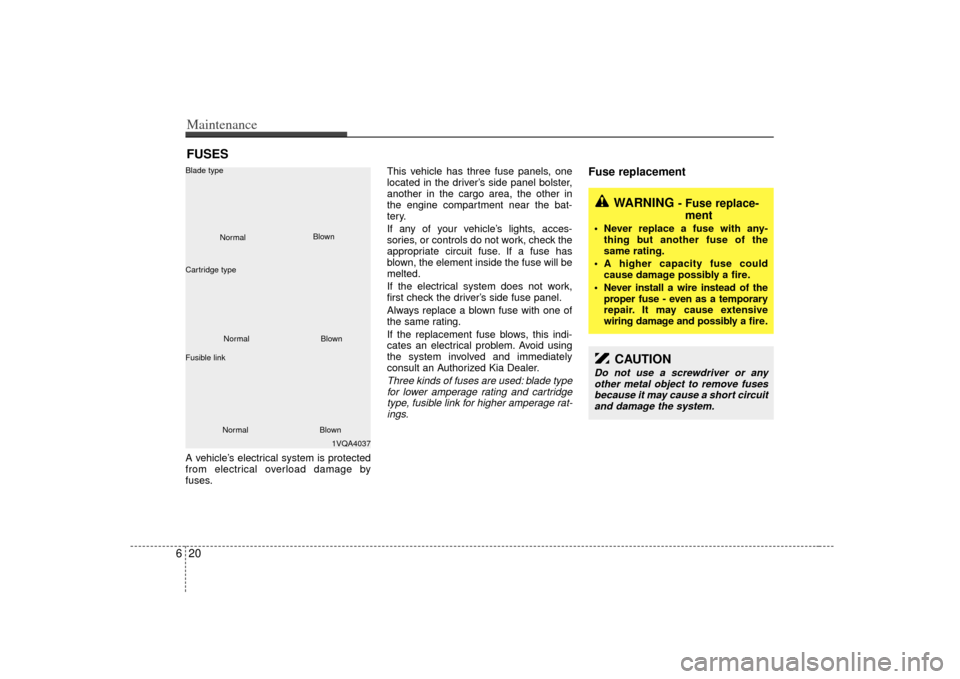
6FUSESA vehicle’s electrical system is protected
from electrical overload damage by
fuses. This vehicle has three fuse panels, one
located in the driver’s side panel bolster,
another in the cargo area, the other in
the engine compartment near the bat-
tery.
If any of your vehicle’s lights, acces-
sories, or controls do not work, check the
appropriate circuit fuse. If a fuse has
blown, the element inside the fuse will be
melted.
If the electrical system does not work,
first check the driver’s side fuse panel.
Always replace a blown fuse with one of
the same rating.
If the replacement fuse blows, this indi-
cates an electrical problem. Avoid using
the system involved and immediately
consult an Authorized Kia Dealer.
Three kinds of fuses are used: blade type
for lower amperage rating and cartridge type, fusible link for higher amperage rat-ings.
Fuse replacement
1VQA4037
Normal
Normal
Blade type
Cartridge type
Fusible link Blown
Blown
Normal Blown
WARNING
- Fuse replace-
ment
Never replace a fuse with any-
thing but another fuse of the
same rating.
A higher capacity fuse could cause damage possibly a fire.
Never install a wire instead of the proper fuse - even as a temporary
repair. It may cause extensive
wiring damage and possibly a fire.
CAUTION
Do not use a screwdriver or anyother metal object to remove fusesbecause it may cause a short circuitand damage the system.
Page 318 of 344
Maintenance28
6
OVQ066018N
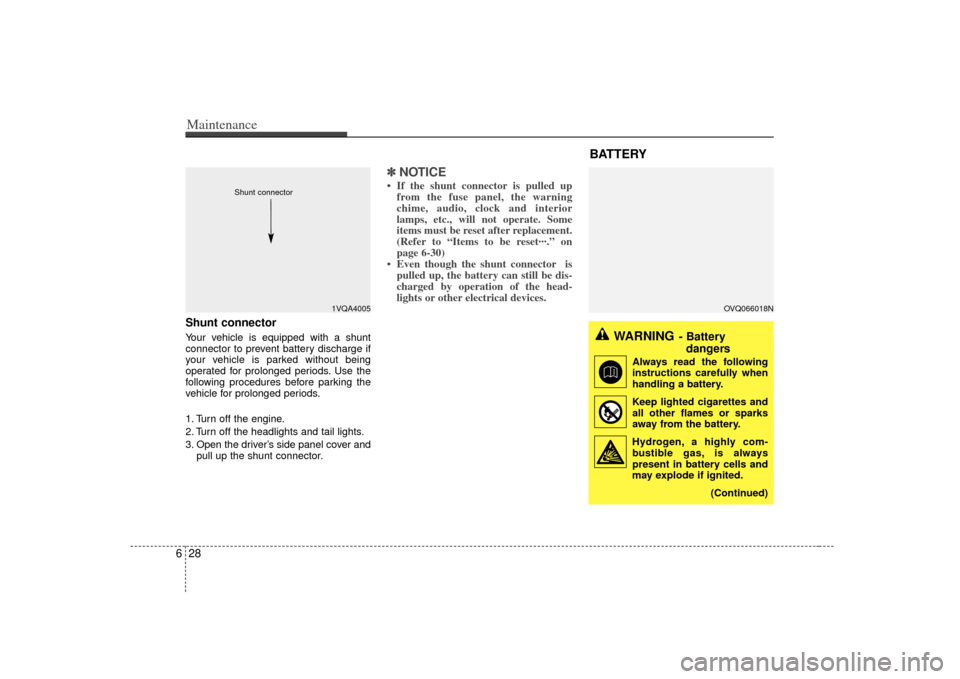
Shunt connector Your vehicle is equipped with a shunt
connector to prevent battery discharge if
your vehicle is parked without being
operated for prolonged periods. Use the
following procedures before parking the
vehicle for prolonged periods.
1. Turn off the engine.
2. Turn off the headlights and tail lights.
3. Open the driver’s side panel cover and
pull up the shunt connector.
✽ ✽NOTICE• If the shunt connector is pulled up
from the fuse panel, the warning
chime, audio, clock and interior
lamps, etc., will not operate. Some
items must be reset after replacement.
(Refer to “Items to be reset···.” on
page 6-30)
• Even though the shunt connector is pulled up, the battery can still be dis-
charged by operation of the head-
lights or other electrical devices.
1VQA4005
Shunt connector
BATTERY
WARNING
- Battery
dangers
Always read the following
instructions carefully when
handling a battery.
Keep lighted cigarettes and all other flames or sparks
away from the battery.
Hydrogen, a highly com- bustible gas, is always
present in battery cells and
may explode if ignited.
(Continued)
Page 343 of 344

83
Index
If the engine overheats ··················\
··················\
···············5-5
If you have a flat tire ··················\
··················\
··················\
·5-6
Immobilizer system ··················\
··················\
··················\
···3-9
Instrument cluster ··················\
··················\
··················\
··3-108
Instrument panel overview ··················\
··················\
··········2-3
Interior features··················\
··················\
··················\
······3-173
Interior lights ··················\
··················\
··················\
·········3-123
Interior overview ··················\
··················\
··················\
·······2-2
Key positions ··················\
··················\
··················\
·············4-3
Keys ··················\
··················\
··················\
··················\
·········3-3
Label information ··················\
··················\
··················\
····4-35
Lighting··················\
··················\
··················\
··················\
3-127
Lubricant ··················\
··················\
··················\
··················\
6-42
Lubricants and fluids ··················\
··················\
·················6-16\
Luggage net holder ··················\
··················\
··················\
3-163
Maintenance schedule··················\
··················\
··················\
6-3
Maintenance services ··················\
··················\
··················\
·6-2
Manual climate control system··················\
··················\
3-136
Mirrors ··················\
··················\
··················\
··················\
·3-103Overloading ··················\
··················\
··················\
·············4-34
Owner maintenance ··················\
··················\
··················\
···6-7
Power adjustable pedals··················\
··················\
·············3-58
Power sliding door and power tailgate ··················\
········3-17
Power steering ··················\
··················\
··················\
·········6-17
Rear parking assist system··················\
··················\
·········4-22
Rear seat entertainment system ··················\
·················3-21\
0
Remote keyless entry ··················\
··················\
··················\
·3-4
Road warning ··················\
··················\
··················\
·············5-2
Roof rack ··················\
··················\
··················\
···············3-164
Safety belts··················\
··················\
··················\
···············3-59
Seat··················\
··················\
··················\
··················\
·········3-37
Special driving conditions ··················\
··················\
·········4-26
Starting the engine ··················\
··················\
··················\
·····4-4
Steering wheel···············\
··················\
··················\
···········3-101
Storage compartment ··················\
··················\
···············3-169
Sunroof··················\
··················\
··················\
··················\
···3-33
Theft-alarm system ··················\
··················\
··················\
····3-7IKLM
OPRST