fuel KIA SEDONA 2017 Workshop Manual
[x] Cancel search | Manufacturer: KIA, Model Year: 2017, Model line: SEDONA, Model: KIA SEDONA 2017Pages: 586, PDF Size: 14.12 MB
Page 489 of 586
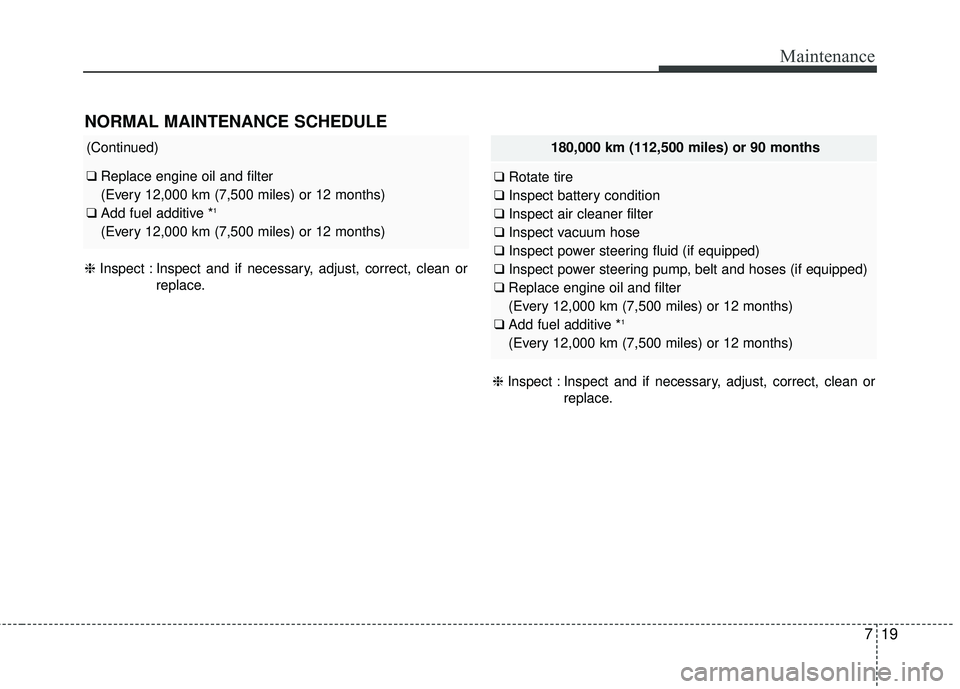
719
Maintenance
NORMAL MAINTENANCE SCHEDULE
(Continued)
❑Replace engine oil and filter
(Every 12,000 km (7,500 miles) or 12 months)
❑ Add fuel additive *
1
(Every 12,000 km (7,500 miles) or 12 months)
180,000 km (112,500 miles) or 90 months
❑ Rotate tire
❑ Inspect battery condition
❑ Inspect air cleaner filter
❑ Inspect vacuum hose
❑ Inspect power steering fluid (if equipped)
❑ Inspect power steering pump, belt and hoses (if equipped)
❑ Replace engine oil and filter
(Every 12,000 km (7,500 miles) or 12 months)
❑ Add fuel additive *
1
(Every 12,000 km (7,500 miles) or 12 months)
❈ Inspect : Inspect and if necessary, adjust, correct, clean or
replace.
❈Inspect : Inspect and if necessary, adjust, correct, clean or
replace.
Page 490 of 586
Maintenance
20
7
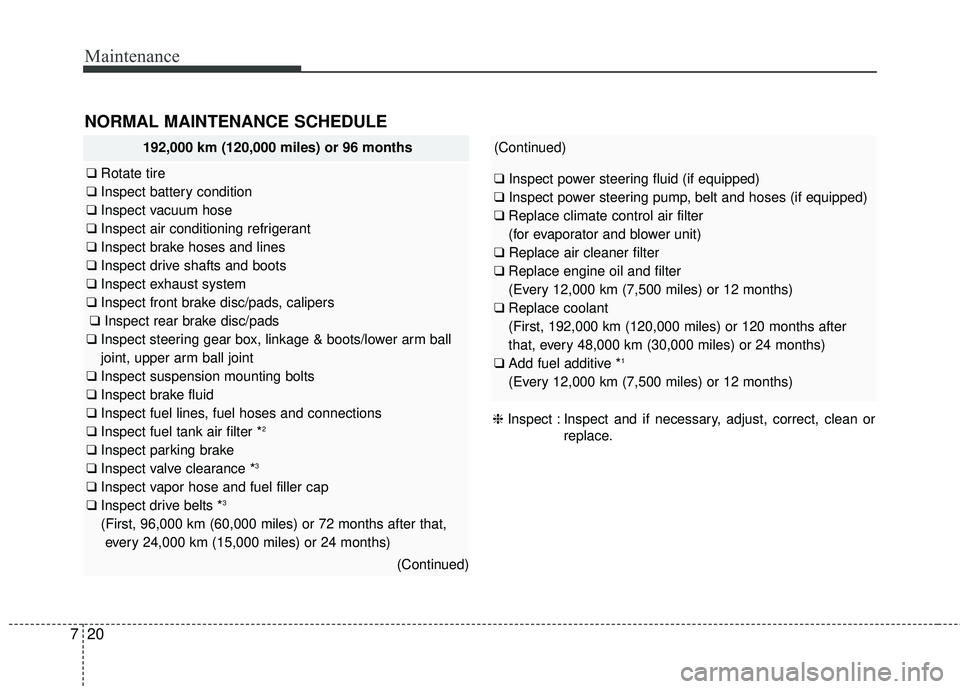
NORMAL MAINTENANCE SCHEDULE
(Continued)
❑ Inspect power steering fluid (if equipped)
❑ Inspect power steering pump, belt and hoses (if equipped)
❑ Replace climate control air filter
(for evaporator and blower unit)
❑ Replace air cleaner filter
❑ Replace engine oil and filter
(Every 12,000 km (7,500 miles) or 12 months)
❑ Replace coolant
(First, 192,000 km (120,000 miles) or 120 months after
that, every 48,000 km (30,000 miles) or 24 months)
❑ Add fuel additive *
1
(Every 12,000 km (7,500 miles) or 12 months)
❈ Inspect : Inspect and if necessary, adjust, correct, clean or
replace.
192,000 km (120,000 miles) or 96 months
❑Rotate tire
❑ Inspect battery condition
❑ Inspect vacuum hose
❑ Inspect air conditioning refrigerant
❑ Inspect brake hoses and lines
❑ Inspect drive shafts and boots
❑ Inspect exhaust system
❑ Inspect front brake disc/pads, calipers
❑ Inspect rear brake disc/pads
❑ Inspect steering gear box, linkage & boots/lower arm ball
joint, upper arm ball joint
❑ Inspect suspension mounting bolts
❑ Inspect brake fluid
❑ Inspect fuel lines, fuel hoses and connections
❑ Inspect fuel tank air filter *
2
❑Inspect parking brake
❑ Inspect valve clearance *3
❑Inspect vapor hose and fuel filler cap
❑ Inspect drive belts *3
(First, 96,000 km (60,000 miles) or 72 months after that,
every 24,000 km (15,000 miles) or 24 months)
(Continued)
Page 491 of 586
721
Maintenance
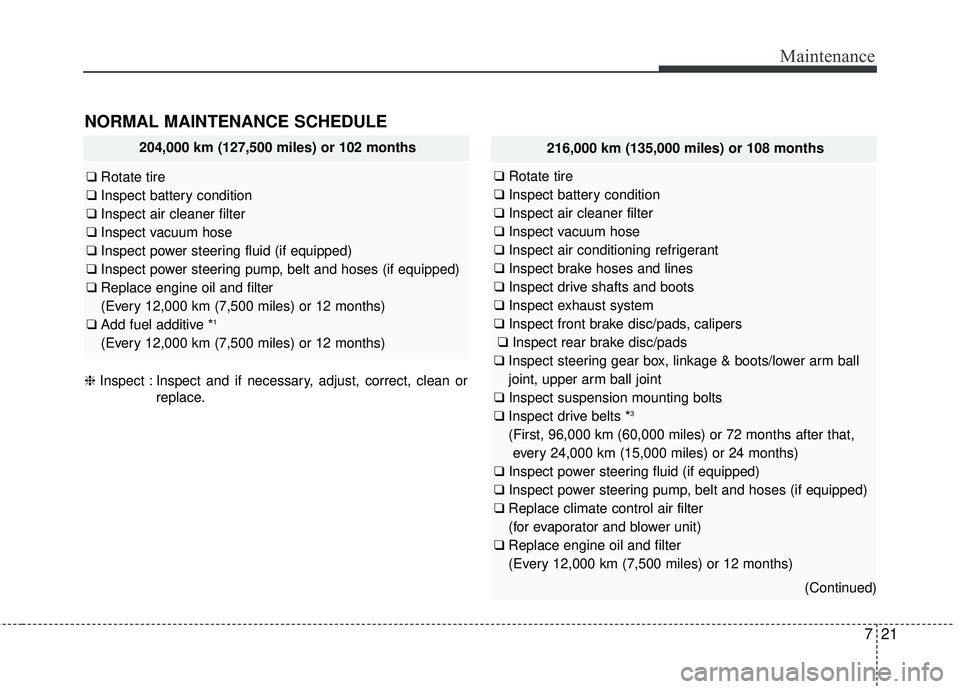
NORMAL MAINTENANCE SCHEDULE
204,000 km (127,500 miles) or 102 months
❑Rotate tire
❑ Inspect battery condition
❑ Inspect air cleaner filter
❑ Inspect vacuum hose
❑ Inspect power steering fluid (if equipped)
❑ Inspect power steering pump, belt and hoses (if equipped)
❑ Replace engine oil and filter
(Every 12,000 km (7,500 miles) or 12 months)
❑ Add fuel additive *
1
(Every 12,000 km (7,500 miles) or 12 months)
❈ Inspect : Inspect and if necessary, adjust, correct, clean or
replace.
216,000 km (135,000 miles) or 108 months
❑Rotate tire
❑ Inspect battery condition
❑ Inspect air cleaner filter
❑ Inspect vacuum hose
❑ Inspect air conditioning refrigerant
❑ Inspect brake hoses and lines
❑ Inspect drive shafts and boots
❑ Inspect exhaust system
❑ Inspect front brake disc/pads, calipers
❑ Inspect rear brake disc/pads
❑ Inspect steering gear box, linkage & boots/lower arm ball
joint, upper arm ball joint
❑ Inspect suspension mounting bolts
❑ Inspect drive belts *
3
(First, 96,000 km (60,000 miles) or 72 months after that,
every 24,000 km (15,000 miles) or 24 months)
❑ Inspect power steering fluid (if equipped)
❑ Inspect power steering pump, belt and hoses (if equipped)
❑ Replace climate control air filter
(for evaporator and blower unit)
❑ Replace engine oil and filter
(Every 12,000 km (7,500 miles) or 12 months)
(Continued)
Page 492 of 586
Maintenance
22
7
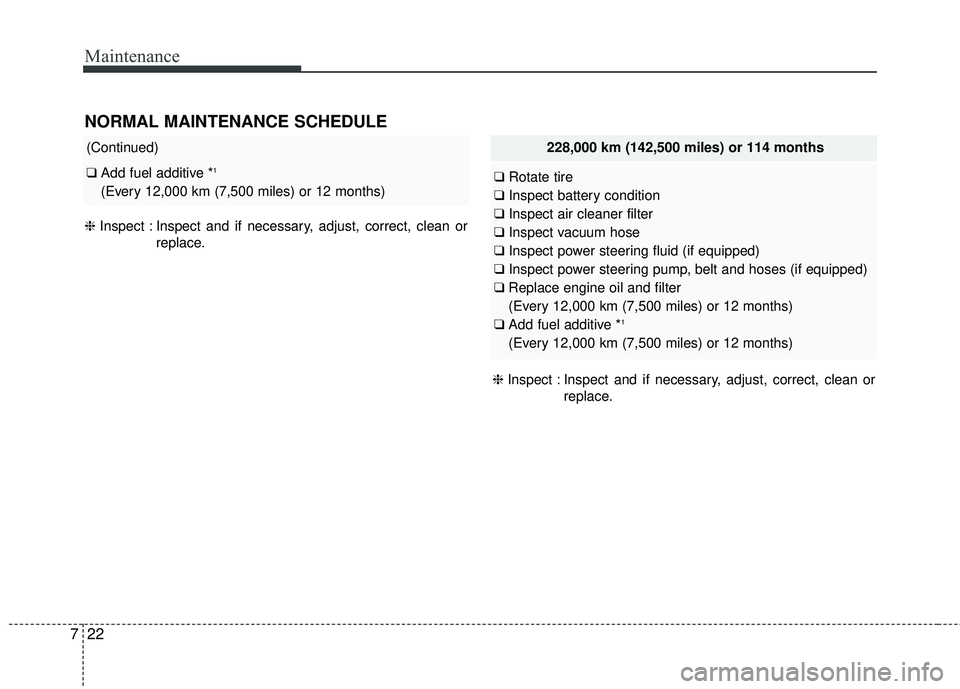
NORMAL MAINTENANCE SCHEDULE
228,000 km (142,500 miles) or 114 months
❑ Rotate tire
❑ Inspect battery condition
❑ Inspect air cleaner filter
❑ Inspect vacuum hose
❑ Inspect power steering fluid (if equipped)
❑ Inspect power steering pump, belt and hoses (if equipped)
❑ Replace engine oil and filter
(Every 12,000 km (7,500 miles) or 12 months)
❑ Add fuel additive *
1
(Every 12,000 km (7,500 miles) or 12 months)
❈ Inspect : Inspect and if necessary, adjust, correct, clean or
replace.
(Continued)
❑Add fuel additive *1
(Every 12,000 km (7,500 miles) or 12 months)
❈ Inspect : Inspect and if necessary, adjust, correct, clean or
replace.
Page 493 of 586
723
Maintenance
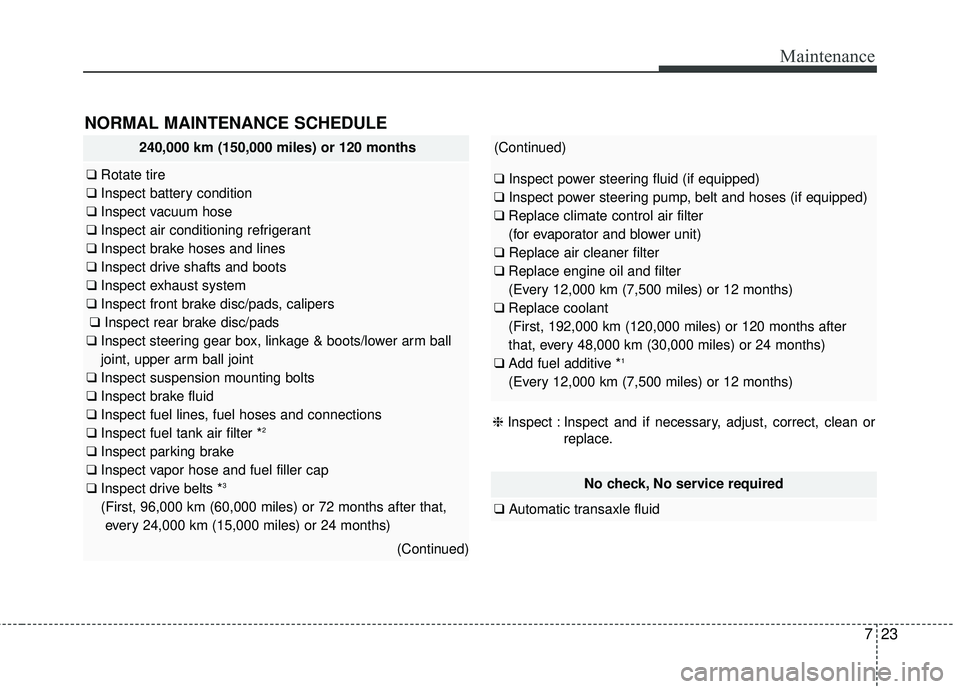
NORMAL MAINTENANCE SCHEDULE
No check, No service required
❑Automatic transaxle fluid
240,000 km (150,000 miles) or 120 months
❑Rotate tire
❑ Inspect battery condition
❑ Inspect vacuum hose
❑ Inspect air conditioning refrigerant
❑ Inspect brake hoses and lines
❑ Inspect drive shafts and boots
❑ Inspect exhaust system
❑ Inspect front brake disc/pads, calipers
❑ Inspect rear brake disc/pads
❑ Inspect steering gear box, linkage & boots/lower arm ball
joint, upper arm ball joint
❑ Inspect suspension mounting bolts
❑ Inspect brake fluid
❑ Inspect fuel lines, fuel hoses and connections
❑ Inspect fuel tank air filter *
2
❑Inspect parking brake
❑ Inspect vapor hose and fuel filler cap
❑ Inspect drive belts *
3
(First, 96,000 km (60,000 miles) or 72 months after that,
every 24,000 km (15,000 miles) or 24 months)
(Continued)
(Continued)
❑ Inspect power steering fluid (if equipped)
❑ Inspect power steering pump, belt and hoses (if equipped)
❑ Replace climate control air filter
(for evaporator and blower unit)
❑ Replace air cleaner filter
❑ Replace engine oil and filter
(Every 12,000 km (7,500 miles) or 12 months)
❑ Replace coolant
(First, 192,000 km (120,000 miles) or 120 months after
that, every 48,000 km (30,000 miles) or 24 months)
❑ Add fuel additive *
1
(Every 12,000 km (7,500 miles) or 12 months)
❈ Inspect : Inspect and if necessary, adjust, correct, clean or
replace.
Page 496 of 586
Maintenance
26
7
EXPLANATION OF SCHEDULED MAINTENANCE ITEMS
Engine oil and filter
The engine oil and filter should be
changed at the intervals specified in
the maintenance schedule. If the car
is being driven in severe conditions,
more frequent oil and filter changes
are required.
Drive belts
Inspect all drive belts for evidence of
cuts, cracks, excessive wear or oil
saturation and replace if necessary.
Fuel filter (cartridge)
A clogged filter can limit the speed at
which the vehicle may be driven,
damage the emission system and
cause multiple issues such as hard
starting. If an excessive amount of
foreign matter accumulates in the
fuel tank, the filter may require
replacement more frequently.
After installing a new filter, run the
engine for several minutes, and
check for leaks at the connections.
Fuel filters should be installed by an
authorized Kia dealer.
Fuel filter (for gasoline)
Kia gasoline vehicle is equipped a life-
time fuel filter that is integrated with
the fuel tank. Regular maintenance or
replacement is not needed but
depends on fuel quality. If there are
some important safety matters like
fuel flow restriction, surging, loss of
power, hard starting problem etc, fuel
filter inspection or replace is needed.
The fuel filter be Inspected or
replaced by an authorized Kia dealer.
Fuel lines, fuel hoses and con-
nections
Check the fuel lines, fuel hoses and
connections for leakage and dam-
age. Have an authorized Kia dealer
replace any damaged or leaking
parts immediately.
Vapor hose and fuel filler cap
The vapor hose and fuel filler cap
should be inspected at those inter-
vals specified in the maintenance
schedule. Make sure that a new
vapor hose or fuel filler cap is cor-
rectly replaced.
Page 519 of 586
749
Maintenance
TIRES AND WHEELS
Tire care
For proper maintenance, safety, and
maximum fuel economy, you must
always maintain recommended tire
inflation pressures and stay within
the load limits and weight distribution
recommended for your vehicle.
Recommended cold tire infla-
tion pressures
All tire pressures (including the
spare) should be checked when the
tires are cold. “Cold Tires” means the
vehicle has not been driven for at
least three hours or driven less than
1.6 km(one mile).
Recommended pressures must be
maintained for the best ride, vehicle
handling, and minimum tire wear.
For recommended inflation pressure,
refer to “Tire and wheels” in chapter
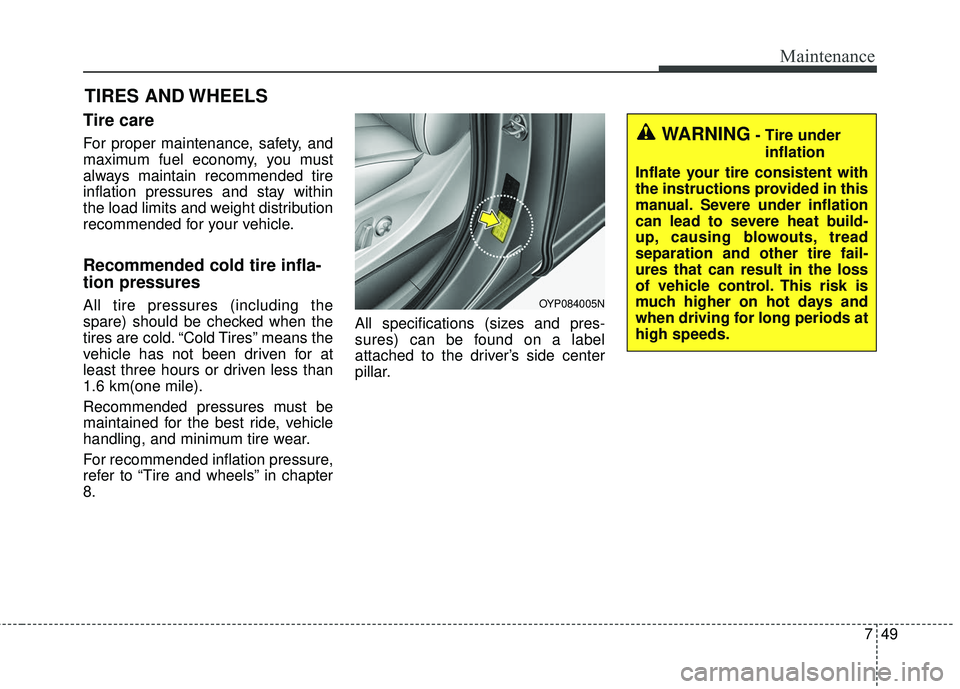
8.All specifications (sizes and pres-
sures) can be found on a label
attached to the driver’s side center
pillar.OYP084005N
WARNING- Tire under
inflation
Inflate your tire consistent with
the instructions provided in this
manual. Severe under inflation
can lead to severe heat build-
up, causing blowouts, tread
separation and other tire fail-
ures that can result in the loss
of vehicle control. This risk is
much higher on hot days and
when driving for long periods at
high speeds.
Page 520 of 586
Maintenance
50
7
Underinflation also results in
excessive wear, poor handling and
reduced fuel economy. Wheel
deformation also is possible. Keep
your tire pressures at the proper
levels. If a tire frequently needs
refilling, have it checked by an
authorized Kia dealer.
Overinflation produces a harsh ride, excessive wear at the center
of the tire tread, and a greater pos-
sibility of damage from road haz-
ards.
Warm tires normally exceed rec- ommended cold tire pressures by
28 to 41 kPa (4 to 6 psi). Do not
release air from warm tires to
adjust the pressure or the tires will
be underinflated.
Be sure to reinstall the tire inflation valve caps. Without the valve cap,
dirt or moisture could get into the
valve core and cause air leakage. If
a valve cap is missing, install a
new one as soon as possible.Tire pressure
Always observe the following:
Check tire pressure when the tiresare cold. (After vehicle has been
parked for at least three hours or
hasn't been driven more than 1.6
km (one mile) since startup.)
Check the pressure of your spare tire each time you check the pres-
sure of other tires.
Never overload your vehicle. Be careful not to overload a vehicle
luggage rack if your vehicle is
equipped with one.
Checking tire inflation pres-
sure
Check your tires once a month or
more.
Also, check the tire pressure of the
spare tire.
How to check
Use a good quality gauge to check
tire pressure. You cannot tell if your
tires are properly inflated simply by
looking at them. Radial tires may
look properly inflated even when
they're underinflated.
Check the tire's inflation pressure
when the tires are cold. - "Cold"
means your vehicle has been sitting
for at least three hours or driven no
more than 1.6 km (1 mile).
Page 529 of 586
759
Maintenance
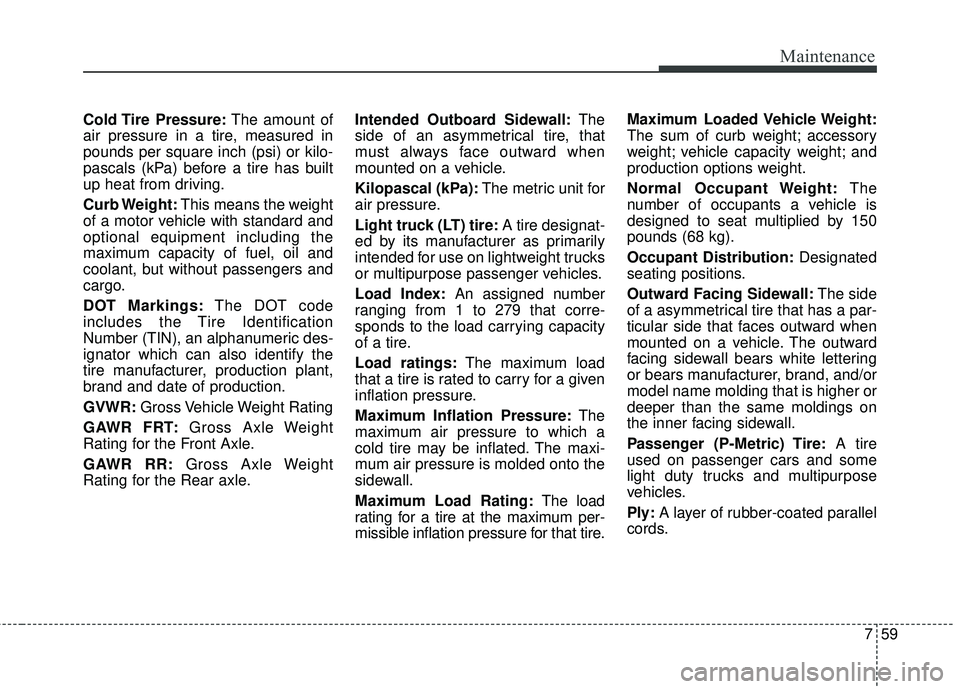
Cold Tire Pressure:The amount of
air pressure in a tire, measured in
pounds per square inch (psi) or kilo-
pascals (kPa) before a tire has built
up heat from driving.
Curb Weight: This means the weight
of a motor vehicle with standard and
optional equipment including the
maximum capacity of fuel, oil and
coolant, but without passengers and
cargo.
DOT Markings: The DOT code
includes the Tire Identification
Number (TIN), an alphanumeric des-
ignator which can also identify the
tire manufacturer, production plant,
brand and date of production.
GVWR: Gross Vehicle Weight Rating
GAWR FRT: Gross Axle Weight
Rating for the Front Axle.
GAWR RR: Gross Axle Weight
Rating for the Rear axle. Intended Outboard Sidewall:
The
side of an asymmetrical tire, that
must always face outward when
mounted on a vehicle.
Kilopascal (kPa): The metric unit for
air pressure.
Light truck (LT) tire: A tire designat-
ed by its manufacturer as primarily
intended for use on lightweight trucks
or multipurpose passenger vehicles.
Load Index: An assigned number
ranging from 1 to 279 that corre-
sponds to the load carrying capacity
of a tire.
Load ratings: The maximum load
that a tire is rated to carry for a given
inflation pressure.
Maximum Inflation Pressure: The
maximum air pressure to which a
cold tire may be inflated. The maxi-
mum air pressure is molded onto the
sidewall.
Maximum Load Rating: The load
rating for a tire at the maximum per-
missible inflation pressure for that tire. Maximum Loaded Vehicle Weight:
The sum of curb weight; accessory
weight; vehicle capacity weight; and
production options weight.
Normal Occupant Weight:
The
number of occupants a vehicle is
designed to seat multiplied by 150
pounds (68 kg).
Occupant Distribution: Designated
seating positions.
Outward Facing Sidewall: The side
of a asymmetrical tire that has a par-
ticular side that faces outward when
mounted on a vehicle. The outward
facing sidewall bears white lettering
or bears manufacturer, brand, and/or
model name molding that is higher or
deeper than the same moldings on
the inner facing sidewall.
Passenger (P-Metric) Tire: A tire
used on passenger cars and some
light duty trucks and multipurpose
vehicles.
Ply: A layer of rubber-coated parallel
cords.
Page 540 of 586
Maintenance
70
7
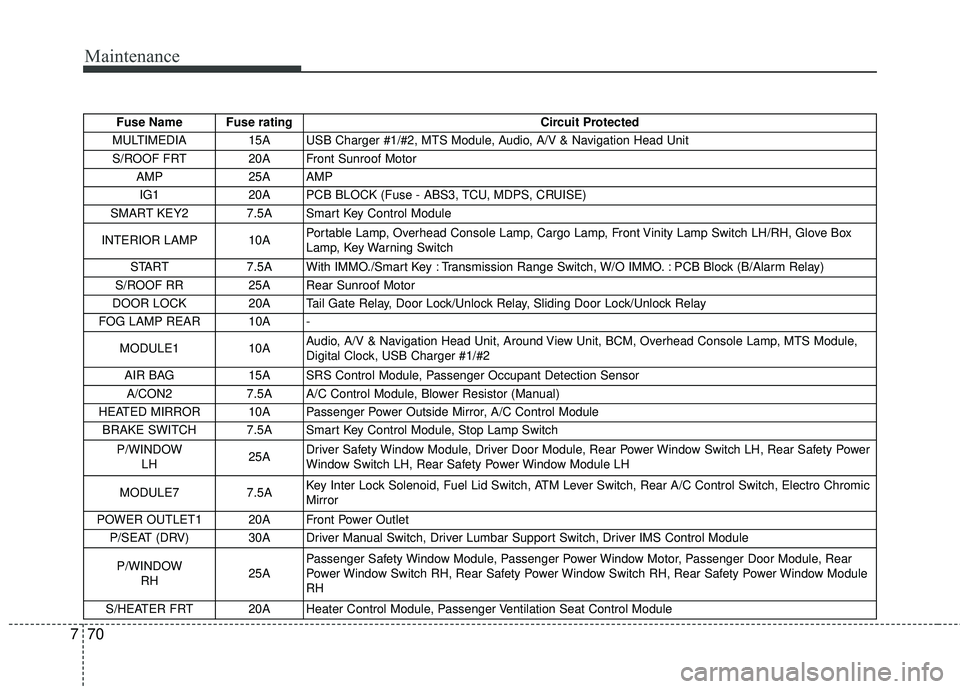
Fuse Name Fuse rating Circuit Protected
MULTIMEDIA 15A USB Charger #1/#2, MTS Module, Audio, A/V & Navigation Head Unit S/ROOF FRT 20A Front Sunroof Motor AMP 25A AMP IG1 20A PCB BLOCK (Fuse - ABS3, TCU, MDPS, CRUISE)
SMART KEY2 7.5A Smart Key Control Module
INTERIOR LAMP 10A Portable Lamp, Overhead Console Lamp, Cargo Lamp, Front Vinity Lamp Switch LH/RH, Glove Box
Lamp, Key Warning Switch
START 7.5A With IMMO./Smart Key : Transmission Range Switch, W/O IMMO. : PCB Block (B/Alarm Relay)
S/ROOF RR 25A Rear Sunroof Motor
DOOR LOCK 20A Tail Gate Relay, Door Lock/Unlock Relay, Sliding Door Lock/Unlock Relay
FOG LAMP REAR 10A -
MODULE1 10A Audio, A/V & Navigation Head Unit, Around View Unit, BCM, Overhead Console Lamp, MTS Module,
Digital Clock, USB Charger #1/#2
AIR BAG 15A SRS Control Module, Passenger Occupant Detection Sensor
A/CON2 7.5A A/C Control Module, Blower Resistor (Manual)
HEATED MIRROR 10A Passenger Power Outside Mirror, A/C Control Module BRAKE SWITCH 7.5A Smart Key Control Module, Stop Lamp Switch
P/WINDOW LH 25ADriver Safety Window Module, Driver Door Module, Rear Power Window Switch LH, Rear Safety Power
Window Switch LH, Rear Safety Power Window Module LH
MODULE7 7.5A Key Inter Lock Solenoid, Fuel Lid Switch, ATM Lever Switch, Rear A/C Control Switch, Electro Chromic
Mirror
POWER OUTLET1 20A Front Power Outlet P/SEAT (DRV) 30A Driver Manual Switch, Driver Lumbar Support Switch, Driver IMS Control Module
P/WINDOW RH 25APassenger Safety Window Module, Passenger Power Window Motor, Passenger Door Module, Rear
Power Window Switch RH, Rear Safety Power Window Switch RH, Rear Safety Power Window Module
RH
S/HEATER FRT 20A Heater Control Module, Passenger Ventilation Seat Control Module