fuel KIA SEDONA 2017 Repair Manual
[x] Cancel search | Manufacturer: KIA, Model Year: 2017, Model line: SEDONA, Model: KIA SEDONA 2017Pages: 586, PDF Size: 14.12 MB
Page 543 of 586
773
Maintenance
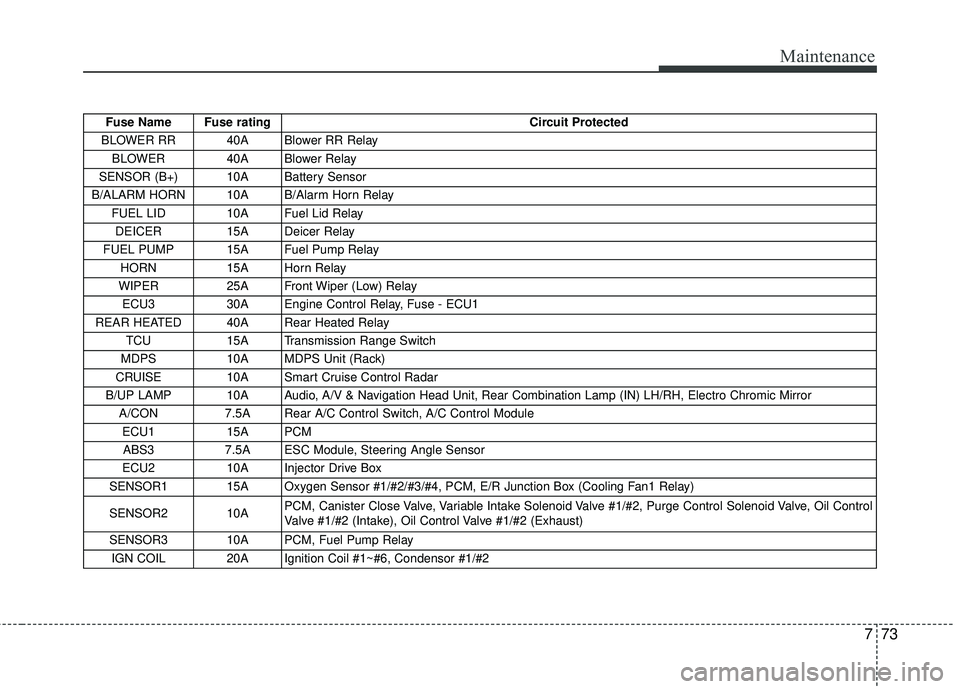
Fuse Name Fuse ratingCircuit Protected
BLOWER RR 40A Blower RR Relay BLOWER 40A Blower Relay
SENSOR (B+) 10A Battery Sensor
B/ALARM HORN 10A B/Alarm Horn Relay FUEL LID 10A Fuel Lid Relay DEICER 15A Deicer Relay
FUEL PUMP 15A Fuel Pump Relay HORN 15A Horn Relay
WIPER 25A Front Wiper (Low) Relay
ECU3 30A Engine Control Relay, Fuse - ECU1
REAR HEATED 40A Rear Heated Relay TCU 15A Transmission Range Switch
MDPS 10A MDPS Unit (Rack)
CRUISE 10A Smart Cruise Control Radar
B/UP LAMP 10A Audio, A/V & Navigation Head Unit, Rear Combination Lamp (IN) LH/RH, Electro Chromic \
Mirror A/CON 7.5A Rear A/C Control Switch, A/C Control Module
ECU1 15A PCM ABS3 7.5A ESC Module, Steering Angle Sensor
ECU2 10A Injector Drive Box
SENSOR1 15A Oxygen Sensor #1/#2/#3/#4, PCM, E/R Junction Box (Cooling Fan1 Relay)
SENSOR2 10A PCM, Canister Close Valve, Variable Intake Solenoid Valve #1/#2, Purge Control Solenoid Valve, Oil Control
Valve #1/#2 (Intake), Oil Control Valve #1/#2 (Exhaust)
SENSOR3 10A PCM, Fuel Pump Relay IGN COIL 20A Ignition Coil #1~#6, Condensor #1/#2
Page 557 of 586
787
Maintenance
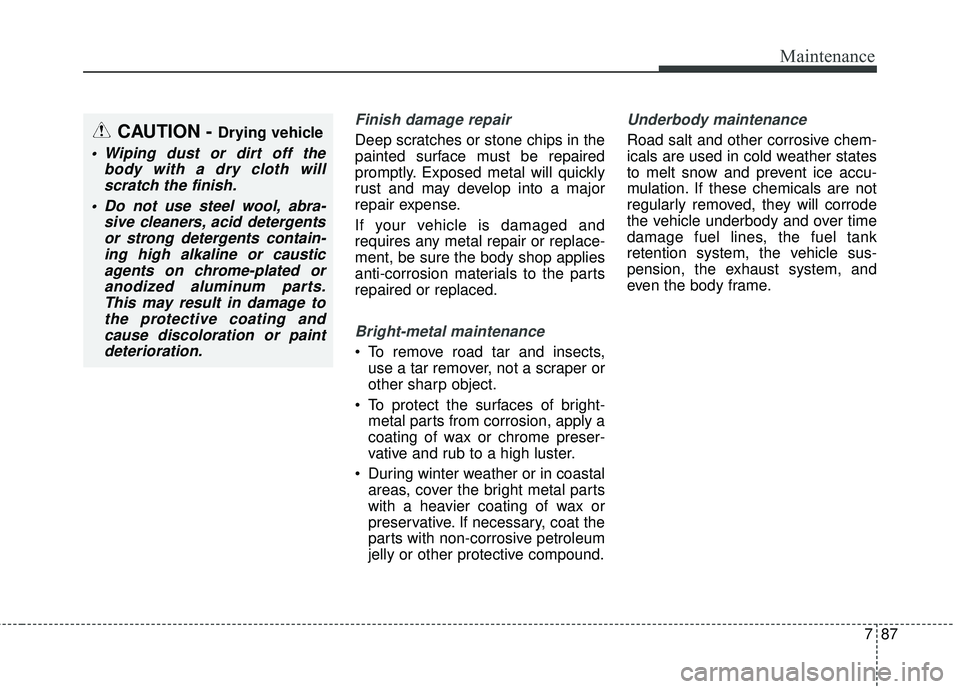
Finish damage repair
Deep scratches or stone chips in the
painted surface must be repaired
promptly. Exposed metal will quickly
rust and may develop into a major
repair expense.
If your vehicle is damaged and
requires any metal repair or replace-
ment, be sure the body shop applies
anti-corrosion materials to the parts
repaired or replaced.
Bright-metal maintenance
To remove road tar and insects,use a tar remover, not a scraper or
other sharp object.
To protect the surfaces of bright- metal parts from corrosion, apply a
coating of wax or chrome preser-
vative and rub to a high luster.
During winter weather or in coastal areas, cover the bright metal parts
with a heavier coating of wax or
preservative. If necessary, coat the
parts with non-corrosive petroleum
jelly or other protective compound.
Underbody maintenance
Road salt and other corrosive chem-
icals are used in cold weather states
to melt snow and prevent ice accu-
mulation. If these chemicals are not
regularly removed, they will corrode
the vehicle underbody and over time
damage fuel lines, the fuel tank
retention system, the vehicle sus-
pension, the exhaust system, and
even the body frame.CAUTION - Drying vehicle
Wiping dust or dirt off the body with a dry cloth willscratch the finish.
Do not use steel wool, abra- sive cleaners, acid detergentsor strong detergents contain-ing high alkaline or causticagents on chrome-plated oranodized aluminum parts.This may result in damage tothe protective coating andcause discoloration or paintdeterioration.
Page 565 of 586
795
Maintenance
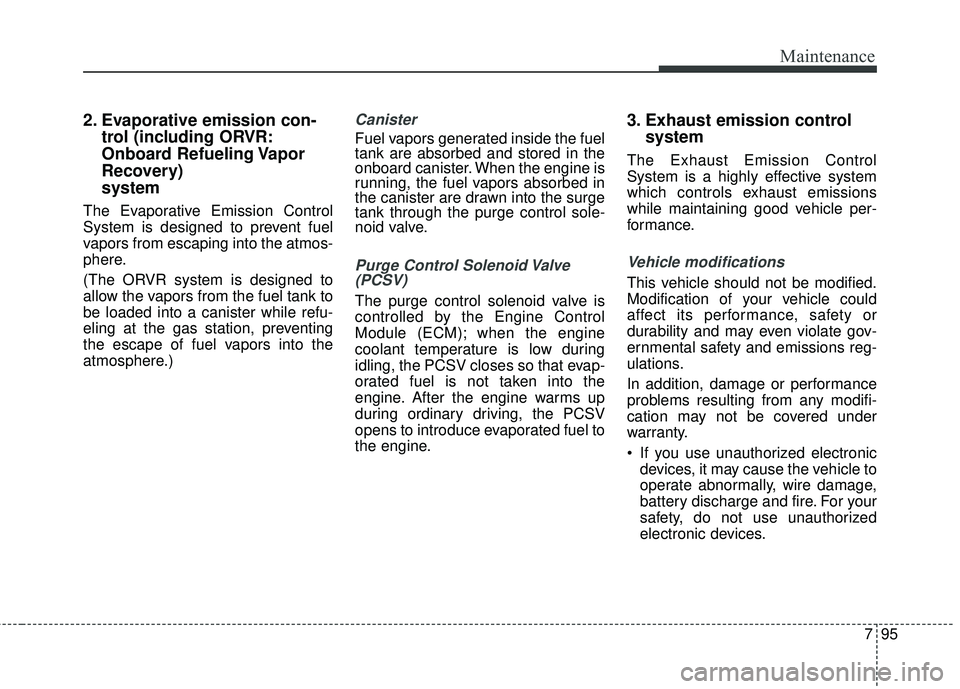
2. Evaporative emission con-trol (including ORVR:
Onboard Refueling Vapor
Recovery)
system
The Evaporative Emission Control
System is designed to prevent fuel
vapors from escaping into the atmos-
phere.
(The ORVR system is designed to
allow the vapors from the fuel tank to
be loaded into a canister while refu-
eling at the gas station, preventing
the escape of fuel vapors into the
atmosphere.)
Canister
Fuel vapors generated inside the fuel
tank are absorbed and stored in the
onboard canister. When the engine is
running, the fuel vapors absorbed in
the canister are drawn into the surge
tank through the purge control sole-
noid valve.
Purge Control Solenoid Valve(PCSV)
The purge control solenoid valve is
controlled by the Engine Control
Module (ECM); when the engine
coolant temperature is low during
idling, the PCSV closes so that evap-
orated fuel is not taken into the
engine. After the engine warms up
during ordinary driving, the PCSV
opens to introduce evaporated fuel to
the engine.
3. Exhaust emission control
system
The Exhaust Emission Control
System is a highly effective system
which controls exhaust emissions
while maintaining good vehicle per-
formance.
Vehicle modifications
This vehicle should not be modified.
Modification of your vehicle could
affect its performance, safety or
durability and may even violate gov-
ernmental safety and emissions reg-
ulations.
In addition, damage or performance
problems resulting from any modifi-
cation may not be covered under
warranty.
If you use unauthorized electronic
devices, it may cause the vehicle to
operate abnormally, wire damage,
battery discharge and fire. For your
safety, do not use unauthorized
electronic devices.
Page 567 of 586
797
Maintenance
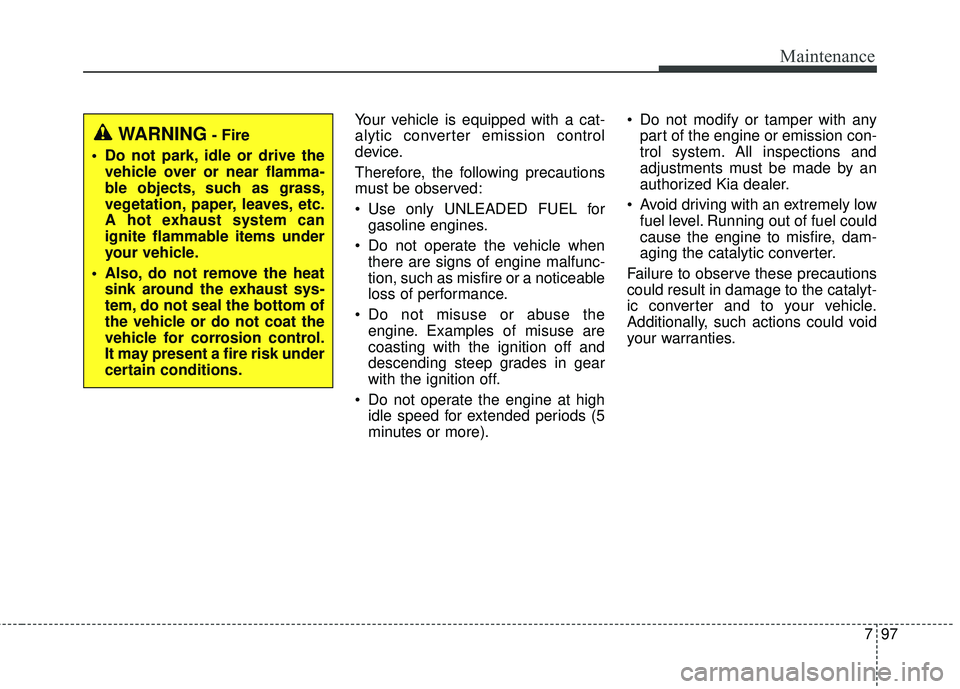
Your vehicle is equipped with a cat-
alytic converter emission control
device.
Therefore, the following precautions
must be observed:
Use only UNLEADED FUEL forgasoline engines.
Do not operate the vehicle when there are signs of engine malfunc-
tion, such as misfire or a noticeable
loss of performance.
Do not misuse or abuse the engine. Examples of misuse are
coasting with the ignition off and
descending steep grades in gear
with the ignition off.
Do not operate the engine at high idle speed for extended periods (5
minutes or more). Do not modify or tamper with any
part of the engine or emission con-
trol system. All inspections and
adjustments must be made by an
authorized Kia dealer.
Avoid driving with an extremely low fuel level. Running out of fuel could
cause the engine to misfire, dam-
aging the catalytic converter.
Failure to observe these precautions
could result in damage to the catalyt-
ic converter and to your vehicle.
Additionally, such actions could void
your warranties.
WARNING- Fire
Do not park, idle or drive the vehicle over or near flamma-
ble objects, such as grass,
vegetation, paper, leaves, etc.
A hot exhaust system can
ignite flammable items under
your vehicle.
Also, do not remove the heat sink around the exhaust sys-
tem, do not seal the bottom of
the vehicle or do not coat the
vehicle for corrosion control.
It may present a fire risk under
certain conditions.
Page 573 of 586
68
Specifications & Consumer information
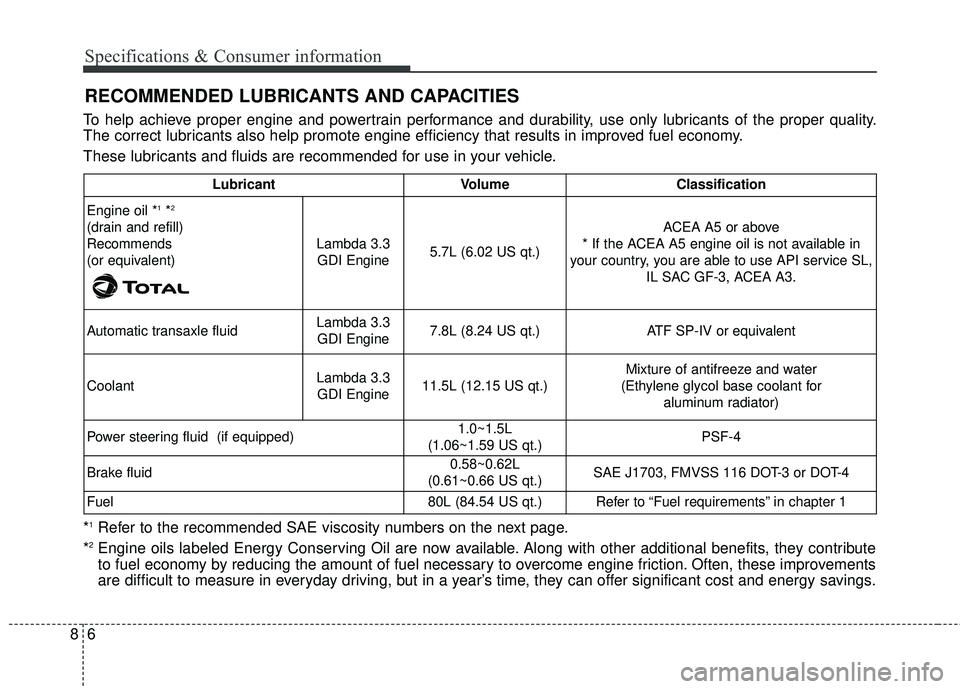
RECOMMENDED LUBRICANTS AND CAPACITIES
To help achieve proper engine and powertrain performance and durability, use only lubricants of the proper quality.
The correct lubricants also help promote engine efficiency that results in improved fuel economy.
These lubricants and fluids are recommended for use in your vehicle.
*
1Refer to the recommended SAE viscosity numbers on the next page.
*2Engine oils labeled Energy Conserving Oil are now available. Along with other additional benefits, they contribute
to fuel economy by reducing the amount of fuel necessary to overcome engine friction. Often, these improvements
are difficult to measure in everyday driving, but in a year’s time, they can offer significant cost and energy savings.
Lubricant Volume Classification
Engine oil *
1*2
(drain and refill)
Recommends
(or equivalent) Lambda 3.3
GDI Engine 5.7L (6.02 US qt.) ACEA A5 or above
* If the ACEA A5 engine oil is not available in
your country, you are able to use API service SL, IL SAC GF-3, ACEA A3.
Automatic transaxle fluid Lambda 3.3
GDI Engine 7.8L (8.24 US qt.) ATF SP-IV or equivalent
Coolant Lambda 3.3
GDI Engine 11.5L (12.15 US qt.) Mixture of antifreeze and water
(Ethylene glycol base coolant for aluminum radiator)
Power steering fluid (if equipped) 1.0~1.5L
(1.06~1.59 US qt.) PSF-4
Brake fluid 0.58~0.62L
(0.61~0.66 US qt.) SAE J1703, FMVSS 116 DOT-3 or DOT-4
Fuel 80L (84.54 US qt.) Refer to “Fuel requirements� in chapter 1
Page 574 of 586
Recommended SAE viscosity
number
Always be sure to clean the area
around any filler plug, drain plug, or
dipstick before checking or draining
any lubricant. This is especially
important in dusty or sandy areas
and when the vehicle is used on
unpaved roads. Cleaning the plug
and dipstick areas will prevent dirt
and grit from entering the engine and
other mechanisms that could be
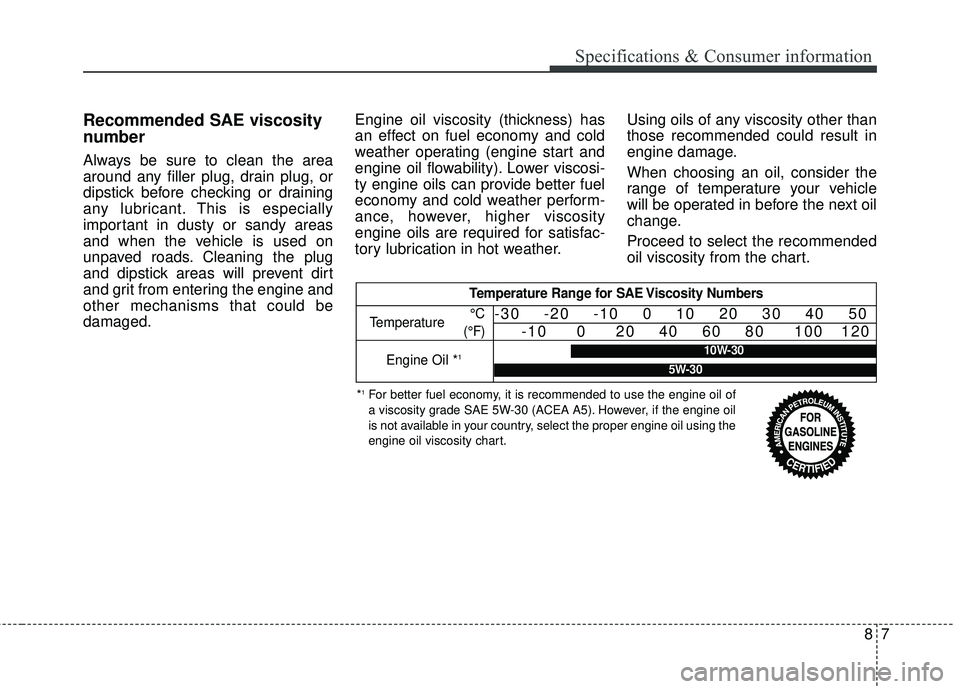
damaged.Engine oil viscosity (thickness) has
an effect on fuel economy and cold
weather operating (engine start and
engine oil flowability). Lower viscosi-
ty engine oils can provide better fuel
economy and cold weather perform-
ance, however, higher viscosity
engine oils are required for satisfac-
tory lubrication in hot weather.
Using oils of any viscosity other than
those recommended could result in
engine damage.
When choosing an oil, consider the
range of temperature your vehicle
will be operated in before the next oil
change.
Proceed to select the recommended
oil viscosity from the chart.
Temperature Range for SAE Viscosity Numbers
Temperature
Engine Oil *
1
°C
(°F)-30 -20 -10 0 10 20 30 40 50 -10 0 20 40 60 80 100 120
*1For better fuel economy, it is recommended to use the engine oil of
a viscosity grade SAE 5W-30 (ACEA A5). However, if the engine oil
is not available in your country, select the proper engine oil using the
engine oil viscosity chart.
10W-30
5W-30
87
Specifications & Consumer information
Page 580 of 586
Index
4I
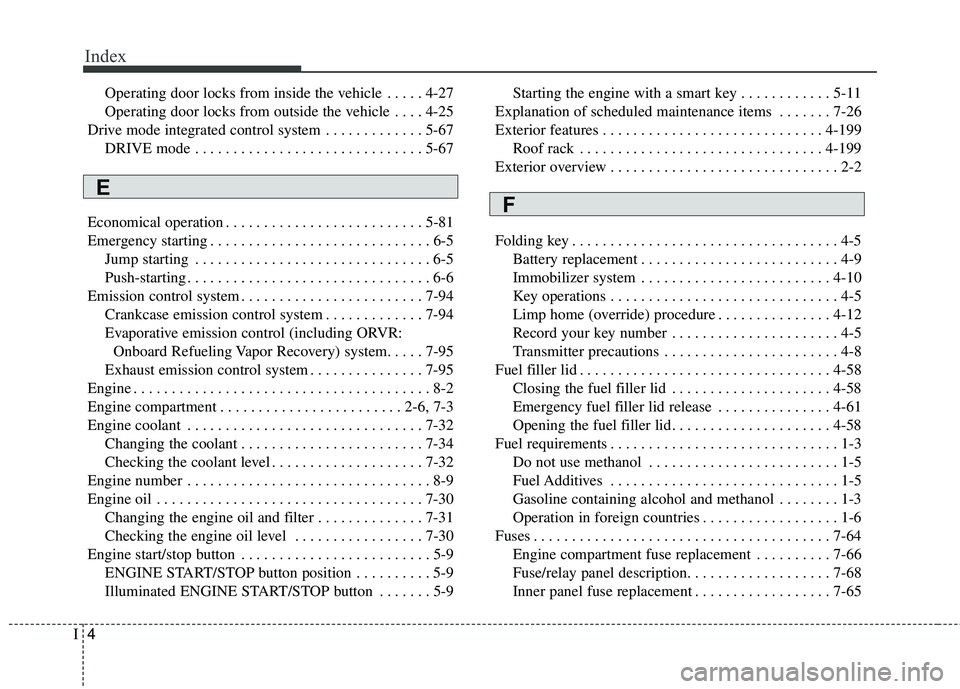
Operating door locks from inside the vehicle . . . . . 4-27
Operating door locks from outside the vehicle . . . . 4-25
Drive mode integrated control system . . . . . . . . . . . . . 5-67 DRIVE mode . . . . . . . . . . . . . . . . . . . . . . . . . . . . . . 5-67
Economical operation . . . . . . . . . . . . . . . . . . . . . . . . . . 5-81
Emergency starting . . . . . . . . . . . . . . . . . . . . . . . . . . . . . 6-5 Jump starting . . . . . . . . . . . . . . . . . . . . . . . . . . . . . . . 6-5
Push-starting . . . . . . . . . . . . . . . . . . . . . . . . . . . . . . . . 6-6
Emission control system . . . . . . . . . . . . . . . . . . . . . . . . 7-94 Crankcase emission control system . . . . . . . . . . . . . 7-94
Evaporative emission control (including ORVR:Onboard Refueling Vapor Recovery) system. . . . . 7-95
Exhaust emission control system . . . . . . . . . . . . . . . 7-95
Engine . . . . . . . . . . . . . . . . . . . . . . . . . . . . . . . . . . . . \
. . . 8-2
Engine compartment . . . . . . . . . . . . . . . . . . . . . . . . 2-6, 7-3
Engine coolant . . . . . . . . . . . . . . . . . . . . . . . . . . . . . . . 7-32 Changing the coolant . . . . . . . . . . . . . . . . . . . . . . . . 7-34
Checking the coolant level . . . . . . . . . . . . . . . . . . . . 7-32
Engine number . . . . . . . . . . . . . . . . . . . . . . . . . . . . . . . . 8-9
Engine oil . . . . . . . . . . . . . . . . . . . . . . . . . . . . . . . . . . . 7-\
30 Changing the engine oil and filter . . . . . . . . . . . . . . 7-31
Checking the engine oil level . . . . . . . . . . . . . . . . . 7-30
Engine start/stop button . . . . . . . . . . . . . . . . . . . . . . . . . 5-9 ENGINE START/STOP button position . . . . . . . . . . 5-9
Illuminated ENGINE START/STOP button . . . . . . . 5-9 Starting the engine with a smart key . . . . . . . . . . . . 5-11
Explanation of scheduled maintenance items . . . . . . . 7-26
Exterior features . . . . . . . . . . . . . . . . . . . . . . . . . . . . . 4-199 Roof rack . . . . . . . . . . . . . . . . . . . . . . . . . . . . . . . . 4-199
Exterior overview . . . . . . . . . . . . . . . . . . . . . . . . . . . . . . 2-2
Folding key . . . . . . . . . . . . . . . . . . . . . . . . . . . . . . . . . . . 4-\
5 Battery replacement . . . . . . . . . . . . . . . . . . . . . . . . . . 4-9
Immobilizer system . . . . . . . . . . . . . . . . . . . . . . . . . 4-10
Key operations . . . . . . . . . . . . . . . . . . . . . . . . . . . . . . 4-5
Limp home (override) procedure . . . . . . . . . . . . . . . 4-12
Record your key number . . . . . . . . . . . . . . . . . . . . . . 4-5
Transmitter precautions . . . . . . . . . . . . . . . . . . . . . . . 4-8
Fuel filler lid . . . . . . . . . . . . . . . . . . . . . . . . . . . . . . . . . 4-58 Closing the fuel filler lid . . . . . . . . . . . . . . . . . . . . . 4-58
Emergency fuel filler lid release . . . . . . . . . . . . . . . 4-61
Opening the fuel filler lid. . . . . . . . . . . . . . . . . . . . . 4-58
Fuel requirements . . . . . . . . . . . . . . . . . . . . . . . . . . . . . . 1-3 Do not use methanol . . . . . . . . . . . . . . . . . . . . . . . . . 1-5
Fuel Additives . . . . . . . . . . . . . . . . . . . . . . . . . . . . . . 1-5
Gasoline containing alcohol and methanol . . . . . . . . 1-3
Operation in foreign countries . . . . . . . . . . . . . . . . . . 1-6
Fuses . . . . . . . . . . . . . . . . . . . . . . . . . . . . . . . . . . . . \
. . . 7-64 Engine compartment fuse replacement . . . . . . . . . . 7-66
Fuse/relay panel description. . . . . . . . . . . . . . . . . . . 7-68
Inner panel fuse replacement . . . . . . . . . . . . . . . . . . 7-65
F
E
Page 585 of 586
I9
Index
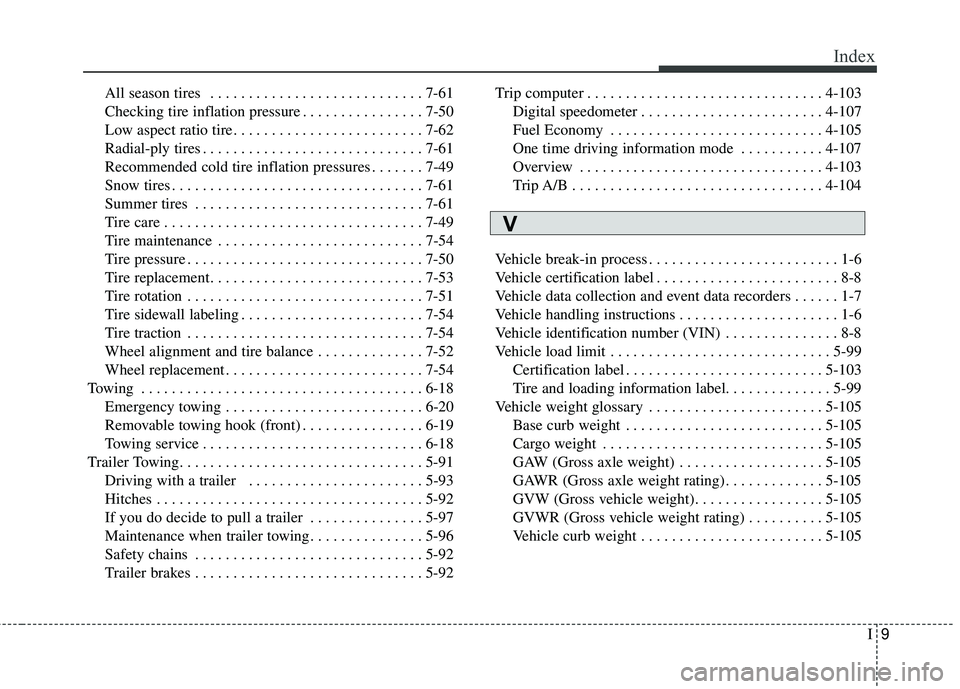
All season tires . . . . . . . . . . . . . . . . . . . . . . . . . . . . 7-61
Checking tire inflation pressure . . . . . . . . . . . . . . . . 7-50
Low aspect ratio tire. . . . . . . . . . . . . . . . . . . . . . . . . 7-62
Radial-ply tires . . . . . . . . . . . . . . . . . . . . . . . . . . . . . 7-61
Recommended cold tire inflation pressures . . . . . . . 7-49
Snow tires . . . . . . . . . . . . . . . . . . . . . . . . . . . . . . . . . 7-61
Summer tires . . . . . . . . . . . . . . . . . . . . . . . . . . . . . . 7-61
Tire care . . . . . . . . . . . . . . . . . . . . . . . . . . . . . . . . . . 7-49\
Tire maintenance . . . . . . . . . . . . . . . . . . . . . . . . . . . 7-54
Tire pressure . . . . . . . . . . . . . . . . . . . . . . . . . . . . . . . 7-50
Tire replacement . . . . . . . . . . . . . . . . . . . . . . . . . . . . 7-53
Tire rotation . . . . . . . . . . . . . . . . . . . . . . . . . . . . . . . 7-51
Tire sidewall labeling . . . . . . . . . . . . . . . . . . . . . . . . 7-54
Tire traction . . . . . . . . . . . . . . . . . . . . . . . . . . . . . . . 7-54
Wheel alignment and tire balance . . . . . . . . . . . . . . 7-52
Wheel replacement . . . . . . . . . . . . . . . . . . . . . . . . . . 7-54
Towing . . . . . . . . . . . . . . . . . . . . . . . . . . . . . . . . . . . . \
. 6-18 Emergency towing . . . . . . . . . . . . . . . . . . . . . . . . . . 6-20
Removable towing hook (front) . . . . . . . . . . . . . . . . 6-19
Towing service . . . . . . . . . . . . . . . . . . . . . . . . . . . . . 6-18
Trailer Towing. . . . . . . . . . . . . . . . . . . . . . . . . . . . . . . . 5-91 Driving with a trailer . . . . . . . . . . . . . . . . . . . . . . . 5-93
Hitches . . . . . . . . . . . . . . . . . . . . . . . . . . . . . . . . . . . 5-\
92
If you do decide to pull a trailer . . . . . . . . . . . . . . . 5-97
Maintenance when trailer towing . . . . . . . . . . . . . . . 5-96
Safety chains . . . . . . . . . . . . . . . . . . . . . . . . . . . . . . 5-92
Trailer brakes . . . . . . . . . . . . . . . . . . . . . . . . . . . . . . 5-92 Trip computer . . . . . . . . . . . . . . . . . . . . . . . . . . . . . . . 4-103
Digital speedometer . . . . . . . . . . . . . . . . . . . . . . . . 4-107
Fuel Economy . . . . . . . . . . . . . . . . . . . . . . . . . . . . 4-105
One time driving information mode . . . . . . . . . . . 4-107
Overview . . . . . . . . . . . . . . . . . . . . . . . . . . . . . . . . 4-103
Trip A/B . . . . . . . . . . . . . . . . . . . . . . . . . . . . . . . . . 4-104
Vehicle break-in process . . . . . . . . . . . . . . . . . . . . . . . . . 1-6
Vehicle certification label . . . . . . . . . . . . . . . . . . . . . . . . 8-8
Vehicle data collection and event data recorders . . . . . . 1-7
Vehicle handling instructions . . . . . . . . . . . . . . . . . . . . . 1-6
Vehicle identification number (VIN) . . . . . . . . . . . . . . . 8-8
Vehicle load limit . . . . . . . . . . . . . . . . . . . . . . . . . . . . . 5-99 Certification label . . . . . . . . . . . . . . . . . . . . . . . . . . 5-103
Tire and loading information label. . . . . . . . . . . . . . 5-99
Vehicle weight glossary . . . . . . . . . . . . . . . . . . . . . . . 5-105 Base curb weight . . . . . . . . . . . . . . . . . . . . . . . . . . 5-105
Cargo weight . . . . . . . . . . . . . . . . . . . . . . . . . . . . . 5-105
GAW (Gross axle weight) . . . . . . . . . . . . . . . . . . . 5-105
GAWR (Gross axle weight rating) . . . . . . . . . . . . . 5-105
GVW (Gross vehicle weight). . . . . . . . . . . . . . . . . 5-105
GVWR (Gross vehicle weight rating) . . . . . . . . . . 5-105
Vehicle curb weight . . . . . . . . . . . . . . . . . . . . . . . . 5-105
V