ECO mode KIA SEDONA 2018 Owner's Guide
[x] Cancel search | Manufacturer: KIA, Model Year: 2018, Model line: SEDONA, Model: KIA SEDONA 2018Pages: 586, PDF Size: 14.1 MB
Page 408 of 586
Driving your vehicle
64
5
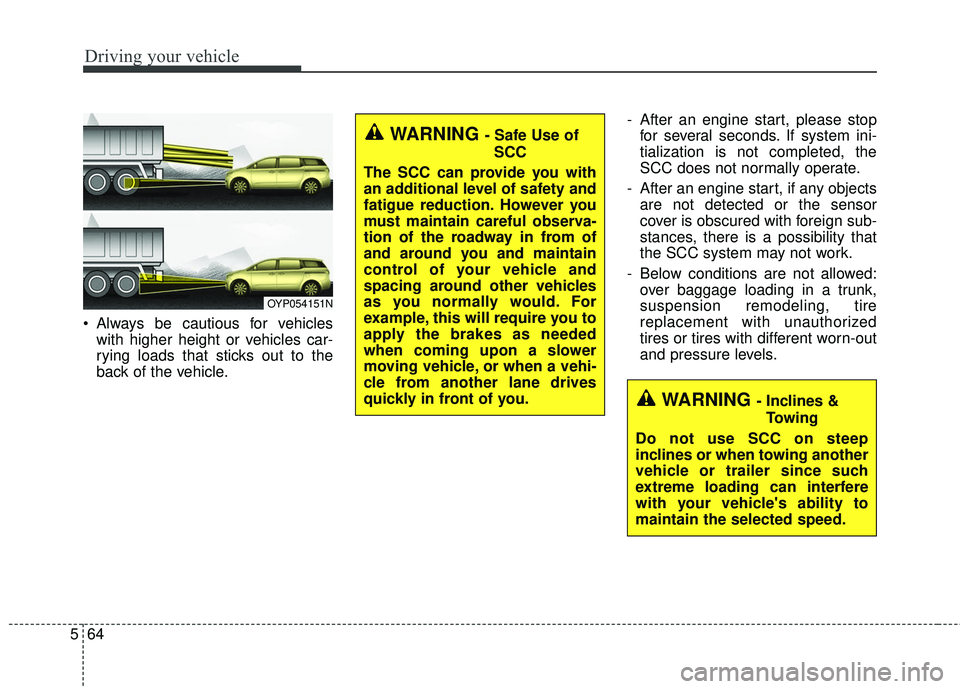
Always be cautious for vehicles
with higher height or vehicles car-
rying loads that sticks out to the
back of the vehicle. - After an engine start, please stop
for several seconds. If system ini-
tialization is not completed, the
SCC does not normally operate.
- After an engine start, if any objects are not detected or the sensor
cover is obscured with foreign sub-
stances, there is a possibility that
the SCC system may not work.
- Below conditions are not allowed: over baggage loading in a trunk,
suspension remodeling, tire
replacement with unauthorized
tires or tires with different worn-out
and pressure levels.
OYP054151N
WARNING - Safe Use of
SCC
The SCC can provide you with
an additional level of safety and
fatigue reduction. However you
must maintain careful observa-
tion of the roadway in from of
and around you and maintain
control of your vehicle and
spacing around other vehicles
as you normally would. For
example, this will require you to
apply the brakes as needed
when coming upon a slower
moving vehicle, or when a vehi-
cle from another lane drives
quickly in front of you.
WARNING - Inclines & Towing
Do not use SCC on steep
inclines or when towing another
vehicle or trailer since such
extreme loading can interfere
with your vehicle's ability to
maintain the selected speed.
Page 410 of 586
Driving your vehicle
66
5
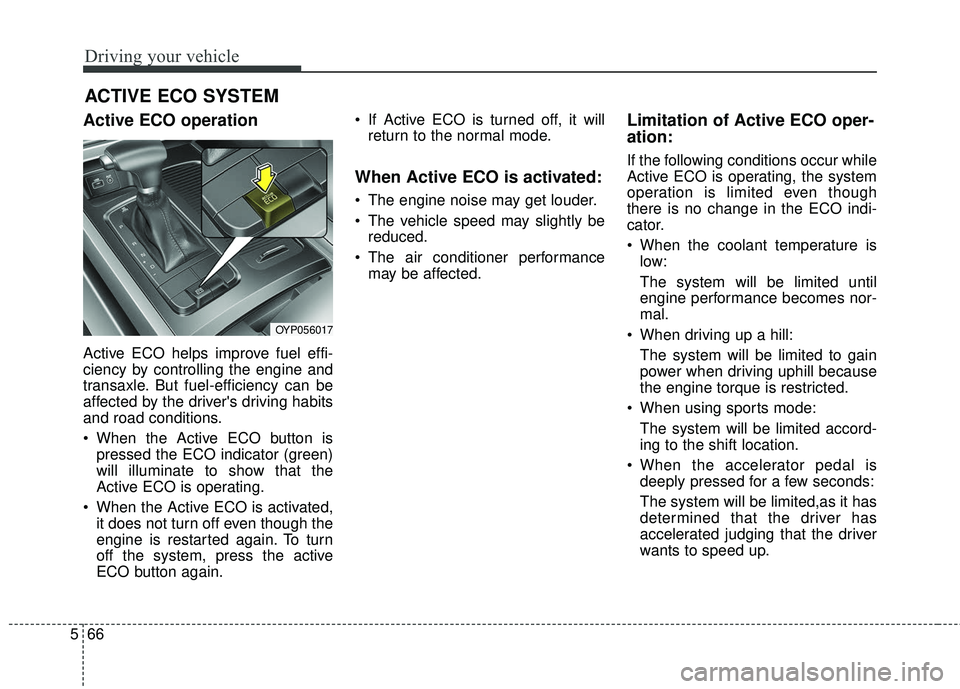
Active ECO operation
Active ECO helps improve fuel effi-
ciency by controlling the engine and
transaxle. But fuel-efficiency can be
affected by the driver's driving habits
and road conditions.
When the Active ECO button is
pressed the ECO indicator (green)
will illuminate to show that the
Active ECO is operating.
When the Active ECO is activated, it does not turn off even though the
engine is restarted again. To turn
off the system, press the active
ECO button again. If Active ECO is turned off, it will
return to the normal mode.
When Active ECO is activated:
The engine noise may get louder.
The vehicle speed may slightly bereduced.
The air conditioner performance may be affected.
Limitation of Active ECO oper-
ation:
If the following conditions occur while
Active ECO is operating, the system
operation is limited even though
there is no change in the ECO indi-
cator.
When the coolant temperature islow:
The system will be limited until
engine performance becomes nor-
mal.
When driving up a hill: The system will be limited to gain
power when driving uphill because
the engine torque is restricted.
When using sports mode: The system will be limited accord-
ing to the shift location.
When the accelerator pedal is deeply pressed for a few seconds:
The system will be limited,as it has
determined that the driver has
accelerated judging that the driver
wants to speed up.
ACTIVE ECO SYSTEM
OYP056017
Page 411 of 586
567
Driving your vehicle
DRIVE mode
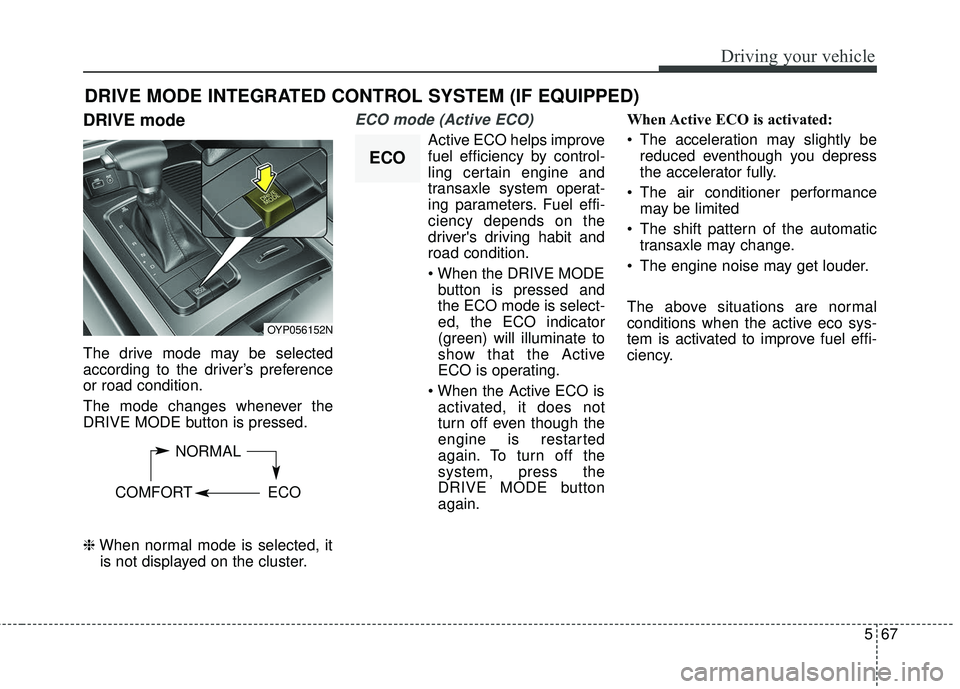
The drive mode may be selected
according to the driver’s preference
or road condition.
The mode changes whenever the
DRIVE MODE button is pressed.
\bWhen normal mode is selected, it
is not displayed on the cluster.
ECO mode (Active ECO)
Active ECO helps improve
fuel efficiency by control-
ling certain engine and
transaxle system operat-
ing parameters. Fuel effi-
ciency depends on the
driver's driving habit and
road condition.
button is pressed and
the ECO mode is select-
ed, the ECO indicator
(green) will illuminate to
show that the Active
ECO is operating.
activated, it does not
turn off even though the
engine is restarted
again. To turn off the
system, press the
DRIVE MODE button
again. When Active ECO is activated:
The acceleration may slightly be
reduced eventhough you depress
the accelerator fully.
The air conditioner performance may be limited
The shift pattern of the automatic transaxle may change.
The engine noise may get louder.
The above situations are normal
conditions when the active eco sys-
tem is activated to improve fuel effi-
ciency.
DRIVE MODE INTEGRATED CONTROL SYSTEM (IF EQUIPPED)
OYP056152N
NORMAL
COMFORT ECO
ECO
Page 412 of 586
Driving your vehicle
68
5
Limitation of Active ECO operation:
If the following conditions occur while
Active ECO is operating, the system
operation is limited even though
there is no change in the ECO indi-
cator.
When the coolant temperature is
low:
The system will be limited until
engine performance becomes nor-
mal.
When driving up a hill: The system will be limited to gain
power when driving uphill because
the engine torque is restricted.
When using manual mode: The system will be limited accord-
ing to the shift location.
When the accelerator pedal is deeply depressed for a few sec-
onds:
The system will be limited, judging
that the driver wants to speed up.Comfort mode
The steering wheel
becomes lighter. The
comfort mode is usually
used when driving in the
city or when parking the
vehicle.
press the steering mode
button while operating
the steering wheel, but
the steering effort will
not change immediately.
After operating the
steering wheel, the
steering effort will
change automatically to
the selected mode.
changing the steering
mode while driving.
power steering is not
operating properly, the
flex steering wheel will
not work.
Page 425 of 586
581
Driving your vehicle
Your vehicle's fuel economy depends
mainly on your style of driving, where
you drive and when you drive.
Each of these factors affects how
many miles (kilometers) you can get
from a gallon (liter) of fuel. To operate
your vehicle as economically as pos-
sible, use the following driving sug-
gestions to help save money in both
fuel and repairs:
Drive smoothly. Accelerate at amoderate rate. Don't make "jack-
rabbit" starts or full-throttle shifts
and maintain a steady cruising
speed. Don't race between stop-
lights. Try to adjust your speed to
the traffic so you don't have to
change speeds unnecessarily.
Avoid heavy traffic whenever pos-
sible. Always maintain a safe dis-
tance from other vehicles so you
can avoid unnecessary braking.
This also reduces brake wear.
Drive at a moderate speed. The faster you drive, the more fuel your
vehicle uses. Driving at a moderate
speed, especially on the highway,
is one of the most effective ways to
reduce fuel consumption. Don't "ride" the brake pedal. This
can increase fuel consumption and
also increase wear on these com-
ponents. In addition, driving with
your foot resting on the brake pedal
may cause the brakes to overheat,
which reduces their effectiveness
and may lead to more serious con-
sequences.
Take care of your tires. Keep them inflated to the recommended pres-
sure. Incorrect inflation, either too
much or too little, results in unnec-
essary tire wear. Check the tire
pressures at least once a month.
Be sure that the wheels are aligned correctly. Improper align-
ment can result from hitting curbs
or driving too fast over irregular
surfaces. Poor alignment causes
faster tire wear and may also result
in other problems as well as
greater fuel consumption. Keep your vehicle in good condi-
tion. For better fuel economy and
reduced maintenance costs, main-
tain your vehicle in accordance
with the maintenance schedule in
section 7. If you drive your vehicle
in severe conditions, more frequent
maintenance is required (see sec-
tion 7 for details).
Keep your vehicle clean. For maxi- mum service, your vehicle should
be kept clean and free of corrosive
materials. It is especially important
that mud, dirt, ice, etc. not be
allowed to accumulate on the
underside of the vehicle. This extra
weight can result in increased fuel
consumption and also contribute to
corrosion.
Travel lightly. Don't carry unneces- sary weight in your vehicle. Weight
reduces fuel economy.
Don't let the engine idle longer than necessary. If you are waiting
(and not in traffic), turn off your
engine and restart only when
you're ready to go.
ECONOMICAL OPERATION
Page 531 of 586
761
Maintenance
All season tires
Kia specifies all season tires on
some models to provide good per-
formance for use all year round,
including snowy and icy road condi-
tions. All season tires are identified
by ALL SEASON and/or M+S (Mud
and Snow) on the tire sidewall. Snow
tires have better snow traction than
all season tires and may be more
appropriate in some areas.
Summer tires
Kia specifies summer tires on some
models to provide superior perform-
ance on dry roads. Summer tire per-
formance is substantially reduced in
snow and ice. Summer tires do not
have the tire traction rating M+S
(Mud and Snow) on the tire side wall.
if you plan to operate your vehicle in
snowy or icy conditions, Kia recom-
mends the use of snow tires or all
season tires on all four wheels.
Snow tires
If you equip your vehicle with snow
tires, they should be the same size
and have the same load capacity as
the original tires. Snow tires should
be installed on all four wheels; other-
wise, poor handling may result.
Snow tires should carry 28 kPa
(4 psi) more air pressure than the
pressure recommended for the stan-
dard tires on the tire label on the dri-
ver's side of the center pillar, or up to
the maximum pressure shown on the
tire sidewall, whichever is less.
Do not drive faster than 120 km/h (75
mph) when your vehicle is equipped
with snow tires.
Radial-ply tires
Radial-ply tires provide improved
tread life, road hazard resistance and
smoother high speed ride. The radi-
al-ply tires used on this vehicle are of
belted construction, and are selected
to complement the ride and handling
characteristics of your vehicle.
Radial-ply tires have the same load
carrying capacity, as bias-ply or bias
belted tires of the same size, and use
the same recommended inflation
pressure. Mixing of radial-ply tires
with bias-ply or bias belted tires is
not recommended. Any combina-
tions of radial-ply and bias-ply or bias
belted tires when used on the same
vehicle will seriously deteriorate
vehicle handling. The best rule to fol-
low is: Identical radial-ply tires should
always be used as a set of four.
Page 563 of 586
793
Maintenance
Fabric seat cover using precau-tions (If equipped)
Please clean the fabric seats regu-
larly with a vacuum cleaner in con-
sideration of fabric material charac-
teristics. If they are heavily soiled
with beverage stains, etc., use a suit-
able interior cleaner. To prevent dam-
age to seat covers, wipe off the seat
covers down to the seams with a
large wiping motion and moderate
pressure using a soft sponge or
microfiber cloth.
Velcro closures on clothing or sharp
objects may cause snagging or
scratches on the surface of the
seats. Make sure not to rub such
objects against the surface.
Cleaning the upholstery and inte-rior trim
Vinyl
Remove dust and loose dirt from
vinyl with a whisk broom or vacuum
cleaner. Clean vinyl surfaces with a
vinyl cleaner.
Fabric
Remove dust and loose dirt from fab-
ric with a whisk broom or vacuum
cleaner. Clean with a mild soap solu-
tion recommended for upholstery or
carpets. Remove fresh spots imme-
diately with a fabric spot cleaner. If
fresh spots do not receive immediate
attention, the fabric can be stained
and its color can be affected. Also, its
fire-resistant properties can be
reduced if the material is not proper-
ly maintained.
Using anything but recommended
cleaners and procedures may affect
the fabric’s appearance and fire-
resistant properties.
Cleaning the lap/shoulder beltwebbing
Clean the belt webbing with any mild
soap solution recommended for
cleaning upholstery or carpet. Follow
the instructions provided with the
soap. Do not bleach or re-dye the
webbing because this may weaken it.
Cleaning the interior windowglass
If the interior glass surfaces of the
vehicle become fogged (that is, cov-
ered with an oily, greasy or waxy
film), they should be cleaned with a
glass cleaner. Follow the directions
on the glass cleaner container.
CAUTION - Rear window
Do not scrape or scratch theinside of the rear window. Thismay result in damage of the rearwindow defroster grid.
Page 580 of 586
Index
4I
Operating door locks from inside the vehicle . . . . . 4-27
Operating door locks from outside the vehicle . . . . 4-25
Drive mode integrated control system . . . . . . . . . . . . . 5-67 DRIVE mode . . . . . . . . . . . . . . . . . . . . . . . . . . . . . . 5-67
Economical operation . . . . . . . . . . . . . . . . . . . . . . . . . . 5-81
Emergency starting . . . . . . . . . . . . . . . . . . . . . . . . . . . . . 6-5 Jump starting . . . . . . . . . . . . . . . . . . . . . . . . . . . . . . . 6-5
Push-starting . . . . . . . . . . . . . . . . . . . . . . . . . . . . . . . . 6-6
Emission control system . . . . . . . . . . . . . . . . . . . . . . . . 7-94 Crankcase emission control system . . . . . . . . . . . . . 7-94
Evaporative emission control (including ORVR:Onboard Refueling Vapor Recovery) system. . . . . 7-95
Exhaust emission control system . . . . . . . . . . . . . . . 7-95
Engine . . . . . . . . . . . . . . . . . . . . . . . . . . . . . . . . . . . . \
. . . 8-2
Engine compartment . . . . . . . . . . . . . . . . . . . . . . . . 2-6, 7-3
Engine coolant . . . . . . . . . . . . . . . . . . . . . . . . . . . . . . . 7-32 Changing the coolant . . . . . . . . . . . . . . . . . . . . . . . . 7-34
Checking the coolant level . . . . . . . . . . . . . . . . . . . . 7-32
Engine number . . . . . . . . . . . . . . . . . . . . . . . . . . . . . . . . 8-9
Engine oil . . . . . . . . . . . . . . . . . . . . . . . . . . . . . . . . . . . 7-\
30 Changing the engine oil and filter . . . . . . . . . . . . . . 7-31
Checking the engine oil level . . . . . . . . . . . . . . . . . 7-30
Engine start/stop button . . . . . . . . . . . . . . . . . . . . . . . . . 5-9 ENGINE START/STOP button position . . . . . . . . . . 5-9
Illuminated ENGINE START/STOP button . . . . . . . 5-9 Starting the engine with a smart key . . . . . . . . . . . . 5-11
Explanation of scheduled maintenance items . . . . . . . 7-26
Exterior features . . . . . . . . . . . . . . . . . . . . . . . . . . . . . 4-199 Roof rack . . . . . . . . . . . . . . . . . . . . . . . . . . . . . . . . 4-199
Exterior overview . . . . . . . . . . . . . . . . . . . . . . . . . . . . . . 2-2
Folding key . . . . . . . . . . . . . . . . . . . . . . . . . . . . . . . . . . . 4-\
5 Battery replacement . . . . . . . . . . . . . . . . . . . . . . . . . . 4-9
Immobilizer system . . . . . . . . . . . . . . . . . . . . . . . . . 4-10
Key operations . . . . . . . . . . . . . . . . . . . . . . . . . . . . . . 4-5
Limp home (override) procedure . . . . . . . . . . . . . . . 4-12
Record your key number . . . . . . . . . . . . . . . . . . . . . . 4-5
Transmitter precautions . . . . . . . . . . . . . . . . . . . . . . . 4-8
Fuel filler lid . . . . . . . . . . . . . . . . . . . . . . . . . . . . . . . . . 4-58 Closing the fuel filler lid . . . . . . . . . . . . . . . . . . . . . 4-58
Emergency fuel filler lid release . . . . . . . . . . . . . . . 4-61
Opening the fuel filler lid. . . . . . . . . . . . . . . . . . . . . 4-58
Fuel requirements . . . . . . . . . . . . . . . . . . . . . . . . . . . . . . 1-3 Do not use methanol . . . . . . . . . . . . . . . . . . . . . . . . . 1-5
Fuel Additives . . . . . . . . . . . . . . . . . . . . . . . . . . . . . . 1-5
Gasoline containing alcohol and methanol . . . . . . . . 1-3
Operation in foreign countries . . . . . . . . . . . . . . . . . . 1-6
Fuses . . . . . . . . . . . . . . . . . . . . . . . . . . . . . . . . . . . . \
. . . 7-64 Engine compartment fuse replacement . . . . . . . . . . 7-66
Fuse/relay panel description. . . . . . . . . . . . . . . . . . . 7-68
Inner panel fuse replacement . . . . . . . . . . . . . . . . . . 7-65
F
E
Page 584 of 586
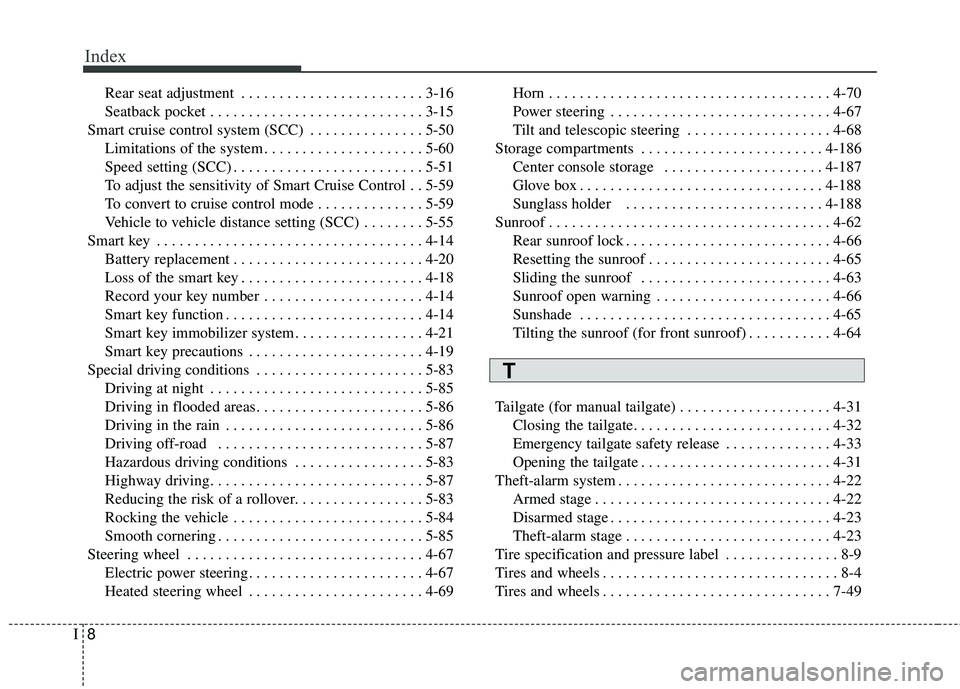
Index
8I
Rear seat adjustment . . . . . . . . . . . . . . . . . . . . . . . . 3-16
Seatback pocket . . . . . . . . . . . . . . . . . . . . . . . . . . . . 3-15
Smart cruise control system (SCC) . . . . . . . . . . . . . . . 5-50 Limitations of the system . . . . . . . . . . . . . . . . . . . . . 5-60
Speed setting (SCC) . . . . . . . . . . . . . . . . . . . . . . . . . 5-51
To adjust the sensitivity of Smart Cruise Control . . 5-59
To convert to cruise control mode . . . . . . . . . . . . . . 5-59
Vehicle to vehicle distance setting (SCC) . . . . . . . . 5-55
Smart key . . . . . . . . . . . . . . . . . . . . . . . . . . . . . . . . . . . 4-\
14 Battery replacement . . . . . . . . . . . . . . . . . . . . . . . . . 4-20
Loss of the smart key . . . . . . . . . . . . . . . . . . . . . . . . 4-18
Record your key number . . . . . . . . . . . . . . . . . . . . . 4-14
Smart key function . . . . . . . . . . . . . . . . . . . . . . . . . . 4-14
Smart key immobilizer system. . . . . . . . . . . . . . . . . 4-21
Smart key precautions . . . . . . . . . . . . . . . . . . . . . . . 4-19
Special driving conditions . . . . . . . . . . . . . . . . . . . . . . 5-83 Driving at night . . . . . . . . . . . . . . . . . . . . . . . . . . . . 5-85
Driving in flooded areas. . . . . . . . . . . . . . . . . . . . . . 5-86
Driving in the rain . . . . . . . . . . . . . . . . . . . . . . . . . . 5-86
Driving off-road . . . . . . . . . . . . . . . . . . . . . . . . . . . 5-87
Hazardous driving conditions . . . . . . . . . . . . . . . . . 5-83
Highway driving . . . . . . . . . . . . . . . . . . . . . . . . . . . . 5-87
Reducing the risk of a rollover. . . . . . . . . . . . . . . . . 5-83
Rocking the vehicle . . . . . . . . . . . . . . . . . . . . . . . . . 5-84
Smooth cornering . . . . . . . . . . . . . . . . . . . . . . . . . . . 5-85
Steering wheel . . . . . . . . . . . . . . . . . . . . . . . . . . . . . . . 4-67 Electric power steering. . . . . . . . . . . . . . . . . . . . . . . 4-67
Heated steering wheel . . . . . . . . . . . . . . . . . . . . . . . 4-69 Horn . . . . . . . . . . . . . . . . . . . . . . . . . . . . . . . . . . . . \
. 4-70
Power steering . . . . . . . . . . . . . . . . . . . . . . . . . . . . . 4-67
Tilt and telescopic steering . . . . . . . . . . . . . . . . . . . 4-68
Storage compartments . . . . . . . . . . . . . . . . . . . . . . . . 4-186 Center console storage . . . . . . . . . . . . . . . . . . . . . 4-187
Glove box . . . . . . . . . . . . . . . . . . . . . . . . . . . . . . . . 4-188
Sunglass holder . . . . . . . . . . . . . . . . . . . . . . . . . . 4-188
Sunroof . . . . . . . . . . . . . . . . . . . . . . . . . . . . . . . . . . . . \
. 4-62 Rear sunroof lock . . . . . . . . . . . . . . . . . . . . . . . . . . . 4-66
Resetting the sunroof . . . . . . . . . . . . . . . . . . . . . . . . 4-65
Sliding the sunroof . . . . . . . . . . . . . . . . . . . . . . . . . 4-63
Sunroof open warning . . . . . . . . . . . . . . . . . . . . . . . 4-66
Sunshade . . . . . . . . . . . . . . . . . . . . . . . . . . . . . . . . . 4-65
Tilting the sunroof (for front sunroof) . . . . . . . . . . . 4-64
Tailgate (for manual tailgate) . . . . . . . . . . . . . . . . . . . . 4-31 Closing the tailgate. . . . . . . . . . . . . . . . . . . . . . . . . . 4-32
Emergency tailgate safety release . . . . . . . . . . . . . . 4-33
Opening the tailgate . . . . . . . . . . . . . . . . . . . . . . . . . 4-31
Theft-alarm system . . . . . . . . . . . . . . . . . . . . . . . . . . . . 4-22 Armed stage . . . . . . . . . . . . . . . . . . . . . . . . . . . . . . . 4-22
Disarmed stage . . . . . . . . . . . . . . . . . . . . . . . . . . . . . 4-23
Theft-alarm stage . . . . . . . . . . . . . . . . . . . . . . . . . . . 4-23
Tire specification and pressure label . . . . . . . . . . . . . . . 8-9
Tires and wheels . . . . . . . . . . . . . . . . . . . . . . . . . . . . . . . 8-4
Tires and wheels . . . . . . . . . . . . . . . . . . . . . . . . . . . . . . 7-49
T
Page 585 of 586
I9
Index
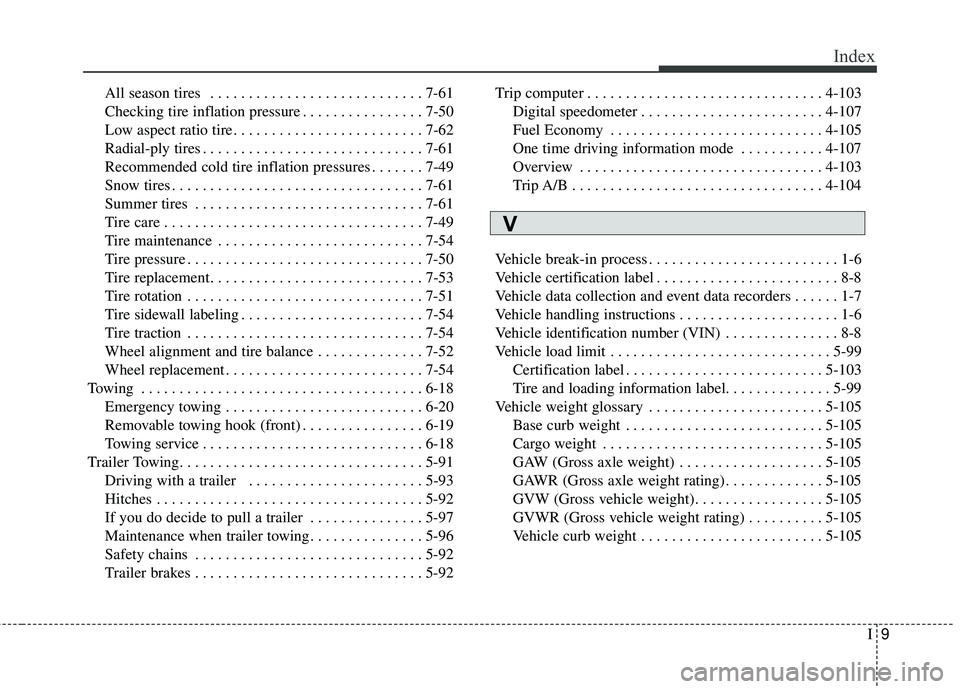
All season tires . . . . . . . . . . . . . . . . . . . . . . . . . . . . 7-61
Checking tire inflation pressure . . . . . . . . . . . . . . . . 7-50
Low aspect ratio tire. . . . . . . . . . . . . . . . . . . . . . . . . 7-62
Radial-ply tires . . . . . . . . . . . . . . . . . . . . . . . . . . . . . 7-61
Recommended cold tire inflation pressures . . . . . . . 7-49
Snow tires . . . . . . . . . . . . . . . . . . . . . . . . . . . . . . . . . 7-61
Summer tires . . . . . . . . . . . . . . . . . . . . . . . . . . . . . . 7-61
Tire care . . . . . . . . . . . . . . . . . . . . . . . . . . . . . . . . . . 7-49\
Tire maintenance . . . . . . . . . . . . . . . . . . . . . . . . . . . 7-54
Tire pressure . . . . . . . . . . . . . . . . . . . . . . . . . . . . . . . 7-50
Tire replacement . . . . . . . . . . . . . . . . . . . . . . . . . . . . 7-53
Tire rotation . . . . . . . . . . . . . . . . . . . . . . . . . . . . . . . 7-51
Tire sidewall labeling . . . . . . . . . . . . . . . . . . . . . . . . 7-54
Tire traction . . . . . . . . . . . . . . . . . . . . . . . . . . . . . . . 7-54
Wheel alignment and tire balance . . . . . . . . . . . . . . 7-52
Wheel replacement . . . . . . . . . . . . . . . . . . . . . . . . . . 7-54
Towing . . . . . . . . . . . . . . . . . . . . . . . . . . . . . . . . . . . . \
. 6-18 Emergency towing . . . . . . . . . . . . . . . . . . . . . . . . . . 6-20
Removable towing hook (front) . . . . . . . . . . . . . . . . 6-19
Towing service . . . . . . . . . . . . . . . . . . . . . . . . . . . . . 6-18
Trailer Towing. . . . . . . . . . . . . . . . . . . . . . . . . . . . . . . . 5-91 Driving with a trailer . . . . . . . . . . . . . . . . . . . . . . . 5-93
Hitches . . . . . . . . . . . . . . . . . . . . . . . . . . . . . . . . . . . 5-\
92
If you do decide to pull a trailer . . . . . . . . . . . . . . . 5-97
Maintenance when trailer towing . . . . . . . . . . . . . . . 5-96
Safety chains . . . . . . . . . . . . . . . . . . . . . . . . . . . . . . 5-92
Trailer brakes . . . . . . . . . . . . . . . . . . . . . . . . . . . . . . 5-92 Trip computer . . . . . . . . . . . . . . . . . . . . . . . . . . . . . . . 4-103
Digital speedometer . . . . . . . . . . . . . . . . . . . . . . . . 4-107
Fuel Economy . . . . . . . . . . . . . . . . . . . . . . . . . . . . 4-105
One time driving information mode . . . . . . . . . . . 4-107
Overview . . . . . . . . . . . . . . . . . . . . . . . . . . . . . . . . 4-103
Trip A/B . . . . . . . . . . . . . . . . . . . . . . . . . . . . . . . . . 4-104
Vehicle break-in process . . . . . . . . . . . . . . . . . . . . . . . . . 1-6
Vehicle certification label . . . . . . . . . . . . . . . . . . . . . . . . 8-8
Vehicle data collection and event data recorders . . . . . . 1-7
Vehicle handling instructions . . . . . . . . . . . . . . . . . . . . . 1-6
Vehicle identification number (VIN) . . . . . . . . . . . . . . . 8-8
Vehicle load limit . . . . . . . . . . . . . . . . . . . . . . . . . . . . . 5-99 Certification label . . . . . . . . . . . . . . . . . . . . . . . . . . 5-103
Tire and loading information label. . . . . . . . . . . . . . 5-99
Vehicle weight glossary . . . . . . . . . . . . . . . . . . . . . . . 5-105 Base curb weight . . . . . . . . . . . . . . . . . . . . . . . . . . 5-105
Cargo weight . . . . . . . . . . . . . . . . . . . . . . . . . . . . . 5-105
GAW (Gross axle weight) . . . . . . . . . . . . . . . . . . . 5-105
GAWR (Gross axle weight rating) . . . . . . . . . . . . . 5-105
GVW (Gross vehicle weight). . . . . . . . . . . . . . . . . 5-105
GVWR (Gross vehicle weight rating) . . . . . . . . . . 5-105
Vehicle curb weight . . . . . . . . . . . . . . . . . . . . . . . . 5-105
V