ECU KIA SEDONA 2019 User Guide
[x] Cancel search | Manufacturer: KIA, Model Year: 2019, Model line: SEDONA, Model: KIA SEDONA 2019Pages: 593, PDF Size: 15.93 MB
Page 74 of 593
Safety features of your vehicle
58
3
Securing a child restraint seat
with tether anchor system
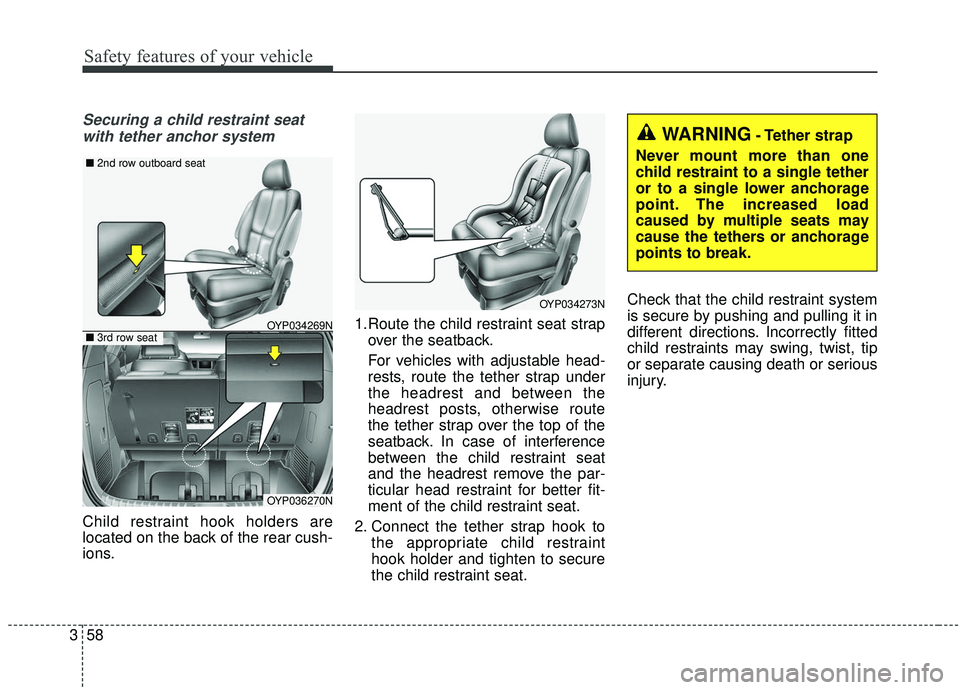
Child restraint hook holders are
located on the back of the rear cush-
ions. 1.Route the child restraint seat strap
over the seatback.
For vehicles with adjustable head-
rests, route the tether strap under
the headrest and between the
headrest posts, otherwise route
the tether strap over the top of the
seatback. In case of interference
between the child restraint seat
and the headrest remove the par-
ticular head restraint for better fit-
ment of the child restraint seat.
2. Connect the tether strap hook to the appropriate child restraint
hook holder and tighten to secure
the child restraint seat. Check that the child restraint system
is secure by pushing and pulling it in
different directions. Incorrectly fitted
child restraints may swing, twist, tip
or separate causing death or serious
injury.
OYP034273N
WARNING- Tether strap
Never mount more than one
child restraint to a single tether
or to a single lower anchorage
point. The increased load
caused by multiple seats may
cause the tethers or anchorage
points to break.
OYP036270N
OYP034269N
■ 2nd row outboard seat
■3rd row seat
Page 75 of 593
359
Safety features of your vehicle
Securing a child restraint seat withchild seat lower anchor system
Some child seat manufacturers
make child restraint seats that are
labeled as LATCH or LATCH-com-
patible child restraint seats. LATCH
stands for "Lower Anchors and
Tethers for Children". These seats
include two rigid or webbing mount-
ed attachments that connect to two
LATCH anchors at specific seating
positions in your vehicle. This type of
child restraint seat eliminates the
need to use seat belts to attach the
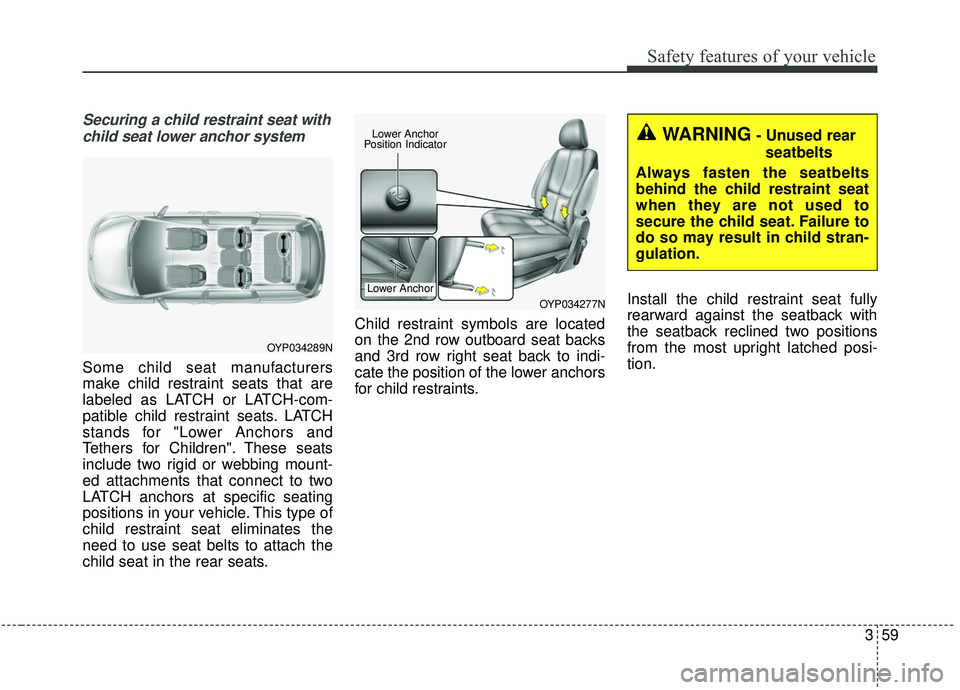
child seat in the rear seats. Child restraint symbols are located
on the 2nd row outboard seat backs
and 3rd row right seat back to indi-
cate the position of the lower anchors
for child restraints.
Install the child restraint seat fully
rearward against the seatback with
the seatback reclined two positions
from the most upright latched posi-
tion.
OYP034277N
Lower Anchor
WARNING- Unused rear
seatbelts
Always fasten the seatbelts
behind the child restraint seat
when they are not used to
secure the child seat. Failure to
do so may result in child stran-
gulation.
OYP034289N
Lower Anchor
Position Indicator
Page 112 of 593
Features of your vehicle
84
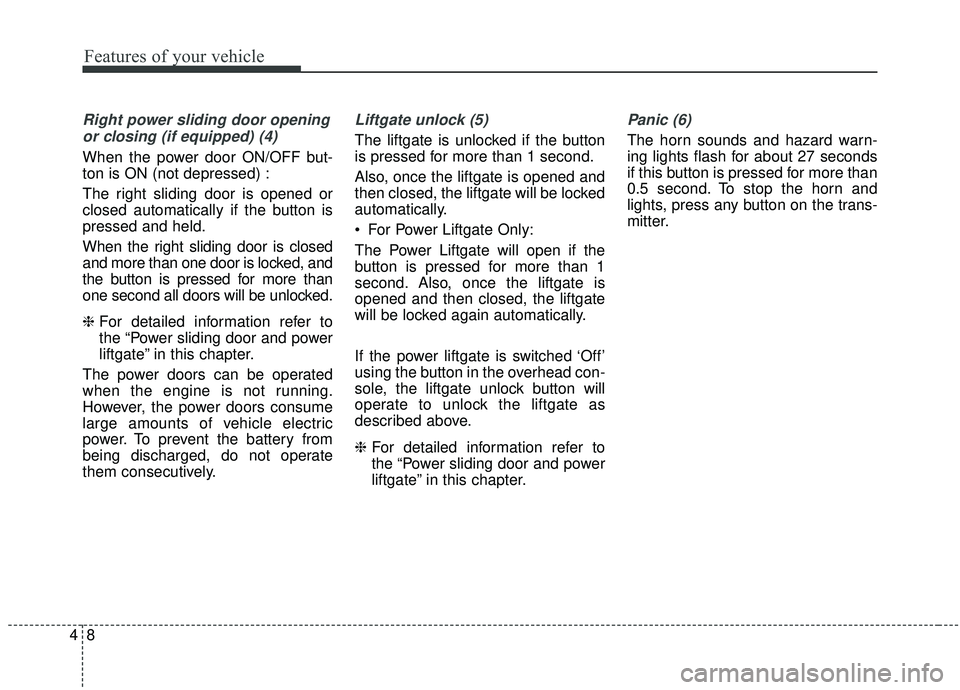
Right power sliding door openingor closing (if equipped) (4)
When the power door ON/OFF but-
ton is ON (not depressed) :
The right sliding door is opened or
closed automatically if the button is
pressed and held.
When the right sliding door is closed
and more than one door is locked, and
the button is pressed for more than
one second all doors will be unlocked.
❈ For detailed information refer to
the “Power sliding door and power
liftgate” in this chapter.
The power doors can be operated
when the engine is not running.
However, the power doors consume
large amounts of vehicle electric
power. To prevent the battery from
being discharged, do not operate
them consecutively.
Liftgate unlock (5)
The liftgate is unlocked if the button
is pressed for more than 1 second.
Also, once the liftgate is opened and
then closed, the liftgate will be locked
automatically.
For Power Liftgate Only:
The Power Liftgate will open if the
button is pressed for more than 1
second. Also, once the liftgate is
opened and then closed, the liftgate
will be locked again automatically.
If the power liftgate is switched ‘Off’
using the button in the overhead con-
sole, the liftgate unlock button will
operate to unlock the liftgate as
described above.
❈ For detailed information refer to
the “Power sliding door and power
liftgate” in this chapter.
Panic (6)
The horn sounds and hazard warn-
ing lights flash for about 27 seconds
if this button is pressed for more than
0.5 second. To stop the horn and
lights, press any button on the trans-
mitter.
Page 129 of 593
425
Features of your vehicle
DOOR LOCKS
Operating door locks from
outside the vehicle
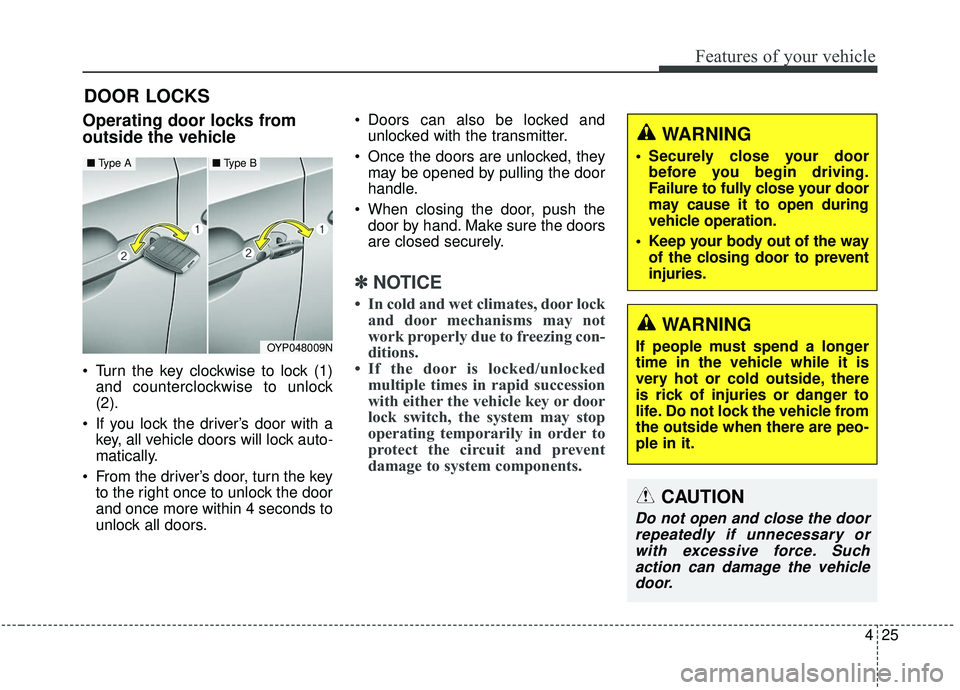
Turn the key clockwise to lock (1)and counterclockwise to unlock
(2).
If you lock the driver’s door with a key, all vehicle doors will lock auto-
matically.
From the driver’s door, turn the key to the right once to unlock the door
and once more within 4 seconds to
unlock all doors. Doors can also be locked and
unlocked with the transmitter.
Once the doors are unlocked, they may be opened by pulling the door
handle.
When closing the door, push the door by hand. Make sure the doors
are closed securely.
✽ ✽ NOTICE
• In cold and wet climates, door lock
and door mechanisms may not
work properly due to freezing con-
ditions.
• If the door is locked/unlocked multiple times in rapid succession
with either the vehicle key or door
lock switch, the system may stop
operating temporarily in order to
protect the circuit and prevent
damage to system components.
OYP048009N
■ Type A■ Type B
WARNING
If people must spend a longer
time in the vehicle while it is
very hot or cold outside, there
is rick of injuries or danger to
life. Do not lock the vehicle from
the outside when there are peo-
ple in it.
WARNING
• Securely close your door
before you begin driving.
Failure to fully close your door
may cause it to open during
vehicle operation.
Keep your body out of the way of the closing door to prevent
injuries.
CAUTION
Do not open and close the doorrepeatedly if unnecessary orwith excessive force. Suchaction can damage the vehicledoor.
Page 136 of 593
Features of your vehicle
32
4
Closing the liftgate
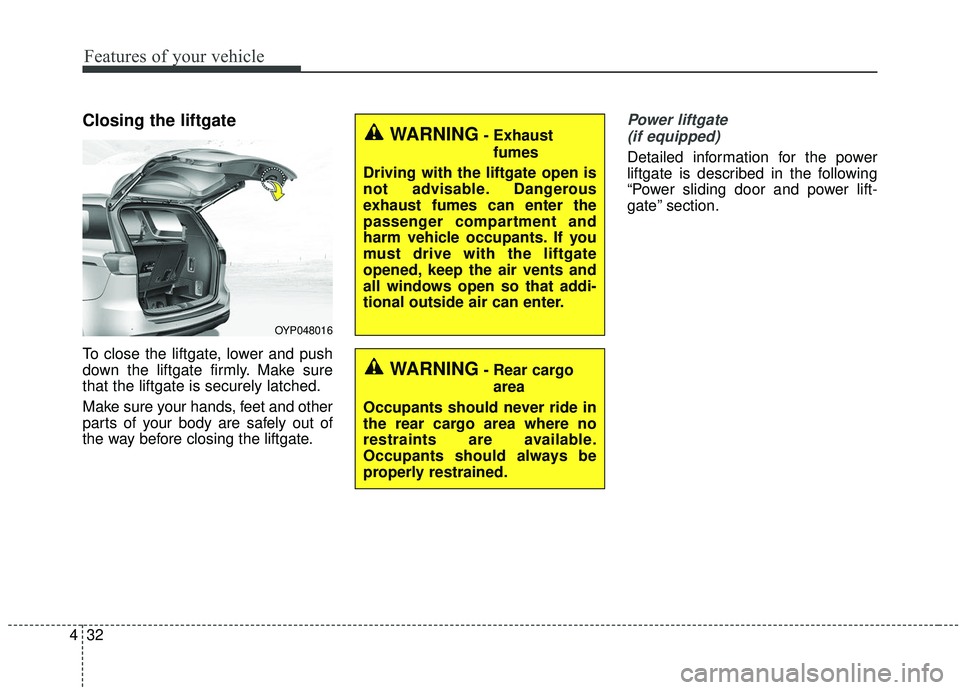
To close the liftgate, lower and push
down the liftgate firmly. Make sure
that the liftgate is securely latched.
Make sure your hands, feet and other
parts of your body are safely out of
the way before closing the liftgate.
Power liftgate
(if equipped)
Detailed information for the power
liftgate is described in the following
“Power sliding door and power lift-
gate” section.
OYP048016
WARNING- Rear cargo area
Occupants should never ride in
the rear cargo area where no
restraints are available.
Occupants should always be
properly restrained.
WARNING- Exhaust fumes
Driving with the liftgate open is
not advisable. Dangerous
exhaust fumes can enter the
passenger compartment and
harm vehicle occupants. If you
must drive with the liftgate
opened, keep the air vents and
all windows open so that addi-
tional outside air can enter.
Page 139 of 593
435
Features of your vehicle
✽ ✽NOTICE
If the power sliding door is open
approximately 6 hours, the ECU will
enter Sleep mode to conserve battery
power and the door might not close
automatically. Close the door or lift-
gate manually and then operate the
door with the power operating system.
✽ ✽NOTICE
In cold and wet climates, power slid-
ing doors and liftgate may not work
properly due to freezing conditions.
✽ ✽NOTICE
When the sliding doors are opened
manually (power OFF), more effort
will be required to open and close
than on non-power sliding doors.
✽ ✽NOTICE
• The power sliding door and power
liftgate can be operated when the
engine is not running. However
the power operation consumes
large amounts of vehicle electric
power. To prevent the battery
from being discharged, do not
operate them excessively.
• To prevent the battery from being discharged, do not leave the power
sliding door and power liftgate at
open position for a long lime.
• When jacking up the vehicle to change a tire or repair the vehicle,
do not operate the power sliding
door or power liftgate. This could
cause the power sliding door or
power liftgate to operate improp-
erly.WARNING - Unattended
children/pets
Never leave children or animals
unattended in your vehicle.
Children or animals might oper-
ate the power sliding door or
power liftgate that could result in
injury to themselves or others or
damage to the vehicle.
Page 148 of 593
Features of your vehicle
44
4
Even though the Power door
ON/OFF button is in the OFF
(depressed) position, if the liftgate
is manually closed to the second-
ary latch position, the liftgate will
be electrically moved to the fully
latched position. Make sure that
face, arms, hands, and other
obstructions are safely out of the
way before operating the liftgate.
The chime will sound and the haz- ard warning flasher will blink 10
times if you drive with the liftgate
closed but not fully secured. Stop
your vehicle immediately at a safe
place to check if your liftgate is
securely locked.
Make sure there are no people or objects around the liftgate before
operating the power liftgate. Wait
until the liftgate is open fully and
stopped before loading or unload-
ing cargo or passengers from the
vehicle. Make sure the liftgate is closed
firmly before driving. If the liftgate
is open, you will draw dangerous
exhaust fumes into your vehicle
which can cause serious injury or
death to vehicle occupants.
If the power liftgate is not closed and latched completely after power
closing operation, the chime will
sound and hazard warning lights
will blink 10 times. Stop the driving
immediately and close the liftgate
securely at the safe place.
If the power liftgate is operated while the liftgate is in the partially
opened position (more than
9degrees), the liftgate will stop the
operation. If you operate the power
liftgate again, the power liftgate will
be operate in the opposite direction. If the power liftgate is operated
while the liftgate is in the partially
closed position (less than
degrees), the liftgate will open fully.
If the power liftgate is operated while the liftgate is in the partially opened
position (less than 9degrees), the
liftgate will stop at approximately
9degree open position.
Page 163 of 593
459
Features of your vehicle
The support rod must be inserted
completely into the hole whenever
you inspect the engine compartment.
This will prevent the hood from falling
and possibly injuring you.
WARNING -Unsecured
engine hood
Always double check to be sure
that the hood is firmly latched
before driving away. If it is not
latched, the hood could fly open
while the vehicle is being driv-
en, causing a total loss of visi-
bility, which might result in an
accident.
Page 164 of 593
Features of your vehicle
60
4
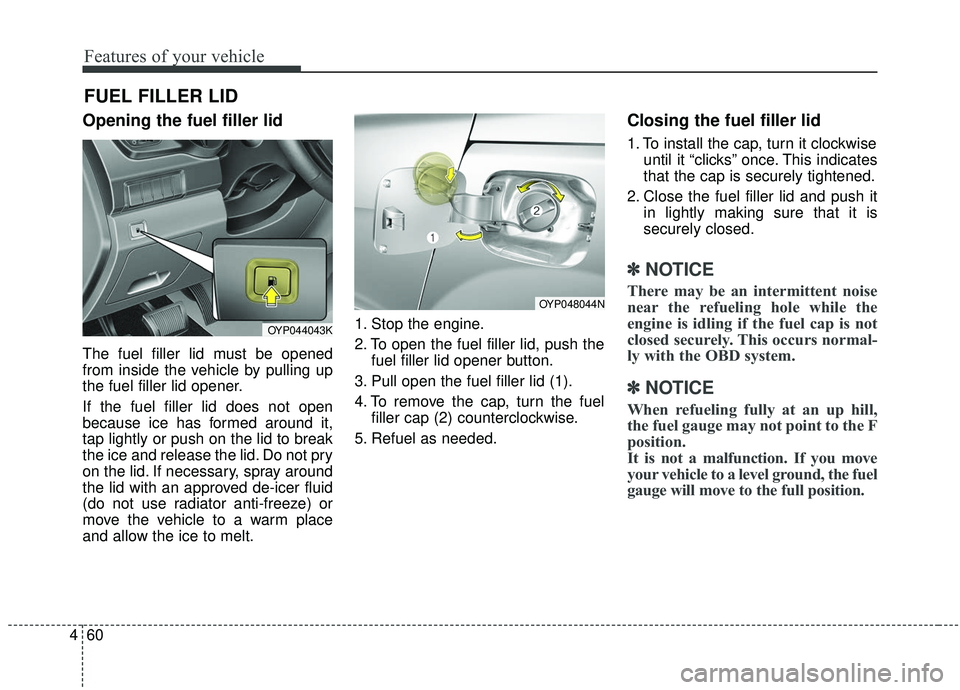
Opening the fuel filler lid
The fuel filler lid must be opened
from inside the vehicle by pulling up
the fuel filler lid opener.
If the fuel filler lid does not open
because ice has formed around it,
tap lightly or push on the lid to break
the ice and release the lid. Do not pry
on the lid. If necessary, spray around
the lid with an approved de-icer fluid
(do not use radiator anti-freeze) or
move the vehicle to a warm place
and allow the ice to melt. 1. Stop the engine.
2. To open the fuel filler lid, push the
fuel filler lid opener button.
3. Pull open the fuel filler lid (1).
4. To remove the cap, turn the fuel filler cap (2) counterclockwise.
5. Refuel as needed.
Closing the fuel filler lid
1. To install the cap, turn it clockwise until it “clicks” once. This indicates
that the cap is securely tightened.
2. Close the fuel filler lid and push it in lightly making sure that it is
securely closed.
✽ ✽NOTICE
There may be an intermittent noise
near the refueling hole while the
engine is idling if the fuel cap is not
closed securely. This occurs normal-
ly with the OBD system.
✽ ✽NOTICE
When refueling fully at an up hill,
the fuel gauge may not point to the F
position.
It is not a malfunction. If you move
your vehicle to a level ground, the fuel
gauge will move to the full position.
FUEL FILLER LID
OYP048044N
OYP044043K
Page 165 of 593
461
Features of your vehicle
Always check that the fuel cap is
installed securely to prevent fuel
spillage in the event of an accident.
✽ ✽NOTICE
Tighten the cap until it clicks once,
otherwise the fuel cap open warning
indicator light will illuminate
WARNING- Fire/explo-
sion risk
Read and follow all warnings
posted at the gas station facili-
ty. Failure to follow all warnings
will result in severe personal
injury, severe burns or death
due to fire or explosion.WARNING- Static electricity
Before touching the fuel noz- zle, you should eliminate
potentially dangerous static
electricity discharge by touch-
ing another metal part of the
vehicle, a safe distance away
from the fuel filler neck, noz-
zle, or other gas source.
Do not get back into a vehicle once you have begun refuel-
ing since you can generate
static electricity by touching,
rubbing or sliding against any
item or fabric (polyester, satin,
nylon, etc.) capable of produc-
ing static electricity. Static
electricity discharge can
ignite fuel vapors resulting in
rapid burning. If you must
reenter the vehicle, you
should once again eliminate
potentially dangerous static
electricity discharge by touch-
ing a metal part of the vehicle,
away from the fuel filler neck,
nozzle or other gasoline
source.WARNING- Refueling
Always remove the fuel cap
carefully and slowly. If the cap
is venting fuel or if you hear a
hissing sound, wait until the
condition stops before com-
pletely removing the cap. If
pressurized fuel sprays out, it
can cover your clothes or skin
and subject you to the risk of
fire and burns.