Wing KIA SEDONA 2020 User Guide
[x] Cancel search | Manufacturer: KIA, Model Year: 2020, Model line: SEDONA, Model: KIA SEDONA 2020Pages: 604, PDF Size: 16.24 MB
Page 71 of 604
355
Safety features of your vehicle
Child restraint system (CRS)
Infants and younger children must be
restrained in an appropriate rear-fac-
ing or forward-facing CRS that has
first been properly secured to the
rear seat of the vehicle. Read and
comply with the instructions for
installation and use provided by the
manufacturer of the child restraint.
Selecting a Child Restraint
System (CRS)
When selecting a CRS for your child,
always:
Make sure the CRS has a labelcertifying that it meets applicable
Safety Standards of your country.
Select a child restraint based on your child’s height and weight. The
required label or the instructions
for use typically provide this infor-
mation.
Select a child restraint that fits the vehicle seating position where it
will be used.
Read and comply with the warn- ings and instructions for installation
and use provided with the child
restraint system.
WARNING
-
Child Restraint Installation
An improperly secured child
restraint can increase the risk
of serious injury or death in an
accident. Always take the fol-
lowing precautions when using
a child restraint system:
Always follow the child restraint system manufactur-
er’s instructions for installa-
tion and use.
(Continued)
(Continued)
Always properly restrain yourchild in the child restraint.
If the vehicle head restraint prevents proper installation of
a child seat (as described in
the child restraint system
manual), the head restraint of
the respective seating posi-
tion shall be readjusted or
entirely removed.
Do not use an infant carrier or a child safety seat that
"hooks" over a seatback, it
may not provide adequate
protection in an accident.
After an accident, have a Kia dealer check the child restraint
system, seat belts, tether
anchors and lower anchors.
Page 73 of 604
357
Safety features of your vehicle
Rear-facing child seats
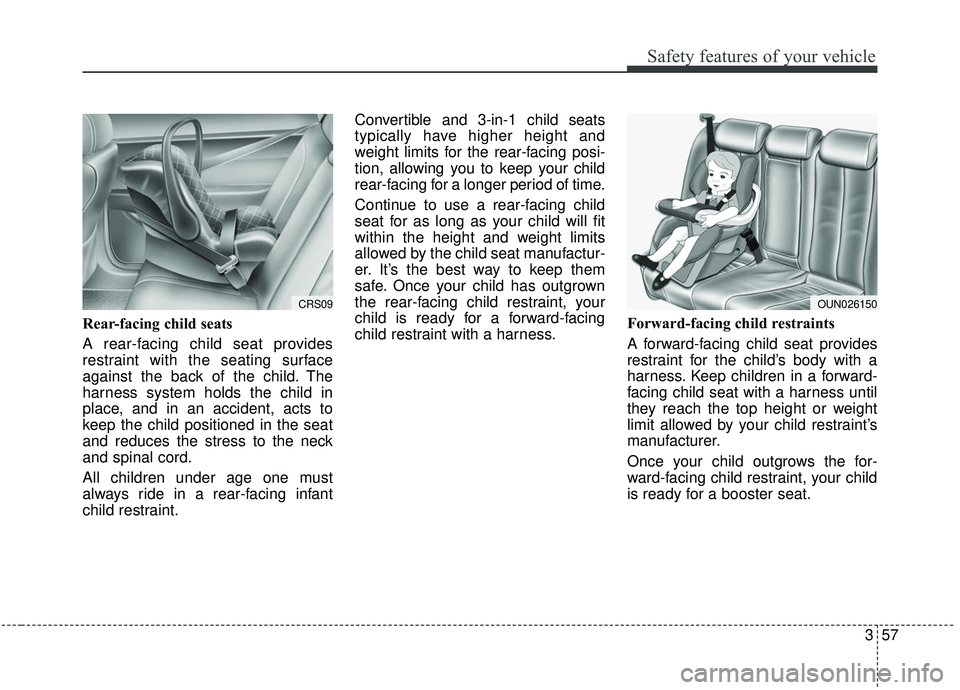
A rear-facing child seat provides
restraint with the seating surface
against the back of the child. The
harness system holds the child in
place, and in an accident, acts to
keep the child positioned in the seat
and reduces the stress to the neck
and spinal cord.
All children under age one must
always ride in a rear-facing infant
child restraint.Convertible and 3-in-1 child seats
typically have higher height and
weight limits for the rear-facing posi-
tion, allowing you to keep your child
rear-facing for a longer period of time.
Continue to use a rear-facing child
seat for as long as your child will fit
within the height and weight limits
allowed by the child seat manufactur-
er. It’s the best way to keep them
safe. Once your child has outgrown
the rear-facing child restraint, your
child is ready for a forward-facing
child restraint with a harness.
Forward-facing child restraints
A forward-facing child seat provides
restraint for the child’s body with a
harness. Keep children in a forward-
facing child seat with a harness until
they reach the top height or weight
limit allowed by your child restraint’s
manufacturer.
Once your child outgrows the for-
ward-facing child restraint, your child
is ready for a booster seat.
CRS09OUN026150
Page 75 of 604
359
Safety features of your vehicle
Securing a child restraint seatwith tether anchor system
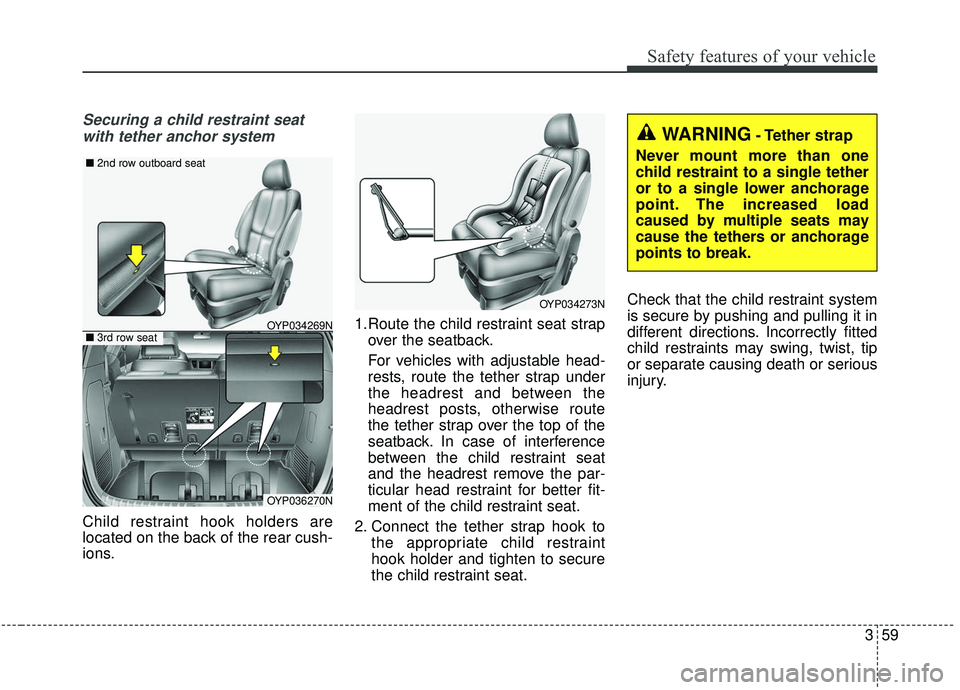
Child restraint hook holders are
located on the back of the rear cush-
ions. 1.Route the child restraint seat strap
over the seatback.
For vehicles with adjustable head-
rests, route the tether strap under
the headrest and between the
headrest posts, otherwise route
the tether strap over the top of the
seatback. In case of interference
between the child restraint seat
and the headrest remove the par-
ticular head restraint for better fit-
ment of the child restraint seat.
2. Connect the tether strap hook to the appropriate child restraint
hook holder and tighten to secure
the child restraint seat. Check that the child restraint system
is secure by pushing and pulling it in
different directions. Incorrectly fitted
child restraints may swing, twist, tip
or separate causing death or serious
injury.
OYP034273N
WARNING- Tether strap
Never mount more than one
child restraint to a single tether
or to a single lower anchorage
point. The increased load
caused by multiple seats may
cause the tethers or anchorage
points to break.
OYP036270N
OYP034269N
■ 2nd row outboard seat
■3rd row seat
Page 78 of 604
Safety features of your vehicle
62
3
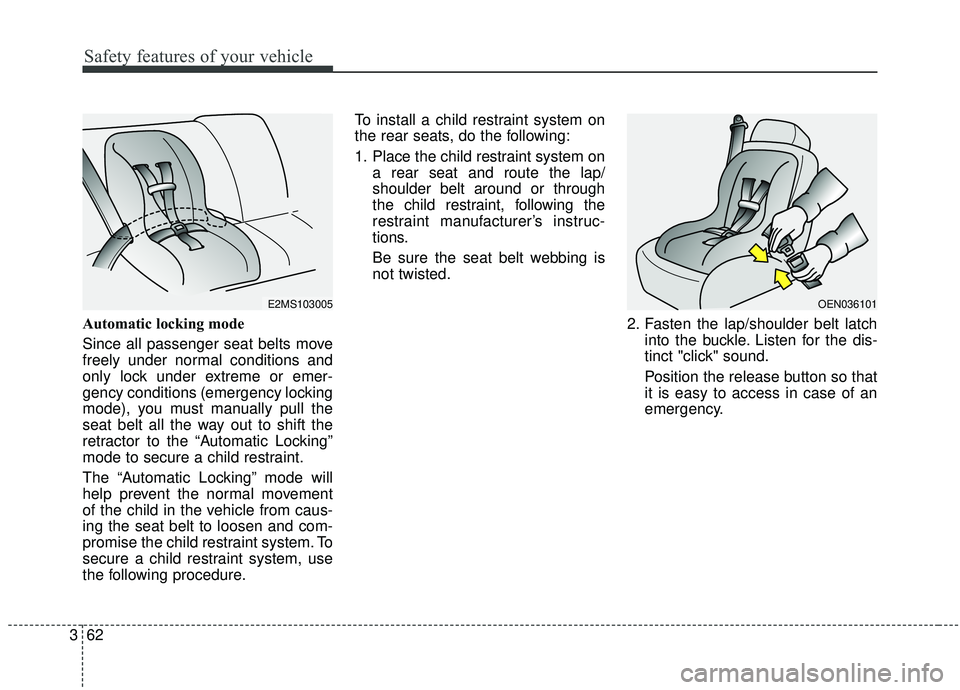
Automatic locking mode
Since all passenger seat belts move
freely under normal conditions and
only lock under extreme or emer-
gency conditions (emergency locking
mode), you must manually pull the
seat belt all the way out to shift the
retractor to the “Automatic Locking”
mode to secure a child restraint.
The “Automatic Locking” mode will
help prevent the normal movement
of the child in the vehicle from caus-
ing the seat belt to loosen and com-
promise the child restraint system. To
secure a child restraint system, use
the following procedure. To install a child restraint system on
the rear seats, do the following:
1. Place the child restraint system on
a rear seat and route the lap/
shoulder belt around or through
the child restraint, following the
restraint manufacturer’s instruc-
tions.
Be sure the seat belt webbing is
not twisted.
2. Fasten the lap/shoulder belt latchinto the buckle. Listen for the dis-
tinct "click" sound.
Position the release button so that
it is easy to access in case of an
emergency.
E2MS103005OEN036101
Page 85 of 604
369
Safety features of your vehicle
SRS components and functions
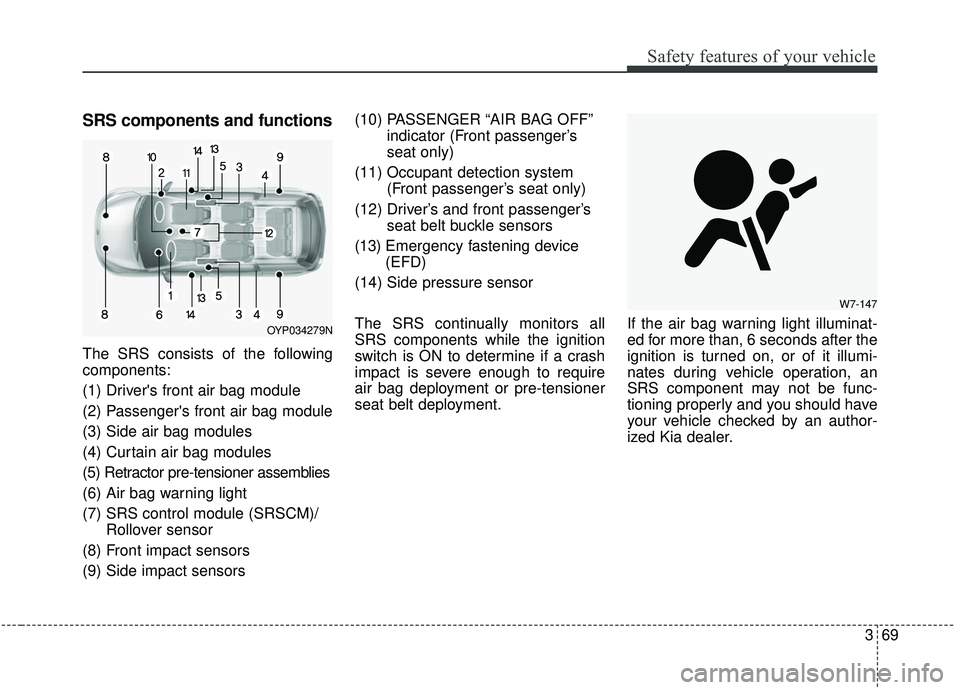
The SRS consists of the following
components:
(1) Driver's front air bag module
(2) Passenger's front air bag module
(3) Side air bag modules
(4) Curtain air bag modules
(5) Retractor pre-tensioner assemblies
(6) Air bag warning light
(7) SRS control module (SRSCM)/Rollover sensor
(8) Front impact sensors
(9) Side impact sensors (10) PASSENGER “AIR BAG OFF”
indicator (Front passenger’s
seat only)
(11) Occupant detection system (Front passenger’s seat only)
(12) Driver’s and front passenger’s seat belt buckle sensors
(13) Emergency fastening device
(EFD)
(14) Side pressure sensor
The SRS continually monitors all
SRS components while the ignition
switch is ON to determine if a crash
impact is severe enough to require
air bag deployment or pre-tensioner
seat belt deployment. If the air bag warning light illuminat-
ed for more than, 6 seconds after the
ignition is turned on, or of it illumi-
nates during vehicle operation, an
SRS component may not be func-
tioning properly and you should have
your vehicle checked by an author-
ized Kia dealer.
OYP034279N
W7-147
Page 86 of 604
Safety features of your vehicle
70
3
If any of the following conditions
occurs, this indicates a malfunction
in the air bag system. Have an
authorized Kia dealer inspect the air
bag system as soon as possible.
The light does not turn on briefly
when you turn the ignition ON.
The light stays on after illuminating for approximately 6 seconds.
The light comes on while the vehi- cle is in motion.
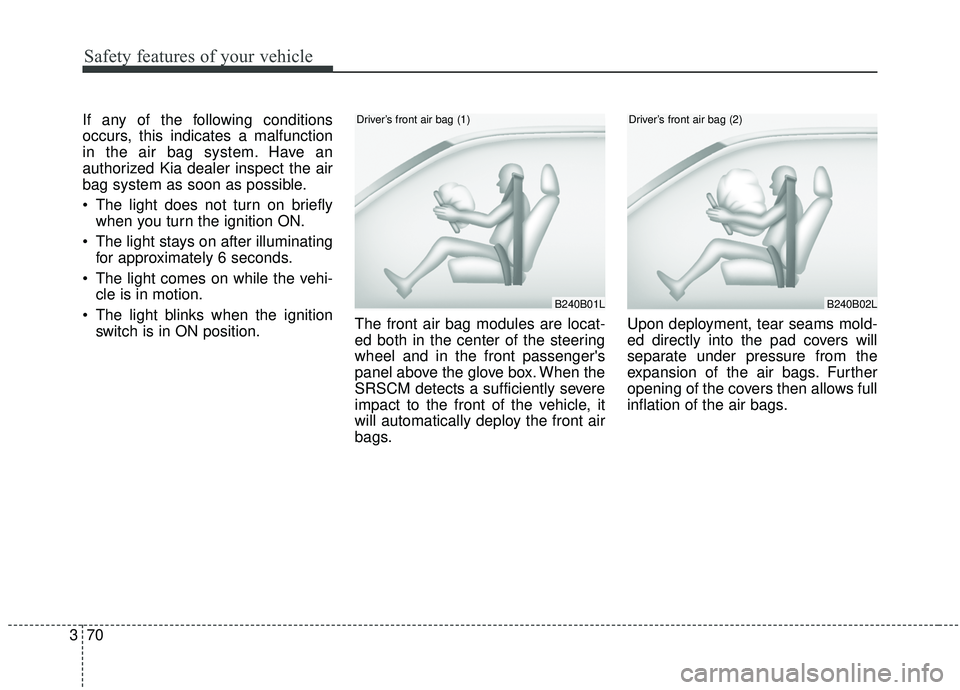
The light blinks when the ignition switch is in ON position. The front air bag modules are locat-
ed both in the center of the steering
wheel and in the front passenger's
panel above the glove box. When the
SRSCM detects a sufficiently severe
impact to the front of the vehicle, it
will automatically deploy the front air
bags. Upon deployment, tear seams mold-
ed directly into the pad covers will
separate under pressure from the
expansion of the air bags. Further
opening of the covers then allows full
inflation of the air bags.
B240B01L
Driver’s front air bag (1)
B240B02L
Driver’s front air bag (2)
Page 89 of 604
373
Safety features of your vehicle
The occupant detection system is
designed to detect the presence of a
properly-seated front passenger and
determine if the passenger's front air
bag should be enabled (may inflate)
or not. Only the front passenger front
air bag is controlled by the Occupant
Detection System.
Do not put anything in front of the
passenger air bag indicator.Main components of the occu-pant detection system
A detection device located within the front passenger seat cushion.
An electronic system which deter- mines whether the passenger air
bag systems should be activated
or deactivated.
A indicator light located on the instrument panel which illuminates
the words PASSENGER AIR BAG
“OFF” indicating the front passen-
ger air bag system is deactivated.
The instrument panel air bag warn- ing light is interconnected with the
occupant detection system. If the front passenger seat is occu-
pied by a person that the system
determines to be of appropriate size,
and he/she sits properly (sitting
upright with the seatback in an
upright position, centered on the
seat cushion with their seat belt on,
legs comfortably extended and their
feet on the floor), the PASSENGER
AIR BAG “OFF” indicator will turn off
and the front passenger's air bag will
be able to inflate, if necessary, in
frontal crashes.
You will find the PASSENGER AIR
BAG “OFF” indicator on the center
facia panel. This system detects the
conditions 1~4 in the following table
and activates or deactivates the front
passenger air bag based on these
conditions.
Page 91 of 604
375
Safety features of your vehicle
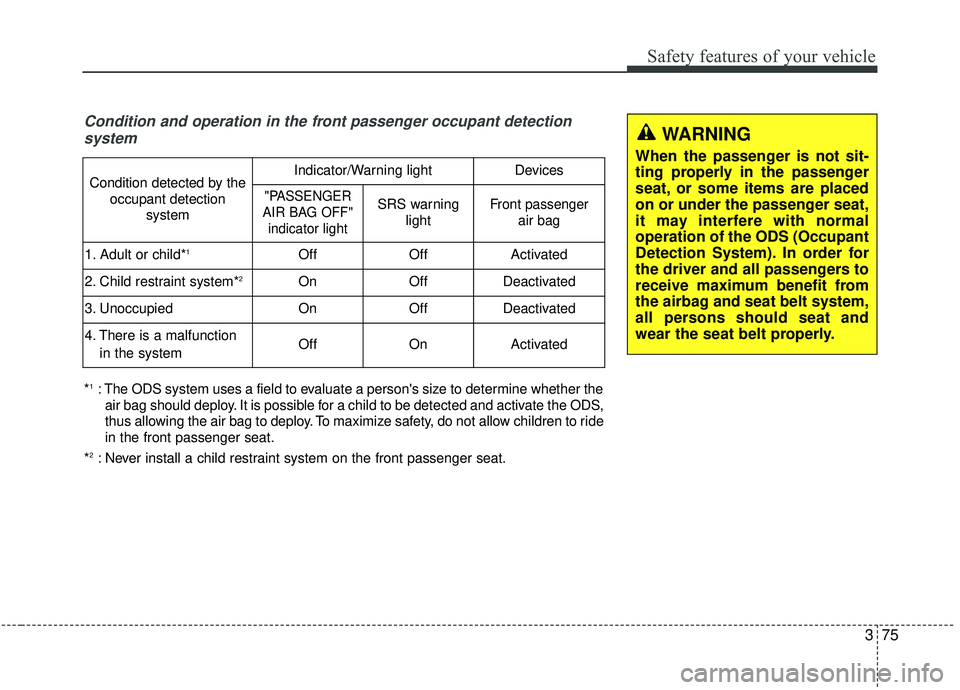
Condition and operation in the front passenger occupant detectionsystem
*1: The ODS system uses a field to evaluate a person's size to determine whether the
air bag should deploy. It is possible for a child to be detected and activate the ODS,
thus allowing the air bag to deploy. To maximize safety, do not allow children to ride
in the front passenger seat.
*
2: Never install a child restraint system on the front passenger seat.
Condition detected by the occupant detection systemIndicator/Warning lightDevices
"PASSENGER
AIR BAG OFF" indicator lightSRS warning lightFront passenger air bag
1. Adult or child*1OffOffActivated
2. Child restraint system*2OnOffDeactivated
3. Unoccupied OnOffDeactivated
4. There is a malfunction
in the systemOffOnActivated
WARNING
When the passenger is not sit-
ting properly in the passenger
seat, or some items are placed
on or under the passenger seat,
it may interfere with normal
operation of the ODS (Occupant
Detection System). In order for
the driver and all passengers to
receive maximum benefit from
the airbag and seat belt system,
all persons should seat and
wear the seat belt properly.
Page 109 of 604
393
Safety features of your vehicle
Adding equipment to or modi-
fying your air bag-equipped
vehicle
If you modify your vehicle by chang-
ing your vehicle's frame, bumper sys-
tem, front end or side sheet metal or
ride height, this may affect the opera-
tion of your vehicle's air bag system.
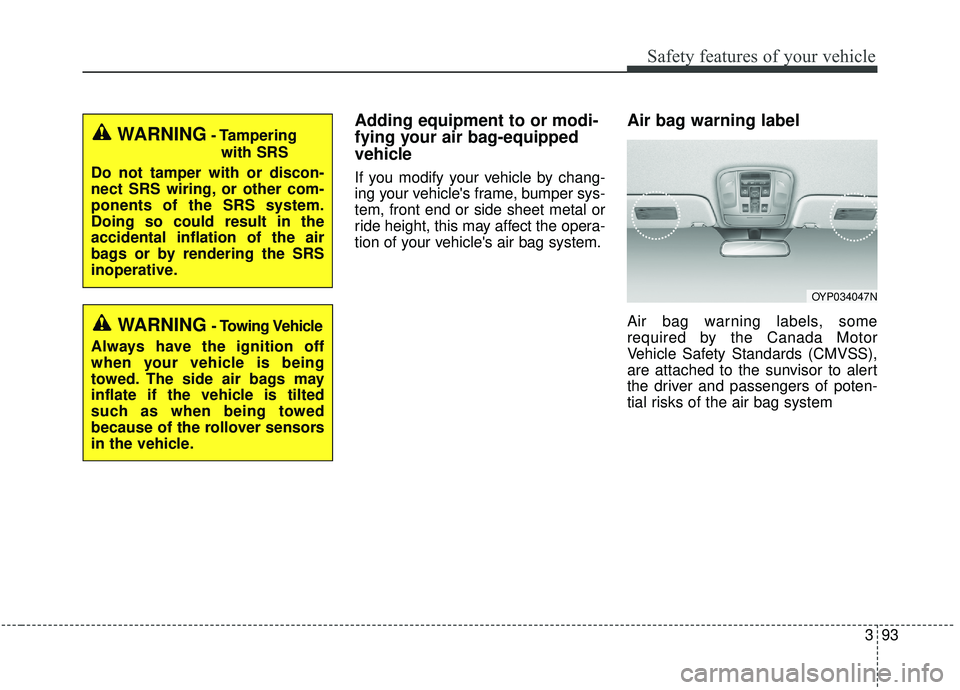
Air bag warning label
Air bag warning labels, some
required by the Canada Motor
Vehicle Safety Standards (CMVSS),
are attached to the sunvisor to alert
the driver and passengers of poten-
tial risks of the air bag system
WARNING- Tamperingwith SRS
Do not tamper with or discon-
nect SRS wiring, or other com-
ponents of the SRS system.
Doing so could result in the
accidental inflation of the air
bags or by rendering the SRS
inoperative.
WARNING- Towing Vehicle
Always have the ignition off
when your vehicle is being
towed. The side air bags may
inflate if the vehicle is tilted
such as when being towed
because of the rollover sensors
in the vehicle.
OYP034047N
Page 118 of 604
49
Features of your vehicle
Transmitter precautions
The transmitter will not work if anyof following occur:
- The ignition key is in the ignitionswitch.
- You exceed the operating dis- tance limit (about 10 m [30 feet]).
- The battery in the transmitter is weak.
- Other vehicles or objects may be blocking the signal.
- The weather is extremely cold.
- The transmitter is close to a radio transmitter such as a radio sub-
station or an airport which can
interfere with normal operation of
the transmitter. When the transmitter does not work
correctly, open and close the door
with the ignition key. If you have a
problem with the transmitter, con-
tact an authorized Kia dealer.
If the transmitter is in close proxim- ity to your mobile phone, the signal
could be blocked by your mobile
phones normal operational signals.
This is especially important when
the phone is active such as making
and receiving calls, text messag-
ing, and/or sending/receiving
emails. Avoid placing the transmit-
ter and your mobile phone in the
same pants or jacket pocket and
always try to maintain an adequate
distance between the two devices.
✽ ✽ NOTICE
If the keyless entry system is inoper-
ative due to exposure to water or liq-
uids, it will not be covered by your
manufacturer’s vehicle warranty.
CAUTION
Keep the transmitter away from
water or any liquid as it canbecome damaged and not func-tion properly.