automatic transmission KIA SEDONA 2020 Owner's Guide
[x] Cancel search | Manufacturer: KIA, Model Year: 2020, Model line: SEDONA, Model: KIA SEDONA 2020Pages: 604, PDF Size: 16.24 MB
Page 495 of 604
Maintenance
12
7
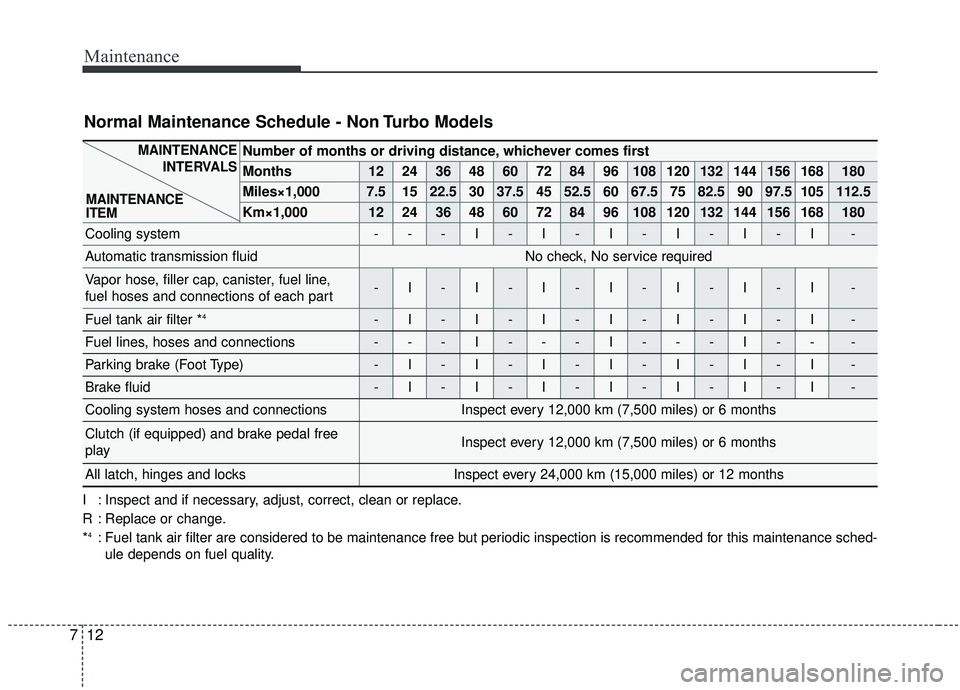
Number of months or driving distance, whichever comes first
Months1224364860728496108120132144156168180
Miles×1,0007.51522.530 37.5 45 52.5 60 67.5 75 82.5 90 97.5 105 112.5
Km×1,00012 24 36 48 60 72 84 96 108 120 132 144 156 168 180
Cooling system---I-I-I-I-I-I-
Automatic transmission fluidNo check, No service required
Vapor hose, filler cap, canister, fuel line,
fuel hoses and connections of each part-I-I-I-I-I-I-I-
Fuel tank air filter *4-I-I-I-I-I-I-I-
Fuel lines, hoses and connections---I---I---I---
Parking brake (Foot Type)-I-I-I-I-I-I-I-
Brake fluid-I-I-I-I-I-I-I-
Cooling system hoses and connectionsInspect every 12,000 km (7,500 miles) or 6 months
Clutch (if equipped) and brake pedal free
playInspect every 12,000 km (7,500 miles) or 6 months
All latch, hinges and locksInspect every 24,000 km (15,000 miles) or 12 months
MAINTENANCE
INTERVALS
MAINTENANCE
ITEM
Normal Maintenance Schedule - Non Turbo Models
I : Inspect and if necessary, adjust, correct, clean or replace.
R : Replace or change.
*
4: Fuel tank air filter are considered to be maintenance free but periodic inspection is recommended for this maintenance sched- ule depends on fuel quality.
Page 496 of 604
713
Maintenance
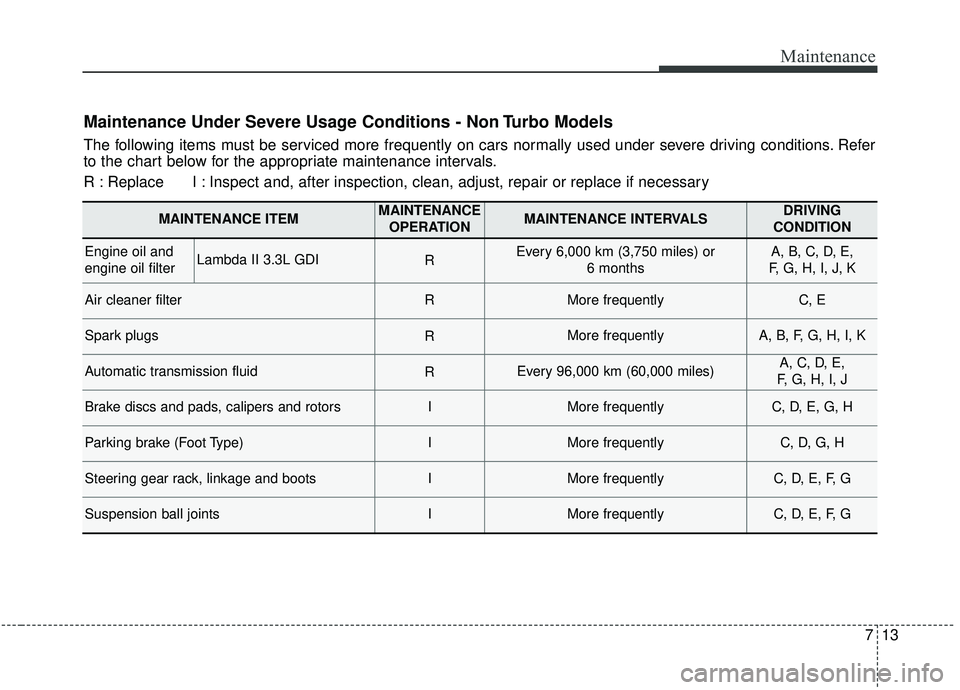
Maintenance Under Severe Usage Conditions - Non Turbo Models
The following items must be serviced more frequently on cars normally used under severe driving conditions. Refer
to the chart below for the appropriate maintenance intervals.
R : Replace I : Inspect and, after inspection, clean, adjust, repair or replace if neces\
sary
MAINTENANCE ITEMMAINTENANCEOPERATIONMAINTENANCE INTERVALSDRIVING
CONDITION
Engine oil and
engine oil filterLambda II 3.3L GDIREvery 6,000 km (3,750 miles) or 6 monthsA, B, C, D, E,
F, G, H, I, J, K
Air cleaner filterRMore frequentlyC, E
Spark plugs RMore frequentlyA, B, F, G, H, I, K
Automatic transmission fluidREvery 96,000 km (60,000 miles)A, C, D, E,
F, G, H, I, J
Brake discs and pads, calipers and rotorsIMore frequentlyC, D, E, G, H
Parking brake (Foot Type)IMore frequentlyC, D, G, H
Steering gear rack, linkage and bootsIMore frequentlyC, D, E, F, G
Suspension ball jointsIMore frequentlyC, D, E, F, G
Page 500 of 604
717
Maintenance
Automatic transmission fluid
Automatic transmission fluid does
not need to be checked under nor-
mal usage conditions.
But in severe conditions, the fluid
should be changed at an authorized
Kia dealer in accordance to the
scheduled maintenance at the begin-
ning of this chapter.
✽ ✽NOTICE
Automatic transmission fluid color
is usually red.
As the vehicle is driven, the auto-
matic transmission fluid will begin
to look darker.
This is normal, and you should not
judge the need to replace the fluid
based upon the changed color.
Brake hoses and lines
Visually check for proper installation,
chafing, cracks, deterioration and
any leakage. Replace any deteriorat-
ed or damaged parts immediately.
Brake fluid
Check brake fluid level in the brake
fluid reservoir. The level should be
between “MIN” and “MAX” marks on
the side of the reservoir. Use only
hydraulic brake fluid conforming to
DOT 3 or DOT 4 specification.
Parking brake
Inspect the parking brake system
including the parking brake pedal or
lever and cables.
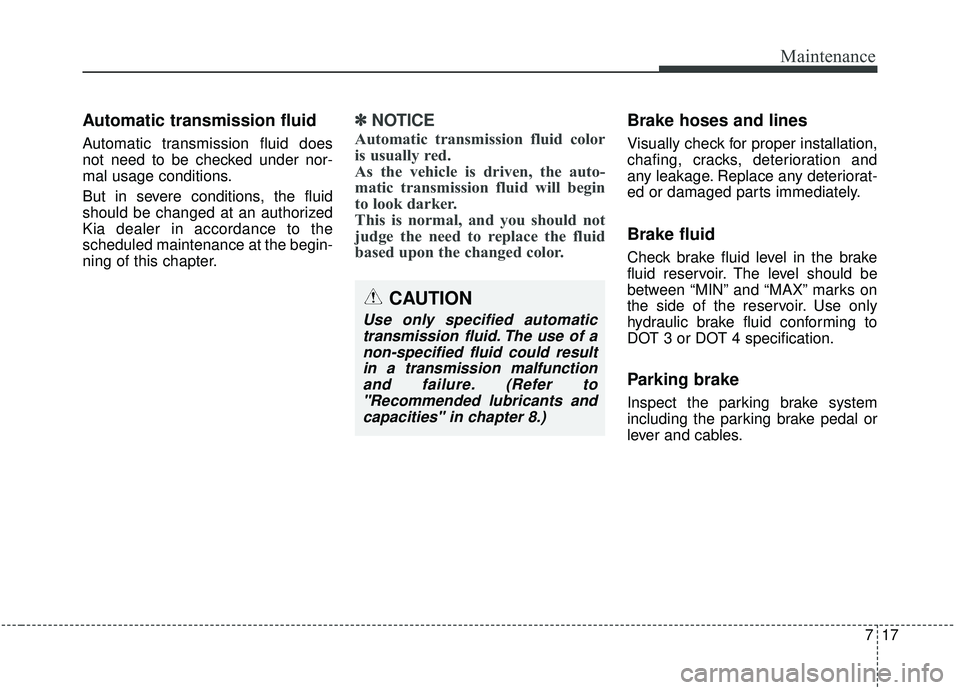
CAUTION
Use only specified automatic
transmission fluid. The use of anon-specified fluid could resultin a transmission malfunctionand failure. (Refer to"Recommended lubricants andcapacities" in chapter 8.)
Page 590 of 604
68
Specifications & Consumer information
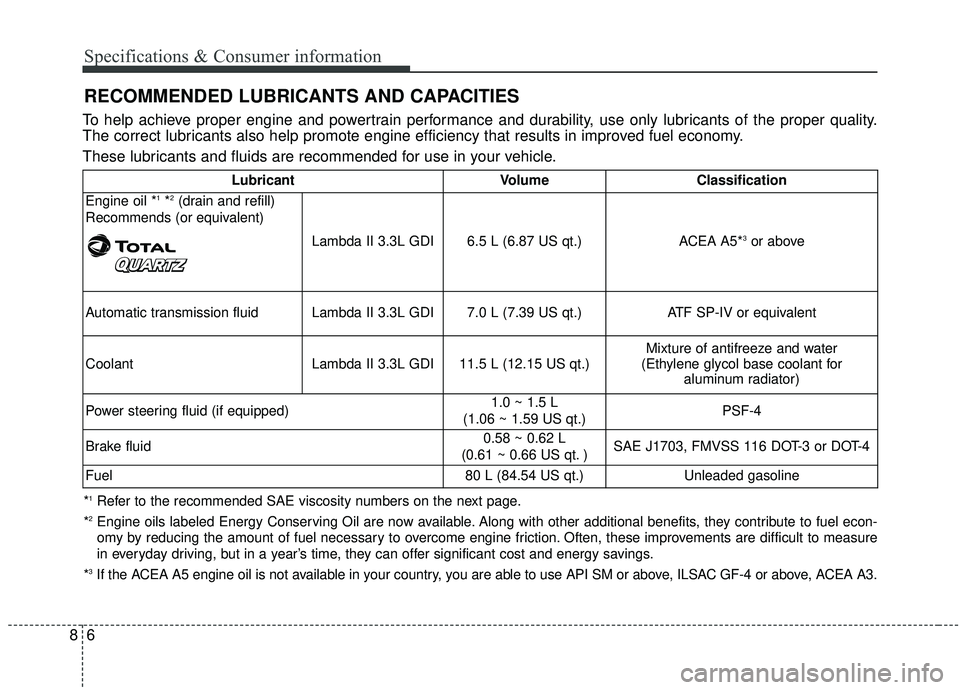
RECOMMENDED LUBRICANTS AND CAPACITIES
To help achieve proper engine and powertrain performance and durability, use only lubricants of the proper quality.
The correct lubricants also help promote engine efficiency that results in improved fuel economy.
These lubricants and fluids are recommended for use in your vehicle.
*1Refer to the recommended SAE viscosity numbers on the next page.
*
2Engine oils labeled Energy Conserving Oil are now available. Along with other additional benefits, they contribute to fuel econ-
omy by reducing the amount of fuel necessary to overcome engine friction. Often, these improvements are difficult to measure
in everyday driving, but in a year’s time, they can offer significant cost and energy savings.
*
3If the ACEA A5 engine oil is not available in your country, you are able to use API SM or above, ILSAC GF-4 or above, ACEA A3. Lubricant Volume Classification
Engine oil *
1*2(drain and refill)
Recommends (or equivalent)
Lambda II 3.3L GDI 6.5 L (6.87 US qt.) ACEA A5*
3or above
Automatic transmission fluid Lambda II 3.3L GDI 7.0 L (7.39 US qt.) ATF SP-IV or equivalent
Coolant Lambda II 3.3L GDI 11.5 L (12.15 US qt.) Mixture of antifreeze and water
(Ethylene glycol base coolant for aluminum radiator)
Power steering fluid (if equipped) 1.0 ~ 1.5 L
(1.06 ~ 1.59 US qt.) PSF-4
Brake fluid 0.58 ~ 0.62 L
(0.61 ~ 0.66 US qt. ) SAE J1703, FMVSS 116 DOT-3 or DOT-4
Fuel 80 L (84.54 US qt.)Unleaded gasoline
Page 595 of 604
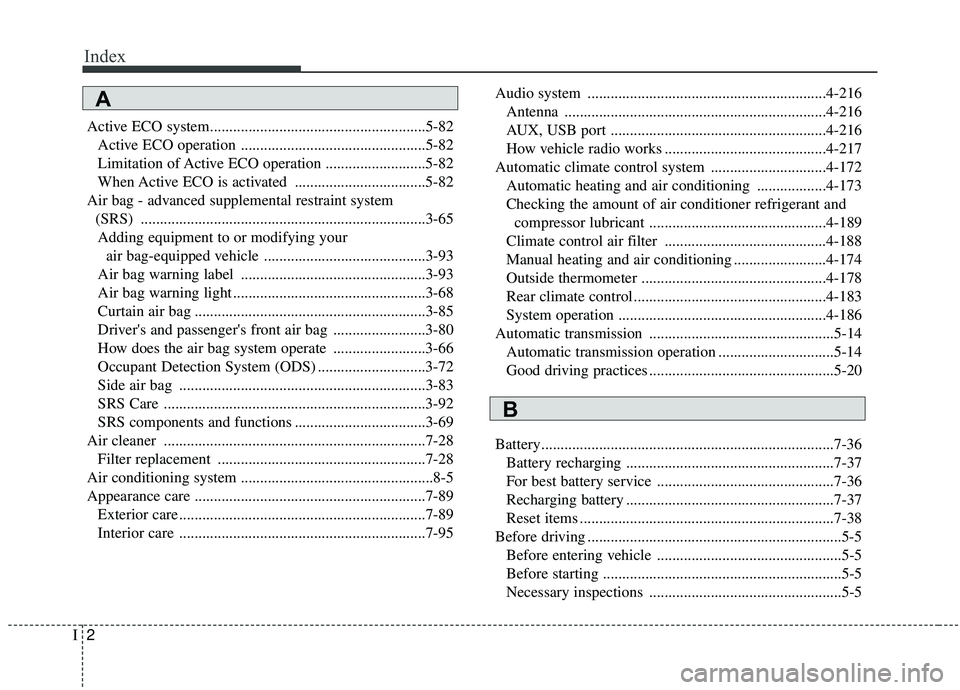
Index
2I
Active ECO system........................................................5-82Active ECO operation ................................................5-82
Limitation of Active ECO operation ..........................5-82
When Active ECO is activated ..................................5-82
Air bag - advanced supplemental restraint system (SRS) ........................................................................\
..3-65Adding equipment to or modifying your air bag-equipped vehicle ..........................................3-93
Air bag warning label ................................................3-93
Air bag warning light ..................................................3-68
Curtain air bag ............................................................3-85
Driver's and passenger's front air bag ........................3-80
How does the air bag system operate ........................3-66
Occupant Detection System (ODS) ............................3-72
Side air bag ................................................................3-83
SRS Care ....................................................................3-92\
SRS components and functions ..................................3-69
Air cleaner ....................................................................7-28\
Filter replacement ......................................................7-28
Air conditioning system ..................................................8-5
Appearance care ............................................................7-89 Exterior care ................................................................7-89
Interior care ................................................................7-95 Audio system ..............................................................4-216
Antenna ....................................................................4-21\
6
AUX, USB port ........................................................4-216
How vehicle radio works ..........................................4-217
Automatic climate control system ..............................4-172 Automatic heating and air conditioning ..................4-173
Checking the amount of air conditioner refrigerant and compressor lubricant ..............................................4-189
Climate control air filter ..........................................4-188
Manual heating and air conditioning ........................4-174
Outside thermometer ................................................4-178
Rear climate control ..................................................4-183
System operation ......................................................4-186
Automatic transmission ................................................5-14 Automatic transmission operation ..............................5-14
Good driving practices ................................................5-20
Battery........................................................................\
....7-36 Battery recharging ......................................................7-37
For best battery service ..............................................7-36
Recharging battery ......................................................7-37
Reset items ..................................................................7-38
Before driving ..................................................................5-5 Before entering vehicle ................................................5-5
Before starting ..............................................................5-5
Necessary inspections ..................................................5-5
A
B