check engine KIA SEDONA 2020 Repair Manual
[x] Cancel search | Manufacturer: KIA, Model Year: 2020, Model line: SEDONA, Model: KIA SEDONA 2020Pages: 604, PDF Size: 16.24 MB
Page 509 of 604
Maintenance
26
7
POWER STEERING FLUID (IF EQUIPPED)
Checking the power steering
fluid level
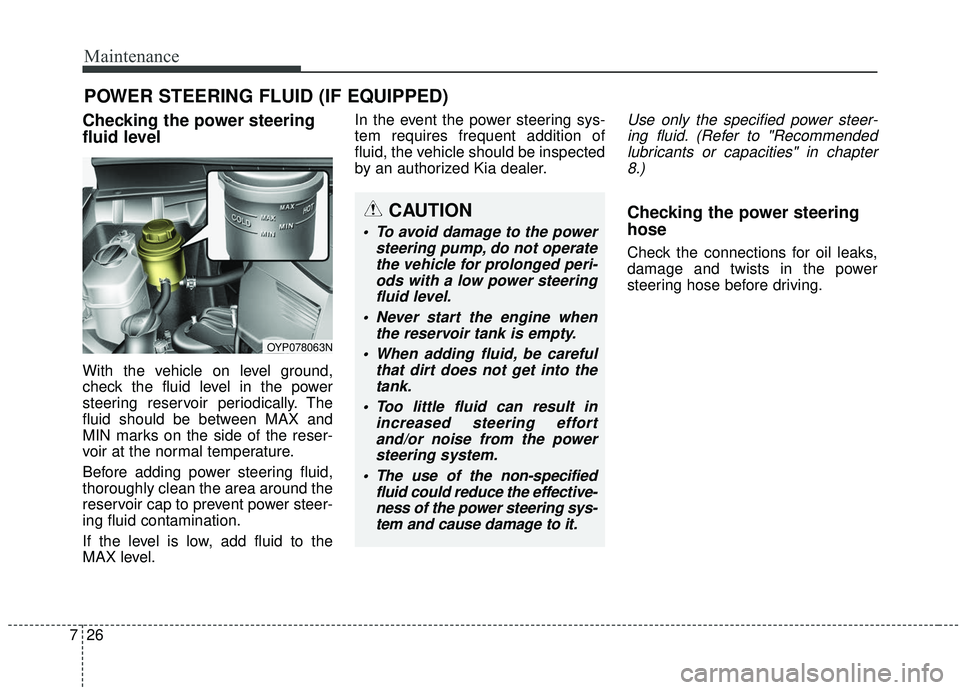
With the vehicle on level ground,
check the fluid level in the power
steering reservoir periodically. The
fluid should be between MAX and
MIN marks on the side of the reser-
voir at the normal temperature.
Before adding power steering fluid,
thoroughly clean the area around the
reservoir cap to prevent power steer-
ing fluid contamination.
If the level is low, add fluid to the
MAX level. In the event the power steering sys-
tem requires frequent addition of
fluid, the vehicle should be inspected
by an authorized Kia dealer.
Use only the specified power steer-
ing fluid. (Refer to "Recommendedlubricants or capacities" in chapter8.)
Checking the power steering
hose
Check the connections for oil leaks,
damage and twists in the power
steering hose before driving.
OYP078063N
CAUTION
To avoid damage to the power steering pump, do not operatethe vehicle for prolonged peri-ods with a low power steeringfluid level.
Never start the engine when the reservoir tank is empty.
When adding fluid, be careful that dirt does not get into thetank.
Too little fluid can result in increased steering effortand/or noise from the powersteering system.
The use of the non-specified fluid could reduce the effective-ness of the power steering sys-tem and cause damage to it.
Page 536 of 604
753
Maintenance
FUSES
A vehicle’s electrical system is pro-
tected from electrical overload dam-
age by fuses.
This vehicle has 2 (or 3) fuse panels,
one located in the driver’s side panel
bolster, the other in the engine com-
partment near the battery.
If any of your vehicle’s lights, acces-
sories, or controls do not work, check
the appropriate circuit fuse. If a fuse
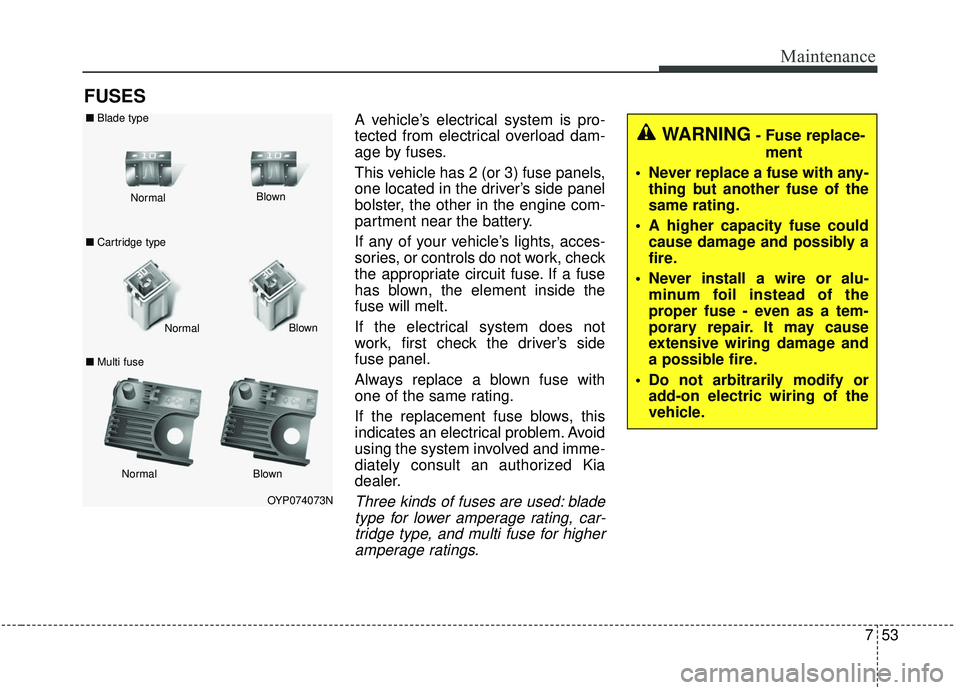
has blown, the element inside the
fuse will melt.
If the electrical system does not
work, first check the driver’s side
fuse panel.
Always replace a blown fuse with
one of the same rating.
If the replacement fuse blows, this
indicates an electrical problem. Avoid
using the system involved and imme-
diately consult an authorized Kia
dealer.
Three kinds of fuses are used: bladetype for lower amperage rating, car-tridge type, and multi fuse for higheramperage ratings.
WARNING- Fuse replace-
ment
Never replace a fuse with any- thing but another fuse of the
same rating.
A higher capacity fuse could cause damage and possibly a
fire.
Never install a wire or alu- minum foil instead of the
proper fuse - even as a tem-
porary repair. It may cause
extensive wiring damage and
a possible fire.
Do not arbitrarily modify or add-on electric wiring of the
vehicle.
OYP074073N
Normal
Normal
■
Blade type
■ Cartridge type
■ Multi fuse Blown
Blown
Normal Blown
Page 539 of 604
Maintenance
56
7
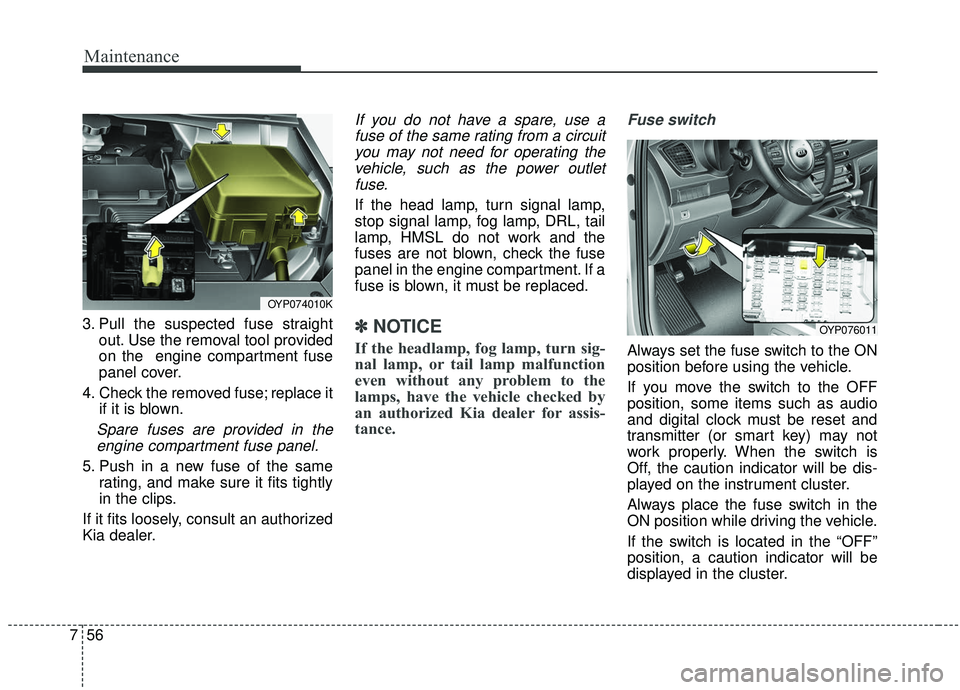
3. Pull the suspected fuse straight
out. Use the removal tool provided
on the engine compartment fuse
panel cover.
4. Check the removed fuse; replace it if it is blown.
Spare fuses are provided in theengine compartment fuse panel.
5. Push in a new fuse of the same rating, and make sure it fits tightly
in the clips.
If it fits loosely, consult an authorized
Kia dealer.
If you do not have a spare, use a fuse of the same rating from a circuityou may not need for operating thevehicle, such as the power outletfuse.
If the head lamp, turn signal lamp,
stop signal lamp, fog lamp, DRL, tail
lamp, HMSL do not work and the
fuses are not blown, check the fuse
panel in the engine compartment. If a
fuse is blown, it must be replaced.
✽ ✽ NOTICE
If the headlamp, fog lamp, turn sig-
nal lamp, or tail lamp malfunction
even without any problem to the
lamps, have the vehicle checked by
an authorized Kia dealer for assis-
tance.
Fuse switch
Always set the fuse switch to the ON
position before using the vehicle.
If you move the switch to the OFF
position, some items such as audio
and digital clock must be reset and
transmitter (or smart key) may not
work properly. When the switch is
Off, the caution indicator will be dis-
played on the instrument cluster.
Always place the fuse switch in the
ON position while driving the vehicle.
If the switch is located in the “OFF”
position, a caution indicator will be
displayed in the cluster.
OYP074010K
OYP076011
Page 540 of 604
757
Maintenance
✽ ✽NOTICE
• Set all switches to ON before driv-
ing.
• If the vehicle is going to be unused for over 1 month, set all switches
to OFF to prevent the batteries
from draining.
Engine compartment fuse
replacement
1. Turn the ignition switch and all
other switches off.
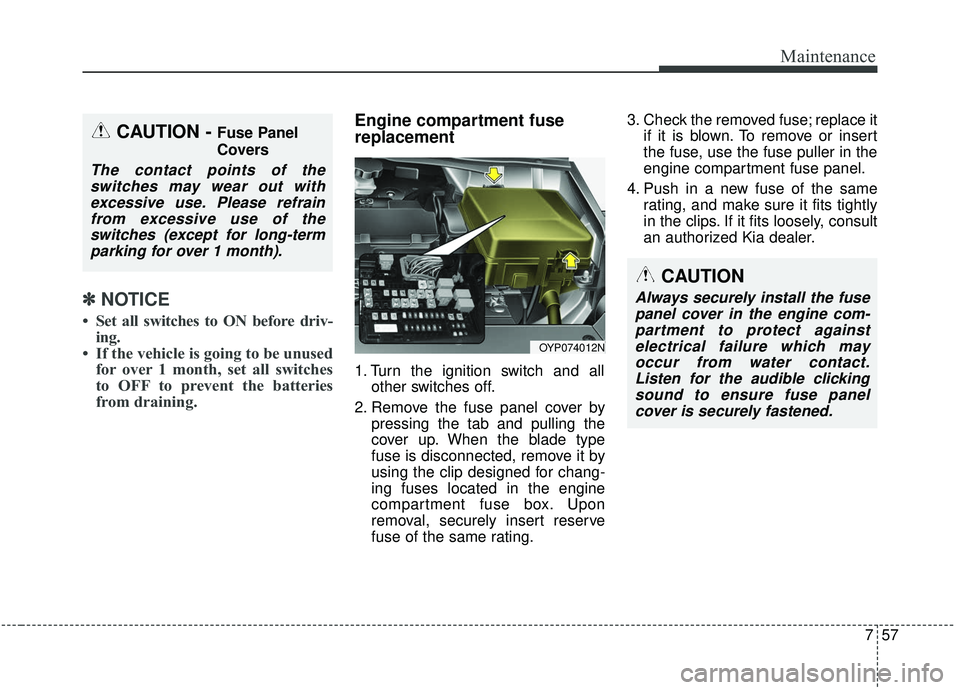
2. Remove the fuse panel cover by pressing the tab and pulling the
cover up. When the blade type
fuse is disconnected, remove it by
using the clip designed for chang-
ing fuses located in the engine
compartment fuse box. Upon
removal, securely insert reserve
fuse of the same rating. 3. Check the removed fuse; replace it
if it is blown. To remove or insert
the fuse, use the fuse puller in the
engine compartment fuse panel.
4. Push in a new fuse of the same rating, and make sure it fits tightly
in the clips. If it fits loosely, consult
an authorized Kia dealer.
OYP074012N
CAUTION - Fuse Panel
Covers
The contact points of theswitches may wear out withexcessive use. Please refrainfrom excessive use of theswitches (except for long-termparking for over 1 month).
CAUTION
Always securely install the fusepanel cover in the engine com-partment to protect againstelectrical failure which mayoccur from water contact.Listen for the audible clickingsound to ensure fuse panelcover is securely fastened.
Page 541 of 604
Maintenance
58
7
Main fuse
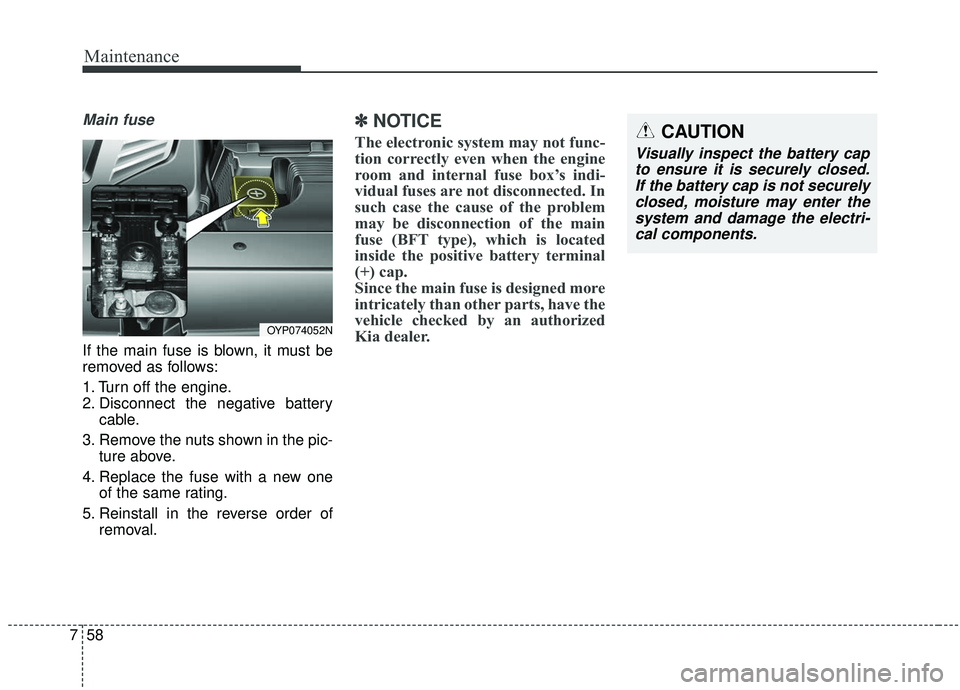
If the main fuse is blown, it must be
removed as follows:
1. Turn off the engine.
2. Disconnect the negative battery
cable.
3. Remove the nuts shown in the pic- ture above.
4. Replace the fuse with a new one of the same rating.
5. Reinstall in the reverse order of removal.
✽ ✽NOTICE
The electronic system may not func-
tion correctly even when the engine
room and internal fuse box’s indi-
vidual fuses are not disconnected. In
such case the cause of the problem
may be disconnection of the main
fuse (BFT type), which is located
inside the positive battery terminal
(+) cap.
Since the main fuse is designed more
intricately than other parts, have the
vehicle checked by an authorized
Kia dealer.
OYP074052N
CAUTION
Visually inspect the battery cap
to ensure it is securely closed.If the battery cap is not securelyclosed, moisture may enter thesystem and damage the electri-cal components.
Page 546 of 604
![KIA SEDONA 2020 Repair Manual 763
Maintenance
Engine compartment fuse panel
Fuse Name Fuse ratingCircuit Protected ]
COOLING FAN 80A Cooling Fan Unit ABS1 40A ESC Module, Multipurpose Check Connector
ABS2 40A ESC Module
INVERTER](/img/2/40439/w960_40439-545.png "KIA SEDONA 2020 Repair Manual 763
Maintenance
Engine compartment fuse panel
Fuse Name Fuse ratingCircuit Protected ]
COOLING FAN 80A Cooling Fan Unit ABS1 40A ESC Module, Multipurpose Check Connector
ABS2 40A ESC Module
INVERTER")
763
Maintenance
Engine compartment fuse panel
Fuse Name Fuse ratingCircuit Protected ]
COOLING FAN 80A Cooling Fan Unit ABS1 40A ESC Module, Multipurpose Check Connector
ABS2 40A ESC Module
INVERTER 30A AC Inverter Unit
H/LAMP HI 10A H/LAMP HI Solenoid
EPB1 15A EPB Unit
EPB2 15A EPB Unit
TCU 15A Transmission Unit
P/SEAT (PASS) 30A Passenger Manual Switch B+4 50A Smart Junction Block (IPS Control Module, IPS3, IPS4, IPS5, IPS6, Fuse - MODULE7)
POWER TAIL GATE 40A Power Tail Gate Module
B+2 50ASmart Junction Block (Leak Current Autocut Device, Fuse - P/SEAT DRV, P/WDW RH), Seat Heater
Rear, Interior Lamp, Multimedia, Memory
IG1 40A With Smart Key : PDM1/2 Relay, W/O Smart Key : Ignition Switch
IG2 40A Start Relay, With Smart Key : PDM3 Relay, W/O Smart Key : Ignition Switch,
B+1 50A Smart Junction Block (IPS Control Module, Fuse - P/WDW LH, S/HEATER FRT, DR LOCK)
BLOWER 40A Blower Relay
TRAILER 30A Trailer Power Outlet
B+5 50ASmart Junction Block (Motor Driver, Power Outlet Relay, Fuse - S/ROOF FRT, S/ROOF RR, BRAKE
SWITCH, SMART KEY1, SMART KEY3, AMP), Power Outlet1, Power Outlet2
PSD1 40A Power Sliding Door Module
PSD2 40A Power Sliding Door Module
B+3 50A Smart Junction Block (IPS Control Module, IPS1, IPS2)
MDPS 125A MDPS Unit (Rack)
BLOWER RR 40A Blower RR Relay
Page 583 of 604
Maintenance
100
7
Engine exhaust gas precautions
(carbon monoxide)
Carbon monoxide can be present with other exhaust fumes.
Therefore, if you smell exhaust
fumes of any kind inside your vehi-
cle, have it inspected and repaired
immediately. If you ever suspect
exhaust fumes are coming into your
vehicle, drive it only with all the win-
dows fully open. Have your vehicle
checked and repaired immediately. Do not operate the engine in con-
fined or closed areas (such as
garages) any more than what is
necessary to move the vehicle in or
out of the area.
When the vehicle is stopped in an open area for more than a short
time with the engine running,
adjust the ventilation system (as
needed) to draw outside air into the
vehicle.
Never sit in a parked or stopped vehicle for any extended time with
the engine running.
When the engine stalls or fails to start, excessive attempts to restart
the engine may cause damage to
the emission control system.
Operating precautions for catalyt-
ic converters (if equipped)
WARNING - Exhaust
Engine exhaust gases contain
carbon monoxide (CO). Though
colorless and odorless, it is
dangerous and could be lethal if
inhaled. Follow the instructions
on this page to avoid CO poi-
soning.
WARNING- Catalytic converter
Keep away from the catalytic
converter and exhaust system
while the vehicle is running or
immediately thereafter. The
exhaust and catalytic systems
are very hot and may burn you.
Page 591 of 604
Recommended SAE viscosity
number
Always be sure to clean the area
around any filler plug, drain plug, or
dipstick before checking or draining
any lubricant. This is especially
important in dusty or sandy areas
and when the vehicle is used on
unpaved roads. Cleaning the plug
and dipstick areas will prevent dirt
and grit from entering the engine and
other mechanisms that could be
damaged.Engine oil viscosity (thickness) has
an effect on fuel economy and cold
weather operating (engine start and
engine oil flowability). Lower viscosi-
ty engine oils can provide better fuel
economy and cold weather perform-
ance, however, higher viscosity
engine oils are required for satisfac-
tory lubrication in hot weather.
Using oils of any viscosity other than
those recommended could result in
engine damage.
When choosing an oil, consider the
range of temperature your vehicle
will be operated in before the next oil
change.
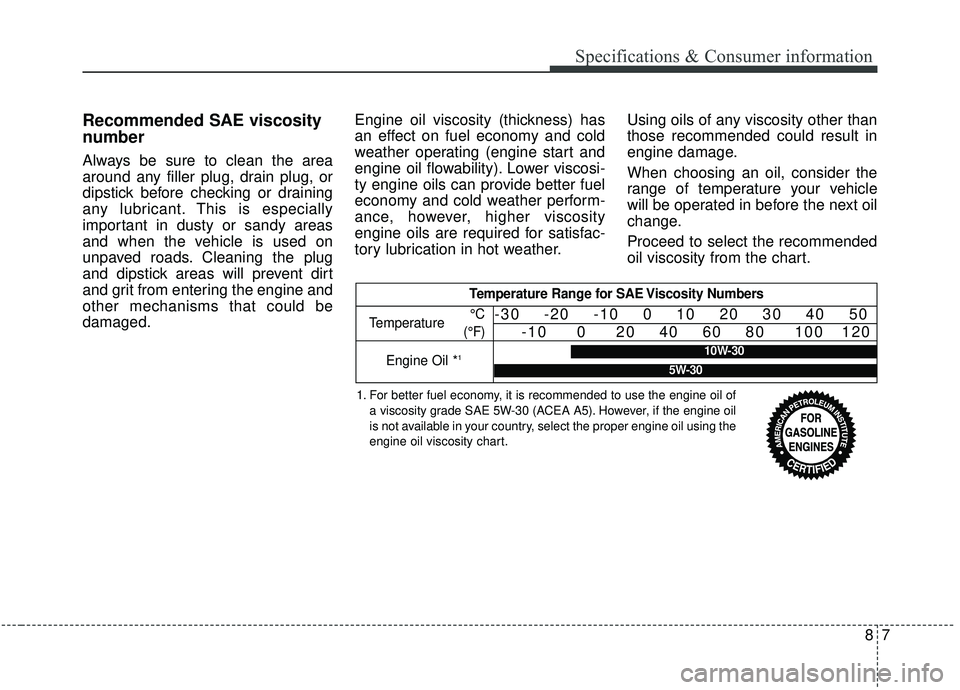
Proceed to select the recommended
oil viscosity from the chart.
Temperature Range for SAE Viscosity Numbers
Temperature
Engine Oil *
1
°C
(°F)-30 -20 -10 0 10 20 30 40 50 -10 0 20 40 60 80 100 120
1. For better fuel economy, it is recommended to use the engine oil of
a viscosity grade SAE 5W-30 (ACEA A5). However, if the engine oil
is not available in your country, select the proper engine oil using the
engine oil viscosity chart.
10W-30
5W-30
87
Specifications & Consumer information
Page 597 of 604
Index
4I
Driver Attention Warning (DAW) system ....................5-94Resetting the system ..................................................5-96
System malfunction ....................................................5-96
System setting and activation ....................................5-94
System standby ..........................................................5-96
Economical operation ..................................................5-103
Emergency starting ..........................................................6-5 Jump starting ................................................................6-5
Push-starting ................................................................6-7
Emission control system ................................................7-98 Crankcase emission control system ............................7-98
Evaporative emission control (including ORVR: Onboard Refueling Vapor Recovery) system ..........7-99
Exhaust emission control system ................................7-99
Engine ........................................................................\
......8-2
Engine compartment ................................................2-6, 7-4
Engine coolant ..............................................................7-22 Changing the coolant ..................................................7-24
Checking the coolant level..........................................7-22
Engine number ................................................................8-9
Engine oil ......................................................................7-\
20 Changing the engine oil and filter ..............................7-21
Checking the engine oil level ....................................7-20 Engine start/stop button ................................................5-10
Engine start/stop button position ................................5-10
Illuminated engine start/stop button ..........................5-10
Starting the engine with a smart key ..........................5-12
Explanation of scheduled maintenance items ..............7-15
Exterior features ..........................................................4-214 Roof rack ..................................................................4-214
Exterior overview ............................................................2-2
Folding key ......................................................................4-\
5 Battery replacement ....................................................4-10
Immobilizer system ....................................................4-11
Key operations ..............................................................4-5
Limp home (override) procedure ................................4-13
Record your key number ..............................................4-5
Transmitter precautions ................................................4-9
Forward Collision-avoidance Assist (FCA) ..................5-44 Brake operation ..........................................................5-47
FCA front radar/Camera sensor ..................................5-48
FCA warning message and system control ................5-46
Limitation of the system ............................................5-51
System malfunction ....................................................5-49
System setting and activation ....................................5-44
E
F