lights KIA Sorento 2006 1.G Owner's Guide
[x] Cancel search | Manufacturer: KIA, Model Year: 2006, Model line: Sorento, Model: KIA Sorento 2006 1.GPages: 312, PDF Size: 5.21 MB
Page 197 of 312
Driving in the Rain
Rain and wet roads can make driving
dangerous, especially if you’re not
prepared for the slick pavement. Here
are a few things to consider when
driving in the rain:
A heavy rainfall will make it harder
to see and will increase the dis-
tance needed to stop your vehicle,
so slow down.
Keep your windshield wiping equip-
ment in good shape. Replace your
windshield wiper blades when they
show signs of streaking or missing
areas on the windshield.
If your tires are not in good condi-
tion, making a quick stop on wet
pavement can cause a skid and
possibly lead to an accident. Be
sure your tires are in good shape. Turn on your headlights to make it
easier for others to see you.
Driving too fast through large pud-
dles can affect your brakes. If you
must go through puddles, try to
drive through them slowly.
If you believe your brakes may have
become wet, apply them lightly
while driving until normal braking
operation returns.Winter Driving
We recommend that you carry
emergency equipment, including
tire chains, a window scraper, wind-
shield de-icer, a bag of sand or salt,
flares, a small shovel and jumper
cables.
Make sure you have sufficient eth-
ylene-glycol coolant in the radiator.
Check the battery condition and
cables. Cold temperatures reduce
the capacity of any battery, so it
must be in excellent condition to
provide enough winter starting
power.
Make sure the engine oil viscosity
is suitable for cold weather.
Check the ignition system for loose
connections and damage.DRIVING TIPS5-10
BL-ENG (CAN)-5.qxd 7/28/05 5:56 PM Page 10
Page 207 of 312
When you drive over bumps, rocks,
or other obstacles, your wheels can
leave the ground. If this happens,
even with one or two wheels, you
can’t control the vehicle as well or
perhaps at all. Because you will be on
an unpaved surface, it’s especially
important to avoid sudden accelera-
tion, sudden turns, or sudden brak-
ing. Any of these actions could cause
the center of gravity of the vehicle to
shift and destabilize the vehicle, lead-
ing to a collision or rollover accident.
Off-road driving requires a different
kind of alertness from driving on
paved roads and highways. There are
no road signs, posted speed limits or
signal lights. You have to use your
own judgment about what is safe and
what isn’t. Bad judgment in this
uncontrolled environment can be
fatal.Driving on Off-Road Hills
Off-road driving often takes you up,
down, or across a hill. Driving safely
on hills requires excellent judgment
and an understanding of what your
vehicle can and can’t do. There are
some hills that simply should not be
driven.DRIVING TIPS5-20
WARNING- Drinking & Driving
Drinking and driving, or drug
use and driving can be very
dangerous on any road. This
certainly remains true for off-
road driving. At the very time
you need special alertness and
driving skills, your reflexes, per-
ceptions and judgement can be
affected by even a small amount
of alcohol or drugs. You could
have a serious - or even fatal -
accident if you drink or take
drugs and drive or ride with a
driver who has been drinking or
taking drugs.
BL-ENG (CAN)-5.qxd 7/28/05 5:56 PM Page 20
Page 209 of 312

Driving uphill
Once you decide you can safely drive
up the hill, you need to take some
special steps.
Use a low gear and get a firm grip
on the steering wheel.
Get a smooth start up the hill and
try to maintain your speed. Don’t
use more power than you need,
because you don’t want your
wheels to start spinning or sliding.
Try to drive straight up the hill, if at
all possible. If the path twists and
turns, you may have to find another
route. Slow down as you approach the top
of the hill.
Attach a flag to the vehicle to make
you more visible to approaching
traffic on trails or hills.
Sound the horn as you approach
the top of the hill to let opposing
traffic know you’re there.
Use your headlights even during
the day. They make you more visi-
ble to other drivers.DRIVING TIPS5-22
WARNING- Driving Across Hills
Turning or driving across steep
hills can be dangerous. You
could lose traction, slide side-
ways, or just reach an area too
steep to traverse. In any case, it
could cause you to roll over. You
could be seriously or fatally
injured. When driving up hills,
always try to go as straight up
as possible.
BL-ENG (CAN)-5.qxd 7/28/05 5:56 PM Page 22
Page 221 of 312
TRAILER TOWINGYour vehicle can tow a trailer. To iden-
tify what the vehicle trailering capaci-
ty is for your vehicle, you should read
the information in “Weight of the
Trailer’’ that appears later in this sec-
tion. Remember that trailering is dif-
ferent than just driving your vehicle
by itself. Trailering means changes in
handling, durability, and fuel econo-
my. Successful, safe trailering takes
correct equipment, and it has to be
used properly.This section contains many time-test-
ed, important trailering tips and safe-
ty rules. Many of these are important
for your safety and that of your pas-
sengers. Please read this section
carefully before you pull a trailer.
Load-pulling components such as the
engine, transmission, wheel assem-
blies, and tires are forced to work
harder against the load of the added
weight. The engine is required to
operate at relatively higher speeds
and under greater loads. This addi-
tional burden generates extra heat.
The trailer also adds considerably to
wind resistance, further increasing
the pulling requirements.If You Do Decide to Pull a Trailer
Here are some important points if you
decide to pull a trailer:
State, provincial, county and
municipal government have varying
trailering laws. Make sure your
hitch, mirrors, lights and wiring
arrangements are legal, not only
where you live, but also where
you’ll be driving. A good source for
this information is provincial or local
law enforcement agencies.
Consider using a sway control. You
can ask a hitch dealer about sway
control.
After your odometer indicates 800
km or more, you can tow a trailer.
For the first 800 km that you tow a
trailer, don’t drive over 80 km/h and
don’t make starts at full throttle.
This helps your engine and other
parts of your vehicle “wear” in at the
heavier loads.
Always drive at a safe speed (less
than 100 km/h) commensurate with
road conditions.
Three important considerations
have to do with weight:DRIVING TIPS5-34✽ ✽
NOTICEPulling a trailer improperly can
damage your vehicle and result in
costly repairs not covered by your
warranty. To pull a trailer correct-
ly, follow the advice in this section.
BL-ENG (CAN)-5.qxd 7/28/05 5:56 PM Page 34
Page 225 of 312
Trailer brakes
If your trailer weighs more than 750
kg (1,650 pounds) loaded, then it
needs its own brakes – and they must
be adequate. Be sure to read and fol-
low the instructions for the trailer
brakes so you’ll be able to install,
adjust and maintain them properly.
Don’t tap into your vehicle’s brake
system.
Do not use a trailer with its own
brakes unless you are absolutely
certain that you have properly set
up the brake system. This is not a
task for amateurs. Use an experi-
enced, competent trailer shop for
this work.Driving with a trailer
Towing a trailer requires a certain
amount of experience. Before setting
out for the open road, you must get to
know your trailer. Acquaint yourself
with the feel of handling and braking
with the added weight of the trailer.
And always keep in mind that the
vehicle you are driving is now a good
deal longer and not nearly so respon-
sive as your vehicle is by itself.
Before you start, check the trailer
hitch and platform, safety chains,
electrical connector(s), lights, tires
and mirror adjustment. If the trailer
has electric brakes, start your vehicle
and trailer moving and then apply the
trailer brake controller by hand to be
sure the brakes are working. This lets
you check your electrical connection
at the same time.
During your trip, check occasionally
to be sure that the load is secure, and
that the lights and any trailer brakes
are still working.Following distance
Stay at least twice as far behind the
vehicle ahead as you would when
driving your vehicle without a trailer.
This can help you avoid situations
that require heavy braking and sud-
den turns.
Passing
You’ll need more passing distance up
ahead when you’re towing a trailer.
And, because you’re a good deal
longer, you’ll need to go much farther
beyond the passed vehicle before
you can return to your lane.DRIVING TIPS5-38
BL-ENG (CAN)-5.qxd 7/28/05 5:56 PM Page 38
Page 226 of 312
Backing up
Hold the bottom of the steering wheel
with one hand. Then, to move the
trailer to the left, just move your hand
to the left. To move the trailer to the
right, move your hand to the right.
Always back up slowly and, if possi-
ble, have someone guide you.
Making turns
When you’re turning with a trailer,
make wider turns than normal. Do
this so your trailer won’t strike soft
shoulders, curbs, road signs, trees,
or other objects. Avoid jerky or sud-
den maneuvers. Signal well in
advance.Turn signals when towing a trailer
When you tow a trailer, your vehicle
has to have a different turn signal
flasher and extra wiring.
The green arrows on your instrument
panel will flash whenever you signal a
turn or lane change. Properly con-
nected, the trailer lights will also flash
to alert other drivers that you’re about
to turn, change lanes, or stop.
When towing a trailer, the green
arrows on your instrument panel will
flash for turns even if the bulbs on the
trailer are burned out. Thus, you may
think drivers behind you are seeing
your signals when, in fact, they are
not. It’s important to check occasion-
ally to be sure the trailer bulbs are still
working. You must also check the
lights every time you disconnect and
then reconnect the wires.Do not connect a trailer lighting sys-
tem directly to your vehicle’s lighting
system.
Use only an approved trailer wiring
harness. Your authorized Kia dealer
can assist you in installing the wiring
harness.
DRIVING TIPS
5-39
WARNING
Using an improper trailer wiring
harness could lead to malfunc-
tioning of your vehicles electri-
cal system and a possible acci-
dent.
BL-ENG (CAN)-5.qxd 7/28/05 5:56 PM Page 39
Page 234 of 312

ROAD WARNINGHazard Warning Flasher
The hazard warning flasher serves
as a warning to other drivers to exer-
cise extreme caution when approach-
ing, overtaking, or passing your vehi-
cle. It should be used whenever
emergency repairs are being made,
when the vehicle is stopped near the
edge of a roadway, or whenever your
vehicle is in distress.Depress the flasher switch to activate
at any time. The flasher switch is
located in the center console switch
panel. All turn signal lights will flash
simultaneously.
• The hazard warning flasher oper-
ates whether your vehicle is run-
ning or not.
The turn signals do not work when
the hazard flasher is on.
Care must be taken when the haz-
ard warning flasher is used while
the vehicle is being towed. Local
regulations may prohibit using it in
this manner.IN CASE OF AN EMERGENCY6-2
AU TO
AUTO AMB
OFF TEMPMODE
AMB
A/C
A/C
L
R
H
M
PASSENGER AIRBAG OFF
5BLC601A
BL-ENG (CAN)-6.qxd 7/28/05 5:57 PM Page 2
Page 239 of 312

ELECTRICAL CIRCUIT
PROTECTIONFuses
A vehicle’s electrical system is pro-
tected from electrical overload dam-
age by fuses.
This vehicle has two fuse panels, one
located in the driver’s side kick panel,
the other in the engine compartment
near the battery.If any of your vehicle’s lights, acces-
sories, or controls do not work, check
the appropriate circuit fuse. If a fuse
has blown, the element inside the
fuse will be melted.
Always replace a blown fuse with one
of the same rating.
If the same fuse blows again, avoid
using the system involved and imme-
diately consult an authorized Kia
dealer.
Two kinds of fuses are used: stan-
dard for lower amperage rating and
main for higher amperage ratings.Fuse Replacement
If the electrical system does not work,
first check the driver’s side fuse
panel.
IN CASE OF AN EMERGENCY
6-7
S2BLD313
StandardMain fuseNormal
Blown
NormalBlown
WARNING- Fuse Replacement
Never replace a fuse with any-
thing but another fuse of the
same rating.
A higher capacity fuse could
cause damage and possibly a
fire.
Never install a wire instead of
the proper fuse – even as a
temporary repair. It may cause
extensive wiring damage and
possibly a fire.
Do not use a screwdriver or
any other metal object to
remove fuses because it may
cause a short circuit and dam-
age the system.
BL-ENG (CAN)-6.qxd 7/28/05 5:57 PM Page 7
Page 240 of 312

1. Turn the ignition switch and all
other switches off.
2. Pull the suspected fuse straight
out. Use the removal tool provided
on the main fuse box in the engine
compartment fuse relay box (if
equipped). Refer to the fuse panel
chart on the fuse panel cover to
identify the likely problem fuse or
electrical circuit.3. Check the removed fuse; replace it
if it is blown. The number of fuses
vary according to the vehicle
model. Check both the passenger
and engine compartment fuse box
covers.
4. Push in a new fuse of the same rat-
ing, and make sure it fits tightly in
the clips.
If it fits loosely, consult an authorized
Kia dealer.If you do not have a spare, use a fuse
of the same rating from a circuit you
may not need for operating the vehi-
cle, such as the radio or room lamp
fuse.
If the headlights or other electrical
components do not work and the
fuses are OK, check the fuse block in
the engine compartment. If a fuse is
blown, it must be replaced.
1. Turn the ignition switch and all
other switches off.
2. Remove the fuse block cover by
unhooking the tab on one end and
tilting the cover back toward the
other end.
3. Check the fuses. If one is blown,
replace it with a new one of the
same rating.IN CASE OF AN EMERGENCY6-8
FUSE
S2BLA604
BL-ENG (CAN)-6.qxd 7/28/05 5:57 PM Page 8
Page 244 of 312
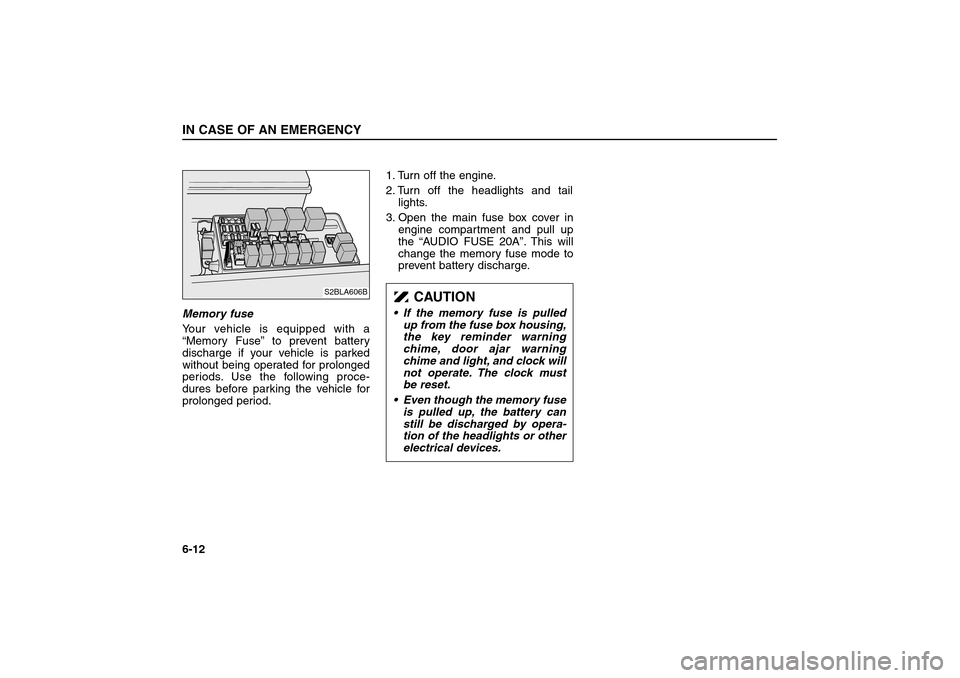
Memory fuse
Your vehicle is equipped with a
“Memory Fuse”to prevent battery
discharge if your vehicle is parked
without being operated for prolonged
periods. Use the following proce-
dures before parking the vehicle for
prolonged period.1. Turn off the engine.
2. Turn off the headlights and tail
lights.
3. Open the main fuse box cover in
engine compartment and pull up
the “AUDIO FUSE 20A”. This will
change the memory fuse mode to
prevent battery discharge.IN CASE OF AN EMERGENCY6-12
S2BLA606B
CAUTION
• If the memory fuse is pulled
up from the fuse box housing,
the key reminder warning
chime, door ajar warning
chime and light, and clock will
not operate. The clock must
be reset.
Even though the memory fuse
is pulled up, the battery can
still be discharged by opera-
tion of the headlights or other
electrical devices.
BL-ENG (CAN)-6.qxd 7/28/05 5:57 PM Page 12