lock KIA Sorento 2006 1.G Owner's Guide
[x] Cancel search | Manufacturer: KIA, Model Year: 2006, Model line: Sorento, Model: KIA Sorento 2006 1.GPages: 312, PDF Size: 5.21 MB
Page 39 of 312
Type B
As a reminder to the driver and pas-
senger, safety belt warning light will
blink for approximately 6 seconds
each time you turn the ignition switch
ON regardless of belt fastening.
If the driver's safety belt is unfastened
after the ignition switch is ON, the
safety belt warning light will blink for
approximately 6 seconds.
If the driver's safety belt is not fas-
tened when the ignition key is turned
ON, the safety belt warning chime will
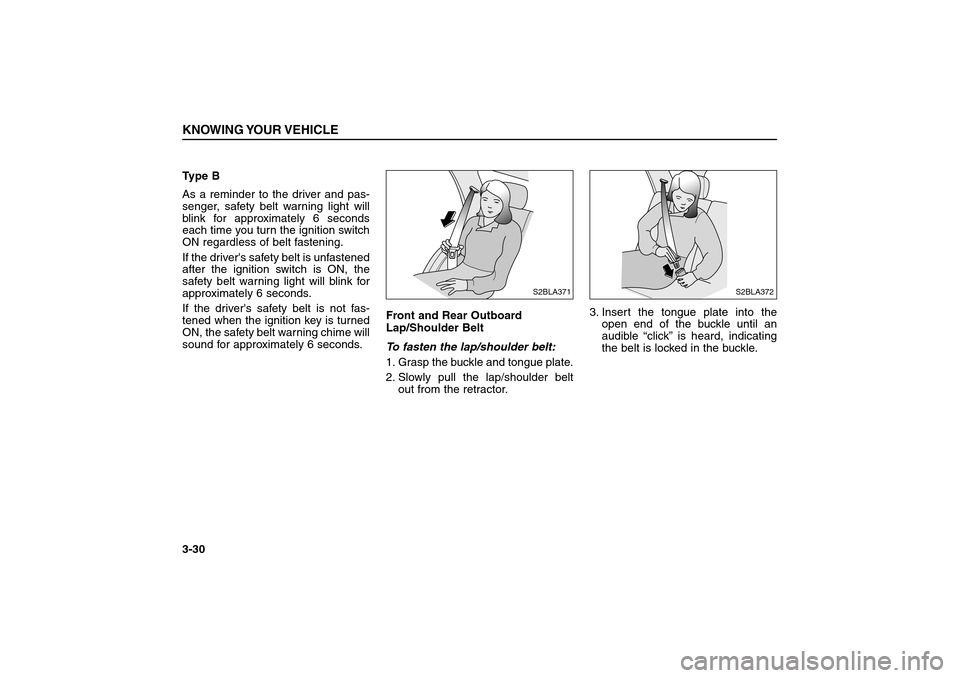
sound for approximately 6 seconds.Front and Rear Outboard
Lap/Shoulder Belt
To fasten the lap/shoulder belt:
1. Grasp the buckle and tongue plate.
2. Slowly pull the lap/shoulder belt
out from the retractor.3. Insert the tongue plate into the
open end of the buckle until an
audible “click”is heard, indicating
the belt is locked in the buckle.KNOWING YOUR VEHICLE3-30
S2BLA371
S2BLA372
BL-ENG (CAN)-3.qxd 7/28/05 5:52 PM Page 30
Page 40 of 312
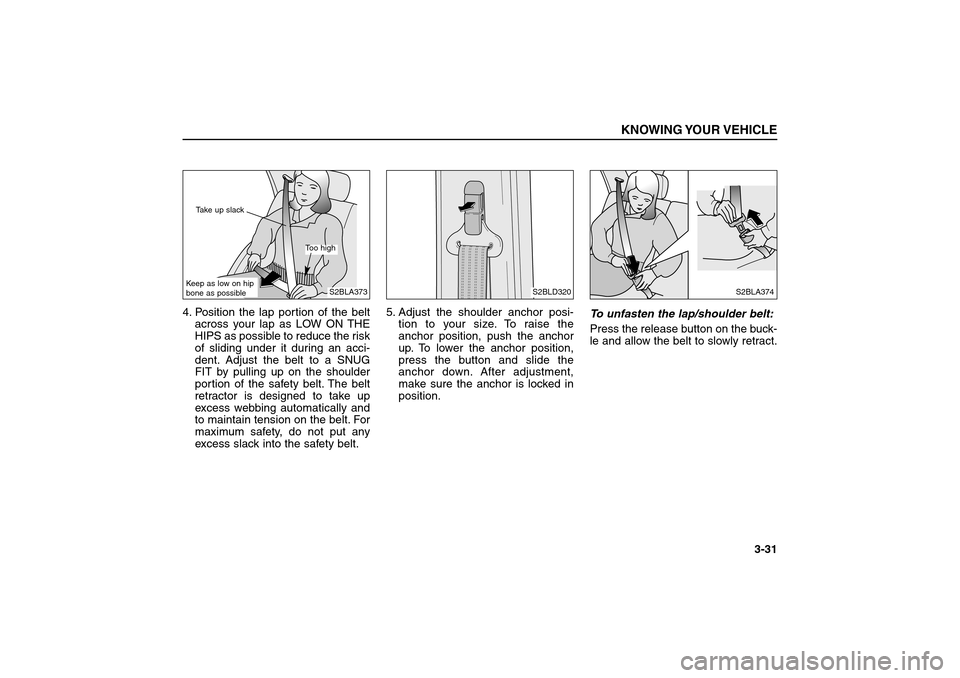
4. Position the lap portion of the belt
across your lap as LOW ON THE
HIPS as possible to reduce the risk
of sliding under it during an acci-
dent. Adjust the belt to a SNUG
FIT by pulling up on the shoulder
portion of the safety belt. The belt
retractor is designed to take up
excess webbing automatically and
to maintain tension on the belt. For
maximum safety, do not put any
excess slack into the safety belt.5. Adjust the shoulder anchor posi-
tion to your size. To raise the
anchor position, push the anchor
up. To lower the anchor position,
press the button and slide the
anchor down. After adjustment,
make sure the anchor is locked in
position.To unfasten the lap/shoulder belt:
Press the release button on the buck-
le and allow the belt to slowly retract.
KNOWING YOUR VEHICLE
3-31
S2BLA373
S2BLD320 Take up slack
Keep as low on hip
bone as possible
Too high
S2BLA374
BL-ENG (CAN)-3.qxd 7/28/05 5:52 PM Page 31
Page 42 of 312
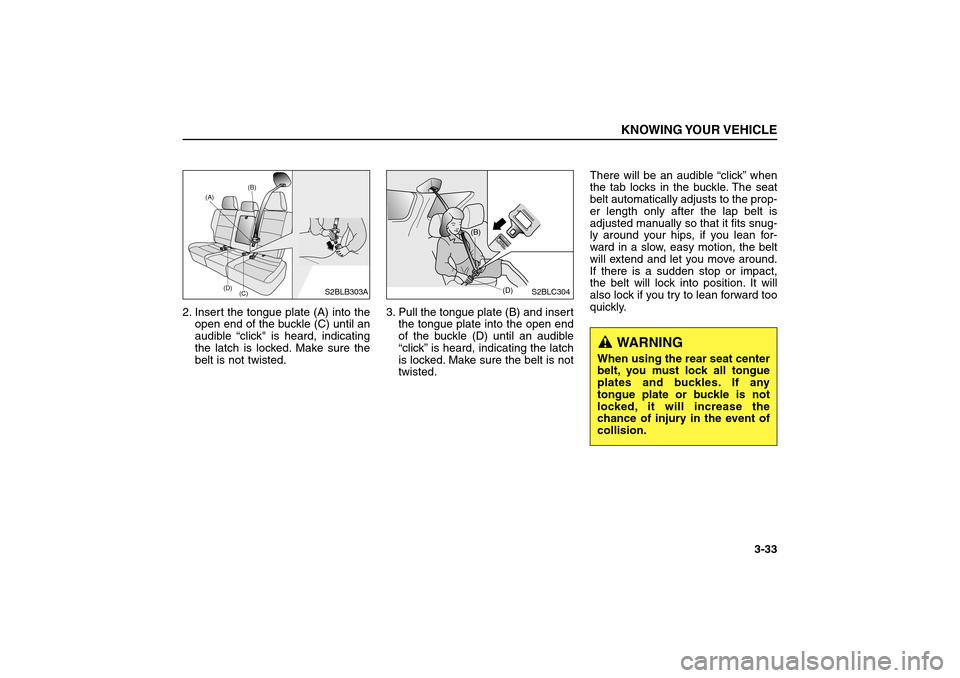
2. Insert the tongue plate (A) into the
open end of the buckle (C) until an
audible “click" is heard, indicating
the latch is locked. Make sure the
belt is not twisted.3. Pull the tongue plate (B) and insert
the tongue plate into the open end
of the buckle (D) until an audible
“click”is heard, indicating the latch
is locked. Make sure the belt is not
twisted.There will be an audible “click”when
the tab locks in the buckle. The seat
belt automatically adjusts to the prop-
er length only after the lap belt is
adjusted manually so that it fits snug-
ly around your hips, if you lean for-
ward in a slow, easy motion, the belt
will extend and let you move around.
If there is a sudden stop or impact,
the belt will lock into position. It will
also lock if you try to lean forward too
quickly.
KNOWING YOUR VEHICLE
3-33
(D) (A)
(C)(B)
S2BLB303A
(D) (B)PRESS
S2BLC304
WARNING
When using the rear seat center
belt, you must lock all tongue
plates and buckles. If any
tongue plate or buckle is not
locked, it will increase the
chance of injury in the event of
collision.
BL-ENG (CAN)-3.qxd 7/28/05 5:52 PM Page 33
Page 46 of 312
Restraint of Large Children
As children grow, they may need to
use new child restraints, including
larger child seats or booster seats,
which are appropriate for their
increased size.
A child who has outgrown available
child restraint systems should use
the belts provided in the vehicle.
When seated, the child should be
restrained by the lap/shoulder belt.
If the shoulder belt slightly touches
the child’s neck or face, try placing
the child closer to the center of the
vehicle. If the shoulder belt still
touches their face or neck, they may
need to be returned to a child
restraint system. In addition, after-
market devices are available from
independent manufacturers which
help pull the shoulder belt lower and
away from the child’s face or neck.Placement of a Child Restraint
System
We recommend that, whenever pos-
sible, you put the child restraint in the
center position of the rear seat.
If the center rear seat is not available,
or you are using more than one child
restraint system in the vehicle at the
same time, the rear safety belts have
been designed to allow a child
restraint to be used in these posi-
tions. Since those safety belts nor-
mally lock only under extreme or
emergency conditions (emergency
lock mode) you must manually adjust
those belts to the auto lock mode.
KNOWING YOUR VEHICLE
3-37
WARNING
When a child restraint is not in
use, make sure that it is
secured by a safety belt. In a
sudden stop or accident, a
loose child restraint could be
thrown forward and injure
someone.
✽ ✽
NOTICEThe driver’s safety belt incorpo-
rates the emergency lock mode
only.
WARNING- Restraint Instructions
Failure to observe this manuals
instructions regarding child
restraint systems and the
instructions provided with the
child restraint system could
increase the chance and/or
severity of injury in an accident.
BL-ENG (CAN)-3.qxd 7/28/05 5:52 PM Page 37
Page 47 of 312
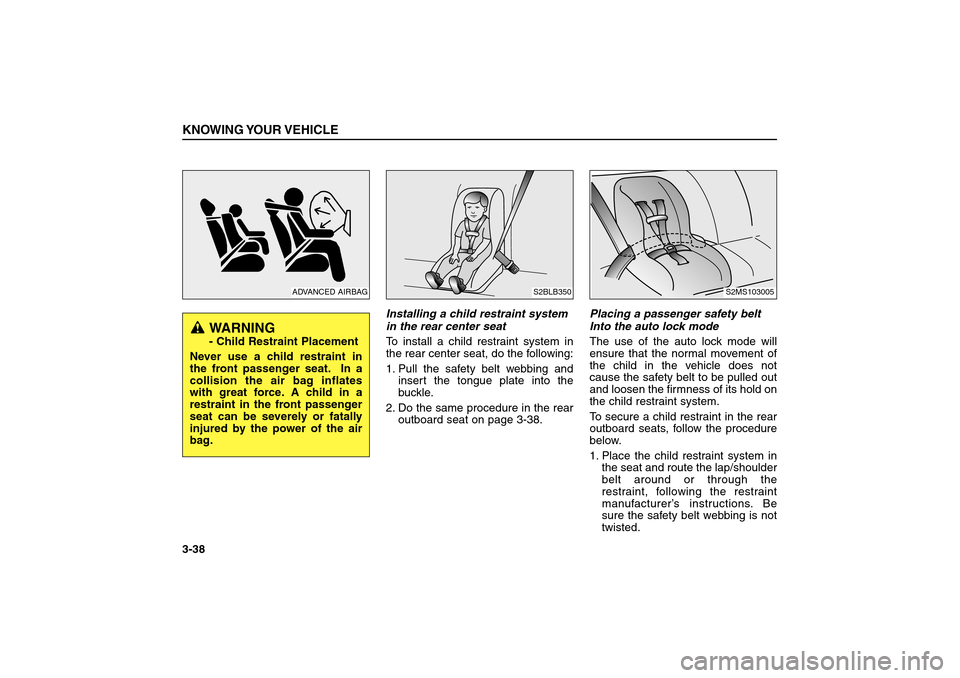
Installing a child restraint system
in the rear center seat
To install a child restraint system in
the rear center seat, do the following:
1. Pull the safety belt webbing and
insert the tongue plate into the
buckle.
2. Do the same procedure in the rear
outboard seat on page 3-38.Placing a passenger safety belt
Into the auto lock mode
The use of the auto lock mode will
ensure that the normal movement of
the child in the vehicle does not
cause the safety belt to be pulled out
and loosen the firmness of its hold on
the child restraint system.
To secure a child restraint in the rear
outboard seats, follow the procedure
below.
1. Place the child restraint system in
the seat and route the lap/shoulder
belt around or through the
restraint, following the restraint
manufacturer’s instructions. Be
sure the safety belt webbing is not
twisted.
KNOWING YOUR VEHICLE3-38
ADVANCED AIRBAG
WARNING- Child Restraint Placement
Never use a child restraint in
the front passenger seat. In a
collision the air bag inflates
with great force. A child in a
restraint in the front passenger
seat can be severely or fatally
injured by the power of the air
bag.
S2BLB350
S2MS103005
BL-ENG (CAN)-3.qxd 7/28/05 5:52 PM Page 38
Page 48 of 312
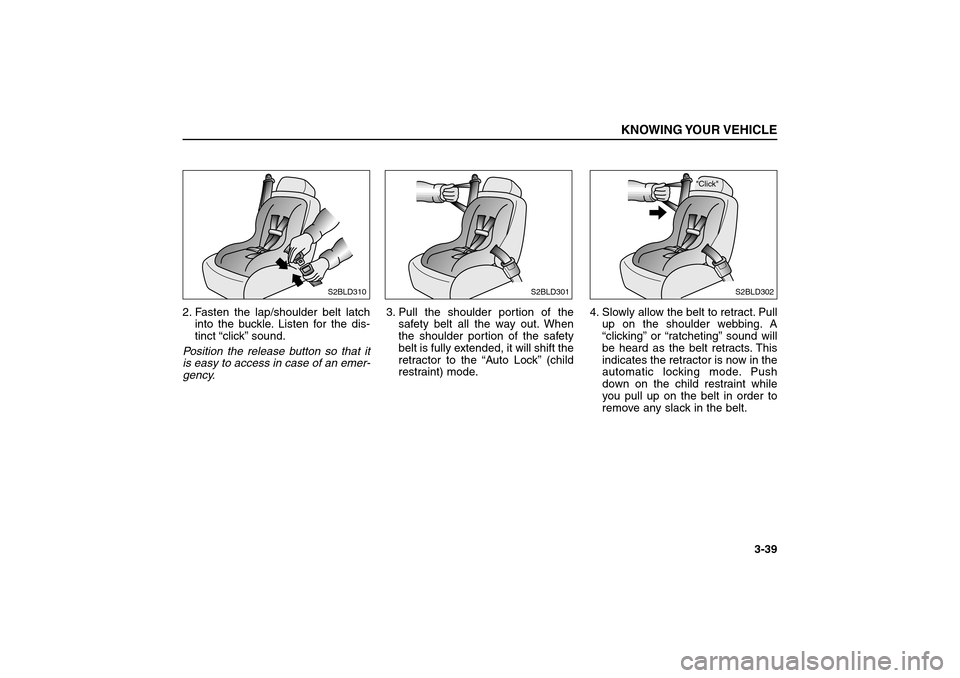
2. Fasten the lap/shoulder belt latch
into the buckle. Listen for the dis-
tinct “click”sound.
Position the release button so that it
is easy to access in case of an emer-
gency.3. Pull the shoulder portion of the
safety belt all the way out. When
the shoulder portion of the safety
belt is fully extended, it will shift the
retractor to the “Auto Lock”(child
restraint) mode.4. Slowly allow the belt to retract. Pull
up on the shoulder webbing. A
“clicking”or “ratcheting”sound will
be heard as the belt retracts. This
indicates the retractor is now in the
automatic locking mode. Push
down on the child restraint while
you pull up on the belt in order to
remove any slack in the belt.
KNOWING YOUR VEHICLE
3-39
S2BLD301
S2BLD310
"Click"
S2BLD302
BL-ENG (CAN)-3.qxd 7/28/05 5:52 PM Page 39
Page 49 of 312
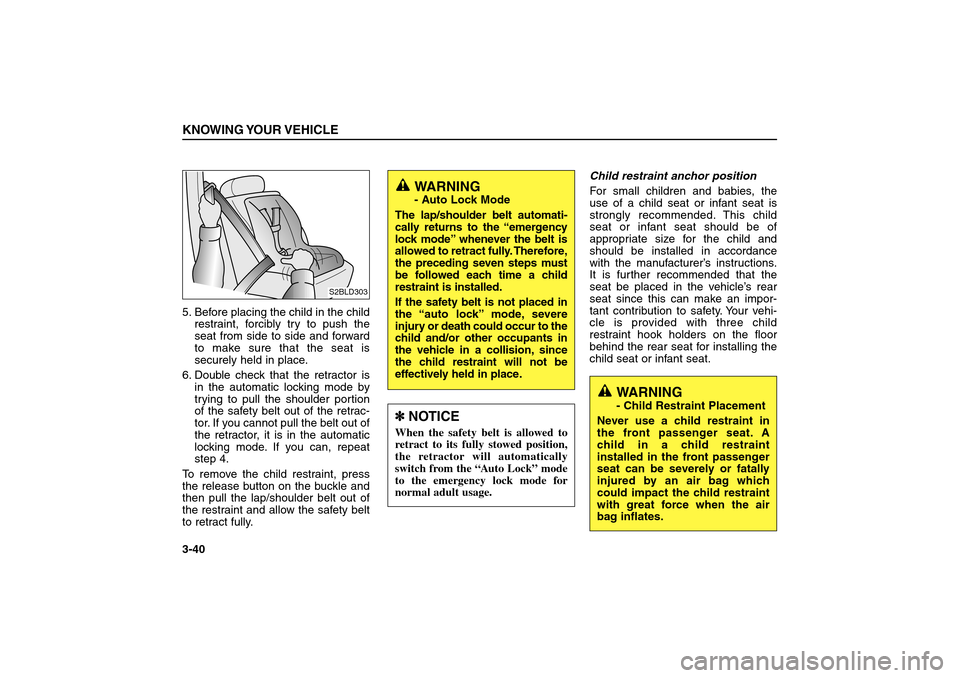
5. Before placing the child in the child
restraint, forcibly try to push the
seat from side to side and forward
to make sure that the seat is
securely held in place.
6. Double check that the retractor is
in the automatic locking mode by
trying to pull the shoulder portion
of the safety belt out of the retrac-
tor. If you cannot pull the belt out of
the retractor, it is in the automatic
locking mode. If you can, repeat
step 4.
To remove the child restraint, press
the release button on the buckle and
then pull the lap/shoulder belt out of
the restraint and allow the safety belt
to retract fully.Child restraint anchor position
For small children and babies, the
use of a child seat or infant seat is
strongly recommended. This child
seat or infant seat should be of
appropriate size for the child and
should be installed in accordance
with the manufacturer’s instructions.
It is further recommended that the
seat be placed in the vehicle’s rear
seat since this can make an impor-
tant contribution to safety. Your vehi-
cle is provided with three child
restraint hook holders on the floor
behind the rear seat for installing the
child seat or infant seat.KNOWING YOUR VEHICLE3-40
WARNING- Auto Lock Mode
The lap/shoulder belt automati-
cally returns to the “emergency
lock mode” whenever the belt is
allowed to retract fully. Therefore,
the preceding seven steps must
be followed each time a child
restraint is installed.
If the safety belt is not placed in
the “auto lock” mode, severe
injury or death could occur to the
child and/or other occupants in
the vehicle in a collision, since
the child restraint will not be
effectively held in place.
✽ ✽
NOTICEWhen the safety belt is allowed to
retract to its fully stowed position,
the retractor will automatically
switch from the “Auto Lock” mode
to the emergency lock mode for
normal adult usage.
WARNING- Child Restraint Placement
Never use a child restraint in
the front passenger seat. A
child in a child restraint
installed in the front passenger
seat can be severely or fatally
injured by an air bag which
could impact the child restraint
with great force when the air
bag inflates.
S2BLD303
BL-ENG (CAN)-3.qxd 7/28/05 5:52 PM Page 40
Page 65 of 312
If the curtain airbag deploys, it
remains inflated for approximately
3 seconds. The curtain airbag
deployment occurs only on the side
of the vehicle affected by the
impact.
The curtain airbags are not
designed to deploy during colli-
sions from the front or rear of the
vehicle or in most rollover situa-
tions.
The curtain airbags are designed to
deploy only during certain side-
impact collisions, depending on the
crash severity, angle, speed and
impact. The curtain airbags are not
designed to deploy in all side
impact situations.KNOWING YOUR VEHICLE3-56
WARNING
In order for the curtain airbags
to provide its best protection,
both front seat occupants and
both outboard rear occupants
should sit in an upright posi-
tion with the safety belts prop-
erly fastened. Especially, chil-
dren should sit in a proper
child restraint system.
When children are seated in
the rear outboard seats, they
must be seated in the proper
child restraint system. Make
sure to put the child restraint
system as far away from the
door side as possible, and
secure the child restraint sys-
tem to be locked in position.
(Continued)
(Continued)
Do not allow the passengers
to lean their heads or bodies
onto doors, put their arms on
the doors, stretch their arms
out of the window, or place
objects between the doors and
passengers when they are
seated on the seats where cur-
tain airbags are equipped.
Never try to open or repair any
components of the curtain
airbag system. This should be
done only by an authorized
Kia dealer.
Failure to follow the above men-
tioned instructions can result in
injury or death to the vehicle
occupants in an accident.
BL-ENG (CAN)-3.qxd 7/28/05 5:52 PM Page 56
Page 73 of 312
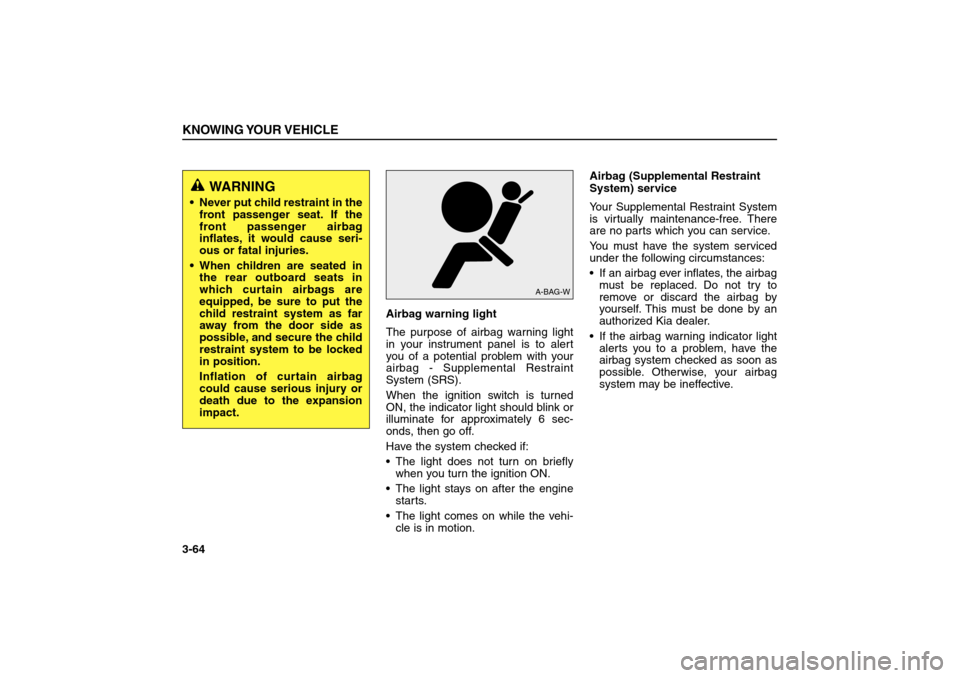
Airbag warning light
The purpose of airbag warning light
in your instrument panel is to alert
you of a potential problem with your
airbag - Supplemental Restraint
System (SRS).
When the ignition switch is turned
ON, the indicator light should blink or
illuminate for approximately 6 sec-
onds, then go off.
Have the system checked if:
The light does not turn on briefly
when you turn the ignition ON.
The light stays on after the engine
starts.
The light comes on while the vehi-
cle is in motion.Airbag (Supplemental Restraint
System) service
Your Supplemental Restraint System
is virtually maintenance-free. There
are no parts which you can service.
You must have the system serviced
under the following circumstances:
If an airbag ever inflates, the airbag
must be replaced. Do not try to
remove or discard the airbag by
yourself. This must be done by an
authorized Kia dealer.
If the airbag warning indicator light
alerts you to a problem, have the
airbag system checked as soon as
possible. Otherwise, your airbag
system may be ineffective.
KNOWING YOUR VEHICLE3-64
A-BAG-W
WARNING
Never put child restraint in the
front passenger seat. If the
front passenger airbag
inflates, it would cause seri-
ous or fatal injuries.
When children are seated in
the rear outboard seats in
which curtain airbags are
equipped, be sure to put the
child restraint system as far
away from the door side as
possible, and secure the child
restraint system to be locked
in position.
Inflation of curtain airbag
could cause serious injury or
death due to the expansion
impact.
BL-ENG (CAN)-3.qxd 7/28/05 5:52 PM Page 64
Page 76 of 312
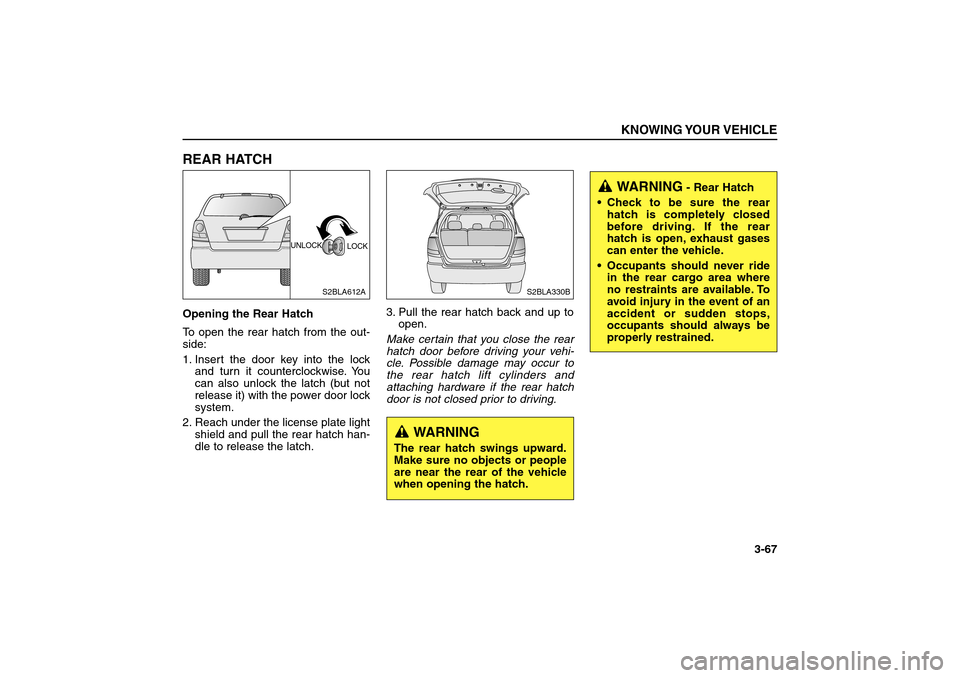
REAR HATCHOpening the Rear Hatch
To open the rear hatch from the out-
side:
1. Insert the door key into the lock
and turn it counterclockwise. You
can also unlock the latch (but not
release it) with the power door lock
system.
2. Reach under the license plate light
shield and pull the rear hatch han-
dle to release the latch.3. Pull the rear hatch back and up to
open.
Make certain that you close the rear
hatch door before driving your vehi-
cle. Possible damage may occur to
the rear hatch lift cylinders and
attaching hardware if the rear hatch
door is not closed prior to driving.
KNOWING YOUR VEHICLE
3-67
S2BLA612A
S2BLA330B
LOCK UNLOCK
WARNING
The rear hatch swings upward.
Make sure no objects or people
are near the rear of the vehicle
when opening the hatch.
WARNING
- Rear Hatch
Check to be sure the rear
hatch is completely closed
before driving. If the rear
hatch is open, exhaust gases
can enter the vehicle.
Occupants should never ride
in the rear cargo area where
no restraints are available. To
avoid injury in the event of an
accident or sudden stops,
occupants should always be
properly restrained.
BL-ENG (CAN)-3.qxd 7/28/05 5:52 PM Page 67