ECU KIA Sorento 2006 1.G Owner's Manual
[x] Cancel search | Manufacturer: KIA, Model Year: 2006, Model line: Sorento, Model: KIA Sorento 2006 1.GPages: 312, PDF Size: 5.21 MB
Page 26 of 312
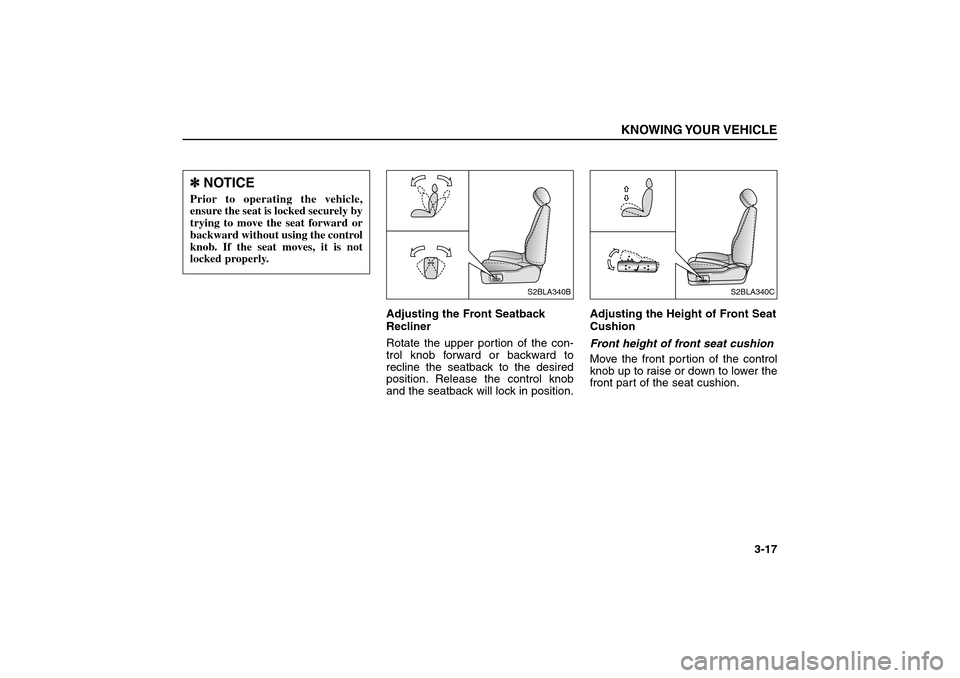
Adjusting the Front Seatback
Recliner
Rotate the upper portion of the con-
trol knob forward or backward to
recline the seatback to the desired
position. Release the control knob
and the seatback will lock in position.Adjusting the Height of Front Seat
Cushion
Front height of front seat cushion
Move the front portion of the control
knob up to raise or down to lower the
front part of the seat cushion.
KNOWING YOUR VEHICLE
3-17
S2BLA340C
S2BLA340B
✽ ✽
NOTICEPrior to operating the vehicle,
ensure the seat is locked securely by
trying to move the seat forward or
backward without using the control
knob. If the seat moves, it is not
locked properly.
BL-ENG (CAN)-3.qxd 7/28/05 5:52 PM Page 17
Page 30 of 312
REAR SEAT
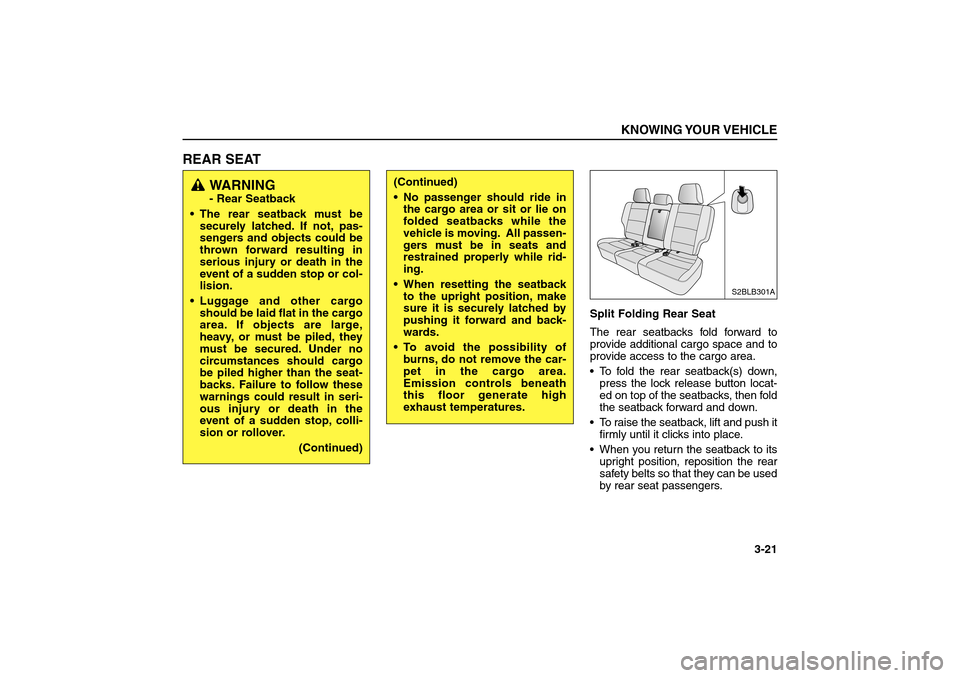
Split Folding Rear Seat
The rear seatbacks fold forward to
provide additional cargo space and to
provide access to the cargo area.
To fold the rear seatback(s) down,
press the lock release button locat-
ed on top of the seatbacks, then fold
the seatback forward and down.
To raise the seatback, lift and push it
firmly until it clicks into place.
When you return the seatback to its
upright position, reposition the rear
safety belts so that they can be used
by rear seat passengers.
KNOWING YOUR VEHICLE
3-21
S2BLB301A
WARNING- Rear Seatback
The rear seatback must be
securely latched. If not, pas-
sengers and objects could be
thrown forward resulting in
serious injury or death in the
event of a sudden stop or col-
lision.
Luggage and other cargo
should be laid flat in the cargo
area. If objects are large,
heavy, or must be piled, they
must be secured. Under no
circumstances should cargo
be piled higher than the seat-
backs. Failure to follow these
warnings could result in seri-
ous injury or death in the
event of a sudden stop, colli-
sion or rollover.
(Continued)
(Continued)
No passenger should ride in
the cargo area or sit or lie on
folded seatbacks while the
vehicle is moving. All passen-
gers must be in seats and
restrained properly while rid-
ing.
When resetting the seatback
to the upright position, make
sure it is securely latched by
pushing it forward and back-
wards.
To avoid the possibility of
burns, do not remove the car-
pet in the cargo area.
Emission controls beneath
this floor generate high
exhaust temperatures.
BL-ENG (CAN)-3.qxd 7/28/05 5:52 PM Page 21
Page 33 of 312
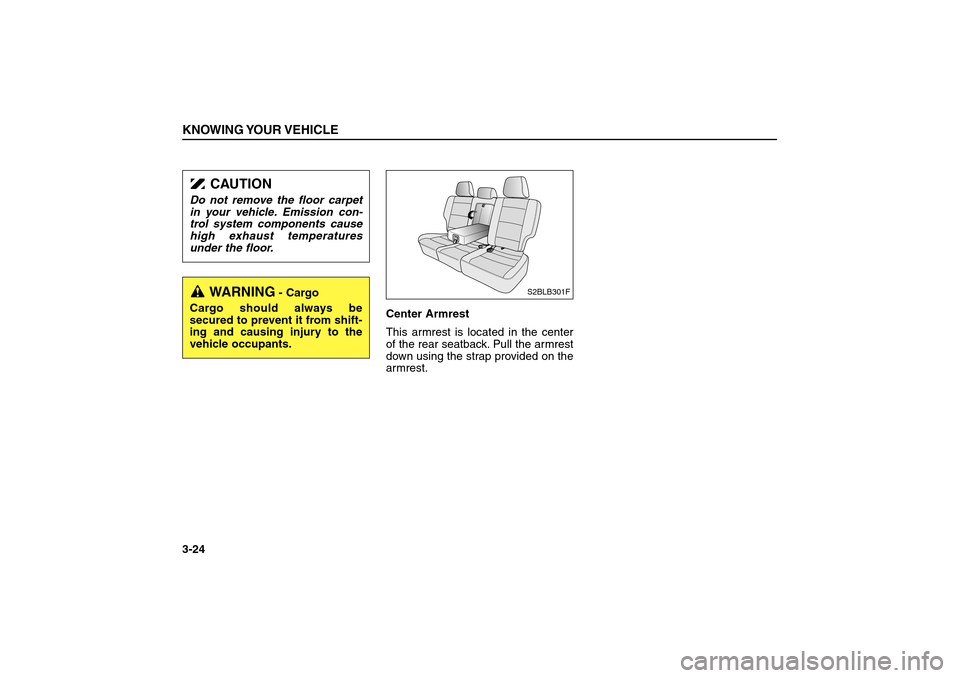
Center Armrest
This armrest is located in the center
of the rear seatback. Pull the armrest
down using the strap provided on the
armrest.
KNOWING YOUR VEHICLE3-24
S2BLB301F
CAUTION
Do not remove the floor carpet
in your vehicle. Emission con-
trol system components cause
high exhaust temperatures
under the floor.
WARNING
- Cargo
Cargo should always be
secured to prevent it from shift-
ing and causing injury to the
vehicle occupants.
BL-ENG (CAN)-3.qxd 7/28/05 5:52 PM Page 24
Page 36 of 312
We strongly recommend that the
driver and all passengers be properly
restrained at all times by using the
safety belts provided with the vehicle.
Proper use of the safety belts
decreases the risk of severe injury or
death in accidents or sudden stops.
In most states, and in Canada, the
law requires their use.
Inertial locks in the safety belt retrac-
tors allow all of the lap/shoulder safe-
ty belts to remain unlocked during
normal vehicle operation.
This allows the occupants some free-
dom of movement and increased
comfort while using the safety belts. If
a force is applied to the vehicle, such
as a strong stop, a sharp turn, or a
collision, the safety belt retractors will
automatically lock the safety belts.Since the inertial locks do not require
a collision to lock up, you may
become aware of the safety belts
locking while braking or going around
sharp corners.
Whenever possible, use the center
rear seat position to install your child
restraint. The center rear seat is the
safest position for a child to sit in. If
the center seat is unavailable, a child
restraint system may be installed in
an outboard rear seat position. Never
install a rear-facing infant seat in the
front passenger position, as an inflat-
ing airbag could cause serious or
fatal injury to a child in that position.The rear safety belts use a special
auto-lock feature designed to allow a
child restraint to be used in these
positions without an added locking
clip. They normally lock only under
extreme or emergency conditions
(emergency lock mode). However
they can be adjusted so that they
remain in fixed and locked when a
child restraint system is placed in
these positions. (Use this auto-lock
mode only to secure a child restraint,
never for passengers restrained by
the safety belts.) Page 3-38 gives
instructions on placing the safety belt
in the auto lock mode.
The drivers safety belt can only oper-
ate in the emergency lock mode.
KNOWING YOUR VEHICLE
3-27
BL-ENG (CAN)-3.qxd 7/28/05 5:52 PM Page 27
Page 46 of 312
Restraint of Large Children
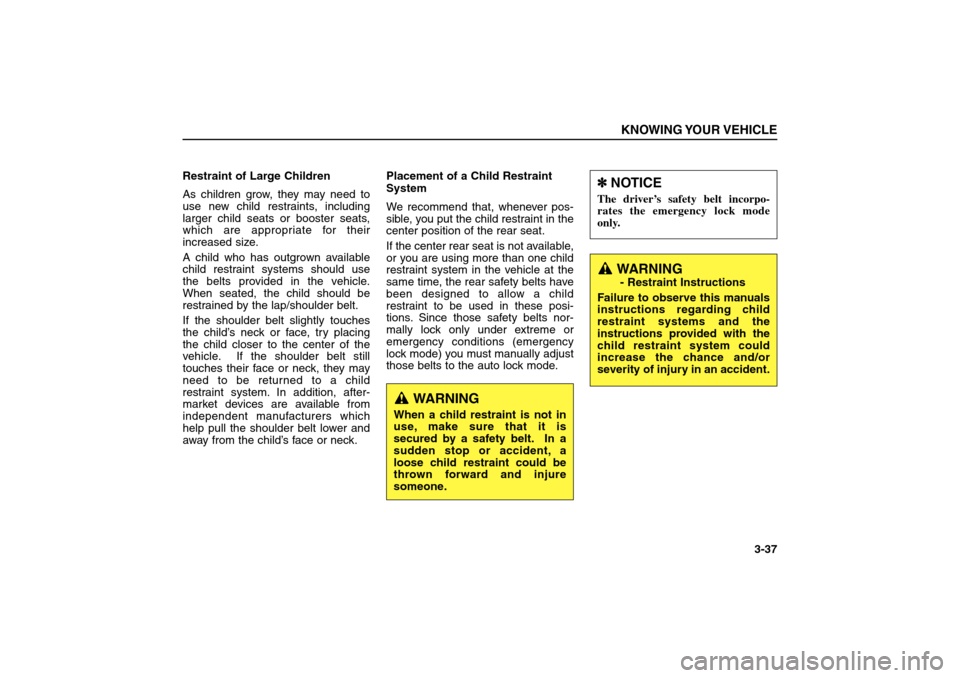
As children grow, they may need to
use new child restraints, including
larger child seats or booster seats,
which are appropriate for their
increased size.
A child who has outgrown available
child restraint systems should use
the belts provided in the vehicle.
When seated, the child should be
restrained by the lap/shoulder belt.
If the shoulder belt slightly touches
the child’s neck or face, try placing
the child closer to the center of the
vehicle. If the shoulder belt still
touches their face or neck, they may
need to be returned to a child
restraint system. In addition, after-
market devices are available from
independent manufacturers which
help pull the shoulder belt lower and
away from the child’s face or neck.Placement of a Child Restraint
System
We recommend that, whenever pos-
sible, you put the child restraint in the
center position of the rear seat.
If the center rear seat is not available,
or you are using more than one child
restraint system in the vehicle at the
same time, the rear safety belts have
been designed to allow a child
restraint to be used in these posi-
tions. Since those safety belts nor-
mally lock only under extreme or
emergency conditions (emergency
lock mode) you must manually adjust
those belts to the auto lock mode.
KNOWING YOUR VEHICLE
3-37
WARNING
When a child restraint is not in
use, make sure that it is
secured by a safety belt. In a
sudden stop or accident, a
loose child restraint could be
thrown forward and injure
someone.
✽ ✽
NOTICEThe driver’s safety belt incorpo-
rates the emergency lock mode
only.
WARNING- Restraint Instructions
Failure to observe this manuals
instructions regarding child
restraint systems and the
instructions provided with the
child restraint system could
increase the chance and/or
severity of injury in an accident.
BL-ENG (CAN)-3.qxd 7/28/05 5:52 PM Page 37
Page 47 of 312
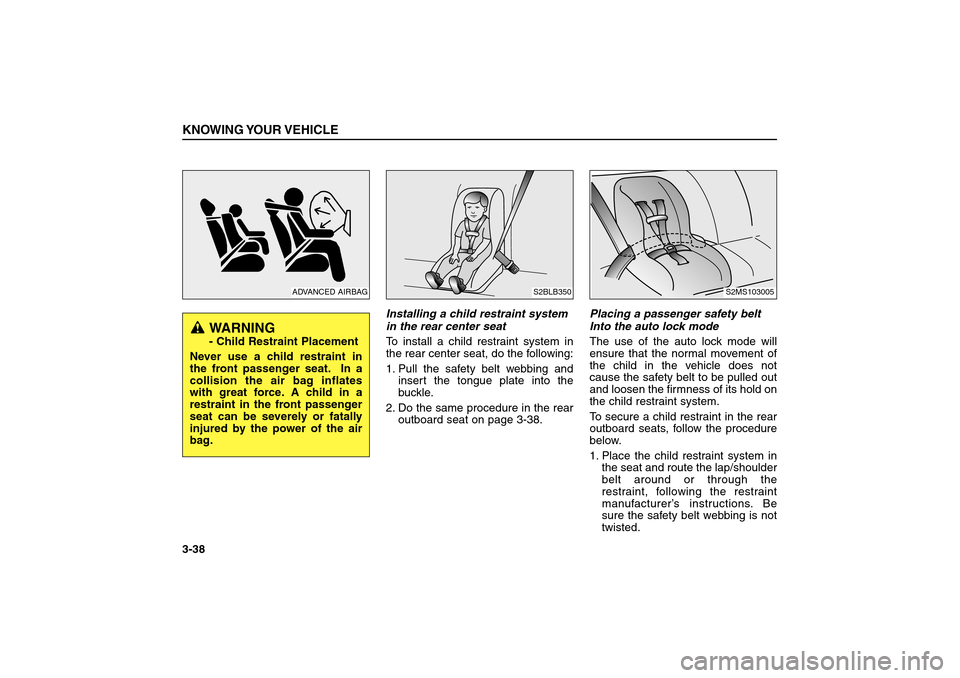
Installing a child restraint system
in the rear center seat
To install a child restraint system in
the rear center seat, do the following:
1. Pull the safety belt webbing and
insert the tongue plate into the
buckle.
2. Do the same procedure in the rear
outboard seat on page 3-38.Placing a passenger safety belt
Into the auto lock mode
The use of the auto lock mode will
ensure that the normal movement of
the child in the vehicle does not
cause the safety belt to be pulled out
and loosen the firmness of its hold on
the child restraint system.
To secure a child restraint in the rear
outboard seats, follow the procedure
below.
1. Place the child restraint system in
the seat and route the lap/shoulder
belt around or through the
restraint, following the restraint
manufacturer’s instructions. Be
sure the safety belt webbing is not
twisted.
KNOWING YOUR VEHICLE3-38
ADVANCED AIRBAG
WARNING- Child Restraint Placement
Never use a child restraint in
the front passenger seat. In a
collision the air bag inflates
with great force. A child in a
restraint in the front passenger
seat can be severely or fatally
injured by the power of the air
bag.
S2BLB350
S2MS103005
BL-ENG (CAN)-3.qxd 7/28/05 5:52 PM Page 38
Page 49 of 312
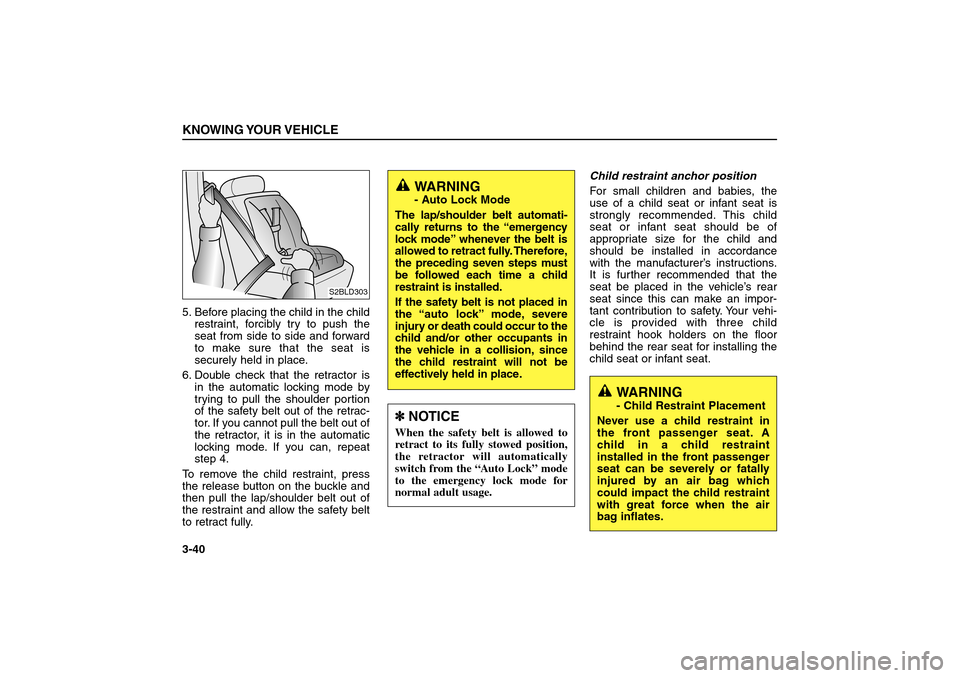
5. Before placing the child in the child
restraint, forcibly try to push the
seat from side to side and forward
to make sure that the seat is
securely held in place.
6. Double check that the retractor is
in the automatic locking mode by
trying to pull the shoulder portion
of the safety belt out of the retrac-
tor. If you cannot pull the belt out of
the retractor, it is in the automatic
locking mode. If you can, repeat
step 4.
To remove the child restraint, press
the release button on the buckle and
then pull the lap/shoulder belt out of
the restraint and allow the safety belt
to retract fully.Child restraint anchor position
For small children and babies, the
use of a child seat or infant seat is
strongly recommended. This child
seat or infant seat should be of
appropriate size for the child and
should be installed in accordance
with the manufacturer’s instructions.
It is further recommended that the
seat be placed in the vehicle’s rear
seat since this can make an impor-
tant contribution to safety. Your vehi-
cle is provided with three child
restraint hook holders on the floor
behind the rear seat for installing the
child seat or infant seat.KNOWING YOUR VEHICLE3-40
WARNING- Auto Lock Mode
The lap/shoulder belt automati-
cally returns to the “emergency
lock mode” whenever the belt is
allowed to retract fully. Therefore,
the preceding seven steps must
be followed each time a child
restraint is installed.
If the safety belt is not placed in
the “auto lock” mode, severe
injury or death could occur to the
child and/or other occupants in
the vehicle in a collision, since
the child restraint will not be
effectively held in place.
✽ ✽
NOTICEWhen the safety belt is allowed to
retract to its fully stowed position,
the retractor will automatically
switch from the “Auto Lock” mode
to the emergency lock mode for
normal adult usage.
WARNING- Child Restraint Placement
Never use a child restraint in
the front passenger seat. A
child in a child restraint
installed in the front passenger
seat can be severely or fatally
injured by an air bag which
could impact the child restraint
with great force when the air
bag inflates.
S2BLD303
BL-ENG (CAN)-3.qxd 7/28/05 5:52 PM Page 40
Page 50 of 312
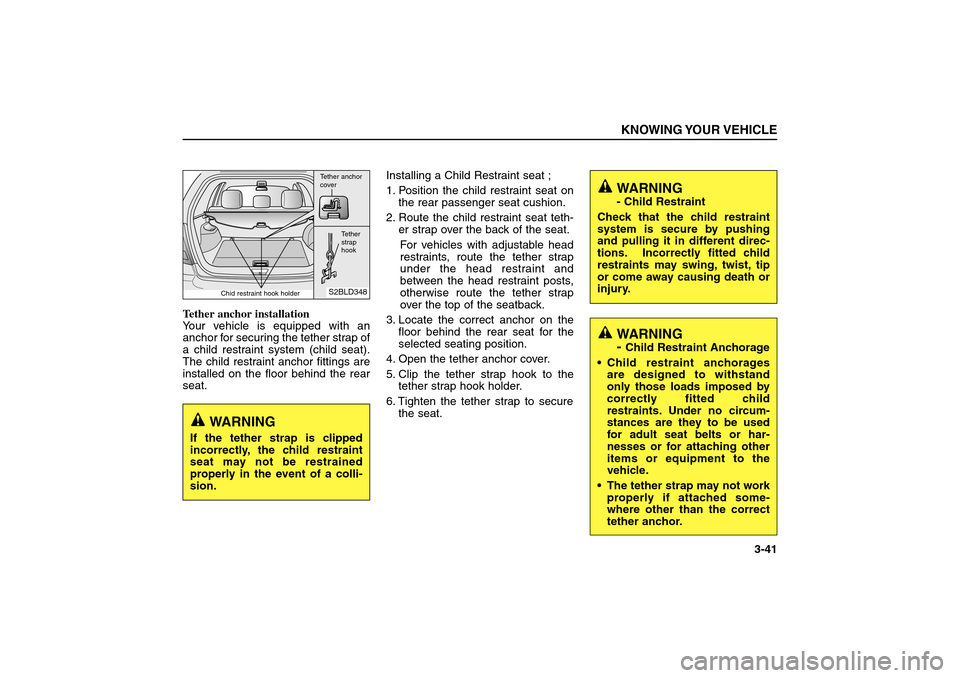
Tether anchor installation
Your vehicle is equipped with an
anchor for securing the tether strap of
a child restraint system (child seat).
The child restraint anchor fittings are
installed on the floor behind the rear
seat.Installing a Child Restraint seat ;
1. Position the child restraint seat on
the rear passenger seat cushion.
2. Route the child restraint seat teth-
er strap over the back of the seat.
For vehicles with adjustable head
restraints, route the tether strap
under the head restraint and
between the head restraint posts,
otherwise route the tether strap
over the top of the seatback.
3. Locate the correct anchor on the
floor behind the rear seat for the
selected seating position.
4. Open the tether anchor cover.
5. Clip the tether strap hook to the
tether strap hook holder.
6. Tighten the tether strap to secure
the seat.
KNOWING YOUR VEHICLE
3-41
S2BLD348
WARNING - Child Restraint
Check that the child restraint
system is secure by pushing
and pulling it in different direc-
tions. Incorrectly fitted child
restraints may swing, twist, tip
or come away causing death or
injury.
WARNING
If the tether strap is clipped
incorrectly, the child restraint
seat may not be restrained
properly in the event of a colli-
sion.
WARNING
- Child Restraint Anchorage
Child restraint anchorages
are designed to withstand
only those loads imposed by
correctly fitted child
restraints. Under no circum-
stances are they to be used
for adult seat belts or har-
nesses or for attaching other
items or equipment to the
vehicle.
The tether strap may not work
properly if attached some-
where other than the correct
tether anchor.
Tether anchor
cover
Tether
strap
hook
Chid restraint hook holder
BL-ENG (CAN)-3.qxd 7/28/05 5:52 PM Page 41
Page 51 of 312
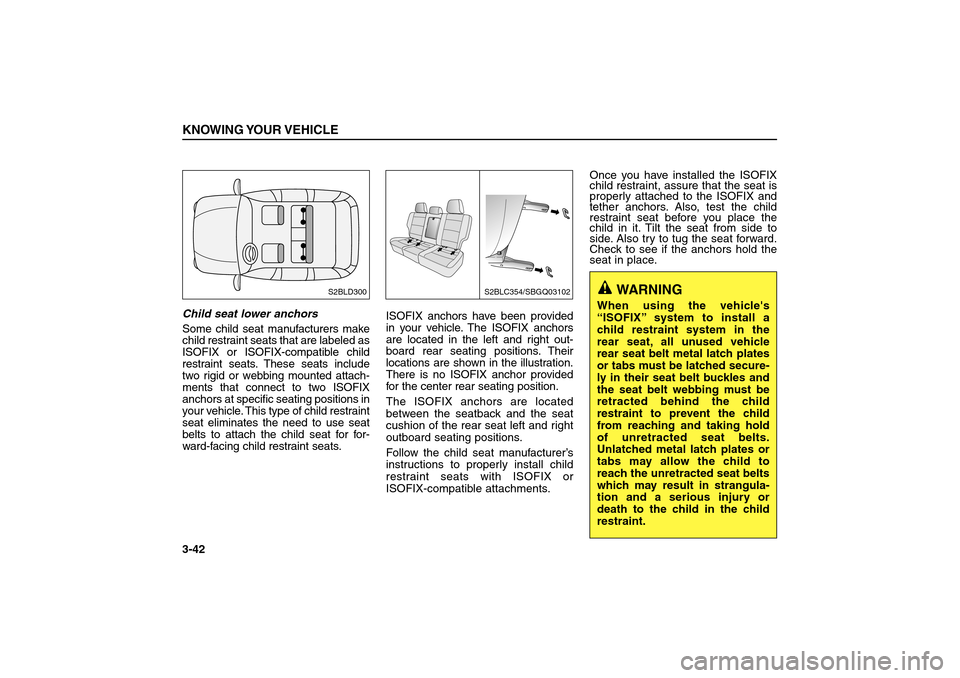
Child seat lower anchors
Some child seat manufacturers make
child restraint seats that are labeled as
ISOFIX or ISOFIX-compatible child
restraint seats. These seats include
two rigid or webbing mounted attach-
ments that connect to two ISOFIX
anchors at specific seating positions in
your vehicle. This type of child restraint
seat eliminates the need to use seat
belts to attach the child seat for for-
ward-facing child restraint seats.ISOFIX anchors have been provided
in your vehicle. The ISOFIX anchors
are located in the left and right out-
board rear seating positions. Their
locations are shown in the illustration.
There is no ISOFIX anchor provided
for the center rear seating position.
The ISOFIX anchors are located
between the seatback and the seat
cushion of the rear seat left and right
outboard seating positions.
Follow the child seat manufacturer’s
instructions to properly install child
restraint seats with ISOFIX or
ISOFIX-compatible attachments.Once you have installed the ISOFIX
child restraint, assure that the seat is
properly attached to the ISOFIX and
tether anchors. Also, test the child
restraint seat before you place the
child in it. Tilt the seat from side to
side. Also try to tug the seat forward.
Check to see if the anchors hold the
seat in place.KNOWING YOUR VEHICLE3-42
S2BLC354/SBGQ03102
S2BLD300
WARNING
When using the vehicle's
“ISOFIX” system to install a
child restraint system in the
rear seat, all unused vehicle
rear seat belt metal latch plates
or tabs must be latched secure-
ly in their seat belt buckles and
the seat belt webbing must be
retracted behind the child
restraint to prevent the child
from reaching and taking hold
of unretracted seat belts.
Unlatched metal latch plates or
tabs may allow the child to
reach the unretracted seat belts
which may result in strangula-
tion and a serious injury or
death to the child in the child
restraint.
BL-ENG (CAN)-3.qxd 7/28/05 5:52 PM Page 42
Page 52 of 312
KNOWING YOUR VEHICLE
3-43
WARNING
If the child restraint is not
anchored properly, the risk of a
child being seriously injured or
killed in a collision greatly
increases.
(Continued)
Do not install a child restraint
seat at the rear center seating
position using the vehicle’s
ISOFIX anchors. The ISOFIX
anchors are only provided for
the left and right outboard rear
seating positions. Do not mis-
use the ISOFIX anchors by
attempting to attach a child
restraint seat in the middle
rear seating position position
to the ISOFIX anchors. In a
crash, the child restraint seat
ISOFIX attachments may not
be strong enough to secure
the child restraint seat proper-
ly in the rear center seating
position and may break, caus-
ing serious injury or death.
(Continued)
(Continued)
Attach the ISOFIX or ISOFIX-
compatible child restraint seat
only to the appropriate loca-
tions shown in the illustration.
Always follow the installation
and use instructions provided
by the manufacturer of the
child restraint.
WARNING
Do not mount more than one
child restraint to a single teth-
er or to a child restraint lower
anchorage point. The improp-
er increased load may cause
the anchorage points or tether
anchor to break, causing seri-
ous injury or death.
(Continued)
BL-ENG (CAN)-3.qxd 7/28/05 5:52 PM Page 43