steering wheel KIA Sorento 2006 1.G Owner's Manual
[x] Cancel search | Manufacturer: KIA, Model Year: 2006, Model line: Sorento, Model: KIA Sorento 2006 1.GPages: 312, PDF Size: 5.21 MB
Page 8 of 312
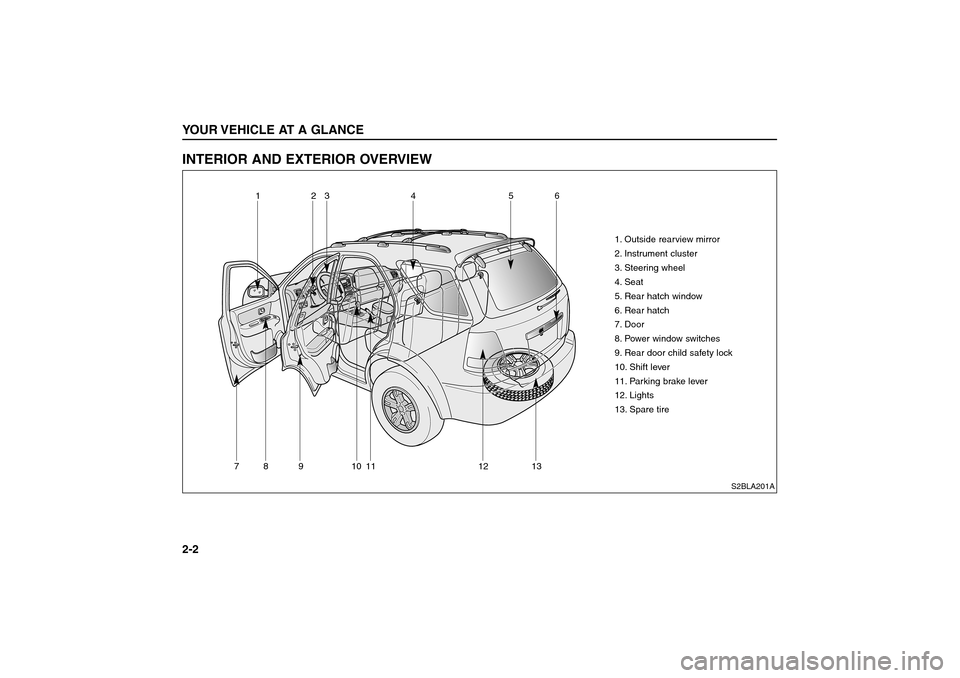
INTERIOR AND EXTERIOR OVERVIEWYOUR VEHICLE AT A GLANCE2-2
S2BLA201A
1. Outside rearview mirror
2. Instrument cluster
3. Steering wheel
4. Seat
5. Rear hatch window
6. Rear hatch
7. Door
8. Power window switches
9. Rear door child safety lock
10. Shift lever
11. Parking brake lever
12. Lights
13. Spare tire
1
2
3
4
5
6
7
8
9
10
11
12
13
BL-ENG (CAN)-2.qxd 7/28/05 6:14 PM Page 2-2
Page 9 of 312
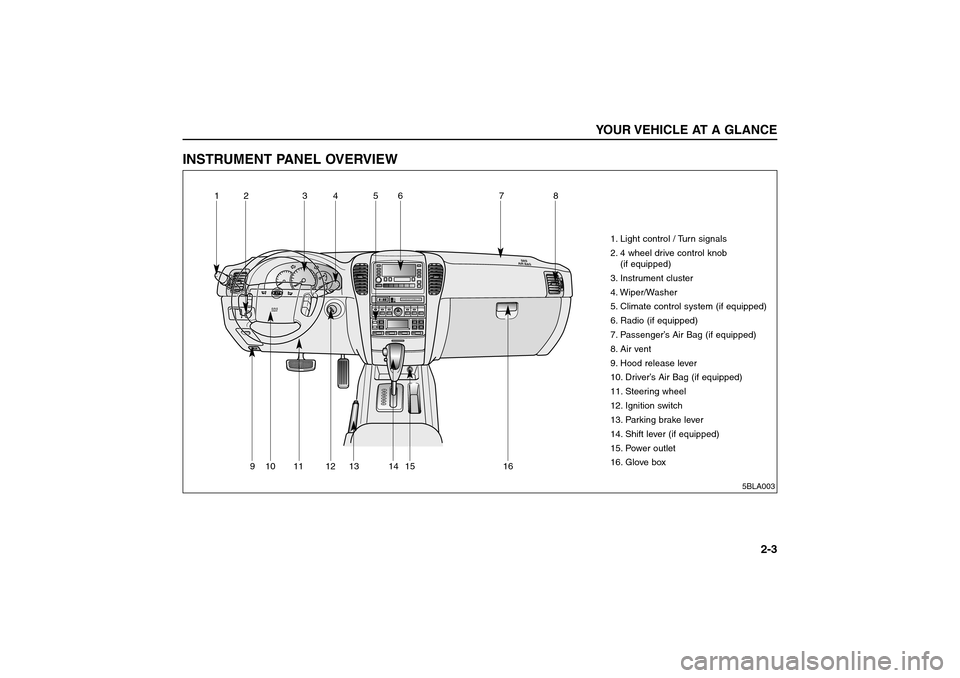
INSTRUMENT PANEL OVERVIEW
YOUR VEHICLE AT A GLANCE
2-3
S
R
S
A
I
R
B
A
G
P
R
N
D2LH
MPASSENGER AIRBAG OFF
5BLA003
1. Light control / Turn signals
2. 4 wheel drive control knob
(if equipped)
3. Instrument cluster
4. Wiper/Washer
5. Climate control system (if equipped)
6. Radio (if equipped)
7. Passenger’s Air Bag (if equipped)
8. Air vent
9. Hood release lever
10. Driver’s Air Bag (if equipped)
11. Steering wheel
12. Ignition switch
13. Parking brake lever
14. Shift lever (if equipped)
15. Power outlet
16. Glove box
1
2
3
4
5
6
7
8
9
10
11
12
13
14
15
16
BL-ENG (CAN)-2.qxd 7/28/05 6:14 PM Page 2-3
Page 10 of 312
3-1
KNOWING YOUR VEHICLEKeys. . . . . . . . . . . . . . . . . . . . . . . . . . . . . . . . . . . . . . . . . . . . . 3-2
Immobilizer System . . . . . . . . . . . . . . . . . . . . . . . . . . . . . . . . 3-3
Door Locks . . . . . . . . . . . . . . . . . . . . . . . . . . . . . . . . . . . . . . . 3-5
Windows . . . . . . . . . . . . . . . . . . . . . . . . . . . . . . . . . . . . . . . . 3-10
Front Seat . . . . . . . . . . . . . . . . . . . . . . . . . . . . . . . . . . . . . . . 3-13
Rear Seat . . . . . . . . . . . . . . . . . . . . . . . . . . . . . . . . . . . . . . . . 3-21
Safety Belts . . . . . . . . . . . . . . . . . . . . . . . . . . . . . . . . . . . . . . 3-25
Air Bag - Supplemental Restraint System . . . . . . . . . . . . . . 3-44
Rear Hatch. . . . . . . . . . . . . . . . . . . . . . . . . . . . . . . . . . . . . . . 3-67
Hood . . . . . . . . . . . . . . . . . . . . . . . . . . . . . . . . . . . . . . . . . . . 3-69
Fuel Filler Lid . . . . . . . . . . . . . . . . . . . . . . . . . . . . . . . . . . . . 3-70
Auto Fuel Cutoff Switch . . . . . . . . . . . . . . . . . . . . . . . . . . . . 3-72
Steering Wheel . . . . . . . . . . . . . . . . . . . . . . . . . . . . . . . . . . . 3-73
Mirrors . . . . . . . . . . . . . . . . . . . . . . . . . . . . . . . . . . . . . . . . . . 3-74
Interior Lights . . . . . . . . . . . . . . . . . . . . . . . . . . . . . . . . . . . . 3-76
Cup Holder . . . . . . . . . . . . . . . . . . . . . . . . . . . . . . . . . . . . . . 3-78
Sunglass Holder . . . . . . . . . . . . . . . . . . . . . . . . . . . . . . . . . . 3-79
Storage Compartment. . . . . . . . . . . . . . . . . . . . . . . . . . . . . . 3-80
Electrical Power Outlet . . . . . . . . . . . . . . . . . . . . . . . . . . . . . 3-82
Sunroof . . . . . . . . . . . . . . . . . . . . . . . . . . . . . . . . . . . . . . . . . 3-83
Antenna . . . . . . . . . . . . . . . . . . . . . . . . . . . . . . . . . . . . . . . . . 3-86
Luggage Net . . . . . . . . . . . . . . . . . . . . . . . . . . . . . . . . . . . . . 3-86
Tonneau cover . . . . . . . . . . . . . . . . . . . . . . . . . . . . . . . . . . . 3-87
Luggage center box . . . . . . . . . . . . . . . . . . . . . . . . . . . . . . . 3-88
Roof Rack . . . . . . . . . . . . . . . . . . . . . . . . . . . . . . . . . . . . . . . 3-89
3
BL-ENG (CAN)-3.qxd 7/28/05 5:52 PM Page 1
Page 22 of 312
FRONT SEAT
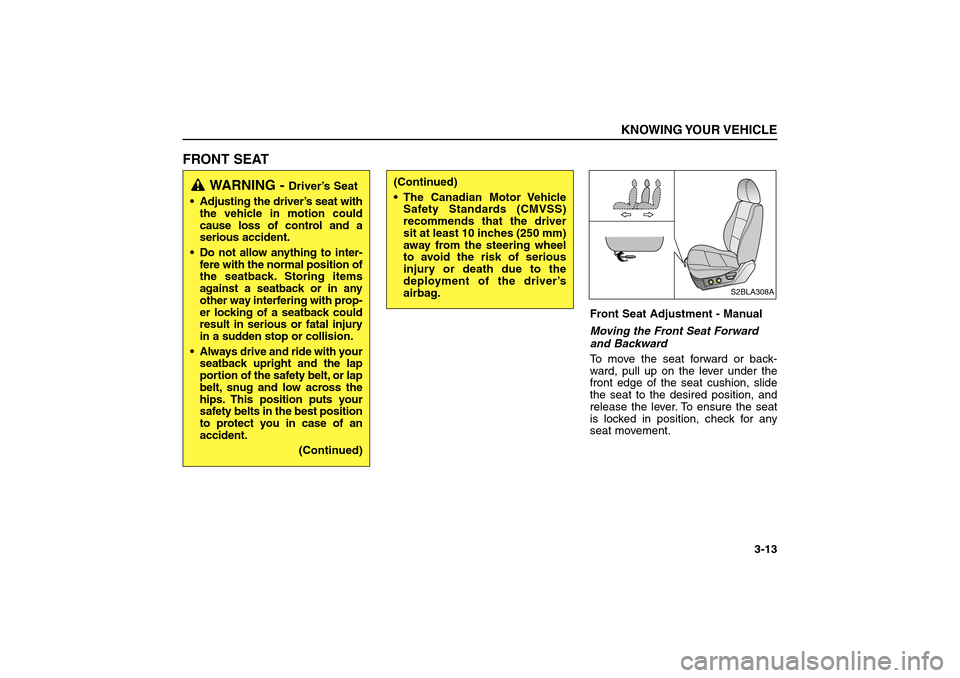
Front Seat Adjustment - Manual
Moving the Front Seat Forward
and Backward
To move the seat forward or back-
ward, pull up on the lever under the
front edge of the seat cushion, slide
the seat to the desired position, and
release the lever. To ensure the seat
is locked in position, check for any
seat movement.
KNOWING YOUR VEHICLE
3-13
S2BLA308A
WARNING -
Driver’s Seat
Adjusting the driver’s seat with
the vehicle in motion could
cause loss of control and a
serious accident.
Do not allow anything to inter-
fere with the normal position of
the seatback. Storing items
against a seatback or in any
other way interfering with prop-
er locking of a seatback could
result in serious or fatal injury
in a sudden stop or collision.
Always drive and ride with your
seatback upright and the lap
portion of the safety belt, or lap
belt, snug and low across the
hips. This position puts your
safety belts in the best position
to protect you in case of an
accident.
(Continued)
(Continued)
The Canadian Motor Vehicle
Safety Standards (CMVSS)
recommends that the driver
sit at least 10 inches (250 mm)
away from the steering wheel
to avoid the risk of serious
injury or death due to the
deployment of the driver’s
airbag.
BL-ENG (CAN)-3.qxd 7/28/05 5:52 PM Page 13
Page 25 of 312
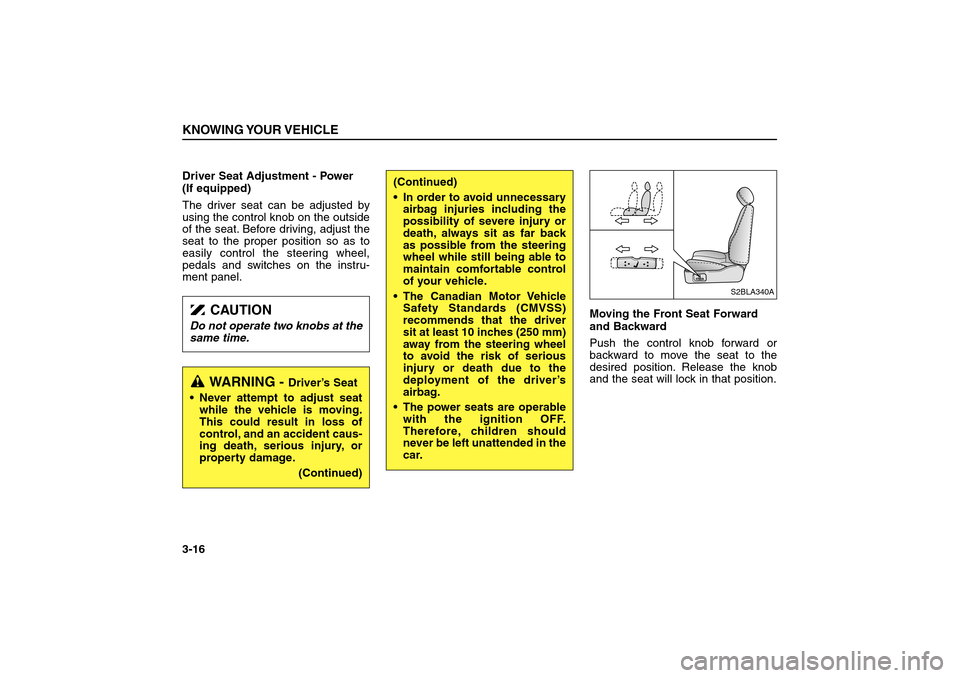
Driver Seat Adjustment - Power
(If equipped)
The driver seat can be adjusted by
using the control knob on the outside
of the seat. Before driving, adjust the
seat to the proper position so as to
easily control the steering wheel,
pedals and switches on the instru-
ment panel.
Moving the Front Seat Forward
and Backward
Push the control knob forward or
backward to move the seat to the
desired position. Release the knob
and the seat will lock in that position.KNOWING YOUR VEHICLE3-16
S2BLA340A
CAUTION
Do not operate two knobs at the
same time.
WARNING -
Driver’s Seat
Never attempt to adjust seat
while the vehicle is moving.
This could result in loss of
control, and an accident caus-
ing death, serious injury, or
property damage.
(Continued)
(Continued)
In order to avoid unnecessary
airbag injuries including the
possibility of severe injury or
death, always sit as far back
as possible from the steering
wheel while still being able to
maintain comfortable control
of your vehicle.
The Canadian Motor Vehicle
Safety Standards (CMVSS)
recommends that the driver
sit at least 10 inches (250 mm)
away from the steering wheel
to avoid the risk of serious
injury or death due to the
deployment of the driver’s
airbag.
The power seats are operable
with the ignition OFF.
Therefore, children should
never be left unattended in the
car.
BL-ENG (CAN)-3.qxd 7/28/05 5:52 PM Page 16
Page 57 of 312
The advanced SRS offers the ability
to control the airbag inflation with two
levels. A first stage level is provided
for moderate-severity impacts. A sec-
ond stage level is provided for more
severe impacts.
According to the impact severity and
safety belt usage, the SRSCM (SRS
Control Module) controls the airbag
inflation. Failure to properly wear
safety belts can increase the risk or
severity of injury in an accident.
Additionally, your SRS is equipped
with an occupant classification sys-
tem in the front passenger’s seat. The
occupant classification system
detects the presence of a passenger
in the front passenger’s seat and will
turn off the front passenger’s airbag
under certain conditions. For more
detail, see “Occupant Classification
System”later in this section.
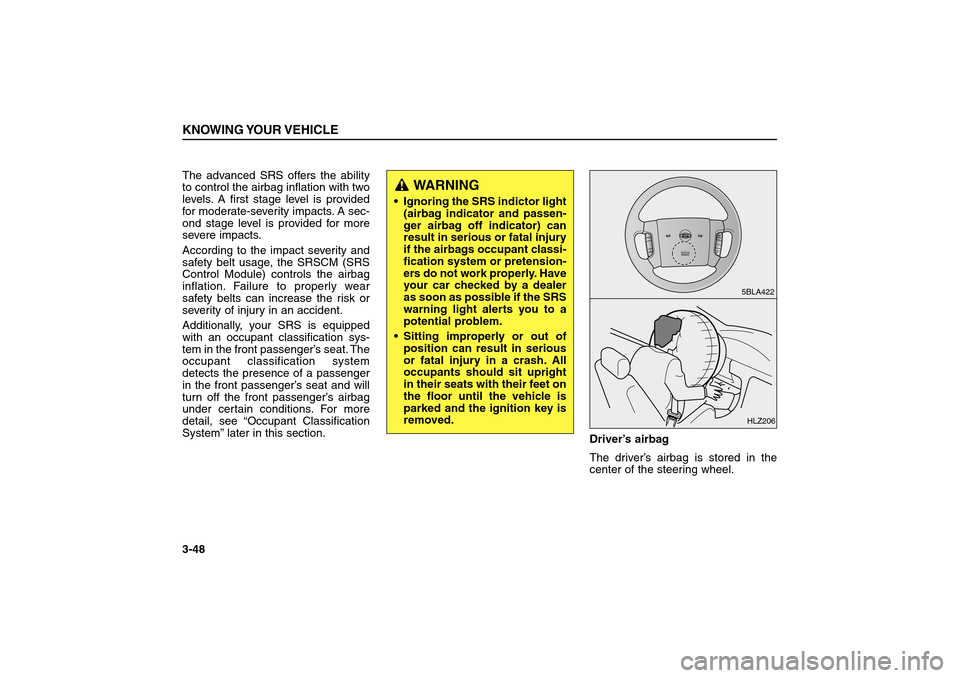
Driver’s airbag
The driver’s airbag is stored in the
center of the steering wheel.KNOWING YOUR VEHICLE3-48
WARNING
Ignoring the SRS indictor light
(airbag indicator and passen-
ger airbag off indicator) can
result in serious or fatal injury
if the airbags occupant classi-
fication system or pretension-
ers do not work properly. Have
your car checked by a dealer
as soon as possible if the SRS
warning light alerts you to a
potential problem.
Sitting improperly or out of
position can result in serious
or fatal injury in a crash. All
occupants should sit upright
in their seats with their feet on
the floor until the vehicle is
parked and the ignition key is
removed.
SRSAIRBAG
R
E
S
A
C
C
E
LCOAST
SET
P
W
RSEEK
C
A
N
C
E
L
5BLA422HLZ206
BL-ENG (CAN)-3.qxd 7/28/05 5:52 PM Page 48
Page 58 of 312
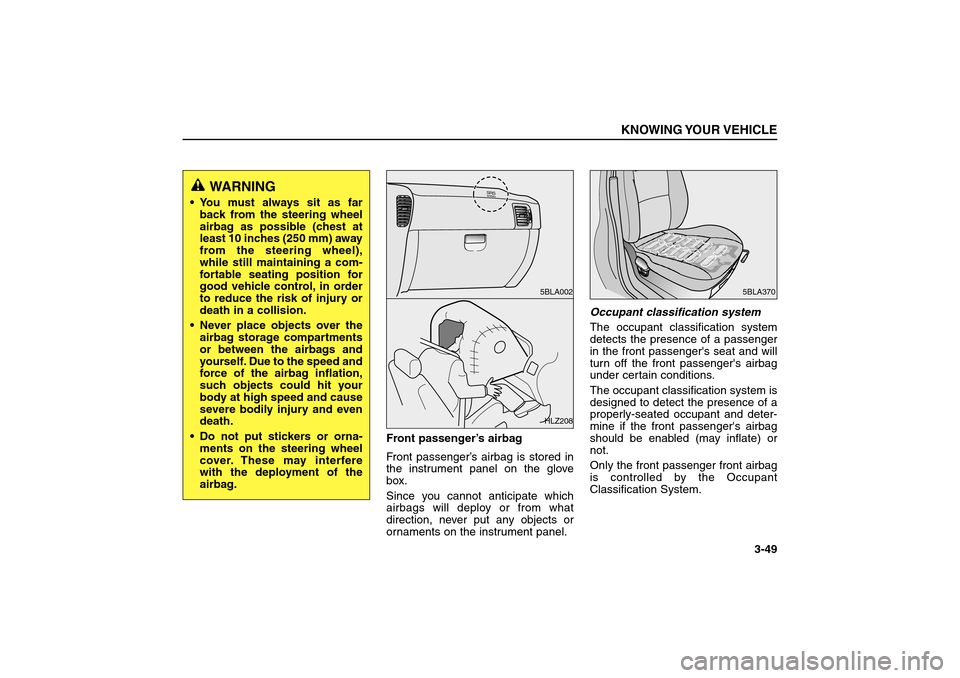
Front passenger’s airbag
Front passenger’s airbag is stored in
the instrument panel on the glove
box.
Since you cannot anticipate which
airbags will deploy or from what
direction, never put any objects or
ornaments on the instrument panel.Occupant classification system
The occupant classification system
detects the presence of a passenger
in the front passenger's seat and will
turn off the front passenger's airbag
under certain conditions.
The occupant classification system is
designed to detect the presence of a
properly-seated occupant and deter-
mine if the front passenger's airbag
should be enabled (may inflate) or
not.
Only the front passenger front airbag
is controlled by the Occupant
Classification System.
KNOWING YOUR VEHICLE
3-49
WARNING
You must always sit as far
back from the steering wheel
airbag as possible (chest at
least 10 inches (250 mm) away
from the steering wheel),
while still maintaining a com-
fortable seating position for
good vehicle control, in order
to reduce the risk of injury or
death in a collision.
Never place objects over the
airbag storage compartments
or between the airbags and
yourself. Due to the speed and
force of the airbag inflation,
such objects could hit your
body at high speed and cause
severe bodily injury and even
death.
Do not put stickers or orna-
ments on the steering wheel
cover. These may interfere
with the deployment of the
airbag.
SRSAIRBAG
5BLA002HLZ208
5BLA370
BL-ENG (CAN)-3.qxd 7/28/05 5:52 PM Page 49
Page 64 of 312
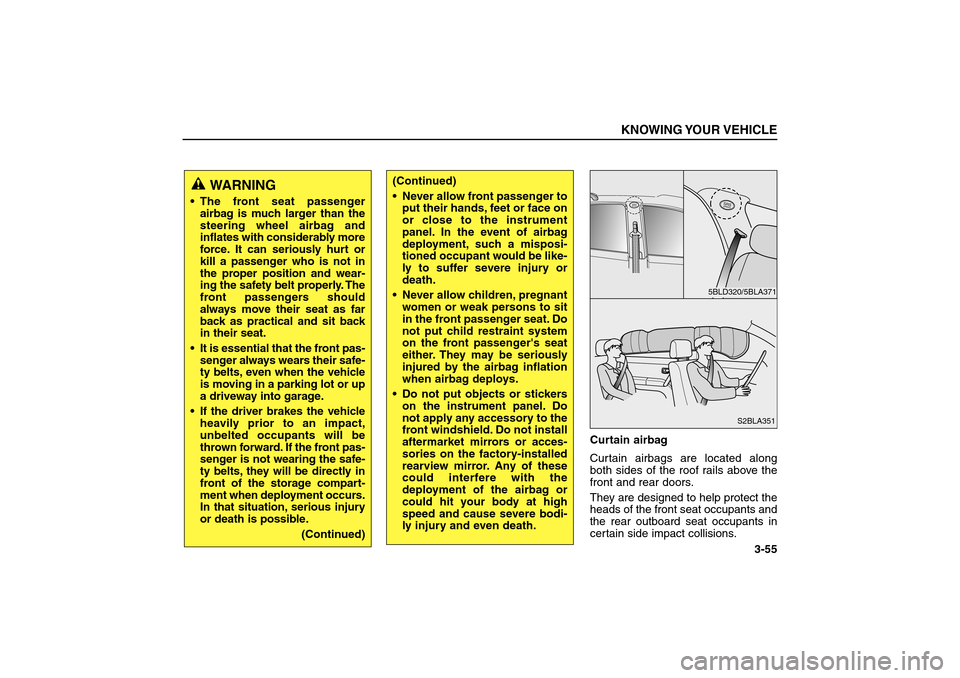
Curtain airbag
Curtain airbags are located along
both sides of the roof rails above the
front and rear doors.
They are designed to help protect the
heads of the front seat occupants and
the rear outboard seat occupants in
certain side impact collisions.
KNOWING YOUR VEHICLE
3-55
S
R
SAIRBAG
5BLD320/5BLA371
S2BLA351
SRSAIRBAG
(Continued)
Never allow front passenger to
put their hands, feet or face on
or close to the instrument
panel. In the event of airbag
deployment, such a misposi-
tioned occupant would be like-
ly to suffer severe injury or
death.
Never allow children, pregnant
women or weak persons to sit
in the front passenger seat. Do
not put child restraint system
on the front passenger's seat
either. They may be seriously
injured by the airbag inflation
when airbag deploys.
Do not put objects or stickers
on the instrument panel. Do
not apply any accessory to the
front windshield. Do not install
aftermarket mirrors or acces-
sories on the factory-installed
rearview mirror. Any of these
could interfere with the
deployment of the airbag or
could hit your body at high
speed and cause severe bodi-
ly injury and even death.
WARNING
The front seat passenger
airbag is much larger than the
steering wheel airbag and
inflates with considerably more
force. It can seriously hurt or
kill a passenger who is not in
the proper position and wear-
ing the safety belt properly. The
front passengers should
always move their seat as far
back as practical and sit back
in their seat.
It is essential that the front pas-
senger always wears their safe-
ty belts, even when the vehicle
is moving in a parking lot or up
a driveway into garage.
If the driver brakes the vehicle
heavily prior to an impact,
unbelted occupants will be
thrown forward. If the front pas-
senger is not wearing the safe-
ty belts, they will be directly in
front of the storage compart-
ment when deployment occurs.
In that situation, serious injury
or death is possible.
(Continued)
BL-ENG (CAN)-3.qxd 7/28/05 5:52 PM Page 55
Page 71 of 312
How does the airbag system
operate
Airbag only operates when the igni-
tion switch is turned to ON or
START position.
Airbags inflate instantly in the event
of serious frontal or side collision in
order to help protect the occupants
from serious physical injury.
There is no single speed at which
the airbags will inflate.
Generally, airbags are designed to
inflate by the severity of a collision
and its direction. These two factors
determine whether the sensors
send out an electronic deploy-
ment/inflation signal.
Airbag deployment depends on a
number of factors including vehicle
speed, angles of impact and the
density and stiffness of the vehicles
or objects which your vehicle hits in
the collision. Though, factors are
not limited to those mentioned
above.The front airbags will completely
inflate and deflate in an instant.
It is virtually impossible for you to
see the airbags inflate during an
accident. It is much more likely that
you will simply see the deflated
airbags hanging out of their storage
compartments after the collision.
In order to help provide protection in
a severe collision, the airbags must
inflate rapidly. The speed of airbag
inflation has been determined by the
Canadian Motor Vehicle Safety
Standards (CMVSS) to reduce the
likelihood of serious or life-threaten-
ing injuries and is thus a mandatory
part of the airbag design.
However, airbag inflation can also
cause injuries which normally can
include facial abrasions, bruises
and broken bones, because that
speed also causes the airbags to
expand with a great deal force.
There are even circumstances
under which contact with the
steering wheel airbag can cause
fatal injuries, especially if the
occupant is positioned exces-
sively close to the steering
wheel.KNOWING YOUR VEHICLE3-62
WARNING
Driver should sit as far back
(at least 10 inches (250 mm)
away) from the steering wheel
airbag as possible to reduce
the risk of injury or death in a
collision. The front passenger
should always move their seat
as far back as possible and sit
back in their seat.
Airbag inflates instantly in an
event of collision, passengers
may be injured by the airbag
expansion force if they are not
in proper position.
Airbag inflation may cause
injuries which normally
include facial or bodily abra-
sions, injuries by the broken
glasses or burns by the explo-
sives.
BL-ENG (CAN)-3.qxd 7/28/05 5:52 PM Page 62
Page 72 of 312
Noise and smoke
When the airbags inflate, they make
a loud noise and they leave smoke
and powder in the air inside of the
vehicle. This is normal and is a result
of the ignition of the airbag inflator.
After the airbag inflates, you may feel
substantial discomfort in breathing
due to the contact of your chest to
both the safety belt and the airbag, as
well as from breathing the smoke and
powder.We strongly urge you to
open your doors and/or windows
as soon as possible after impact in
order to reduce discomfort and
prevent prolonged exposure to the
smoke and powder.
Though smoke and powder are non-
toxic, it may cause irritation to the
skin (eyes, nose and throat etc). If
this is the case, wash and rinse with
the cold water immediately and con-
sult the doctor if the symptom per-
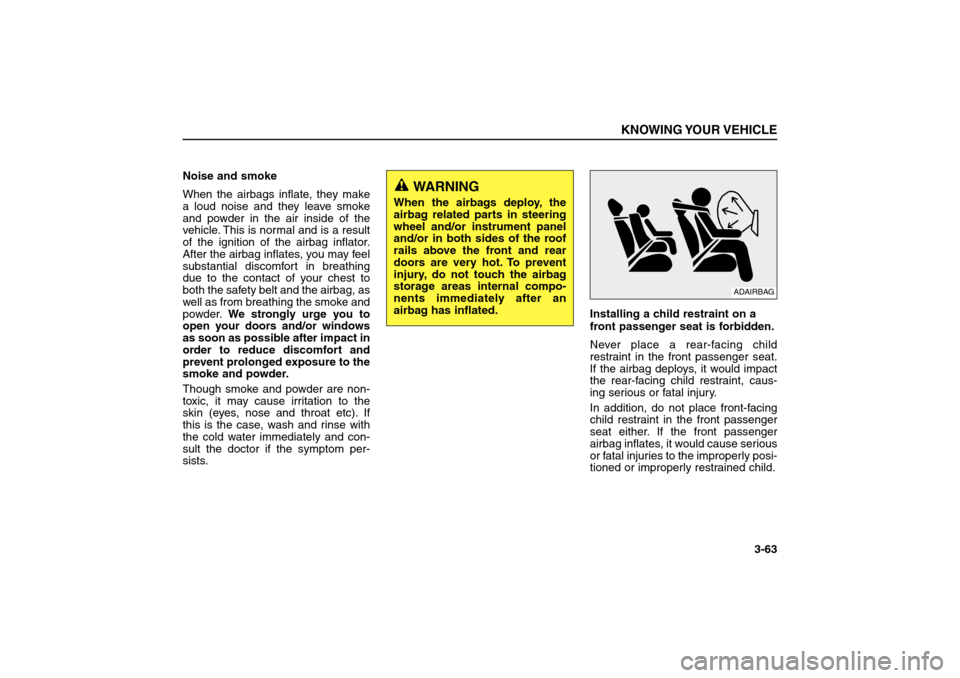
sists.Installing a child restraint on a
front passenger seat is forbidden.
Never place a rear-facing child
restraint in the front passenger seat.
If the airbag deploys, it would impact
the rear-facing child restraint, caus-
ing serious or fatal injury.
In addition, do not place front-facing
child restraint in the front passenger
seat either. If the front passenger
airbag inflates, it would cause serious
or fatal injuries to the improperly posi-
tioned or improperly restrained child.
KNOWING YOUR VEHICLE
3-63
WARNING
When the airbags deploy, the
airbag related parts in steering
wheel and/or instrument panel
and/or in both sides of the roof
rails above the front and rear
doors are very hot. To prevent
injury, do not touch the airbag
storage areas internal compo-
nents immediately after an
airbag has inflated.
ADAIRBAG
BL-ENG (CAN)-3.qxd 7/28/05 5:52 PM Page 63