tow KIA Sorento 2006 1.G Owner's Manual
[x] Cancel search | Manufacturer: KIA, Model Year: 2006, Model line: Sorento, Model: KIA Sorento 2006 1.GPages: 312, PDF Size: 5.21 MB
Page 13 of 312
Limp home (override) procedure
When you turn the ignition key to the
ON position, if the IMMO indicator
remains on continuously after blink-
ing 6 times, the transponder installed
in the ignition key is out of order. You
cannot start the engine without using
the limp home procedure. To start the
engine, you have to input your pass-
word using the ignition switch.The following procedure shows how
to input a sample password of “2345.”
1. Turn the ignition key to the ON
position. The IMMO indicator will
blink 6 times and remain on indi-
cating the beginning of the limp
home procedure.
2. Turn the ignition key to the ACC
position.
3. To enter the first digit (in this exam-
ple “2”), turn the ignition key to the
ON and ACC position twice. Wait 3
seconds but not more than 10 sec-
onds, and perform the same pro-
cedure for the next digits (for
example, for “3”, turn the ignition to
ON and ACC 3 times).
4. If all of the digits have been input
successfully, you have to start the
engine within 10 seconds. If you
attempt to start the engine after 10
seconds, the engine will not start
and you will have to input your
password again.After performing the limp home pro-
cedure, you have to see an author-
ized Kia dealer immediately to
inspect and repair your ignition key or
immobilizer system.KNOWING YOUR VEHICLE3-4
CAUTION
If you cannot start your engine
in spite of the limp home proce-
dure, have your vehicle towed
by an authorized Kia dealer for
inspection and necessary
repairs.
CAUTION
Do not change, alter or adjust
the immobilizer system at your
discretion. It could cause the
malfunction of your immobilizer
system. A malfunction resulting
from the changing, altering
and/or adjusting by persons
other than an authorized Kia
dealer will not be covered by
the Kia Warranty.
BL-ENG (CAN)-3.qxd 7/28/05 5:52 PM Page 4
Page 14 of 312
DOOR LOCKSAutomatic Door Locks
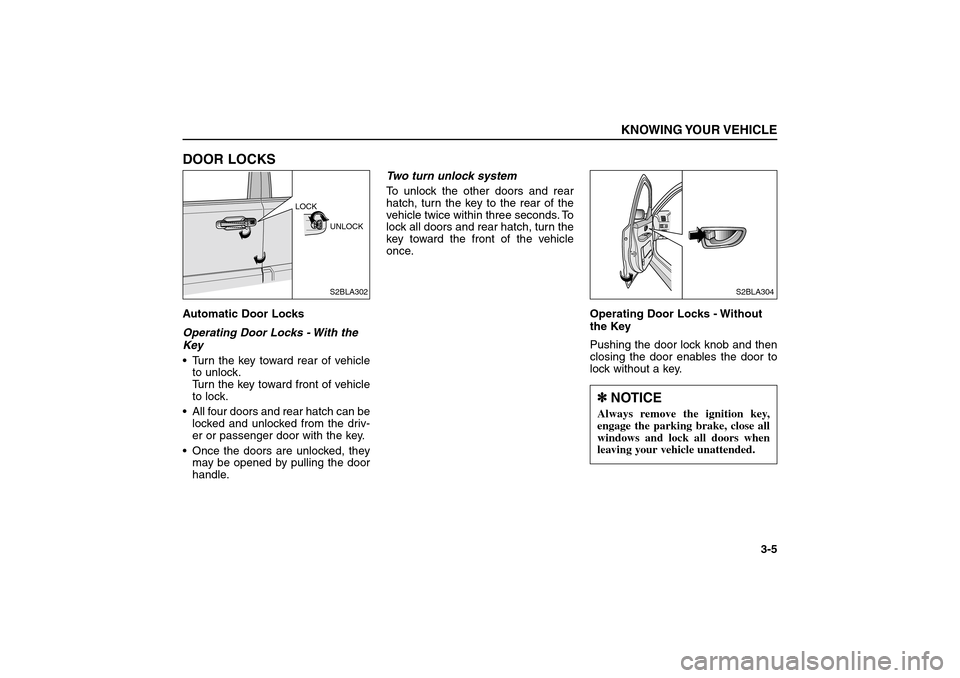
Operating Door Locks - With the
Key
Turn the key toward rear of vehicle
to unlock.
Turn the key toward front of vehicle
to lock.
All four doors and rear hatch can be
locked and unlocked from the driv-
er or passenger door with the key.
Once the doors are unlocked, they
may be opened by pulling the door
handle.Two turn unlock system
To unlock the other doors and rear
hatch, turn the key to the rear of the
vehicle twice within three seconds. To
lock all doors and rear hatch, turn the
key toward the front of the vehicle
once.
Operating Door Locks - Without
the Key
Pushing the door lock knob and then
closing the door enables the door to
lock without a key.
KNOWING YOUR VEHICLE
3-5
S2BLA302 LOCK
UNLOCK
S2BLA304
✽ ✽
NOTICEAlways remove the ignition key,
engage the parking brake, close all
windows and lock all doors when
leaving your vehicle unattended.
BL-ENG (CAN)-3.qxd 7/28/05 5:52 PM Page 5
Page 24 of 312
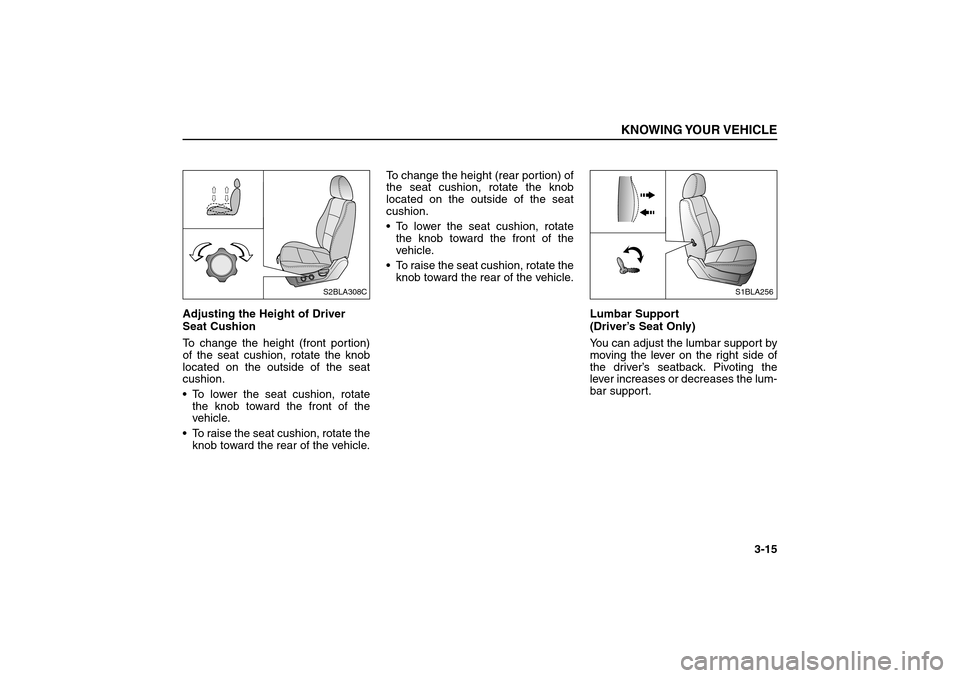
Adjusting the Height of Driver
Seat Cushion
To change the height (front portion)
of the seat cushion, rotate the knob
located on the outside of the seat
cushion.
To lower the seat cushion, rotate
the knob toward the front of the
vehicle.
To raise the seat cushion, rotate the
knob toward the rear of the vehicle.To change the height (rear portion) of
the seat cushion, rotate the knob
located on the outside of the seat
cushion.
To lower the seat cushion, rotate
the knob toward the front of the
vehicle.
To raise the seat cushion, rotate the
knob toward the rear of the vehicle.
Lumbar Support
(Driver’s Seat Only)
You can adjust the lumbar support by
moving the lever on the right side of
the driver’s seatback. Pivoting the
lever increases or decreases the lum-
bar support.
KNOWING YOUR VEHICLE
3-15
S2BLA308C
S1BLA256
BL-ENG (CAN)-3.qxd 7/28/05 5:52 PM Page 15
Page 43 of 312
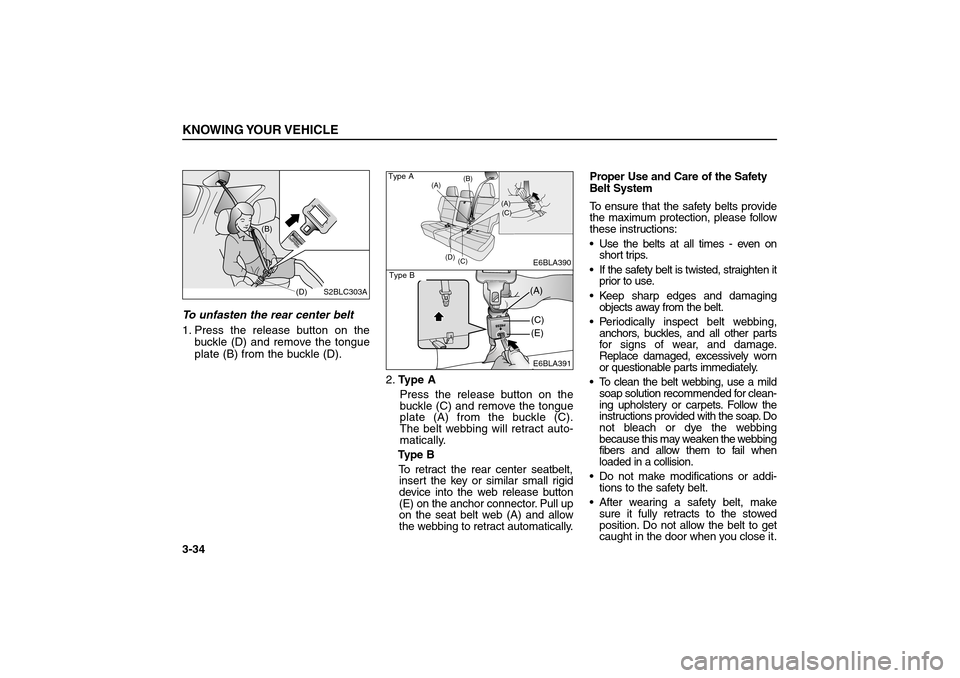
To unfasten the rear center belt
1. Press the release button on the
buckle (D) and remove the tongue
plate (B) from the buckle (D).
2.Type A
Press the release button on the
buckle (C) and remove the tongue
plate (A) from the buckle (C).
The belt webbing will retract auto-
matically.
Type B
To retract the rear center seatbelt,
insert the key or similar small rigid
device into the web release button
(E) on the anchor connector. Pull up
on the seat belt web (A) and allow
the webbing to retract automatically.Proper Use and Care of the Safety
Belt System
To ensure that the safety belts provide
the maximum protection, please follow
these instructions:
Use the belts at all times - even on
short trips.
If the safety belt is twisted, straighten it
prior to use.
Keep sharp edges and damaging
objects away from the belt.
Periodically inspect belt webbing,
anchors, buckles, and all other parts
for signs of wear, and damage.
Replace damaged, excessively worn
or questionable parts immediately.
To clean the belt webbing, use a mild
soap solution recommended for clean-
ing upholstery or carpets. Follow the
instructions provided with the soap. Do
not bleach or dye the webbing
because this may weaken the webbing
fibers and allow them to fail when
loaded in a collision.
Do not make modifications or addi-
tions to the safety belt.
After wearing a safety belt, make
sure it fully retracts to the stowed
position. Do not allow the belt to get
caught in the door when you close it.KNOWING YOUR VEHICLE3-34
(D) (B)P
R
E
S
S
S2BLC303A
(A)
(A)
(C) (B)
(D)
(C)
(A)
(C)(E)E6BLA390E6BLA391
Type AType B
BL-ENG (CAN)-3.qxd 7/28/05 5:52 PM Page 34
Page 49 of 312
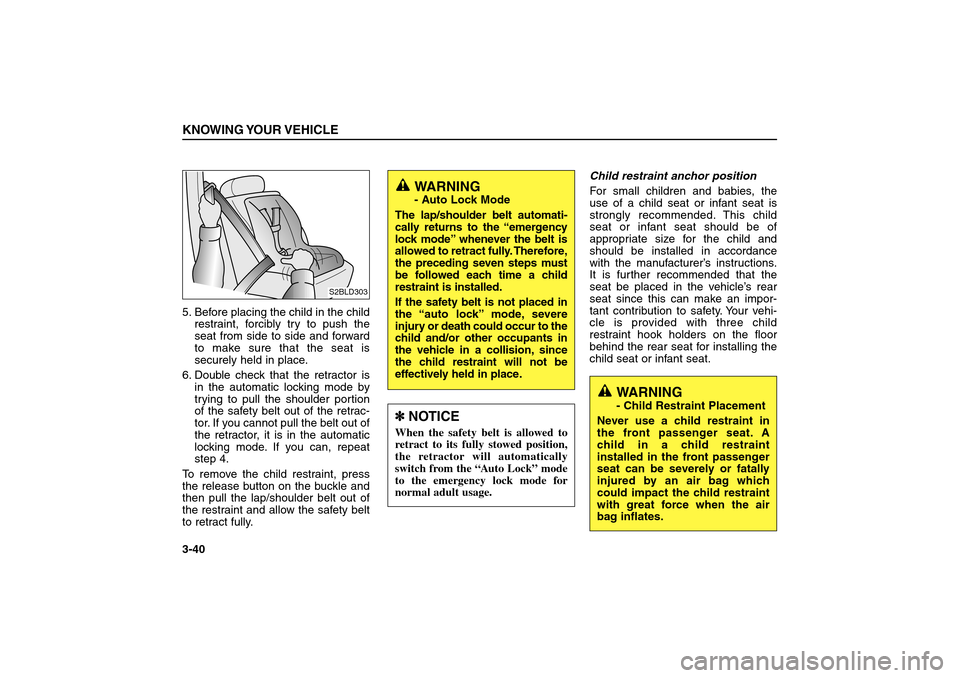
5. Before placing the child in the child
restraint, forcibly try to push the
seat from side to side and forward
to make sure that the seat is
securely held in place.
6. Double check that the retractor is
in the automatic locking mode by
trying to pull the shoulder portion
of the safety belt out of the retrac-
tor. If you cannot pull the belt out of
the retractor, it is in the automatic
locking mode. If you can, repeat
step 4.
To remove the child restraint, press
the release button on the buckle and
then pull the lap/shoulder belt out of
the restraint and allow the safety belt
to retract fully.Child restraint anchor position
For small children and babies, the
use of a child seat or infant seat is
strongly recommended. This child
seat or infant seat should be of
appropriate size for the child and
should be installed in accordance
with the manufacturer’s instructions.
It is further recommended that the
seat be placed in the vehicle’s rear
seat since this can make an impor-
tant contribution to safety. Your vehi-
cle is provided with three child
restraint hook holders on the floor
behind the rear seat for installing the
child seat or infant seat.KNOWING YOUR VEHICLE3-40
WARNING- Auto Lock Mode
The lap/shoulder belt automati-
cally returns to the “emergency
lock mode” whenever the belt is
allowed to retract fully. Therefore,
the preceding seven steps must
be followed each time a child
restraint is installed.
If the safety belt is not placed in
the “auto lock” mode, severe
injury or death could occur to the
child and/or other occupants in
the vehicle in a collision, since
the child restraint will not be
effectively held in place.
✽ ✽
NOTICEWhen the safety belt is allowed to
retract to its fully stowed position,
the retractor will automatically
switch from the “Auto Lock” mode
to the emergency lock mode for
normal adult usage.
WARNING- Child Restraint Placement
Never use a child restraint in
the front passenger seat. A
child in a child restraint
installed in the front passenger
seat can be severely or fatally
injured by an air bag which
could impact the child restraint
with great force when the air
bag inflates.
S2BLD303
BL-ENG (CAN)-3.qxd 7/28/05 5:52 PM Page 40
Page 56 of 312
Airbag system components
The main components of your SRS
are:
To indicate that your vehicle is
equipped with airbags, the corre-
sponding airbag covers are marked
with “SRS AIRBAG”.
- Driver’s airbag (see page 3- 48)
- Passenger’s airbag(see page 3- 49)
- Curtain airbag (see page 3- 55)
A diagnostic system that continual-
ly monitors the system operation.
An indicator light to warn you of a
possible problem with the system.
Emergency power backup in case
your car’s electrical system is dis-
connected in a crash.The SRS uses a collection of sensors
to gather information about the dri-
ver’s and front passenger’s safety
belt usage and impact severity.
The safety belt usage sensors deter-
mine if the driver and front passen-
ger’s safety belts are fastened. These
sensors provide the ability to control
the SRS deployment based on
whether or not the safety belts are
fastened, and how severe is the
impact.
KNOWING YOUR VEHICLE
3-47
(Continued)
If your vehicle has been sub-
jected to flood conditions
(e.g. soaked carpeting/stand-
ing water on the floor of the
vehicle, etc.) or if your vehicle
has become flood damaged in
any way, do not attempt to
start the vehicle or put the key
in the ignition before discon-
necting the battery. This may
cause airbag deployment,
which could result in serious
personal injury or death. If
flooded conditions are sub-
jected to your vehicle, before
starting the vehicle, have the
vehicle towed to an author-
ized Kia dealer for inspection
and necessary repairs.
BL-ENG (CAN)-3.qxd 7/28/05 5:52 PM Page 47
Page 59 of 312
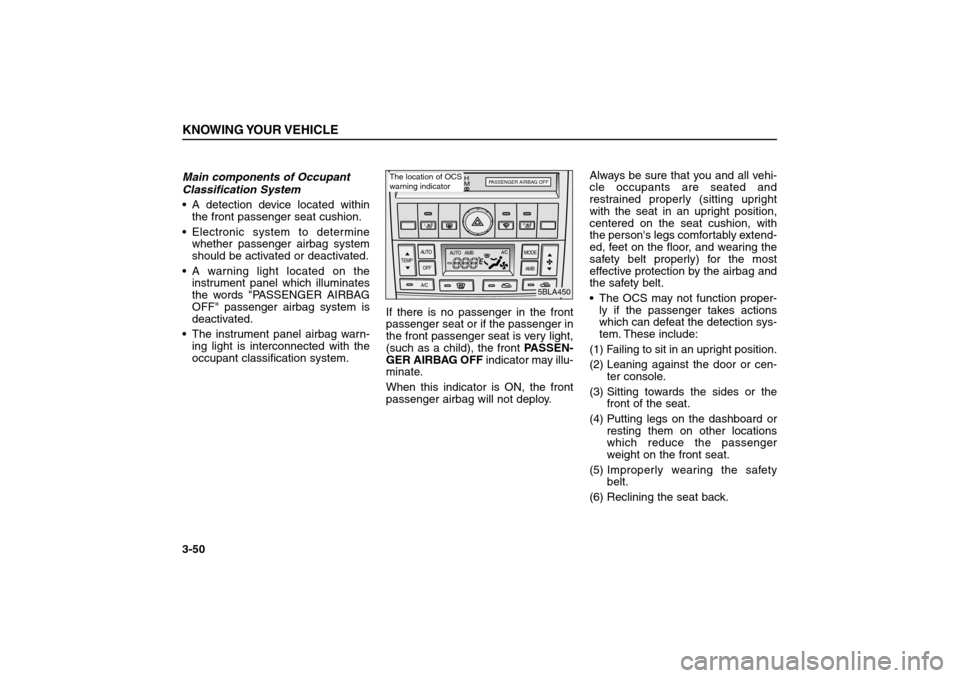
Main components of Occupant
Classification System
A detection device located within
the front passenger seat cushion.
Electronic system to determine
whether passenger airbag system
should be activated or deactivated.
A warning light located on the
instrument panel which illuminates
the words "PASSENGER AIRBAG
OFF" passenger airbag system is
deactivated.
The instrument panel airbag warn-
ing light is interconnected with the
occupant classification system.If there is no passenger in the front
passenger seat or if the passenger in
the front passenger seat is very light,
(such as a child), the front PASSEN-
GER AIRBAG OFFindicator may illu-
minate.
When this indicator is ON, the front
passenger airbag will not deploy.Always be sure that you and all vehi-
cle occupants are seated and
restrained properly (sitting upright
with the seat in an upright position,
centered on the seat cushion, with
the person's legs comfortably extend-
ed, feet on the floor, and wearing the
safety belt properly) for the most
effective protection by the airbag and
the safety belt.
The OCS may not function proper-
ly if the passenger takes actions
which can defeat the detection sys-
tem. These include:
(1) Failing to sit in an upright position.
(2) Leaning against the door or cen-
ter console.
(3) Sitting towards the sides or the
front of the seat.
(4) Putting legs on the dashboard or
resting them on other locations
which reduce the passenger
weight on the front seat.
(5) Improperly wearing the safety
belt.
(6) Reclining the seat back.KNOWING YOUR VEHICLE3-50
AUTO
AUTO AMB
OFF TEMPMODE
AMB
A/C
A/C
H
M
L
R
PASSENGER AIRBAG OFF
5BLA450
The location of OCS
warning indicator
BL-ENG (CAN)-3.qxd 7/28/05 5:52 PM Page 50
Page 62 of 312
KNOWING YOUR VEHICLE
3-53
(Continued)
If a very low weight adult is
seated in the front passenger
seat, the occupant classifica-
tion system may or may not
turn off the right front passen-
ger air bag, depending upon
the person's seating position
and body type. Everyone in
your vehicle should wear a
safety belt properly -- whether
or not there is an air bag for
that person.
If the front seat passenger
changes their seating posi-
tion (for example, by not sit-
ting upright, by sitting on the
edge of the seat, or by other-
wise being out of position),
the "PASSENGER AIRBAG
OFF" indicator may be turned
on, and the passenger airbag
may not deploy in a collision.
Always be sure to sit properly
in the front passenger seat
and wear the safety belt prop-
erly.
(Continued)
1KMN3661
Do Not Do This:Do Not Do This:
1KMN3662
1KMN36631KMN3664
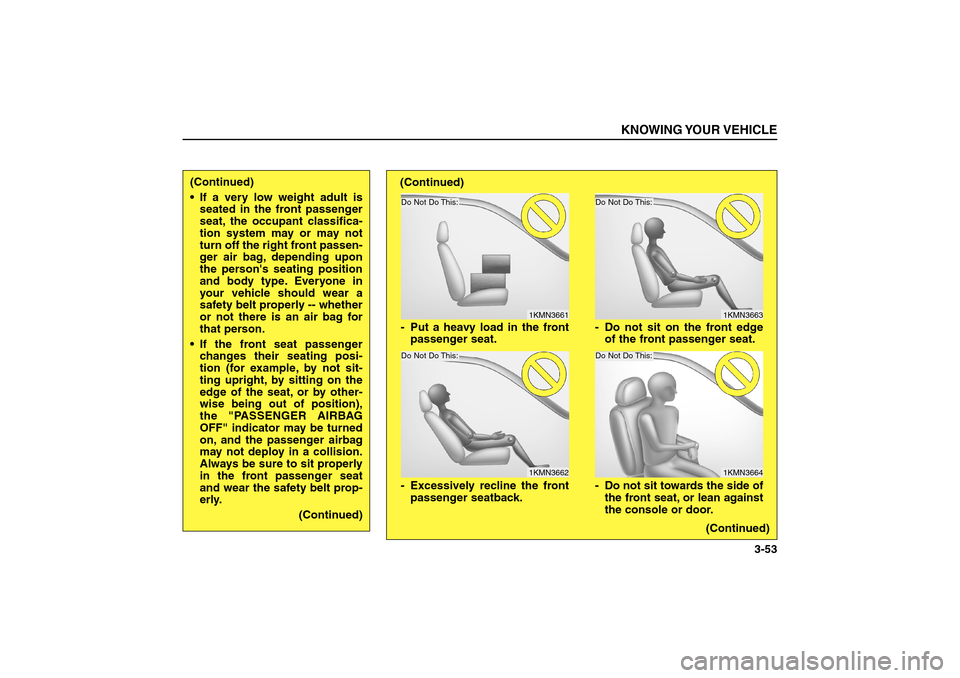
- Put a heavy load in the front
passenger seat.
- Excessively recline the front
passenger seatback.- Do not sit on the front edge
of the front passenger seat.
- Do not sit towards the side of
the front seat, or lean against
the console or door.
Do Not Do This:Do Not Do This:
(Continued)
(Continued)
BL-ENG (CAN)-3.qxd 7/28/05 5:52 PM Page 53
Page 84 of 312
Outside Rearview Mirror Heater
(If equipped)
The outside rearview mirror heater is
actuated in conjunction with the rear
window defroster. To heat the outside
rearview mirror glass, push the
switch for the rear window defroster.
The outside rearview mirror glass will
be heated for defrosting or defogging
and will give you improved rear vision
in inclement weather conditions.
Push the switch again to turn the
heater off. The outside rearview mir-
ror heater automatically turns itself
off after 20 minutes.Folding the Outside Rearview mir-
ror
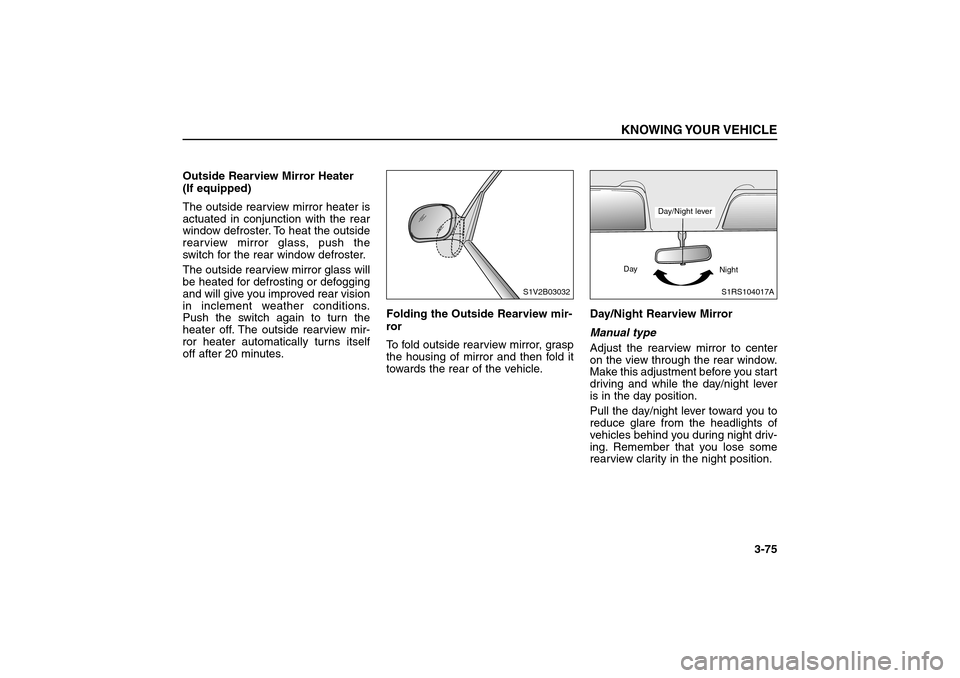
To fold outside rearview mirror, grasp
the housing of mirror and then fold it
towards the rear of the vehicle.Day/Night Rearview Mirror
Manual type
Adjust the rearview mirror to center
on the view through the rear window.
Make this adjustment before you start
driving and while the day/night lever
is in the day position.
Pull the day/night lever toward you to
reduce glare from the headlights of
vehicles behind you during night driv-
ing. Remember that you lose some
rearview clarity in the night position.
KNOWING YOUR VEHICLE
3-75
S1V2B03032
S1RS104017A
Day
Night
Day/Night lever
BL-ENG (CAN)-3.qxd 7/28/05 5:52 PM Page 75
Page 100 of 312
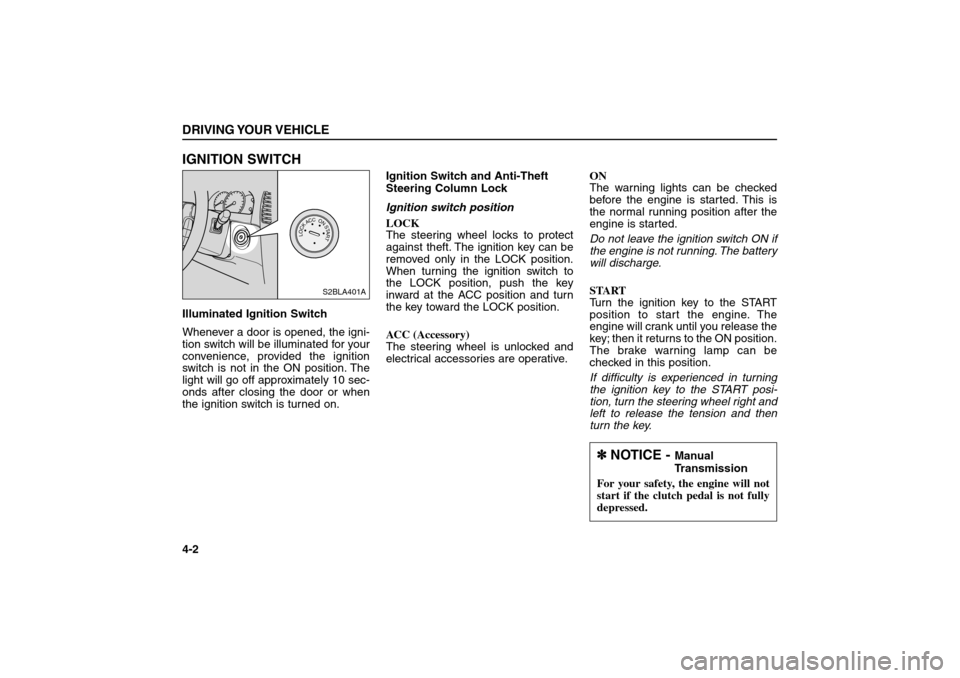
IGNITION SWITCHIlluminated Ignition Switch
Whenever a door is opened, the igni-
tion switch will be illuminated for your
convenience, provided the ignition
switch is not in the ON position. The
light will go off approximately 10 sec-
onds after closing the door or when
the ignition switch is turned on.Ignition Switch and Anti-Theft
Steering Column Lock
Ignition switch position
LOCK
The steering wheel locks to protect
against theft. The ignition key can be
removed only in the LOCK position.
When turning the ignition switch to
the LOCK position, push the key
inward at the ACC position and turn
the key toward the LOCK position.
ACC (Accessory)
The steering wheel is unlocked and
electrical accessories are operative.ON
The warning lights can be checked
before the engine is started. This is
the normal running position after the
engine is started.
Do not leave the ignition switch ON if
the engine is not running. The battery
will discharge.
START
Turn the ignition key to the START
position to start the engine. The
engine will crank until you release the
key; then it returns to the ON position.
The brake warning lamp can be
checked in this position.
If difficulty is experienced in turning
the ignition key to the START posi-
tion, turn the steering wheel right and
left to release the tension and then
turn the key.DRIVING YOUR VEHICLE4-2
PUSH
LOCKACCONSTARTS2BLA401A
✽ ✽
NOTICE -
Manual
Transmission
For your safety, the engine will not
start if the clutch pedal is not fully
depressed.
BL-ENG (CAN)-4.qxd 7/28/05 5:55 PM Page 2