lock KIA Sorento 2007 1.G User Guide
[x] Cancel search | Manufacturer: KIA, Model Year: 2007, Model line: Sorento, Model: KIA Sorento 2007 1.GPages: 325, PDF Size: 5.01 MB
Page 26 of 325
317
Knowing your vehicle
WARNING
- Driver respon-
sibility for front seat pas-
senger
Riding in a vehicle with a front seat-
back reclined could lead to serious
or fatal injury in an accident. If a
front seat is reclined during an acci-
dent, the occupant’s hips may slide
under the lap portion of the safety
belt applying great force to the
unprotected abdomen or neck or a
passenger may be ejected in a
rollover. Serious or fatal internal
injuries could result. The driver
must advise the front passenger to
keep the seatback in a comfortably
upright position whenever the vehi-
cle is in motion.
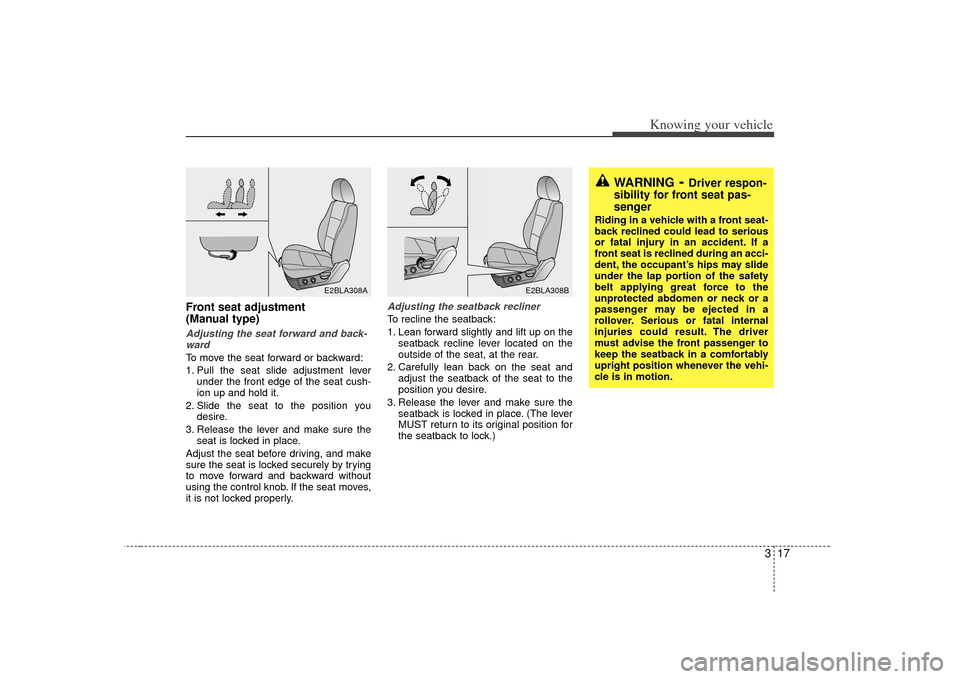
Front seat adjustment
(Manual type)Adjusting the seat forward and back-
wardTo move the seat forward or backward:
1. Pull the seat slide adjustment lever under the front edge of the seat cush-
ion up and hold it.
2. Slide the seat to the position you desire.
3. Release the lever and make sure the seat is locked in place.
Adjust the seat before driving, and make
sure the seat is locked securely by trying
to move forward and backward without
using the control knob. If the seat moves,
it is not locked properly.
Adjusting the seatback reclinerTo recline the seatback:
1. Lean forward slightly and lift up on the seatback recline lever located on the
outside of the seat, at the rear.
2. Carefully lean back on the seat and adjust the seatback of the seat to the
position you desire.
3. Release the lever and make sure the seatback is locked in place. (The lever
MUST return to its original position for
the seatback to lock.)
E2BLA308A
E2BLA308B
Page 27 of 325
Knowing your vehicle18
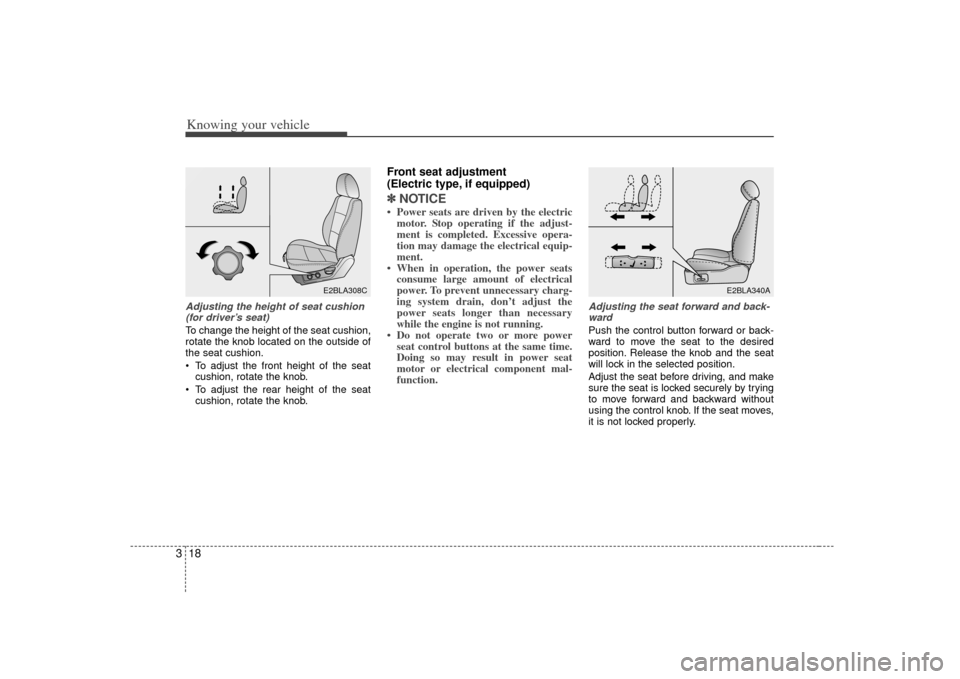
3Adjusting the height of seat cushion
(for driver’s seat)To change the height of the seat cushion,
rotate the knob located on the outside of
the seat cushion.
To adjust the front height of the seat cushion, rotate the knob.
To adjust the rear height of the seat cushion, rotate the knob.
Front seat adjustment
(Electric type, if equipped)✽ ✽ NOTICE• Power seats are driven by the electric
motor. Stop operating if the adjust-
ment is completed. Excessive opera-
tion may damage the electrical equip-
ment.
• When in operation, the power seats consume large amount of electrical
power. To prevent unnecessary charg-
ing system drain, don’t adjust the
power seats longer than necessary
while the engine is not running.
• Do not operate two or more power seat control buttons at the same time.
Doing so may result in power seat
motor or electrical component mal-
function.
Adjusting the seat forward and back-
wardPush the control button forward or back-
ward to move the seat to the desired
position. Release the knob and the seat
will lock in the selected position.
Adjust the seat before driving, and make
sure the seat is locked securely by trying
to move forward and backward without
using the control knob. If the seat moves,
it is not locked properly.
E2BLA308C
E2BLA340A
Page 28 of 325
319
Knowing your vehicle
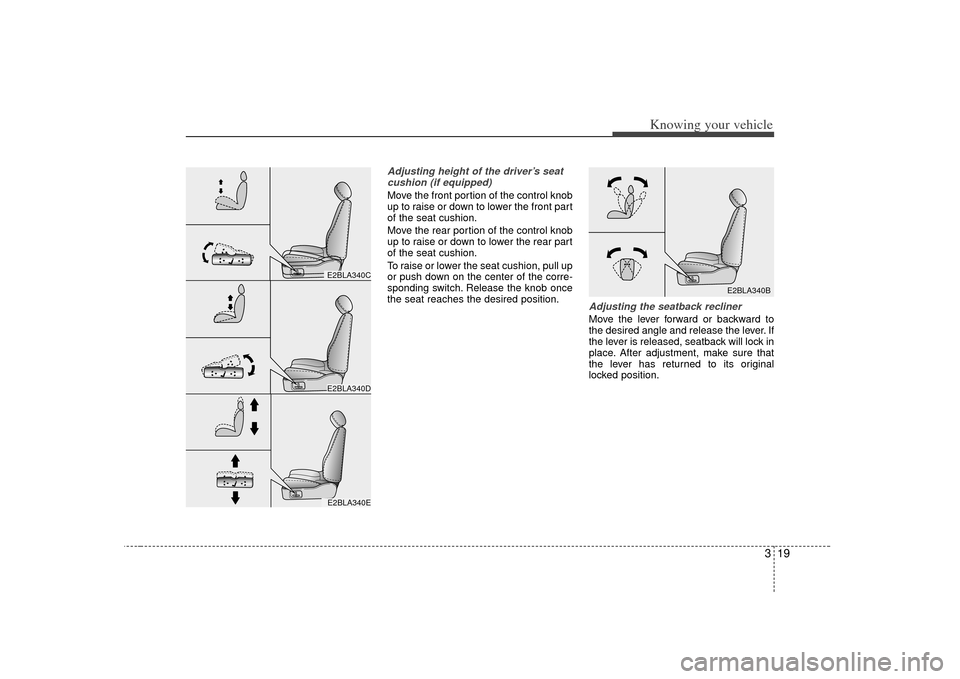
Adjusting height of the driver’s seatcushion (if equipped)Move the front portion of the control knob
up to raise or down to lower the front part
of the seat cushion.
Move the rear portion of the control knob
up to raise or down to lower the rear part
of the seat cushion.
To raise or lower the seat cushion, pull up
or push down on the center of the corre-
sponding switch. Release the knob once
the seat reaches the desired position.
Adjusting the seatback reclinerMove the lever forward or backward to
the desired angle and release the lever. If
the lever is released, seatback will lock in
place. After adjustment, make sure that
the lever has returned to its original
locked position.
E2BLA340B
E2BLA340CE2BLA340DE2BLA340E
Page 31 of 325
Knowing your vehicle22
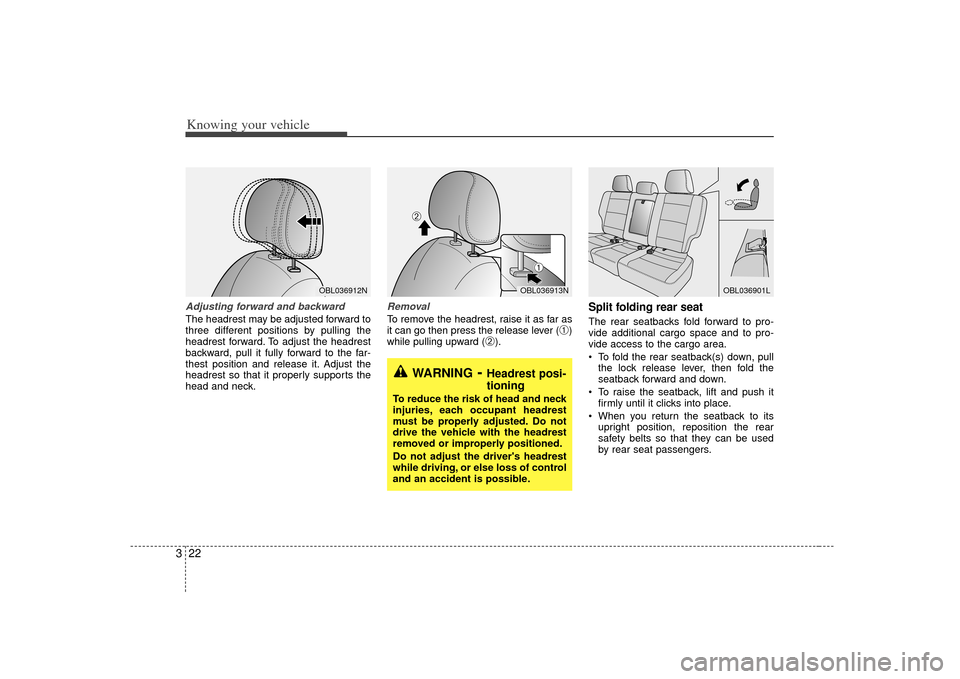
3Adjusting forward and backwardThe headrest may be adjusted forward to
three different positions by pulling the
headrest forward. To adjust the headrest
backward, pull it fully forward to the far-
thest position and release it. Adjust the
headrest so that it properly supports the
head and neck.
RemovalTo remove the headrest, raise it as far as
it can go then press the release lever (
➀)
while pulling upward (
➁).
Split folding rear seat The rear seatbacks fold forward to pro-
vide additional cargo space and to pro-
vide access to the cargo area.
To fold the rear seatback(s) down, pull the lock release lever, then fold the
seatback forward and down.
To raise the seatback, lift and push it firmly until it clicks into place.
When you return the seatback to its upright position, reposition the rear
safety belts so that they can be used
by rear seat passengers.
WARNING
- Headrest posi-
tioning
To reduce the risk of head and neck
injuries, each occupant headrest
must be properly adjusted. Do not
drive the vehicle with the headrest
removed or improperly positioned.
Do not adjust the driver's headrest
while driving, or else loss of control
and an accident is possible.
OBL036912N
OBL036901L
OBL036913N
➀
➁
Page 32 of 325
323
Knowing your vehicle
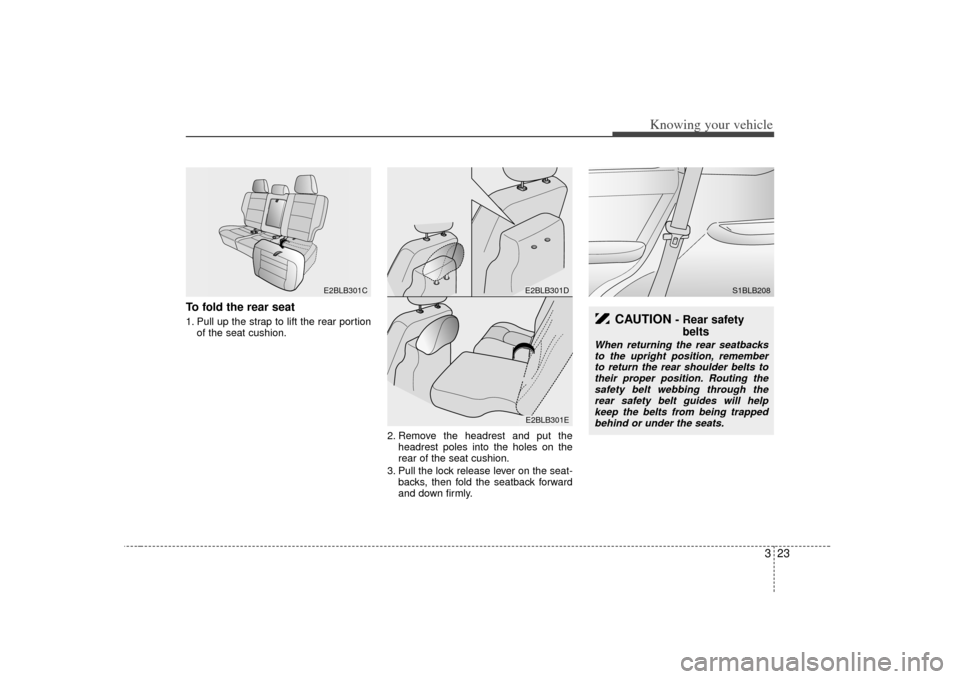
To fold the rear seat1. Pull up the strap to lift the rear portionof the seat cushion.
2. Remove the headrest and put theheadrest poles into the holes on the
rear of the seat cushion.
3. Pull the lock release lever on the seat- backs, then fold the seatback forward
and down firmly.
E2BLB301E
E2BLB301C
E2BLB301D
CAUTION
- Rear safetybelts
When returning the rear seatbacks
to the upright position, remember to return the rear shoulder belts totheir proper position. Routing thesafety belt webbing through therear safety belt guides will help keep the belts from being trappedbehind or under the seats.
S1BLB208
Page 36 of 325
327
Knowing your vehicle
Safety belt restraint system
We strongly recommend that the driver
and all passengers be properly restrained
at all times by using the safety belts pro-
vided with the vehicle. Proper use of the
safety belts decreases the risk of severe
injury or death in accidents or sudden
stops. In most states, and in Canada, the
law requires their use.
All seats have lap/shoulder belts. Inertial
locks in the safety belt retractors allow all
of the lap/shoulder safety belts to remain
unlocked during normal vehicle opera-
tion. This allows the occupants some
freedom of movement and increased
comfort while using the safety belts. If a
force is applied to the vehicle, such as a
strong stop, a sharp turn, or a collision,
the safety belt retractors will automatical-
ly lock the safety belts.
Since the inertial locks do not require a
collision in order to lock up, you may
become aware of the safety belts locking
while braking or going around sharp cor-
ners.
Always use the rear seat position(s) to
install your child restraint(s).
WARNING
- Replacing
used pre-tensioners
Pre-tensioners are designed to
operate once. After activation,
pre-tensioner seat belts must be
replaced. All seat belts, of any
type, should always be replaced
after they have been worn during
a collision.
Do not attempt to replace the pre- tensioners yourself. This must be
done by an authorized Kia dealer.
WARNING
- Damaging the
pre-tensioners
Do not hit or strike the pre-ten-
sioner assemblies, especially
with a tool or heavy object.
Do not attempt to service or repair the pre-tensioners.
WARNING
- Safety belts
To minimize the risk of serious or
fatal injury in an accident, the driv-
er and all passengers should use
the appropriate safety restraints for
their age and size. The presence of
air bags does not change the need
to be properly restrained by a safe-
ty belt or size-appropriate child
restraint. In fact, air bags are
designed to work the best when
passengers are correctly restrained
in the vehicle.
Be sure you are familiar with theinformation in this section,
including the information on
infant and child restraints.
Read the safety warnings on the sunvisors of your vehicle also.
Page 37 of 325
Knowing your vehicle28
3The rear safety belts use a special auto-
lock feature designed to allow a child
restraint to be used in these positions
without an added locking clip. They nor-
mally lock only under extreme or emer-
gency conditions (emergency lock
mode). However they can be adjusted so
that they remain fixed and locked when a
child restraint system is placed in these
positions. (Use this auto-lock mode only
to secure a child restraint, never for pas-
sengers restrained by the safety belts.)
Page 3-41 gives instructions on placing
the safety belt in the auto lock mode.
The drivers safety belt can only operate
in the emergency lock mode. Safety belts provide the best restraint
when:
The seatback is upright.
The occupant is sitting upright (not
slouched).
The lap belt is snug across the hips.
The shoulder belt is snug across the chest.
The knees are straight forward.
To help you remember to fasten your
safety belt, a warning light will blink. See
“Safety belt warning light and chime” on
page 3-30.
WARNING
- Child restraint
in front seat
Never install a child restraint sys-
tem in the front passenger position,
as an inflating air bag could cause
serious or fatal injury to a child in
that position.
WARNING
- After a colli- sion
Lap/shoulder belt assemblies
may be stretched or damaged
when subjected to the stress and
forces of a collision.
The entire restraint system should be inspected following
any collision. All belts, retractors,
anchors and hardware damaged
by a collision should be replaced
before the vehicle is operated
again.
WARNING -
Cargo area
Passengers should never be
allowed to ride in the cargo area of
a vehicle. No safety belts are pro-
vided for the cargo area. Persons
riding in the vehicle without a fas-
tened safety belt are much more
likely to suffer serious bodily injury
or death during an accident.
Page 40 of 325
331
Knowing your vehicle
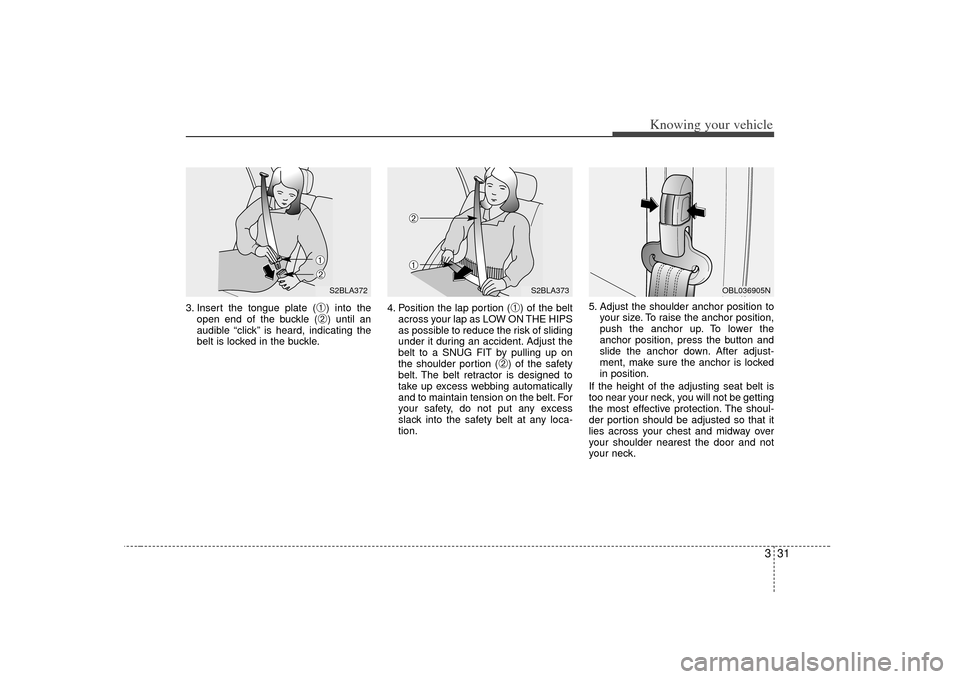
3. Insert the tongue plate (
➀) into the
open end of the buckle (➁) until an
audible “click” is heard, indicating the
belt is locked in the buckle. 4. Position the lap portion (
➀) of the belt
across your lap as LOW ON THE HIPS
as possible to reduce the risk of sliding
under it during an accident. Adjust the
belt to a SNUG FIT by pulling up on
the shoulder portion (
➁) of the safety
belt. The belt retractor is designed to
take up excess webbing automatically
and to maintain tension on the belt. For
your safety, do not put any excess
slack into the safety belt at any loca-
tion. 5. Adjust the shoulder anchor position to
your size. To raise the anchor position,
push the anchor up. To lower the
anchor position, press the button and
slide the anchor down. After adjust-
ment, make sure the anchor is locked
in position.
If the height of the adjusting seat belt is
too near your neck, you will not be getting
the most effective protection. The shoul-
der portion should be adjusted so that it
lies across your chest and midway over
your shoulder nearest the door and not
your neck.
S2BLA372
S2BLA373
OBL036905N
➀➁
➀➁
Page 41 of 325
Knowing your vehicle32
3
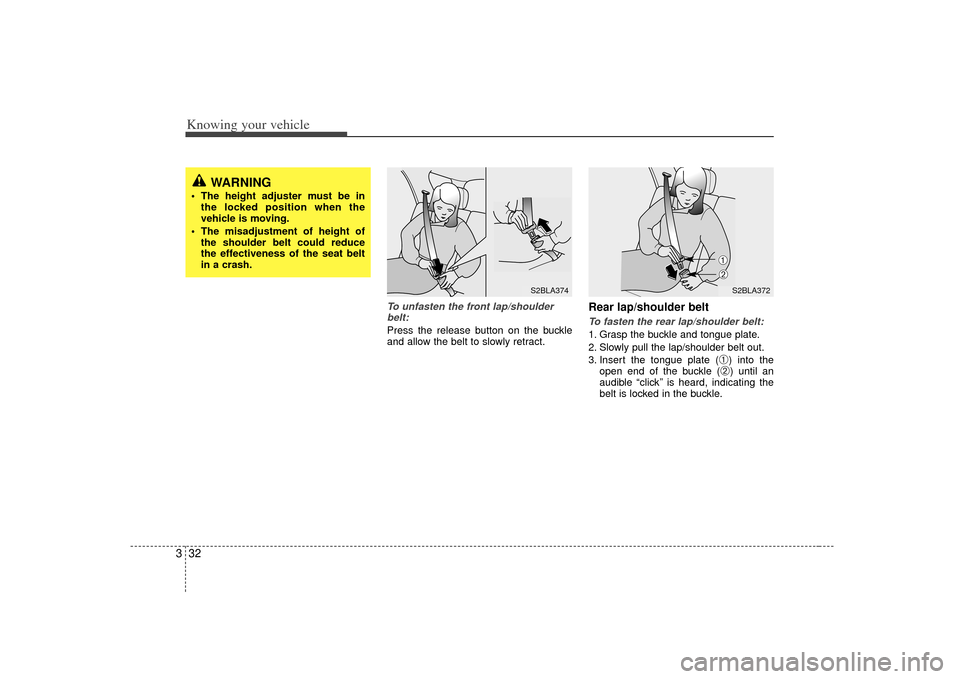
To unfasten the front lap/shoulder
belt:Press the release button on the buckle
and allow the belt to slowly retract.
Rear lap/shoulder belt To fasten the rear lap/shoulder belt:1. Grasp the buckle and tongue plate.
2. Slowly pull the lap/shoulder belt out.
3. Insert the tongue plate (
➀) into the
open end of the buckle (➁) until an
audible “click’’ is heard, indicating the
belt is locked in the buckle.
WARNING
The height adjuster must be in the locked position when the
vehicle is moving.
The misadjustment of height of the shoulder belt could reduce
the effectiveness of the seat belt
in a crash.
S2BLA374
S2BLA372
➀➁
Page 43 of 325

Knowing your vehicle34
32. Insert the tongue plate (A) into the
open end of the buckle (C) until an
audible “click" is heard, indicating the
latch is locked. Make sure the belt is
not twisted. 3. Pull the tongue plate (B) and insert the
tongue plate (B) into the open end of
the buckle (D) until an audible “click” is
heard, indicating the latch is locked.
Make sure the belt is not twisted. There will be an audible “click” when the
tab locks in the buckle. The safety belt
automatically adjusts to the proper length
only after the lap belt is adjusted manu-
ally so that it fits snugly around your hips,
if you lean forward in a slow, easy
motion, the belt will extend and let you
move around. If there is a sudden stop or
impact, the belt will lock into position. It
will also lock if you try to lean forward too
quickly.
WARNING
When using the rear safety center
belt, you must lock all tongue plates
and buckles. If any tongue plate or
buckle is not locked, it will increase
the chance of injury in the event of
collision.
(D)
(B)PRESS
E2BLC304
(D)
(A)
(C)(B)
S2BLB303A