lock KIA Sorento 2007 1.G Repair Manual
[x] Cancel search | Manufacturer: KIA, Model Year: 2007, Model line: Sorento, Model: KIA Sorento 2007 1.GPages: 325, PDF Size: 5.01 MB
Page 217 of 325
59
Driving tips
Winter driving We recommend that you carry emer-gency equipment, including tire chains,
a window scraper, windshield deicer, a
bag of sand or salt, flares, a small
shovel and jumper cables.
Make sure you have sufficient ethylene glycol coolant in the radiator.
Check the battery condition and cables. Cold temperatures reduce the
capacity of any battery, so it must be in
excellent condition to provide enough
winter starting power.
Make sure the engine oil viscosity is suitable for cold weather.
Check the ignition system for loose connections and damage.
Use antifreeze formulated windshield washer fluid. (Do not use engine
coolant antifreeze.)
Do not use the parking brake if it might freeze. When parking, shift to 1 (First)
or R (Reverse) with a manual trans-
mission or P (Park) with an automatic
transmission and block the rear
wheels.
Snow tires If you mount snow tires on your Kia,
make sure they are radial tires of the
same size and load range as the original
tires. Mount snow tires on all four wheels
to balance your vehicle’s handling in all
weather conditions. Keep in mind that the
traction provided by snow tires on dry
roads may not be as high as your vehi-
cle's original equipment tires. You should
drive cautiously even when the roads are
clear. Check with the tire dealer for max-
imum speed recommendations.Do not install studded tires without firstchecking local, state and municipal regu-lations for possible restrictions againsttheir use.
Driving in flooded areas Avoid driving through flooded areas
unless you are sure the water is no high-
er than the bottom of the wheel hub.
Drive through any water slowly. Allow
adequate stopping distance because
brake performance may be affected.
After driving through water, dry the
brakes by gently applying them several
times while the vehicle is moving slowly.
WARNING
- Snow tire size
Snow tires should be equivalent in
size and type to the vehicle's stan-
dard tires. Otherwise, the safety and
handling of your vehicle may be
adversely affected.
Page 225 of 325

517
Driving tips
Driving on off-road hillsOff-road driving often takes you up,
down, or across a hill. Driving safely on
hills requires excellent judgment and an
understanding of what your vehicle can
and can’t do. There are some hills that
simply should not be driven.
Approaching a hillWhen you approach a hill, you need to
decide if it’s one of those hills that’s just
too steep to climb, descend, or cross.
Steepness can be difficult to judge. On a
very small hill, for example, there may be
a smooth, constant incline with only a
small change in elevation where you can
easily see all the way to the top. On a
large hill, the incline may get steeper as
you near the top, but you may not see
this because the crest of the hill is hidden
by bushes, grass, or shrubs.
Here are some other things to consider
as you approach a hill:
Is there a constant incline, or does thehill get sharply steeper in places?
Is there good traction on the hillside, or will the surface cause tire slipping?
Is there a straight path up or down the hill so you won’t have to make turning
maneuvers?
Are there obstructions on the hill that can block your path (boulders, trees,
logs or ruts)? What’s beyond the hill? Is there a cliff,
an embankment, a drop-off, or a
fence? Get out of the vehicle and walk
the hill if you are unsure. It’s the smart
way to find out.
Is the hill simply too rough? Steep hills often have ruts, gullies, troughs, and
exposed rocks because they are more
susceptible to the effects of erosion.
How have weather conditions affected the terrain? Is there likely to be mud,
snow or ice on the hill?
What time of day is it? Are tempera- tures dropping so that wet surfaces will
start to freeze?
WARNING -
Driving on
hills
Many hills are simply too steep for
any vehicle. If you drive up them,
you will stall. If you drive down
them, you can’t control your speed.
In either case, you could flip over. If
you drive across them, you will roll
over. You could be seriously or
fatally injured. If you have any
doubt about the steepness, don’t
drive up or down the hill, even if it
means that you have to turn around
and find another route. Re-tracking
is a normal part of safe off-roading.
Page 226 of 325
Driving tips18
5Driving uphillOnce you decide you can safely drive up
the hill, you need to take some special
steps.
Use a low gear and get a firm grip on
the steering wheel.
Get a smooth start up the hill and try to maintain your speed. Don’t use more
power than you need, because you
don’t want your wheels to start spin-
ning or sliding.
Try to drive straight up the hill, if at all possible. If the path twists and turns,
you may have to find another route. Slow down as you approach the top of
the hill.
Attach a flag to the vehicle to make you more visible to approaching traffic on
trails or hills.
Sound the horn as you approach the top of the hill to let opposing traffic
know you’re there.
Use your headlights even during the day. They make you more visible to
other drivers.
Stalling while driving uphill
What should I do if my vehicle stalls, or isabout to stall, and I can’t make it up thehill?If your vehicle stalls, or is about to stall
while driving uphill, there are some
things you should do, and there are some
things you must not do. First, here’s what
you should do:
Push the brake pedal to stop the vehi- cle and keep it from rolling backwards.
Also, apply the parking brake.
If your engine is still running, shift the transmission into reverse, release the
parking brake, and slowly back down
the hill in reverse.
If your engine has stopped running, you’ll need to restart it. With the brake
pedal depressed and the parking
brake still applied, shift a manual trans-
mission to N (Neutral), or an automatic
transmission to P (Park) and restart
the engine. Then, shift to reverse,
release the parking brake, and slowly
back down the hill in reverse.
As you are backing down the hill, put your left hand on the steering wheel at
the 12 o’clock position. This way, you’ll
be able to tell if your wheels are
straight or turned to the left or right as
you back down.
WARNING -
Driving across
hills
Turning or driving across steep
hills can be dangerous. You could
lose traction, slide sideways, or just
reach an area too steep to traverse.
In any case, it could cause you to
roll over. You could be seriously or
fatally injured. When driving up
hills, always try to go as straight up
as possible.
WARNING
- Driving overhills
Driving to the top (crest) of a hill at
full speed can cause an accident
and result in serious or fatal injury.
There could be a drop-off, embank-
ment, cliff, another vehicle or peo-
ple sitting on the ground. As you
near the top of a hill, slow down and
stay alert.
Page 228 of 325
Driving tips20
5Driving downhillGoing downhill can be considerably more
dangerous than driving uphill. When off-
roading takes you downhill, you’ll want to
consider many of the same things you
thought about before you went uphill. As
a brief reminder, those include:
How steep is the downhill? Will I be
able to maintain vehicle control?
What’s the surface like? Smooth? Rough? Slippery? Hard-packed dirt?
Gravel?
Are there hidden surface obstacles? Ruts? Logs? Boulders?
What’s at the bottom of the hill? Is there a hidden creek bank or even a
river bottom with large rocks?
Have changes in the weather condi- tions and their effect on the terrain
since you went uphill made your task
more difficult?
Once you have decided that you can go
down a hill safely, try to keep your vehicle
headed straight down, and use a low
gear. This way, engine braking can help
your brakes so they won’t have to do all
the work. Descend slowly, keeping your
vehicle under control at all times. Avoid turns that take you across the
incline of the hill. A hill that’s not too
steep to drive down may be too steep to
drive across. You could roll over if you
don’t drive straight down.
Never go downhill with the clutch pedal
depressed. This is called “free-wheeling.”
Your brakes will have to do all the work
and could overheat and fade.
If your wheels lock up during downhill
braking, you may feel the vehicle starting
to slide sideways. To regain your direc-
tion, just ease off the brakes and steer to
keep the front of the vehicle pointing
straight downhill.
WARNING
- Braking
Heavy braking when going down a
hill can cause your brakes to over-
heat and fade. This could cause
loss of control and a serious acci-
dent. Apply the brakes lightly when
descending a hill and use a low
gear to keep vehicle speed under
control.
WARNING
- Wheel locking
Avoid braking so hard that you lock
the wheels when going downhill. If
your front wheels are locked, you
can’t steer your vehicle.
WARNING
- Downhill
Before beginning to go downhill, it
is critical that you ensure that no
cargo can shift forward while you
are heading downhill. Such shifting
could either endanger you and your
occupants, or interfere with your
ability to control the vehicle.
Page 256 of 325
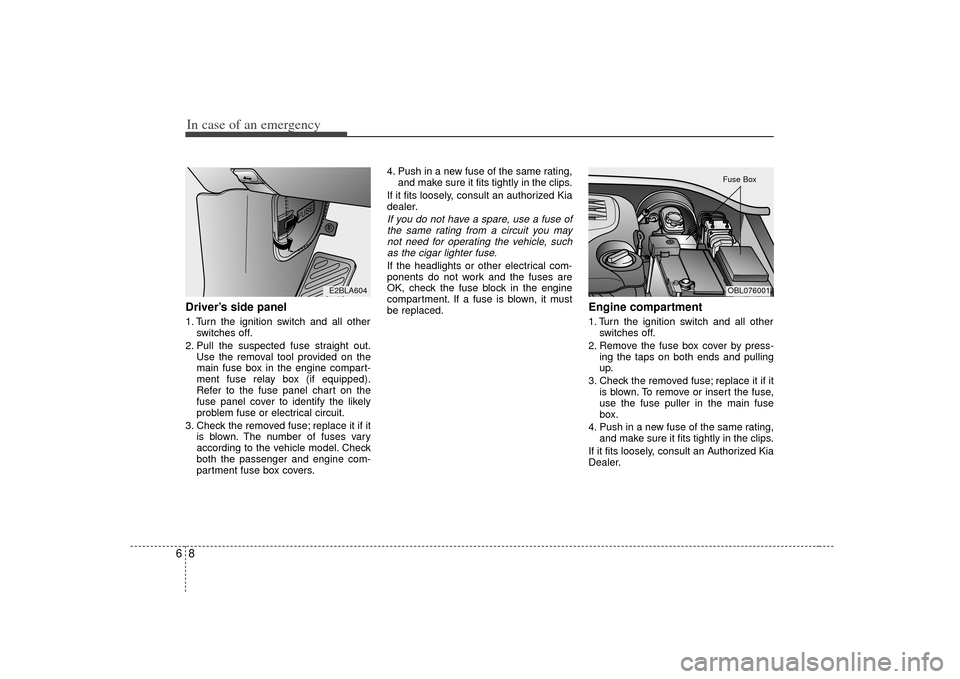
In case of an emergency86Driver’s side panel1. Turn the ignition switch and all otherswitches off.
2. Pull the suspected fuse straight out. Use the removal tool provided on the
main fuse box in the engine compart-
ment fuse relay box (if equipped).
Refer to the fuse panel chart on the
fuse panel cover to identify the likely
problem fuse or electrical circuit.
3. Check the removed fuse; replace it if it is blown. The number of fuses vary
according to the vehicle model. Check
both the passenger and engine com-
partment fuse box covers. 4. Push in a new fuse of the same rating,
and make sure it fits tightly in the clips.
If it fits loosely, consult an authorized Kia
dealer.
If you do not have a spare, use a fuse of the same rating from a circuit you maynot need for operating the vehicle, suchas the cigar lighter fuse.If the headlights or other electrical com-
ponents do not work and the fuses are
OK, check the fuse block in the engine
compartment. If a fuse is blown, it must
be replaced.
Engine compartment1. Turn the ignition switch and all other switches off.
2. Remove the fuse box cover by press- ing the taps on both ends and pulling
up.
3. Check the removed fuse; replace it if it is blown. To remove or insert the fuse,
use the fuse puller in the main fuse
box.
4. Push in a new fuse of the same rating, and make sure it fits tightly in the clips.
If it fits loosely, consult an Authorized Kia
Dealer.
FUSE
E2BLA604
OBL076001Fuse Box
Page 259 of 325
611
In case of an emergency
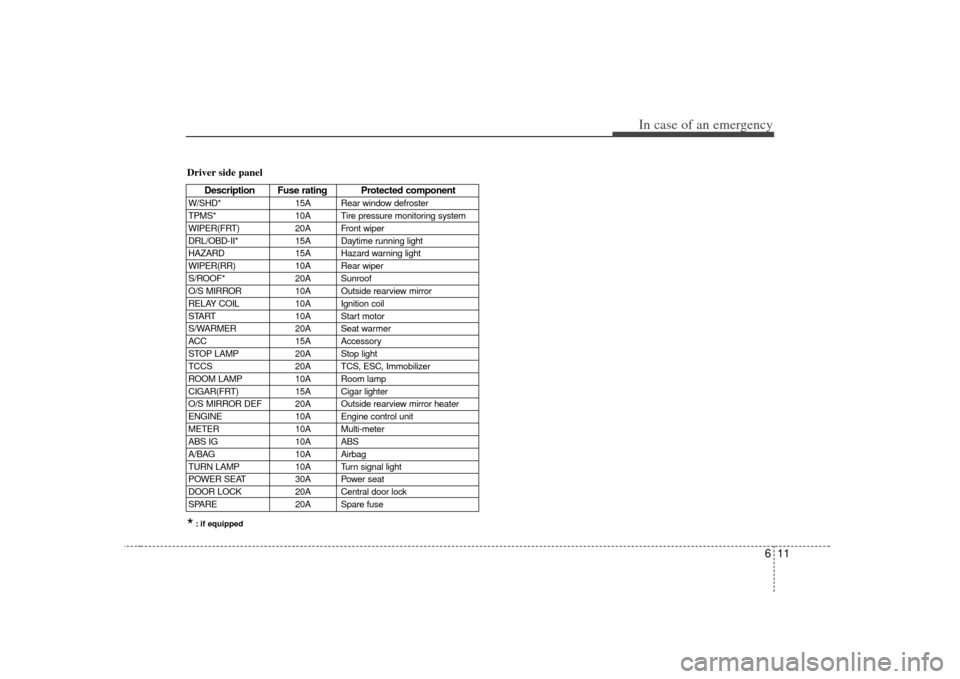
Driver side panel
Description Fuse rating Protected component
W/SHD*15A Rear window defroster
TPMS* 10A Tire pressure monitoring system
WIPER(FRT) 20A Front wiper
DRL/OBD-II* 15A Daytime running light
HAZARD 15A Hazard warning light
WIPER(RR) 10A Rear wiper
S/ROOF* 20A Sunroof
O/S MIRROR 10A Outside rearview mirror
RELAY COIL 10A Ignition coil
START 10A Start motor
S/WARMER 20A Seat warmer
ACC 15A Accessory
STOP LAMP 20A Stop light
TCCS 20A TCS, ESC, Immobilizer
ROOM LAMP 10A Room lamp
CIGAR(FRT) 15A Cigar lighter
O/S MIRROR DEF 20A Outside rearview mirror heater
ENGINE 10A Engine control unit
METER 10A Multi-meter
ABS IG 10A ABS
A/BAG 10A Airbag
TURN LAMP 10A Turn signal light
POWER SEAT 30A Power seat
DOOR LOCK 20A Central door lock
SPARE 20A Spare fuse*: if equipped
Page 260 of 325
In case of an emergency12
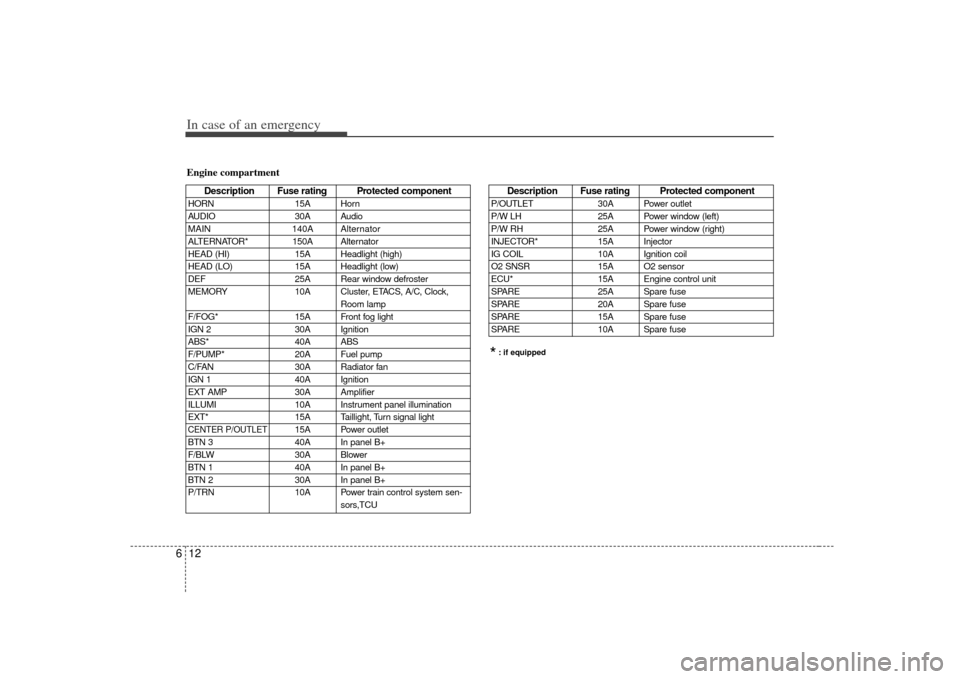
6Engine compartment
Description Fuse rating Protected component
HORN 15A Horn
AUDIO 30A Audio
MAIN 140A Alternator
ALTERNATOR* 150A Alternator
HEAD (HI) 15A Headlight (high)
HEAD (LO) 15A Headlight (low)
DEF 25A Rear window defroster
MEMORY 10A Cluster, ETACS, A/C, Clock,
Room lamp
F/FOG* 15A Front fog light
IGN 2 30A Ignition
ABS* 40A ABS
F/PUMP* 20A Fuel pump
C/FAN 30A Radiator fan
IGN 1 40A Ignition
EXT AMP 30A Amplifier
ILLUMI 10A Instrument panel illumination
EXT* 15A Taillight, Turn signal lightCENTER P/OUTLET
15A Power outlet
BTN 3 40A In panel B+
F/BLW 30A Blower
BTN 1 40A In panel B+
BTN 2 30A In panel B+
P/TRN 10A Power train control system sen- sors,TCU
*: if equippedDescription Fuse rating Protected component
P/OUTLET30A Power outlet
P/W LH 25A Power window (left)
P/W RH 25A Power window (right)
INJECTOR* 15A Injector
IG COIL 10A Ignition coil
O2 SNSR 15A O2 sensor
ECU* 15A Engine control unit
SPARE 25A Spare fuse
SPARE 20A Spare fuse
SPARE 15A Spare fuse
SPARE 10A Spare fuse
Page 261 of 325
613
In case of an emergency
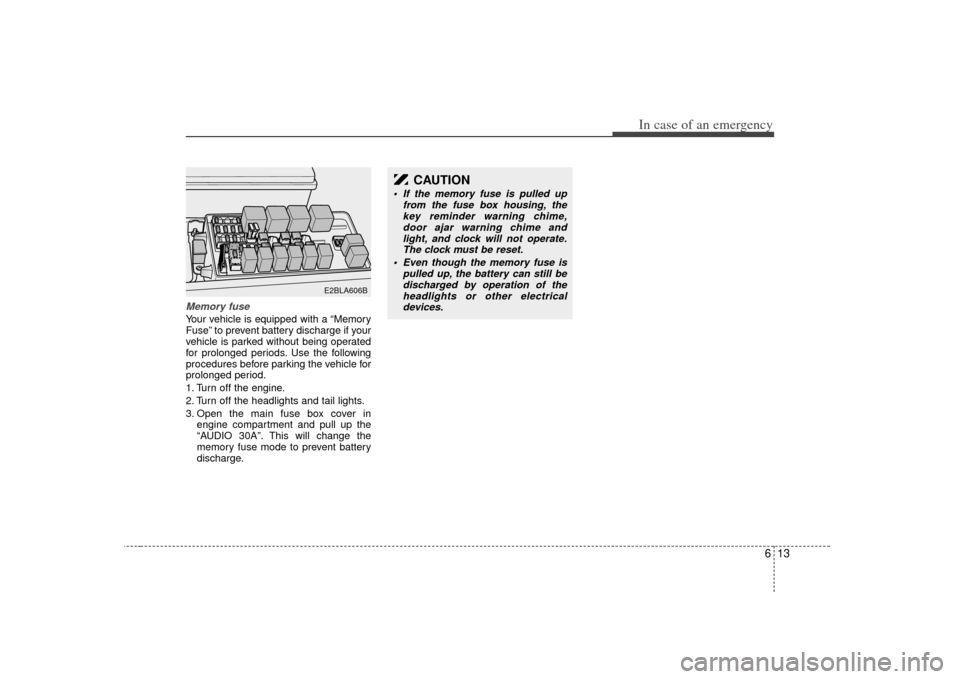
Memory fuseYour vehicle is equipped with a “Memory
Fuse” to prevent battery discharge if your
vehicle is parked without being operated
for prolonged periods. Use the following
procedures before parking the vehicle for
prolonged period.
1. Turn off the engine.
2. Turn off the headlights and tail lights.
3. Open the main fuse box cover inengine compartment and pull up the
“AUDIO 30A”. This will change the
memory fuse mode to prevent battery
discharge.
E2BLA606B
CAUTION
If the memory fuse is pulled up from the fuse box housing, thekey reminder warning chime,door ajar warning chime and light, and clock will not operate.The clock must be reset.
Even though the memory fuse is pulled up, the battery can still bedischarged by operation of theheadlights or other electricaldevices.
Page 265 of 325
617
In case of an emergency
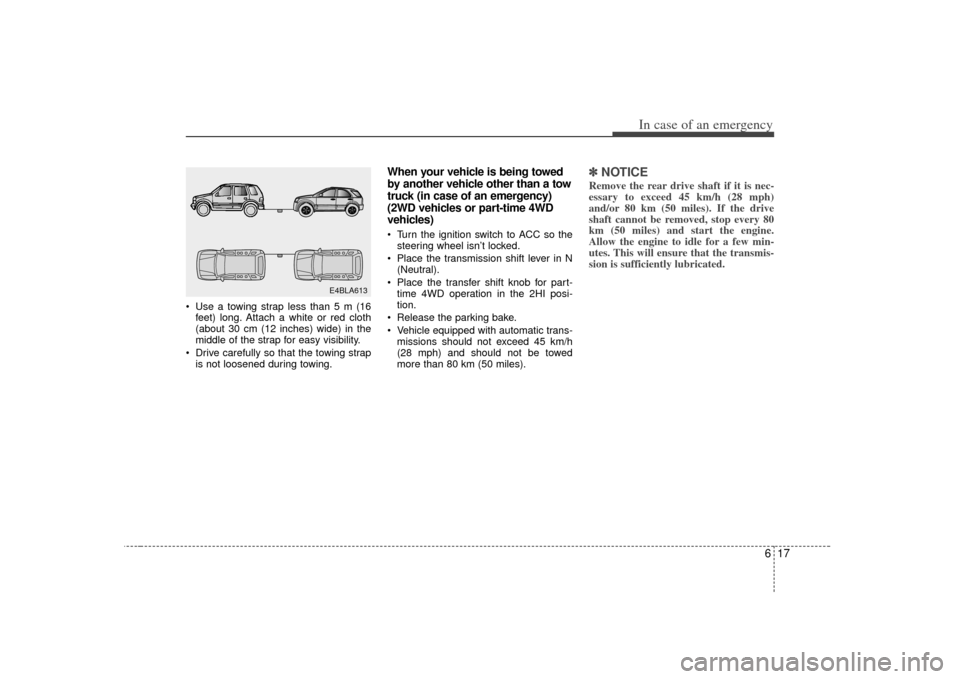
Use a towing strap less than 5 m (16feet) long. Attach a white or red cloth
(about 30 cm (12 inches) wide) in the
middle of the strap for easy visibility.
Drive carefully so that the towing strap is not loosened during towing.
When your vehicle is being towed
by another vehicle other than a tow
truck (in case of an emergency)
(2WD vehicles or part-time 4WD
vehicles) Turn the ignition switch to ACC so thesteering wheel isn’t locked.
Place the transmission shift lever in N (Neutral).
Place the transfer shift knob for part- time 4WD operation in the 2HI posi-
tion.
Release the parking bake.
Vehicle equipped with automatic trans- missions should not exceed 45 km/h
(28 mph) and should not be towed
more than 80 km (50 miles).
✽ ✽ NOTICERemove the rear drive shaft if it is nec-
essary to exceed 45 km/h (28 mph)
and/or 80 km (50 miles). If the drive
shaft cannot be removed, stop every 80
km (50 miles) and start the engine.
Allow the engine to idle for a few min-
utes. This will ensure that the transmis-
sion is sufficiently lubricated.
E4BLA613
Page 267 of 325
619
In case of an emergency
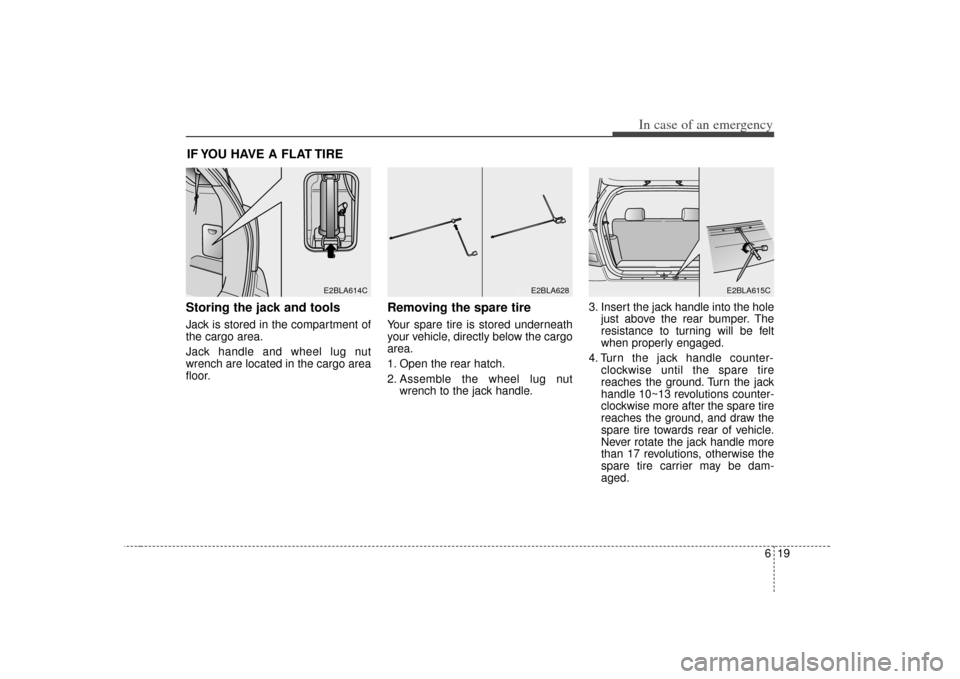
IF YOU HAVE A FLAT TIRE
Storing the jack and tools Jack is stored in the compartment of
the cargo area.
Jack handle and wheel lug nut
wrench are located in the cargo area
floor.
Removing the spare tire Your spare tire is stored underneath
your vehicle, directly below the cargo
area.
1. Open the rear hatch.
2. Assemble the wheel lug nut wrench to the jack handle. 3. Insert the jack handle into the hole
just above the rear bumper. The
resistance to turning will be felt
when properly engaged.
4. Turn the jack handle counter- clockwise until the spare tire
reaches the ground. Turn the jack
handle 10~13 revolutions counter-
clockwise more after the spare tire
reaches the ground, and draw the
spare tire towards rear of vehicle.
Never rotate the jack handle more
than 17 revolutions, otherwise the
spare tire carrier may be dam-
aged.
E2BLA614C
E2BLA628
E2BLA615C