engine KIA Sorento 2008 1.G Owner's Manual
[x] Cancel search | Manufacturer: KIA, Model Year: 2008, Model line: Sorento, Model: KIA Sorento 2008 1.GPages: 326, PDF Size: 8.63 MB
Page 292 of 326
Maintenance
18 7
LUBRICANTS AND FLUIDS
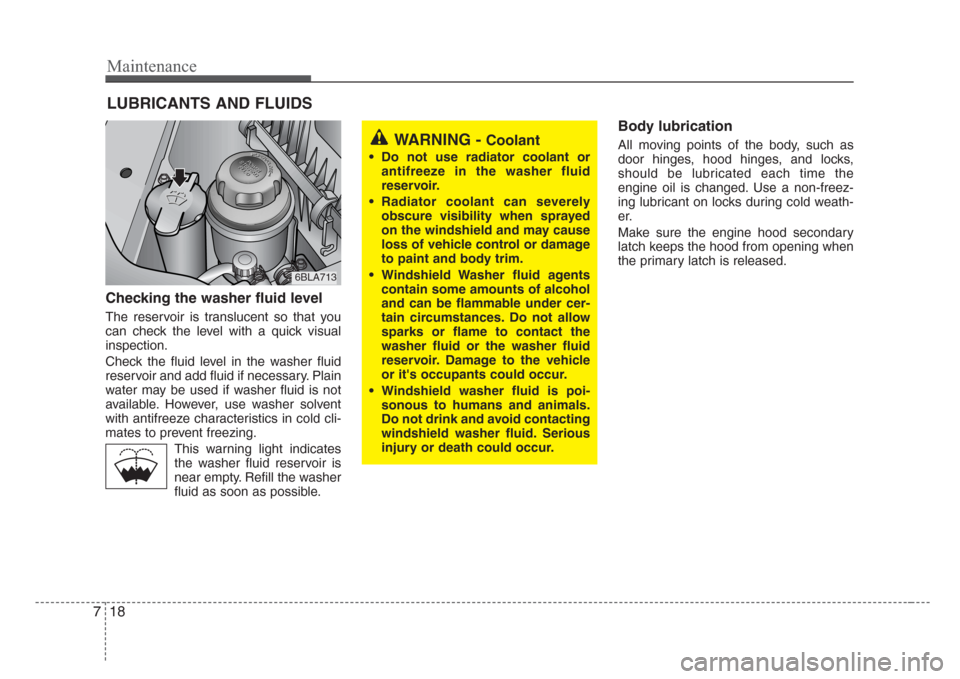
Checking the washer fluid level
The reservoir is translucent so that you
can check the level with a quick visual
inspection.
Check the fluid level in the washer fluid
reservoir and add fluid if necessary. Plain
water may be used if washer fluid is not
available. However, use washer solvent
with antifreeze characteristics in cold cli-
mates to prevent freezing.
This warning light indicates
the washer fluid reservoir is
near empty. Refill the washer
fluid as soon as possible.
Body lubrication
All moving points of the body, such as
door hinges, hood hinges, and locks,
should be lubricated each time the
engine oil is changed. Use a non-freez-
ing lubricant on locks during cold weath-
er.
Make sure the engine hood secondary
latch keeps the hood from opening when
the primary latch is released.WARNING - Coolant
• Do not use radiator coolant or
antifreeze in the washer fluid
reservoir.
• Radiator coolant can severely
obscure visibility when sprayed
on the windshield and may cause
loss of vehicle control or damage
to paint and body trim.
•Windshield Washer fluid agents
contain some amounts of alcohol
and can be flammable under cer-
tain circumstances. Do not allow
sparks or flame to contact the
washer fluid or the washer fluid
reservoir. Damage to the vehicle
or it's occupants could occur.
•Windshield washer fluid is poi-
sonous to humans and animals.
Do not drink and avoid contacting
windshield washer fluid. Serious
injury or death could occur.
6BLA713
Page 293 of 326
719
Maintenance
AIR CLEANER
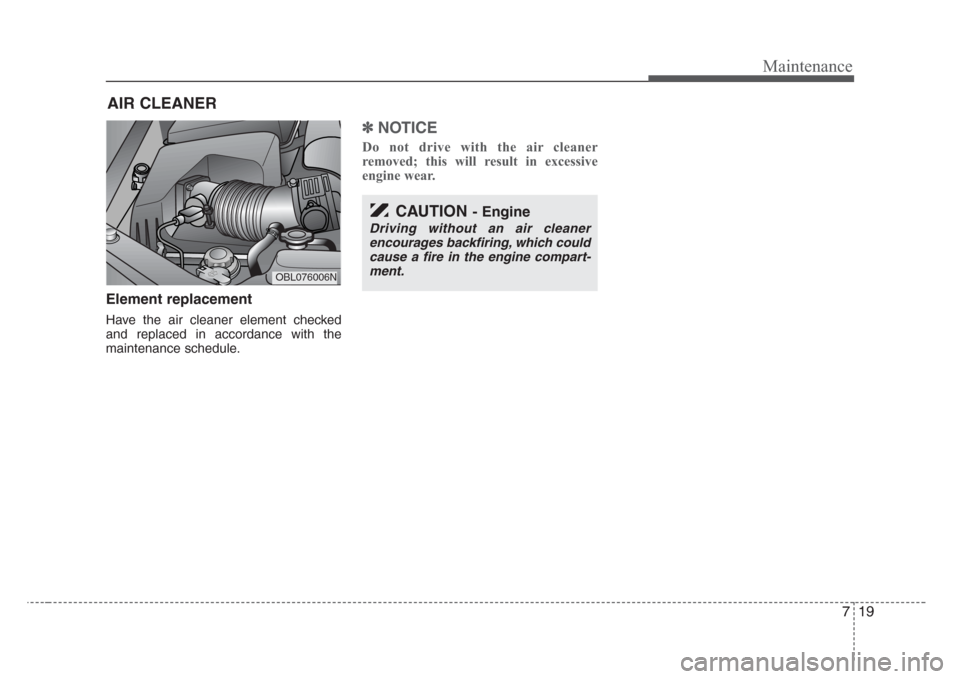
Element replacement
Have the air cleaner element checked
and replaced in accordance with the
maintenance schedule.
✽
NOTICE
Do not drive with the air cleaner
removed; this will result in excessive
engine wear.
OBL076006N
CAUTION- Engine
Driving without an air cleaner
encourages backfiring, which could
cause a fire in the engine compart-
ment.
Page 297 of 326
723
Maintenance
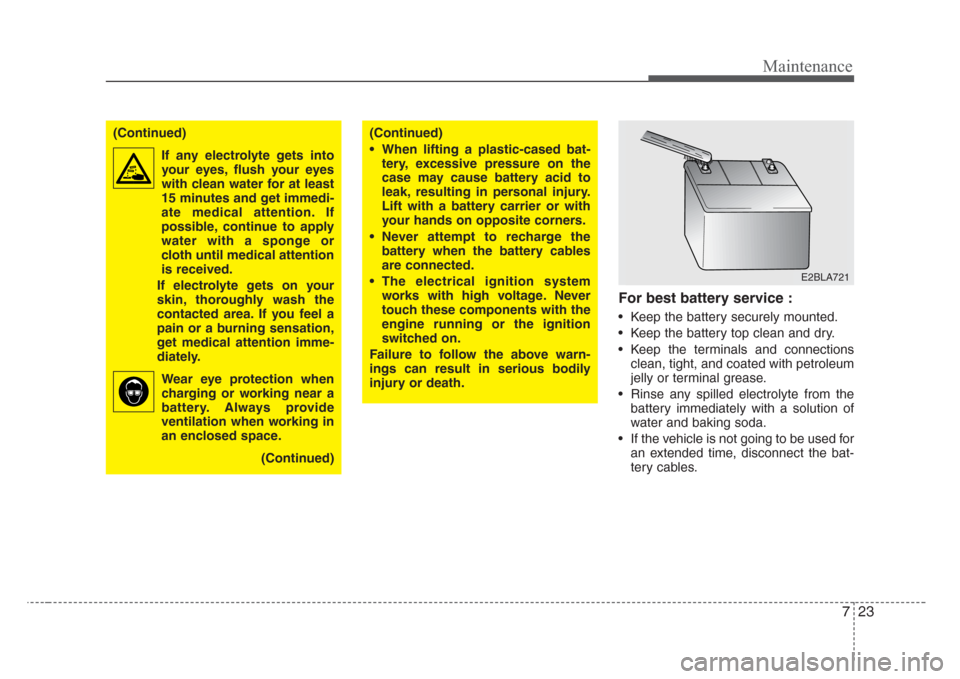
For best battery service :
• Keep the battery securely mounted.
• Keep the battery top clean and dry.
• Keep the terminals and connections
clean, tight, and coated with petroleum
jelly or terminal grease.
• Rinse any spilled electrolyte from the
battery immediately with a solution of
water and baking soda.
• If the vehicle is not going to be used for
an extended time, disconnect the bat-
tery cables.
(Continued)
If any electrolyte gets into
your eyes, flush your eyes
with clean water for at least
15 minutes and get immedi-
ate medical attention. If
possible, continue to apply
water with a sponge or
cloth until medical attention
is received.
If electrolyte gets on your
skin, thoroughly wash the
contacted area. If you feel a
pain or a burning sensation,
get medical attention imme-
diately.
Wear eye protection when
charging or working near a
battery. Always provide
ventilation when working in
an enclosed space.
(Continued)(Continued)
• When lifting a plastic-cased bat-
tery, excessive pressure on the
case may cause battery acid to
leak, resulting in personal injury.
Lift with a battery carrier or with
your hands on opposite corners.
• Never attempt to recharge the
battery when the battery cables
are connected.
• The electrical ignition system
works with high voltage. Never
touch these components with the
engine running or the ignition
switched on.
Failure to follow the above warn-
ings can result in serious bodily
injury or death.
E2BLA721
Page 298 of 326

Maintenance
24 7
Battery recharging
Your vehicle has a maintenance-free,
calcium-based battery.
• If the battery becomes discharged in a
short time (because, for example, the
headlights or interior lights were left on
while the vehicle was not in use),
recharge it by slow charging (trickle)
for 10 hours.
• If the battery gradually discharges
because of high electric load while the
vehicle is being used, recharge it at 20-
30A for two hours.
Items to be reset after the battery has
been discharged or the battery has
been disconnected.
• Clock (See Chapter 3)
• Trip computer (See Chapter 4)
• Compass (See Chapter 4)
• Climate control system (See Chapter 4)
• Audio (See Chapter 3)
WARNING- Recharging
battery
When recharging the battery,
observe the following precautions:
• The battery must be removed
from the vehicle and placed in an
area with good ventilation.
• Do not allow cigarettes,sparks,or
flame near the battery.
• Watch the battery during charg-
ing, and stop or reduce the charg-
ing rate if the battery cells begin
gassing (boiling) violently or if
the temperature of the electrolyte
of any cell exceeds 49°C (120°F).
• Wear eye protection when check-
ing the battery during charging.
•Disconnect the battery charger in
the following order.
1. Turn off the battery charger main
switch.
2. Unhook the negative clamp from
the negative battery terminal.
3. Unhook the positive clamp from
the positive battery terminal.
CAUTION
• Before performing maintenance
or recharging the battery, turn off
all accessories and stop the
engine.
• The negative battery cable must
be removed first and installed last
when the battery is disconnected.
Page 312 of 326
Maintenance
38 7
LUBRICANT SPECIFICATIONS
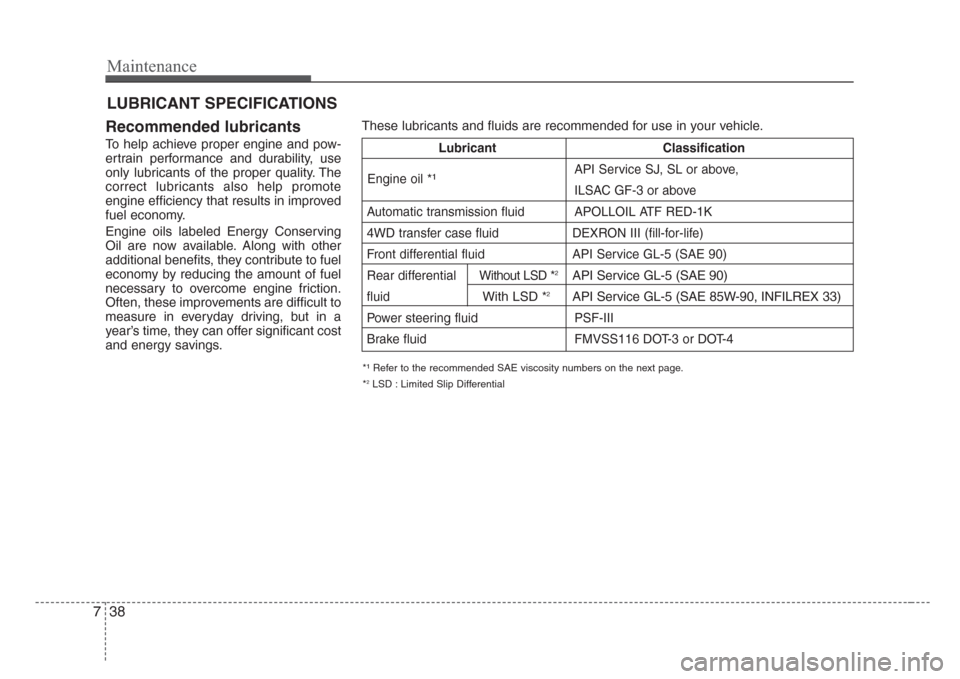
Recommended lubricants
To help achieve proper engine and pow-
ertrain performance and durability, use
only lubricants of the proper quality. The
correct lubricants also help promote
engine efficiency that results in improved
fuel economy.
Engine oils labeled Energy Conserving
Oil are now available. Along with other
additional benefits, they contribute to fuel
economy by reducing the amount of fuel
necessary to overcome engine friction.
Often, these improvements are difficult to
measure in everyday driving, but in a
year’s time, they can offer significant cost
and energy savings.
*¹ Refer to the recommended SAE viscosity numbers on the next page.
*
2LSD : Limited Slip Differential
These lubricants and fluids are recommended for use in your vehicle.
Lubricant Classification
API Service SJ, SL or above,
ILSAC GF-3 or above
Automatic transmission fluid APOLLOIL ATF RED-1K
4WD transfer case fluid DEXRON III (fill-for-life)
Front differential fluid API Service GL-5 (SAE 90)
Rear differential Without LSD *
2API Service GL-5 (SAE 90)
fluidWith LSD *2API Service GL-5 (SAE 85W-90, INFILREX 33)
Power steering fluid PSF-III
Brake fluid FMVSS116 DOT-3 or DOT-4
Engine oil *¹
Page 313 of 326
739
Maintenance
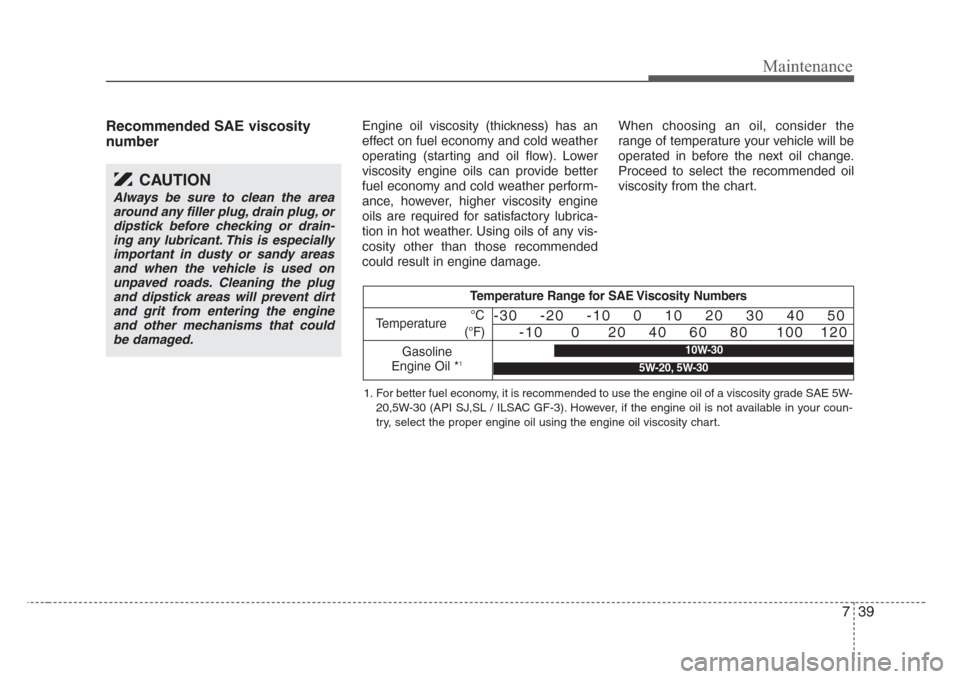
Recommended SAE viscosity
number Engine oil viscosity (thickness) has an
effect on fuel economy and cold weather
operating (starting and oil flow). Lower
viscosity engine oils can provide better
fuel economy and cold weather perform-
ance, however, higher viscosity engine
oils are required for satisfactory lubrica-
tion in hot weather. Using oils of any vis-
cosity other than those recommended
could result in engine damage.When choosing an oil, consider the
range of temperature your vehicle will be
operated in before the next oil change.
Proceed to select the recommended oil
viscosity from the chart.
Temperature Range for SAE Viscosity Numbers
Temperature
Gasoline
Engine Oil *
1
°C
(°F)-30 -20 -10 0 10 20 30 40 50
-10 0 20 40 60 80 100 120
1. For better fuel economy, it is recommended to use the engine oil of a viscosity grade SAE 5W-
20,5W-30 (API SJ,SL / ILSAC GF-3). However, if the engine oil is not available in your coun-
try, select the proper engine oil using the engine oil viscosity chart.
10W-30
5W-20, 5W-30
CAUTION
Always be sure to clean the area
around any filler plug, drain plug, or
dipstick before checking or drain-
ing any lubricant. This is especially
important in dusty or sandy areas
and when the vehicle is used on
unpaved roads. Cleaning the plug
and dipstick areas will prevent dirt
and grit from entering the engine
and other mechanisms that could
be damaged.
Page 314 of 326
Maintenance
40 7
EXTERIOR CARE
Exterior general caution
It is very important to follow the label
directions when using any chemical
cleaner or polish. Read all warning and
caution statements that appear on the
label.
Finish maintenance
Washing
To help protect your vehicle’s finish from
rust and deterioration, wash it thoroughly
and frequently at least once a month with
lukewarm or cold water.
If you use your vehicle for off-road driv-
ing, you should wash it after each off-
road trip. Pay special attention to the
removal of any accumulation of salt, dirt,
mud, and other foreign materials. Make
sure the drain holes in the lower edges of
the doors and rocker panels are kept
clear and clean.
Insects, tar, tree sap, bird droppings,
industrial pollution and similar deposits
can damage your vehicle’s finish if not
removed immediately.Even prompt washing with plain water
may not completely remove all these
deposits. A mild soap, safe for use on
painted surfaces, may be used.
After washing, rinse the vehicle thor-
oughly with lukewarm or cold water. Do
not allow soap to dry on the finish.
WARNING - Wet brakes
After washing the vehicle, test the
brakes while driving slowly to see if
they have been affected by water. If
braking performance is impaired,
dry the brakes by applying them
lightly while maintaining a slow for-
ward speed.
CAUTION
Do not use strong soap, chemical
detergents or hot water, and do not
wash the vehicle in direct sunlight
or when the body of the vehicle is
warm.
CAUTION
• Water washing in the engine com-
partment including high pressure
water washing may cause the fail-
ure of electrical circuits located in
the engine compartment.
• Never allow water or other liquids
to come in contact with electri-
cal/electronic components inside
the vehicle as this may damage
them.
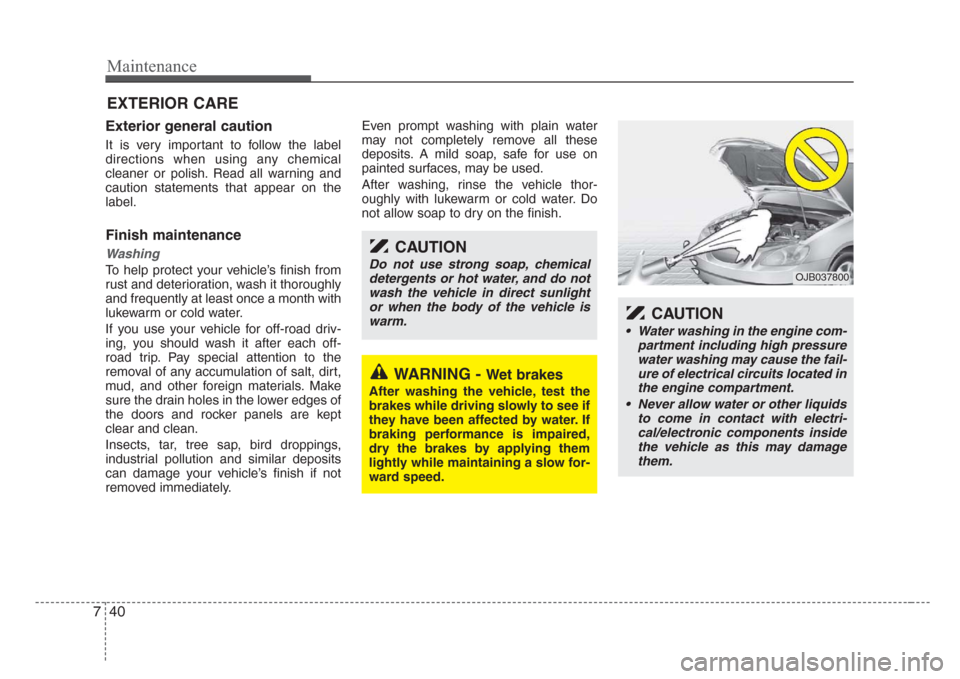
OJB037800
Page 322 of 326
Specifications
4 8
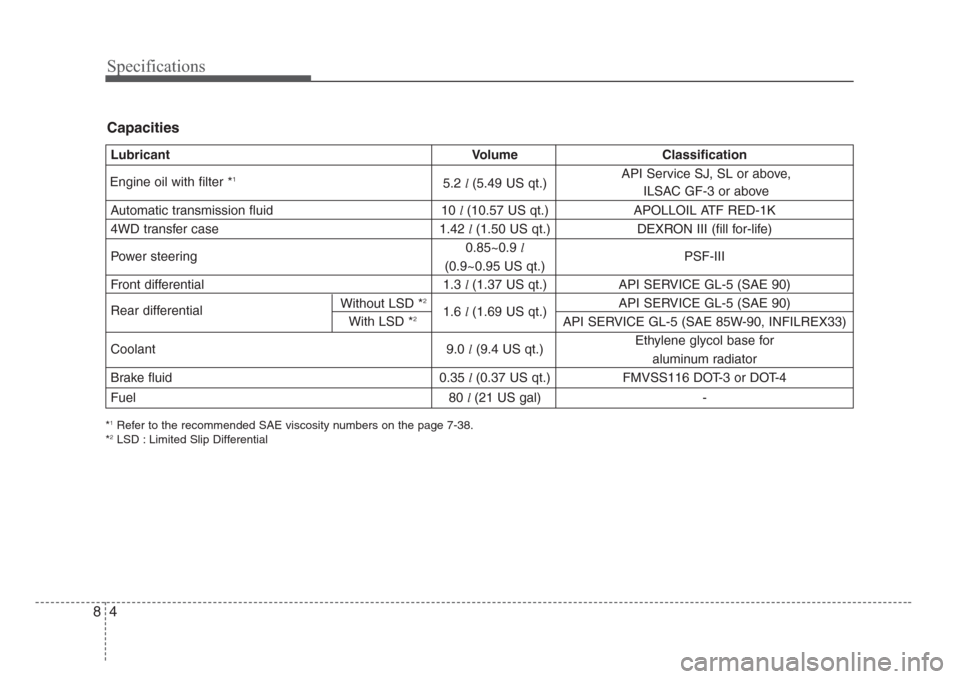
Capacities
*1Refer to the recommended SAE viscosity numbers on the page 7-38.
*2LSD : Limited Slip Differential
Lubricant Volume Classification
5.2l(5.49 US qt.)
Automatic transmission fluid 10 l(10.57 US qt.) APOLLOIL ATF RED-1K
4WD transfer case 1.42 l(1.50 US qt.) DEXRON III (fill for-life)
Power steering0.85~0.9l
PSF-III
(0.9~0.95 US qt.)
Front differential 1.3 l(1.37 US qt.) API SERVICE GL-5 (SAE 90)
Rear differentialAPI SERVICE GL-5 (SAE 90)
1.6l(1.69 US qt.)
API SERVICE GL-5 (SAE 85W-90, INFILREX33)
Coolant 9.0 l(9.4 US qt.)Ethylene glycol base for
aluminum radiator
Brake fluid 0.35 l(0.37 US qt.) FMVSS116 DOT-3 or DOT-4
Fuel 80 l(21 US gal) -
Engine oil with filter *1
Without LSD *2
With LSD *2
API Service SJ, SL or above,
ILSAC GF-3 or above
Page 324 of 326
Index
2 9
Air bags - advanced supplemental restraint
system ········································································3-47
Air cleaner ····································································7-19
Antenna ·········································································3-98
Audio remote control···················································3-99
Audio system ······························································3-100
Auto fuel cutoff switch ················································3-74
Automatic climate control system ······························4-66
Automatic transmission ········································4-5,7-16
Battery···········································································7-22
Before driving·································································5-5
Brake fluid ····································································7-14
Brake system ································································4-20
Climate control air filter ·············································7-20
Cruise control system ··················································4-27
Defroster ·······································································4-57
Door locks ·······································································3-7Electrical circuit protection ··········································6-7
Electronic stability control ··········································4-30
Emergency starting························································6-4
Emission control system ················································5-3
Engine compartment ·············································2-3,7-10
Engine cooling system ·················································7-12
Engine oil ······································································7-11
Exterior care·································································7-39
Four wheel drive (4WD)··············································4-10
Fuel filler lid ·································································3-71
Fuel requirements ··························································5-2
Gauges ···········································································4-37
Hazard warning flasher ··············································4-58
Homelink® wireless control system ···························3-78
Hood ··············································································3-69
How to use this manual ·················································1-2
A
B
C
D
E
F
G
H
Page 325 of 326
93
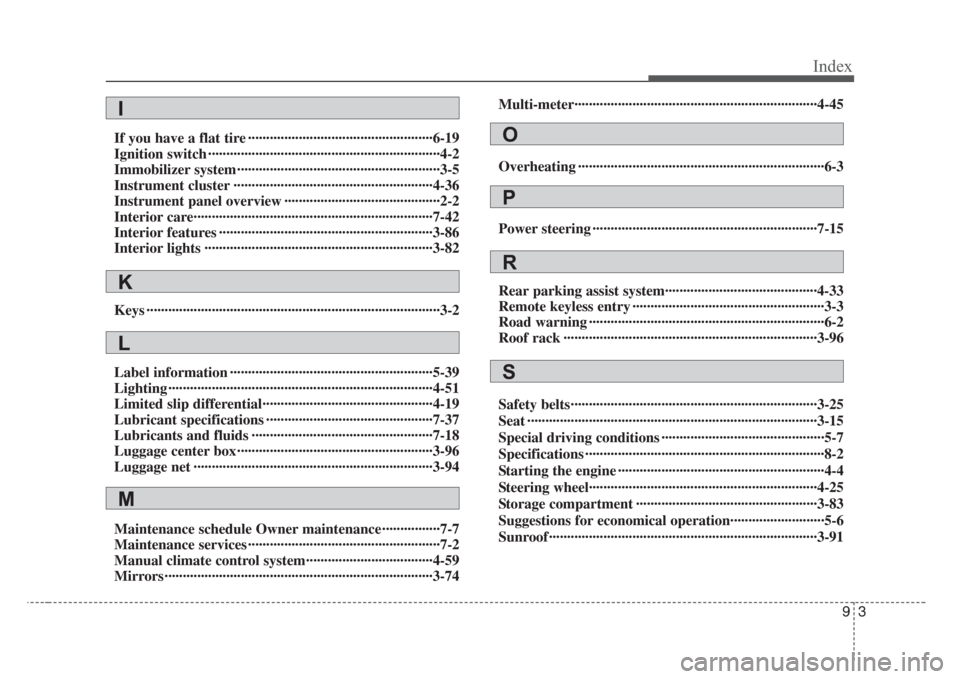
Index
If you have a flat tire ···················································6-19
Ignition switch ································································4-2
Immobilizer system ························································3-5
Instrument cluster ·······················································4-36
Instrument panel overview ···········································2-2
Interior care··································································7-42
Interior features ···························································3-86
Interior lights ·······························································3-82
Keys ·················································································3-2
Label information ························································5-39
Lighting·········································································4-51
Limited slip differential···············································4-19
Lubricant specifications ··············································7-37
Lubricants and fluids ··················································7-18
Luggage center box ······················································3-96
Luggage net ··································································3-94
Maintenance schedule Owner maintenance ················7-7
Maintenance services ·····················································7-2
Manual climate control system···································4-59
Mirrors ··········································································3-74Multi-meter···································································4-45
Overheating····································································6-3
Power steering······························································7-15
Rear parking assist system··········································4-33
Remote keyless entry ·····················································3-3
Road warning·································································6-2
Roof rack ······································································3-96
Safety belts····································································3-25
Seat ················································································3-15
Special driving conditions ·············································5-7
Specifications ··································································8-2
Starting the engine ·························································4-4
Steering wheel·······························································4-25
Storage compartment ··················································3-83
Suggestions for economical operation··························5-6
Sunroof ··········································································3-91
K
L
M
I
O
P
R
S