engine coolant KIA Sorento 2008 1.G User Guide
[x] Cancel search | Manufacturer: KIA, Model Year: 2008, Model line: Sorento, Model: KIA Sorento 2008 1.GPages: 326, PDF Size: 8.63 MB
Page 284 of 326
Maintenance
10 7
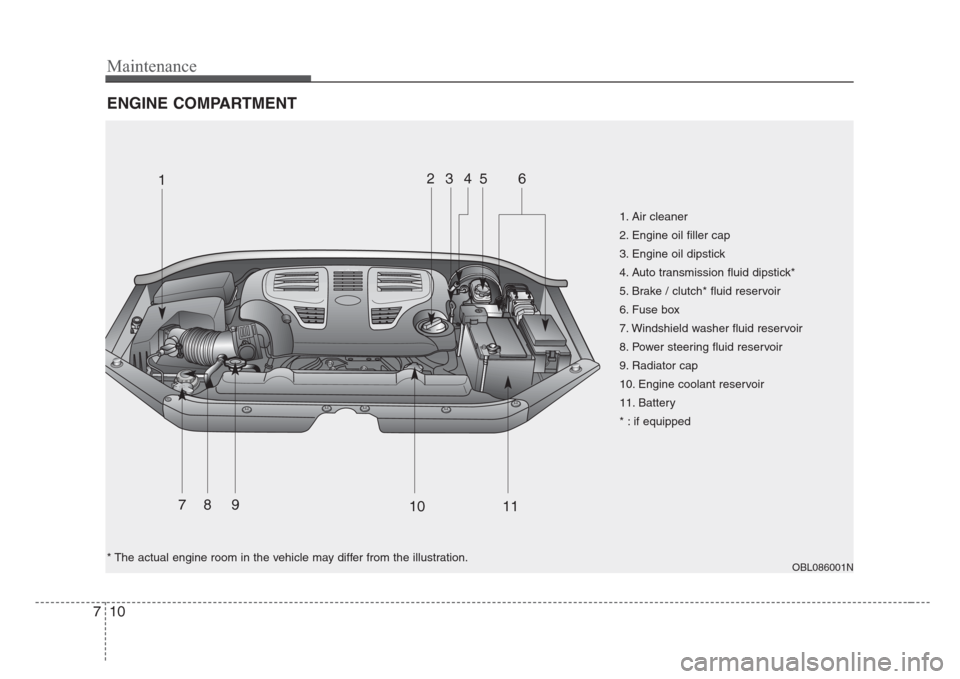
ENGINE COMPARTMENT
OBL086001N
1. Air cleaner
2. Engine oil filler cap
3. Engine oil dipstick
4. Auto transmission fluid dipstick*
5. Brake / clutch* fluid reservoir
6. Fuse box
7. Windshield washer fluid reservoir
8. Power steering fluid reservoir
9. Radiator cap
10. Engine coolant reservoir
11. Battery
* : if equipped
1435 62
7
89
1110
* The actual engine room in the vehicle may differ from the illustration.
Page 286 of 326
Maintenance
12 7
ENGINE COOLING SYSTEM
The high-pressure cooling system has a
reservoir filled with a mixture of
antifreeze and water. The reservoir is
filled at the factory.
Check the antifreeze protection and
coolant level at least once a year, at the
beginning of the winter season, and
before traveling to a colder climate.
Checking the coolant level
Check the condition and connections of
all cooling system hoses and heater
hoses. Replace any swollen or deterio-
rated hoses.
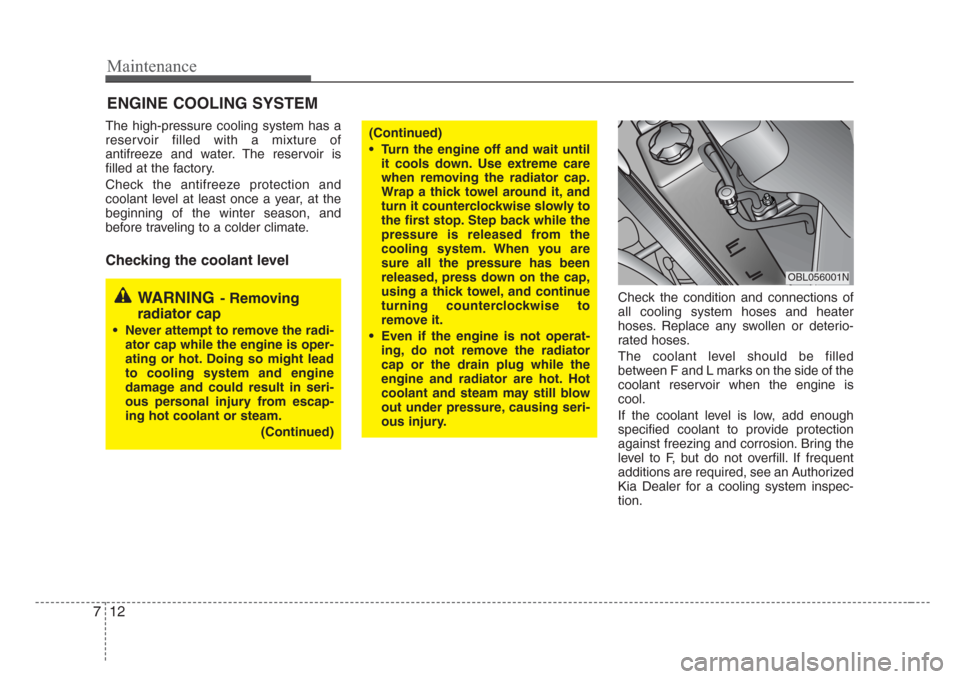
The coolant level should be filled
between F and L marks on the side of the
coolant reservoir when the engine is
cool.
If the coolant level is low, add enough
specified coolant to provide protection
against freezing and corrosion. Bring the
level to F, but do not overfill. If frequent
additions are required, see an Authorized
Kia Dealer for a cooling system inspec-
tion.WARNING- Removing
radiator cap
• Never attempt to remove the radi-
ator cap while the engine is oper-
ating or hot. Doing so might lead
to cooling system and engine
damage and could result in seri-
ous personal injury from escap-
ing hot coolant or steam.
(Continued)
(Continued)
• Turn the engine off and wait until
it cools down. Use extreme care
when removing the radiator cap.
Wrap a thick towel around it, and
turn it counterclockwise slowly to
the first stop. Step back while the
pressure is released from the
cooling system. When you are
sure all the pressure has been
released, press down on the cap,
using a thick towel, and continue
turning counterclockwise to
remove it.
• Even if the engine is not operat-
ing, do not remove the radiator
cap or the drain plug while the
engine and radiator are hot. Hot
coolant and steam may still blow
out under pressure, causing seri-
ous injury.
OBL056001N
Page 287 of 326
713
Maintenance
Changing coolant
Have coolant changed by an Authorized
Kia Dealer according to the Maintenance
Schedule at the beginning of this section.
• Use only soft (de-mineralized) water in
the coolant mixture.
• The engine in your vehicle has alu-
minum engine parts and must be pro-
tected by an ethylene-glycol-based
coolant to prevent corrosion and freez-
ing.
• DO NOT USE alcohol or methanol
coolant or mix them with the specified
coolant.
• Do not use a solution that contains
more than 60% antifreeze or less than
35% antifreeze, which would reduce
the effectiveness of the solution.For mixture percentage, refer to the fol-
lowing table.
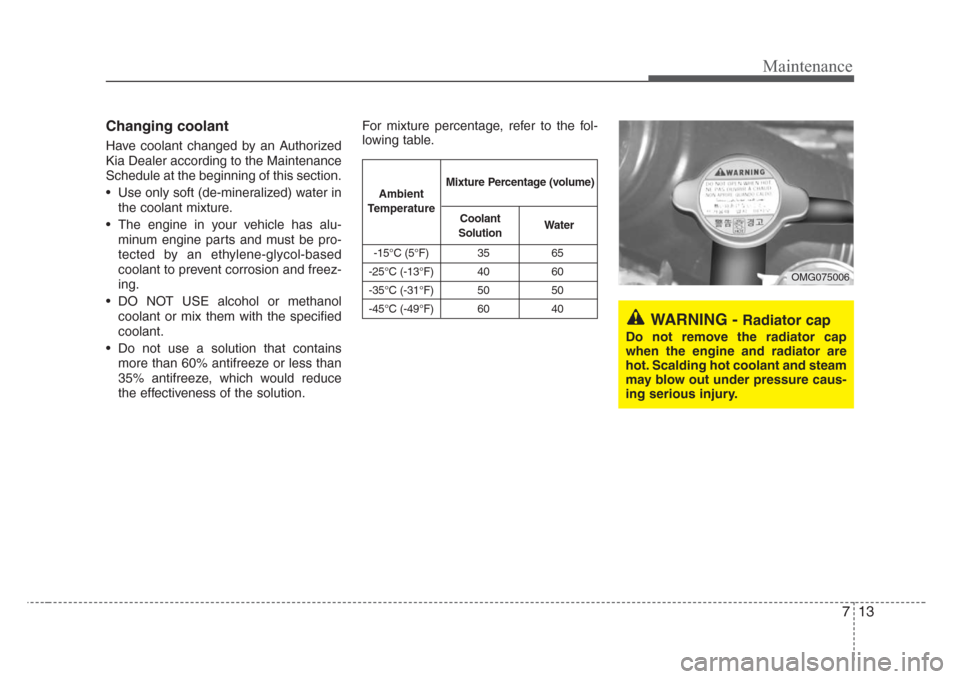
WARNING - Radiator cap
Do not remove the radiator cap
when the engine and radiator are
hot. Scalding hot coolant and steam
may blow out under pressure caus-
ing serious injury.
-15°C (5°F) 35 65
-25°C (-13°F) 40 60
-35°C (-31°F) 50 50
-45°C (-49°F) 60 40
Ambient
TemperatureMixture Percentage (volume)
Coolant
SolutionWater
OMG075006
Page 292 of 326
Maintenance
18 7
LUBRICANTS AND FLUIDS
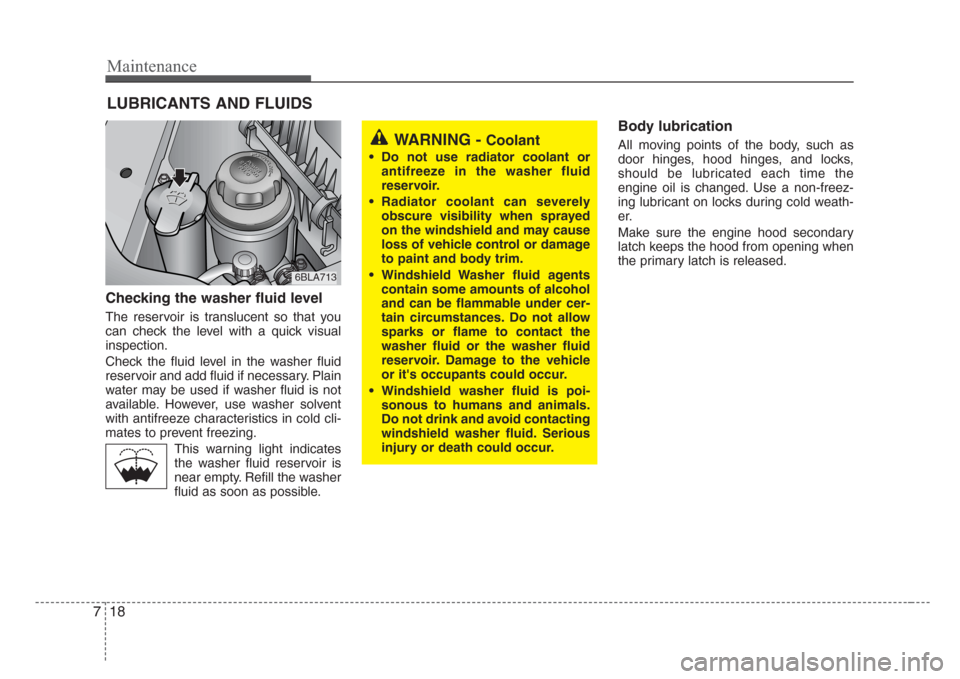
Checking the washer fluid level
The reservoir is translucent so that you
can check the level with a quick visual
inspection.
Check the fluid level in the washer fluid
reservoir and add fluid if necessary. Plain
water may be used if washer fluid is not
available. However, use washer solvent
with antifreeze characteristics in cold cli-
mates to prevent freezing.
This warning light indicates
the washer fluid reservoir is
near empty. Refill the washer
fluid as soon as possible.
Body lubrication
All moving points of the body, such as
door hinges, hood hinges, and locks,
should be lubricated each time the
engine oil is changed. Use a non-freez-
ing lubricant on locks during cold weath-
er.
Make sure the engine hood secondary
latch keeps the hood from opening when
the primary latch is released.WARNING - Coolant
• Do not use radiator coolant or
antifreeze in the washer fluid
reservoir.
• Radiator coolant can severely
obscure visibility when sprayed
on the windshield and may cause
loss of vehicle control or damage
to paint and body trim.
•Windshield Washer fluid agents
contain some amounts of alcohol
and can be flammable under cer-
tain circumstances. Do not allow
sparks or flame to contact the
washer fluid or the washer fluid
reservoir. Damage to the vehicle
or it's occupants could occur.
•Windshield washer fluid is poi-
sonous to humans and animals.
Do not drink and avoid contacting
windshield washer fluid. Serious
injury or death could occur.
6BLA713
Page 322 of 326
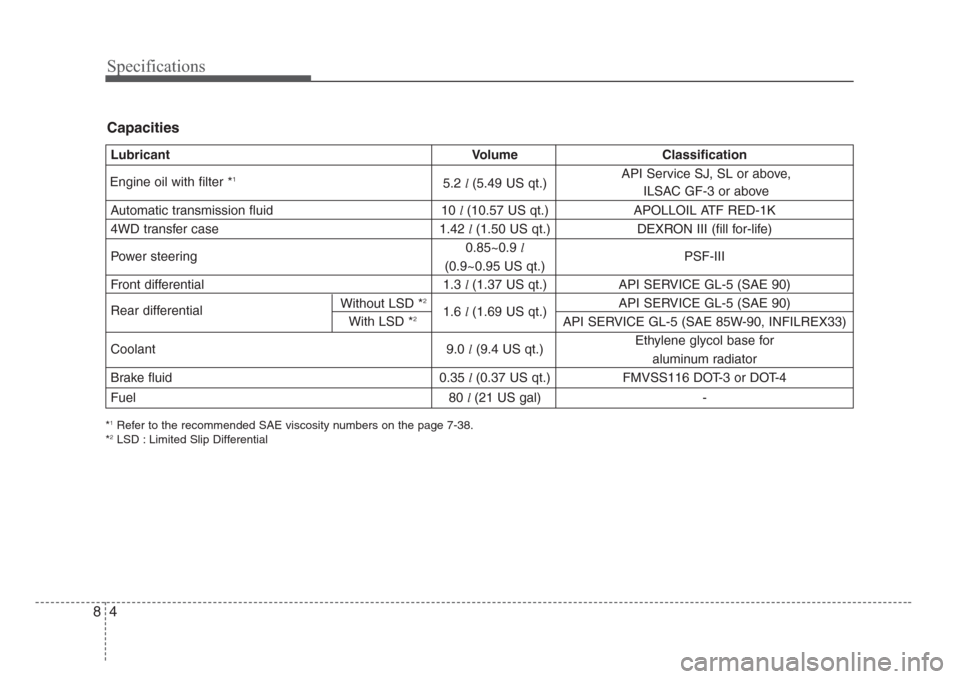
Specifications
4 8
Capacities
*1Refer to the recommended SAE viscosity numbers on the page 7-38.
*2LSD : Limited Slip Differential
Lubricant Volume Classification
5.2l(5.49 US qt.)
Automatic transmission fluid 10 l(10.57 US qt.) APOLLOIL ATF RED-1K
4WD transfer case 1.42 l(1.50 US qt.) DEXRON III (fill for-life)
Power steering0.85~0.9l
PSF-III
(0.9~0.95 US qt.)
Front differential 1.3 l(1.37 US qt.) API SERVICE GL-5 (SAE 90)
Rear differentialAPI SERVICE GL-5 (SAE 90)
1.6l(1.69 US qt.)
API SERVICE GL-5 (SAE 85W-90, INFILREX33)
Coolant 9.0 l(9.4 US qt.)Ethylene glycol base for
aluminum radiator
Brake fluid 0.35 l(0.37 US qt.) FMVSS116 DOT-3 or DOT-4
Fuel 80 l(21 US gal) -
Engine oil with filter *1
Without LSD *2
With LSD *2
API Service SJ, SL or above,
ILSAC GF-3 or above