ignition KIA Sorento 2008 1.G User Guide
[x] Cancel search | Manufacturer: KIA, Model Year: 2008, Model line: Sorento, Model: KIA Sorento 2008 1.GPages: 326, PDF Size: 8.63 MB
Page 29 of 326
Knowing your vehicle
20 3
Lumbar support (For driver’s
seat, if equipped)
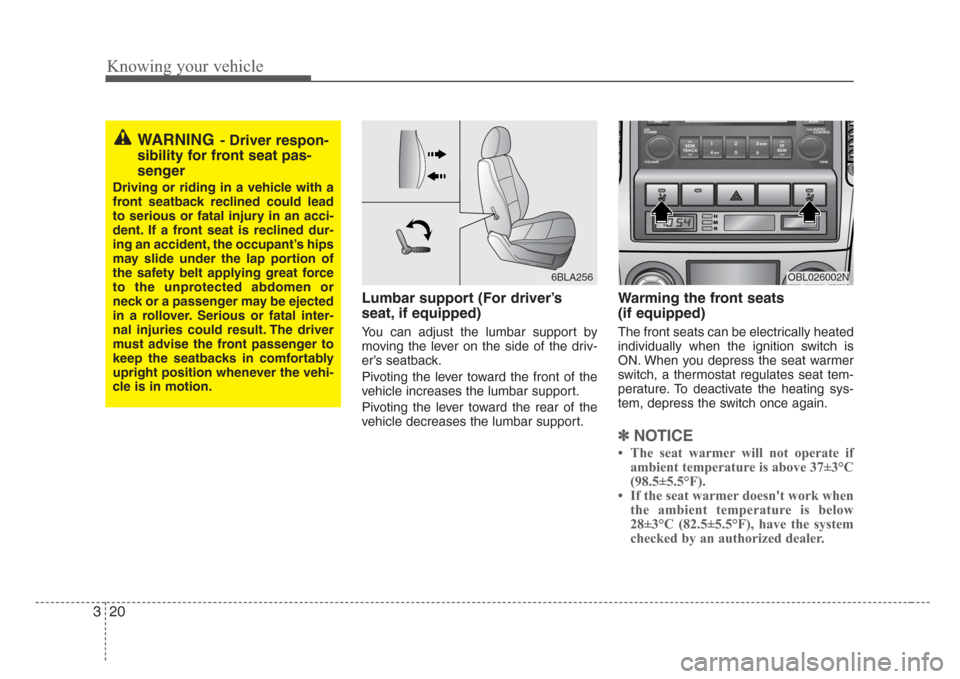
You can adjust the lumbar support by
moving the lever on the side of the driv-
er’s seatback.
Pivoting the lever toward the front of the
vehicle increases the lumbar support.
Pivoting the lever toward the rear of the
vehicle decreases the lumbar support.
Warming the front seats
(if equipped)
The front seats can be electrically heated
individually when the ignition switch is
ON. When you depress the seat warmer
switch, a thermostat regulates seat tem-
perature. To deactivate the heating sys-
tem, depress the switch once again.
✽
NOTICE
The seat warmer will not operate if
ambient temperature is above 37±3°C
(98.5±5.5°F).
If the seat warmer doesn't work when
the ambient temperature is below
28±3°C (82.5±5.5°F), have the system
checked by an authorized dealer.
OBL026002N
WARNING- Driver respon-
sibility for front seat pas-
senger
Driving or riding in a vehicle with a
front seatback reclined could lead
to serious or fatal injury in an acci-
dent. If a front seat is reclined dur-
ing an accident, the occupant’s hips
may slide under the lap portion of
the safety belt applying great force
to the unprotected abdomen or
neck or a passenger may be ejected
in a rollover. Serious or fatal inter-
nal injuries could result. The driver
must advise the front passenger to
keep the seatbacks in comfortably
upright position whenever the vehi-
cle is in motion.
6BLA256
Page 34 of 326
325
Knowing your vehicle
Pre-tensioner safety belt
Your vehicle is equipped with driver's and
front passenger's pre-tensioner safety
belts. The purpose of the pre-tensioner
is to make sure that excess slack is taken
up in certain frontal collisions. The pre-
tensioners may activate along with the
front air bags in frontal collisions based
on angle of impact, seat belt usage and
impact severity.
✽
NOTICE
The pre-tensioner seat belt is installed at
the front seats, and the sensor is
equipped inside the buckle, where pres-
ence of passenger is sensed by the fas-
tening of the seat belts. Therefore, pre-
tensioner will not activate if the passen-
ger is not fastened with the seat belts.
Likewise, it will activate if buckled even
without a passenger in the seat. Pre-ten-
sioner seat belt is designed to activate
when the seatbelt is in use. To ensure the
pretensioner seatbelts activate in event
of a possible seatbelt buckle switch mal-
function, the system is designed to acti-
vate regardless of whether a seat belt is
in use or if no seat belt use is detected
within 6 seconds of turning the ignition
switch ON.
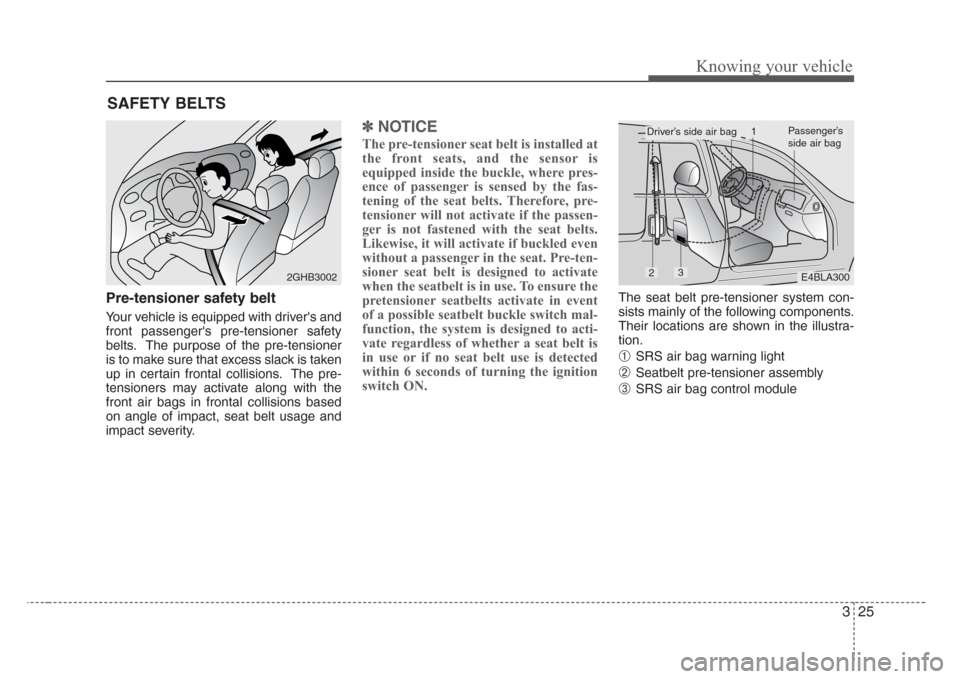
The seat belt pre-tensioner system con-
sists mainly of the following components.
Their locations are shown in the illustra-
tion.
➀ SRS air bag warning light
➁ Seatbelt pre-tensioner assembly
➂ SRS air bag control module
SAFETY BELTS
2GHB3002E4BLA30023
1Passenger’s
side air bagDriver’s side air bag
Page 58 of 326
349
Knowing your vehicle
Air bag system components
The main components of your SRS are:
• To indicate that your vehicle is
equipped with air bags, the corre-
sponding air bag covers are marked
with “SRS AIR BAG”.
- Driver’s air bag
- Driver’s knee air bag
- Front passenger’s air bag
- Curtain air bag
• A diagnostic system that continually
monitors the system operation.
• An indicator light to warn you of a pos-
sible problem with the system.
• Emergency power backup in case your
car’s electrical system is disconnected
in a crash.
Your vehicles SRS uses a variety of sen-
sors to monitor the driver’s and front pas-
senger’s safety belt usage and impact
severity.
The safety belt usage sensors determine
if the driver and front passenger’s safety
belts are fastened. These sensors pro-
vide the ability to control the SRS deploy-
ment based on whether or not the safety
belts are fastened, and how severe the
impact is.The advanced SRS offers the ability to
control the air bag inflation with two lev-
els. A first stage level is provided for mod-
erate-severity impacts. A second stage
level is provided for more severe impacts.
According to the impact severity and
safety belt usage, the SRSCM (SRS
Control Module) controls the air bag infla-
tion. Failure to properly wear safety belts
can increase the risk or severity of injury
in an accident.
Additionally, your SRS is equipped with
an occupant classification system in the
front passenger’s seat. The occupant
classification system detects the pres-
ence of a passenger in the front passen-
ger’s seat and will turn off the front pas-
senger’s air bag under certain conditions.
For more detail, see “Occupant
Classification System” later in this sec-
tion.
(Continued)
They will generally not provide
protection in side impacts (except
curtain air bags) or rear impacts,
rollovers,less severe frontal colli-
sions. They will not provide pro-
tection from later impacts in a
multi-impact collision.
• If your vehicle has been subject-
ed to flood conditions (e.g.
soaked carpeting/standing water
on the floor of the vehicle, etc.) or
if your vehicle has become flood
damaged in any way, do not
attempt to start the vehicle or put
the key in the ignition before dis-
connecting the battery. This may
cause air bag deployment, which
could result in serious personal
injury or death. If your vehicle has
been subjected to flooded condi-
tions, before attempting to start
the vehicle, have the vehicle
towed to an authorized Kia dealer
for inspection and necessary
repairs.
Page 62 of 326
353
Knowing your vehicle
• The "PASSENGER AIR BAG OFF"
indicator illuminates after the ignition
key is turned to the "ON" position or
after the engine is started. If the front
passenger seat is unoccupied or is
occupied by very small person, or is
occupied by someone who is improp-
erly seated, the "PASSENGER AIR
BAG OFF" indicator will remain illumi-
nated and the front passenger air bag
will not deploy in frontal crashes. If the
front passenger seat is occupied by
someone of adult size and body
shape, the "PASSENGER AIR BAG
OFF" indicator will turn off after 6 sec-
onds and the front passenger's air bag
will deploy in frontal crashes.
• If the "PASSENGER AIR BAG OFF"
indicator illuminates, the front passen-
ger air bag will not deploy in either a
side or frontal collision.
• If the "PASSENGER AIR BAG OFF"
indicator is not illuminated, the front
passenger air bag may deploy in
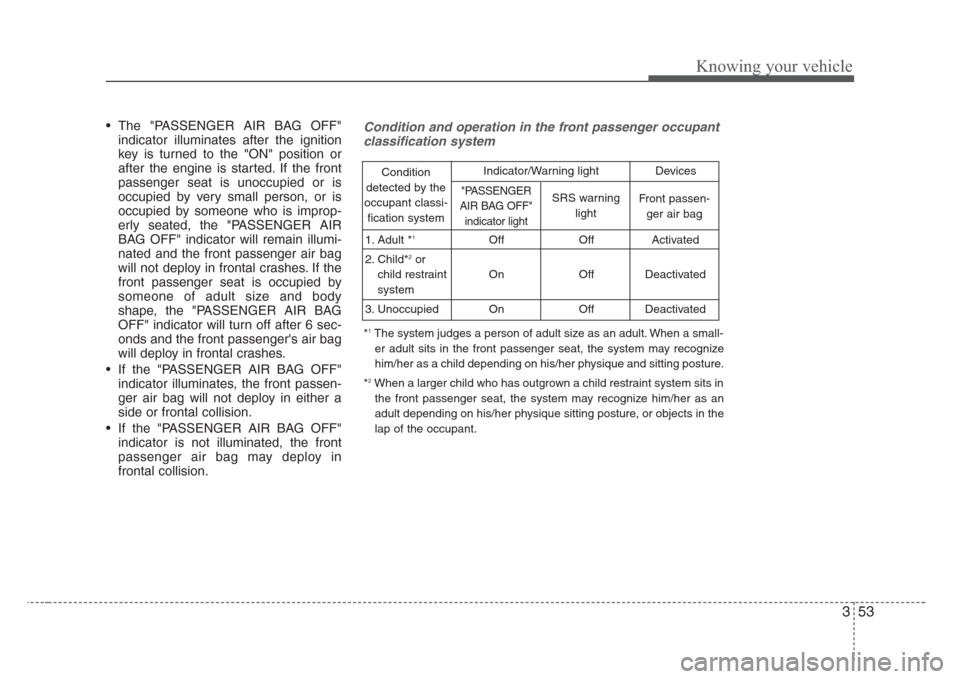
frontal collision.Condition and operation in the front passenger occupant
classification system
*1The system judges a person of adult size as an adult. When a small-
er adult sits in the front passenger seat, the system may recognize
him/her as a child depending on his/her physique and sitting posture.
*
2When a larger child who has outgrown a child restraint system sits in
the front passenger seat, the system may recognize him/her as an
adult depending on his/her physique sitting posture, or objects in the
lap of the occupant.
Condition
detected by the
occupant classi-
fication system
1. Adult *
1
2. Child*2or
child restraint
system
3. Unoccupied Off
On
OnOff
Off
OffActivated
Deactivated
Deactivated
"PASSENGER
AIR BAG OFF"
indicator lightSRS warning
lightFront passen-
ger air bag Indicator/Warning light Devices
Page 63 of 326
Knowing your vehicle
54 3
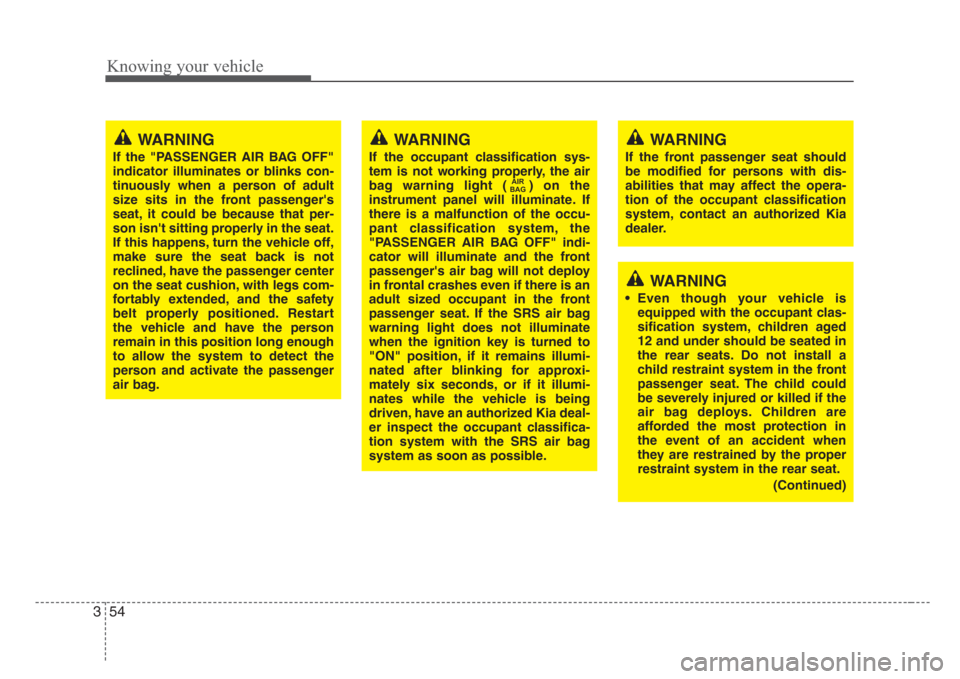
WARNING
If the front passenger seat should
be modified for persons with dis-
abilities that may affect the opera-
tion of the occupant classification
system, contact an authorized Kia
dealer.
WARNING
If the "PASSENGER AIR BAG OFF"
indicator illuminates or blinks con-
tinuously when a person of adult
size sits in the front passenger's
seat, it could be because that per-
son isn't sitting properly in the seat.
If this happens, turn the vehicle off,
make sure the seat back is not
reclined, have the passenger center
on the seat cushion, with legs com-
fortably extended, and the safety
belt properly positioned. Restart
the vehicle and have the person
remain in this position long enough
to allow the system to detect the
person and activate the passenger
air bag.
WARNING
If the occupant classification sys-
tem is not working properly, the air
bag warning light ( ) on the
instrument panel will illuminate. If
there is a malfunction of the occu-
pant classification system, the
"PASSENGER AIR BAG OFF" indi-
cator will illuminate and the front
passenger's air bag will not deploy
in frontal crashes even if there is an
adult sized occupant in the front
passenger seat. If the SRS air bag
warning light does not illuminate
when the ignition key is turned to
"ON" position, if it remains illumi-
nated after blinking for approxi-
mately six seconds, or if it illumi-
nates while the vehicle is being
driven, have an authorized Kia deal-
er inspect the occupant classifica-
tion system with the SRS air bag
system as soon as possible.
AIR
BAG
WARNING
• Even though your vehicle is
equipped with the occupant clas-
sification system, children aged
12 and under should be seated in
the rear seats. Do not install a
child restraint system in the front
passenger seat. The child could
be severely injured or killed if the
air bag deploys. Children are
afforded the most protection in
the event of an accident when
they are restrained by the proper
restraint system in the rear seat.
(Continued)
Page 73 of 326
Knowing your vehicle
64 3
How does the air bag system
operate
• Air bag only operates when the ignition
switch is turned to ON or START posi-
tion.
• Air bags inflate instantly in the event of
serious frontal or side collision in order
to help protect the occupants from seri-
ous physical injury.
• There is no single speed at which the
air bags will inflate.
Generally, air bags are designed to
inflate by the severity of a collision and
its direction. These two factors deter-
mine whether the sensors send out an
electronic deployment/inflation signal.
• Air bag deployment depends on a
number of factors including vehicle
speed, angles of impact and the densi-
ty and stiffness of the vehicles or
objects which your vehicle hits in the
collision. Though, factors are not limit-
ed to those mentioned above.
• The front air bags will completely
inflate and deflate in an instant.
It is virtually impossible for you to see
the air bags inflate during an accident.
It is much more likely that you will sim-
ply see the deflated air bags hanging
out of their storage compartments after
the collision.• In order to help provide protection in a
severe collision, the air bags must
inflate rapidly. The speed of air bag
inflation has been determined by the
Canadian Motor Vehicle Safety
Standards (CMVSS) to reduce the like-
lihood of serious or life-threatening
injuries and is thus a mandatory part of
the air bag design.
However, air bag inflation can also
cause injuries which normally can
include facial abrasions, bruises and
broken bones, and sometimes more
serious injuries because the inflation
speed also causes the air bags to
expand with a great deal of force.
• There are even circumstances
under which contact with the steer-
ing wheel air bag can cause fatal
injuries,especially if the occupant
is positioned excessively close to
the steering wheel.
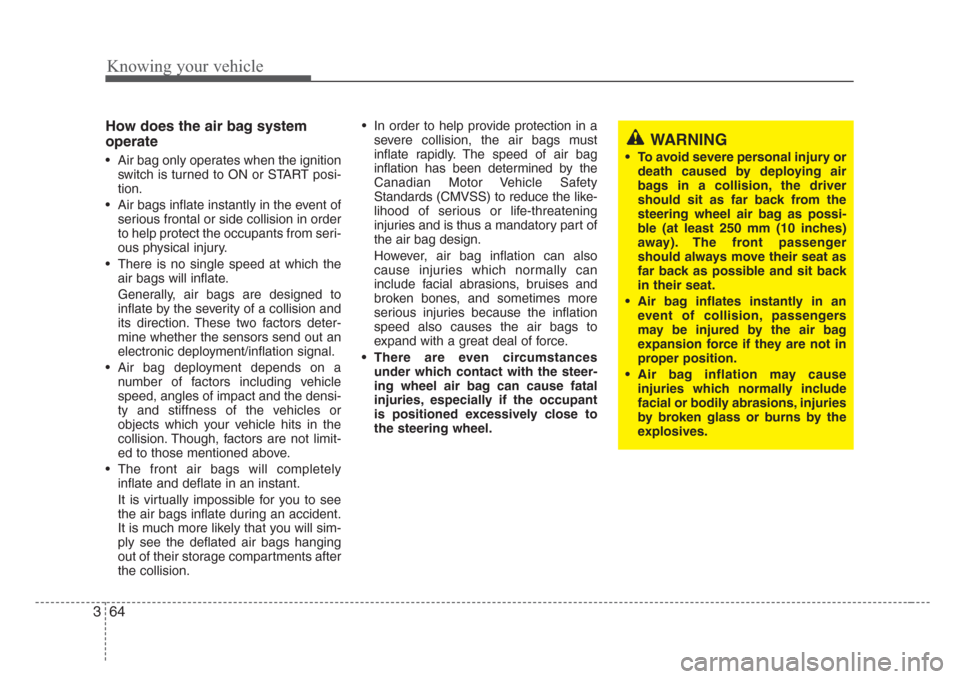
WARNING
• To avoid severe personal injury or
death caused by deploying air
bags in a collision, the driver
should sit as far back from the
steering wheel air bag as possi-
ble (at least 250 mm (10 inches)
away). The front passenger
should always move their seat as
far back as possible and sit back
in their seat.
• Air bag inflates instantly in an
event of collision, passengers
may be injured by the air bag
expansion force if they are not in
proper position.
• Air bag inflation may cause
injuries which normally include
facial or bodily abrasions, injuries
by broken glass or burns by the
explosives.
Page 75 of 326
Knowing your vehicle
66 3
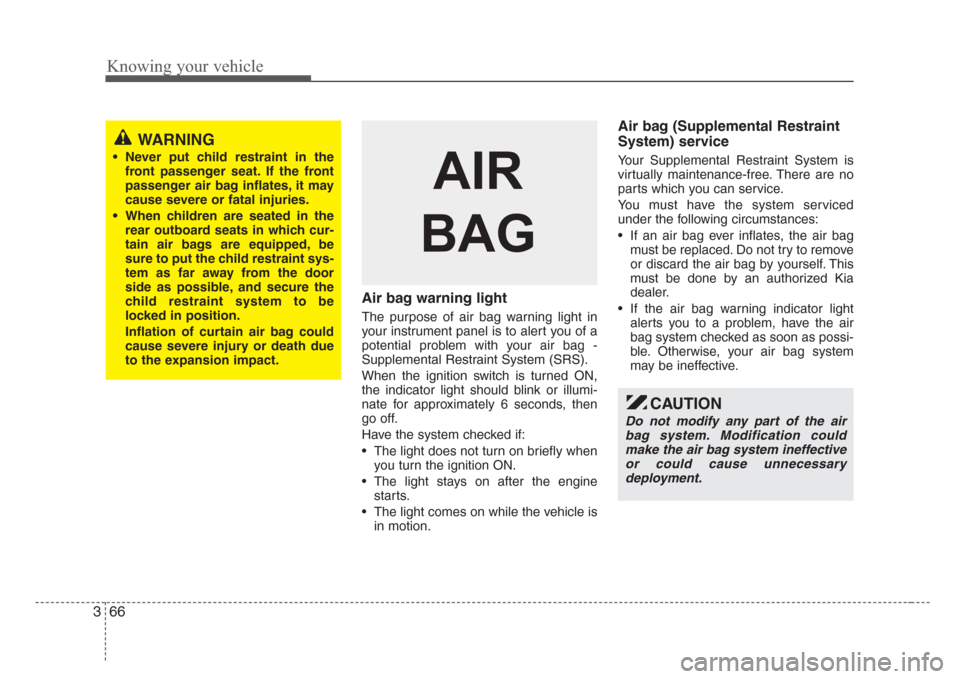
Air bag warning light
The purpose of air bag warning light in
your instrument panel is to alert you of a
potential problem with your air bag -
Supplemental Restraint System (SRS).
When the ignition switch is turned ON,
the indicator light should blink or illumi-
nate for approximately 6 seconds, then
go off.
Have the system checked if:
• The light does not turn on briefly when
you turn the ignition ON.
• The light stays on after the engine
starts.
• The light comes on while the vehicle is
in motion.
Air bag (Supplemental Restraint
System) service
Your Supplemental Restraint System is
virtually maintenance-free. There are no
parts which you can service.
You must have the system serviced
under the following circumstances:
• If an air bag ever inflates, the air bag
must be replaced. Do not try to remove
or discard the air bag by yourself. This
must be done by an authorized Kia
dealer.
• If the air bag warning indicator light
alerts you to a problem, have the air
bag system checked as soon as possi-
ble. Otherwise, your air bag system
may be ineffective.
WARNING
• Never put child restraint in the
front passenger seat. If the front
passenger air bag inflates, it may
cause severe or fatal injuries.
• When children are seated in the
rear outboard seats in which cur-
tain air bags are equipped, be
sure to put the child restraint sys-
tem as far away from the door
side as possible, and secure the
child restraint system to be
locked in position.
Inflation of curtain air bag could
cause severe injury or death due
to the expansion impact.
AIR
BAG
CAUTION
Do not modify any part of the air
bag system. Modification could
make the air bag system ineffective
or could cause unnecessary
deployment.
Page 87 of 326
Knowing your vehicle
78 3
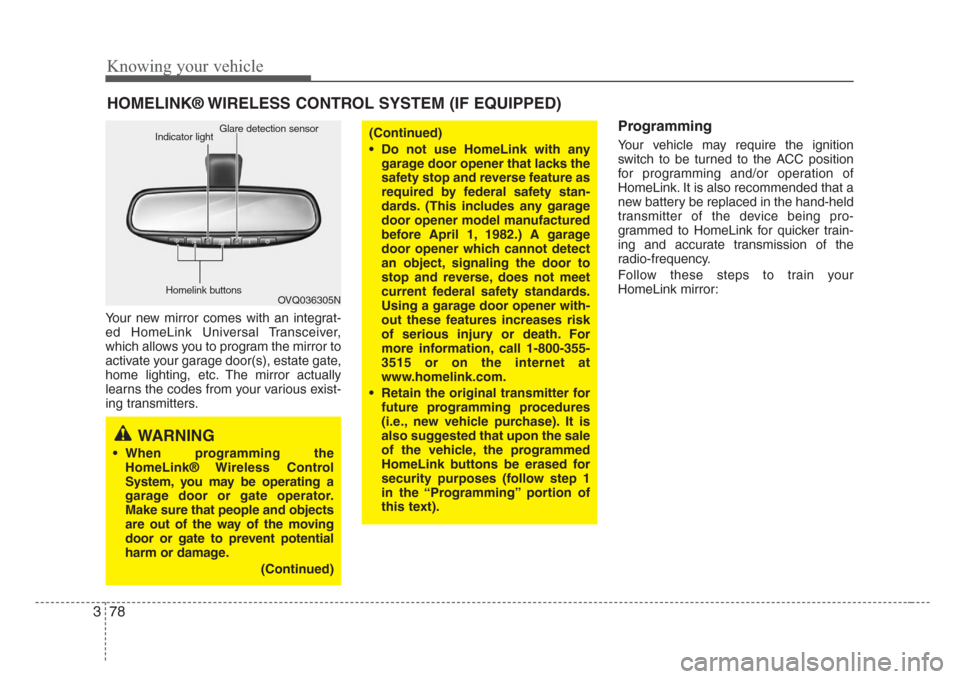
Your new mirror comes with an integrat-
ed HomeLink Universal Transceiver,
which allows you to program the mirror to
activate your garage door(s), estate gate,
home lighting, etc. The mirror actually
learns the codes from your various exist-
ing transmitters.
Programming
Your vehicle may require the ignition
switch to be turned to the ACC position
for programming and/or operation of
HomeLink. It is also recommended that a
new battery be replaced in the hand-held
transmitter of the device being pro-
grammed to HomeLink for quicker train-
ing and accurate transmission of the
radio-frequency.
Follow these steps to train your
HomeLink mirror:
HOMELINK® WIRELESS CONTROL SYSTEM (IF EQUIPPED)
WARNING
• When programming the
HomeLink® Wireless Control
System, you may be operating a
garage door or gate operator.
Make sure that people and objects
are out of the way of the moving
door or gate to prevent potential
harm or damage.
(Continued)
(Continued)
• Do not use HomeLink with any
garage door opener that lacks the
safety stop and reverse feature as
required by federal safety stan-
dards. (This includes any garage
door opener model manufactured
before April 1, 1982.) A garage
door opener which cannot detect
an object,signaling the door to
stop and reverse, does not meet
current federal safety standards.
Using a garage door opener with-
out these features increases risk
of serious injury or death. For
more information, call 1-800-355-
3515 or on the internet at
www.homelink.com.
• Retain the original transmitter for
future programming procedures
(i.e., new vehicle purchase). It is
also suggested that upon the sale
of the vehicle, the programmed
HomeLink buttons be erased for
security purposes (follow step 1
in the “Programming” portion of
this text).
OVQ036305N Glare detection sensor
Indicator light
Homelink buttons
Page 91 of 326
Knowing your vehicle
82 3
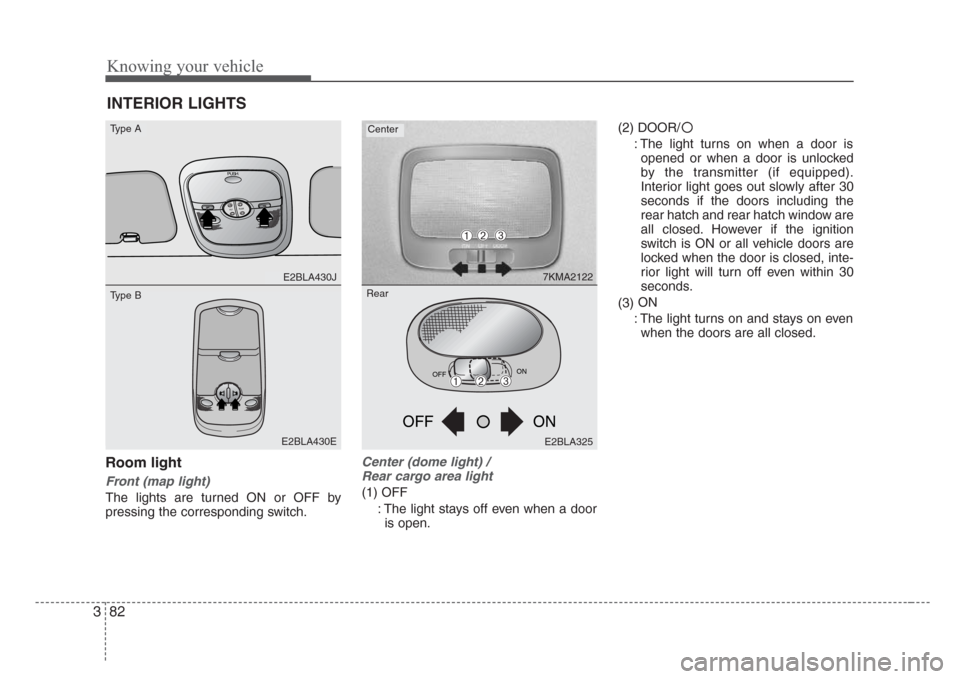
Room light
Front (map light)
The lights are turned ON or OFF by
pressing the corresponding switch.
Center (dome light) /
Rear cargo area light
(1) OFF
: The light stays off even when a door
is open.(2) DOOR/
: The light turns on when a door is
opened or when a door is unlocked
by the transmitter (if equipped).
Interior light goes out slowly after 30
seconds if the doors including the
rear hatch and rear hatch window are
all closed. However if the ignition
switch is ON or all vehicle doors are
locked when the door is closed, inte-
rior light will turn off even within 30
seconds.
(3)ON
: The light turns on and stays on even
when the doors are all closed.
INTERIOR LIGHTS
PUSH
T
IL
TSLIDE
E2BLA430J
E2BLA430E
7KMA2122
Type ACenter
Type B
OFFON
ON OFF
E2BLA325
➀➁➂
➀➁➂
Rear
Page 95 of 326
Knowing your vehicle
86 3
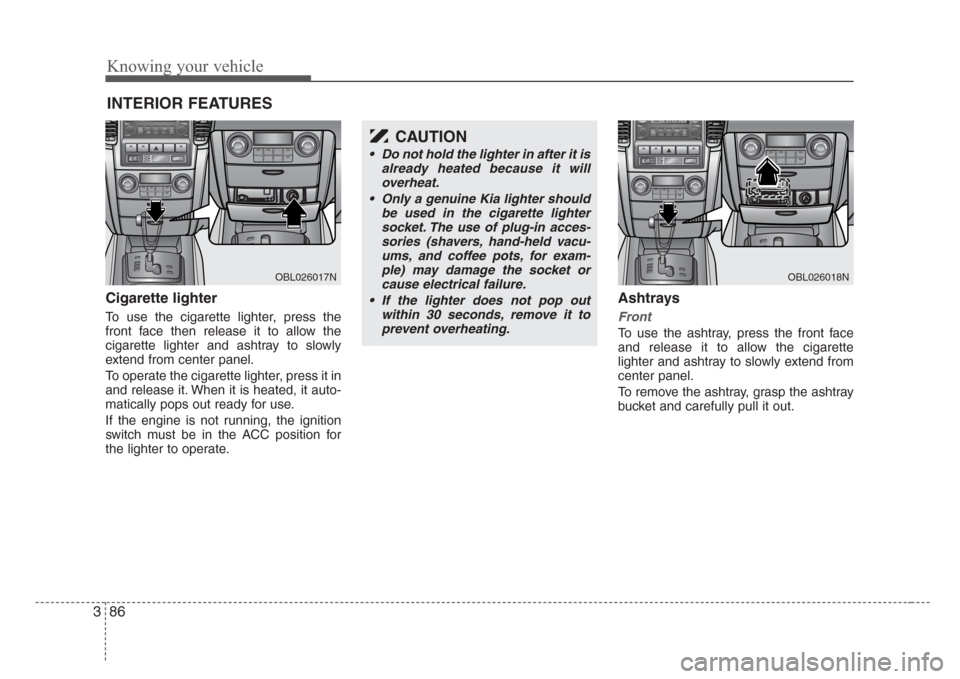
Cigarette lighter
To use the cigarette lighter, press the
front face then release it to allow the
cigarette lighter and ashtray to slowly
extend from center panel.
To operate the cigarette lighter, press it in
and release it. When it is heated, it auto-
matically pops out ready for use.
If the engine is not running, the ignition
switch must be in the ACC position for
the lighter to operate.
Ashtrays
Front
To use the ashtray, press the front face
and release it to allow the cigarette
lighter and ashtray to slowly extend from
center panel.
To remove the ashtray, grasp the ashtray
bucket and carefully pull it out.
INTERIOR FEATURES
OBL026017N
CAUTION
• Do not hold the lighter in after it is
already heated because it will
overheat.
• Only a genuine Kia lighter should
be used in the cigarette lighter
socket. The use of plug-in acces-
sories (shavers, hand-held vacu-
ums, and coffee pots, for exam-
ple) may damage the socket or
cause electrical failure.
• If the lighter does not pop out
within 30 seconds, remove it to
prevent overheating.
OBL026018N