cooling KIA Sorento 2009 2.G User Guide
[x] Cancel search | Manufacturer: KIA, Model Year: 2009, Model line: Sorento, Model: KIA Sorento 2009 2.GPages: 327, PDF Size: 5.03 MB
Page 273 of 327
7
Maintenance services / 7-2
Maintenance schedule / 7-3
Explanation of scheduled maintenance items / 7-7
Owner maintenance / 7-10
Engine compartment / 7-13
Engine oil / 7-14
Engine cooling system / 7-15
Brake fluid / 7-17
Power steering / 7-18
Automatic transmission / 7-19
Lubricants and fluids / 7-21
Air cleaner / 7-22
Climate control air filter / 7-23
Wiper blades / 7-23
Battery / 7-25
Tires and wheels / 7-28
Lubricant specifications / 7-41
Exterior care / 7-43
Interior care / 7-46
Maintenance
Page 275 of 327
73
Maintenance
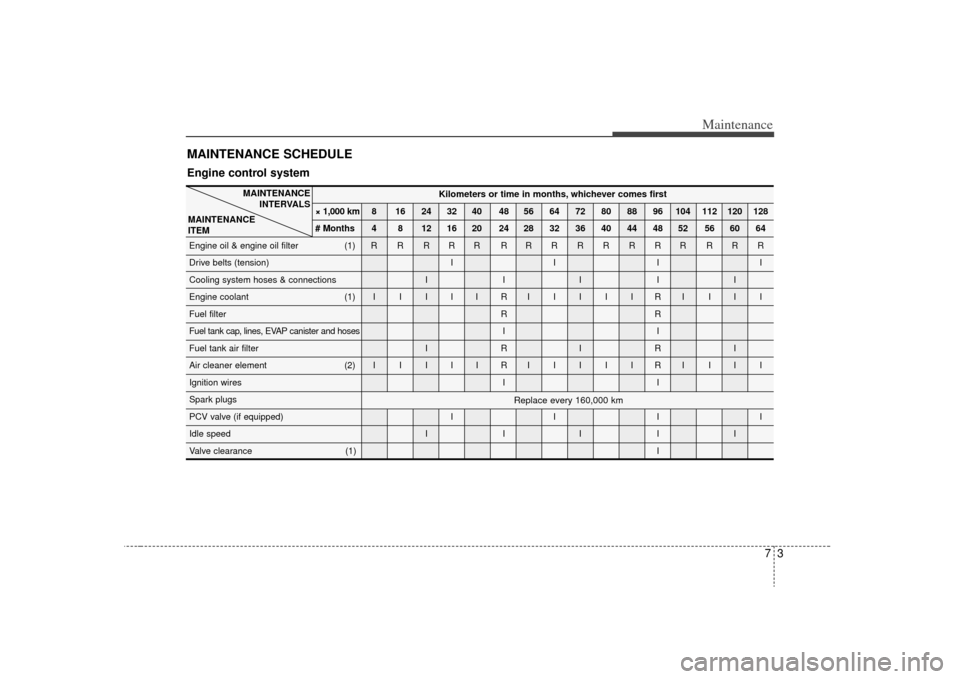
MAINTENANCE SCHEDULE Engine control system
MAINTENANCEINTERVALS
MAINTENANCE
ITEM
Replace every 160,000 km
Kilometers or time in months, whichever comes first
× 1,000 km 8 16 24 32 40 48 56 64 72 80 88 96 104 112 120 128
# Months 4 8 12 16 20 24 28 32 36 40 44 48 52 56 60 64
Engine oil & engine oil filter (1) R R R R R R RRRRRRR RRR
Drive belts (tension) I I I I
Cooling system hoses & connections I I I I I
Engine coolant (1) I I I I I R IIIIIRI III
Fuel filter R R
Fuel tank cap, lines, EVAP canister and hoses I I
Fuel tank air filter I R I R I
Air cleaner element (2) I I I I I R IIIIIRI III
Ignition wires I I
Spark plugs
PCV valve (if equipped) I I I I
Idle speed I I I I I
Valve clearance (1) I
Page 280 of 327
Maintenance87Vacuum crankcase ventilation
hoses Inspect the surface of hoses for evidence
of heat and/or mechanical damage. Hard
and brittle rubber, cracking, tears, cuts,
abrasions, and excessive swelling indi-
cate deterioration. Particular attention
should be paid to examine those hose
surfaces nearest to high heat sources,
such as the exhaust manifold.
Inspect the hose routing to assure that
the hoses do not come in contact with
any heat source, sharp edges or moving
component which might cause heat dam-
age or mechanical wear. Inspect all hose
connections, such as clamps and cou-
plings, to make sure they are secure, and
that no leaks are present. Hoses should
be replaced immediately if there is any
evidence of deterioration or damage.
Air cleaner filterA Genuine KIA air cleaner filter is recom-
mended when the filter is replaced.Spark plugsMake sure to install new spark plugs of
the correct heat range.Valve clearanceInspect excessive valve noise and/or
engine vibration and adjust if necessary.
An authorized KIA dealer should perform
the operation.Cooling systemCheck cooling system components, such
as radiator, coolant reservoir, hoses and
connections for leakage and damage.
Replace any damaged parts.
CoolantThe coolant should be changed at the
intervals specified in the maintenance
schedule.Automatic transmission fluidThe fluid level should be in the "HOT"
range of the dipstick, after the engine
and transmission are at normal operating
temperature. Check the automatic trans-
mission fluid level with the engine run-
ning and the transmission in neutral, with
the parking brake properly applied.Brake hoses and linesVisually check for proper installation,
chafing, cracks, deterioration and any
leakage. Replace any deteriorated or
damaged parts immediately.Brake fluidCheck brake fluid level in the brake fluid
reservoir. The level should be between
“MIN” and “MAX” marks on the side of
the reservoir. Use only hydraulic brake
fluid conforming to DOT 3 or DOT 4
specification.
Page 287 of 327
715
Maintenance
ENGINE COOLING SYSTEMThe high-pressure cooling system has a
reservoir filled with a mixture of
antifreeze and water. The reservoir is
filled at the factory.
Check the antifreeze protection and
coolant level at least once a year, at the
beginning of the winter season, and
before traveling to a colder climate.Checking the coolant level
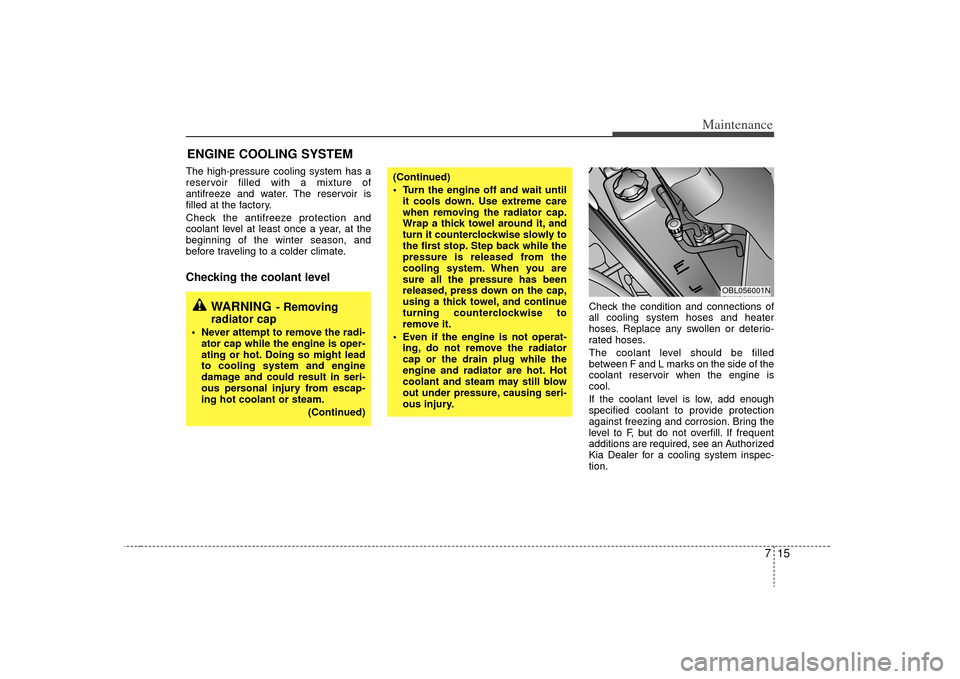
Check the condition and connections of
all cooling system hoses and heater
hoses. Replace any swollen or deterio-
rated hoses.
The coolant level should be filled
between F and L marks on the side of the
coolant reservoir when the engine is
cool.
If the coolant level is low, add enough
specified coolant to provide protection
against freezing and corrosion. Bring the
level to F, but do not overfill. If frequent
additions are required, see an Authorized
Kia Dealer for a cooling system inspec-
tion.
WARNING
- Removing
radiator cap
Never attempt to remove the radi-
ator cap while the engine is oper-
ating or hot. Doing so might lead
to cooling system and engine
damage and could result in seri-
ous personal injury from escap-
ing hot coolant or steam.
(Continued)
(Continued)
Turn the engine off and wait untilit cools down. Use extreme care
when removing the radiator cap.
Wrap a thick towel around it, and
turn it counterclockwise slowly to
the first stop. Step back while the
pressure is released from the
cooling system. When you are
sure all the pressure has been
released, press down on the cap,
using a thick towel, and continue
turning counterclockwise to
remove it.
Even if the engine is not operat- ing, do not remove the radiator
cap or the drain plug while the
engine and radiator are hot. Hot
coolant and steam may still blow
out under pressure, causing seri-
ous injury.
OBL056001N
Page 325 of 327

Index29Air bags - advanced supplemental restraint system ··················\
··················\
··················\
··················\
3-47
Air cleaner ··················\
··················\
··················\
··············7-22
Antenna ··················\
··················\
··················\
··················\
·3-96
Audio remote control··················\
··················\
···············3-97
Audio system ··················\
··················\
··················\
··········3-99
Auto fuel cutoff switch ··················\
··················\
············3-74
Automatic climate control system ··················\
············4-66
Automatic transmission ··················\
··················\
····4-5,7-19
Battery··················\
··················\
··················\
··················\
···7-25
Before driving··················\
··················\
··················\
···········5-5
Brake fluid ··················\
··················\
··················\
··············7-17
Brake system ··················\
··················\
··················\
··········4-20
Climate control air filter ··················\
··················\
·········7-23
Cruise control system ··················\
··················\
··············4-27
Defroster ··················\
··················\
··················\
·················4-57\
Door locks ··················\
··················\
··················\
·················3-7 Electrical circuit protection ··················\
··················\
······6-7
Electronic stability control ··················\
··················\
······4-30
Emergency starting··················\
··················\
··················\
··6-4
Emission control system ··················\
··················\
············5-3
Engine compartment ··················\
··················\
·········2-3,7-13
Engine cooling system ··················\
··················\
·············7-15
Engine oil ··················\
··················\
··················\
················7-14
Explanation of scheduled maintenance items ·············7-7
Exterior care··················\
··················\
··················\
···········7-43
Four wheel drive (4WD)··················\
··················\
··········4-10
Fuel filler lid ··················\
··················\
··················\
···········3-71
Fuel requirements ··················\
··················\
··················\
····5-2
Gauges ··················\
··················\
··················\
··················\
···4-37
Hazard warning flasher ··················\
··················\
··········4-58
Homelink® wireless control system ··················\
·········3-78
Hood ··················\
··················\
··················\
··················\
······3-69
How to use this manual ··················\
··················\
·············1-2ABCD
EFGH