steering KIA Sorento 2009 2.G Owner's Guide
[x] Cancel search | Manufacturer: KIA, Model Year: 2009, Model line: Sorento, Model: KIA Sorento 2009 2.GPages: 327, PDF Size: 5.03 MB
Page 221 of 327

515
Driving tips
Getting familiar with off-road drivingIt’s necessary for you to practice in an
area that’s safe and close to home before
you begin serious off-road driving. Off-
road driving requires new and different
driving skills.
You need to tune your senses to different
kinds of signals. For example, constantly
sweep the terrain with your eyes looking
for unexpected obstacles. Listen for
unusual tire, gear, or engine sounds. Feel
and respond to the vibrations of the vehi-
cle with your hands, feet, and body while
still carefully controlling your vehicle.
You’ll also need to adjust your expecta-
tions and greatly lower the number of
miles you expect to cover in an hour or a
day.
Controlling your vehicle is the key to suc-
cessful off-road driving. One of the best
ways to control your vehicle is to control
your speed. Here are some things to
keep in mind when traveling at higher
speeds:
You approach things faster and youhave less time to scan the terrain for
obstacles. You have less time to react.
You have much more vehicle bounce
when you drive over obstacles, giving
you less vehicle control.
You’ll need more distance for braking, especially since you’re on an unpaved
surface. Such terrain will always be
more “slippery” than a paved road. Scanning the terrain
Off-road driving can take you over many
different kinds of terrain. You need to be
familiar with the terrain and its many dif-
ferent features. Here are some things to
consider.
Surface conditionsOff-roading can take you over hard-
packed dirt, gravel, rocks, grass, sand,
mud, snow or ice. Each of these surfaces
affects the steering, acceleration, and
braking of your vehicle in different ways.
Depending upon the kind of surface you
are on, you may experience slipping,
sliding, wheel spinning, delayed acceler-
ation, poor traction, and longer braking
distances.
WARNING -
Off road driv-
ing
When you’re driving off-road,
bouncing and quick changes in
direction can easily throw you out
of position in your seat. This could
cause you to lose control of the
vehicle and crash. Whether you are
driving on or off the road, you and
your passengers should always
wear safety belts.
Page 222 of 327

Driving tips16
5
WARNING -
Drinking &
driving
Drinking and driving, or drug use
and driving can be very dangerous
on any road. This certainly remains
true for off-road driving. At the very
time you need special alertness and
driving skills, your reflexes, percep-
tions and judgement can be affect-
ed by even a small amount of alco-
hol or drugs. You could have a seri-
ous - or even fatal - accident if you
drink or take drugs and drive or ride
with a driver who has been drinking
or taking drugs.
Surface obstaclesUnseen or hidden obstacles can be haz-
ardous. A rock, log, hole, rut, or bump
can startle you if you’re not prepared.
Often these obstacles are hidden by
grass, bushes, snow or even the rise and
fall of the terrain itself. Here are some
things to constantly evaluate:
Is the path ahead clear?
Will the surface texture change ahead?
Does the path take you uphill or down-
hill?
Might you have to stop suddenly or change direction quickly?
When you drive over obstacles or rough
terrain, it is critical that you keep a firm
grip on the steering wheel. Ruts, troughs,
or other surface features can force the
wheel out of your hands if you’re not pre-
pared. When you drive over bumps, rocks, or
other obstacles, your wheels can leave
the ground. If this happens, even with
one or two wheels, you can’t control the
vehicle as well or perhaps at all. Because
you will be on an unpaved surface, it’s
especially important to avoid sudden
acceleration, sudden turns, or sudden
braking. Any of these actions could
cause the center of gravity of the vehicle
to shift and destabilize the vehicle, lead-
ing to a collision or rollover accident.
Off-road driving requires a different kind
of alertness from driving on paved roads
and highways. There are no road signs,
posted speed limits or signal lights. You
have to use your own judgment about
what is safe and what isn’t. Bad judgment
in this uncontrolled environment can be
fatal.
Page 224 of 327
Driving tips18
5Driving uphillOnce you decide you can safely drive up
the hill, you need to take some special
steps.
Use a low gear and get a firm grip on
the steering wheel.
Get a smooth start up the hill and try to maintain your speed. Don’t use more
power than you need, because you
don’t want your wheels to start spin-
ning or sliding.
Try to drive straight up the hill, if at all possible. If the path twists and turns,
you may have to find another route. Slow down as you approach the top of
the hill.
Attach a flag to the vehicle to make you more visible to approaching traffic on
trails or hills.
Sound the horn as you approach the top of the hill to let opposing traffic
know you’re there.
Use your headlights even during the day. They make you more visible to
other drivers.
Stalling while driving uphill
What should I do if my vehicle stalls, or isabout to stall, and I can’t make it up thehill?If your vehicle stalls, or is about to stall
while driving uphill, there are some
things you should do, and there are some
things you must not do. First, here’s what
you should do:
Push the brake pedal to stop the vehi- cle and keep it from rolling backwards.
Also, apply the parking brake.
If your engine is still running, shift the transmission into reverse, release the
parking brake, and slowly back down
the hill in reverse.
If your engine has stopped running, you’ll need to restart it. With the brake
pedal depressed and the parking
brake still applied, shift a manual trans-
mission to N (Neutral), or an automatic
transmission to P (Park) and restart
the engine. Then, shift to reverse,
release the parking brake, and slowly
back down the hill in reverse.
As you are backing down the hill, put your left hand on the steering wheel at
the 12 o’clock position. This way, you’ll
be able to tell if your wheels are
straight or turned to the left or right as
you back down.
WARNING -
Driving across
hills
Turning or driving across steep
hills can be dangerous. You could
lose traction, slide sideways, or just
reach an area too steep to traverse.
In any case, it could cause you to
roll over. You could be seriously or
fatally injured. When driving up
hills, always try to go as straight up
as possible.
WARNING
- Driving overhills
Driving to the top (crest) of a hill at
full speed can cause an accident
and result in serious or fatal injury.
There could be a drop-off, embank-
ment, cliff, another vehicle or peo-
ple sitting on the ground. As you
near the top of a hill, slow down and
stay alert.
Page 228 of 327
Driving tips22
5If your vehicle slides downhillIf you feel your vehicle starting to slide
sideways, turn downhill immediately. This
should help straighten out the vehicle
and prevent the side slipping. However, a
much better way to prevent this is to get
out and “walk the course” first so you
know what the surface is like before you
drive it.Stalling while crossing an inclineIf your vehicle stalls when you’re crossing
an incline, be sure you (and your pas-
sengers) get out on the uphill side, even
if that door is harder to open. If you get
out on the downhill side and the vehicle
starts to roll over, you’ll be in its path.
If you have to walk down the slope, stay
out of the path the vehicle will take if it
does roll over.
Driving in mud, sand, snow, or iceWhen you drive in mud, sand, snow, or
ice, your wheels won’t get good traction.
You can’t accelerate as quickly, turning is
more difficult, and you’ll need longer
braking distances.
It’s best to use a low gear when you’re in
mud, the deeper the mud, the lower the
gear. In extremely deep mud, the idea is
to keep your vehicle moving so you don’t
get stuck.
When you drive on sand, you’ll sense a
change in wheel traction. But it will
depend upon how loosely packed the
sand is. On loosely packed sand (as on
beaches or sand dunes) your tires will
tend to sink into the sand. This has an
effect on steering, accelerating, and
braking. You may want to reduce the air
pressure in your tires slightly when driv-
ing on sand. This will improve traction.
Remember to re-inflate them the first
chance that you have after you leave the
loosely packed sand.
WARNING
- Exiting vehicle
Getting out on the downhill (low)
side of a vehicle stopped across an
incline is dangerous. If the vehicle
rolls over, you could be crushed or
fatally injured. Always get out on
the uphill (high) side of the vehicle
and stay well clear of the rollover
path.
Page 229 of 327

523
Driving tips
Hard-packed snow and ice offer the
worst tire traction. On these surfaces, it’s
very easy to lose control. On wet ice, for
example, the traction is so poor that you
will even have difficulty accelerating. And
if you do get moving, poor steering and
difficult braking can easily cause you to
slide out of control.
Driving in waterLight rain causes no special off-road driv-
ing problems. However, heavy rain can
cause flash flooding, and flood waters
demand extreme caution.
Find out how deep the water is before
you drive through it. If it’s deep enough to
cover your wheel bearing hubs, axles, or
exhaust pipe, don’t try it, You probably
won’t get through. Also, water that deep
can damage your axle and other vehicle
parts.
If the water isn’t too deep, then drive
through slowly. At fast speeds, water can
splash on your ignition system and your
vehicle can stall. Stalling can also occur
if your tailpipe goes underwater. As long
as your tailpipe is underwater, you will
not be able to start your engine. When
you go through water, remember that it
may take you longer to stop when your
brakes are wet.
If you have driven through water that was
deep enough to cover your wheel bear-
ing hubs, it may be a good idea to have
an Authorized Kia dealer or other com-
petent service center repack your front
wheel bearings and examine your rear-
end fluid for evidence of water.
CAUTION
In case of loss of traction in mud,loose soil, or sand, turn the steer-ing wheel rapidly from side-to-side. This can help generate addi- tional traction.
Do not gun the engine. This will cause the tires to spin and digdown, not forward, and couldbury the vehicle to the frame. Smooth, easy power is betterthan too much power.
WARNING
- Frozen sur-
faces
Driving on frozen lakes, ponds or
rivers can be dangerous.
Underwater springs, currents under
the ice, or sudden thaws can weak-
en the ice. Your vehicle could fall
through the ice and you and your
passengers could drown. Drive
your vehicle on safe surfaces only.
Page 230 of 327

Driving tips24
5
After off-road drivingRemove any brush or debris that has col-
lected on the underbody, chassis or
under the hood. These accumulations
can be a fire hazard.
After driving in mud or sand, clean and
check the brake linings. Accumulation of
mud or sand can cause glazing and
uneven braking. Check the body struc-
ture, steering, suspension, wheels, tires,
and exhaust system for damage. Also,
check the fuel lines and cooling system
for any leakage. Your vehicle will also
require more frequent service due to off-
road use.
WARNING
- Water
Driving through rushing water can
be dangerous. Deep water can
sweep your vehicle downstream
and you and your passengers could
drown. If it’s only inches deep, it
can still wash away the ground from
under your tires, and you could lose
traction and roll the vehicle. Never
drive through rushing water.
Page 241 of 327

535
Driving tips
Following distance Stay at least twice as far behind the vehi-
cle ahead as you would when driving
your vehicle without a trailer. This can
help you avoid situations that require
heavy braking and sudden turns.Passing You’ll need more passing distance up
ahead when you’re towing a trailer. And,
because you’re a good deal longer, you’ll
need to go much farther beyond the
passed vehicle before you can return to
your lane.
Backing up Hold the bottom of the steering wheel
with one hand. Then, to move the trailer
to the left, just move your hand to the left.
To move the trailer to the right, move your
hand to the right. Always back up slowly
and, if possible, have someone guide
you.Making turns When you’re turning with a trailer, make
wider turns than normal. Do this so your
trailer won’t strike soft shoulders, curbs,
road signs, trees, or other objects. Avoid
jerky or sudden maneuvers. Signal well
in advance.
Turn signals when towing a trailer When you tow a trailer, your vehicle has
to have a different turn signal flasher and
extra wiring. The green arrows on your
instrument panel will flash whenever you
signal a turn or lane change. Properly
connected, the trailer lights will also flash
to alert other drivers you’re about to turn,
change lanes, or stop.
When towing a trailer, the green arrows
on your instrument panel will flash for
turns even if the bulbs on the trailer are
burned out. Thus, you may think drivers
behind you are seeing your signals
when, in fact, they are not. It’s important
to check occasionally to be sure the trail-
er bulbs are still working. You must also
check the lights every time you discon-
nect and then reconnect the wires.
Page 243 of 327

537
Driving tips
Parking on hills Generally, if you have a trailer attached to
your vehicle, you should not park your
vehicle on a hill. People can be seriously
or fatally injured, and both your vehicle
and the trailer can be damaged if unex-
pectedly roll down hill.
However, if you ever have to park your
trailer on a hill, here’s how to do it:
1. Pull the vehicle into the parking space.Turn the steering wheel in the direction
of the curb (right if headed down hill,
left if headed up hill).
2. If the vehicle has a manual transmis- sion, place the car in neutral. If the
vehicle has an automatic transmission,
place the car in P (Park).
3. Set the parking brake and shut off the vehicle.
4. Place chocks under the trailer wheels on the down hill side of the wheels. 5. Start the vehicle, hold the brakes, shift
to neutral, release the parking brake
and slowly release the brakes until the
trailer chocks absorb the load.
6. Reapply the brakes, reapply the park- ing brake and shift the vehicle to R
(Reverse) for manual transmission or
P (Park) for automatic transmission.
7. Shut off the vehicle and release the vehicle brakes but leave the parking
brake set.
When you are ready to leave afterparking on a hill 1. With the manual transmission in Neutral or automatic transmission in P
(Park), apply your brakes and hold the
brake pedal down while you:
and
2. Slowly remove your foot from the brake pedal.
3. Drive slowly until the trailer is clear of the chocks.
4. Stop and have someone pick up and store the chocks.
WARNING
- Parking brake
It can be dangerous to get out of
your vehicle if the parking brake is
not firmly set.
If you have left the engine running,
the vehicle can move suddenly. You
or others could be seriously or
fatally injured.
WARNING
- Parking on ahill
Parking your vehicle on a hill with a
trailer attached could cause serious
injury or death, should the trailer
break lose.
Page 262 of 327
In case of an emergency16
6If towing service is not available in an
emergency, your vehicle may be tem-
porarily towed using a cable or chain
secured to the emergency towing hook
under the front of the vehicle. Use
extreme caution when towing the vehicle.
A driver must be in the vehicle to steer it
and operate the brakes.
Towing in this manner may be done only
on hard-surfaced roads for a short dis-
tance and at low speeds. Also, the
wheels, axles, power train, steering and
brakes must all be in good condition.
Do not use the tow hooks to pull a
vehicle out of mud, sand or other con-
ditions from which the vehicle cannot
be driven out under its own power.
Avoid towing a vehicle heavier than the vehicle doing the towing.
The drivers of both vehicles should communicate with each other frequent-
ly. Before emergency towing, check that
the hook is not broken or damaged.
Fasten the towing cable or chain securely to the hook.
Do not jerk the hook. Apply steady and even force.
To avoid damaging the hook, do not pull from the side or at a vertical angle.
Always pull straight ahead.
CAUTION
Attach a towing strap to the tow hook.
Using a portion of the vehicle other than the tow hooks for tow-ing may damage the body of yourvehicle.
Use only a cable or chain specifi- cally intended for use in towingvehicles. Securely fasten the cable or chain to the towing hookprovided.
WARNING
Use extreme caution when towing
the vehicle.
driving maneuvers which would
place excessive stress on the
emergency towing hook and tow-
ing cable or chain. The hook and
towing cable or chain may break
and cause serious injury or dam-
age.
If the towing vehicle can hardly move, do not forcibly continue
the towing. Contact an Authorized
Kia dealer or a commercial tow
truck service for assistance.
Tow the vehicle as straight ahead as possible.
Keep away from the vehicle dur- ing towing.
Page 263 of 327
617
In case of an emergency
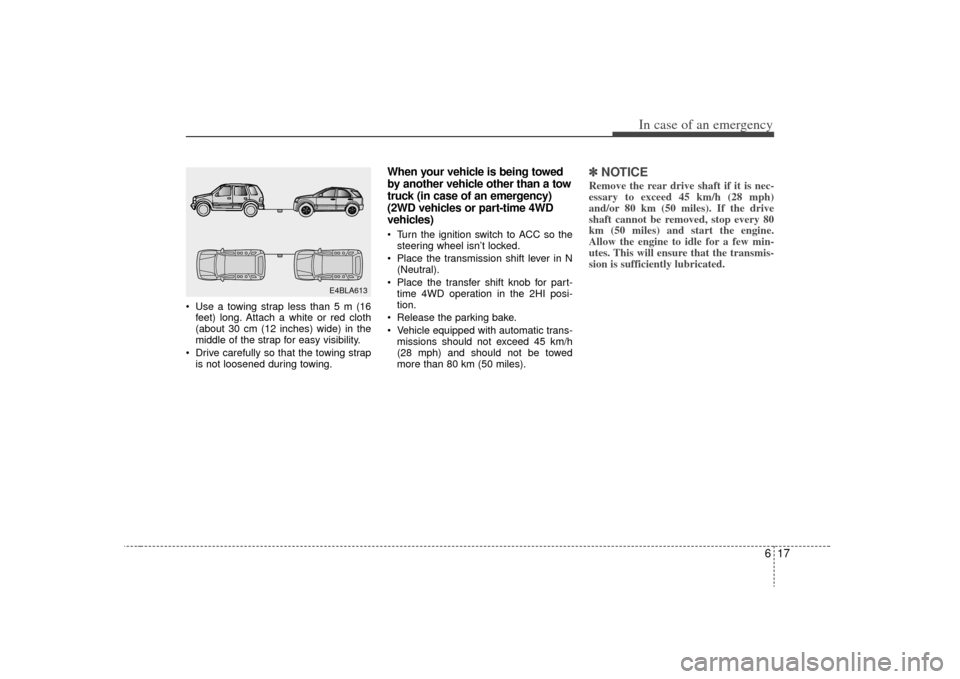
Use a towing strap less than 5 m (16feet) long. Attach a white or red cloth
(about 30 cm (12 inches) wide) in the
middle of the strap for easy visibility.
Drive carefully so that the towing strap is not loosened during towing.
When your vehicle is being towed
by another vehicle other than a tow
truck (in case of an emergency)
(2WD vehicles or part-time 4WD
vehicles) Turn the ignition switch to ACC so thesteering wheel isn’t locked.
Place the transmission shift lever in N (Neutral).
Place the transfer shift knob for part- time 4WD operation in the 2HI posi-
tion.
Release the parking bake.
Vehicle equipped with automatic trans- missions should not exceed 45 km/h
(28 mph) and should not be towed
more than 80 km (50 miles).
✽ ✽ NOTICERemove the rear drive shaft if it is nec-
essary to exceed 45 km/h (28 mph)
and/or 80 km (50 miles). If the drive
shaft cannot be removed, stop every 80
km (50 miles) and start the engine.
Allow the engine to idle for a few min-
utes. This will ensure that the transmis-
sion is sufficiently lubricated.
E4BLA613