steering KIA Sorento 2009 2.G Service Manual
[x] Cancel search | Manufacturer: KIA, Model Year: 2009, Model line: Sorento, Model: KIA Sorento 2009 2.GPages: 327, PDF Size: 5.03 MB
Page 264 of 327
In case of an emergency18
6
than normal since you will have
reduced brake performance.
because the power steering system
will be disabled.
brakes may overheat and brake per-
formance will be reduced. Stop often
and let the brakes cool off.✽ ✽ NOTICETo prevent internal damage to the trans-
mission, never tow your vehicle from the
rear (backwards) with all four tires in
contact with the surface.
Tips for towing a stuck vehicleThe following methods are effective
when your vehicle is stuck in mud, sand
or similar substances that prevent the
vehicle from being driven out under its
own power.
Remove the soil and sand, etc. from
the front and the back of the tires.
Place a stone or wood under the tires.
Page 273 of 327
7
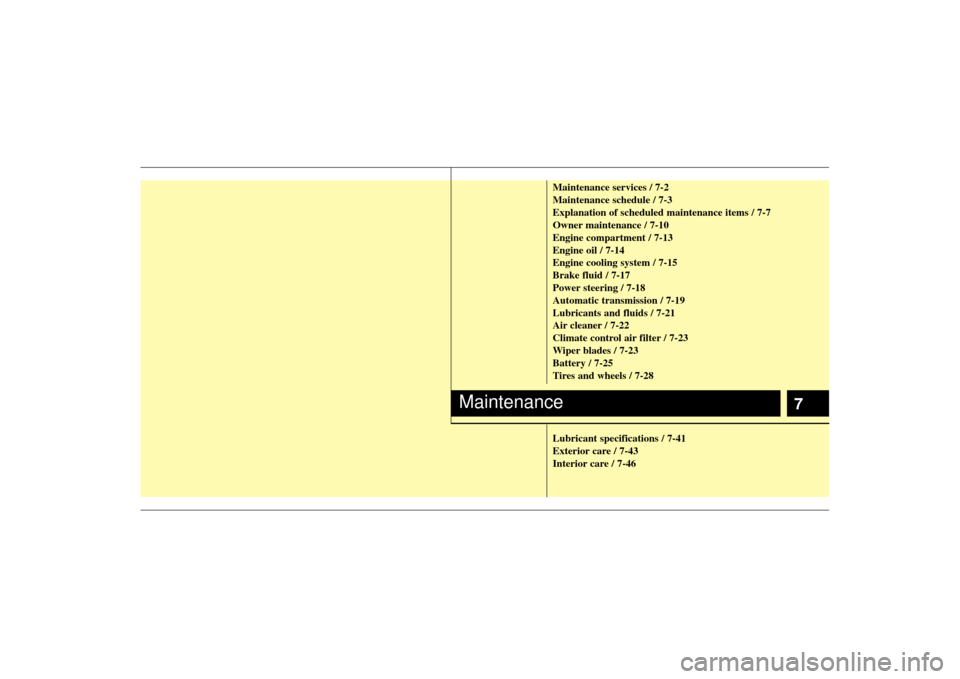
Maintenance services / 7-2
Maintenance schedule / 7-3
Explanation of scheduled maintenance items / 7-7
Owner maintenance / 7-10
Engine compartment / 7-13
Engine oil / 7-14
Engine cooling system / 7-15
Brake fluid / 7-17
Power steering / 7-18
Automatic transmission / 7-19
Lubricants and fluids / 7-21
Air cleaner / 7-22
Climate control air filter / 7-23
Wiper blades / 7-23
Battery / 7-25
Tires and wheels / 7-28
Lubricant specifications / 7-41
Exterior care / 7-43
Interior care / 7-46
Maintenance
Page 277 of 327
75
Maintenance
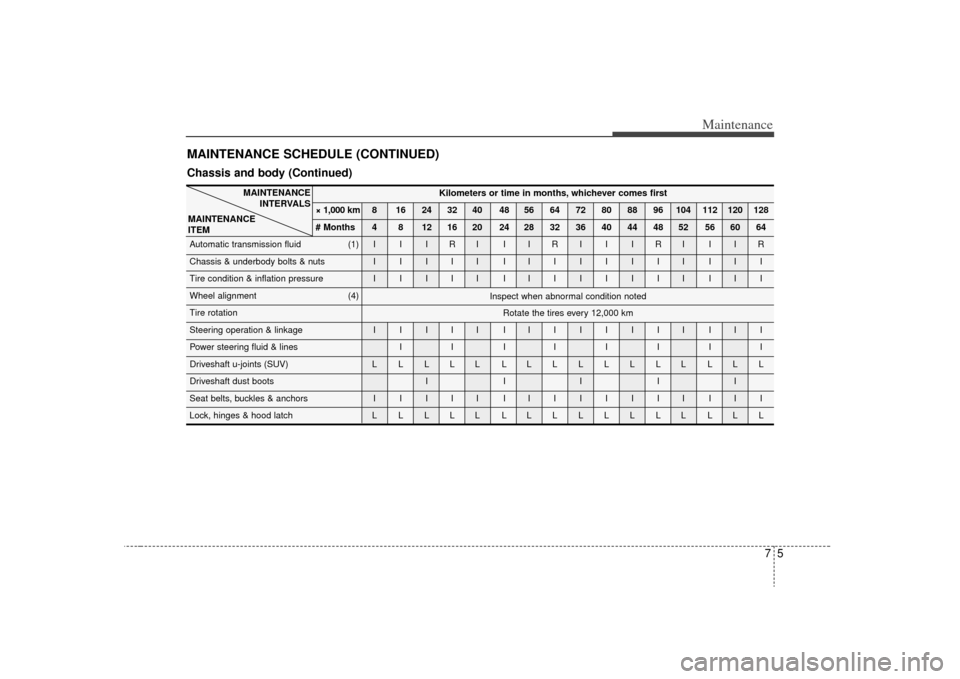
MAINTENANCE SCHEDULE (CONTINUED)
MAINTENANCEINTERVALS
MAINTENANCE
ITEM
Inspect when abnormal condition noted
Rotate the tires every 12,000 km
Chassis and body (Continued)
Kilometers or time in months, whichever comes first
× 1,000 km 8 16 24 32 40 48 56 64 72 80 88 96 104 112 120 128
# Months 4 8 12 16 20 24 28 32 36 40 44 48 52 56 60 64
Automatic transmission fluid (1) I I I R I I I R I I I R I I I R
Chassis & underbody bolts & nuts I I I I I I IIIIIII III
Tire condition & inflation pressure I I I I I I IIIIIII III
Wheel alignment (4)
Tire rotation
Steering operation & linkage I I I I I I IIIIIII III
Power steering fluid & lines I I I IIIII
Driveshaft u-joints (SUV) L L L L L L LLLLLLL LLL
Driveshaft dust boots I I I I I
Seat belts, buckles & anchors I I I I I I IIIIIII III
Lock, hinges & hood latch L L L L L L LLLLLLL LLL
Page 281 of 327

79
Maintenance
Parking brakeInspect the parking brake system includ-
ing the parking brake pedal and cables.Brake discs, pads, calipers and
rotorsCheck the pads for excessive wear, discs
for run out and wear, and calipers for fluid
leakage.Exhaust pipe and mufflerVisually inspect the exhaust pipes, muf-
fler and hangers for cracks, deterioration,
or damage. Start the engine and listen
carefully for any exhaust gas leakage.
Tighten connections or replace parts as
necessary.Suspension mounting boltsCheck the suspension connections for
looseness or damage. Retighten to the
specified torque.
Steering gear box, linkage &
boots/lower arm ball jointWith the vehicle stopped and engine off,
check for excessive free-play in the
steering wheel.
Check the linkage for bends or damage.
Check the dust boots and ball joints for
deterioration, cracks, or damage.
Replace any damaged parts.Power steering pump, belt and
hosesCheck the power steering pump and
hoses for leakage and damage. Replace
any damaged or leaking parts immedi-
ately. Inspect the power steering belt for
evidence of cuts, cracks, excessive wear,
oiliness and proper tension. Replace or
adjust it if necessary.
Drive shafts and bootsCheck the drive shafts, boots and clamps
for cracks, deterioration, or damage.
Replace any damaged parts and, if nec-
essary, repack the grease.Air conditioning refrigerant
(if equipped)Check the air conditioning lines and con-
nections for leakage and damage.
Page 282 of 327

Maintenance10
7OWNER MAINTENANCE Owner maintenance schedule The following lists are vehicle checks and
inspections that should be performed by
the owner or an Authorized Kia Dealer at
the frequencies indicated to help ensure
safe, dependable operation of your vehi-
cle.
Any adverse conditions should be
brought to the attention of your dealer as
soon as possible.
These Owner Maintenance Checks are
generally not covered by warranties and
you may be charged for labor, parts and
lubricants used.
When you stop for fuel: Check the engine oil level.
Check coolant level in coolant reser-
voir.
Check the windshield washer fluid level.
Look for low or under-inflated tires.
While operating your vehicle: Note any changes in the sound of the exhaust or any smell of exhaust fumes
in the vehicle.
Check for vibrations in the steering wheel. Notice any increased steering
effort or looseness in the steering
wheel, or change in its straight-ahead
position.
Notice if your vehicle constantly turns slightly or “pulls” to one side when trav-
eling on smooth, level road.
When stopping, listen and check for strange sounds, pulling to one side,
increased brake pedal travel or “hard-
to-push” brake pedal.
If any slipping or changes in the oper- ation of your transmission occurs,
check the transmission fluid level.
Check automatic transmission P (Park) function.
Check parking brake.
Check for fluid leaks under your vehicle (water dripping from the air condition-
ing system during or after use is nor-
mal).
WARNING
Be careful when checking your
engine coolant level when the
engine is hot. Scalding hot coolant
and steam may blow out under
pressure. This could cause burns or
other serious injury.
Page 283 of 327

711
Maintenance
At least monthly: Check coolant level in the coolantrecovery reservoir.
Check the operation of all exterior lights, including the stoplights, turn sig-
nals and hazard warning flashers.
Check the inflation pressures of all tires including the spare.
At least twice a year (i.e., every Spring and Fall) : Check radiator, heater and air condi- tioning hoses for leaks or damage.
Check windshield washer spray and wiper operation. Clean wiper blades
with clean cloth dampened with wash-
er fluid.
Check headlight alignment.
Check muffler, exhaust pipes, shields and clamps.
Check the lap/shoulder belts for wear and function.
Check for worn tires and loose wheel lug nuts.
At least once a year : Clean body and door drain holes.
Lubricate door hinges and checks, andhood hinges.
Lubricate door and hood locks and latches.
Lubricate door rubber weatherstrips.
Check the air conditioning system before the warm weather season.
Check the power steering fluid level.
Inspect and lubricate automatic trans- mission linkage and controls.
Clean battery and terminals.
Check the brake fluid level.
Page 285 of 327

713
Maintenance
ENGINE COMPARTMENT
OBL086001N
1. Air cleaner
2. Engine oil filler cap
3. Engine oil dipstick
4. Auto transmission fluid dipstick*
5. Brake / clutch* fluid reservoir
6. Fuse box
7. Windshield washer fluid reservoir
8. Power steering fluid reservoir
9. Radiator cap
10. Engine coolant reservoir
11. Battery
* : if equipped
1
4
35 6
2
7
89 11
10
* The actual engine room in the vehicle may differ from the illustration.
Page 290 of 327

Maintenance18
7POWER STEERING Checking the power steering fluid
level With the vehicle on level ground, check
the fluid level in the power steering reser-
voir periodically. The fluid should be
between MAX and MIN marks on the
side of the reservoir at the normal tem-
perature.
Before adding power steering fluid, thor-
oughly clean the area around the reser-
voir cap to prevent power steering fluid
contamination.
If the level is low, add fluid to the MAX
level. In the event the power steering system
requires frequent addition of fluid, the
vehicle should be inspected by an
Authorized Kia Dealer.
Use only the specified power steering
fluid. (Refer to "Recommended Lubricants" later in this section.)
Power steering hoseCheck the connections for oil leaks,
severe damage and the twists in the
power steering hose before driving.
OBL056007
CAUTION
To avoid damage to the power steering pump, do not operate thevehicle for prolonged periodswith a low power steering fluid level.
Never start the engine when the reservoir tank is empty.
When adding fluid, be careful that dirt does not get into the tank.
Too little fluid can make the steer- ing wheel heavier or strangenoise can be generated.
The use of the non-specified fluid could reduce the effectiveness ofthe power steering wheel andcause damage to it.
Page 304 of 327
Maintenance32
7Compact spare tire replacement
(if equipped)
A compact spare tire has a shorter
tread life than a regular size tire.
Replace it when you can see the
tread wear indicator bars on the tire.
The replacement compact spare tire
should be the same size and design
tire as the one provided with your
new Kia and should be mounted on
the same compact spare tire wheel.
The compact spare tire is not
designed to be mounted on a regular
size wheel, and the compact spare
tire wheel is not designed for mount-
ing a regular size tire. Wheel alignment and tire
balance
The wheels on your vehicle were
aligned and balanced carefully at the
factory to give you the longest tire life
and best overall performance.
In most cases, you will not need to
have your wheels aligned again.
However, if you notice unusual tire
wear or your vehicle pulling one way
or the other, the alignment may need
to be reset.
If you notice your vehicle vibrating
when driving on a smooth road, your
wheels may need to be rebalanced.
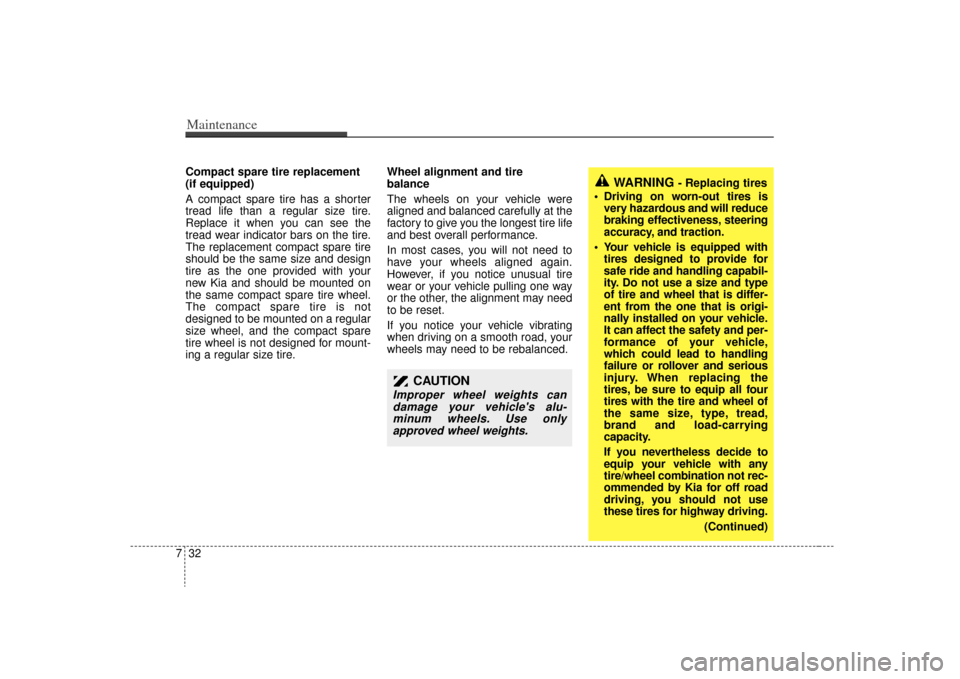
WARNING
- Replacing tires
Driving on worn-out tires is very hazardous and will reduce
braking effectiveness, steering
accuracy, and traction.
Your vehicle is equipped with tires designed to provide for
safe ride and handling capabil-
ity. Do not use a size and type
of tire and wheel that is differ-
ent from the one that is origi-
nally installed on your vehicle.
It can affect the safety and per-
formance of your vehicle,
which could lead to handling
failure or rollover and serious
injury. When replacing the
tires, be sure to equip all four
tires with the tire and wheel of
the same size, type, tread,
brand and load-carrying
capacity.
If you nevertheless decide to
equip your vehicle with any
tire/wheel combination not rec-
ommended by Kia for off road
driving, you should not use
these tires for highway driving.
(Continued)
CAUTION
Improper wheel weights candamage your vehicle's alu-minum wheels. Use onlyapproved wheel weights.
Page 313 of 327

741
Maintenance
LUBRICANT SPECIFICATIONSRecommended lubricants To help achieve proper engine and pow-
ertrain performance and durability, use
only lubricants of the proper quality. The
correct lubricants also help promote
engine efficiency that results in improved
fuel economy.
Engine oils labeled Energy Conserving
Oil are now available. Along with other
additional benefits, they contribute to fuel
economy by reducing the amount of fuel
necessary to overcome engine friction.
Often, these improvements are difficult to
measure in everyday driving, but in a
year’s time, they can offer significant cost
and energy savings.
*¹ Refer to the recommended SAE viscosity numbers on the next page.
*2LSD : Limited Slip DifferentialThese lubricants and fluids are recommended for use in your vehicle.
LubricantClassification
API Service SL or SM,
ILSAC GF-3 or above
Automatic transmission fluid APOLLOIL ATF RED-1K
4WD transfer case fluid DEXRON III (fill-for-life)
Front differential fluid API Service GL-5 (SAE 90)
Rear differential Without LSD *
2
API Service GL-5 (SAE 90)
fluid
With LSD
*2
API Service GL-5 (SAE 85W-90, INFILREX 33)
Power steering fluid PSF-III
Brake fluid FMVSS116 DOT-3 or DOT-4Engine oil
*¹