air condition KIA SORENTO 2010 Workshop Manual
[x] Cancel search | Manufacturer: KIA, Model Year: 2010, Model line: SORENTO, Model: KIA SORENTO 2010Pages: 399, PDF Size: 40.44 MB
Page 364 of 399
Maintenance
58
7
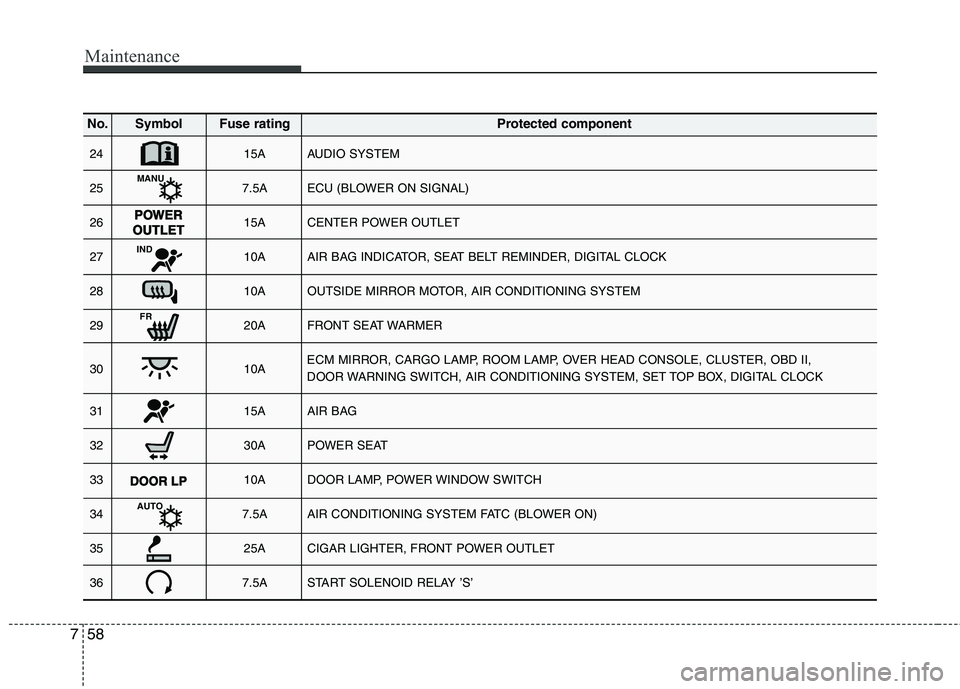
24 15A AUDIO SYSTEM
25 7.5A ECU (BLOWER ON SIGNAL)
26 15A CENTER POWER OUTLET
27 10A AIR BAG INDICATOR, SEAT BELT REMINDER, DIGITAL CLOCK
28 10A OUTSIDE MIRROR MOTOR, AIR CONDITIONING SYSTEM
29 20A FRONT SEAT WARMER
30 10A ECM MIRROR, CARGO LAMP, ROOM LAMP, OVER HEAD CONSOLE, CLUSTER, OBD II,
DOOR WARNING SWITCH, AIR CONDITIONING SYSTEM, SET TOP BOX, DIGITAL CLOCK
31 15A AIR BAG
32 30A POWER SEAT
33 10A DOOR LAMP, POWER WINDOW SWITCH
34 7.5A AIR CONDITIONING SYSTEM FATC (BLOWER ON)
35 25A CIGAR LIGHTER, FRONT POWER OUTLET
36 7.5A START SOLENOID RELAY ’S’
No. Symbol Fuse rating Protected component
MANU
IND
FR
AUTO
Page 381 of 399
775
Maintenance
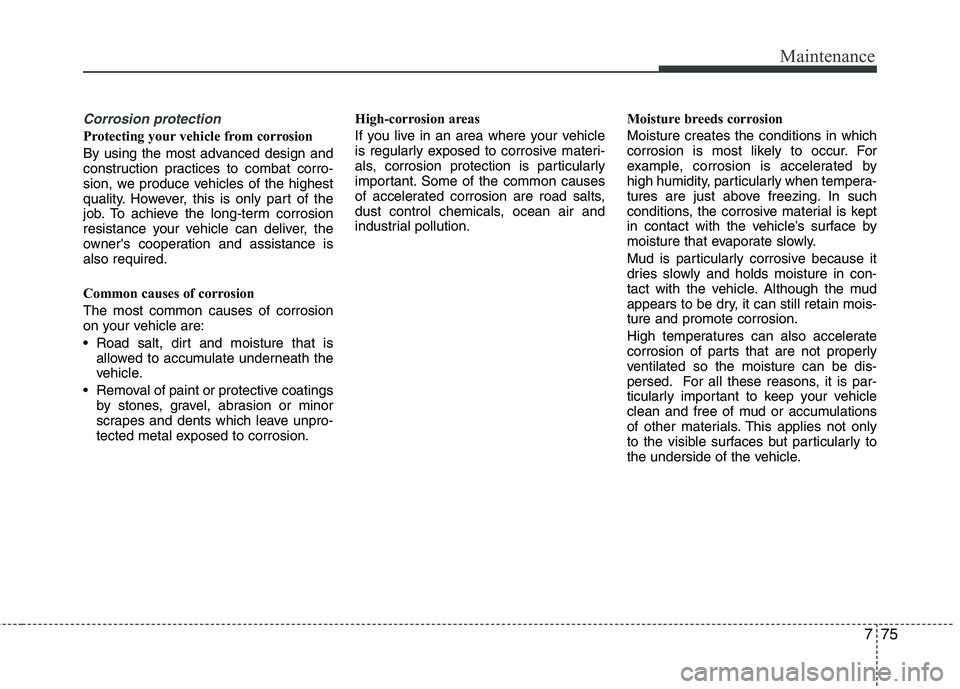
Corrosion protection
Protecting your vehicle from corrosion
By using the most advanced design and
construction practices to combat corro-
sion, we produce vehicles of the highest
quality. However, this is only part of the
job. To achieve the long-term corrosion
resistance your vehicle can deliver, the
owner's cooperation and assistance isalso required.
Common causes of corrosion The most common causes of corrosion
on your vehicle are:
allowed to accumulate underneath the
vehicle.
Removal of paint or protective coatings by stones, gravel, abrasion or minor
scrapes and dents which leave unpro-
tected metal exposed to corrosion. High-corrosion areas
If you live in an area where your vehicle
is regularly exposed to corrosive materi-
als, corrosion protection is particularly
important. Some of the common causes
of accelerated corrosion are road salts,
dust control chemicals, ocean air and
industrial pollution.
Moisture breeds corrosion Moisture creates the conditions in which
corrosion is most likely to occur. For
example, corrosion is accelerated by
high humidity, particularly when tempera-
tures are just above freezing. In such
conditions, the corrosive material is kept
in contact with the vehicle’s surface by
moisture that evaporate slowly.
Mud is particularly corrosive because it
dries slowly and holds moisture in con-
tact with the vehicle. Although the mud
appears to be dry, it can still retain mois-ture and promote corrosion.
High temperatures can also accelerate
corrosion of parts that are not properly
ventilated so the moisture can be dis-
persed. For all these reasons, it is par-
ticularly important to keep your vehicle
clean and free of mud or accumulations
of other materials. This applies not only
to the visible surfaces but particularly to
the underside of the vehicle.
Page 387 of 399
781
Maintenance
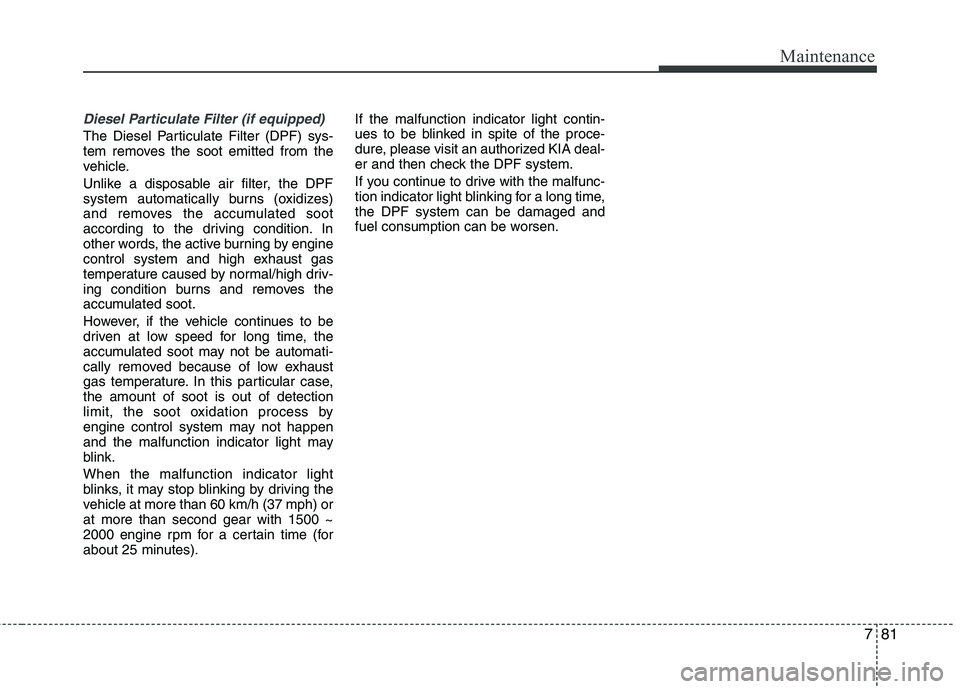
Diesel Particulate Filter (if equipped)
The Diesel Particulate Filter (DPF) sys-
tem removes the soot emitted from the
vehicle.
Unlike a disposable air filter, the DPF
system automatically burns (oxidizes)
and removes the accumulated soot
according to the driving condition. In
other words, the active burning by engine
control system and high exhaust gas
temperature caused by normal/high driv-
ing condition burns and removes the
accumulated soot.
However, if the vehicle continues to be
driven at low speed for long time, the
accumulated soot may not be automati-
cally removed because of low exhaust
gas temperature. In this particular case,the amount of soot is out of detection
limit, the soot oxidation process by
engine control system may not happen
and the malfunction indicator light may
blink. When the malfunction indicator light
blinks, it may stop blinking by driving the
vehicle at more than 60 km/h (37 mph) orat more than second gear with 1500 ~
2000 engine rpm for a certain time (for
about 25 minutes).If the malfunction indicator light contin-
ues to be blinked in spite of the proce-
dure, please visit an authorized KIA deal-
er and then check the DPF system.
If you continue to drive with the malfunc-
tion indicator light blinking for a long time,the DPF system can be damaged and
fuel consumption can be worsen.