steering wheel KIA Sorento 2012 2.G Service Manual
[x] Cancel search | Manufacturer: KIA, Model Year: 2012, Model line: Sorento, Model: KIA Sorento 2012 2.GPages: 388, PDF Size: 7.56 MB
Page 283 of 388
555
Driving your vehicle
E140400AUNDriving with a trailer Towing a trailer requires a certain
amount of experience. Before setting out
for the open road, you must get to know
your trailer. Acquaint yourself with the
feel of handling and braking with the
added weight of the trailer. And always
keep in mind that the vehicle you are
driving is now a good deal longer and not
nearly so responsive as your vehicle is
by itself.
Before you start, check the trailer hitch
and platform, safety chains, electrical
connector(s), lights, tires and mirror
adjustment. If the trailer has electric
brakes, start your vehicle and trailer mov-
ing and then apply the trailer brake con-
troller by hand to be sure the brakes are
working. This lets you check your electri-
cal connection at the same time.
During your trip, check occasionally to be
sure that the load is secure, and that the
lights and any trailer brakes are still work-
ing.
E140401AUNFollowing distance Stay at least twice as far behind the vehi-
cle ahead as you would when driving
your vehicle without a trailer. This can
help you avoid situations that require
heavy braking and sudden turns.E140402AUNPassing You’ll need more passing distance up
ahead when you’re towing a trailer. And,
because of the increased vehicle length,
you’ll need to go much farther beyond the
passed vehicle before you can return to
your lane. Due to the added load to the
engine when going uphill the vehicle may
also take longer to pass than it would on
flat ground.E140403AUNBacking up Hold the bottom of the steering wheel
with one hand. Then, to move the trailer
to the left, just move your hand to the left.
To move the trailer to the right, move your
hand to the right. Always back up slowly
and, if possible, have someone guide
you.
E140404AUNMaking turns When you’re turning with a trailer, make
wider turns than normal. Do this so your
trailer won’t strike soft shoulders, curbs,
road signs, trees, or other objects near
the edge of the road. Avoid jerky or sud-
den maneuvers. Signal well in advance
before turning or lane changes.
XM CAN (ENG) 5.QXP 11/5/2010 11:40 AM Page 55
Page 285 of 388
557
Driving your vehicle
E140407AUN-EAParking on hills Generally, if you have a trailer attached to
your vehicle, you should not park your
vehicle on a hill. People can be seriously
or fatally injured, and both your vehicle
and the trailer can be damaged if they
unexpectedly roll downhill.
However, if you ever have to park your
trailer on a hill, here's how to do it:
1. Pull the vehicle into the parking space.Turn the steering wheel in the direction
of the curb (right if headed downhill,
left if headed up hill).
2. If the vehicle has a manual transaxle, place the car in neutral. If the vehicle
has an automatic transaxle, place the
car in P (Park).
3. Set the parking brake and shut off the vehicle. 4. Place chocks under the trailer wheels
on the down hill side of the wheels.
5. Start the vehicle, hold the brakes, shift to neutral, release the parking brake
and slowly release the brakes until the
trailer chocks absorb the load.
6. Reapply the brakes, reapply the park- ing brake and shift the vehicle to R
(Reverse) for manual transaxle or P
(Park) for automatic transaxle.
7. Shut off the vehicle and release the vehicle brakes but leave the parking
brake set.
CAUTION
When towing a trailer on steep grades (in excess of 6%) payclose attention to the enginecoolant temperature gauge toensure the engine does not over- heat.
If the needle of the coolant tem-perature gauge moves across thedial towards “H” (HOT), pull overand stop as soon as it is safe to do so, and allow the engine to idleuntil it cools down. You may pro-ceed once the engine has cooledsufficiently.
You must decide driving speed depending on trailer weight anduphill grade to reduce the possi-bility of engine and transaxle overheating.
WARNING
- Parking on a hill
Parking your vehicle on a hill with a
trailer attached could cause seri-
ous injury or death, should the trail-
er break loose or brake stops work-
ing.
WARNING
- Parking brake
It can be dangerous to get out of
your vehicle if the parking brake is
not firmly set.
If you have left the engine running,
the vehicle can move suddenly. You
or others could be seriously or
fatally injured.
XM CAN (ENG) 5.QXP 11/5/2010 11:40 AM Page 57
Page 313 of 388
What to do in an emergency18
6If towing service is not available in an
emergency, your vehicle may be tem-
porarily towed using a cable or chain
secured to the emergency towing hook
(if equipped) under the front of the vehi-
cle. Use extreme caution when towing
the vehicle. A driver must be in the vehi-
cle to steer it and operate the brakes.
Towing in this manner may be done only
on hard-surfaced roads for a short dis-
tance and at low speeds. Also, the
wheels, axles, power train, steering and
brakes must all be in good condition.
Do not use the tow hooks to pull a vehi-
cle out of mud, sand or other condi-
tions from which the vehicle cannot be
driven out under its own power.
Avoid towing a vehicle heavier than the vehicle doing the towing.
The drivers of both vehicles should communicate with each other frequent-
ly. Before emergency towing, check that
the hook is not broken or damaged.
Fasten the towing cable or chain securely to the hook.
Do not jerk the hook. Apply it steadily and with even force.
To avoid damaging the hook, do not pull from the side or at a vertical angle.
Always pull straight ahead.
CAUTION
Attach a towing strap to the tow hook.
Using a portion of the vehicle other than the tow hooks for tow-ing may damage the body of yourvehicle.
Only use a cable or chain specifi- cally intended for use in towingvehicles. Securely fasten thecable or chain to the towing hookprovided.
WARNING
Use extreme caution when towing
the vehicle.
Avoid sudden starts or erratic driving maneuvers which would
place excessive stress on the
emergency towing hook and tow-
ing cable or chain. The hook and
towing cable or chain may break
and cause serious injury or dam-
age.
If the disabled vehicle cannot be moved, do not forcibly continue
the towing. Contact an authorized
KIA dealer or a commercial tow
truck service for assistance.
Tow the vehicle as straight ahead as possible.
Keep away from the vehicle dur- ing towing.
XM CAN (ENG) 6.QXP 4/19/2011 10:51 AM Page 18
Page 314 of 388
619
What to do in an emergency
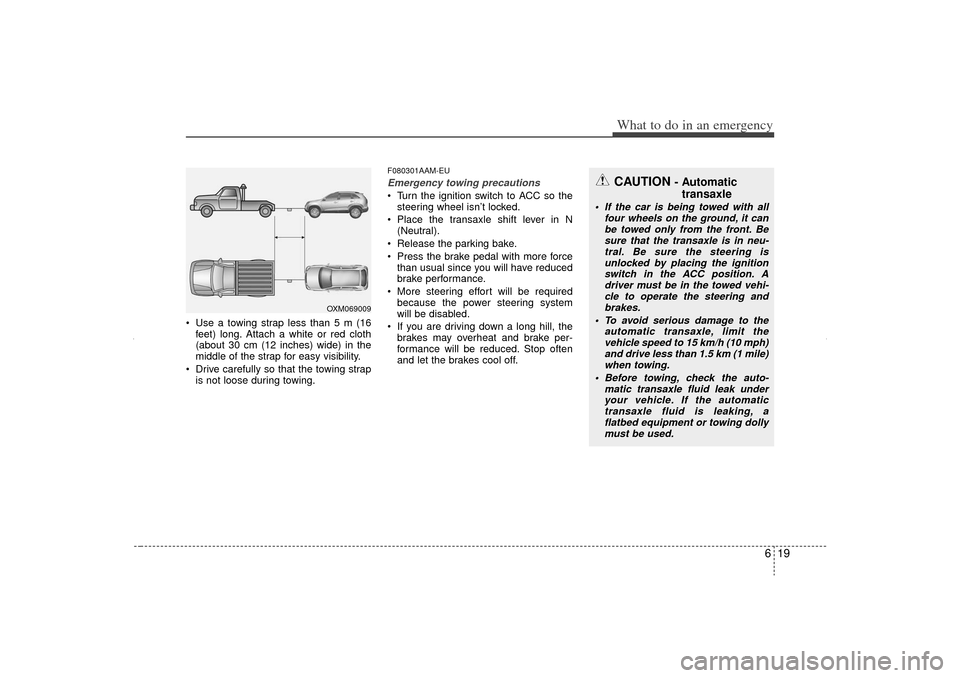
Use a towing strap less than 5 m (16feet) long. Attach a white or red cloth
(about 30 cm (12 inches) wide) in the
middle of the strap for easy visibility.
Drive carefully so that the towing strap is not loose during towing.
F080301AAM-EUEmergency towing precautions Turn the ignition switch to ACC so thesteering wheel isn’t locked.
Place the transaxle shift lever in N (Neutral).
Release the parking bake.
Press the brake pedal with more force than usual since you will have reduced
brake performance.
More steering effort will be required because the power steering system
will be disabled.
If you are driving down a long hill, the brakes may overheat and brake per-
formance will be reduced. Stop often
and let the brakes cool off.
OXM069009
CAUTION
- Automatictransaxle
If the car is being towed with all
four wheels on the ground, it canbe towed only from the front. Be sure that the transaxle is in neu-tral. Be sure the steering isunlocked by placing the ignition switch in the ACC position. Adriver must be in the towed vehi- cle to operate the steering andbrakes.
To avoid serious damage to the automatic transaxle, limit thevehicle speed to 15 km/h (10 mph) and drive less than 1.5 km (1 mile)when towing.
Before towing, check the auto- matic transaxle fluid leak underyour vehicle. If the automatictransaxle fluid is leaking, a flatbed equipment or towing dollymust be used.
XM CAN (ENG) 6.QXP 4/19/2011 10:51 AM Page 19
Page 315 of 388
7
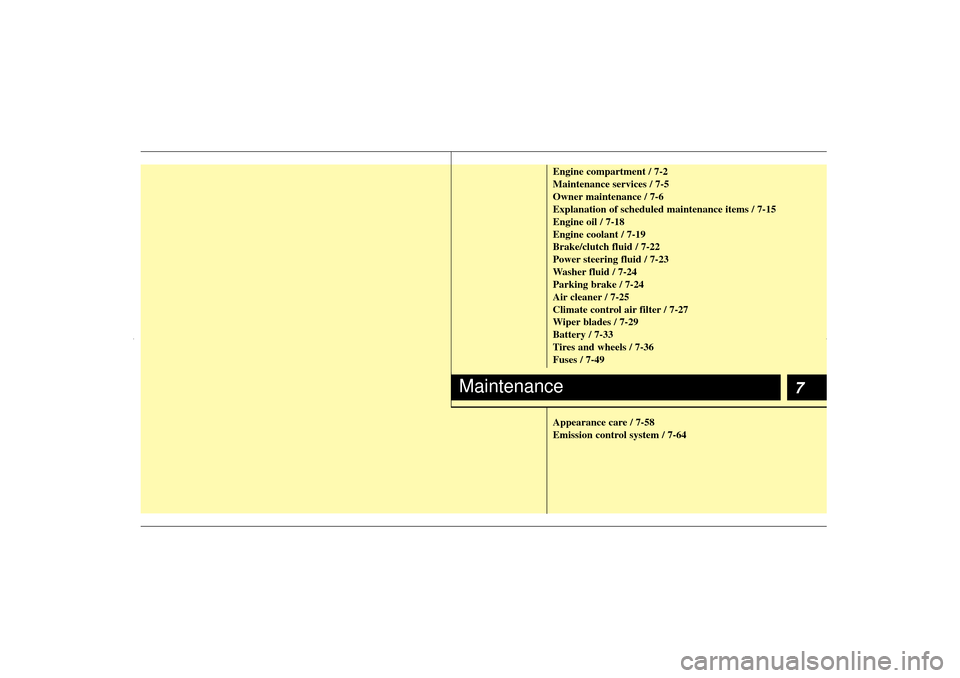
Engine compartment / 7-2
Maintenance services / 7-5
Owner maintenance / 7-6
Explanation of scheduled maintenance items / 7-15
Engine oil / 7-18
Engine coolant / 7-19
Brake/clutch fluid / 7-22
Power steering fluid / 7-23
Washer fluid / 7-24
Parking brake / 7-24
Air cleaner / 7-25
Climate control air filter / 7-27
Wiper blades / 7-29
Battery / 7-33
Tires and wheels / 7-36
Fuses / 7-49
Appearance care / 7-58
Emission control system / 7-64
Maintenance
XM CAN (ENG) 7.QXP 4/19/2011 10:51 AM Page 1
Page 321 of 388
77
Maintenance
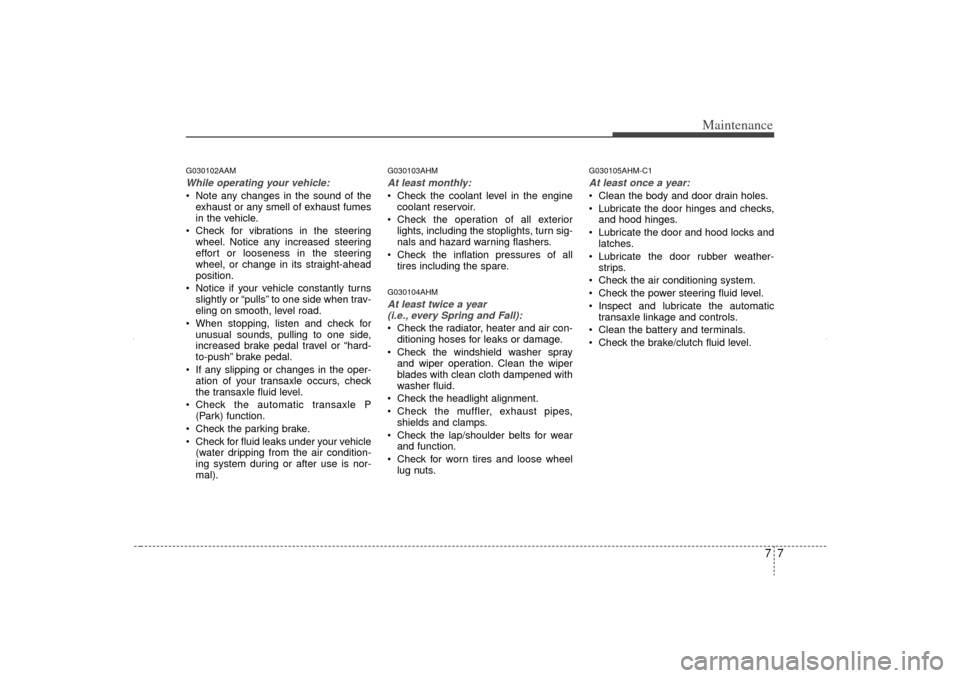
G030102AAMWhile operating your vehicle: Note any changes in the sound of theexhaust or any smell of exhaust fumes
in the vehicle.
Check for vibrations in the steering wheel. Notice any increased steering
effort or looseness in the steering
wheel, or change in its straight-ahead
position.
Notice if your vehicle constantly turns slightly or “pulls” to one side when trav-
eling on smooth, level road.
When stopping, listen and check for unusual sounds, pulling to one side,
increased brake pedal travel or “hard-
to-push” brake pedal.
If any slipping or changes in the oper- ation of your transaxle occurs, check
the transaxle fluid level.
Check the automatic transaxle P (Park) function.
Check the parking brake.
Check for fluid leaks under your vehicle (water dripping from the air condition-
ing system during or after use is nor-
mal).
G030103AHMAt least monthly: Check the coolant level in the enginecoolant reservoir.
Check the operation of all exterior lights, including the stoplights, turn sig-
nals and hazard warning flashers.
Check the inflation pressures of all tires including the spare.G030104AHMAt least twice a year (i.e., every Spring and Fall): Check the radiator, heater and air con- ditioning hoses for leaks or damage.
Check the windshield washer spray and wiper operation. Clean the wiper
blades with clean cloth dampened with
washer fluid.
Check the headlight alignment.
Check the muffler, exhaust pipes, shields and clamps.
Check the lap/shoulder belts for wear and function.
Check for worn tires and loose wheel lug nuts.
G030105AHM-C1At least once a year: Clean the body and door drain holes.
Lubricate the door hinges and checks,and hood hinges.
Lubricate the door and hood locks and latches.
Lubricate the door rubber weather- strips.
Check the air conditioning system.
Check the power steering fluid level.
Inspect and lubricate the automatic transaxle linkage and controls.
Clean the battery and terminals.
Check the brake/clutch fluid level.
XM CAN (ENG) 7.QXP 4/19/2011 10:52 AM Page 7
Page 326 of 388
Maintenance12
7
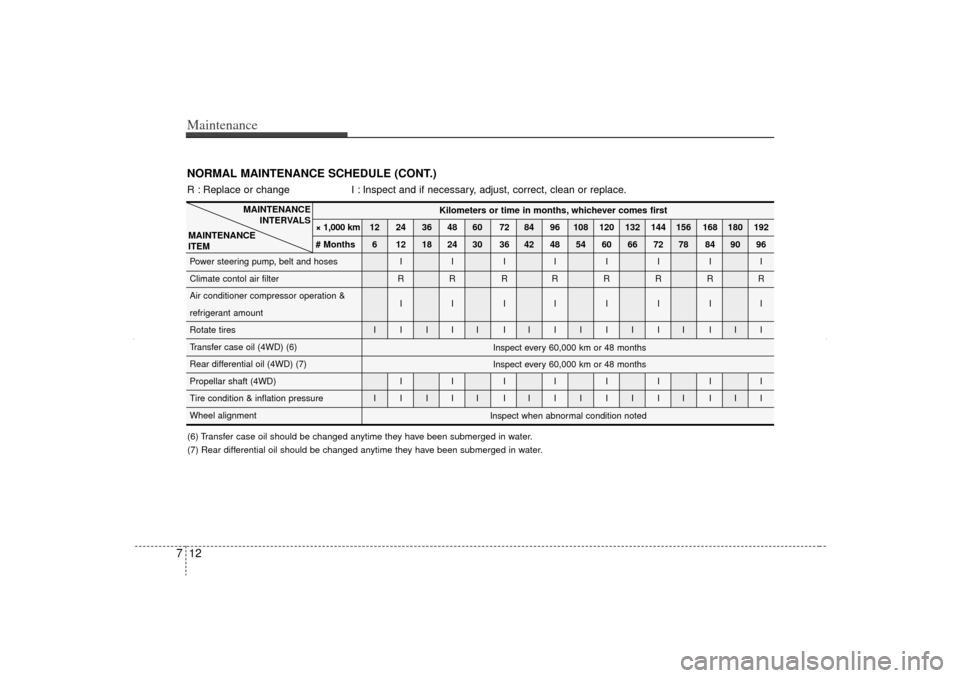
Kilometers or time in months, whichever comes first
× 1,000 km 12 24 36 48 60 72 84 96 108 120 132 144 156 168 180 192
# Months 6 12 18 24 30 36 42 48 54 60 66 72 78 84 90 96
Power steering pump, belt and hoses I I I IIIII
Climate contol air filter R R R RRRRR
Air conditioner compressor operation & IIIIIIII
refrigerant amount
Rotate tires I I I I I I IIIIIII III
Transfer case oil (4WD) (6)
Rear differential oil (4WD) (7)
Propellar shaft (4WD) I I I IIIII
Tire condition & inflation pressure I I I I I I IIIIIII III
Wheel alignment
MAINTENANCE INTERVALS
MAINTENANCE
ITEM
Inspect every 60,000 km or 48 months
Inspect every 60,000 km or 48 months
NORMAL MAINTENANCE SCHEDULE (CONT.)R : Replace or change I : Inspect and if necessary, adjust, correct, clean or replace.
Inspect when abnormal condition noted
(6) Transfer case oil should be changed anytime they have been submerged in water.
(7) Rear differential oil should be changed anytime they have been submerged in water.
XM CAN (ENG) 7.QXP 4/19/2011 10:52 AM Page 12
Page 331 of 388
717
Maintenance
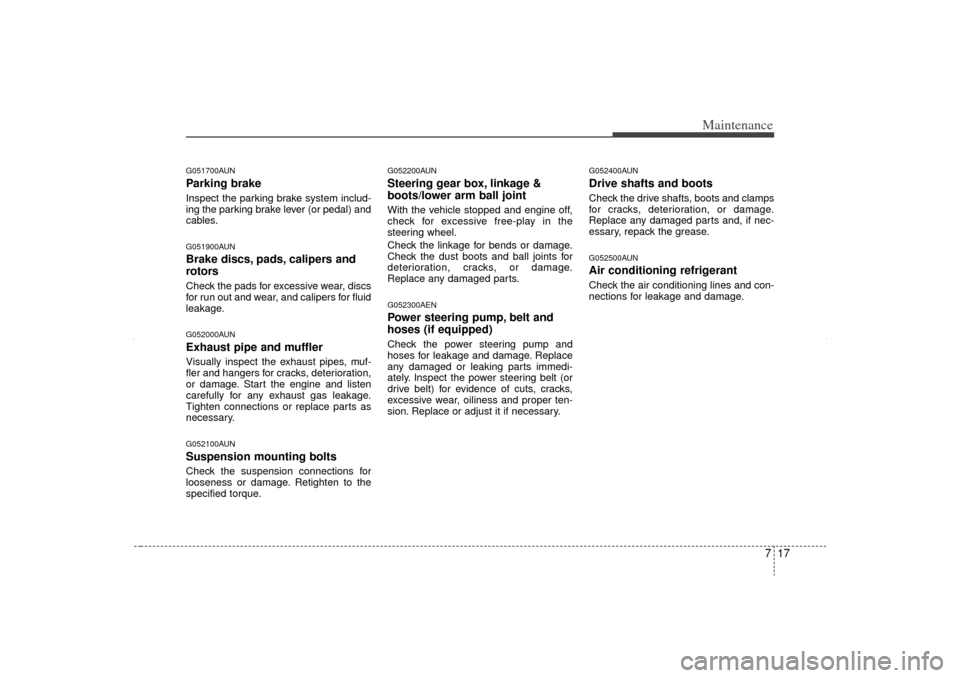
G051700AUNParking brakeInspect the parking brake system includ-
ing the parking brake lever (or pedal) and
cables.G051900AUNBrake discs, pads, calipers and
rotorsCheck the pads for excessive wear, discs
for run out and wear, and calipers for fluid
leakage.G052000AUNExhaust pipe and mufflerVisually inspect the exhaust pipes, muf-
fler and hangers for cracks, deterioration,
or damage. Start the engine and listen
carefully for any exhaust gas leakage.
Tighten connections or replace parts as
necessary.G052100AUNSuspension mounting boltsCheck the suspension connections for
looseness or damage. Retighten to the
specified torque.
G052200AUNSteering gear box, linkage &
boots/lower arm ball jointWith the vehicle stopped and engine off,
check for excessive free-play in the
steering wheel.
Check the linkage for bends or damage.
Check the dust boots and ball joints for
deterioration, cracks, or damage.
Replace any damaged parts.G052300AENPower steering pump, belt and
hoses (if equipped)Check the power steering pump and
hoses for leakage and damage. Replace
any damaged or leaking parts immedi-
ately. Inspect the power steering belt (or
drive belt) for evidence of cuts, cracks,
excessive wear, oiliness and proper ten-
sion. Replace or adjust it if necessary.
G052400AUNDrive shafts and bootsCheck the drive shafts, boots and clamps
for cracks, deterioration, or damage.
Replace any damaged parts and, if nec-
essary, repack the grease.G052500AUNAir conditioning refrigerant Check the air conditioning lines and con-
nections for leakage and damage.
XM CAN (ENG) 7.QXP 4/19/2011 10:52 AM Page 17
Page 354 of 388
Maintenance40
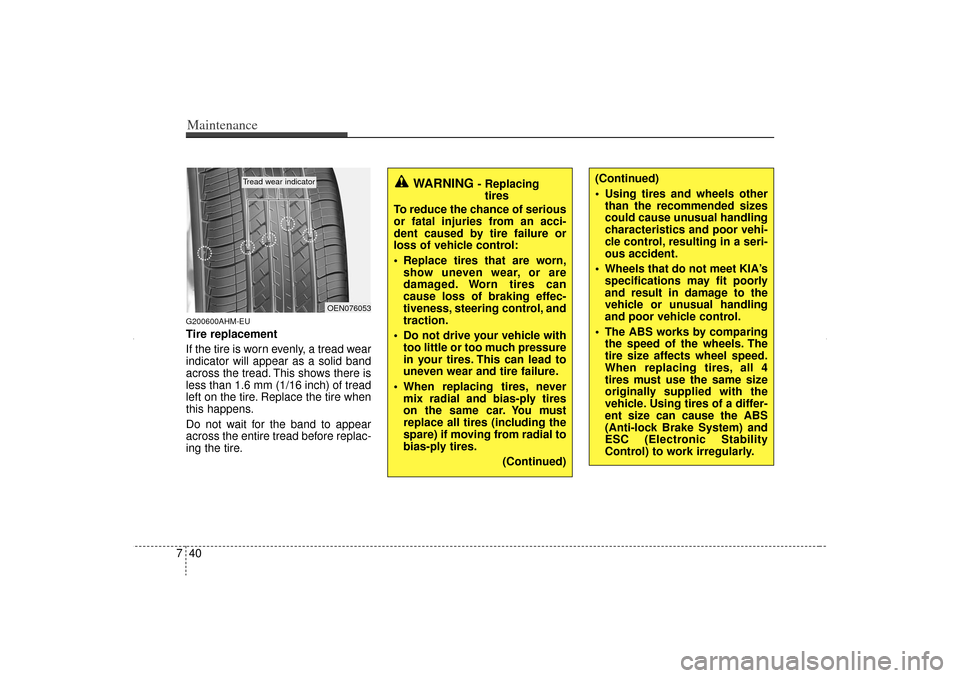
7G200600AHM-EUTire replacement
If the tire is worn evenly, a tread wear
indicator will appear as a solid band
across the tread. This shows there is
less than 1.6 mm (1/16 inch) of tread
left on the tire. Replace the tire when
this happens.
Do not wait for the band to appear
across the entire tread before replac-
ing the tire.
OEN076053
Tread wear indicator
WARNING
- Replacing
tires
To reduce the chance of serious
or fatal injuries from an acci-
dent caused by tire failure or
loss of vehicle control:
Replace tires that are worn, show uneven wear, or are
damaged. Worn tires can
cause loss of braking effec-
tiveness, steering control, and
traction.
Do not drive your vehicle with too little or too much pressure
in your tires. This can lead to
uneven wear and tire failure.
When replacing tires, never mix radial and bias-ply tires
on the same car. You must
replace all tires (including the
spare) if moving from radial to
bias-ply tires.
(Continued)
(Continued)
Using tires and wheels otherthan the recommended sizes
could cause unusual handling
characteristics and poor vehi-
cle control, resulting in a seri-
ous accident.
Wheels that do not meet KIA’s specifications may fit poorly
and result in damage to the
vehicle or unusual handling
and poor vehicle control.
The ABS works by comparing the speed of the wheels. The
tire size affects wheel speed.
When replacing tires, all 4
tires must use the same size
originally supplied with the
vehicle. Using tires of a differ-
ent size can cause the ABS
(Anti-lock Brake System) and
ESC (Electronic Stability
Control) to work irregularly.
XM CAN (ENG) 7.QXP 4/19/2011 10:53 AM Page 40
Page 369 of 388
755
Maintenance
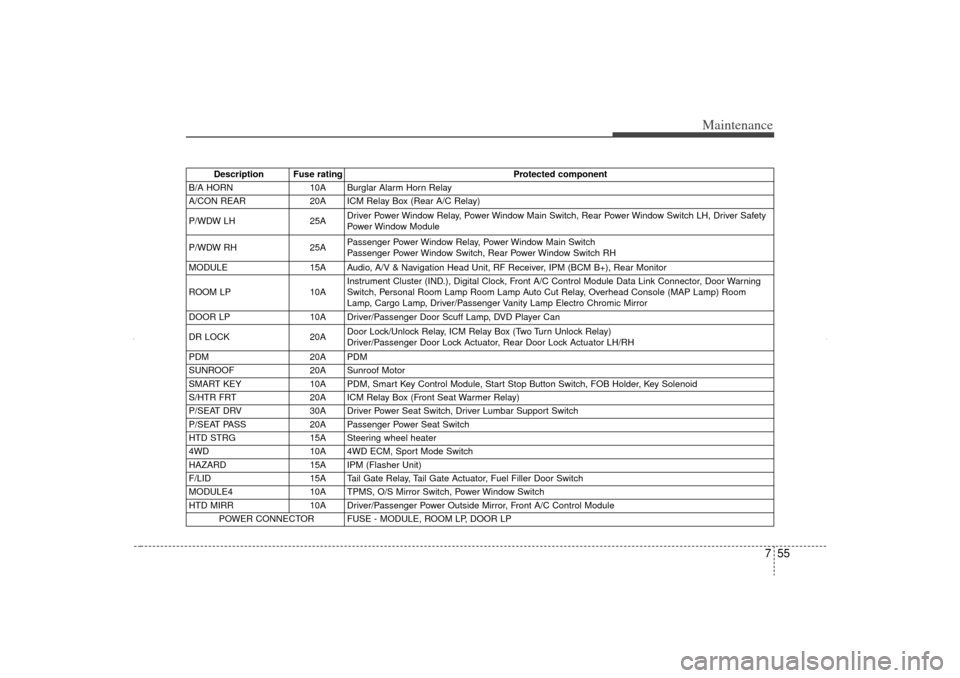
Description Fuse ratingProtected component
B/A HORN 10A Burglar Alarm Horn Relay
A/CON REAR 20A ICM Relay Box (Rear A/C Relay)
P/WDW LH 25ADriver Power Window Relay, Power Window Main Switch, Rear Power Window Switch LH, Driver Safety
Power Window Module
P/WDW RH 25APassenger Power Window Relay, Power Window Main Switch
Passenger Power Window Switch, Rear Power Window Switch RH
MODULE 15A Audio, A/V & Navigation Head Unit, RF Receiver, IPM (BCM B+), Rear Monitor
ROOM LP 10AInstrument Cluster (IND.), Digital Clock, Front A/C Control Module Data Link Connector, Door Warning
Switch, Personal Room Lamp Room Lamp Auto Cut Relay, Overhead Console (MAP Lamp) Room
Lamp, Cargo Lamp, Driver/Passenger Vanity Lamp Electro Chromic Mirror
DOOR LP 10A Driver/Passenger Door Scuff Lamp, DVD Player Can
DR LOCK 20ADoor Lock/Unlock Relay, ICM Relay Box (Two Turn Unlock Relay)
Driver/Passenger Door Lock Actuator, Rear Door Lock Actuator LH/RH
PDM 20A PDM
SUNROOF 20A Sunroof Motor
SMART KEY 10A PDM, Smart Key Control Module, Start Stop Button Switch, FOB Holder, Key Solenoid
S/HTR FRT 20A ICM Relay Box (Front Seat Warmer Relay)
P/SEAT DRV 30A Driver Power Seat Switch, Driver Lumbar Support Switch
P/SEAT PASS 20A Passenger Power Seat Switch
HTD STRG 15A Steering wheel heater
4WD 10A 4WD ECM, Sport Mode Switch
HAZARD 15A IPM (Flasher Unit)
F/LID 15A Tail Gate Relay, Tail Gate Actuator, Fuel Filler Door Switch
MODULE4 10A TPMS, O/S Mirror Switch, Power Window Switch
HTD MIRR 10A Driver/Passenger Power Outside Mirror, Front A/C Control Module
POWER CONNECTOR FUSE - MODULE, ROOM LP, DOOR LP
XM CAN (ENG) 7.QXP 4/19/2011 10:54 AM Page 55