engine overheat KIA Sorento 2012 2.G Owner's Manual
[x] Cancel search | Manufacturer: KIA, Model Year: 2012, Model line: Sorento, Model: KIA Sorento 2012 2.GPages: 388, PDF Size: 7.56 MB
Page 7 of 388

Index4I
Emergency starting ··················\
··················\
··················\
····6-4Jump starting ··················\
··················\
··················\
·········6-4
Push starting ··················\
··················\
··················\
··········6-5
Emergency tailgate safety release ··················\
···············4-20
Emergency towing ··················\
··················\
··················\
···6-17
Emergency while driving··················\
··················\
·············6-2
Emission control system ··················\
··················\
············7-64 Crankcase emission control system ··················\
········7-64
Evaporative emission control (including ORVR) System ··················\
··················\
··················\
··············7-64
Exhaust emission control system ··················\
············7-65
Engine compartment ··················\
··················\
············2-4, 7-2
Engine coolant ··················\
··················\
··················\
·········7-19
Engine number ··················\
··················\
··················\
···········8-8
Engine oil ··················\
··················\
··················\
·················7-18\
Engine overheats··················\
··················\
··················\
········6-6
Engine start/stop button ··················\
··················\
···············5-7
Engine temperature gauge ··················\
··················\
·········4-50
Engine will not start··················\
··················\
··················\
···6-3
Evaporative emission control (including ORVR) System ··················\
··················\
··················\
·················7-64\
Exhaust emission control system··················\
·················7-65\
Explanation of scheduled maintenance items ···············7-15
Exterior care··················\
··················\
··················\
·············7-58
Exterior features··················\
··················\
··················\
·····4-105 Roof rack ··················\
··················\
··················\
···········4-105 Flat tire ··················\
··················\
··················\
··················\
·····6-7
Changing tires ··················\
··················\
··················\
·······6-9
Compact spare tire ··················\
··················\
················6-14
Jack and tools ··················\
··················\
··················\
········6-7
Removing and storing the spare tire ··················\
·········6-8
Floor mat anchor(s) ··················\
··················\
·················4-10\
3
Fluid Brake/clutch fluid ··················\
··················\
··················\
7-22
Power steering fluid ··················\
··················\
··············7-23
Washer fluid ··················\
··················\
··················\
········7-24
Folding the rear seat ··················\
··················\
··················\
3-13
Four wheel drive (4WD) ··················\
··················\
···········5-21
Front seat adjustment - manual ··················\
··················\
···3-4
Front seat adjustment - power ··················\
··················\
·····3-5
Fuel filler lid ··················\
··················\
··················\
············4-27
Fuel gauge··················\
··················\
··················\
················4-51
Fuel requirements ··················\
··················\
··················\
······1-3
Fuses ··················\
··················\
··················\
··················\
······7-49 Fuse/relay panel description··················\
··················\
··7-53
Memory fuse ··················\
··················\
··················\
·······7-51
Multi fuse ··················\
··················\
··················\
············7-52
F
XM CAN (ENG) INDEX.QXP 4/19/2011 10:59 AM Page 4
Page 10 of 388

I7
Index
Occupant detection system ··················\
··················\
········3-47
Odometer/Tripmeter/Trip computer ··················\
············4-51
Oil (Engine) ··················\
··················\
··················\
·············7-18
Outside rearview mirror··················\
··················\
·············4-45
Overheats ··················\
··················\
··················\
··················\
·6-6
Owner maintenance ··················\
··················\
··················\
···7-6
Panoramic sunroof ··················\
··················\
··················\
···4-30
Parking brake··················\
··················\
··················\
··5-28, 7-24
Passenger's front air bag ··················\
··················\
············3-53
Power brakes··················\
··················\
··················\
············5-27
Power outlet ··················\
··················\
··················\
···········4-101
Power steering ··················\
··················\
··················\
·········4-36
Power steering fluid ··················\
··················\
··················\
·7-23
Power window lock button ··················\
··················\
········4-24
Pre-tensioner seat belt··················\
··················\
················3-26
Push starting··················\
··················\
··················\
···············6-5
Rear parking assist system··················\
··················\
·········4-63
Rear seat adjustment ··················\
··················\
··················\
3-12
Rearview camera ··················\
··················\
··················\
·····4-66
Recommended cold tire inflation pressures ··················\
7-36Recommended lubricants and capacities ··················\
·······8-4
Recommended SAE viscosity number··················\
······8-6
Remote keyless entry ··················\
··················\
··················\
·4-6
Road warning ··················\
··················\
··················\
·············6-2
Rocking the vehicle ··················\
··················\
··················\
·5-46
Roof rack ··················\
··················\
··················\
···············4-105
Safety chains ··················\
··················\
··················\
············5-54
Seat belts ··················\
··················\
··················\
··················\
3-20 Pre-tensioner seat belt ··················\
··················\
···········3-26
Seat belt - Driver's··················\
··················\
·················3-22\
Seat belt warning··················\
··················\
··················\
·3-21
Seat belts - Front passenger and rear seat ·················3-24\
Seat heater··················\
··················\
··················\
··················\
3-9
Seat heater with air ventilation ··················\
··················\
··3-10
Seatback pocket ··················\
··················\
··················\
·······3-12
Seating capacity ··················\
··················\
··················\
·······5-62
Seats ··················\
··················\
··················\
··················\
·········3-2 Armrest ··················\
··················\
··················\
················3-19
Folding the rear seat ··················\
··················\
··············3-13
Front seat adjustment - manual ··················\
·················3-4
Front seat adjustment - power ··················\
··················\
·3-5
Headrest ··················\
··················\
··················\
·······3-7, 3-17
Lumbar support ··················\
··················\
··················\
·····3-7
Rear seat adjustment ··················\
··················\
·············3-12
Seat heater ··················\
··················\
··················\
·············3-9OP
S
R
XM CAN (ENG) INDEX.QXP 4/19/2011 10:59 AM Page 7
Page 140 of 388
Features of your vehicle50
4When the door is opened, or if the engine
is not started within 1 minute, the
tachometer pointer may move slightly in
the ON position with the engine OFF.
This movement is normal and will not
affect the accuracy of the tachometer
once the engine is running.
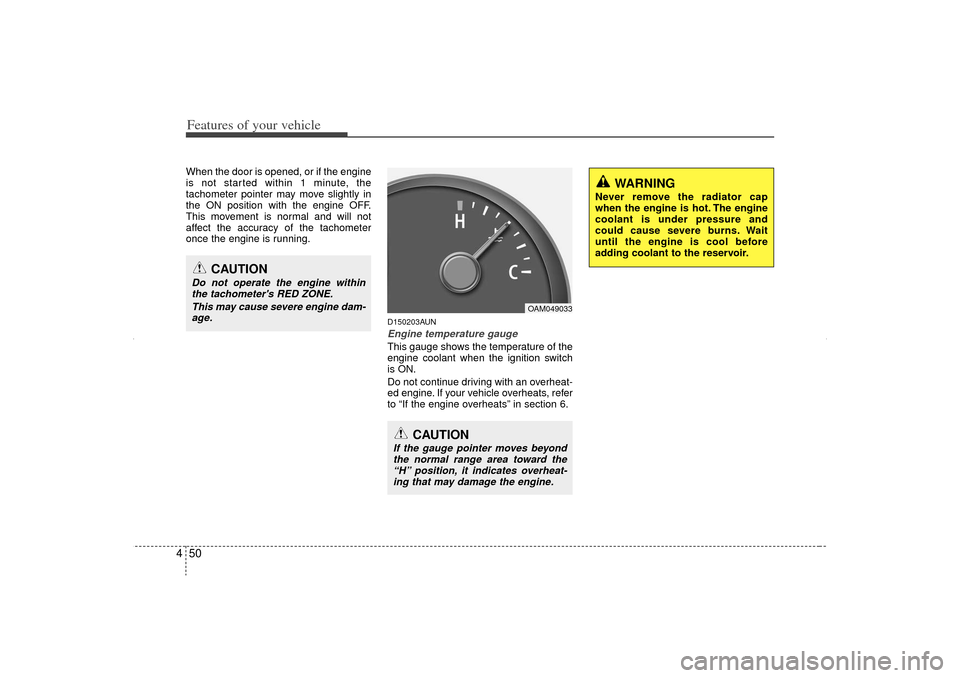
D150203AUNEngine temperature gauge This gauge shows the temperature of the
engine coolant when the ignition switch
is ON.
Do not continue driving with an overheat-
ed engine. If your vehicle overheats, refer
to “If the engine overheats” in section 6.
OAM049033
CAUTION
If the gauge pointer moves beyond
the normal range area toward the“H” position, it indicates overheat- ing that may damage the engine.
CAUTION
Do not operate the engine withinthe tachometer's RED ZONE.
This may cause severe engine dam-age.
WARNING
Never remove the radiator cap
when the engine is hot. The engine
coolant is under pressure and
could cause severe burns. Wait
until the engine is cool before
adding coolant to the reservoir.
XM CAN (ENG) 4(~105).QXP 4/19/2011 10:38 AM Page 50
Page 175 of 388
485
Features of your vehicle
✽
✽NOTICE• When using the air conditioning sys-
tem, monitor the temperature gauge
closely while driving up hills or in
heavy traffic when outside tempera-
tures are high. Air conditioning sys-
tem operation may cause engine over-
heating. Continue to use the blower
fan but turn the air conditioning sys-
tem off if the temperature gauge indi-
cates engine overheating.
• When opening the windows in humid weather air conditioning may create
water droplets inside the vehicle.
Since excessive water droplets may
cause damage to electrical equipment,
air conditioning should only be used
with the windows closed.
Air conditioning system operation tips
If the vehicle has been parked in direct
sunlight during hot weather, open the
windows for a short time to let the hot
air inside the vehicle escape.
To help reduce moisture inside of the windows on rainy or humid days,
decrease the humidity inside the vehi-
cle by operating the air conditioning
system.
During air conditioning system opera- tion, you may occasionally notice a
slight change in engine speed as the
air conditioning compressor cycles.
This is a normal system operation
characteristic.
Use the air conditioning system every month only for a few minutes to ensure
maximum system performance. When using the air conditioning sys-
tem, you may notice clear water drip-
ping (or even puddling) on the ground
under the passenger side of the vehi-
cle. This is a normal system operation
characteristic.
Operating the air conditioning system in the recirculated air position provides
maximum cooling, however, continual
operation in this mode may cause the
air inside the vehicle to become stale.
During cooling operation, you may occasionally notice a misty air flow
because of rapid cooling and humid air
intake. This is a normal system opera-
tion characteristic.
XM CAN (ENG) 4(~105).QXP 4/19/2011 10:40 AM Page 85
Page 232 of 388
Driving your vehicle45
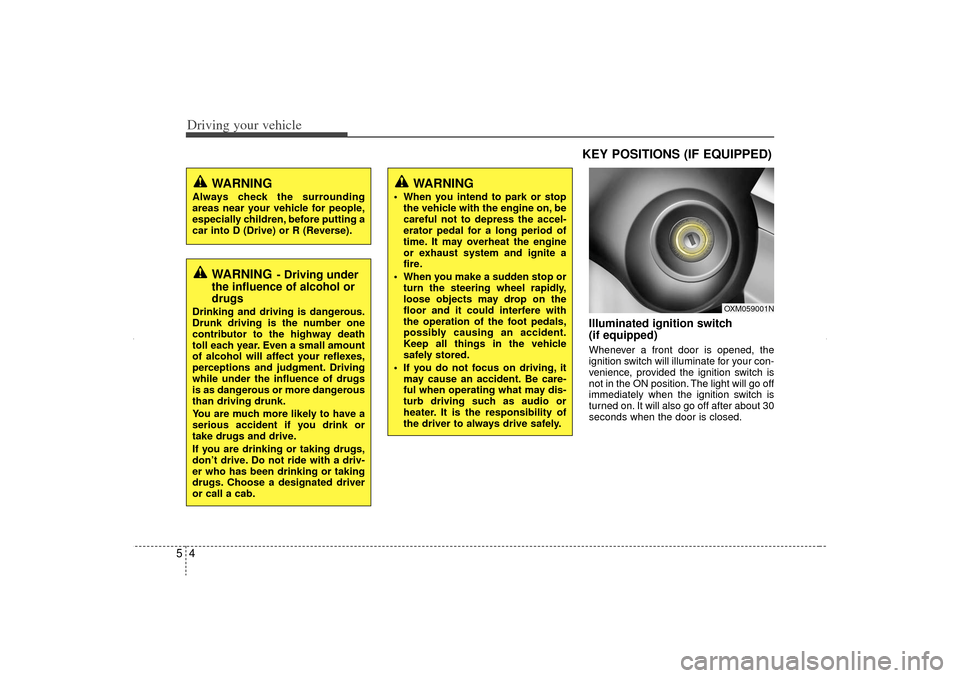
Illuminated ignition switch
(if equipped)Whenever a front door is opened, the
ignition switch will illuminate for your con-
venience, provided the ignition switch is
not in the ON position. The light will go off
immediately when the ignition switch is
turned on. It will also go off after about 30
seconds when the door is closed.
OXM059001N
KEY POSITIONS (IF EQUIPPED)
WARNING
When you intend to park or stopthe vehicle with the engine on, be
careful not to depress the accel-
erator pedal for a long period of
time. It may overheat the engine
or exhaust system and ignite a
fire.
When you make a sudden stop or turn the steering wheel rapidly,
loose objects may drop on the
floor and it could interfere with
the operation of the foot pedals,
possibly causing an accident.
Keep all things in the vehicle
safely stored.
If you do not focus on driving, it may cause an accident. Be care-
ful when operating what may dis-
turb driving such as audio or
heater. It is the responsibility of
the driver to always drive safely.
WARNING
- Driving under
the influence of alcohol or
drugs
Drinking and driving is dangerous.
Drunk driving is the number one
contributor to the highway death
toll each year. Even a small amount
of alcohol will affect your reflexes,
perceptions and judgment. Driving
while under the influence of drugs
is as dangerous or more dangerous
than driving drunk.
You are much more likely to have a
serious accident if you drink or
take drugs and drive.
If you are drinking or taking drugs,
don’t drive. Do not ride with a driv-
er who has been drinking or taking
drugs. Choose a designated driver
or call a cab.
WARNING
Always check the surrounding
areas near your vehicle for people,
especially children, before putting a
car into D (Drive) or R (Reverse).
XM CAN (ENG) 5.QXP 11/5/2010 11:38 AM Page 4
Page 242 of 388
Driving your vehicle14
5E050200AUN-C1Good driving practices Never take the vehicle out of gear and
coast down a hill. This is extremely
hazardous. Always leave the vehicle in
gear.
Don't "ride" the brakes. This can cause them to overheat and malfunction.
Instead, when you are driving down a
long hill, slow down and shift to a lower
gear. When you do this, engine braking
will help slow down the vehicle.
Slow down before shifting to a lower gear. This will help avoid over-revving
the engine, which can cause damage.
Slow down when you encounter cross winds. This gives you much better con-
trol of your vehicle.
Be sure the vehicle is completely stopped before you attempt to shift into
reverse. The transaxle can be dam-
aged if you do not. To shift into reverse,
depress the clutch, move the shift lever
to neutral, then shift to the reverse
position. Exercise extreme caution when driving
on a slippery surface. Be especially
careful when braking, accelerating or
shifting gears. On a slippery surface,
an abrupt change in vehicle speed can
cause the drive wheels to lose traction
and the vehicle to go out of control.
WARNING
Always buckle-up! In a collision,an unbelted occupant is signifi-
cantly more likely to be seriously
injured or killed than a properly
belted occupant.
Avoid high speeds when corner- ing or turning.
Do not make quick steering wheel movements, such as sharp
lane changes or fast, sharp turns.
The risk of rollover is greatly increased if you lose control of
your vehicle at highway speeds.
Loss of control often occurs if two or more wheels drop off the
roadway and the driver over-
steers to reenter the roadway.
In the event your vehicle leaves the roadway, do not steer sharply.
Instead, slow down before pulling
back into the travel lanes.
Never exceed posted speed lim- its.
XM CAN (ENG) 5.QXP 11/5/2010 11:38 AM Page 14
Page 247 of 388
519
Driving your vehicle
E060103AHMIgnition key interlock system The ignition key cannot be removed
unless the shift lever is in the P (Park)
position. Even if the ignition switch is in
the LOCK position, the key also cannot
be removed.
If your vehicle is equipped with ENGINE
START/STOP button, the button will not
change to the OFF position unless the
shift lever is in the P (Park) position.
E060200AAMGood driving practices Never move the gear shift lever from P(Park) or N (Neutral) to any other posi-
tion with the accelerator pedal
depressed.
Never move the gear shift lever into P (Park) when the vehicle is in motion.
Be sure the vehicle is completely stopped before you attempt to shift into
R (Reverse) or D (Drive).
Never take the vehicle out of gear and coast down a hill. This may be
extremely hazardous. Always leave the
car in gear when moving.
Do not "ride" the brakes. This can cause them to overheat and malfunc-
tion. Instead, when you are driving
down a long hill, slow down and shift to
a lower gear. When you do this, engine
braking will help slow down the car.
Slow down before shifting to a lower gear. Otherwise, the lower gear may
not be engaged. Always use the parking brake. Do not
depend on placing the transaxle in P
(Park) to keep the vehicle from moving.
Exercise extreme caution when driving on a slippery surface. Be especially
careful when braking, accelerating or
shifting gears. On a slippery surface,
an abrupt change in vehicle speed can
cause the drive wheels to lose traction
and the vehicle to go out of control.
Optimum vehicle performance and economy is obtained by smoothly
depressing and releasing the accelera-
tor pedal.
XM CAN (ENG) 5.QXP 11/5/2010 11:39 AM Page 19
Page 255 of 388
527
Driving your vehicle
E070100AHMPower brakesYour vehicle has power-assisted brakes
that adjust automatically through normal
usage.
In the event that the power-assisted
brakes lose power because of a stalled
engine or some other reason, you can
still stop your vehicle by applying greater
force to the brake pedal than you nor-
mally would. The stopping distance, how-
ever, will be longer.
When the engine is not running, the
reserve brake power is partially depleted
each time the brake pedal is applied. Do
not pump the brake pedal when the
power assist has been interrupted.
Pump the brake pedal only when neces-
sary to maintain steering control on slip-
pery surfaces.
E070101AUNIn the event of brake failure If service brakes fail to operate while the
vehicle is in motion, you can make an
emergency stop with the parking brake.
The stopping distance, however, will be
much greater than normal.
BRAKE SYSTEM
(Continued)
When descending a long or steephill, shift to a lower gear and
avoid continuous application of
the brakes. Continuous brake
application will cause the brakes
to overheat and could result in a
temporary loss of braking per-
formance.
Wet brakes may impair the vehi- cle’s ability to safely slow down;
the vehicle may also pull to one
side when the brakes are applied.
Applying the brakes lightly will
indicate whether they have been
affected in this way. Always test
your brakes in this fashion after
driving through deep water. To
dry the brakes, apply them lightly
while maintaining a safe forward
speed until brake performance
returns to normal.
Always, confirm the position of the brake and accelerator pedal
before driving. If you don’t check
the position of the accelerator
and brake pedal before driving,
you may depress the accelerator
instead of the brake pedal. It may
cause a serious accident.
WARNING
- Parking brake
Applying the parking brake while
the vehicle is moving at normal
speeds can cause a sudden loss of
control of the vehicle. If you must
use the parking brake to stop the
vehicle, use great caution in apply-
ing the brake.
WARNING
Do not operate the parking brake
while the vehicle is moving except
in an emergency situation. It could
damage the vehicle system and
make endanger driving safety.
WARNING
- Brakes
Do not drive with your foot rest-ing on the brake pedal. This will
create abnormal high brake tem-
peratures, excessive brake lining
and pad wear, and increased
stopping distances.
(Continued)
XM CAN (ENG) 5.QXP 11/5/2010 11:39 AM Page 27
Page 264 of 388
Driving your vehicle36
5
✽
✽
NOTICE• The DBC does not turn ON in the P
(Park) position.
• The DBC may not activate if the ESC (or BAS) is activated.
• Noise or vibration may occur from the brakes when the DBC is activated.
• The rear stop light comes on when the DBC is activated.
• In a very steep hill even though the brake pedal or accelerator pedal is
depressed the DBC may not deacti-
vate.
• Always turn OFF the DBC on normal roads. The DBC might activate from
the standby mode when abrupt corn-
ing or driving through speed bumps.
• DBC may activate and cause the engine to stop in vehicles with manual
transaxle if you drive in 3rd gear (or
above) with DBC on. Do not turn on
DBC when driving in 3rd gear (or
above).
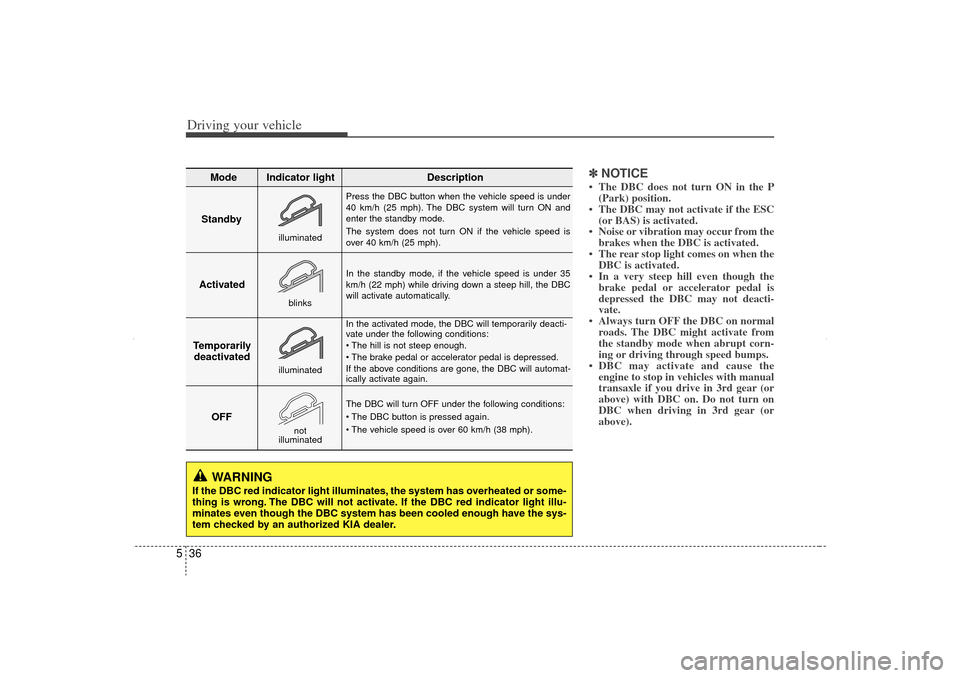
Standby
Press the DBC button when the vehicle speed is under
40 km/h (25 mph). The DBC system will turn ON and
enter the standby mode.
The system does not turn ON if the vehicle speed is
over 40 km/h (25 mph).
In the standby mode, if the vehicle speed is under 35
km/h (22 mph) while driving down a steep hill, the DBC
will activate automatically.
In the activated mode, the DBC will temporarily deacti-
vate under the following conditions:
The hill is not steep enough.
The brake pedal or accelerator pedal is depressed.
If the above conditions are gone, the DBC will automat-
ically activate again.
The DBC will turn OFF under the following conditions:
The DBC button is pressed again.
The vehicle speed is over 60 km/h (38 mph).
Activated
Temporarily deactivated
OFF
Mode Indicator light Description
blinksilluminated
not
illuminated
illuminated
WARNING
If the DBC red indicator light illuminates, the system has overheated or some-
thing is wrong. The DBC will not activate. If the DBC red indicator light illu-
minates even though the DBC system has been cooled enough have the sys-
tem checked by an authorized KIA dealer.
XM CAN (ENG) 5.QXP 11/5/2010 11:39 AM Page 36
Page 265 of 388
537
Driving your vehicle
E070600AAMGood braking practices
Check to be sure the parking brake isnot engaged and the parking brake
indicator light is out before driving
away.
Driving through water may get the brakes wet. They can also get wet
when the vehicle is washed. Wet
brakes can be dangerous! Your vehicle
will not stop as quickly if the brakes are
wet. Wet brakes may cause the vehicle
to pull to one side.
To dry the brakes, apply the brakes
lightly until the braking action returns to
normal, taking care to keep the vehicle
under control at all times. If the braking
action does not return to normal, stop
as soon as it is safe to do so and call
an authorized KIA dealer for assis-
tance. Don't coast down hills with the vehicle
out of gear. This is extremely haz-
ardous. Keep the vehicle in gear at all
times, use the brakes to slow down,
then shift to a lower gear so that
engine braking will help you maintain a
safe speed.
Don't "ride" the brake pedal. Resting your foot on the brake pedal while driv-
ing can be dangerous because the
brakes might overheat and lose their
effectiveness. It also increases the
wear of the brake components.
If a tire goes flat while you are driving, apply the brakes gently and keep the
vehicle pointed straight ahead while
you slow down. When you are moving
slowly enough for it to be safe to do so,
pull off the road and stop in a safe
place.
WARNING
Whenever you leave or park yourvehicle, always set the parking
brake as far as possible and shift
the vehicle to 1st (First) gear or R
(Reverse) for manual transaxle, or
P (Park) for automatic transaxle. If
the parking brake is not fully
engaged, the vehicle may move
inadvertently and injure yourself
and others.
All vehicles should always have the parking brake fully engaged
when parking to avoid inadver-
tent movement of the vehicle
which can injure occupants or
pedestrians.
XM CAN (ENG) 5.QXP 11/5/2010 11:39 AM Page 37