climate control KIA Sorento 2016 3.G User Guide
[x] Cancel search | Manufacturer: KIA, Model Year: 2016, Model line: Sorento, Model: KIA Sorento 2016 3.GPages: 565, PDF Size: 10.63 MB
Page 228 of 565
Features of your vehicle
144
4
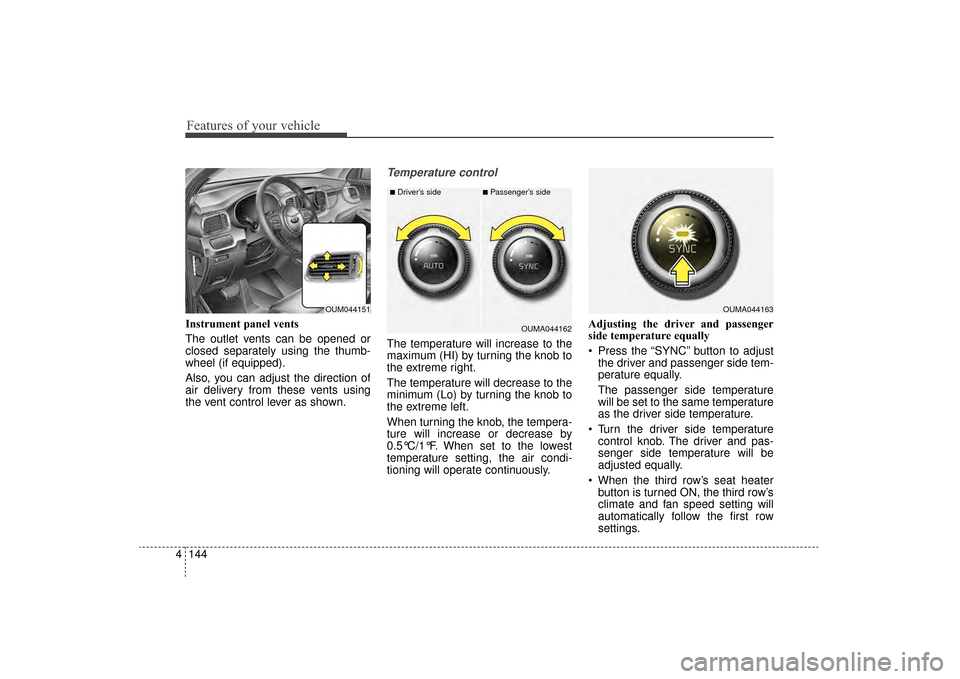
Instrument panel vents
The outlet vents can be opened or
closed separately using the thumb-
wheel (if equipped).
Also, you can adjust the direction of
air delivery from these vents using
the vent control lever as shown.
Temperature control
The temperature will increase to the
maximum (HI) by turning the knob to
the extreme right.
The temperature will decrease to the
minimum (Lo) by turning the knob to
the extreme left.
When turning the knob, the tempera-
ture will increase or decrease by
0.5°C/1°F. When set to the lowest
temperature setting, the air condi-
tioning will operate continuously. Adjusting the driver and passenger
side temperature equally
Press the “SYNC” button to adjust
the driver and passenger side tem-
perature equally.
The passenger side temperature
will be set to the same temperature
as the driver side temperature.
Turn the driver side temperature control knob. The driver and pas-
senger side temperature will be
adjusted equally.
When the third row’s seat heater button is turned ON, the third row’s
climate and fan speed setting will
automatically follow the first row
settings.
OUM044151
■Driver’s side■Passenger’s side
OUMA044163
OUMA044162
UM CAN (ENG) 4.qxp 12/1/2014 12:58 PM Page 144
Page 231 of 565
4147
Features of your vehicle
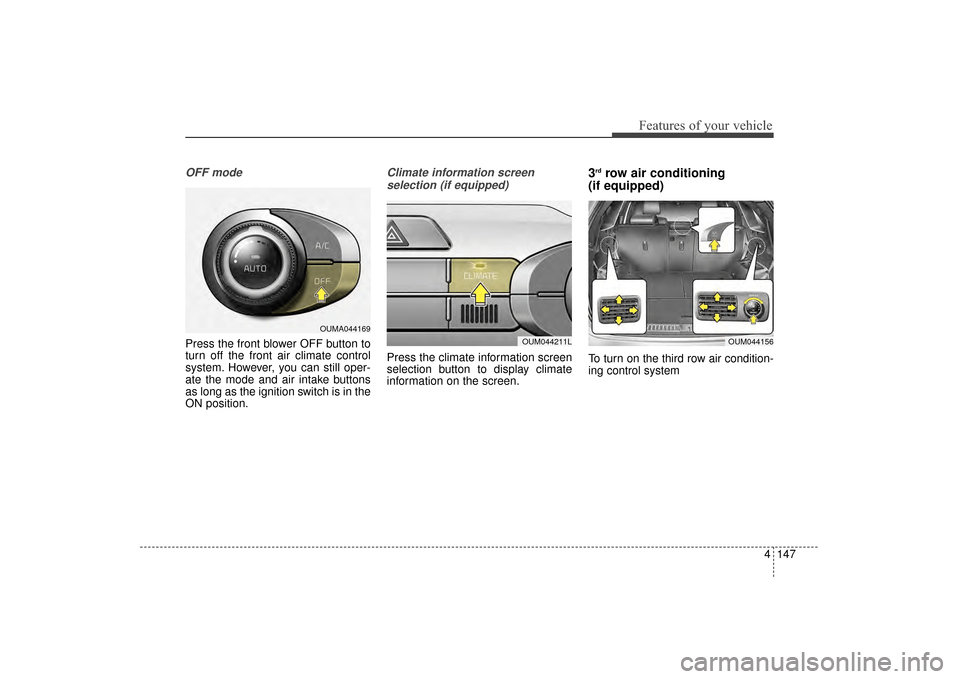
OFF mode
Press the front blower OFF button to
turn off the front air climate control
system. However, you can still oper-
ate the mode and air intake buttons
as long as the ignition switch is in the
ON position.
Climate information screen selection (if equipped)
Press the climate information screen
selection button to display climate
information on the screen.
3rdrow air conditioning
(if equipped)
To turn on the third row air condition-
ing control system
OUMA044169
OUM044211LOUM044156
UM CAN (ENG) 4.qxp 12/1/2014 12:58 PM Page 147
Page 234 of 565
Features of your vehicle
150
4
When using the air conditioning
system, you may notice clear water
dripping (or even puddling) on the
ground under the passenger side
of the vehicle. This is a normal sys-
tem operation characteristic.
Operating the air conditioning sys- tem in the recirculated air position
provides maximum cooling, how-
ever, continual operation in this
mode may cause the air inside the
vehicle to become stale.
During cooling operation, you may occasionally notice a misty air flow
because of rapid cooling and
humid air intake. This is a normal
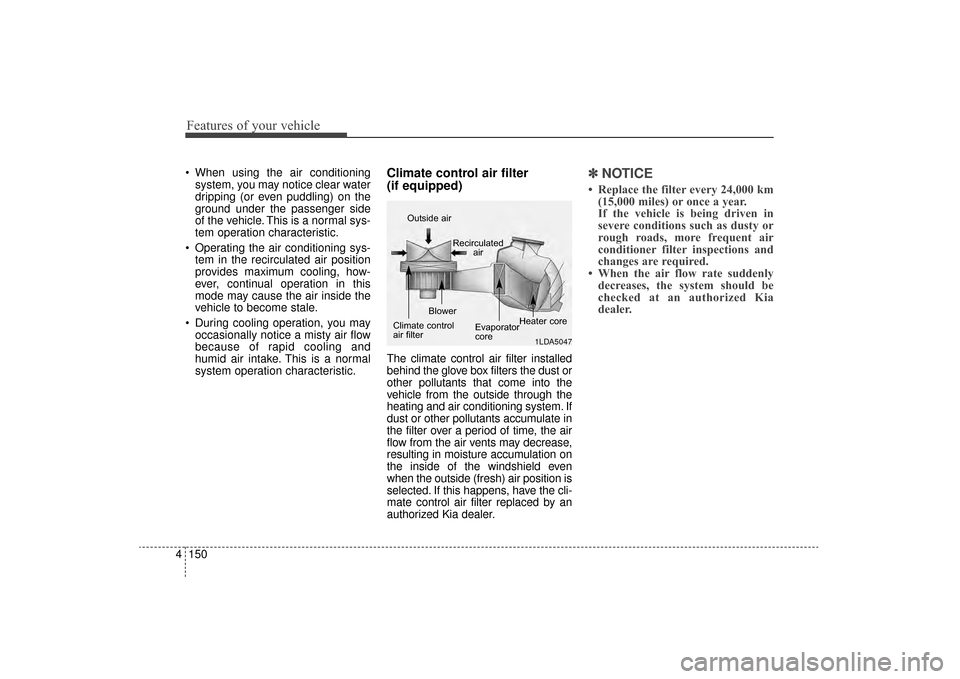
system operation characteristic.Climate control air filter
(if equipped)
The climate control air filter installed
behind the glove box filters the dust or
other pollutants that come into the
vehicle from the outside through the
heating and air conditioning system. If
dust or other pollutants accumulate in
the filter over a period of time, the air
flow from the air vents may decrease,
resulting in moisture accumulation on
the inside of the windshield even
when the outside (fresh) air position is
selected. If this happens, have the cli-
mate control air filter replaced by an
authorized Kia dealer.
✽ ✽ NOTICE
• Replace the filter every 24,000 km
(15,000 miles) or once a year.
If the vehicle is being driven in
severe conditions such as dusty or
rough roads, more frequent air
conditioner filter inspections and
changes are required.
• When the air flow rate suddenly decreases, the system should be
checked at an authorized Kia
dealer.
1LDA5047
Outside air
Recirculatedair
Climate control
air filter Blower
Evaporator
coreHeater core
UM CAN (ENG) 4.qxp 12/1/2014 12:58 PM Page 150
Page 236 of 565
Features of your vehicle
152
4
For maximum defrosting, set the
temperature control to the extreme
right/hot position and the fan speed
control to the highest speed.
If warm air to the floor is desired while defrosting or defogging, set
the mode to the floor-defrost posi-
tion.
Before driving, clear all snow and ice from the windshield, rear win-
dow, outside rear view mirrors, and
all side windows.
Clear all snow and ice from the hood and air inlet in the cowl grill to
improve heater and defroster effi-
ciency and to reduce the probabili-
ty of fogging up the inside of the
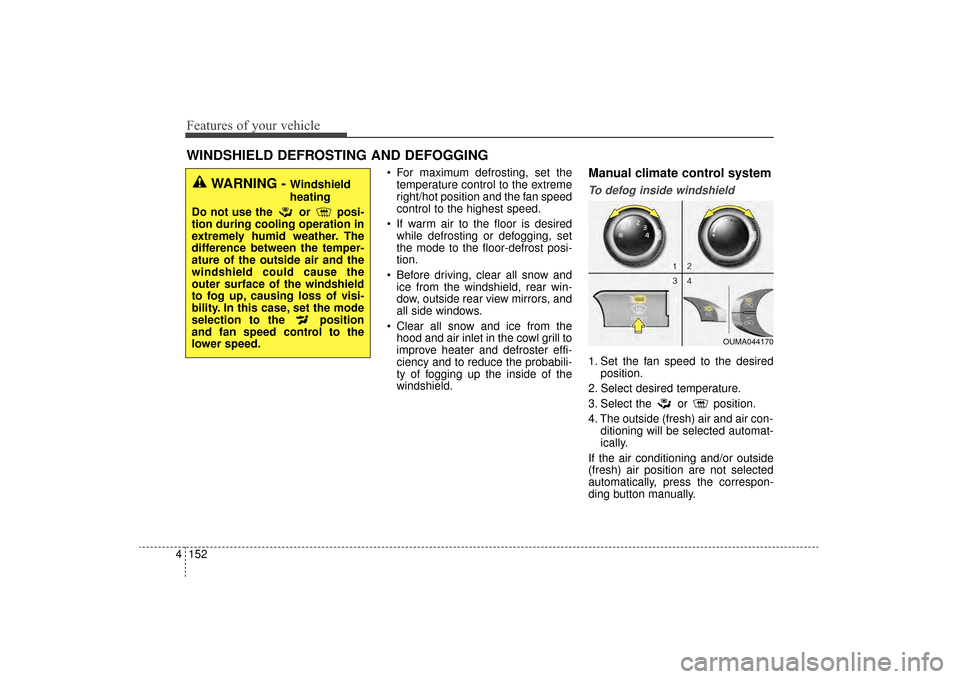
windshield.Manual climate control system
To defog inside windshield
1. Set the fan speed to the desired position.
2. Select desired temperature.
3. Select the or position.
4. The outside (fresh) air and air con- ditioning will be selected automat-
ically.
If the air conditioning and/or outside
(fresh) air position are not selected
automatically, press the correspon-
ding button manually.
WINDSHIELD DEFROSTING AND DEFOGGING
WARNING - Windshield
heating
Do not use the or posi-
tion during cooling operation in
extremely humid weather. The
difference between the temper-
ature of the outside air and the
windshield could cause the
outer surface of the windshield
to fog up, causing loss of visi-
bility. In this case, set the mode
selection to the position
and fan speed control to the
lower speed.
OUMA044170
UM CAN (ENG) 4.qxp 12/1/2014 12:58 PM Page 152
Page 237 of 565
4153
Features of your vehicle
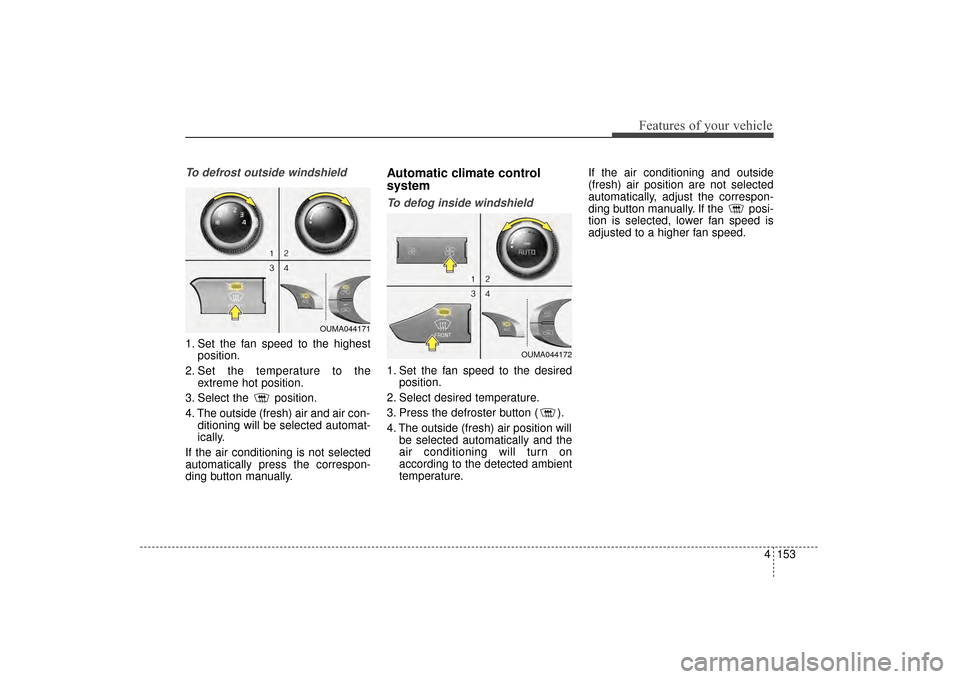
To defrost outside windshield
1. Set the fan speed to the highestposition.
2. Set the temperature to the extreme hot position.
3. Select the position.
4. The outside (fresh) air and air con- ditioning will be selected automat-
ically.
If the air conditioning is not selected
automatically press the correspon-
ding button manually.
Automatic climate control
system
To defog inside windshield
1. Set the fan speed to the desired position.
2. Select desired temperature.
3. Press the defroster button ( ).
4. The outside (fresh) air position will be selected automatically and the
air conditioning will turn on
according to the detected ambient
temperature. If the air conditioning and outside
(fresh) air position are not selected
automatically, adjust the correspon-
ding button manually. If the posi-
tion is selected, lower fan speed is
adjusted to a higher fan speed.
OUMA044172
OUMA044171
UM CAN (ENG) 4.qxp 12/1/2014 12:59 PM Page 153
Page 238 of 565
Features of your vehicle
154
4
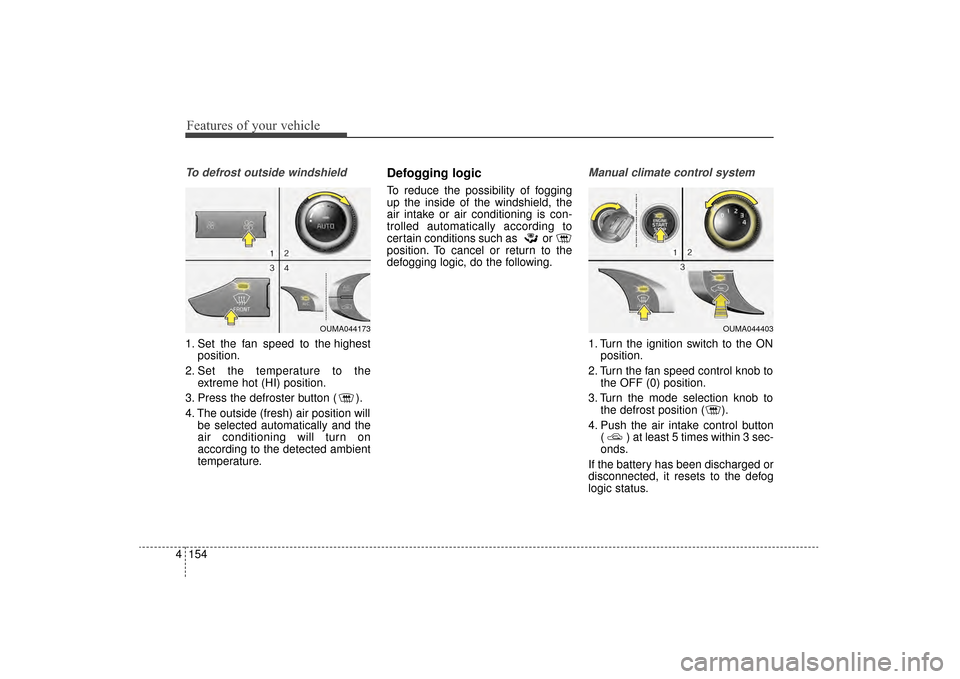
To defrost outside windshield
1. Set the fan speed to the highest
position.
2. Set the temperature to the extreme hot (HI) position.
3. Press the defroster button ( ).
4. The outside (fresh) air position will be selected automatically and the
air conditioning will turn on
according to the detected ambient
temperature.
Defogging logic
To reduce the possibility of fogging
up the inside of the windshield, the
air intake or air conditioning is con-
trolled automatically according to
certain conditions such as or
position. To cancel or return to the
defogging logic, do the following.
Manual climate control system
1. Turn the ignition switch to the ONposition.
2. Turn the fan speed control knob to the OFF (0) position.
3. Turn the mode selection knob to the defrost position ( ).
4. Push the air intake control button ( ) at least 5 times within 3 sec-
onds.
If the battery has been discharged or
disconnected, it resets to the defog
logic status.
OUMA044173OUMA044403
UM CAN (ENG) 4.qxp 12/1/2014 12:59 PM Page 154
Page 239 of 565
4155
Features of your vehicle
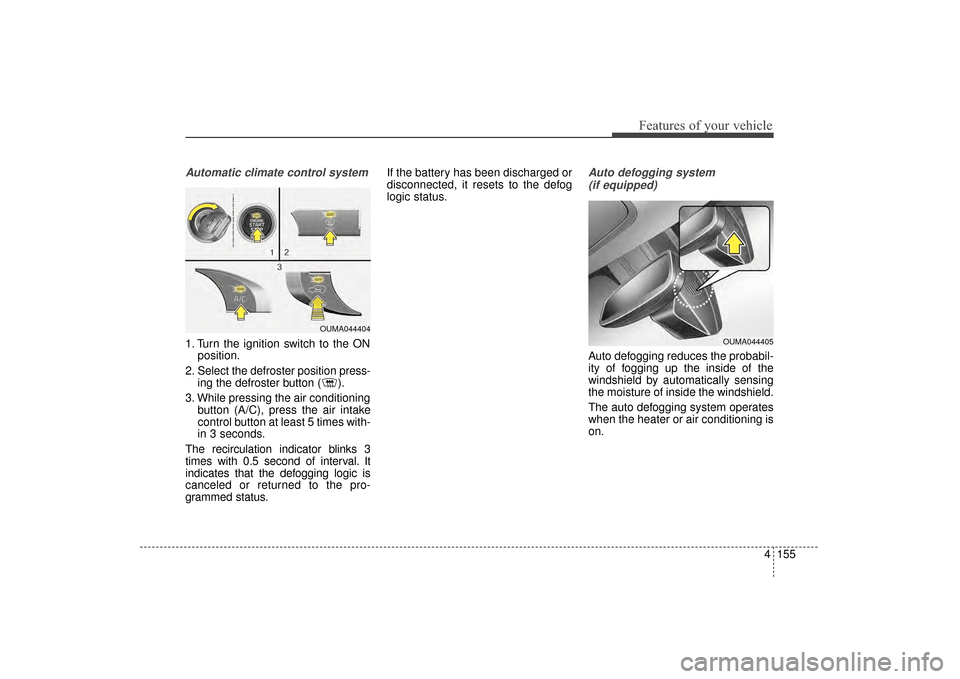
Automatic climate control system
1. Turn the ignition switch to the ONposition.
2. Select the defroster position press- ing the defroster button ( ).
3. While pressing the air conditioning button (A/C), press the air intake
control button at least 5 times with-
in 3 seconds.
The recirculation indicator blinks 3
times with 0.5 second of interval. It
indicates that the defogging logic is
canceled or returned to the pro-
grammed status. If the battery has been discharged or
disconnected, it resets to the defog
logic status.
Auto defogging system
(if equipped)
Auto defogging reduces the probabil-
ity of fogging up the inside of the
windshield by automatically sensing
the moisture of inside the windshield.
The auto defogging system operates
when the heater or air conditioning is
on.
OUMA044404
OUMA044405
UM CAN (ENG) 4.qxp 12/1/2014 12:59 PM Page 155
Page 338 of 565
527
Driving your vehicle
In the event of brake failure
If service brakes fail to operate while
the vehicle is in motion, you can
make an emergency stop with the
parking brake. The stopping dis-
tance, however, will be much greater
than normal.
Disc brakes wear indicator
When your brake pads are worn and
new pads are required, you will hear
a high-pitched warning sound from
your front brakes or rear brakes. You
may hear this sound come and go or
it may occur whenever you depress
the brake pedal.
Please remember that some driving
conditions or climates may cause a
brake squeal when you first apply (or
lightly apply) the brakes. This is nor-
mal and does not indicate a problem
with your brakes.
Always replace the front or rear
brake pads as pairs.
WARNING- Parkingbrake
Applying the parking brake
while the vehicle is moving at
normal speeds can cause a
sudden loss of control of the
vehicle. If you must use the
parking brake to stop the vehi-
cle, use great caution in apply-
ing the brake.
WARNING- Brake wear
Do not ignore high pitched wear
sounds from your brakes. If you
ignore this audible warning, you
will eventually lose braking per-
formance, which could lead to a
serious accident.
CAUTION- Replace brake pads
Do not continue to drive withworn brake pads. Continuing todrive with worn brake pads candamage the braking system andresult in costly brake repairs.
UM CAN (ENG) 5.QXP 12/1/2014 1:02 PM Page 27
Page 445 of 565
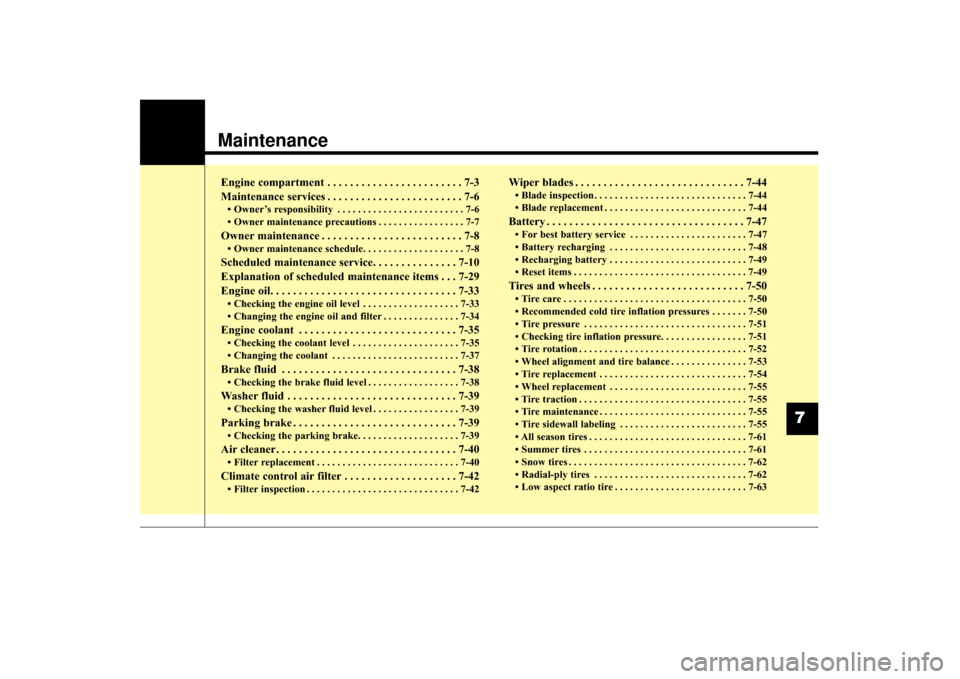
Maintenance
Engine compartment . . . . . . . . . . . . . . . . . . . . . . . . 7-3
Maintenance services . . . . . . . . . . . . . . . . . . . . . . . . 7-6
• Owner’s responsibility . . . . . . . . . . . . . . . . . . . . . . . . . 7-6
• Owner maintenance precautions . . . . . . . . . . . . . . . . . 7-7
Owner maintenance . . . . . . . . . . . . . . . . . . . . . . . . . 7-8
• Owner maintenance schedule. . . . . . . . . . . . . . . . . . . . 7-8
Scheduled maintenance service. . . . . . . . . . . . . . . 7-10
Explanation of scheduled maintenance items . . . 7-29
Engine oil. . . . . . . . . . . . . . . . . . . . . . . . . . . . . . . . . 7-33
• Checking the engine oil level . . . . . . . . . . . . . . . . . . . 7-33
• Changing the engine oil and filter . . . . . . . . . . . . . . . 7-34
Engine coolant . . . . . . . . . . . . . . . . . . . . . . . . . . . . 7-35
• Checking the coolant level . . . . . . . . . . . . . . . . . . . . . 7-35
• Changing the coolant . . . . . . . . . . . . . . . . . . . . . . . . . 7-37
Brake fluid . . . . . . . . . . . . . . . . . . . . . . . . . . . . . . . 7-38
• Checking the brake fluid level . . . . . . . . . . . . . . . . . . 7-38
Washer fluid . . . . . . . . . . . . . . . . . . . . . . . . . . . . . . 7-39
• Checking the washer fluid level . . . . . . . . . . . . . . . . . 7-39
Parking brake . . . . . . . . . . . . . . . . . . . . . . . . . . . . . 7-39
• Checking the parking brake. . . . . . . . . . . . . . . . . . . . 7-39
Air cleaner. . . . . . . . . . . . . . . . . . . . . . . . . . . . . . . . 7-40
• Filter replacement . . . . . . . . . . . . . . . . . . . . . . . . . . . . 7-40
Climate control air filter . . . . . . . . . . . . . . . . . . . . 7-42
• Filter inspection . . . . . . . . . . . . . . . . . . . . . . . . . . . . . . 7-42
Wiper blades . . . . . . . . . . . . . . . . . . . . . . . . . . . . . . 7-44
• Blade inspection . . . . . . . . . . . . . . . . . . . . . . . . . . . . . . 7-44
• Blade replacement . . . . . . . . . . . . . . . . . . . . . . . . . . . . 7-44
Battery . . . . . . . . . . . . . . . . . . . . . . . . . . . . . . . . . . . 7-\
47
• For best battery service . . . . . . . . . . . . . . . . . . . . . . . 7-47
• Battery recharging . . . . . . . . . . . . . . . . . . . . . . . . . . . 7-48
• Recharging battery . . . . . . . . . . . . . . . . . . . . . . . . . . . 7-49
• Reset items . . . . . . . . . . . . . . . . . . . . . . . . . . . . . . . . . . 7-49\
Tires and wheels . . . . . . . . . . . . . . . . . . . . . . . . . . . 7-50
• Tire care . . . . . . . . . . . . . . . . . . . . . . . . . . . . . . . . . . . . \
7-50
• Recommended cold tire inflation pressures . . . . . . . 7-50
• Tire pressure . . . . . . . . . . . . . . . . . . . . . . . . . . . . . . . . 7-51
• Checking tire inflation pressure. . . . . . . . . . . . . . . . . 7-51
• Tire rotation . . . . . . . . . . . . . . . . . . . . . . . . . . . . . . . . . 7-52
• Wheel alignment and tire balance . . . . . . . . . . . . . . . 7-53
• Tire replacement . . . . . . . . . . . . . . . . . . . . . . . . . . . . . 7-54
• Wheel replacement . . . . . . . . . . . . . . . . . . . . . . . . . . . 7-55
• Tire traction . . . . . . . . . . . . . . . . . . . . . . . . . . . . . . . . . 7-55
• Tire maintenance . . . . . . . . . . . . . . . . . . . . . . . . . . . . . 7-55
• Tire sidewall labeling . . . . . . . . . . . . . . . . . . . . . . . . . 7-55
• All season tires . . . . . . . . . . . . . . . . . . . . . . . . . . . . . . . 7-61
• Summer tires . . . . . . . . . . . . . . . . . . . . . . . . . . . . . . . . 7-61
• Snow tires . . . . . . . . . . . . . . . . . . . . . . . . . . . . . . . . . . . 7-\
62
• Radial-ply tires . . . . . . . . . . . . . . . . . . . . . . . . . . . . . . 7-62
• Low aspect ratio tire . . . . . . . . . . . . . . . . . . . . . . . . . . 7-63
7
UM CAN (ENG) 7.qxp 12/1/2014 1:16 PM Page 1
Page 457 of 565
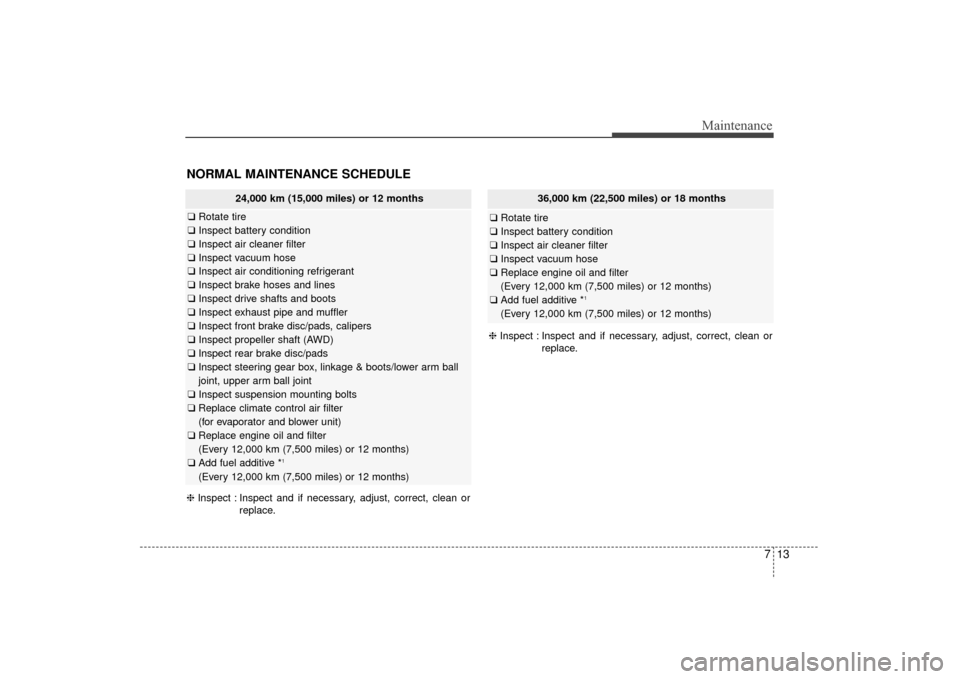
713
Maintenance
24,000 km (15,000 miles) or 12 months
❑Rotate tire
❑ Inspect battery condition
❑ Inspect air cleaner filter
❑ Inspect vacuum hose
❑ Inspect air conditioning refrigerant
❑ Inspect brake hoses and lines
❑ Inspect drive shafts and boots
❑ Inspect exhaust pipe and muffler
❑ Inspect front brake disc/pads, calipers
❑ Inspect propeller shaft (AWD)
❑ Inspect rear brake disc/pads
❑ Inspect steering gear box, linkage & boots/lower arm ball
joint, upper arm ball joint
❑ Inspect suspension mounting bolts
❑ Replace climate control air filter
(for evaporator and blower unit)
❑ Replace engine oil and filter
(Every 12,000 km (7,500 miles) or 12 months)
❑ Add fuel additive *
1
(Every 12,000 km (7,500 miles) or 12 months)
❈ Inspect : Inspect and if necessary, adjust, correct, clean or
replace.
NORMAL MAINTENANCE SCHEDULE
36,000 km (22,500 miles) or 18 months
❑Rotate tire
❑ Inspect battery condition
❑ Inspect air cleaner filter
❑ Inspect vacuum hose
❑ Replace engine oil and filter
(Every 12,000 km (7,500 miles) or 12 months)
❑ Add fuel additive *
1
(Every 12,000 km (7,500 miles) or 12 months)
❈ Inspect : Inspect and if necessary, adjust, correct, clean or
replace.
UM CAN (ENG) 7.qxp 12/1/2014 1:17 PM Page 13