belt KIA Sorento 2016 3.G Owner's Manual
[x] Cancel search | Manufacturer: KIA, Model Year: 2016, Model line: Sorento, Model: KIA Sorento 2016 3.GPages: 565, PDF Size: 10.63 MB
Page 9 of 565
Introduction
61
This vehicle is equipped with an
event data recorder (EDR). The
main purpose of an EDR is to
record, in certain crash or near
crash-like situations, such as an
air bag deployment or hitting a
road obstacle, data that will assist
in understanding how a vehicle's
systems performed. The EDR is
designed to record data related to
vehicle dynamics and safety sys-
tems for a short period of time,
typically 30 seconds or less. The
EDR in this vehicle is designed to
record such data as:
How various systems in yourvehicle were operating;
Whether or not the driver and passenger safety belts were
buckled/ fastened;
How far (if at all) the driver was depressing the accelerator
and/or brake pedal; and,
How fast the vehicle was travel- ing. These data can help provide a bet-
ter understanding of the circum-
stances in which crashes and
injuries occur. NOTE: EDR data
are recorded by your vehicle only
if a non-trivial crash situation
occurs; no data are recorded by
the EDR under normal driving
conditions and no personal data
(e.g., name, gender, age, and
crash location) are recorded.
However, other parties, such as
law enforcement, could combine
the EDR data with the type of per-
sonally identifying data routinely
acquired during a crash investiga-
tion.
To read data recorded by an EDR,
special equipment is required, and
access to the vehicle or the EDR is
needed. In addition to the vehicle
manufacturer, other parties, such
as law enforcement, that have the
special equipment, can read the
information if they have access to
the vehicle or the EDR.
VEHICLE DATA COLLECTION AND EVENT DATA RECORDERS
UM CAN (ENG) 1.qxp 12/1/2014 11:49 AM Page 6
Page 18 of 565

Safety features of your vehicle
Seats . . . . . . . . . . . . . . . . . . . . . . . . . . . . . . . . . . . . \
. . 3-2
• Front seat adjustment - manual. . . . . . . . . . . . . . . . . . 3-5
. . . . . . . . . . . . . . . . . . . 3-6
. . . . 3-9
. . . . . . . . . . . . . . . . . . . . . . . 3-11
. . . . . . . . . . . . . . . . . . . . . . . . . . . . . . 3-15
. . . . . . . . . . . . . . . . . . . . . . . . . 3-15
. . . . . . . . . . . . . . . . . . . . . . . 3-21
Seat belts . . . . . . . . . . . . . . . . . . . . . . . . . . . . . . . . . 3-24
. . . . . . . . . . . . . . . . . . . . . . 3-24
. . . . . . . . . . . . . . . . . . . . . . . . 3-30
. . . . . . . . . . . . . . . . . . . . . . . . . . 3-32
. . . . . . . . . . . . . . . . . . . . . . . . . . . . . 3-34
Child restraint system . . . . . . . . . . . . . . . . . . . . . . 3-35
. . . . . . . . . . . . . . . . . . . . . . . . . 3-36
. . . . . . . . . . . . . . . . . . . . . . . . . 3-40
. . . . . . . . . . . . . . . . . . . . . . . . . 3-41
Air bag - advanced supplemental restraint system. . . . . 3-43
. . . . . . . . . . . . 3-44
passenger’s seat . . . . . . . . . . . . . . . . . . . . . . . . . . . . . 3-46
. . . . . . . . . . . . . . . . . . . . . . . . . 3-46
. . . . . . . . . . . . . . . . . 3-47
. . . . . . . . . . . . . . 3-50
. . . . . . . . . . . 3-56
. . . . . . . . . . . . . . . . . . . . . . . . . . . . . . . . . 3-58
. . . . . . . . . . . . . . . . . . . . . . . . . . . . . . 3-60
of the air bag . . . . . . . . . . . . . . . . . . . . . . . . . . . . . . . 3-61
. . . . . . . . . . . . . . . . . . . . . . . . . . . . . . . . . . . 3-\
66
. . . . . . . . . . . . . . . . . . . . . . . . . 3-67
3
UM CAN (ENG) 3.QXP 12/1/2014 11:56 AM Page 1
Page 20 of 565
33
Safety features of your vehicle
WARNING- Uprightingseat
Do not press the release lever
on a manual seatback without
holding and controlling the
seatback. The seatback will
spring upright possibly impact-
ing you or other passengers.
WARNING- Loose objects
Do not place anything in the dri-
ver's foot well or under the front
seats. Loose objects in the dri-
ver's foot area could interfere
with the operation of the foot
pedals.WARNING- Seat cushion
Occupants should never sit on
supplemental seat cushions.
The passenger's hips may slide
under the lap portion of the seat
belt during an accident or a
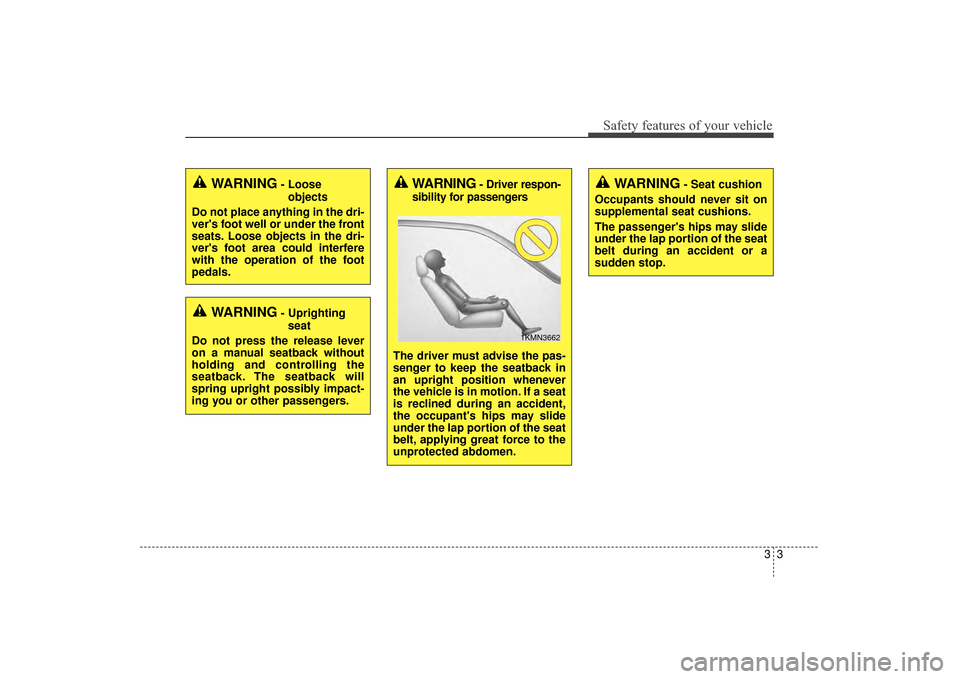
sudden stop.WARNING- Driver respon-
sibility for passengers
The driver must advise the pas-
senger to keep the seatback in
an upright position whenever
the vehicle is in motion. If a seat
is reclined during an accident,
the occupant's hips may slide
under the lap portion of the seat
belt, applying great force to the
unprotected abdomen.
1KMN3662
UM CAN (ENG) 3.QXP 12/1/2014 11:56 AM Page 3
Page 22 of 565
35
Safety features of your vehicle
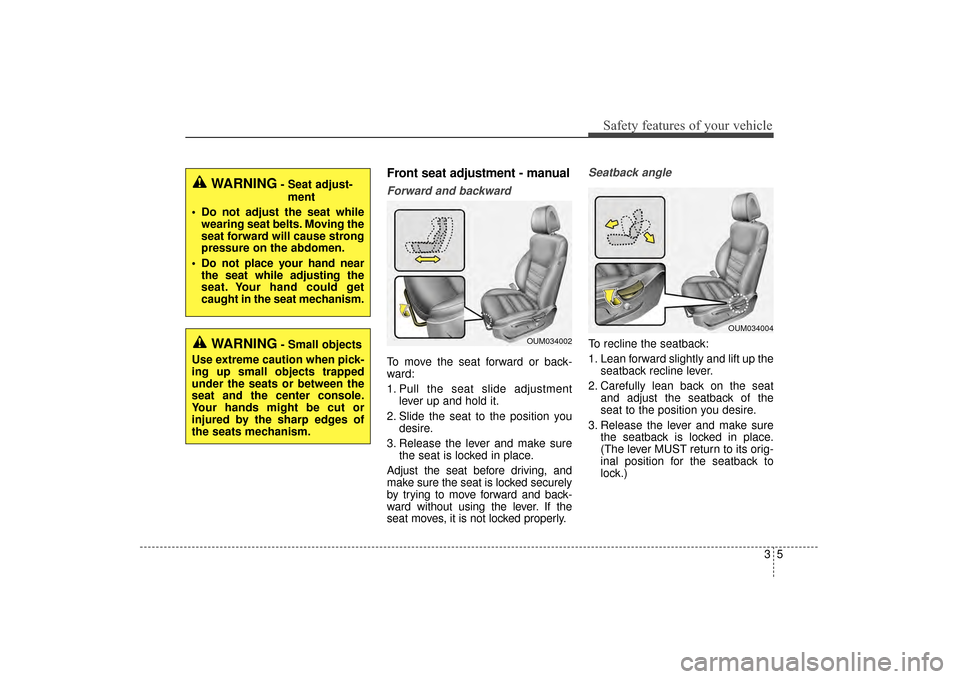
Front seat adjustment - manual
Forward and backward
To move the seat forward or back-
ward:
1. Pull the seat slide adjustmentlever up and hold it.
2. Slide the seat to the position you desire.
3. Release the lever and make sure the seat is locked in place.
Adjust the seat before driving, and
make sure the seat is locked securely
by trying to move forward and back-
ward without using the lever. If the
seat moves, it is not locked properly.
Seatback angle
To recline the seatback:
1. Lean forward slightly and lift up the seatback recline lever.
2. Carefully lean back on the seat and adjust the seatback of the
seat to the position you desire.
3. Release the lever and make sure the seatback is locked in place.
(The lever MUST return to its orig-
inal position for the seatback to
lock.)
WARNING- Seat adjust-
ment
Do not adjust the seat while wearing seat belts. Moving the
seat forward will cause strong
pressure on the abdomen.
Do not place your hand near the seat while adjusting the
seat. Your hand could get
caught in the seat mechanism.
WARNING- Small objects
Use extreme caution when pick-
ing up small objects trapped
under the seats or between the
seat and the center console.
Your hands might be cut or
injured by the sharp edges of
the seats mechanism.OUM034002
OUM034004
UM CAN (ENG) 3.QXP 12/1/2014 11:57 AM Page 5
Page 33 of 565
Safety features of your vehicle
16
3
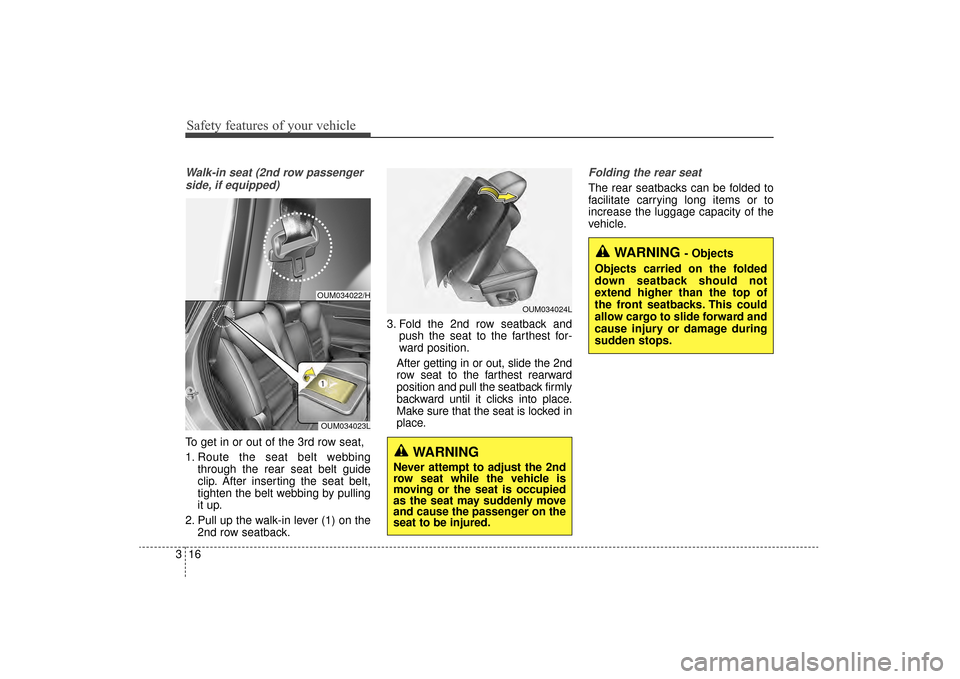
Walk-in seat (2nd row passenger
side, if equipped)
To get in or out of the 3rd row seat,
1. Route the seat belt webbing through the rear seat belt guide
clip. After inserting the seat belt,
tighten the belt webbing by pulling
it up.
2. Pull up the walk-in lever (1) on the 2nd row seatback. 3. Fold the 2nd row seatback and
push the seat to the farthest for-
ward position.
After getting in or out, slide the 2nd
row seat to the farthest rearward
position and pull the seatback firmly
backward until it clicks into place.
Make sure that the seat is locked in
place.
Folding the rear seat
The rear seatbacks can be folded to
facilitate carrying long items or to
increase the luggage capacity of the
vehicle.
OUM034024L
OUM034022/H
OUM034023L
WARNING
Never attempt to adjust the 2nd
row seat while the vehicle is
moving or the seat is occupied
as the seat may suddenly move
and cause the passenger on the
seat to be injured.
WARNING - Objects
Objects carried on the folded
down seatback should not
extend higher than the top of
the front seatbacks. This could
allow cargo to slide forward and
cause injury or damage during
sudden stops.
UM CAN (ENG) 3.QXP 12/1/2014 11:58 AM Page 16
Page 34 of 565
317
Safety features of your vehicle
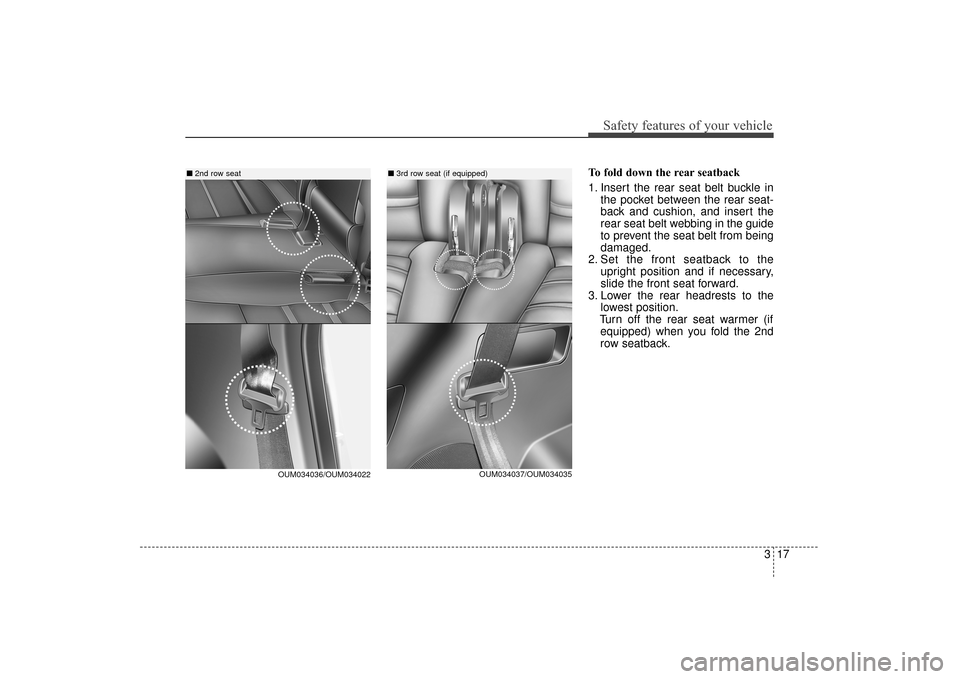
To fold down the rear seatback
1. Insert the rear seat belt buckle inthe pocket between the rear seat-
back and cushion, and insert the
rear seat belt webbing in the guide
to prevent the seat belt from being
damaged.
2. Set the front seatback to the upright position and if necessary,
slide the front seat forward.
3. Lower the rear headrests to the lowest position.
Turn off the rear seat warmer (if equipped) when you fold the 2nd
row seatback.
OUM034036/OUM034022
■ 2nd row seat
OUM034037/OUM034035
■3rd row seat (if equipped)
UM CAN (ENG) 3.QXP 12/1/2014 11:58 AM Page 17
Page 35 of 565
Safety features of your vehicle
18
3
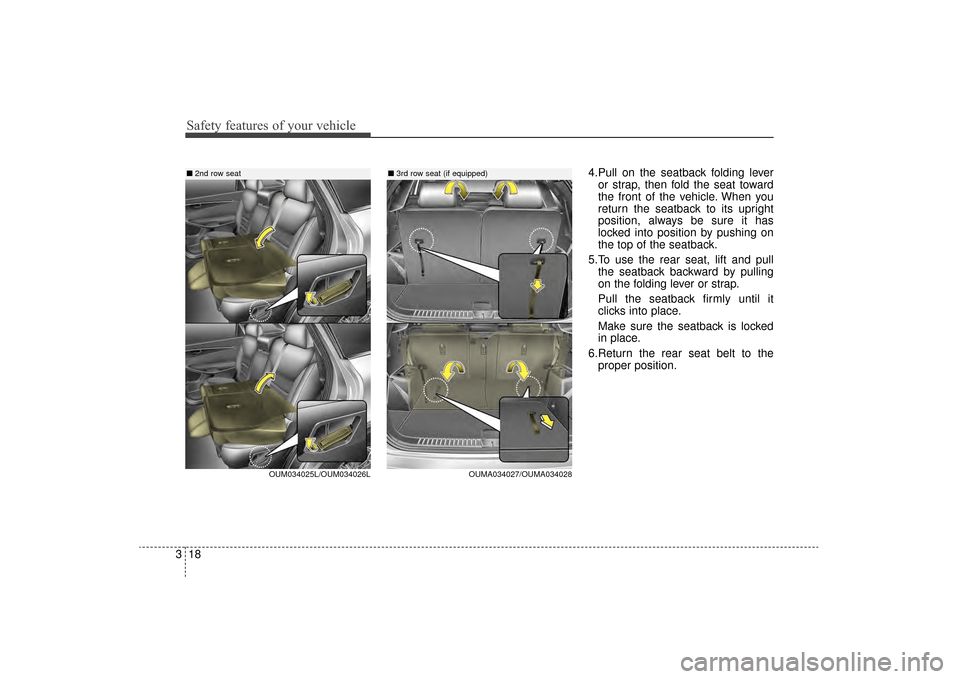
4.Pull on the seatback folding lever
or strap, then fold the seat toward
the front of the vehicle. When you
return the seatback to its upright
position, always be sure it has
locked into position by pushing on
the top of the seatback.
5.To use the rear seat, lift and pull the seatback backward by pulling
on the folding lever or strap.
Pull the seatback firmly until it
clicks into place.
Make sure the seatback is locked
in place.
6.Return the rear seat belt to the proper position.
OUM034025L/OUM034026L
■ 2nd row seat■3rd row seat (if equipped)
OUMA034027/OUMA034028
UM CAN (ENG) 3.QXP 12/1/2014 11:58 AM Page 18
Page 37 of 565
Safety features of your vehicle
20
3
Remember to return the rear shoulder
belts to their proper position. Routing
the seat belt webbing through the rear
seat belt guides will help keep the belts
from being trapped behind or under
the seats.
WARNING - 2nd row cen-
ter seat folding
Do not fold the 2nd row center seat, if there are occupants in
the 3rd row seats, as this may
result in injury to occupants if
the seat moves during a colli-
sion. If occupants in the 3rd
row seats, fix the 2nd row cen-
ter seat in its upright and
locked position.
The 2nd row center seat back does not lock into position
when it is folded toward the
front of the vehicle. If you use
the 2nd row center seat back
folding function to carry long
objects, you should fix the
long object to prevent it from
being thrown about the vehi-
cle in a collision and causing
injury to vehicle occupants.
CAUTION - Damaging
rear seat belt buckles
When you fold the rear (2nd and/or 3rd row) seatback, insertthe buckle in the pocket betweenthe rear seatback and cushion.Doing so can prevent the bucklefrom being damaged by the rearseatback.
WARNING- Cargo
Do not place objects in the rear
(2nd and/or 3rd row) seats,
since they cannot be properly
secured and may hit the front
seat occupants in a collision.
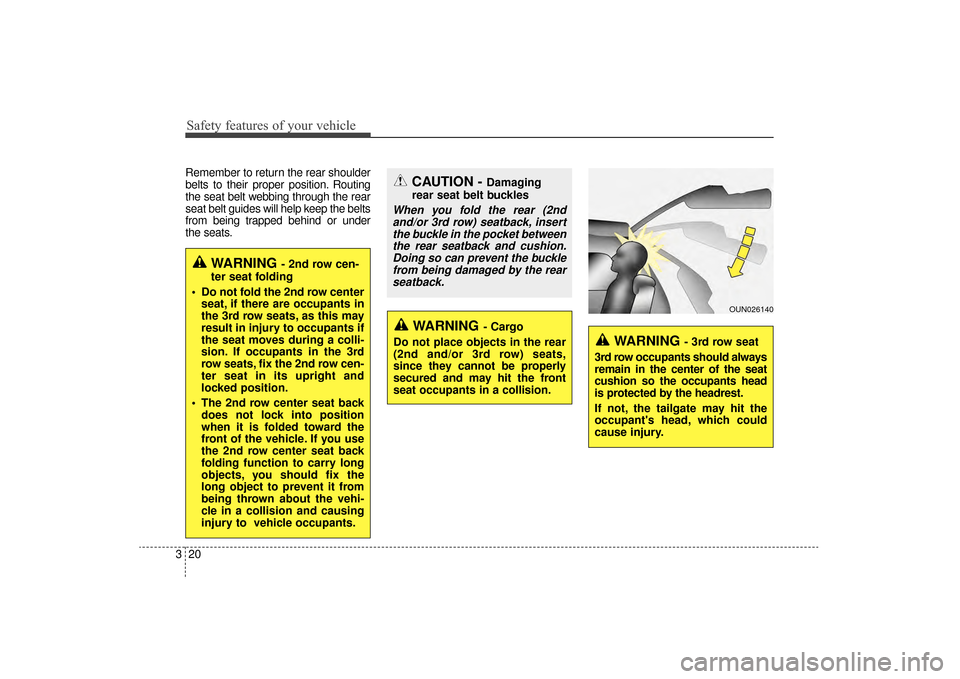
OUN026140
WARNING - 3rd row seat
3rd row occupants should always
remain in the center of the seat
cushion so the occupants head
is protected by the headrest.
If not, the tailgate may hit the
occupant's head, which could
cause injury.
UM CAN (ENG) 3.QXP 12/1/2014 11:58 AM Page 20
Page 41 of 565
Safety features of your vehicle
24
3
SEAT BELTS
Seat belt restraint system
For maximum restraint system pro-
tection, the seat belts must always
be used whenever the vehicle is
moving. A properly positioned
shoulder belt should be positioned
midway over your shoulder across
your collarbone.
Never allow children to ride in the front passenger seat. See child
restraint system section for further
discussion. Seat belts are designed to bear upon
the bony structure of the body, and
should be worn low across the front
of the pelvis or the pelvis, chest and
shoulders, as applicable; wearing the
lap section of the belt across the
abdominal area must be avoided.
Seat belts should be adjusted as
firmly as possible, consistent with
comfort, to provide the protection for
which they have been designed.
A slack belt will greatly reduce the
protection afforded to the wearer.
Care should be taken to avoid con-
tamination of the webbing with pol-
ishes, oils and chemicals, and partic-
ularly battery acid. Cleaning may
safely be carried out using mild soap
and water. The belt should be
replaced if webbing becomes frayed,
contaminated or damaged.
WARNING- Damaged
seat belt
Replace the entire seat belt
assembly if any part of the web-
bing or hardware is damage as
you can no longer be sure that a
damage seat belt will provide
protection in a crash.WARNING- Twisted seat belt
Make sure your seat belt is not
twisted when worn. A twisted
seat belt may not properly pro-
tect you in an accident and
could even cut into your body.
WARNING- Shoulder Belt
Never wear the shoulder belt under your arm or behind
your back. An improperly
positioned shoulder belt can-
not protect the occupant in a
crash.
Always wear both the shoul- der portion and lap portion of
the lap/shoulder belt.
UM CAN (ENG) 3.QXP 12/1/2014 11:59 AM Page 24
Page 42 of 565
325
Safety features of your vehicle
No modifications or additionsshould be made by the user which
will either prevent the seat belt
adjusting devices from operating to
remove slack, or prevent the seat
belt assembly from being adjusted
to remove slack.
When you fasten the seat belt, be careful not to latch the seat belt in
buckles of other seat. It's very dan-
gerous and you may not be pro-
tected by the seat belt properly.
Do not unfasten the seat belt and do not fasten and unfasten the seat
belt repeatedly while driving. This
could result in loss of control, and
an accident causing death, serious
injury, or property damage.
When fastening the seat belt, make sure that the seat belt does
not pass over objects that are hard
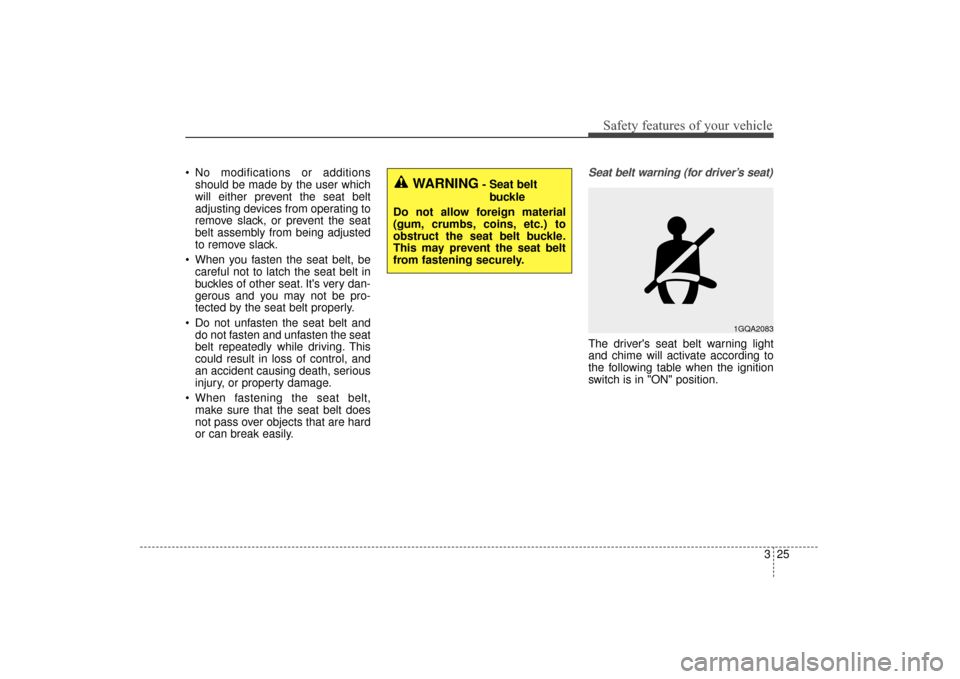
or can break easily.Seat belt warning (for driver’s seat)
The driver's seat belt warning light
and chime will activate according to
the following table when the ignition
switch is in "ON" position.
1GQA2083
WARNING- Seat belt
buckle
Do not allow foreign material
(gum, crumbs, coins, etc.) to
obstruct the seat belt buckle.
This may prevent the seat belt
from fastening securely.
UM CAN (ENG) 3.QXP 12/1/2014 11:59 AM Page 25