warning light KIA SORENTO 2018 Owners Manual
[x] Cancel search | Manufacturer: KIA, Model Year: 2018, Model line: SORENTO, Model: KIA SORENTO 2018Pages: 536, PDF Size: 13.42 MB
Page 405 of 536
613
What to do in an emergency
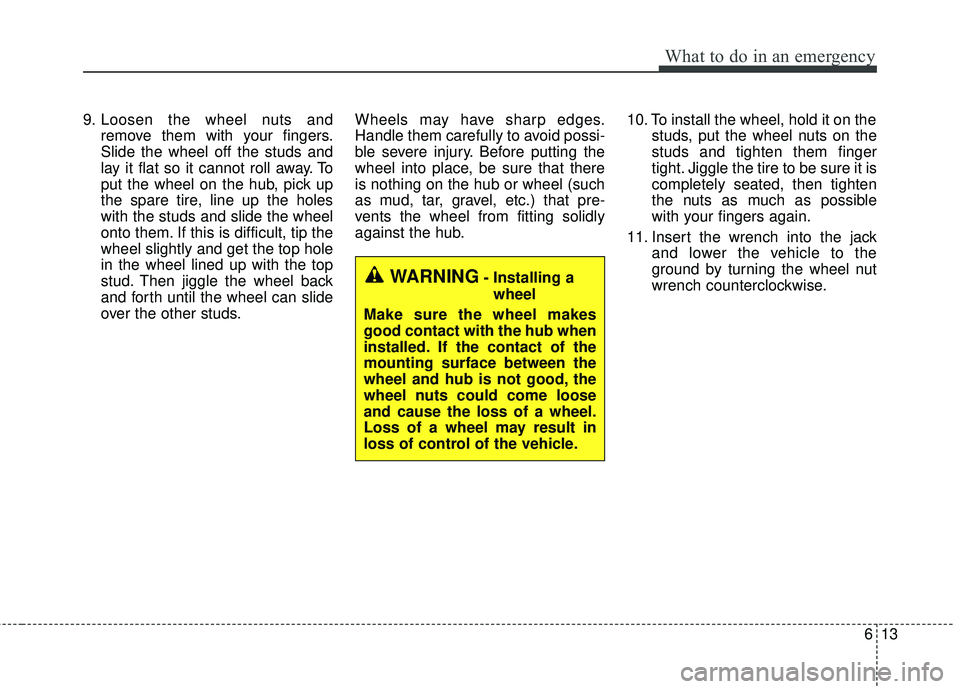
9. Loosen the wheel nuts andremove them with your fingers.
Slide the wheel off the studs and
lay it flat so it cannot roll away. To
put the wheel on the hub, pick up
the spare tire, line up the holes
with the studs and slide the wheel
onto them. If this is difficult, tip the
wheel slightly and get the top hole
in the wheel lined up with the top
stud. Then jiggle the wheel back
and forth until the wheel can slide
over the other studs. Wheels may have sharp edges.
Handle them carefully to avoid possi-
ble severe injury. Before putting the
wheel into place, be sure that there
is nothing on the hub or wheel (such
as mud, tar, gravel, etc.) that pre-
vents the wheel from fitting solidly
against the hub.
10. To install the wheel, hold it on the
studs, put the wheel nuts on the
studs and tighten them finger
tight. Jiggle the tire to be sure it is
completely seated, then tighten
the nuts as much as possible
with your fingers again.
11. Insert the wrench into the jack and lower the vehicle to the
ground by turning the wheel nut
wrench counterclockwise.
WARNING- Installing a
wheel
Make sure the wheel makes
good contact with the hub when
installed. If the contact of the
mounting surface between the
wheel and hub is not good, the
wheel nuts could come loose
and cause the loss of a wheel.
Loss of a wheel may result in
loss of control of the vehicle.
Page 419 of 536
Maintenance
87
OWNER MAINTENANCE
The following lists are vehicle checks
and inspections that should be per-
formed by the owner or an author-
ized Kia dealer at the frequencies
indicated to help ensure safe,
dependable operation of your vehi-
cle.
Any adverse conditions should be
brought to the attention of your deal-
er as soon as possible.
These Owner Maintenance Checks
are generally not covered by war-
ranties and you may be charged for
labor, parts and lubricants used.Owner maintenance schedule
When you stop for fuel:
Check the engine oil level.
Check the coolant level in thecoolant reservoir.
Check the windshield washer fluid level.
Look for low or under-inflated tires.
While operating your vehicle:
Note any changes in the sound of the exhaust or any smell of
exhaust fumes in the vehicle.
Check for vibrations in the steering wheel. Notice any increased steer-
ing effort or looseness in the steer-
ing wheel, or change in its straight-
ahead position.
Notice if your vehicle constantly turns slightly or “pulls” to one side
when traveling on smooth, level
road.
When stopping, listen and check for unusual sounds, pulling to one
side, increased brake pedal travel
or “hard-to-push” brake pedal.
If any slipping or changes in the operation of your transaxle occurs,
check the transaxle fluid level.
Check the automatic transaxle P (Park) function.
Check the parking brake.
Check for fluid leaks under your vehicle (water dripping from the air
conditioning system during or after
use is normal).
WARNING - Hot coolant
Be careful when checking your
engine coolant level when the
engine is hot. Scalding hot
coolant and steam may blow
out under pressure.
Page 420 of 536
79
Maintenance
At least monthly:
Check the coolant level in theengine coolant reservoir.
Check the operation of all exterior lights, including the stoplights, turn
signals and hazard warning flash-
ers.
Check the inflation pressures of all tires including the spare.
At least twice a year
(i.e., every Spring and Fall):
Check the radiator, heater and air conditioning hoses for leaks or
damage.
Check the windshield washer spray and wiper operation. Clean
the wiper blades with clean cloth
dampened with washer fluid.
Check the headlight alignment.
Check the muffler, exhaust pipes, shields and clamps.
Check the lap/shoulder belts for wear and function.
Check for worn tires and loose wheel lug nuts.
At least once a year:
Clean the body and door drainholes.
Lubricate the door hinges and checks, and hood hinges.
Lubricate the door and hood locks and latches.
Lubricate the door rubber weather- strips.
Check the air conditioning system.
Inspect and lubricate the automat- ic transaxle linkage and controls.
Clean the battery and terminals.
Check the brake fluid level.
Page 477 of 536
Maintenance
66
7
FUSES
A vehicle’s electrical system is pro-
tected from electrical overload dam-
age by fuses.
This vehicle has 2 (or 3) fuse panels,
one located in the driver’s side panel
bolster, the other in the engine com-
partment near the battery.
If any of your vehicle’s lights, acces-
sories, or controls do not work, check
the appropriate circuit fuse. If a fuse
has blown, the element inside the
fuse will melt.
If the electrical system does not
work, first check the driver’s side
fuse panel.
Always replace a blown fuse with
one of the same rating.
If the replacement fuse blows, this
indicates an electrical problem. Avoid
using the system involved and imme-
diately consult an authorized Kia
dealer.
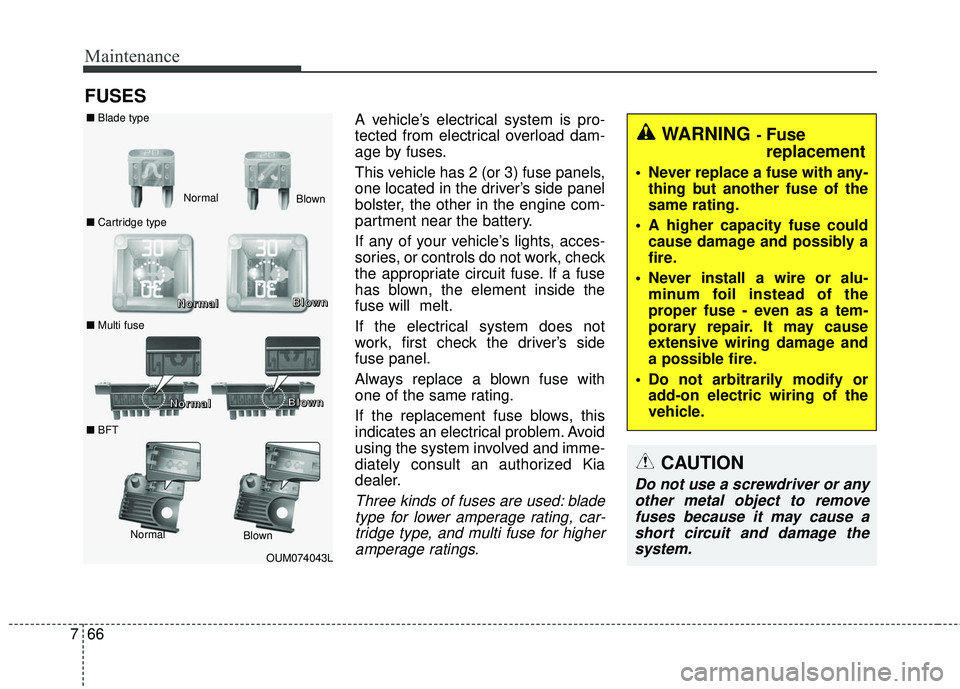
Three kinds of fuses are used: blade
type for lower amperage rating, car-tridge type, and multi fuse for higheramperage ratings.
WARNING - Fuse
replacement
Never replace a fuse with any- thing but another fuse of the
same rating.
A higher capacity fuse could cause damage and possibly a
fire.
Never install a wire or alu- minum foil instead of the
proper fuse - even as a tem-
porary repair. It may cause
extensive wiring damage and
a possible fire.
Do not arbitrarily modify or add-on electric wiring of the
vehicle.
CAUTION
Do not use a screwdriver or anyother metal object to removefuses because it may cause ashort circuit and damage thesystem.
OUM074043L
Normal
■
Blade type
■ Cartridge type
■ Multi fuse Blown
N N
N N
o o
o o
r r
r r
m m
m m
a a
a a
l l
l l B B
B B
l l
l l
o o
o o
w w
w w
n n
n n
Normal Blo
wn
■
BFT N N
N N
o o
o o
r r
r r
m m
m m
a a
a a
l l
l l B B
B B
l l
l l
o o
o o
w w
w w
n n
n n
Page 493 of 536
Maintenance
82
7
LIGHT BULBS
Please prepare lamps with appropri-
ate standards in case of emergen-
cies. (Refer to chapter 8 for further
information)
When changing lamps and sorts,
first turn off the engine at a safe
place, firmly apply the side brake and
take out the battery’s negative (-) ter-
minal.Use only the bulbs of the specified
wattage.✽ ✽ NOTICE
• If the light bulb or lamp connector
is removed from an operating
lamp activated by electricity, the
fuse box’s electronic device may
scan it as a malfunction.
Therefore, a lamp malfunction
history may be recorded in
Diagnostic Trouble Code (DTC) in
the fuse box.
• It is normal for an operating lamp may blink temporarily. Since this
occurrence is due stabilization
function of the vehicle’s electronic
control device, if the lamp lights
up normally after temporary
blinking, there is no problem in
the vehicle.
However, if the lamp continues to
blink several times or turn off
completely, there may be an error
in the vehicle’s electronic control
device. So please have the vehicle
checked by an authorized Kia
dealer immediately.
WARNING - Working on
the lights
Prior to working on the light,
firmly apply the parking brake,
ensure that the ignition switch
is turned to the LOCK position
and turn off the lights to avoid
sudden movement of the vehi-
cle and burning your fingers or
receiving an electric shock.
CAUTION -Light replace-
ment
Be sure to replace the burned-
out bulb with one of the samewattage rating. Otherwise, itmay cause damage to the fuseor electric wiring system.
CAUTION -Headlamp
Lens
To prevent damage, do notclean headlamp lens with chem-ical solvents or strong deter-gents.
Page 495 of 536
Maintenance
84
7
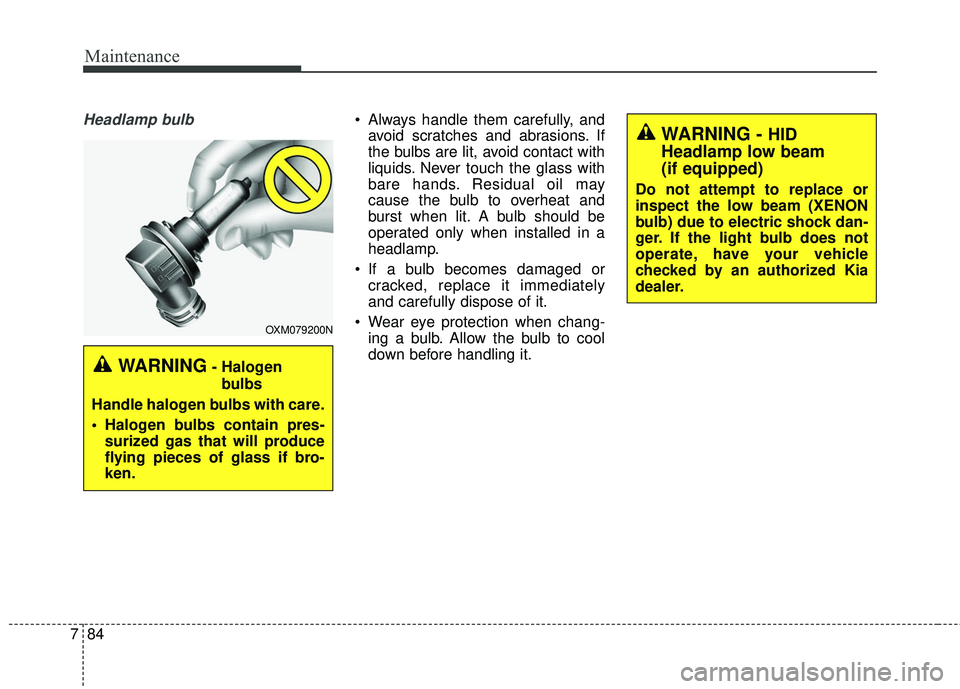
Headlamp bulb Always handle them carefully, and
avoid scratches and abrasions. If
the bulbs are lit, avoid contact with
liquids. Never touch the glass with
bare hands. Residual oil may
cause the bulb to overheat and
burst when lit. A bulb should be
operated only when installed in a
headlamp.
If a bulb becomes damaged or cracked, replace it immediately
and carefully dispose of it.
Wear eye protection when chang- ing a bulb. Allow the bulb to cool
down before handling it.
WARNING - HID
Headlamp low beam
(if equipped)
Do not attempt to replace or
inspect the low beam (XENON
bulb) due to electric shock dan-
ger. If the light bulb does not
operate, have your vehicle
checked by an authorized Kia
dealer.
OXM079200N
WARNING- Halogen
bulbs
Handle halogen bulbs with care.
Halogen bulbs contain pres- surized gas that will produce
flying pieces of glass if bro-
ken.
Page 503 of 536
Maintenance
92
7
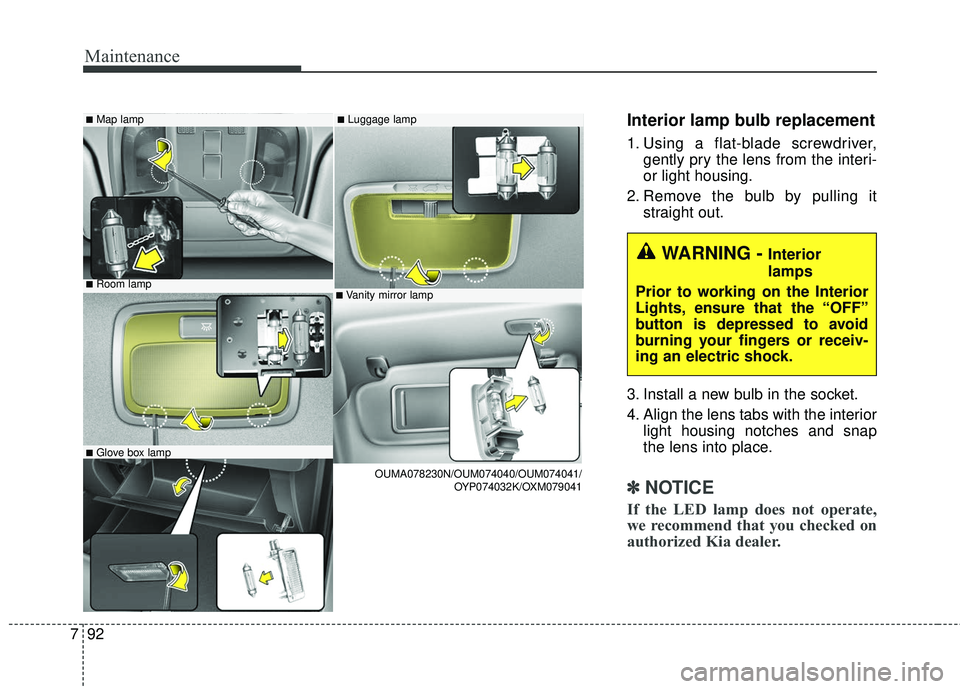
Interior lamp bulb replacement
1. Using a flat-blade screwdriver,
gently pry the lens from the interi-
or light housing.
2. Remove the bulb by pulling it straight out.
3. Install a new bulb in the socket.
4. Align the lens tabs with the interior light housing notches and snap
the lens into place.
✽ ✽NOTICE
If the LED lamp does not operate,
we recommend that you checked on
authorized Kia dealer.
WARNING - Interior
lamps
Prior to working on the Interior
Lights, ensure that the “OFF”
button is depressed to avoid
burning your fingers or receiv-
ing an electric shock.
■Room lamp
■Map lamp
■Glove box lamp
■Luggage lamp
■Vanity mirror lamp
OUMA078230N/OUM074040/OUM074041/ OYP074032K/OXM079041
Page 504 of 536
793
Maintenance
APPEARANCE CARE
Exterior care
Exterior general caution
It is very important to follow the label
directions when using any chemical
cleaner or polish. Read all warning
and caution statements that appear
on the label.
Finish maintenance
Washing
To help protect your vehicle’s finish
from rust and deterioration, wash it
thoroughly and frequently at least
once a month with lukewarm or cold
water.
If you use your vehicle for off-road
driving, you should wash it after each
off-road trip. Pay special attention to
the removal of any accumulation of
salt, dirt, mud, and other foreign
materials. Make sure the drain holes
in the lower edges of the doors and
rocker panels are kept clear and
clean.
Insects, tar, tree sap, bird droppings,
industrial pollution and similar
deposits can damage your vehicle’s
finish if not removed immediately.
Even prompt washing with plain
water may not completely remove all
these deposits. A mild soap, safe for
use on painted surfaces, may be
used.
After washing, rinse the vehicle thor-
oughly with lukewarm or cold water.
Do not allow soap to dry on the fin-
ish.After washing the vehicle, test the
brakes while driving slowly to see if
they have been affected by water. If
braking performance is impaired, dry
the brakes by applying them lightly
while maintaining a slow forward
speed.
CAUTION - Headlight Lens
To prevent damage, do not
clean headlight lens with chem-ical solvents or strong deter-gents.
Page 528 of 536
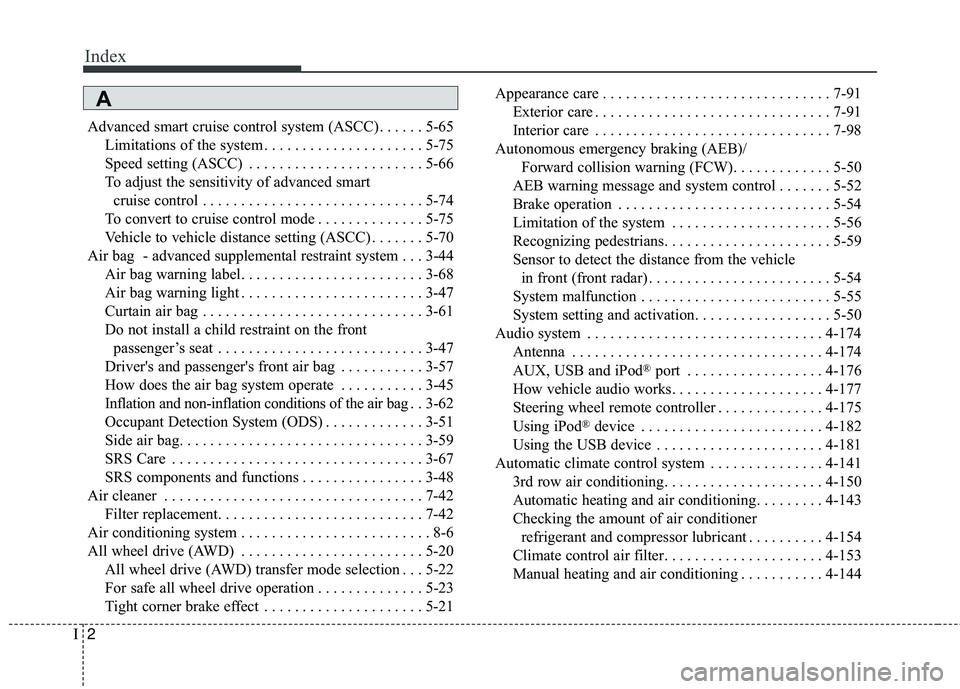
Index
2I
Advanced smart cruise control system (ASCC) . . . . . . 5-65Limitations of the system . . . . . . . . . . . . . . . . . . . . . 5-75
Speed setting (ASCC) . . . . . . . . . . . . . . . . . . . . . . . 5-66
To adjust the sensitivity of advanced smartcruise control . . . . . . . . . . . . . . . . . . . . . . . . . . . . . 5-74
To convert to cruise control mode . . . . . . . . . . . . . . 5-75
Vehicle to vehicle distance setting (ASCC) . . . . . . . 5-70
Air bag - advanced supplemental restraint system . . . 3-44 Air bag warning label. . . . . . . . . . . . . . . . . . . . . . . . 3-68
Air bag warning light . . . . . . . . . . . . . . . . . . . . . . . . 3-47
Curtain air bag . . . . . . . . . . . . . . . . . . . . . . . . . . . . . 3-61
Do not install a child restraint on the frontpassenger’s seat . . . . . . . . . . . . . . . . . . . . . . . . . . . 3-47
Driver's and passenger's front air bag . . . . . . . . . . . 3-57
How does the air bag system operate . . . . . . . . . . . 3-45
Inflation and non-inflation conditions of the air bag . . 3-62
Occupant Detection System (ODS) . . . . . . . . . . . . . 3-51
Side air bag. . . . . . . . . . . . . . . . . . . . . . . . . . . . . . . . 3-59
SRS Care . . . . . . . . . . . . . . . . . . . . . . . . . . . . . . . . . 3-67
SRS components and functions . . . . . . . . . . . . . . . . 3-48
Air cleaner . . . . . . . . . . . . . . . . . . . . . . . . . . . . . . . . . . 7-42\
Filter replacement. . . . . . . . . . . . . . . . . . . . . . . . . . . 7-42
Air conditioning system . . . . . . . . . . . . . . . . . . . . . . . . . 8-6
All wheel drive (AWD) . . . . . . . . . . . . . . . . . . . . . . . . 5-20 All wheel drive (AWD) transfer mode selection . . . 5-22
For safe all wheel drive operation . . . . . . . . . . . . . . 5-23
Tight corner brake effect . . . . . . . . . . . . . . . . . . . . . 5-21 Appearance care . . . . . . . . . . . . . . . . . . . . . . . . . . . . . . 7-91
Exterior care . . . . . . . . . . . . . . . . . . . . . . . . . . . . . . . 7-91
Interior care . . . . . . . . . . . . . . . . . . . . . . . . . . . . . . . 7-98
Autonomous emergency braking (AEB)/ Forward collision warning (FCW). . . . . . . . . . . . . 5-50
AEB warning message and system control . . . . . . . 5-52
Brake operation . . . . . . . . . . . . . . . . . . . . . . . . . . . . 5-54
Limitation of the system . . . . . . . . . . . . . . . . . . . . . 5-56
Recognizing pedestrians. . . . . . . . . . . . . . . . . . . . . . 5-59
Sensor to detect the distance from the vehicle in front (front radar) . . . . . . . . . . . . . . . . . . . . . . . . 5-54
System malfunction . . . . . . . . . . . . . . . . . . . . . . . . . 5-55
System setting and activation. . . . . . . . . . . . . . . . . . 5-50
Audio system . . . . . . . . . . . . . . . . . . . . . . . . . . . . . . . 4-174 Antenna . . . . . . . . . . . . . . . . . . . . . . . . . . . . . . . . . 4-174
AUX, USB and iPod
®port . . . . . . . . . . . . . . . . . . 4-176
How vehicle audio works. . . . . . . . . . . . . . . . . . . . 4-177
Steering wheel remote controller . . . . . . . . . . . . . . 4-175
Using iPod
®device . . . . . . . . . . . . . . . . . . . . . . . . 4-182
Using the USB device . . . . . . . . . . . . . . . . . . . . . . 4-181
Automatic climate control system . . . . . . . . . . . . . . . 4-141 3rd row air conditioning. . . . . . . . . . . . . . . . . . . . . 4-150
Automatic heating and air conditioning. . . . . . . . . 4-143
Checking the amount of air conditionerrefrigerant and compressor lubricant . . . . . . . . . . 4-154
Climate control air filter. . . . . . . . . . . . . . . . . . . . . 4-153
Manual heating and air conditioning . . . . . . . . . . . 4-144
A
Page 531 of 536
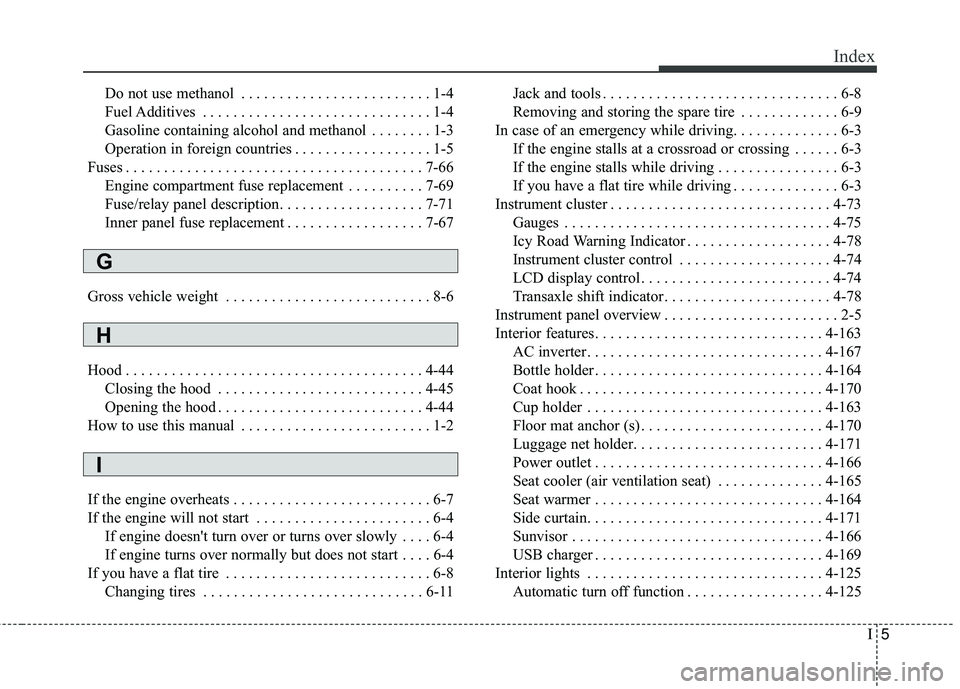
I5
Index
Do not use methanol . . . . . . . . . . . . . . . . . . . . . . . . . 1-4
Fuel Additives . . . . . . . . . . . . . . . . . . . . . . . . . . . . . . 1-4
Gasoline containing alcohol and methanol . . . . . . . . 1-3
Operation in foreign countries . . . . . . . . . . . . . . . . . . 1-5
Fuses . . . . . . . . . . . . . . . . . . . . . . . . . . . . . . . . . . . . \
. . . 7-66 Engine compartment fuse replacement . . . . . . . . . . 7-69
Fuse/relay panel description. . . . . . . . . . . . . . . . . . . 7-71
Inner panel fuse replacement . . . . . . . . . . . . . . . . . . 7-67
Gross vehicle weight . . . . . . . . . . . . . . . . . . . . . . . . . . . 8-6
Hood . . . . . . . . . . . . . . . . . . . . . . . . . . . . . . . . . . . . \
. . . 4-44 Closing the hood . . . . . . . . . . . . . . . . . . . . . . . . . . . 4-45
Opening the hood . . . . . . . . . . . . . . . . . . . . . . . . . . . 4-44
How to use this manual . . . . . . . . . . . . . . . . . . . . . . . . . 1-2
If the engine overheats . . . . . . . . . . . . . . . . . . . . . . . . . . 6-7
If the engine will not start . . . . . . . . . . . . . . . . . . . . . . . 6-4 If engine doesn't turn over or turns over slowly . . . . 6-4
If engine turns over normally but does not start . . . . 6-4
If you have a flat tire . . . . . . . . . . . . . . . . . . . . . . . . . . . 6-8 Changing tires . . . . . . . . . . . . . . . . . . . . . . . . . . . . . 6-11 Jack and tools . . . . . . . . . . . . . . . . . . . . . . . . . . . . . . . 6-8
Removing and storing the spare tire . . . . . . . . . . . . . 6-9
In case of an emergency while driving. . . . . . . . . . . . . . 6-3 If the engine stalls at a crossroad or crossing . . . . . . 6-3
If the engine stalls while driving . . . . . . . . . . . . . . . . 6-3
If you have a flat tire while driving . . . . . . . . . . . . . . 6-3
Instrument cluster . . . . . . . . . . . . . . . . . . . . . . . . . . . . . 4-73 Gauges . . . . . . . . . . . . . . . . . . . . . . . . . . . . . . . . . . . 4-\
75
Icy Road Warning Indicator . . . . . . . . . . . . . . . . . . . 4-78
Instrument cluster control . . . . . . . . . . . . . . . . . . . . 4-74
LCD display control . . . . . . . . . . . . . . . . . . . . . . . . . 4-74
Transaxle shift indicator . . . . . . . . . . . . . . . . . . . . . . 4-78
Instrument panel overview . . . . . . . . . . . . . . . . . . . . . . . 2-5
Interior features. . . . . . . . . . . . . . . . . . . . . . . . . . . . . . 4-163 AC inverter . . . . . . . . . . . . . . . . . . . . . . . . . . . . . . . 4-167
Bottle holder . . . . . . . . . . . . . . . . . . . . . . . . . . . . . . 4-164
Coat hook . . . . . . . . . . . . . . . . . . . . . . . . . . . . . . . . 4-170
Cup holder . . . . . . . . . . . . . . . . . . . . . . . . . . . . . . . 4-163
Floor mat anchor (s) . . . . . . . . . . . . . . . . . . . . . . . . 4-170
Luggage net holder. . . . . . . . . . . . . . . . . . . . . . . . . 4-171
Power outlet . . . . . . . . . . . . . . . . . . . . . . . . . . . . . . 4-166
Seat cooler (air ventilation seat) . . . . . . . . . . . . . . 4-165
Seat warmer . . . . . . . . . . . . . . . . . . . . . . . . . . . . . . 4-164
Side curtain. . . . . . . . . . . . . . . . . . . . . . . . . . . . . . . 4-171
Sunvisor . . . . . . . . . . . . . . . . . . . . . . . . . . . . . . . . . 4-166
USB charger . . . . . . . . . . . . . . . . . . . . . . . . . . . . . . 4-169
Interior lights . . . . . . . . . . . . . . . . . . . . . . . . . . . . . . . 4-125 Automatic turn off function . . . . . . . . . . . . . . . . . . 4-125
I
H
G