all KIA SORENTO 2019 Owners Manual
[x] Cancel search | Manufacturer: KIA, Model Year: 2019, Model line: SORENTO, Model: KIA SORENTO 2019Pages: 573, PDF Size: 10.61 MB
Page 539 of 573
Maintenance
96
7
When cleaning lower door panels,
rocker panels and frame members,
be sure that drain holes are kept
open so that moisture can escape
and not be trapped inside to accel-
erate corrosion.
Keep your garage dry
Don't park your vehicle in a damp,
poorly ventilated garage. This cre-
ates a favorable environment for cor-
rosion. This is particularly true if you
wash your vehicle in the garage or
drive it into the garage when it is still
wet or covered with snow, ice or
mud. Even a heated garage can con-
tribute to corrosion unless it is well
ventilated so moisture is dispersed. Keep paint and trim in good condi-
tion
Scratches or chips in the finish
should be covered with "touch-up"
paint as soon as possible to reduce
the possibility of corrosion. If bare
metal is showing through, the atten-
tion of a qualified body and paint
shop is recommended.
Bird droppings : Bird droppings are
highly corrosive and may damage
painted surfaces in just a few hours.
Always remove bird droppings as
soon as possible.
Don't neglect the interior
Moisture can collect under the floor
mats and carpeting and cause corro-
sion. Check under the mats periodi-
cally to be sure the carpeting is dry.
Use particular care if you carry fertil-
izers, cleaning materials or chemi-
cals in the vehicle.
These should be carried only in prop-
er containers and any spills or leaks
should be cleaned up, flushed with
clean water and thoroughly dried.Interior care
Interior general precautions
Prevent chemicals such as perfume,
cosmetic oil, sun cream, hand clean-
er, and air freshener from contacting
the interior parts because they may
cause damage or discoloration. If
they do contact the interior parts,
wipe them off immediately. If neces-
sary, use a vinyl cleaner, see product
instructions for correct usage.
CAUTION - Electrical
components
Never allow water or other liq-
uids to come in contact withelectrical/electronic compo-nents inside the vehicle as thismay damage them.
Page 540 of 573
797
Maintenance
Taking care of leather seats
Vacuum the seat periodically toremove dust and sand on the seat.
It will prevent abrasion or damage of
the leather and maintain its quality.
Wipe the natural leather seat cover often with dry or soft cloth.
Sufficient use of a leather protec- tive may prevent abrasion of the
cover and helps maintain the color.
Be sure to read the instructions
and consult a specialist when
using leather coating or protective
agents.
Leather with bright colors(beige, cream beige) is easily contaminat-
ed and clear in appearance. Clean
the seats frequently.
Avoid wiping with wet cloth. It may cause the surface to crack.
Cleaning the leather seats
Remove all contaminates instantly.Refer to instructions below for
removal of each contaminant.
Cosmetic products(sunscreen, foundation, etc.)
- Apply cleansing cream on a clothand wipe the contaminated point.
Wipe off the cream with a wet
cloth and remove water with a dry
cloth.
Beverages(coffee, soft drink, etc.) - Apply a small amount of neutraldetergent and wipe until contami-
nations do not smear.
Oil - Remove oil instantly withabsorbable cloth and wipe with
stain remover for natural leather
only.
Chewing gum - Harden the gum with ice andremove gradually.CAUTION - Leather
When cleaning leather products(steering wheel, seats etc.), useneutral detergents or low alco-hol content solutions. If you usehigh alcohol content solutionsor acid/alkaline detergents, thecolor of the leather may fade orthe surface may get stripped off.
Page 543 of 573
Maintenance
100
7
EMISSION CONTROL SYSTEM
The emission control system of your
vehicle is covered by a written limited
warranty. Please see the warranty
information contained in the
Warranty & Maintenance booklet in
your vehicle.
Your vehicle is equipped with an
emission control system to meet all
applicable emission regulations.
There are three emission control
systems, as follows.
(1) Crankcase emission control sys-
tem
(2) Evaporative emission control sys- tem
(3) Exhaust emission control system
In order to assure the proper function
of the emission control systems, it is
recommended that you have your
vehicle inspected and maintained by
an authorized Kia dealer in accor-
dance with the maintenance sched-
ule in this manual. Caution for the Inspection and
Maintenance Test (With Electronic
Stability Control (ESC) system)
To prevent the vehicle from mis-
firing during dynamometer test-
ing, turn the Electronic Stability
Control (ESC) system off by
pressing the ESC switch.
After dynamometer testing is completed, turn the ESC system
back on by pressing the ESC
switch again.1. Crankcase emission control system
The positive crankcase ventilation
system is employed to prevent air
pollution caused by blow-by gases
being emitted from the crankcase.
This system supplies fresh filtered air
to the crankcase through the air
intake hose. Inside the crankcase,
the fresh air mixes with blow-by
gases, which then pass through the
PCV valve into the induction system.
2. Evaporative emission con-trol (including ORVR:
Onboard Refueling Vapor
Recovery) system
The Evaporative Emission Control
System is designed to prevent fuel
vapors from escaping into the atmos-
phere.
(The ORVR system is designed to
allow the vapors from the fuel tank to
be loaded into a canister while refu-
eling at the gas station, preventing
the escape of fuel vapors into the
atmosphere.)
Page 544 of 573
7101
Maintenance
Canister
Fuel vapors generated inside the fuel
tank are absorbed and stored in the
onboard canister. When the engine is
running, the fuel vapors absorbed in
the canister are drawn into the surge
tank through the purge control sole-
noid valve.
Purge Control Solenoid Valve(PCSV)
The purge control solenoid valve is
controlled by the Engine Control
Module (ECM); when the engine
coolant temperature is low during
idling, the PCSV closes so that evap-
orated fuel is not taken into the
engine. After the engine warms up
during ordinary driving, the PCSV
opens to introduce evaporated fuel to
the engine.
3. Exhaust emission control system
The Exhaust Emission Control
System is a highly effective system
which controls exhaust emissions
while maintaining good vehicle per-
formance.
Vehicle modifications
This vehicle should not be modified.
Modification of your vehicle could
affect its performance, safety or
durability and may even violate gov-
ernmental safety and emissions reg-
ulations.
In addition, damage or performance
problems resulting from any modifi-
cation may not be covered under
warranty.
If you use unauthorized electronic
devices, it may cause the vehicle to
operate abnormally, wire damage,
battery discharge and fire. For your
safety, do not use unauthorized
electronic devices.
Engine exhaust gas precautions
(carbon monoxide)
Carbon monoxide can be present with other exhaust fumes.
Therefore, if you smell exhaust
fumes of any kind inside your vehi-
cle, have it inspected and repaired
immediately. If you ever suspect
exhaust fumes are coming into
your vehicle, drive it only with all
the windows fully open. Have your
vehicle checked and repaired
immediately.
WARNING - Exhaust
Engine exhaust gases contain
carbon monoxide (CO). Though
colorless and odorless, it is
dangerous and could be lethal if
inhaled. Follow the instructions
on this page to avoid CO poi-
soning.
Page 545 of 573
Maintenance
102
7
Do not operate the engine in con-
fined or closed areas (such as
garages) any more than what is
necessary to move the vehicle in or
out of the area.
When the vehicle is stopped in an open area for more than a short
time with the engine running,
adjust the ventilation system (as
needed) to draw outside air into the
vehicle.
Never sit in a parked or stopped vehicle for any extended time with
the engine running.
When the engine stalls or fails to start, excessive attempts to restart
the engine may cause damage to
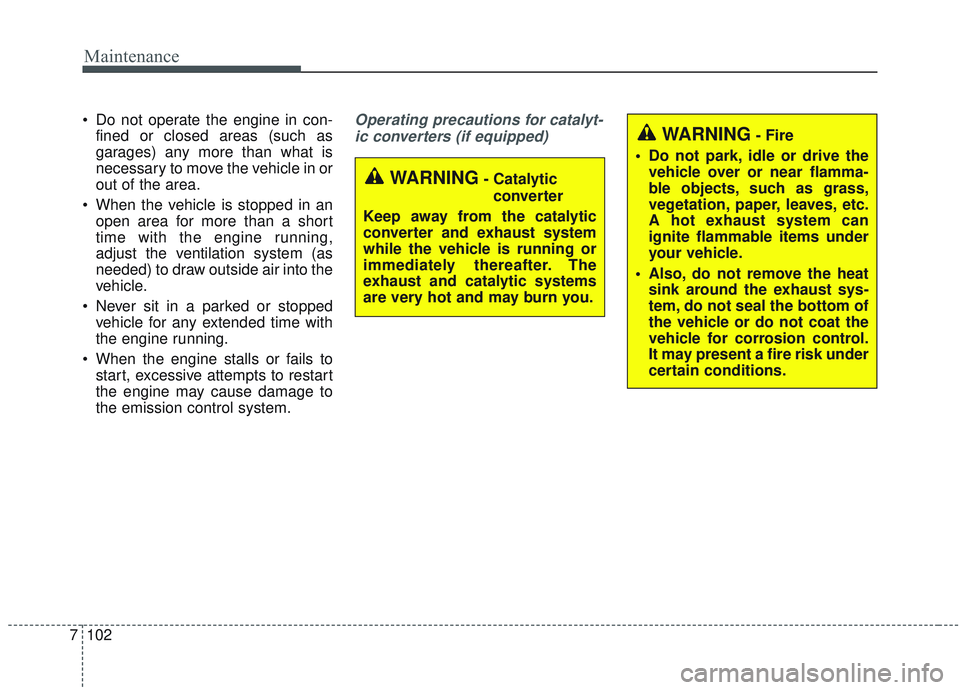
the emission control system.Operating precautions for catalyt-
ic converters (if equipped)
WARNING- Catalytic converter
Keep away from the catalytic
converter and exhaust system
while the vehicle is running or
immediately thereafter. The
exhaust and catalytic systems
are very hot and may burn you.
WARNING- Fire
Do not park, idle or drive the vehicle over or near flamma-
ble objects, such as grass,
vegetation, paper, leaves, etc.
A hot exhaust system can
ignite flammable items under
your vehicle.
Also, do not remove the heat sink around the exhaust sys-
tem, do not seal the bottom of
the vehicle or do not coat the
vehicle for corrosion control.
It may present a fire risk under
certain conditions.
Page 546 of 573
7103
Maintenance
Your vehicle is equipped with a cat-
alytic converter emission control
device.
Therefore, the following precautions
must be observed:
Use only UNLEADED FUEL forgasoline engines.
Do not operate the vehicle when there are signs of engine malfunc-
tion, such as misfire or a noticeable
loss of performance.
Do not misuse or abuse the engine. Examples of misuse are
coasting with the ignition off and
descending steep grades in gear
with the ignition off.
Do not operate the engine at high idle speed for extended periods (5
minutes or more).
Do not modify or tamper with any part of the engine or emission con-
trol system. All inspections and
adjustments must be made by an
authorized Kia dealer.
Avoid driving with an extremely low fuel level. Running out of fuel could
cause the engine to misfire, dam-
aging the catalytic converter. Failure to observe these precautions
could result in damage to the catalyt-
ic converter and to your vehicle.
Additionally, such actions could void
your warranties.
Page 548 of 573
![KIA SORENTO 2019 Owners Manual 28
DIMENSIONS Specifications & Consumer information
ENGINE
ITEM5 Seats7 Seats
Overall length [mm (in.)]4,800 (189.0)←
Overall width [mm (in.)]1,890 (74.4)←
Overall height[mm (in.)]Without Roof rac](/img/2/40476/w960_40476-547.png "KIA SORENTO 2019 Owners Manual 28
DIMENSIONS Specifications & Consumer information
ENGINE
ITEM5 Seats7 Seats
Overall length [mm (in.)]4,800 (189.0)←
Overall width [mm (in.)]1,890 (74.4)←
Overall height[mm (in.)]Without Roof rac")
28
DIMENSIONS Specifications & Consumer information
ENGINE
ITEM5 Seats7 Seats
Overall length [mm (in.)]4,800 (189.0)←
Overall width [mm (in.)]1,890 (74.4)←
Overall height[mm (in.)]Without Roof rack1,685 (66.3)←
With Roof rack1,690 (66.5)←
Tread [mm (in.)]
Front
235/65 R171,633 (64.3)←
235/60 R181,628 (64.1)←
235/55 R191,628 (64.1)←
Rear
235/65 R171,644 (64.7)←
235/60 R181,639 (64.5)←
235/55 R191,639 (64.5)←
Wheelbase [mm (in.)]2,780 (109.4)←
ITEMGasoline
Theta II 2.4Gasoline
Lambda II 3.3
Displacement [cc (cu. in)]2,359 (143.95)3,342 (203.94)
Bore x Stroke [mm (in.)]88x97 (3.46x3.81)92x83.8 (3.62x3.29)
Firing order 1-3-4-2 1-2-3-4-5-6
No. of cylinders 4. In-line V - type
Page 551 of 573
85
Specifications & Consumer information
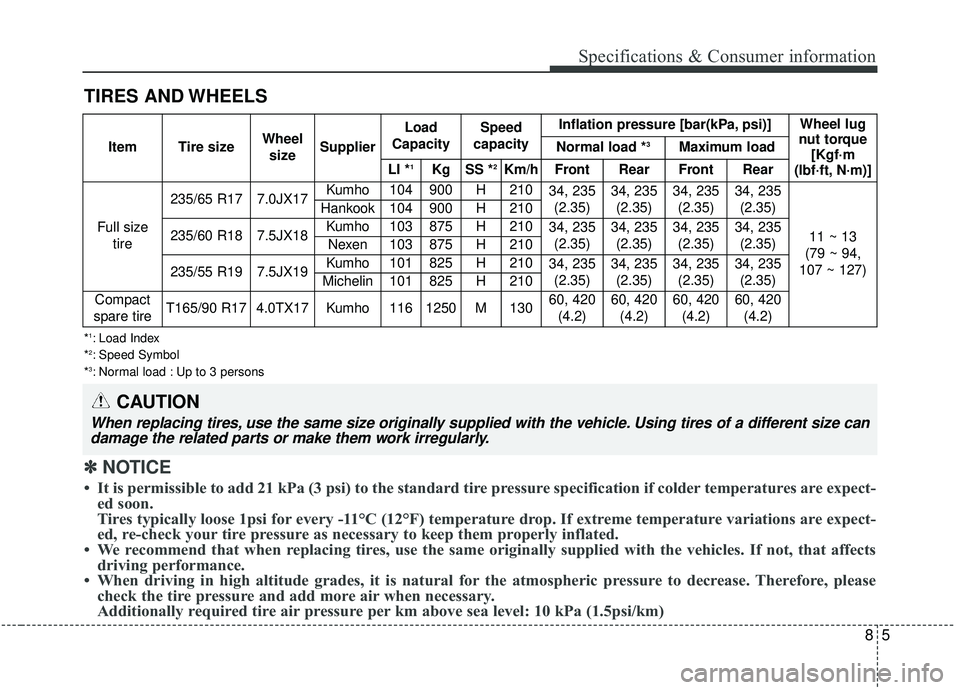
TIRES AND WHEELS
CAUTION
When replacing tires, use the same size originally supplied with the vehicle. Using tires of a different size candamage the related parts or make them work irregularly.
*1: Load Index
*2: Speed Symbol
*3: Normal load : Up to 3 persons
✽ ✽ NOTICE
• It is permissible to add 21 kPa (3 psi) to the standard tire pressure specification if colder temperatures are expect-
ed soon.
Tires typically loose 1psi for every -11°C (12°F) temperature drop. If extreme temperature variations are expect-
ed, re-check your tire pressure as necessary to keep them properly inflated.
• We recommend that when replacing tires, use the same originally supplied with the vehicles. If not, that aff\
ects driving performance.
• When driving in high altitude grades, it is natural for the atmospheric pressure to decrease. Therefore, please check the tire pressure and add more air when necessary.
Additionally required tire air pressure per km above sea level: 10 kPa (1.5psi/km)
ItemTire sizeWheel
sizeSupplier
Load
CapacitySpeed
capacityInflation pressure [bar(kPa, psi)]Wheel lug
nut torque [Kgf·m
(lbf·ft, N·m)]
Normal load *3Maximum load
LI *1KgSS *2Km/hFront RearFront Rear
Full size
tire
235/65 R177.0JX17Kumho104900H21034, 235(2.35)34, 235(2.35)34, 235(2.35)34, 235(2.35)
11 ~ 13
(79 ~ 94,
107 ~ 127)
Hankook104900H210
235/60 R187.5JX18Kumho103875H21034, 235 (2.35)34, 235(2.35)34, 235(2.35)34, 235(2.35)
Nexen103875H210
235/55 R197.5JX19Kumho101825H21034, 235(2.35)34, 235(2.35)34, 235(2.35)34, 235(2.35)
Michelin101825H210
Compact
spare tireT165/90 R174.0TX17Kumho1161250M13060, 420 (4.2)60, 420(4.2)60, 420(4.2)60, 420(4.2)
Page 556 of 573
10
8
Specifications & Consumer information
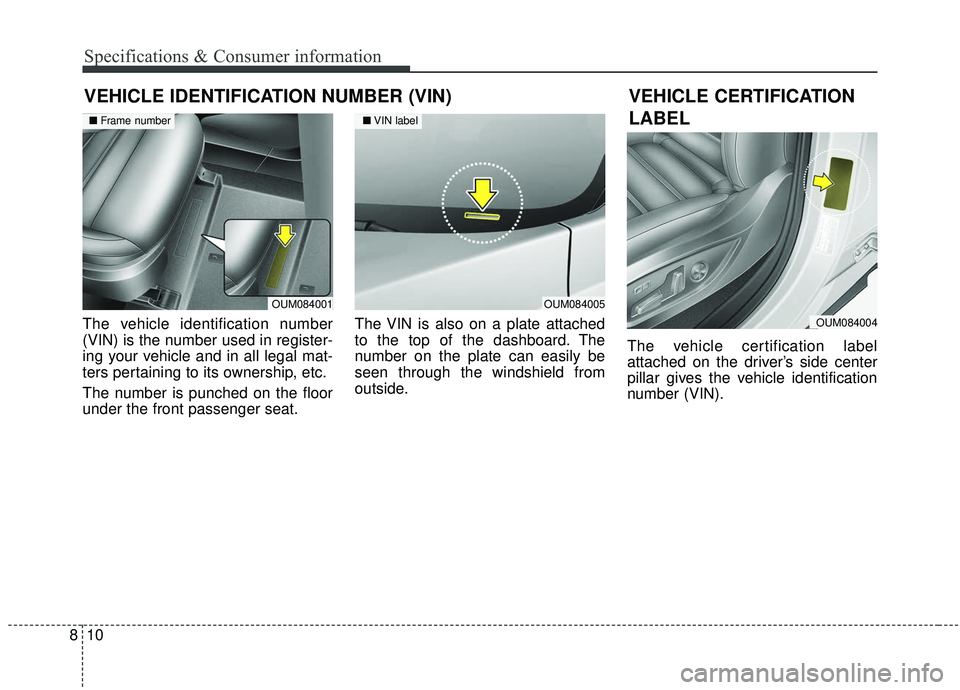
VEHICLE IDENTIFICATION NUMBER (VIN)
The vehicle identification number
(VIN) is the number used in register-
ing your vehicle and in all legal mat-
ters pertaining to its ownership, etc.
The number is punched on the floor
under the front passenger seat. The VIN is also on a plate attached
to the top of the dashboard. The
number on the plate can easily be
seen through the windshield from
outside.
The vehicle certification label
attached on the driver’s side center
pillar gives the vehicle identification
number (VIN).
VEHICLE CERTIFICATION
LABEL
OUM084001
■
Frame number
OUM084005
■VIN label
OUM084004
Page 559 of 573
Index
2I
AC inverter . . . . . . . . . . . . . . . . . . . . . . . . . . . . . . . . . 4-176
Accumulated driving information mode . . . . . . . . . . . 4-85
Adding equipment to or modifying your air bag-equipped vehicle . . . . . . . . . . . . . . . . . . . . . . . . . . . . . . . . . . . 3-\
71
Air bag inflation conditions . . . . . . . . . . . . . . . . . . . . . 3-66
Air bag non-inflation conditions . . . . . . . . . . . . . . . . . 3-68
Air bag warning label . . . . . . . . . . . . . . . . . . . . . . . . . . 3-71
Air bag warning light . . . . . . . . . . . . . . . . . . . . . . . . . . 3-49
Air bags. . . . . . . . . . . . . . . . . . . . . . . . . . . . . . . . . . . . \
. 3-46 Operation . . . . . . . . . . . . . . . . . . . . . . . . . . . . . . . . . 3-47
Air bag warning light . . . . . . . . . . . . . . . . . . . . . . . . 3-49
SRS components and functions . . . . . . . . . . . . . . . . 3-50
Occupant detection system. . . . . . . . . . . . . . . . . . . . 3-53
Driver's and passenger's front air bag . . . . . . . . . . . 3-59
Side air bag. . . . . . . . . . . . . . . . . . . . . . . . . . . . . . . . 3-61
Curtain air bag . . . . . . . . . . . . . . . . . . . . . . . . . . . . . 3-63
Air bag inflation conditions . . . . . . . . . . . . . . . . . . . 3-66
Air bag non-inflation conditions . . . . . . . . . . . . . . . 3-68
SRS Care . . . . . . . . . . . . . . . . . . . . . . . . . . . . . . . . . 3-70
Adding equipment to or modifying your air bag-equipped vehicle . . . . . . . . . . . . . . . . . . . . 3-71
Air bag warning label. . . . . . . . . . . . . . . . . . . . . . . . 3-71
Air cleaner . . . . . . . . . . . . . . . . . . . . . . . . . . . . . . . . . . 7-27\
Filter replacement. . . . . . . . . . . . . . . . . . . . . . . . . . . 7-27
Air conditioning system lubricants. . . . . . . . . . . . . . . . . 8-6 All Wheel Drive (AWD). . . . . . . . . . . . . . . . . . . . . . . . 5-21
All Wheel Drive (AWD) transfer mode selection . . 5-22
For safe all wheel drive operation . . . . . . . . . . . . . . 5-23
Antenna . . . . . . . . . . . . . . . . . . . . . . . . . . . . . . . . . . . . \
4-186
Anti-lock Brake System (ABS) . . . . . . . . . . . . . . . . . . 5-39
Appearance care . . . . . . . . . . . . . . . . . . . . . . . . . . . . . . 7-91 Exterior care . . . . . . . . . . . . . . . . . . . . . . . . . . . . . . . 7-91
Interior care . . . . . . . . . . . . . . . . . . . . . . . . . . . . . . . 7-96
Assist mode. . . . . . . . . . . . . . . . . . . . . . . . . . . . . . . . . . 4-86\
Audio system . . . . . . . . . . . . . . . . . . . . . . . . . . . . . . . 4-186 Antenna . . . . . . . . . . . . . . . . . . . . . . . . . . . . . . . . . 4-186
Steering wheel remote controller . . . . . . . . . . . . . . 4-187
AUX, USB port . . . . . . . . . . . . . . . . . . . . . . . . . . . 4-188
Auto defogging system . . . . . . . . . . . . . . . . . . . . . . . . 4-168
Auto hold . . . . . . . . . . . . . . . . . . . . . . . . . . . . . . . . . . . 5-\
36
Auto light . . . . . . . . . . . . . . . . . . . . . . . . . . . . . . . . . . 4-12\
4
Automatic car wash entry support guidelines . . . . . . 4-122
Automatic climate control system . . . . . . . . . . . . . . . 4-152 Automatic heating and air conditioning. . . . . . . . . 4-153
Manual heating and air conditioning . . . . . . . . . . . 4-154
To cancel or reset the automatic ventilation . . . . . 4-159
Climate control air filter. . . . . . . . . . . . . . . . . . . . . 4-162
Checking the amount of air conditioner refrigerant and compressor lubricant . . . . . . . . . . . . . . . . . . . . . . 4-163
Automatic heating and air conditioning . . . . . . . . . . . 4-153
A