maintenance schedule KIA SOUL 2009 Owner's Manual
[x] Cancel search | Manufacturer: KIA, Model Year: 2009, Model line: SOUL, Model: KIA SOUL 2009Pages: 328, PDF Size: 29.57 MB
Page 269 of 328
Maintenance
28
7
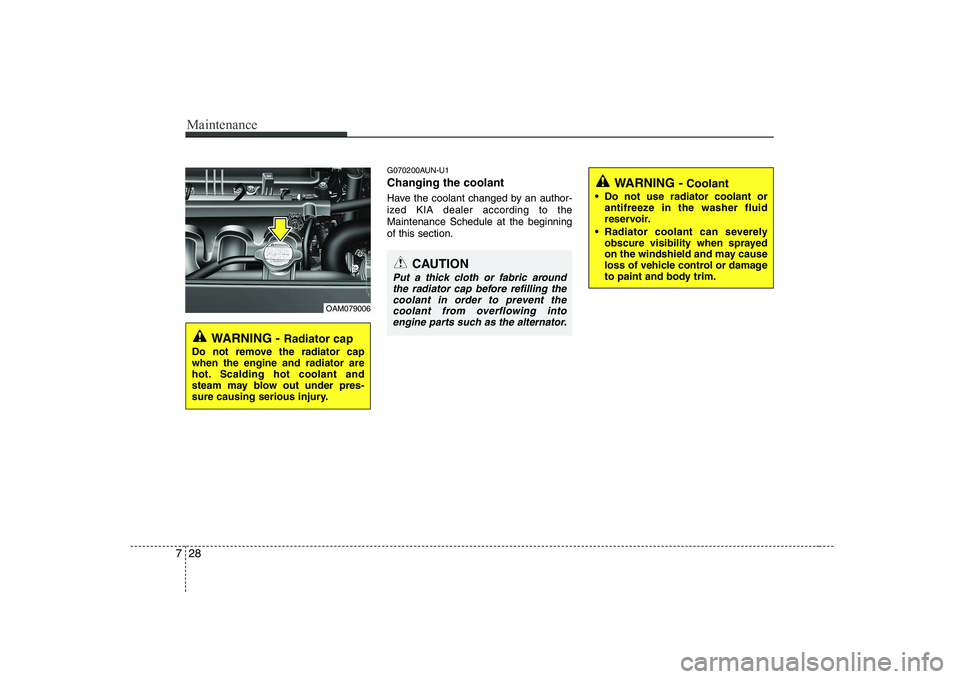
G070200AUN-U1 Changing the coolant
Have the coolant changed by an author-
ized KIA dealer according to theMaintenance Schedule at the beginningof this section.
WARNING - Radiator cap
Do not remove the radiator cap when the engine and radiator are
hot. Scalding hot coolant and
steam may blow out under pres-
sure causing serious injury.
OAM079006
CAUTION
Put a thick cloth or fabric around the radiator cap before refilling thecoolant in order to prevent the coolant from overflowing into
engine parts such as the alternator.
WARNING - Coolant
Do not use radiator coolant or antifreeze in the washer fluid
reservoir.
Radiator coolant can severely obscure visibility when sprayed
on the windshield and may cause
loss of vehicle control or damage
to paint and body trim.
Page 272 of 328
731
Maintenance
✽✽NOTICE
“C” (COLD) range is for reference only
and should NOT be used to determinetransaxle fluid level. ✽✽
NOTICE
New automatic transaxle fluid should be
red. The red dye is added so the assem-bly plant can identify it as automatic
transaxle fluid and distinguish it from
engine oil or antifreeze. The red dye,
which is not an indicator of fluid quali-
ty, is not permanent. As the vehicle isdriven, the automatic transaxle fluid
will begin to look darker. The color may
eventually appear light brown.
Therefore, have an authorized KIA
dealer change the automatic transaxlefluid according to the ScheduledMaintenance at the beginning of thissection.
Use only specified automatic transaxle
fluid. (Refer to "Recommended lubricantsor capacities" in section 8.) G100200AUN-U1 Changing the automatic transaxle fluid
Have the automatic transaxle fluid
changed by an authorized KIA dealeraccording to the Maintenance Scheduleat the beginning of this section.
Page 276 of 328
735
Maintenance
Replace the filter according to the
Maintenance Schedule.
If the vehicle is operated in extremelydusty or sandy areas, replace the ele-
ment more often than the usual recom-mended intervals. (Refer to“Maintenance under severe usage condi-
tions” in this section.)
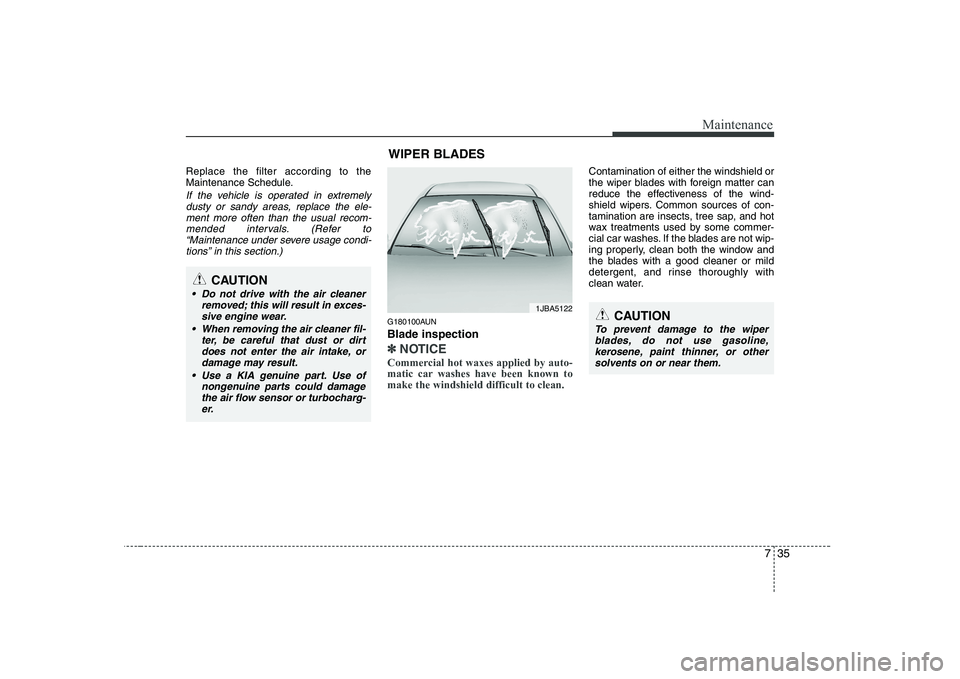
G180100AUN Blade inspection
✽✽ NOTICE
Commercial hot waxes applied by auto-
matic car washes have been known tomake the windshield difficult to clean.
Contamination of either the windshield or
the wiper blades with foreign matter can
reduce the effectiveness of the wind-
shield wipers. Common sources of con-
tamination are insects, tree sap, and hot
wax treatments used by some commer-
cial car washes. If the blades are not wip-
ing properly, clean both the window and
the blades with a good cleaner or mild
detergent, and rinse thoroughly with
clean water.
CAUTION
Do not drive with the air cleaner removed; this will result in exces-
sive engine wear.
When removing the air cleaner fil- ter, be careful that dust or dirtdoes not enter the air intake, or damage may result.
Use a KIA genuine part. Use of nongenuine parts could damagethe air flow sensor or turbocharg- er.
WIPER BLADES
1JBA5122CAUTION
To prevent damage to the wiperblades, do not use gasoline,
kerosene, paint thinner, or other solvents on or near them.
Page 315 of 328
Maintenance
74
7
EMISSION CONTROL SYSTEM
G270000AUN
The emission control system of your
vehicle is covered by a written limited
warranty. Please see the warranty infor-
mation contained in the Warranty &
Maintenance booklet in your vehicle.
Your vehicle is equipped with an emis- sion control system to meet all emission
regulations. There are three emission control sys-
tems which are as follows.
(1) Crankcase emission control system
(2) Evaporative emission control system(3) Exhaust emission control system In order to assure the proper function of
the emission control systems, it is rec-
ommended that you have your vehicle
inspected and maintained by an author-
ized KIA dealer in accordance with the
maintenance schedule in this manual. Caution for the Inspection and
Maintenance Test (With Electronic
Stability Program (ESP) system)
To prevent the vehicle from misfir-
ing during dynamometer testing,
turn the Electronic Stability
Program (ESP) system off by press-
ing the ESP switch.
After dynamometer testing is com- pleted, turn the ESP system back on
by pressing the ESP switch again. G270100AUN
1. Crankcase emission control
system
The positive crankcase ventilation sys-
tem is employed to prevent air pollution
caused by blow-by gases being emitted
from the crankcase. This system supplies
fresh filtered air to the crankcase through
the air intake hose. Inside the crankcase,
the fresh air mixes with blow-by gases,
which then pass through the PCV valveinto the induction system.
G270200AUN-C1
2. Evaporative emission control system
The Evaporative Emission Control
System is designed to prevent fuel
vapors from escaping into the atmos-
phere.
Page 326 of 328
Index
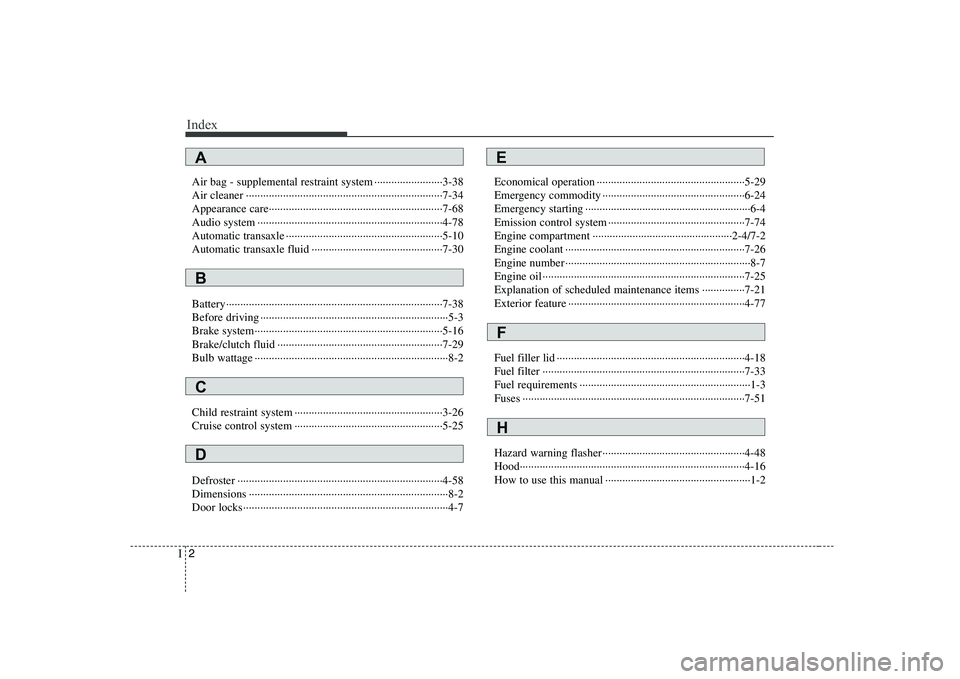
2
I
Air bag - supplemental restraint system ························3-38
Air cleaner ·····································································7-34
Appearance care·····························································7-68
Audio system ·································································4-78
Automatic transaxle ·······················································5-10
Automatic transaxle fluid ··············································7-30
Battery············································································7-38
Before driving ··································································5-3
Brake system··································································5-16
Brake/clutch fluid ··························································7-29
Bulb wattage ····································································8-2
Child restraint system ····················································3-26
Cruise control system ····················································5-25
Defroster ········································································4-58
Dimensions ······································································8-2
Door locks········································································4-7 Economical operation ····················································5-29
Emergency commodity ··················································6-24
Emergency starting ··························································6-4
Emission control system ················································7-74
Engine compartment ·················································2-4/7-2
Engine coolant ·······························································7-26
Engine number ·································································8-7
Engine oil ·······································································7-25
Explanation of scheduled maintenance items ···············7-21
Exterior feature ······························································4-77
Fuel filler lid ··································································4-18
Fuel filter ·······································································7-33
Fuel requirements ····························································1-3
Fuses ··············································································7-51
Hazard warning flasher··················································4-48
Hood···············································································4-16
How to use this manual ···················································1-2
A
B
C
D
E
F
H
Page 327 of 328
I3
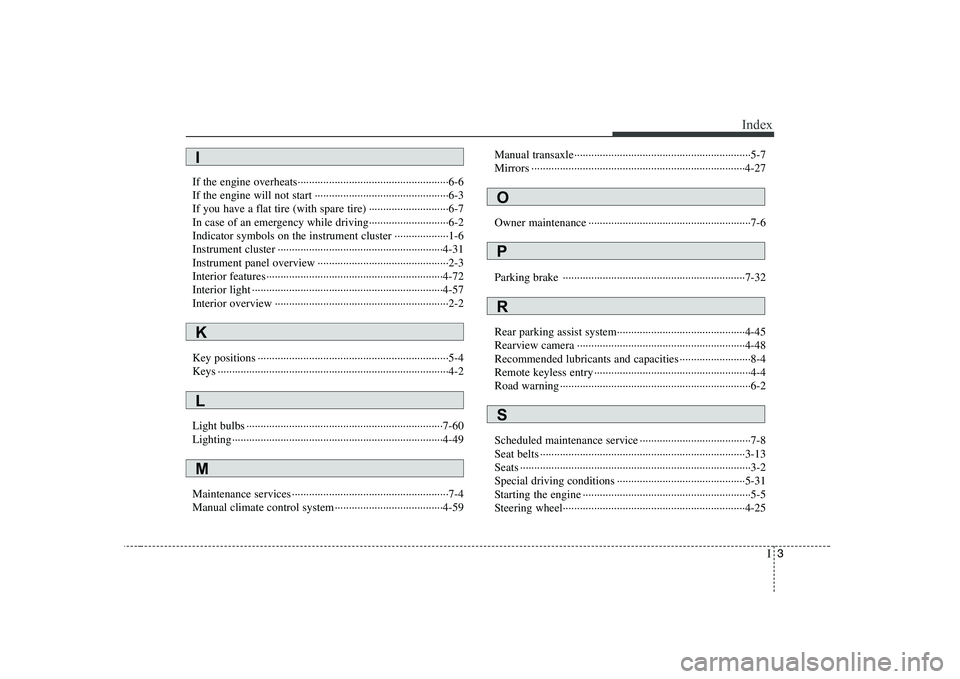
Index
If the engine overheats·····················································6-6
If the engine will not start ···············································6-3
If you have a flat tire (with spare tire) ····························6-7
In case of an emergency while driving····························6-2
Indicator symbols on the instrument cluster ···················1-6
Instrument cluster ··························································4-31
Instrument panel overview ··············································2-3
Interior features······························································4-72
Interior light ···································································4-57
Interior overview ·····························································2-2
Key positions ···································································5-4
Keys ·················································································4-2
Light bulbs ·····································································7-60
Lighting··········································································4-49
Maintenance services ·······················································7-4
Manual climate control system······································4-59 Manual transaxle······························································5-7
Mirrors ···········································································4-27
Owner maintenance ·························································7-6
Parking brake ································································7-32
Rear parking assist system·············································4-45
Rearview camera ···························································4-48
Recommended lubricants and capacities ·························8-4
Remote keyless entry ·······················································4-4
Road warning ···································································6-2
Scheduled maintenance service ·······································7-8
Seat belts ········································································3-13
Seats ·················································································3-2
Special driving conditions ·············································5-31
Starting the engine ···························································5-5
Steering wheel································································4-25
I
K
L
M
O
P
R
S