seats KIA Soul 2012 1.G Owner's Manual
[x] Cancel search | Manufacturer: KIA, Model Year: 2012, Model line: Soul, Model: KIA Soul 2012 1.GPages: 393, PDF Size: 8.76 MB
Page 11 of 393

Index
8I
Seating capacity ··················\
··················\
··················\
·······5-52
Seats ··················\
··················\
··················\
··················\
·········3-2Armrest(front) ··················\
··················\
··················\
·······3-9
Folding the rear seat ··················\
··················\
··············3-10
Front seat adjustment ··················\
··················\
··············3-4
Headrest(front) ··················\
··················\
··················\
······3-6
Headrest(rear) ··················\
··················\
··················\
······3-12
Rear seat ··················\
··················\
··················\
··············3-10
Seat warmer··················\
··················\
··················\
···········3-8
Seatback pocket··················\
··················\
··················\
·····3-9
Shopping bag holder ··················\
··················\
················4-103
Side impact air bag ··················\
··················\
··················\
··3-47
Smart key ··················\
··················\
··················\
··················\
·4-9
Smooth cornering··················\
··················\
··················\
·····5-46
Snow tires ··················\
··················\
··················\
················5-49
Spare tire Compact spare tire ··················\
··················\
················6-19
Compact spare tire replacement ··················\
··············7-45
Removing and storing the spare tire ··················\
·······6-14
Special driving conditions ··················\
··················\
·········5-44 Driving at night ··················\
··················\
··················\
···5-46
Driving in flooded areas··················\
··················\
········5-47
Driving in the rain ··················\
··················\
·················5-47\
Hazardous driving conditions ··················\
·················5-44\
Highway driving··················\
··················\
··················\
··5-48
Rocking the vehicle··················\
··················\
···············5-45
Smooth cornering ··················\
··················\
··················\
5-46
Speedometer··················\
··················\
··················\
·············4-41
Sports mode ··················\
··················\
··················\
·············5-22 SRS components and functions ··················\
··················\
·3-36
Starting difficulties, see engine will not start ··················\
6-4
Steering wheel···············\
··················\
··················\
·············4-34
Electric power steering··················\
··················\
··········4-34
Horn··················\
··················\
··················\
··················\
···4-35
Tilt steering ··················\
··················\
··················\
·········4-35
Steering wheel audio control ··················\
··················\
···4-110
Steps For Determining Correct Load Limit ··················\
5-53
Storage compartment ··················\
··················\
·················4-98\
Center console storage ··················\
··················\
··········4-98
Glove box ··················\
··················\
··················\
············4-98
Luggage box ··················\
··················\
··················\
········4-99
Multi box ··················\
··················\
··················\
·············4-99
Sunroof··················\
··················\
··················\
··················\
···4-30
Sunvisor ··················\
··················\
··················\
·················4-10\
1
Tachometer··················\
··················\
··················\
···············4-41
Tailgate··················\
··················\
··················\
··················\
···4-20
Tether anchor system ··················\
··················\
·················3-28\
Tilt steering ··················\
··················\
··················\
··············4-35
Tire and loading information label ··················\
··············5-52
Tire mobility kit ··················\
··················\
··················\
·······6-21
Tire pressure monitoring system (TPMS) ··················\
·····6-8
Tire specification and pressure label ··················\
·············8-8
T
Page 24 of 393
3
Seats / 3-2
Seat belts / 3-14
Child restraint system / 3-24
Air bag - advanced supplemental restraint system / 3-32
Safety features of your vehicle
Page 25 of 393
Safety features of your vehicle
23
SEATS
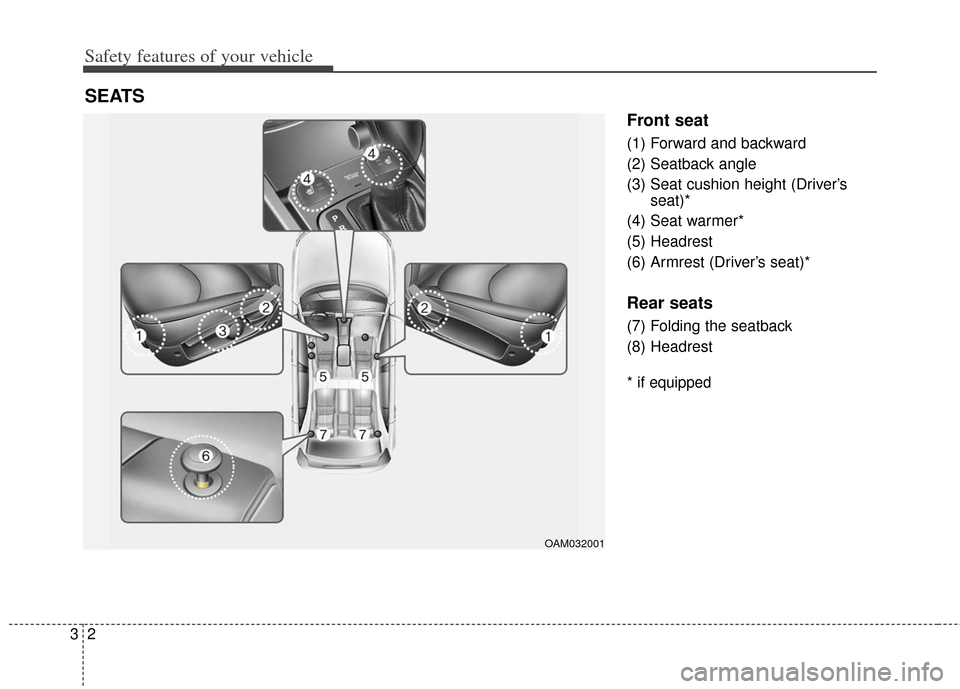
Front seat
(1) Forward and backward
(2) Seatback angle
(3) Seat cushion height (Driver’sseat)*
(4) Seat warmer*
(5) Headrest
(6) Armrest (Driver’s seat)*
Rear seats
(7) Folding the seatback
(8) Headrest
* if equipped
OAM032001
Page 29 of 393
Safety features of your vehicle
63
Headrest
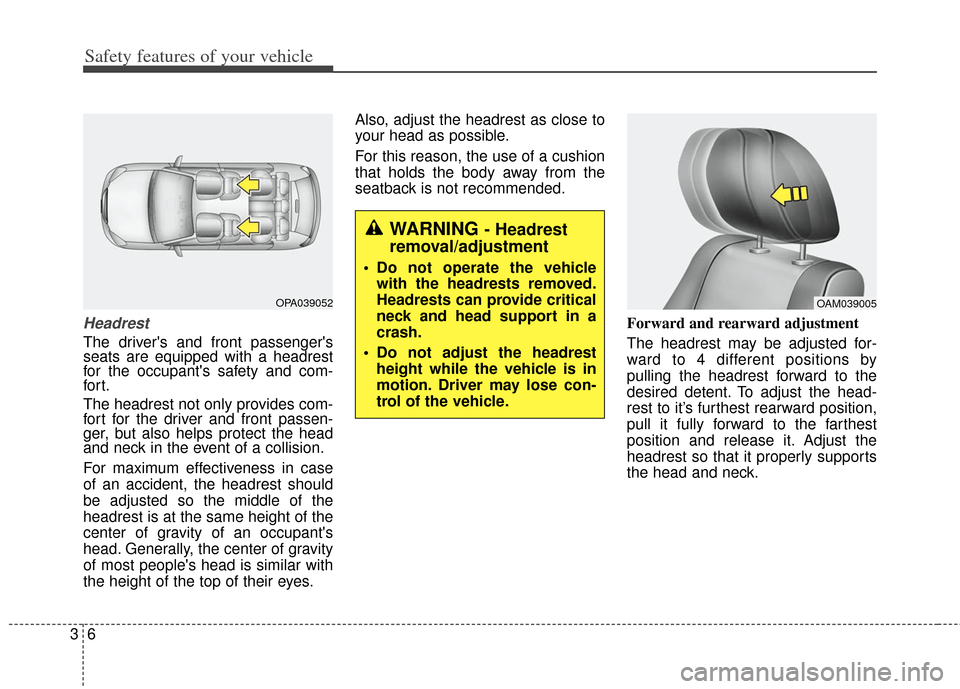
The driver's and front passenger's
seats are equipped with a headrest
for the occupant's safety and com-
for t.
The headrest not only provides com-
fort for the driver and front passen-
ger, but also helps protect the head
and neck in the event of a collision.
For maximum effectiveness in case
of an accident, the headrest should
be adjusted so the middle of the
headrest is at the same height of the
center of gravity of an occupant's
head. Generally, the center of gravity
of most people's head is similar with
the height of the top of their eyes.Also, adjust the headrest as close to
your head as possible.
For this reason, the use of a cushion
that holds the body away from the
seatback is not recommended.
Forward and rearward adjustment
The headrest may be adjusted for-
ward to 4 different positions by
pulling the headrest forward to the
desired detent. To adjust the head-
rest to it’s furthest rearward position,
pull it fully forward to the farthest
position and release it. Adjust the
headrest so that it properly supports
the head and neck.
OAM039005OPA039052
WARNING - Headrest
removal/adjustment
Do not operate the vehicle
with the headrests removed.
Headrests can provide critical
neck and head support in a
crash.
Do not adjust the headrest height while the vehicle is in
motion. Driver may lose con-
trol of the vehicle.
Page 31 of 393
Safety features of your vehicle
83
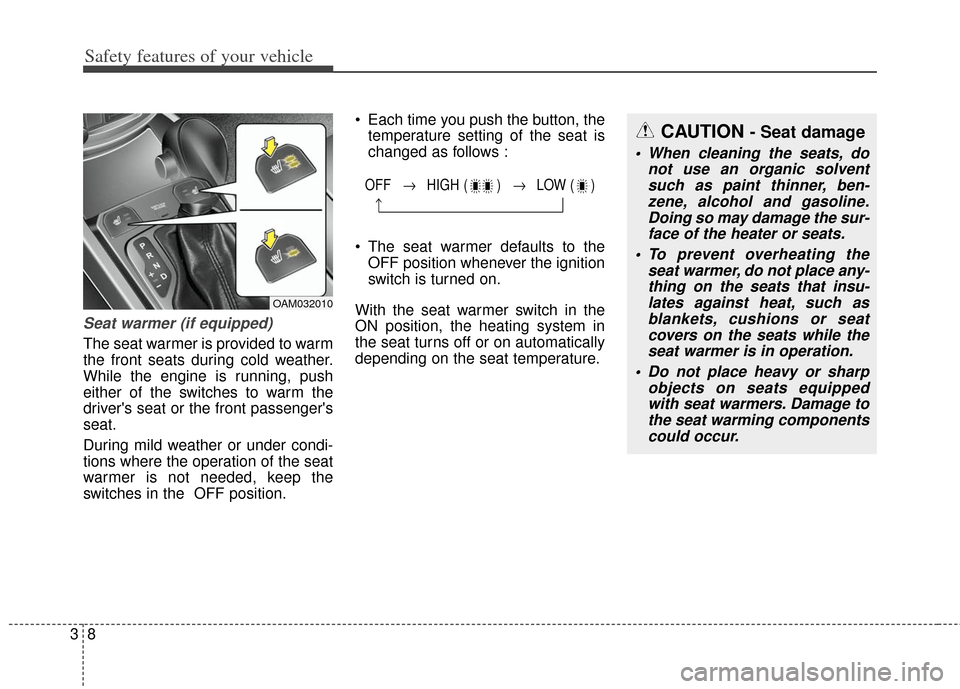
Seat warmer (if equipped)
The seat warmer is provided to warm
the front seats during cold weather.
While the engine is running, push
either of the switches to warm the
driver's seat or the front passenger's
seat.
During mild weather or under condi-
tions where the operation of the seat
warmer is not needed, keep the
switches in the OFF position. Each time you push the button, the
temperature setting of the seat is
changed as follows :
The seat warmer defaults to the OFF position whenever the ignition
switch is turned on.
With the seat warmer switch in the
ON position, the heating system in
the seat turns off or on automatically
depending on the seat temperature.
OFF → HIGH ( ) → LOW ( )
→
OAM032010
CAUTION - Seat damage
When cleaning the seats, do not use an organic solventsuch as paint thinner, ben-zene, alcohol and gasoline.Doing so may damage the sur-face of the heater or seats.
To prevent overheating the seat warmer, do not place any-thing on the seats that insu-lates against heat, such asblankets, cushions or seatcovers on the seats while theseat warmer is in operation.
Do not place heavy or sharp objects on seats equippedwith seat warmers. Damage tothe seat warming componentscould occur.
Page 35 of 393
Safety features of your vehicle
12
3
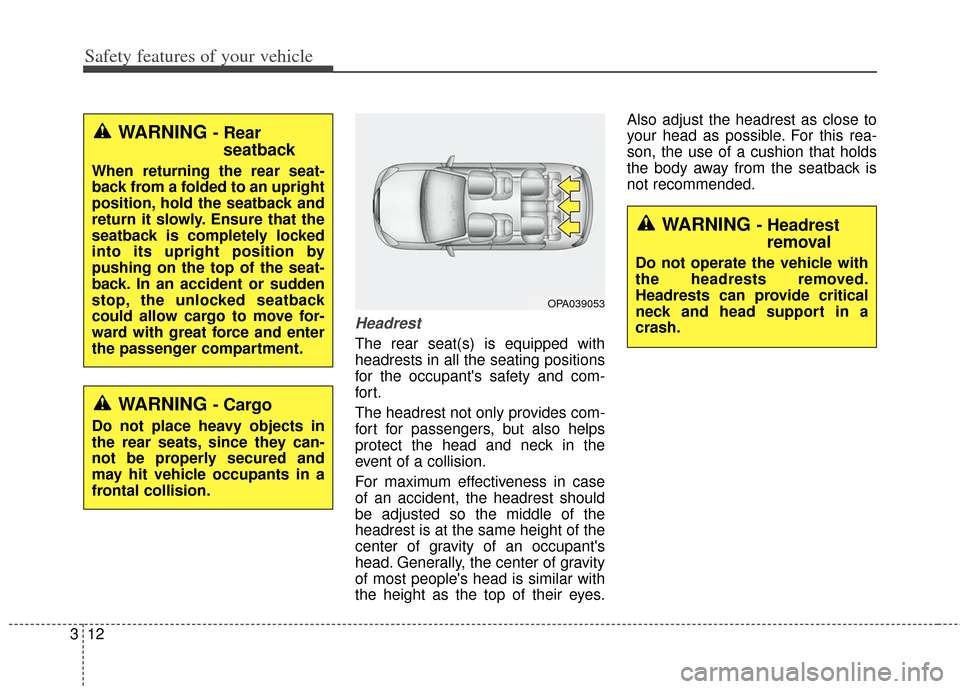
Headrest
The rear seat(s) is equipped with
headrests in all the seating positions
for the occupant's safety and com-
for t.
The headrest not only provides com-
fort for passengers, but also helps
protect the head and neck in the
event of a collision.
For maximum effectiveness in case
of an accident, the headrest should
be adjusted so the middle of the
headrest is at the same height of the
center of gravity of an occupant's
head. Generally, the center of gravity
of most people's head is similar with
the height as the top of their eyes. Also adjust the headrest as close to
your head as possible. For this rea-
son, the use of a cushion that holds
the body away from the seatback is
not recommended.
OPA039053
WARNING - Headrest
removal
Do not operate the vehicle with
the headrests removed.
Headrests can provide critical
neck and head support in a
crash.
WARNING - Rear seatback
When returning the rear seat-
back from a folded to an upright
position, hold the seatback and
return it slowly. Ensure that the
seatback is completely locked
into its upright position by
pushing on the top of the seat-
back. In an accident or sudden
stop, the unlocked seatback
could allow cargo to move for-
ward with great force and enter
the passenger compartment.
WARNING - Cargo
Do not place heavy objects in
the rear seats, since they can-
not be properly secured and
may hit vehicle occupants in a
frontal collision.
Page 42 of 393
319
Safety features of your vehicle
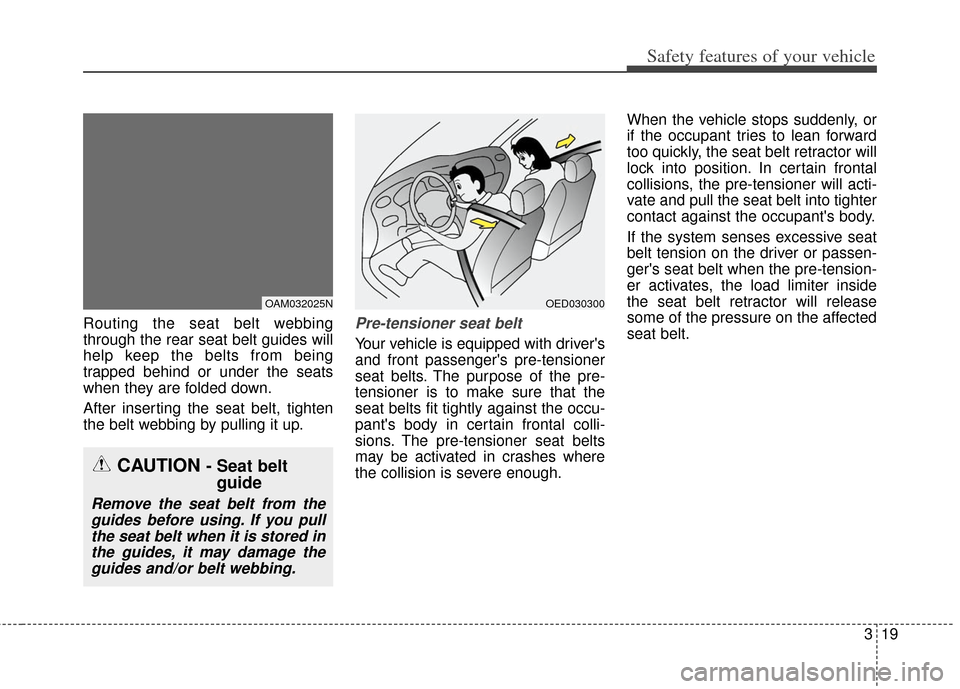
Routing the seat belt webbing
through the rear seat belt guides will
help keep the belts from being
trapped behind or under the seats
when they are folded down.
After inserting the seat belt, tighten
the belt webbing by pulling it up.Pre-tensioner seat belt
Your vehicle is equipped with driver's
and front passenger's pre-tensioner
seat belts. The purpose of the pre-
tensioner is to make sure that the
seat belts fit tightly against the occu-
pant's body in certain frontal colli-
sions. The pre-tensioner seat belts
may be activated in crashes where
the collision is severe enough.When the vehicle stops suddenly, or
if the occupant tries to lean forward
too quickly, the seat belt retractor will
lock into position. In certain frontal
collisions, the pre-tensioner will acti-
vate and pull the seat belt into tighter
contact against the occupant's body.
If the system senses excessive seat
belt tension on the driver or passen-
ger's seat belt when the pre-tension-
er activates, the load limiter inside
the seat belt retractor will release
some of the pressure on the affected
seat belt.
OAM032025NOED030300
CAUTION - Seat belt
guide
Remove the seat belt from the
guides before using. If you pullthe seat belt when it is stored inthe guides, it may damage theguides and/or belt webbing.
Page 44 of 393
321
Safety features of your vehicle
✽
✽NOTICE
Do not attempt to service or repair
the pre-tensioner seat belt system in
any manner. Do not attempt to
inspect or replace the pre-tensioner
seat belts yourself. This must be
done by an authorized Kia dealer.
Pre-tensioners are designed to oper-
ate only one time. After activation,
pre-tensioner seat belts must be
replaced. If the pre-tensioner must
be replaced, contact an authorized
Kia dealer.
Seat belt precautions
Infant or small child
You should be aware of the specific
requirements in your country. Child
and/or infant seats must be properly
placed and installed in the rear seat.
For more information about the use
of these restraints, refer to “Child
restraint system” in this section.
WARNING - Hot preten-
sioner
Do not touch the pre-tensioner
seat belt assemblies for several
minutes after they have been
activated. When the pre-ten-
sioner seat belt mechanism
fires during a collision the pre-
tensioner becomes hot and can
burn you.
Page 46 of 393
323
Safety features of your vehicle
Injured person
A seat belt should be used when an
injured person is being transported.
When this is necessary, you should
consult a physician for recommenda-
tions.
One person per belt
Two people (including children)
should never attempt to use a single
seat belt. This could increase the
severity of injuries in case of an acci-
dent.
Do not lie down
To reduce the chance of injuries in
the event of an accident and to
achieve maximum effectiveness of
the restraint system, all passengers
should be sitting up and the front and
rear seats should be in an upright
position when the vehicle is moving.
A seat belt cannot provide proper
protection if the person is lying down
in the rear seat or if the front and rear
seats are in a reclined position.
Care of seat belts
Seat belt systems should never be
disassembled or modified. In addi-
tion, care should be taken to assure
that seat belts and belt hardware are
not damaged by seat hinges, doors
or other abuse.
Periodic inspection
All seat belts should be inspected
periodically for wear or damage of
any kind. Any damaged parts should
be replaced as soon as possible.
Keep belts clean and dry
Seat belts should be kept clean and
dry. If belts become dirty, they can be
cleaned by using a mild soap solu-
tion and warm water. Bleach, dye,
strong detergents or abrasives
should not be used because they
may damage and weaken the fabric.
When to replace seat belts
The entire in-use seat belt assembly
or assemblies should be replaced if
the vehicle has been involved in an
accident. This should be done even if
no damage is visible. Additional
questions concerning seat belt oper-
ation should be directed to an
authorized Kia dealer.
WARNING - Pinchedseat belt
Make sure that the webbing
and/or buckle does not get
caught or pinched in the rear
seat when returning the rear
seatback to its upright position.
A caught or pinched
webbing/buckle may become
damaged and could fail during a
collision or sudden stop.
Page 47 of 393
Safety features of your vehicle
24
3
Children riding in the car should sit in
the rear seat and must always be
properly restrained to minimize the
risk of injury in an accident, sudden
stop or sudden maneuver. According
to accident statistics, children are
safer when properly restrained in the
rear seats than in the front seat.
Larger children not in a child restraint
should use one of the seat belts pro-
vided.
You should be aware of the specific
requirements in your country. Child
and/or infant safety seats must be
properly placed and installed in the
rear seat. You must use a commer-
cially available child restraint system
that meets the requirements of the
safety standards of your country.
Child restraint systems are designed
to be secured in vehicle seats by
seat belt, or by a tether anchor
and/or LATCH anchors (if equipped). Children could be injured or killed in
a crash if their restraints are not
properly secured. For small children
and babies, a child seat or infant seat
must be used. Before buying a par-
ticular child restraint system, make
sure it fits your car seat and seat
belts, and fits your child.
Follow all the instructions provided
by the manufacturer when installing
the child restraint system.
When the child restraint system is
not in use, store it in the luggage
area or fasten it with a seat belt so
that it will not be thrown forward in
case of a sudden stop or an acci-
dent.
CHILD RESTRAINT SYSTEM
WARNING - Restraintlocation
Never install a child or infant
seat on the front passenger's
seat. A child riding in the front
passenger seat can be forceful-
ly struck by an inflating airbag.
CAUTION - Hot child restraint
A child restraint system can
become very hot if it is left in aclosed vehicle on a sunny day.Be sure to check the seat cover,buckles and latches before plac-ing a child in the restraint sys-tem.