washer fluid KIA Soul 2012 1.G Owner's Manual
[x] Cancel search | Manufacturer: KIA, Model Year: 2012, Model line: Soul, Model: KIA Soul 2012 1.GPages: 393, PDF Size: 8.76 MB
Page 7 of 393

Index
4I
Drinks holders, see cup holders··················\
·················4-10\
1
Driver's 3-point seat belt··················\
··················\
············3-15
Driver's and passenger's front air bag··················\
··········3-44
Driving at night··················\
··················\
··················\
········5-46
Driving in flooded areas ··················\
··················\
············5-47
Driving in the rain ··················\
··················\
··················\
···5-47
Economical operation ··················\
··················\
················5-42
Electric chromic mirror ··················\
··················\
·············4-36
Electric power steering ··················\
··················\
··············4-34
Electronic stability control(ESC)··················\
·················5-30\
Emergency starting ··················\
··················\
··················\
····6-4Jump starting ··················\
··················\
··················\
·········6-5
Push starting ··················\
··················\
··················\
··········6-6
Emergency while driving··················\
··················\
·············6-3
Emission control system ··················\
··················\
············7-72 Crankcase emission control system ··················\
········7-72
Evaporative emission control System ··················\
·····7-72
Exhaust emission control system ··················\
············7-73
Engine ··················\
··················\
··················\
··················\
······8-2
Engine compartment ··················\
··················\
··················\
··2-4
Engine coolant ··················\
··················\
··················\
·········7-28
Engine number ··················\
··················\
··················\
···········8-8
Engine oil ··················\
··················\
··················\
·················7-26\
Engine overheats··················\
··················\
··················\
········6-7
Engine start/stop button ··················\
··················\
···············5-8 Engine temperature gauge ··················\
··················\
·········4-42
Engine will not start··················\
··················\
··················\
···6-4
Evaporative emission control System ··················\
·········7-72
Exhaust emission control system··················\
·················7-73\
Explanation of scheduled maintenance items ···············7-22
Exterior care··················\
··················\
··················\
·············7-66
Exterior features··················\
··················\
··················\
·····4-107
Roof rack ··················\
··················\
··················\
···········4-107
Flat tire (with spare tire) ··················\
··················\
············6-13 Changing tires ··················\
··················\
··················\
·····6-14
Compact spare tire ··················\
··················\
················6-19
Removing and storing the spare tire ··················\
·······6-14
Floor mat anchor(s) ··················\
··················\
·················4-10\
4
Fluid Brakes/clutch fluid ··················\
··················\
················7-31
Washer fluid ··················\
··················\
··················\
········7-32
Folding the rear seat ··················\
··················\
··················\
3-10
Front passenger and rear seat belt ··················\
···············3-17
Front seat adjustment ··················\
··················\
··················\
·3-4
Fuel filler lid ··················\
··················\
··················\
············4-27
Fuel gauge··················\
··················\
··················\
················4-43
Fuel requirements ··················\
··················\
··················\
······1-3
E
F
Page 13 of 393

Index
10I
Warning and indicators ··················\
··················\
··············4-50
Washer fluid ··················\
··················\
··················\
·············7-32
Weight/volume ··················\
··················\
··················\
···········8-3
Wheel alignment and tire balance ··················\
···············7-44
Wheel replacement ··················\
··················\
··················\
··7-46
Windows ··················\
··················\
··················\
··················\
4-22Auto down window ··················\
··················\
···············4-24
Power window lock button ··················\
··················\
···4-24
Windshield defrosting and defogging··················\
··········4-94 Defogging logic··················\
··················\
··················\
···4-96
Winter driving ··················\
··················\
··················\
··········5-49 Snow tires ··················\
··················\
··················\
············5-49
Wiper blades ··················\
··················\
··················\
············7-35
Wipers and washers ··················\
··················\
··················\
·4-69
W
Page 19 of 393
Introduction
61
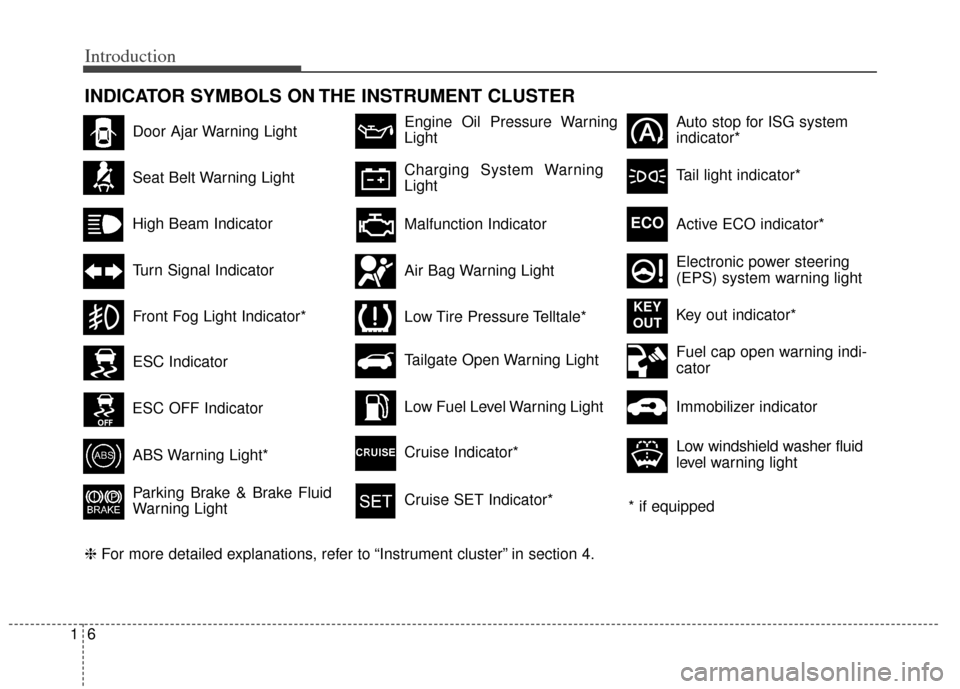
INDICATOR SYMBOLS ON THE INSTRUMENT CLUSTER
Seat Belt Warning Light
High Beam Indicator
Turn Signal Indicator
ABS Warning Light*
Parking Brake & Brake Fluid
Warning Light
Malfunction Indicator
Low Fuel Level Warning Light Tailgate Open Warning Light
❈ For more detailed explanations, refer to “Instrument cluster” in section 4.
Charging System Warning
Light
Door Ajar Warning Light
Front Fog Light Indicator*
Engine Oil Pressure Warning
Light
Air Bag Warning Light
Low Tire Pressure Telltale*
Cruise Indicator*
Cruise SET Indicator*
ESC Indicator
ESC OFF Indicator
Tail light indicator*
Electronic power steering
(EPS) system warning light
Auto stop for ISG system
indicator*
Active ECO indicator*
ECO
Key out indicator*
KEY
OUT
* if equipped
Fuel cap open warning indi-
cator
Low windshield washer fluid
level warning light Immobilizer indicator
Page 23 of 393
Your vehicle at a glance
42
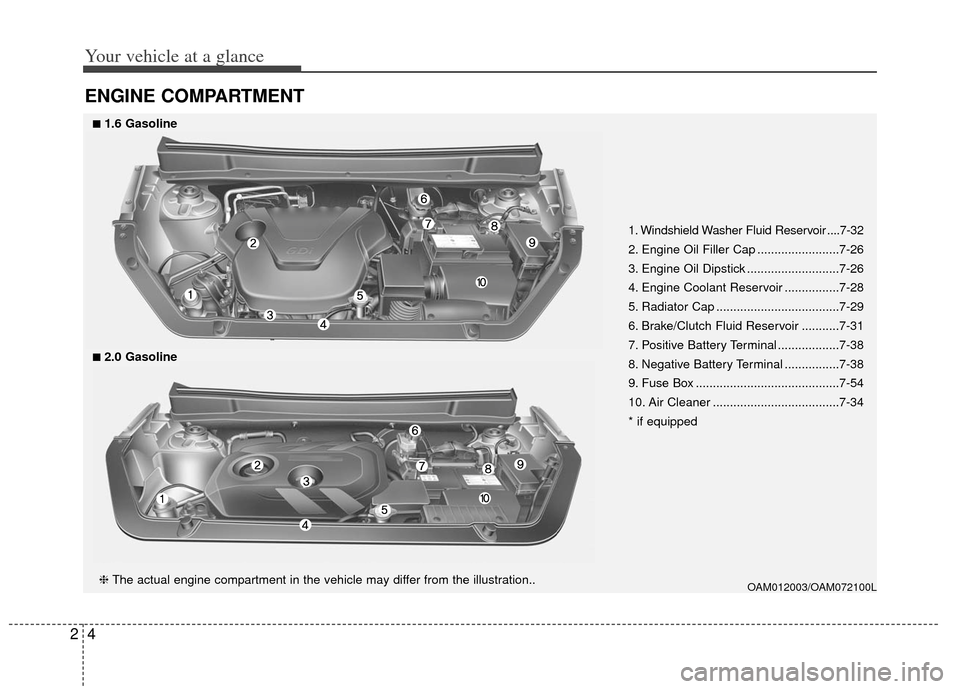
ENGINE COMPARTMENT
OAM012003/OAM072100L
1. Windshield Washer Fluid Reservoir ....7-32
2. Engine Oil Filler Cap ........................7-26
3. Engine Oil Dipstick ...........................7-26
4. Engine Coolant Reservoir ................7-28
5. Radiator Cap ....................................7-29
6. Brake/Clutch Fluid Reservoir ...........7-31
7. Positive Battery Terminal ..................7-38
8. Negative Battery Terminal ................7-38
9. Fuse Box ..........................................7-54
10. Air Cleaner .....................................7-34
* if equipped
❈The actual engine compartment in the vehicle may differ from the illustration..
■2.0 Gasoline
■1.6 Gasoline
Page 136 of 393
457
Features of your vehicle
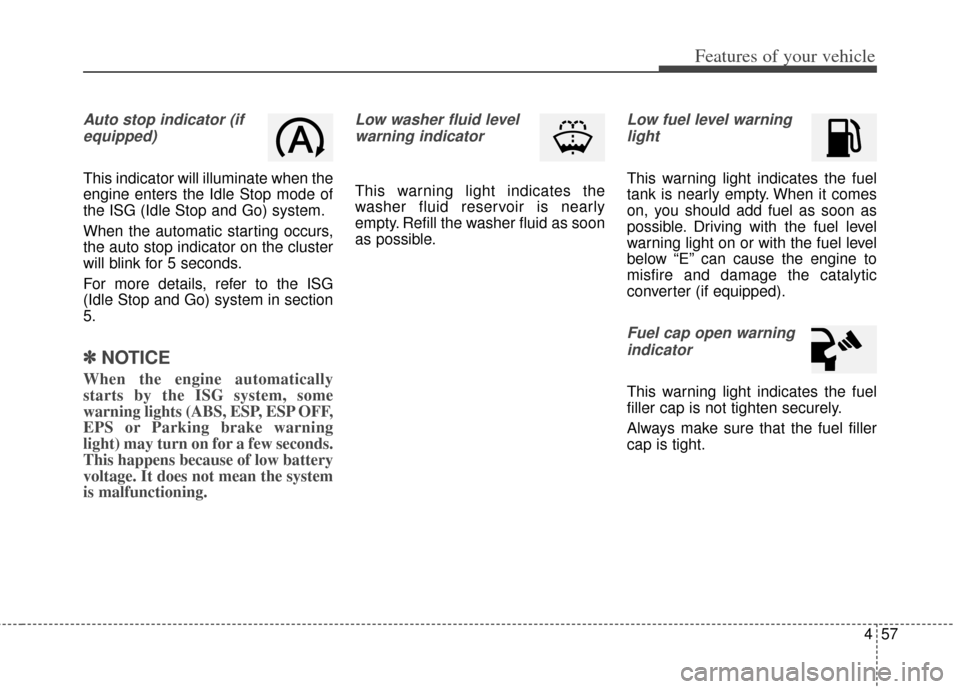
Auto stop indicator (ifequipped)
This indicator will illuminate when the
engine enters the Idle Stop mode of
the ISG (Idle Stop and Go) system.
When the automatic starting occurs,
the auto stop indicator on the cluster
will blink for 5 seconds.
For more details, refer to the ISG
(Idle Stop and Go) system in section
5.
✽ ✽ NOTICE
When the engine automatically
starts by the ISG system, some
warning lights (ABS, ESP, ESP OFF,
EPS or Parking brake warning
light) may turn on for a few seconds.
This happens because of low battery
voltage. It does not mean the system
is malfunctioning.
Low washer fluid level
warning indicator
This warning light indicates the
washer fluid reservoir is nearly
empty. Refill the washer fluid as soon
as possible.
Low fuel level warninglight
This warning light indicates the fuel
tank is nearly empty. When it comes
on, you should add fuel as soon as
possible. Driving with the fuel level
warning light on or with the fuel level
below “E” can cause the engine to
misfire and damage the catalytic
converter (if equipped).
Fuel cap open warningindicator
This warning light indicates the fuel
filler cap is not tighten securely.
Always make sure that the fuel filler
cap is tight.
Page 149 of 393
Features of your vehicle
70
4
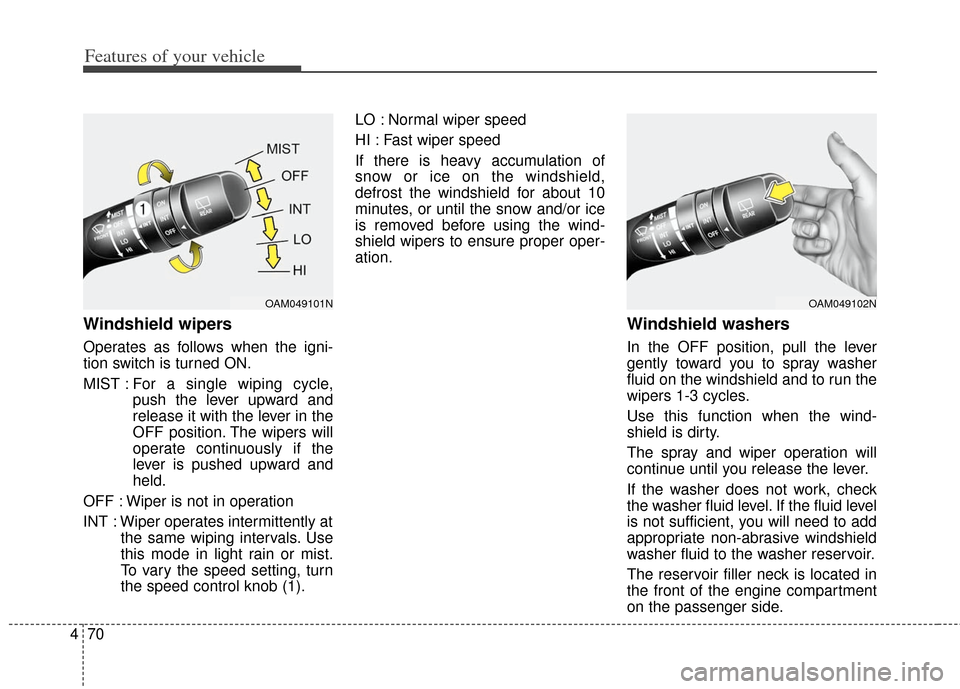
Windshield wipers
Operates as follows when the igni-
tion switch is turned ON.
MIST : For a single wiping cycle,
push the lever upward and
release it with the lever in the
OFF position. The wipers will
operate continuously if the
lever is pushed upward and
held.
OFF : Wiper is not in operation
INT : Wiper operates intermittently at the same wiping intervals. Use
this mode in light rain or mist.
To vary the speed setting, turn
the speed control knob (1). LO : Normal wiper speed
HI : Fast wiper speed
If there is heavy accumulation of
snow or ice on the windshield,
defrost the windshield for about 10
minutes, or until the snow and/or ice
is removed before using the wind-
shield wipers to ensure proper oper-
ation.
Windshield washers
In the OFF position, pull the lever
gently toward you to spray washer
fluid on the windshield and to run the
wipers 1-3 cycles.
Use this function when the wind-
shield is dirty.
The spray and wiper operation will
continue until you release the lever.
If the washer does not work, check
the washer fluid level. If the fluid level
is not sufficient, you will need to add
appropriate non-abrasive windshield
washer fluid to the washer reservoir.
The reservoir filler neck is located in
the front of the engine compartment
on the passenger side.
OAM049101NOAM049102N
Page 150 of 393
471
Features of your vehicle
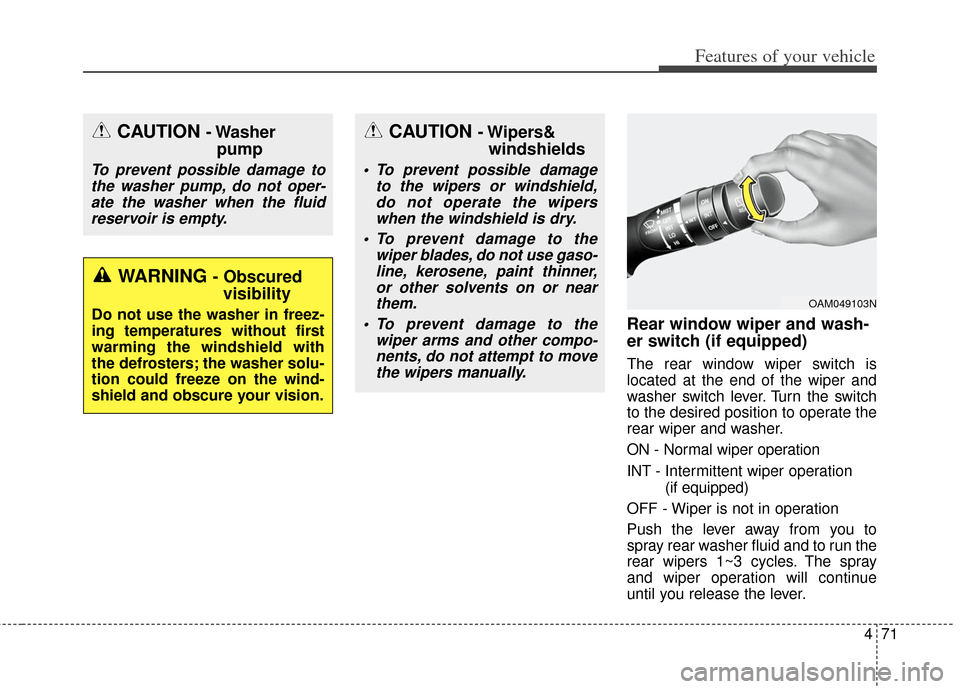
Rear window wiper and wash-
er switch (if equipped)
The rear window wiper switch is
located at the end of the wiper and
washer switch lever. Turn the switch
to the desired position to operate the
rear wiper and washer.
ON - Normal wiper operation
INT - Intermittent wiper operation(if equipped)
OFF - Wiper is not in operation
Push the lever away from you to
spray rear washer fluid and to run the
rear wipers 1~3 cycles. The spray
and wiper operation will continue
until you release the lever.
OAM049103N
CAUTION - Washer pump
To prevent possible damage to
the washer pump, do not oper-ate the washer when the fluidreservoir is empty.
CAUTION - Wipers& windshields
To prevent possible damage
to the wipers or windshield,do not operate the wiperswhen the windshield is dry.
To prevent damage to the wiper blades, do not use gaso-line, kerosene, paint thinner,or other solvents on or nearthem.
To prevent damage to the wiper arms and other compo-nents, do not attempt to movethe wipers manually.
WARNING - Obscured visibility
Do not use the washer in freez-
ing temperatures without first
warming the windshield with
the defrosters; the washer solu-
tion could freeze on the wind-
shield and obscure your vision.
Page 225 of 393
53
Driving your vehicle
Before entering vehicle
• Be sure that all windows, outsidemirror(s), and outside lights are
clean.
Check the condition of the tires.
Check under the vehicle for any sign of leaks.
Be sure there are no obstacles behind you if you intend to back up.
Necessary inspections
Fluid levels, such as engine oil,
engine coolant, brake fluid, and
washer fluid should be checked on a
regular basis, with the exact interval
depending on the fluid. Further
details are provided in section 7,
“Maintenance”.
Before starting
Close and lock all doors.
Position the seat so that all con-trols are easily reached.
Buckle your seat belt.
Adjust the inside and outside rearview mirrors.
Be sure that all lights work.
Check all gauges.
Check the operation of warning lights when the ignition switch is
turned to the ON position.
Release the parking brake and make sure the brake warning light
goes out.
For safe operation, be sure you are
familiar with your vehicle and its
equipment.
BEFORE DRIVING
WARNING - Distracted driving
Focus on the road while driving.
The driver's primary responsi-
bility is in the safe and legal
operation of the vehicle. Use of
any handled devices, other
equipment or vehicle systems
that distract the drive should
not be used during vehicle
operation.
WARNING - Check sur-rounding
Always check the surrounding
areas near your vehicle for peo-
ple, especially children, before
putting a car into D (Drive) or R
(Reverse).
Page 272 of 393
Driving your vehicle
50
5
Use high quality ethylene gly-
col coolant
Your vehicle is delivered with high
quality ethylene glycol coolant in the
cooling system. It is the only type of
coolant that should be used because
it helps prevent corrosion in the cool-
ing system, lubricates the water
pump and prevents freezing. Be sure
to replace or replenish your coolant
in accordance with the maintenance
schedule in section 7. Before winter,
have your coolant tested to assure
that its freezing point is sufficient for
the temperatures anticipated during
the winter.
Check battery and cables
Winter puts additional burdens on
the battery system. Visually inspect
the battery and cables as described
in section 7. The level of charge in
your battery can be checked by an
authorized Kia dealer or a service
station.
Change to "winter weight" oil
if necessary
In some climates it is recommended
that a lower viscosity "winter weight"
oil be used during cold weather. See
section 8 for recommendations. If
you aren't sure what weight oil you
should use, consult an authorized
Kia dealer.
Check spark plugs and igni-
tion system
Inspect your spark plugs as
described in section 7 and replace
them if necessary. Also check all
ignition wiring and components to be
sure they are not cracked, worn or
damaged in any way.
To keep locks from freezing
To keep the locks from freezing,
squirt an approved de-icer fluid or
glycerine into the key opening. If a
lock is covered with ice, squirt it with
an approved de-icing fluid to remove
the ice. If the lock is frozen internally,
you may be able to thaw it out by
using a heated key. Handle the heat-
ed key with care to avoid injury.
Use approved window washer
anti-freeze in system
To keep the water in the window
washer system from freezing, add an
approved window washer anti-freeze
solution in accordance with instruc-
tions on the container. Window wash-
er anti-freeze is available from an
authorized Kia dealer and most auto
parts outlets. Do not use engine
coolant or other types of anti-freeze
as these may damage the paint fin-
ish.
Don’t let your parking brake
freeze
Under some conditions your parking
brake can freeze in the engaged
position. This is most likely to hap-
pen when there is an accumulation
of snow or ice around or near the
rear brakes or if the brakes are wet.
If there is a risk the parking brake
may freeze, apply it only temporarily
while you put the gear shift lever in P
(Park, automatic transaxle) or in first
or reverse gear (manual transaxle)
and block the rear wheels so the
vehicle cannot roll. Then release the
parking brake.
Page 311 of 393
7
Engine compartment / 7-2
Maintenance services / 7-4
Owner maintenance / 7-6
Scheduled maintenance service / 7-8
Explanation of scheduled maintenance items / 7-22
Engine oil / 7-26
Engine coolant / 7-28
Brake/clutch fluid / 7-31
Washer fluid / 7-32
Parking brake / 7-33
Air cleaner / 7-34
Wiper blades / 7-35
Battery / 7-38
Tires and wheels / 7-41
Fuses / 7-54
Appearance care / 7-66
Emission control system / 7-72
Maintenance