lock KIA Soul 2013 1.G User Guide
[x] Cancel search | Manufacturer: KIA, Model Year: 2013, Model line: Soul, Model: KIA Soul 2013 1.GPages: 393, PDF Size: 8.76 MB
Page 34 of 393
311
Safety features of your vehicle
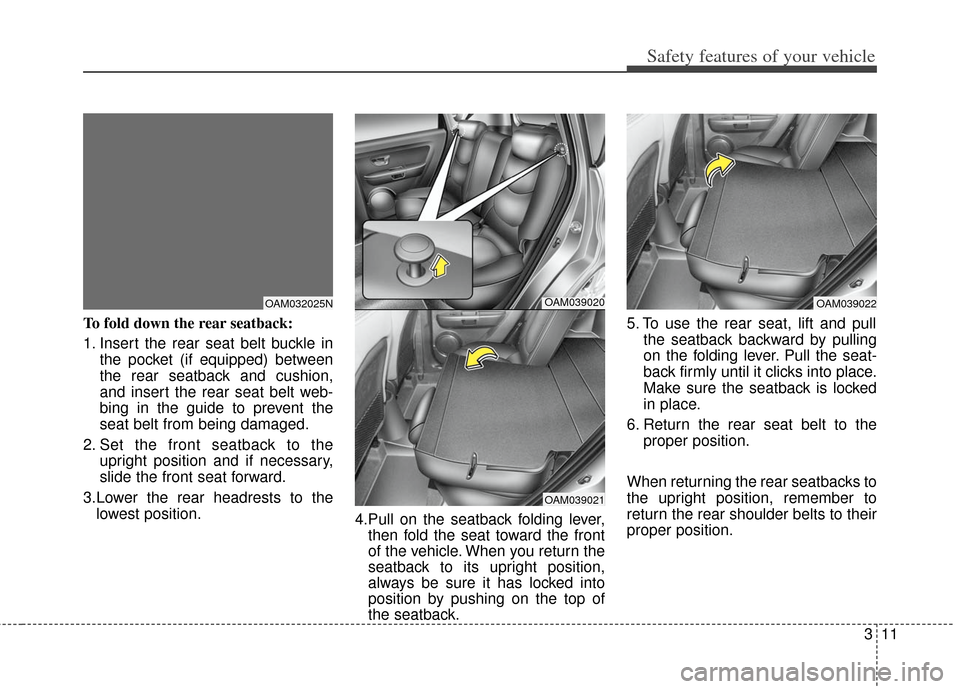
To fold down the rear seatback:
1. Insert the rear seat belt buckle inthe pocket (if equipped) between
the rear seatback and cushion,
and insert the rear seat belt web-
bing in the guide to prevent the
seat belt from being damaged.
2. Set the front seatback to the upright position and if necessary,
slide the front seat forward.
3.Lower the rear headrests to the lowest position. 4.Pull on the seatback folding lever,
then fold the seat toward the front
of the vehicle. When you return the
seatback to its upright position,
always be sure it has locked into
position by pushing on the top of
the seatback. 5. To use the rear seat, lift and pull
the seatback backward by pulling
on the folding lever. Pull the seat-
back firmly until it clicks into place.
Make sure the seatback is locked
in place.
6. Return the rear seat belt to the proper position.
When returning the rear seatbacks to
the upright position, remember to
return the rear shoulder belts to their
proper position.
OAM039020
OAM039021
OAM039022OAM032025N
Page 35 of 393
Safety features of your vehicle
12
3
Headrest
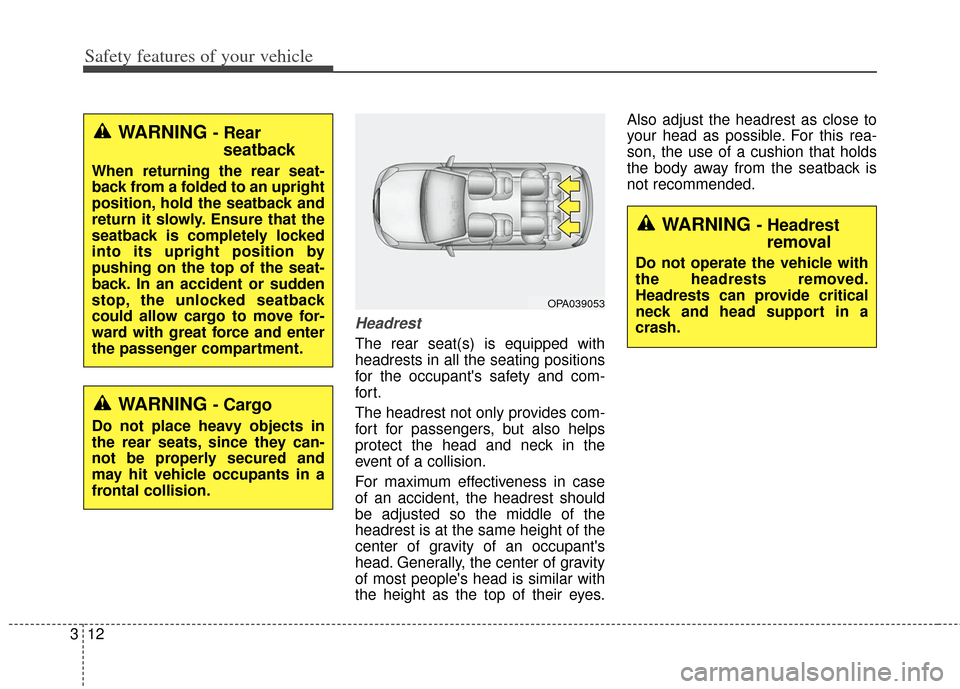
The rear seat(s) is equipped with
headrests in all the seating positions
for the occupant's safety and com-
for t.
The headrest not only provides com-
fort for passengers, but also helps
protect the head and neck in the
event of a collision.
For maximum effectiveness in case
of an accident, the headrest should
be adjusted so the middle of the
headrest is at the same height of the
center of gravity of an occupant's
head. Generally, the center of gravity
of most people's head is similar with
the height as the top of their eyes. Also adjust the headrest as close to
your head as possible. For this rea-
son, the use of a cushion that holds
the body away from the seatback is
not recommended.
OPA039053
WARNING - Headrest
removal
Do not operate the vehicle with
the headrests removed.
Headrests can provide critical
neck and head support in a
crash.
WARNING - Rear seatback
When returning the rear seat-
back from a folded to an upright
position, hold the seatback and
return it slowly. Ensure that the
seatback is completely locked
into its upright position by
pushing on the top of the seat-
back. In an accident or sudden
stop, the unlocked seatback
could allow cargo to move for-
ward with great force and enter
the passenger compartment.
WARNING - Cargo
Do not place heavy objects in
the rear seats, since they can-
not be properly secured and
may hit vehicle occupants in a
frontal collision.
Page 36 of 393
313
Safety features of your vehicle
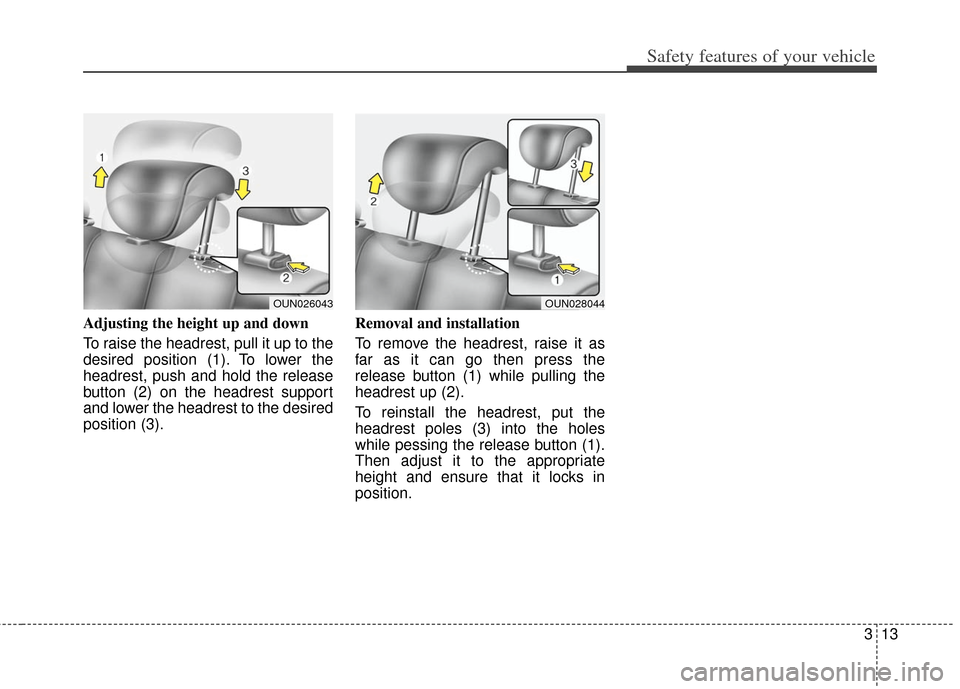
Adjusting the height up and down
To raise the headrest, pull it up to the
desired position (1). To lower the
headrest, push and hold the release
button (2) on the headrest support
and lower the headrest to the desired
position (3).Removal and installation
To remove the headrest, raise it as
far as it can go then press the
release button (1) while pulling the
headrest up (2).
To reinstall the headrest, put the
headrest poles (3) into the holes
while pessing the release button (1).
Then adjust it to the appropriate
height and ensure that it locks in
position.
OUN026043OUN028044
Page 38 of 393
315
Safety features of your vehicle
Seat belt warning (for driver’sseat)
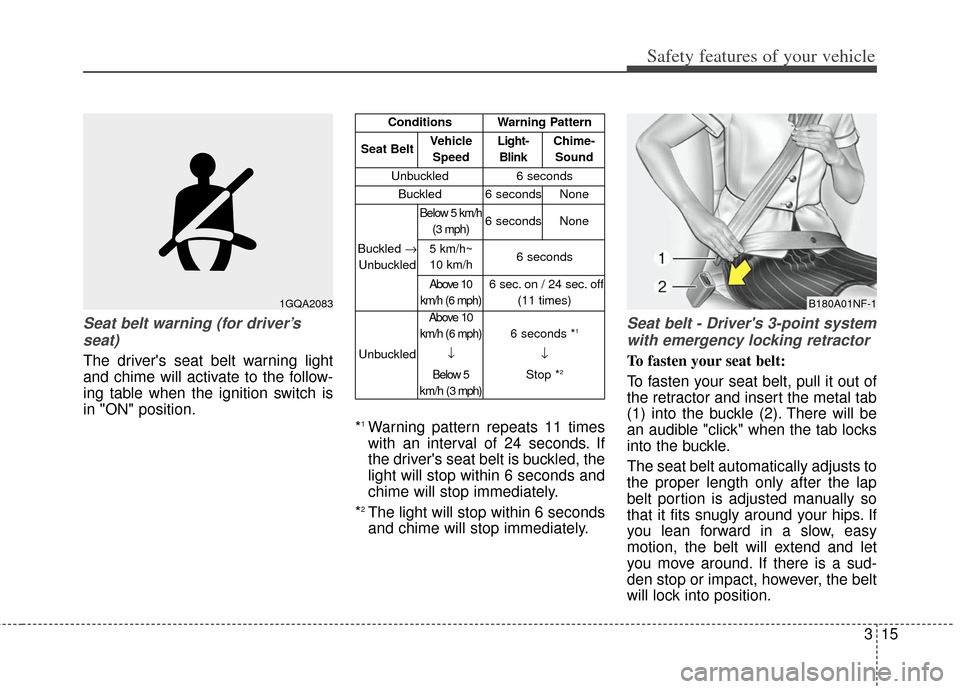
The driver's seat belt warning light
and chime will activate to the follow-
ing table when the ignition switch is
in "ON" position.
*
1Warning pattern repeats 11 times
with an interval of 24 seconds. If
the driver's seat belt is buckled, the
light will stop within 6 seconds and
chime will stop immediately.
*
2The light will stop within 6 seconds
and chime will stop immediately.
Seat belt - Driver's 3-point system with emergency locking retractor
To fasten your seat belt:
To fasten your seat belt, pull it out of
the retractor and insert the metal tab
(1) into the buckle (2). There will be
an audible "click" when the tab locks
into the buckle.
The seat belt automatically adjusts to
the proper length only after the lap
belt portion is adjusted manually so
that it fits snugly around your hips. If
you lean forward in a slow, easy
motion, the belt will extend and let
you move around. If there is a sud-
den stop or impact, however, the belt
will lock into position.
1GQA2083
ConditionsWarning Pattern
Seat BeltVehicle
SpeedLight-BlinkChime-Sound
Unbuckled6 seconds
Buckled6 secondsNone
Buckled →
Unbuckled
Below 5 km/h
(3 mph)6 secondsNone
5 km/h~10 km/h6 seconds
Above 10
km/h (6 mph)6 sec. on / 24 sec. off (11 times)
Unbuckled
Above 10
km/h (6 mph)
↓
Below 5
km/h (3 mph)
6 seconds *1
↓
Stop *
2
B180A01NF-1
Page 39 of 393
Safety features of your vehicle
16
3
It will also lock if you try to lean for-
ward too quickly.
If you are not able to smoothly pull
enough of the seat belt from the
retractor, firmly pull the belt out and
release it. Then you will be able to
pull the belt out smoothly.
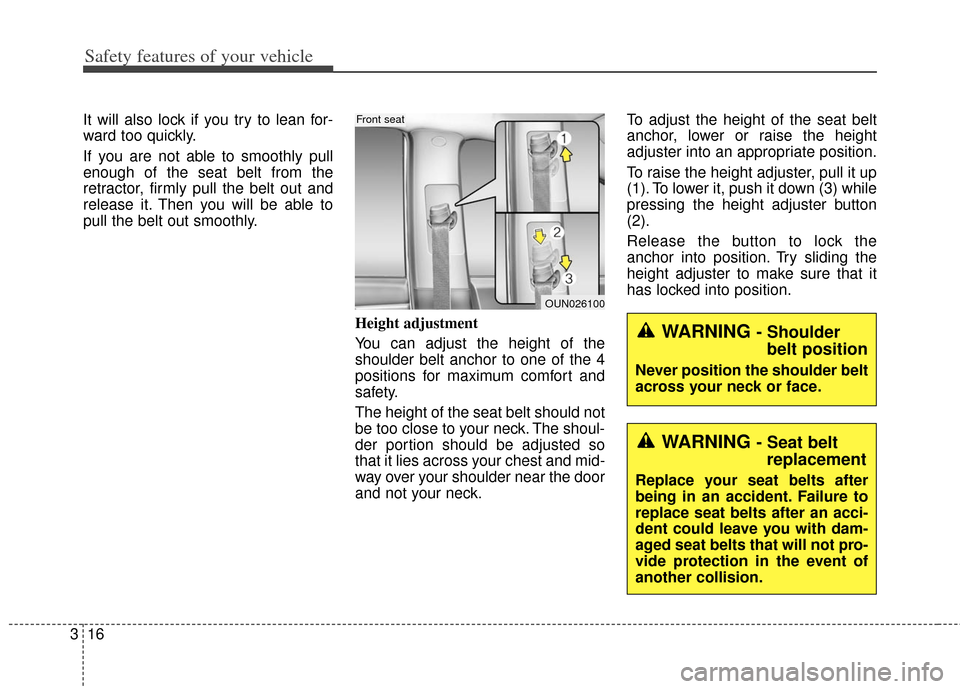
Height adjustment
You can adjust the height of the
shoulder belt anchor to one of the 4
positions for maximum comfort and
safety.
The height of the seat belt should not
be too close to your neck. The shoul-
der portion should be adjusted so
that it lies across your chest and mid-
way over your shoulder near the door
and not your neck.To adjust the height of the seat belt
anchor, lower or raise the height
adjuster into an appropriate position.
To raise the height adjuster, pull it up
(1). To lower it, push it down (3) while
pressing the height adjuster button
(2).
Release the button to lock the
anchor into position. Try sliding the
height adjuster to make sure that it
has locked into position.
OUN026100
Front seat
WARNING - Shoulder
belt position
Never position the shoulder belt
across your neck or face.
WARNING - Seat beltreplacement
Replace your seat belts after
being in an accident. Failure to
replace seat belts after an acci-
dent could leave you with dam-
aged seat belts that will not pro-
vide protection in the event of
another collision.
Page 40 of 393
317
Safety features of your vehicle
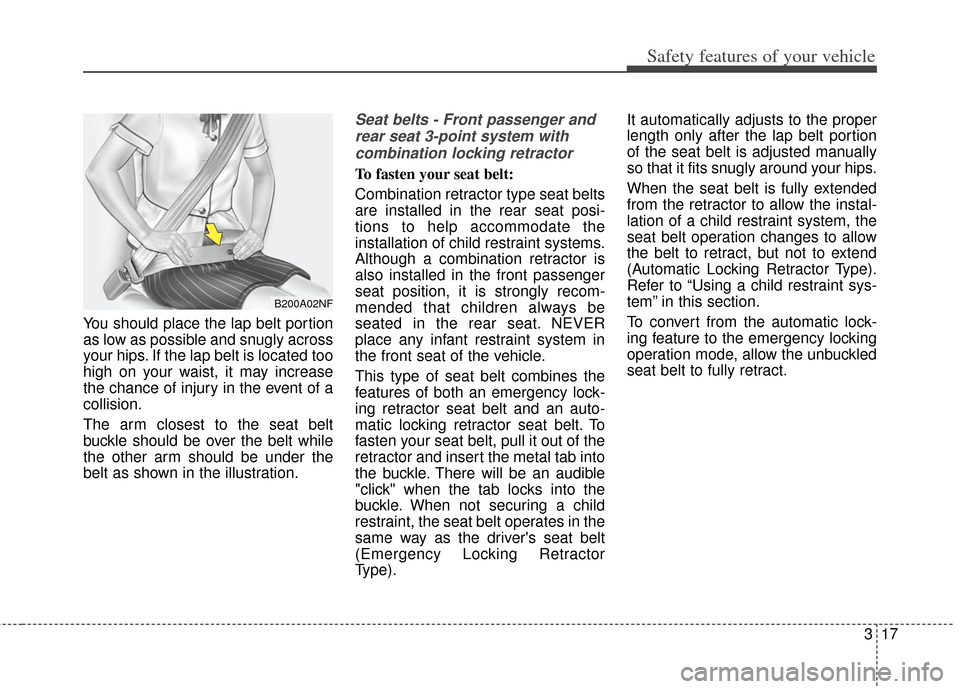
You should place the lap belt portion
as low as possible and snugly across
your hips. If the lap belt is located too
high on your waist, it may increase
the chance of injury in the event of a
collision.
The arm closest to the seat belt
buckle should be over the belt while
the other arm should be under the
belt as shown in the illustration.
Seat belts - Front passenger andrear seat 3-point system withcombination locking retractor
To fasten your seat belt:
Combination retractor type seat belts
are installed in the rear seat posi-
tions to help accommodate the
installation of child restraint systems.
Although a combination retractor is
also installed in the front passenger
seat position, it is strongly recom-
mended that children always be
seated in the rear seat. NEVER
place any infant restraint system in
the front seat of the vehicle.
This type of seat belt combines the
features of both an emergency lock-
ing retractor seat belt and an auto-
matic locking retractor seat belt. To
fasten your seat belt, pull it out of the
retractor and insert the metal tab into
the buckle. There will be an audible
"click" when the tab locks into the
buckle. When not securing a child
restraint, the seat belt operates in the
same way as the driver's seat belt
(Emergency Locking Retractor
Type). It automatically adjusts to the proper
length only after the lap belt portion
of the seat belt is adjusted manually
so that it fits snugly around your hips.
When the seat belt is fully extended
from the retractor to allow the instal-
lation of a child restraint system, the
seat belt operation changes to allow
the belt to retract, but not to extend
(Automatic Locking Retractor Type).
Refer to “Using a child restraint sys-
tem” in this section.
To convert from the automatic lock-
ing feature to the emergency locking
operation mode, allow the unbuckled
seat belt to fully retract.
B200A02NF
Page 41 of 393
Safety features of your vehicle
18
3
When using the rear center seat belt,
the buckle with the “CENTER” mark
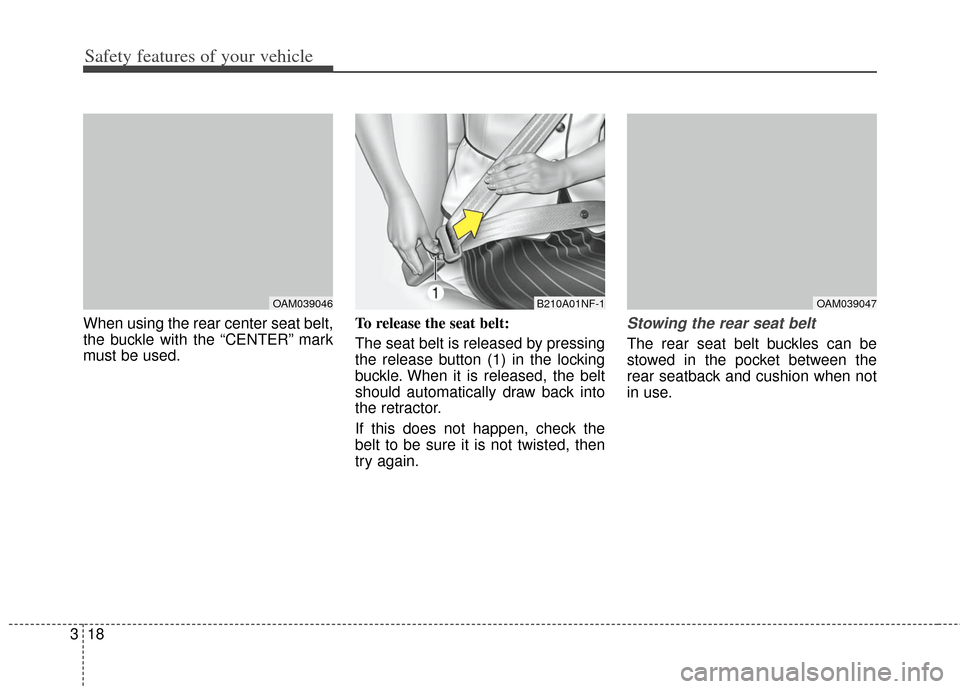
must be used. To release the seat belt:
The seat belt is released by pressing
the release button (1) in the locking
buckle. When it is released, the belt
should automatically draw back into
the retractor.
If this does not happen, check the
belt to be sure it is not twisted, then
try again.Stowing the rear seat belt
The rear seat belt buckles can be
stowed in the pocket between the
rear seatback and cushion when not
in use.
OAM039046OAM039047B210A01NF-1
Page 42 of 393
319
Safety features of your vehicle
Routing the seat belt webbing
through the rear seat belt guides will
help keep the belts from being
trapped behind or under the seats
when they are folded down.
After inserting the seat belt, tighten
the belt webbing by pulling it up.Pre-tensioner seat belt
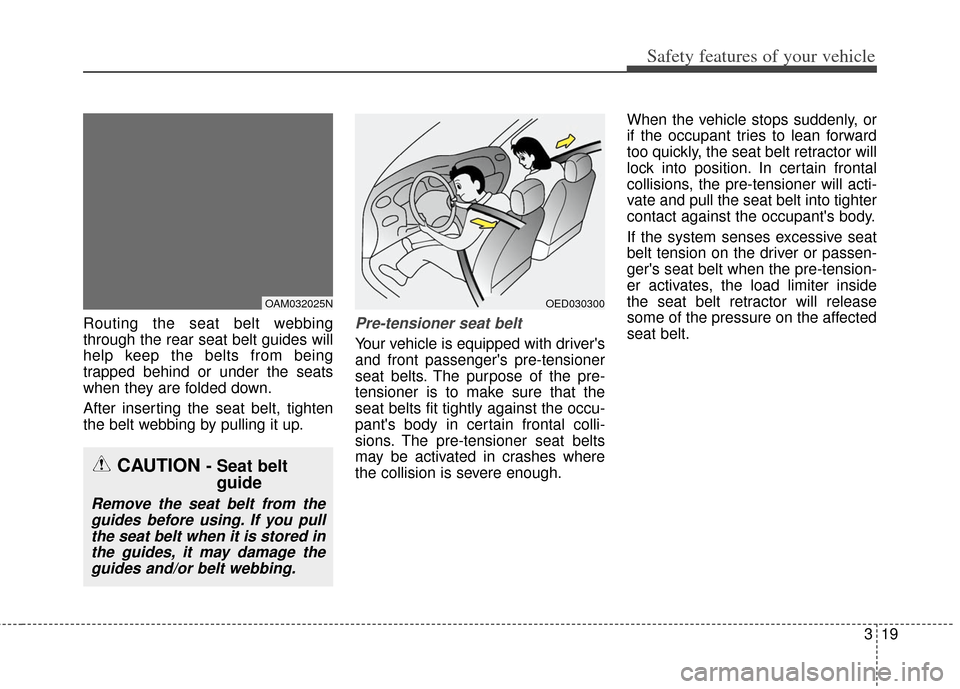
Your vehicle is equipped with driver's
and front passenger's pre-tensioner
seat belts. The purpose of the pre-
tensioner is to make sure that the
seat belts fit tightly against the occu-
pant's body in certain frontal colli-
sions. The pre-tensioner seat belts
may be activated in crashes where
the collision is severe enough.When the vehicle stops suddenly, or
if the occupant tries to lean forward
too quickly, the seat belt retractor will
lock into position. In certain frontal
collisions, the pre-tensioner will acti-
vate and pull the seat belt into tighter
contact against the occupant's body.
If the system senses excessive seat
belt tension on the driver or passen-
ger's seat belt when the pre-tension-
er activates, the load limiter inside
the seat belt retractor will release
some of the pressure on the affected
seat belt.
OAM032025NOED030300
CAUTION - Seat belt
guide
Remove the seat belt from the
guides before using. If you pullthe seat belt when it is stored inthe guides, it may damage theguides and/or belt webbing.
Page 49 of 393
Safety features of your vehicle
26
3
For safety reasons, we recommend
that the child restraint system be
used in the rear seats.
Since all passenger seat belts move
freely under normal conditions and
only lock under extreme or emer-
gency conditions (emergency locking
mode), you must manually change
these seat belts to the automatic
locking mode to secure a child
restraint. If the seat belt does not operate as
described in this section, have the
system checked immediately by your
authorized Kia dealer.
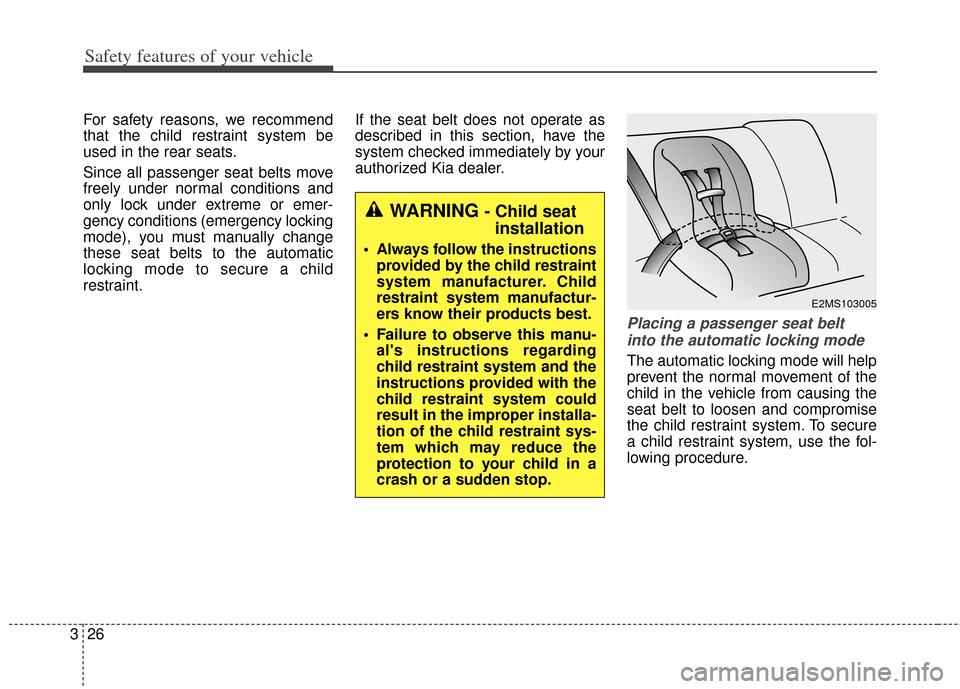
Placing a passenger seat belt
into the automatic locking mode
The automatic locking mode will help
prevent the normal movement of the
child in the vehicle from causing the
seat belt to loosen and compromise
the child restraint system. To secure
a child restraint system, use the fol-
lowing procedure.
E2MS103005
WARNING - Child seat installation
Always follow the instructions
provided by the child restraint
system manufacturer. Child
restraint system manufactur-
ers know their products best.
Failure to observe this manu- al's instructions regarding
child restraint system and the
instructions provided with the
child restraint system could
result in the improper installa-
tion of the child restraint sys-
tem which may reduce the
protection to your child in a
crash or a sudden stop.
Page 50 of 393
327
Safety features of your vehicle
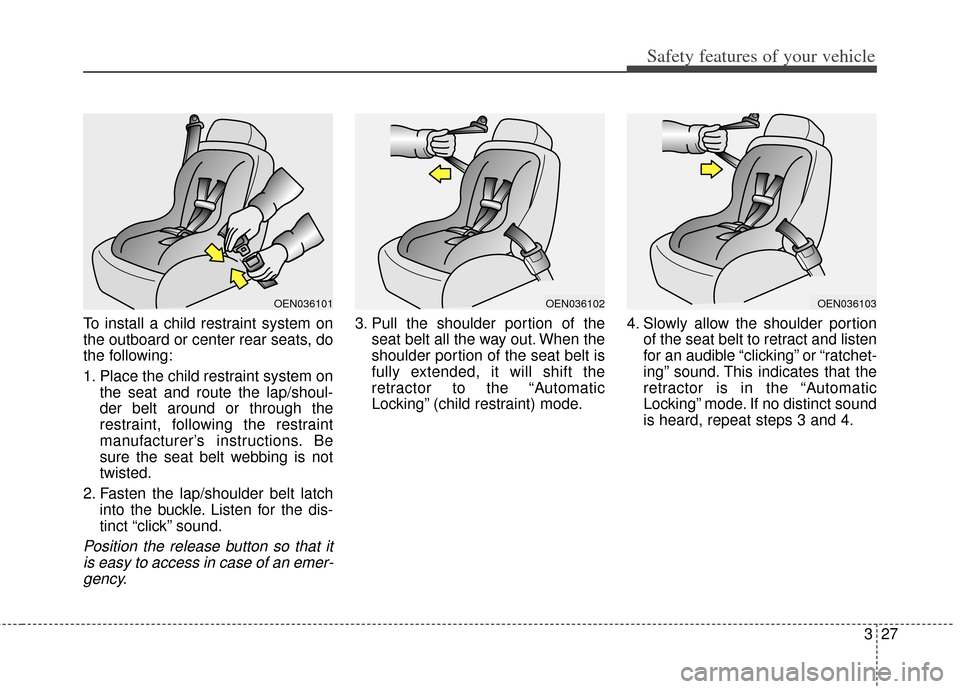
To install a child restraint system on
the outboard or center rear seats, do
the following:
1. Place the child restraint system onthe seat and route the lap/shoul-
der belt around or through the
restraint, following the restraint
manufacturer’s instructions. Be
sure the seat belt webbing is not
twisted.
2. Fasten the lap/shoulder belt latch into the buckle. Listen for the dis-
tinct “click” sound.
Position the release button so that itis easy to access in case of an emer-gency.
3. Pull the shoulder portion of the seat belt all the way out. When the
shoulder portion of the seat belt is
fully extended, it will shift the
retractor to the “Automatic
Locking” (child restraint) mode. 4. Slowly allow the shoulder portion
of the seat belt to retract and listen
for an audible “clicking” or “ratchet-
ing” sound. This indicates that the
retractor is in the “Automatic
Locking” mode. If no distinct sound
is heard, repeat steps 3 and 4.
OEN036101OEN036102OEN036103