belt KIA Soul 2014 2.G Owner's Manual
[x] Cancel search | Manufacturer: KIA, Model Year: 2014, Model line: Soul, Model: KIA Soul 2014 2.GPages: 500, PDF Size: 13.89 MB
Page 3 of 500

ii
1
2
3
4
5
6
7
8I
IntroductionHow to use this manual / Fuel requirements / Vehicle break-in process
Your vehicle at a glance
Exterior overview / Interior overview / Instrument panel overview / Engi\
ne compartment
Safety features of your vehicle
Seats / Seat belts / Child restraint system / Air bag
Features of your vehicleKeys / Door locks / Tailgate / Windows / Hood / Fuel filler lid / Panoramic sunroof / Steering wheel / Mirrors/ Instrument cluster / Lighting / Wipers & Washers / Climate control system / Audio system / Etc.
Driving your vehicleBefore driving / Engine start/stop button / Transaxle / Brake system / Cruise control system /
Active ECO system / Winter driving / Vehicle load limit / Etc.
What to do in an emergencyRoad warning / Emergency while driving / Emergency starting / Engine overheat / Flat tire / Towing / Etc.
MaintenanceEngine compartment / Maintenance service / Engine oil / Engine coolant /\
Brake fluid / Washer fluid /
Parking brake / Air cleaner / Wiper blades / Battery / Tire and wheels / Fuses / Etc.
Specifications & Consumer information
Index
table of contents
Page 17 of 500

Safety features of your vehicle
Seats . . . . . . . . . . . . . . . . . . . . . . . . . . . . . . . . . . . . \
. . 3-2
• Front seat adjustment - Manual . . . . . . . . . . . . . . . . . 3-5
• Front seat adjustment - Power . . . . . . . . . . . . . . . . . . . 3-6
• Seatback pocket . . . . . . . . . . . . . . . . . . . . . . . . . . . . . . 3-11
• Rear seat adjustment . . . . . . . . . . . . . . . . . . . . . . . . . 3-11
Seat belts . . . . . . . . . . . . . . . . . . . . . . . . . . . . . . . . . 3-16
• Seat belt restraint system . . . . . . . . . . . . . . . . . . . . . . 3-16
• Pre-tensioner seat belt . . . . . . . . . . . . . . . . . . . . . . . . 3-24
• Seat belt precautions . . . . . . . . . . . . . . . . . . . . . . . . . . 3-27
• Care of seat belts . . . . . . . . . . . . . . . . . . . . . . . . . . . . . 3-30
Child restraint system . . . . . . . . . . . . . . . . . . . . . . 3-31
• Using a child restraint system . . . . . . . . . . . . . . . . . . 3-33
• Tether anchor system . . . . . . . . . . . . . . . . . . . . . . . . . 3-36
• Lower anchor system . . . . . . . . . . . . . . . . . . . . . . . . . 3-37
Air bag -
advanced supplemental restraint system . . . . . . 3-40
• How does the air bag system operate . . . . . . . . . . . . 3-41
• Do not Installing a child restraint on a front passenger's seat . . . . . . . . . . . . . . . . . . . . . . . . . . . . . 3-43
• Air bag warning light . . . . . . . . . . . . . . . . . . . . . . . . . 3-43
• SRS components and functions . . . . . . . . . . . . . . . . . 3-44
• Occupant Detection System (ODS) . . . . . . . . . . . . . . 3-47
• Driver's and passenger's front air bag . . . . . . . . . . . 3-53
• Side air bag . . . . . . . . . . . . . . . . . . . . . . . . . . . . . . . . . 3-59
• Curtain air bag . . . . . . . . . . . . . . . . . . . . . . . . . . . . . . 3-60 •
Inflation and non-inflation conditions of the air bag . . 3-63
• SRS care . . . . . . . . . . . . . . . . . . . . . . . . . . . . . . . . . . . . \
3-67
• Additional safety precautions. . . . . . . . . . . . . . . . . . . 3-68
• Adding equipment to or modifying your air bag-
equipped vehicle . . . . . . . . . . . . . . . . . . . . . . . . . . . . . 3-69
• Air bag warning label . . . . . . . . . . . . . . . . . . . . . . . . . 3-70
3
Page 19 of 500
33
Safety features of your vehicle
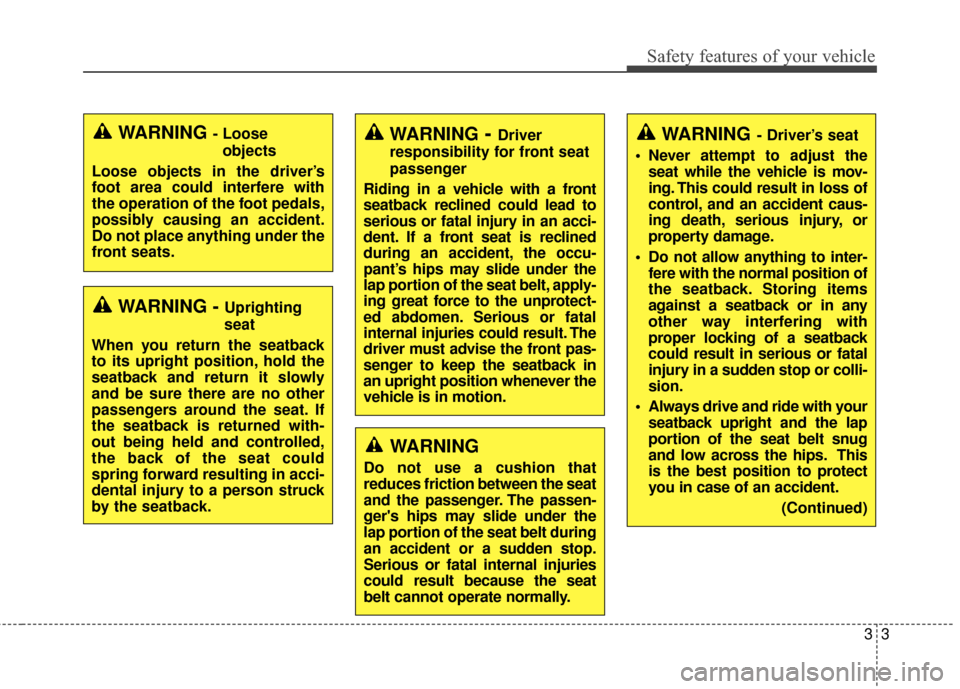
WARNING- Driver’s seat
Never attempt to adjust the seat while the vehicle is mov-
ing. This could result in loss of
control, and an accident caus-
ing death, serious injury, or
property damage.
Do not allow anything to inter- fere with the normal position of
the seatback. Storing items
against a seatback or in any
other way interfering with
proper locking of a seatback
could result in serious or fatal
injury in a sudden stop or colli-
sion.
Always drive and ride with your seatback upright and the lap
portion of the seat belt snug
and low across the hips. This
is the best position to protect
you in case of an accident.
(Continued)
WARNING - Uprighting
seat
When you return the seatback
to its upright position, hold the
seatback and return it slowly
and be sure there are no other
passengers around the seat. If
the seatback is returned with-
out being held and controlled,
the back of the seat could
spring forward resulting in acci-
dental injury to a person struck
by the seatback.
WARNING - Loose objects
Loose objects in the driver’s
foot area could interfere with
the operation of the foot pedals,
possibly causing an accident.
Do not place anything under the
front seats.WARNING- Driver
responsibility for front seat
passenger
Riding in a vehicle with a front
seatback reclined could lead to
serious or fatal injury in an acci-
dent. If a front seat is reclined
during an accident, the occu-
pant’s hips may slide under the
lap portion of the seat belt, apply-
ing great force to the unprotect-
ed abdomen. Serious or fatal
internal injuries could result. The
driver must advise the front pas-
senger to keep the seatback in
an upright position whenever the
vehicle is in motion.
WARNING
Do not use a cushion that
reduces friction between the seat
and the passenger. The passen-
ger's hips may slide under the
lap portion of the seat belt during
an accident or a sudden stop.
Serious or fatal internal injuries
could result because the seat
belt cannot operate normally.
Page 21 of 500
35
Safety features of your vehicle
Front seat adjustment - manual
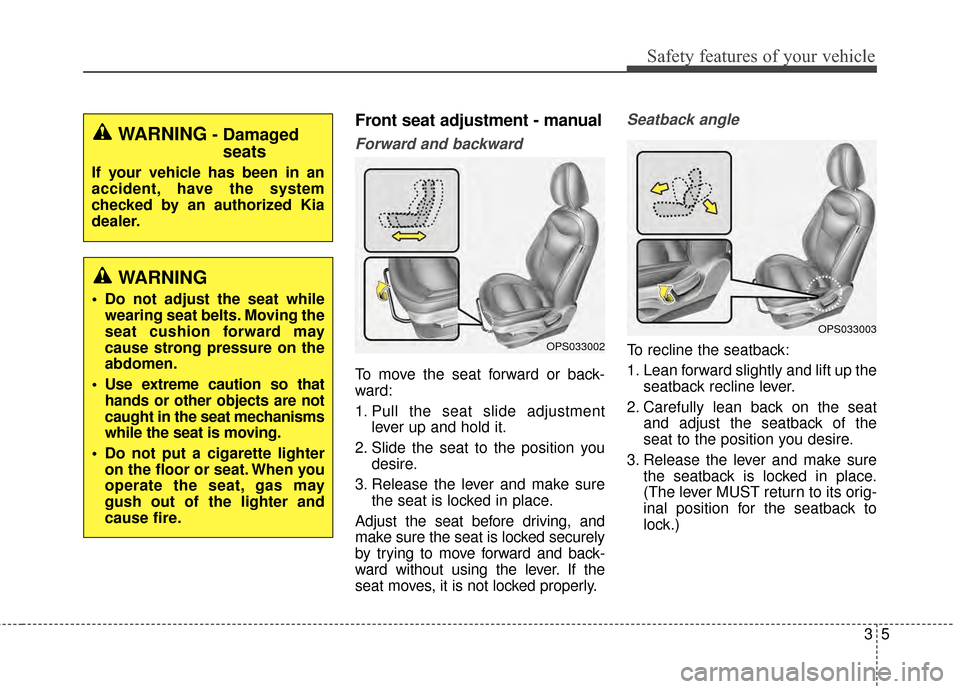
Forward and backward
To move the seat forward or back-
ward:
1. Pull the seat slide adjustmentlever up and hold it.
2. Slide the seat to the position you desire.
3. Release the lever and make sure the seat is locked in place.
Adjust the seat before driving, and
make sure the seat is locked securely
by trying to move forward and back-
ward without using the lever. If the
seat moves, it is not locked properly.
Seatback angle
To recline the seatback:
1. Lean forward slightly and lift up the seatback recline lever.
2. Carefully lean back on the seat and adjust the seatback of the
seat to the position you desire.
3. Release the lever and make sure the seatback is locked in place.
(The lever MUST return to its orig-
inal position for the seatback to
lock.)
WARNING- Damagedseats
If your vehicle has been in an
accident, have the system
checked by an authorized Kia
dealer.
OPS033002
OPS033003
WARNING
Do not adjust the seat while
wearing seat belts. Moving the
seat cushion forward may
cause strong pressure on the
abdomen.
Use extreme caution so that hands or other objects are not
caught in the seat mechanisms
while the seat is moving.
Do not put a cigarette lighter on the floor or seat. When you
operate the seat, gas may
gush out of the lighter and
cause fire.
Page 27 of 500
311
Safety features of your vehicle
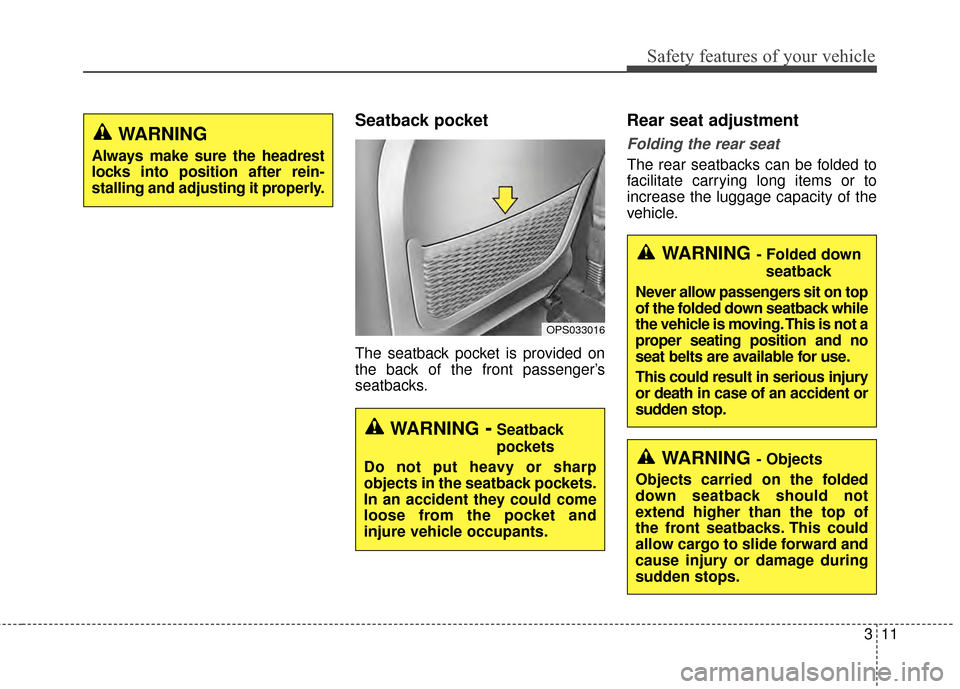
Seatback pocket
The seatback pocket is provided on
the back of the front passenger’s
seatbacks.
Rear seat adjustment
Folding the rear seat
The rear seatbacks can be folded to
facilitate carrying long items or to
increase the luggage capacity of the
vehicle.
OPS033016
WARNING-Seatback
pockets
Do not put heavy or sharp
objects in the seatback pockets.
In an accident they could come
loose from the pocket and
injure vehicle occupants.
WARNING - Folded down seatback
Never allow passengers sit on top
of the folded down seatback while
the vehicle is moving. This is not a
proper seating position and no
seat belts are available for use.
This could result in serious injury
or death in case of an accident or
sudden stop.
WARNING - Objects
Objects carried on the folded
down seatback should not
extend higher than the top of
the front seatbacks. This could
allow cargo to slide forward and
cause injury or damage during
sudden stops.
WARNING
Always make sure the headrest
locks into position after rein-
stalling and adjusting it properly.
Page 28 of 500
Safety features of your vehicle
12
3
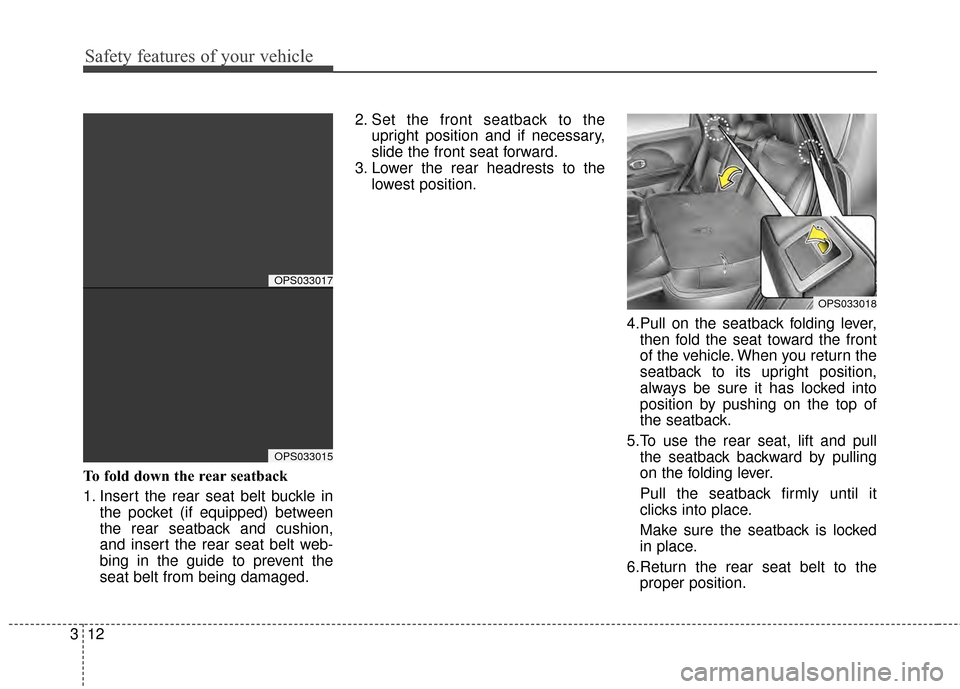
To fold down the rear seatback
1. Insert the rear seat belt buckle in
the pocket (if equipped) between
the rear seatback and cushion,
and insert the rear seat belt web-
bing in the guide to prevent the
seat belt from being damaged. 2. Set the front seatback to the
upright position and if necessary,
slide the front seat forward.
3. Lower the rear headrests to the lowest position.
4.Pull on the seatback folding lever,then fold the seat toward the front
of the vehicle. When you return the
seatback to its upright position,
always be sure it has locked into
position by pushing on the top of
the seatback.
5.To use the rear seat, lift and pull the seatback backward by pulling
on the folding lever.
Pull the seatback firmly until it
clicks into place.
Make sure the seatback is locked
in place.
6.Return the rear seat belt to the proper position.
OPS033018
OPS033017
OPS033015
Page 32 of 500
Safety features of your vehicle
16
3
SEAT BELTS
Seat belt restraint system
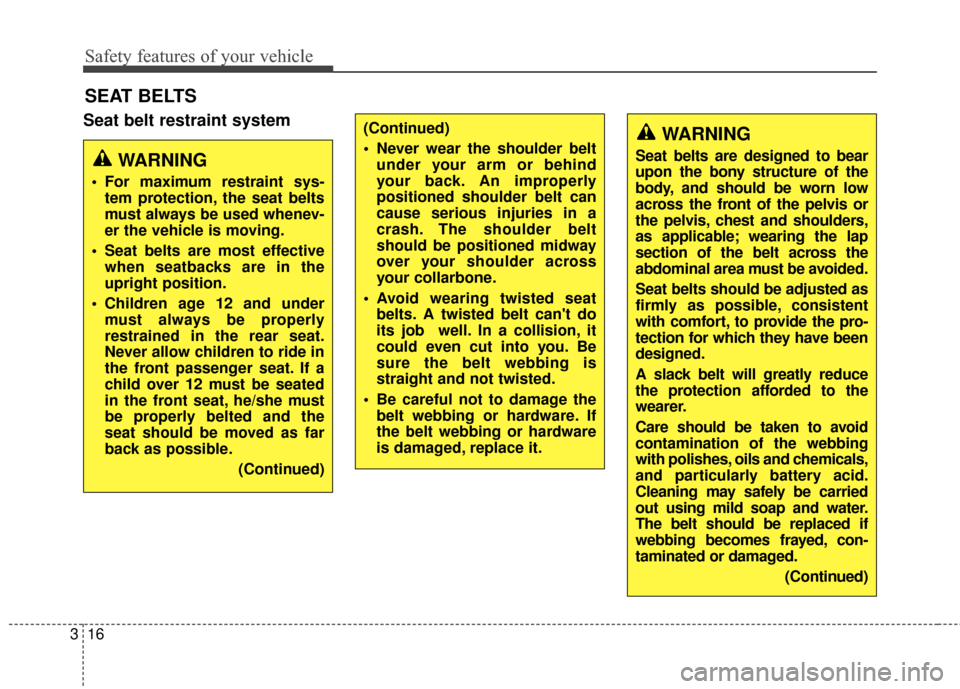
WARNING
For maximum restraint sys-
tem protection, the seat belts
must always be used whenev-
er the vehicle is moving.
Seat belts are most effective when seatbacks are in the
upright position.
Children age 12 and under must always be properly
restrained in the rear seat.
Never allow children to ride in
the front passenger seat. If a
child over 12 must be seated
in the front seat, he/she must
be properly belted and the
seat should be moved as far
back as possible.
(Continued)
(Continued)
Never wear the shoulder beltunder your arm or behind
your back. An improperly
positioned shoulder belt can
cause serious injuries in a
crash. The shoulder belt
should be positioned midway
over your shoulder across
your collarbone.
Avoid wearing twisted seat belts. A twisted belt can't do
its job well. In a collision, it
could even cut into you. Be
sure the belt webbing is
straight and not twisted.
Be careful not to damage the belt webbing or hardware. If
the belt webbing or hardware
is damaged, replace it.WARNING
Seat belts are designed to bear
upon the bony structure of the
body, and should be worn low
across the front of the pelvis or
the pelvis, chest and shoulders,
as applicable; wearing the lap
section of the belt across the
abdominal area must be avoided.
Seat belts should be adjusted as
firmly as possible, consistent
with comfort, to provide the pro-
tection for which they have been
designed.
A slack belt will greatly reduce
the protection afforded to the
wearer.
Care should be taken to avoid
contamination of the webbing
with polishes, oils and chemicals,
and particularly battery acid.
Cleaning may safely be carried
out using mild soap and water.
The belt should be replaced if
webbing becomes frayed, con-
taminated or damaged.
(Continued)
Page 33 of 500
317
Safety features of your vehicle
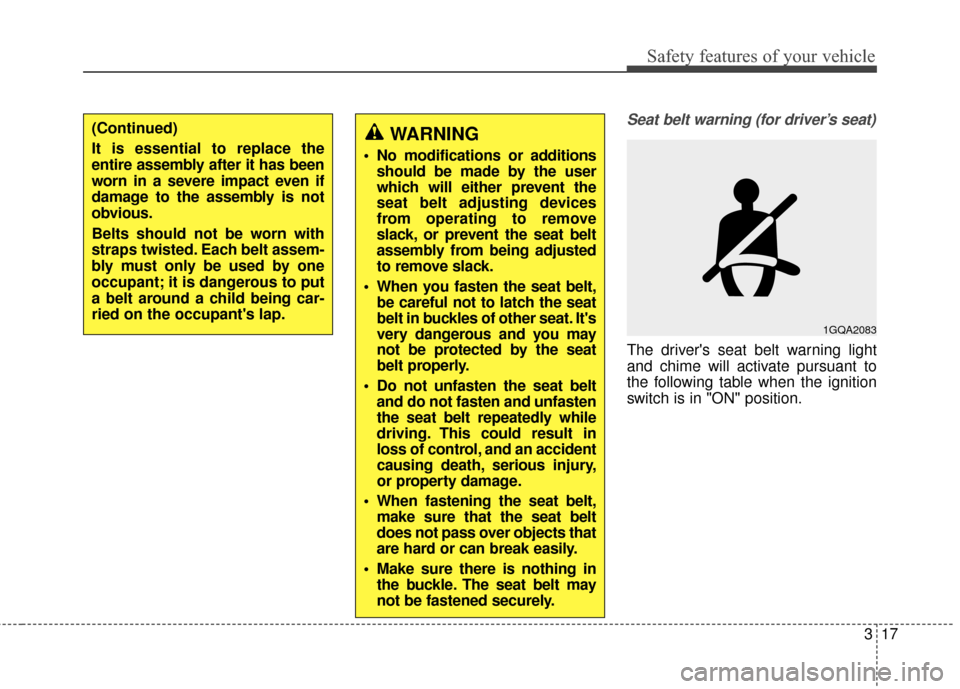
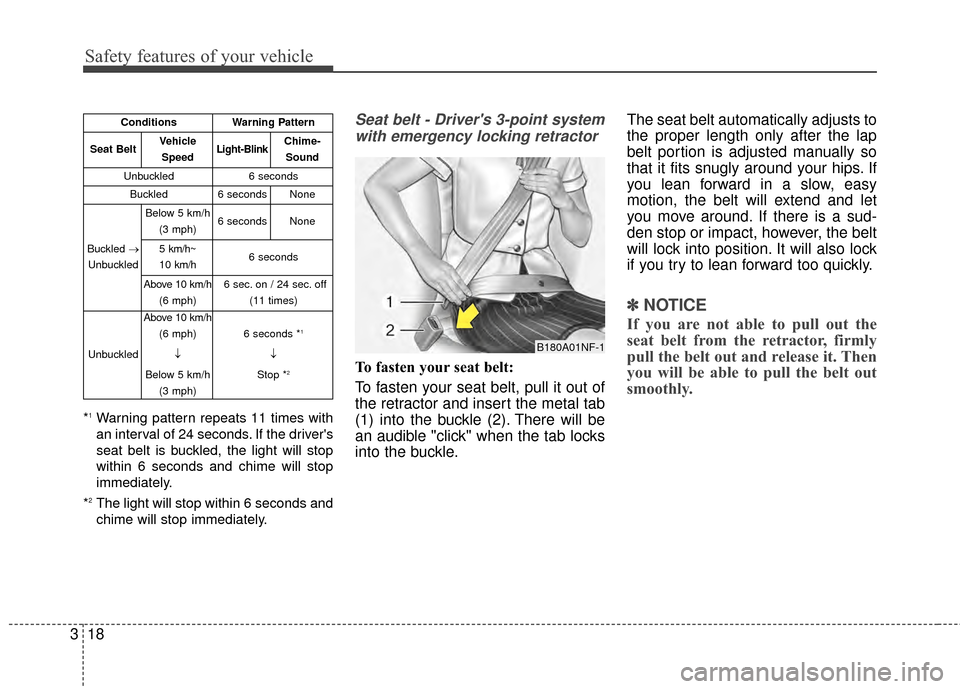
Seat belt warning (for driver’s seat)
The driver's seat belt warning light
and chime will activate pursuant to
the following table when the ignition
switch is in "ON" position.
1GQA2083
(Continued)
It is essential to replace the
entire assembly after it has been
worn in a severe impact even if
damage to the assembly is not
obvious.
Belts should not be worn with
straps twisted. Each belt assem-
bly must only be used by one
occupant; it is dangerous to put
a belt around a child being car-
ried on the occupant's lap.WARNING
No modifications or additionsshould be made by the user
which will either prevent the
seat belt adjusting devices
from operating to remove
slack, or prevent the seat belt
assembly from being adjusted
to remove slack.
When you fasten the seat belt, be careful not to latch the seat
belt in buckles of other seat. It's
very dangerous and you may
not be protected by the seat
belt properly.
Do not unfasten the seat belt and do not fasten and unfasten
the seat belt repeatedly while
driving. This could result in
loss of control, and an accident
causing death, serious injury,
or property damage.
When fastening the seat belt, make sure that the seat belt
does not pass over objects that
are hard or can break easily.
Make sure there is nothing in the buckle. The seat belt may
not be fastened securely.
Page 34 of 500
Safety features of your vehicle
18
3
*1Warning pattern repeats 11 times with
an interval of 24 seconds. If the driver's
seat belt is buckled, the light will stop
within 6 seconds and chime will stop
immediately.
*
2The light will stop within 6 seconds and
chime will stop immediately.
Seat belt - Driver's 3-point system with emergency locking retractor
To fasten your seat belt:
To fasten your seat belt, pull it out of
the retractor and insert the metal tab
(1) into the buckle (2). There will be
an audible "click" when the tab locks
into the buckle. The seat belt automatically adjusts to
the proper length only after the lap
belt portion is adjusted manually so
that it fits snugly around your hips. If
you lean forward in a slow, easy
motion, the belt will extend and let
you move around. If there is a sud-
den stop or impact, however, the belt
will lock into position. It will also lock
if you try to lean forward too quickly.
✽ ✽
NOTICE
If you are not able to pull out the
seat belt from the retractor, firmly
pull the belt out and release it. Then
you will be able to pull the belt out
smoothly.
B180A01NF-1
ConditionsWarning Pattern
Seat BeltVehicle
SpeedLight-BlinkChime-Sound
Unbuckled6 seconds
Buckled6 secondsNone
Buckled →
Unbuckled
Below 5 km/h (3 mph)6 secondsNone
5 km/h~
10 km/h6 seconds
Above 10 km/h (6 mph)6 sec. on / 24 sec. off (11 times)
Unbuckled
Above 10 km/h(6 mph)
↓
Below 5 km/h (3 mph)
6 seconds *1
↓
Stop *
2
Page 35 of 500
319
Safety features of your vehicle
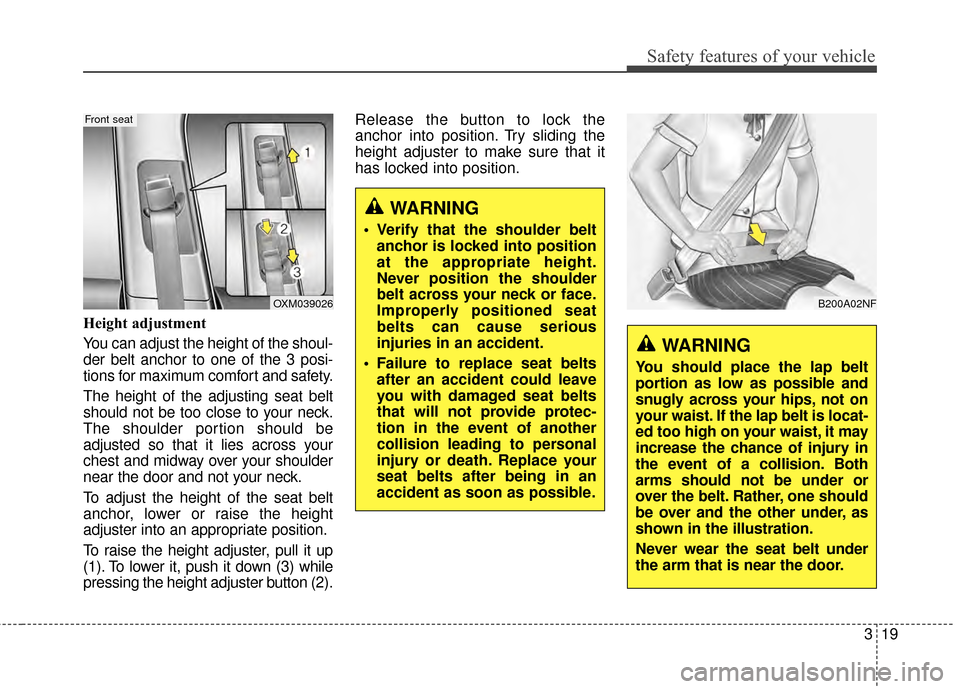
Height adjustment
You can adjust the height of the shoul-
der belt anchor to one of the 3 posi-
tions for maximum comfort and safety.
The height of the adjusting seat belt
should not be too close to your neck.
The shoulder portion should be
adjusted so that it lies across your
chest and midway over your shoulder
near the door and not your neck.
To adjust the height of the seat belt
anchor, lower or raise the height
adjuster into an appropriate position.
To raise the height adjuster, pull it up
(1). To lower it, push it down (3) while
pressing the height adjuster button (2).Release the button to lock the
anchor into position. Try sliding the
height adjuster to make sure that it
has locked into position.
B200A02NF
WARNING
You should place the lap belt
portion as low as possible and
snugly across your hips, not on
your waist. If the lap belt is locat-
ed too high on your waist, it may
increase the chance of injury in
the event of a collision. Both
arms should not be under or
over the belt. Rather, one should
be over and the other under, as
shown in the illustration.
Never wear the seat belt under
the arm that is near the door.
WARNING
Verify that the shoulder belt
anchor is locked into position
at the appropriate height.
Never position the shoulder
belt across your neck or face.
Improperly positioned seat
belts can cause serious
injuries in an accident.
Failure to replace seat belts after an accident could leave
you with damaged seat belts
that will not provide protec-
tion in the event of another
collision leading to personal
injury or death. Replace your
seat belts after being in an
accident as soon as possible.
OXM039026
Front seat