seats KIA SOUL 2015 Owner's Manual
[x] Cancel search | Manufacturer: KIA, Model Year: 2015, Model line: SOUL, Model: KIA SOUL 2015Pages: 544, PDF Size: 19.81 MB
Page 210 of 544
4133
Features of your vehicle
During mild weather or under condi-
tions where the operation of the seat
warmer is not needed, keep the
switches in the "OFF" position.
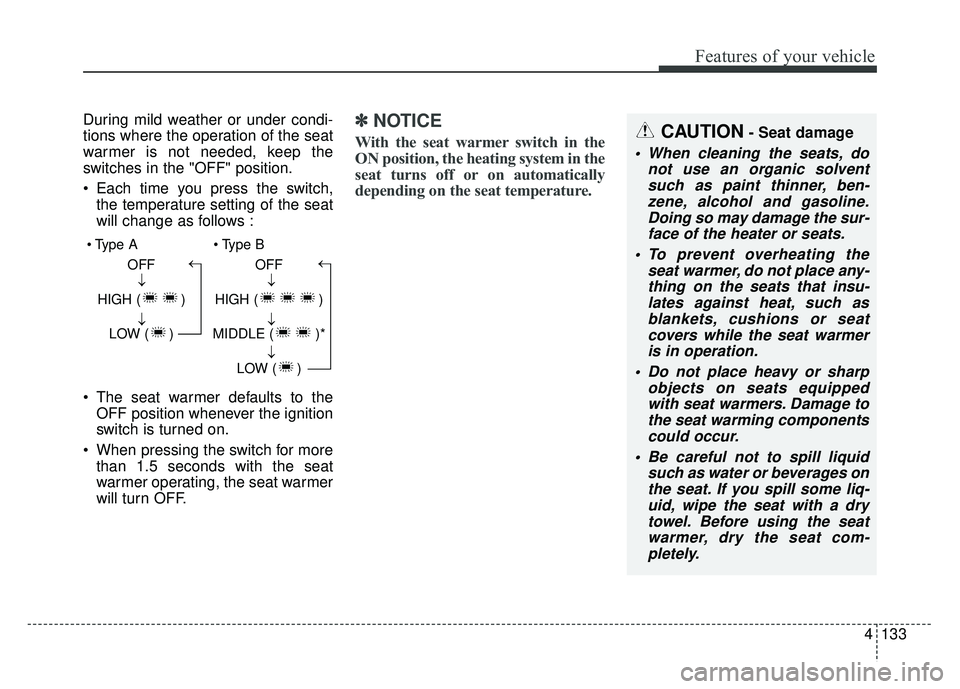
Each time you press the switch,the temperature setting of the seat
will change as follows :
The seat warmer defaults to the OFF position whenever the ignition
switch is turned on.
When pressing the switch for more than 1.5 seconds with the seat
warmer operating, the seat warmer
will turn OFF.✽ ✽ NOTICE
With the seat warmer switch in the
ON position, the heating system in the
seat turns off or on automatically
depending on the seat temperature.CAUTION- Seat damage
When cleaning the seats, do
not use an organic solventsuch as paint thinner, ben-zene, alcohol and gasoline.Doing so may damage the sur-face of the heater or seats.
To prevent overheating the seat warmer, do not place any-thing on the seats that insu-lates against heat, such asblankets, cushions or seatcovers while the seat warmeris in operation.
Do not place heavy or sharp objects on seats equippedwith seat warmers. Damage tothe seat warming componentscould occur.
Be careful not to spill liquid such as water or beverages onthe seat. If you spill some liq-uid, wipe the seat with a drytowel. Before using the seatwarmer, dry the seat com-pletely.
OFF
HIGH ( ) LOW ( )→→→ OFF
HIGH ( )
MIDDLE ( )* LOW ( )
→→→→
Page 212 of 544
4135
Features of your vehicle
Rear seat warmer (if equipped)
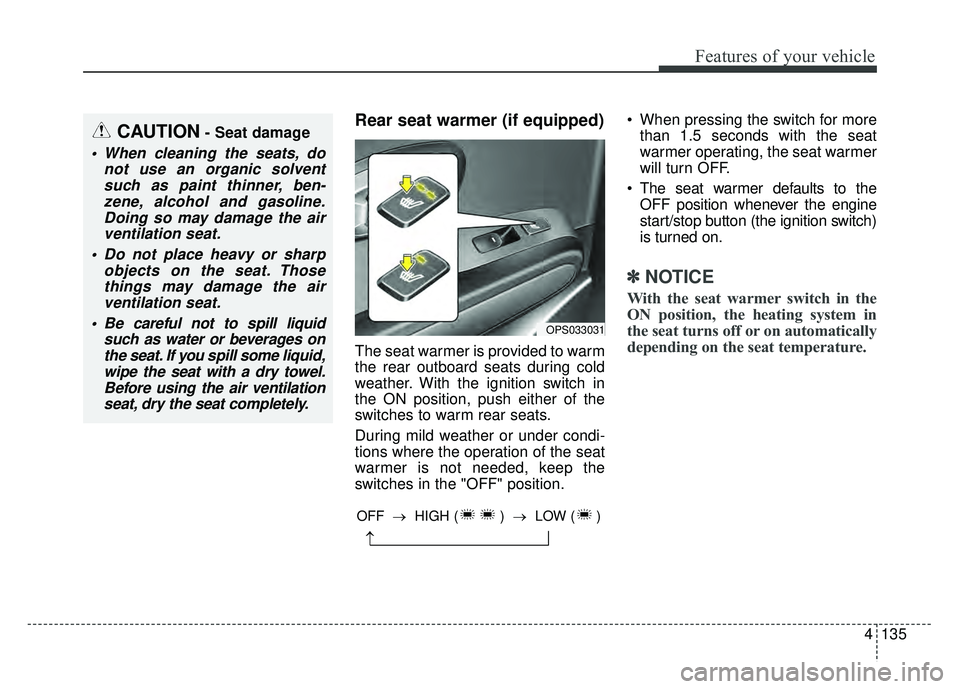
The seat warmer is provided to warm
the rear outboard seats during cold
weather. With the ignition switch in
the ON position, push either of the
switches to warm rear seats.
During mild weather or under condi-
tions where the operation of the seat
warmer is not needed, keep the
switches in the "OFF" position. When pressing the switch for more
than 1.5 seconds with the seat
warmer operating, the seat warmer
will turn OFF.
The seat warmer defaults to the OFF position whenever the engine
start/stop button (the ignition switch)
is turned on.
✽ ✽ NOTICE
With the seat warmer switch in the
ON position, the heating system in
the seat turns off or on automatically
depending on the seat temperature.
CAUTION- Seat damage
When cleaning the seats, do
not use an organic solventsuch as paint thinner, ben-zene, alcohol and gasoline.Doing so may damage the airventilation seat.
Do not place heavy or sharp objects on the seat. Thosethings may damage the airventilation seat.
Be careful not to spill liquid such as water or beverages onthe seat. If you spill some liquid,wipe the seat with a dry towel.Before using the air ventilationseat, dry the seat completely.
OPS033031
→
OFF → HIGH ( ) →LOW ( )
Page 213 of 544
Features of your vehicle
136
4
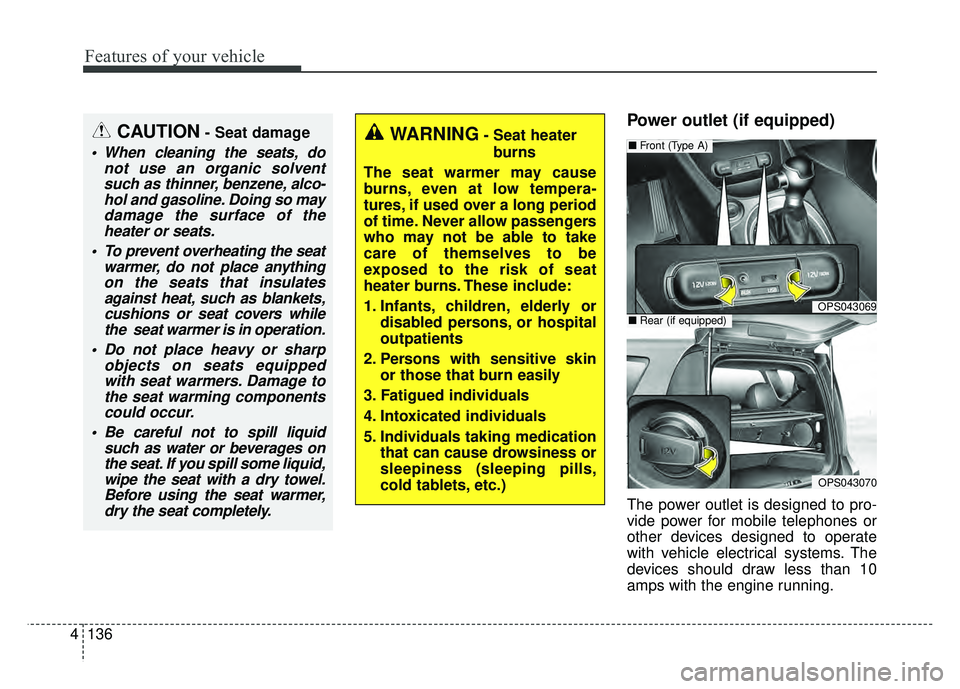
Power outlet (if equipped)
The power outlet is designed to pro-
vide power for mobile telephones or
other devices designed to operate
with vehicle electrical systems. The
devices should draw less than 10
amps with the engine running.
OPS043069
■ Front (Type A)
OPS043070
■Rear (if equipped)
CAUTION- Seat damage
When cleaning the seats, do
not use an organic solventsuch as thinner, benzene, alco-hol and gasoline. Doing so maydamage the surface of theheater or seats.
To prevent overheating the seat warmer, do not place anythingon the seats that insulatesagainst heat, such as blankets,cushions or seat covers whilethe seat warmer is in operation.
Do not place heavy or sharp objects on seats equippedwith seat warmers. Damage tothe seat warming componentscould occur.
Be careful not to spill liquid such as water or beverages onthe seat. If you spill some liquid,wipe the seat with a dry towel.Before using the seat warmer,dry the seat completely.
WARNING- Seat heater
burns
The seat warmer may cause
burns, even at low tempera-
tures, if used over a long period
of time. Never allow passengers
who may not be able to take
care of themselves to be
exposed to the risk of seat
heater burns. These include:
1. Infants, children, elderly or disabled persons, or hospital
outpatients
2. Persons with sensitive skin or those that burn easily
3. Fatigued individuals
4. Intoxicated individuals
5. Individuals taking medication that can cause drowsiness or
sleepiness (sleeping pills,
cold tablets, etc.)
Page 385 of 544
Driving your vehicle
64
5
✽
✽
NOTICE
Overloading your vehicle may cause
damage. Repairs would not be cov-
ered by your warranty. Do not over-
load your vehicle.
WARNING- Loose cargo
Do not travel with unsecured
blunt objects in the passenger
compartment of your vehicle
(e.g. suit cases or unsecured
child seats). These items may
strike occupant during a sud-
den stop or crash.WARNING- Over loading
Do not overload your vehicle.
Overloading your vehicle can
cause heat buildup in your vehi-
cle's tires and possible tire fail-
ure, increased stopping dis-
tances and poor vehicle han-
dling all of which may result in a
crash.
Page 475 of 544
755
Maintenance
Traction - AA, A, B & C
The traction grades, from highest to
lowest, are AA, A, B and C. Those
grades represent the tire’s ability to
stop on wet pavement as measured
under controlled conditions on spec-
ified government test surfaces of
asphalt and concrete. A tire marked
C may have poor traction perform-
ance.
The traction grade assigned to this
tire is based on straight-ahead brak-
ing traction tests, and does not
include acceleration, cornering,
hydroplaning, or peak traction char-
acteristics.Temperature -A, B & C
The temperature grades are A (the
highest), B and C representing the
tire’s resistance to the generation of
heat and its ability to dissipate heat
when tested under controlled condi-
tions on a specified indoor laboratory
test wheel.
Sustained high temperature can
cause the material of the tire to
degenerate and reduce tire life, and
excessive temperature can lead to
sudden tire failure. The grade C cor-
responds to a level of performance
which all passenger vehicle tires
must meet under the Federal Motor
Vehicle Safety Standard No. 109.
Grades B and A represent higher
levels of performance on the labora-
tory test wheel than the minimum
required by law.Tire terminology and definitions
Air Pressure: The amount of air
inside the tire pressing outward on
the tire. Air pressure is expressed in
pounds per square inch (psi) or kilo-
pascal (kPa).
Accessory Weight
: This means the
combined weight of optional acces-
sories. Some examples of optional
accessories are, automatic
transaxle, power seats, and air con-
ditioning.
Aspect Ratio : The relationship of a
tire's height to its width.
Belt: A rubber coated layer of cords
that is located between the plies and
the tread. Cords may be made from
steel or other reinforcing materials.
Bead: The tire bead contains steel
wires wrapped by steel cords that
hold the tire onto the rim.
Bias Ply Tire : A pneumatic tire in
which the plies are laid at alternate
angles less than 90 degrees to the
centerline of the tread.
Page 512 of 544
Maintenance
92
7
Cleaning the upholstery and inte-
rior trim
Vinyl
Remove dust and loose dirt from
vinyl with a whisk broom or vacuum
cleaner. Clean vinyl surfaces with a
vinyl cleaner.
Fabric
Remove dust and loose dirt from fab-
ric with a whisk broom or vacuum
cleaner. Clean with a mild soap solu-
tion recommended for upholstery or
carpets. Remove fresh spots imme-
diately with a fabric spot cleaner. If
fresh spots do not receive immediate
attention, the fabric can be stained
and its color can be affected. Also, its
fire-resistant properties can be
reduced if the material is not proper-
ly maintained.
Using anything but recommended
cleaners and procedures may affect
the fabric’s appearance and fire-
resistant properties.
Cleaning the lap/shoulder beltwebbing
Clean the belt webbing with any mild
soap solution recommended for
cleaning upholstery or carpet. Follow
the instructions provided with the
soap. Do not bleach or re-dye the
webbing because this may weaken
it.
Cleaning the interior window glass
If the interior glass surfaces of the
vehicle become fogged (that is, cov-
ered with an oily, greasy or waxy
film), they should be cleaned with a
glass cleaner. Follow the directions
on the glass cleaner container.
CAUTION- Leather
When cleaning leather products(steering wheel, seats etc.), useneutral detergents or low alco-hol content solutions. If you usehigh alcohol content solutionsor acid/alkaline detergents, thecolor of the leather may fade orthe surface may get stripped off.
CAUTION- Rear window
Do not scrape or scratch theinside of the rear window. Thismay result in damage of the rearwindow defroster grid.
Page 541 of 544

Index
10I
Seat belts . . . . . . . . . . . . . . . . . . . . . . . . . . . . . . . . . . . . \
3-163 Point rear center belt . . . . . . . . . . . . . . . . . . . . . . . 3-22
Hight adjustment . . . . . . . . . . . . . . . . . . . . . . . . . . . 3-19
Lap/shoulder belt . . . . . . . . . . . . . . . . . . . . . . . . . . . 3-18
Pre-tensioner seat belt . . . . . . . . . . . . . . . . . . . . . . . 3-24
Seat belt Precautions . . . . . . . . . . . . . . . . . . . . . . . . 3-27
Seat belt warning . . . . . . . . . . . . . . . . . . . . . . . . . . . 3-17
Seat cooler see air ventilation seat . . . . . . . . . . . . . . . 4-134
Seat warmer . . . . . . . . . . . . . . . . . . . . . . . . . . . . . . . . 4-132
Seatback pocket . . . . . . . . . . . . . . . . . . . . . . . . . . . . . . 3-11
Seats . . . . . . . . . . . . . . . . . . . . . . . . . . . . . . . . . . . . \
. . . . 3-2 Armrest (rear) . . . . . . . . . . . . . . . . . . . . . . . . . . . . . . 3-15
Folding the rear seat . . . . . . . . . . . . . . . . . . . . . . . . . 3-11
Front seat adjustment - Manual . . . . . . . . . . . . . . . . . 3-5
Front seat adjustment - power . . . . . . . . . . . . . . . . . . 3-6
Headrest(front) . . . . . . . . . . . . . . . . . . . . . . . . . . . . . . 3-8
Headrest(rear) . . . . . . . . . . . . . . . . . . . . . . . . . . . . . . 3-13
Rear seat adjustment . . . . . . . . . . . . . . . . . . . . . . . . 3-11
Seatback pocket . . . . . . . . . . . . . . . . . . . . . . . . . . . . 3-11
Service Mode . . . . . . . . . . . . . . . . . . . . . . . . . . . . . . . . 4-59
Shift lock system . . . . . . . . . . . . . . . . . . . . . . . . . . . . . 5-21
Shift-lock override . . . . . . . . . . . . . . . . . . . . . . . . . . . . 5-21
Side air bag . . . . . . . . . . . . . . . . . . . . . . . . . . . . . . . . . . 3-52\
Smart key . . . . . . . . . . . . . . . . . . . . . . . . . . . . . . . . . 4-10,1\
3
Smooth cornering . . . . . . . . . . . . . . . . . . . . . . . . . . . . . 5-52
Snow tires . . . . . . . . . . . . . . . . . . . . . . . . . . . . . . . . . . . 5-\
55
Spare tire . . . . . . . . . . . . . . . . . . . . . . . . . . . . . . . . . . . . \
6-15 Changing tires . . . . . . . . . . . . . . . . . . . . . . . . . . . . . 6-15 Compact spare tire . . . . . . . . . . . . . . . . . . . . . . . . . . 6-20
Compact spare tire replacement . . . . . . . . . . . . . . . . 7-50
Removing and storing the spare tire . . . . . . . . . . . . 6-15
Special driving conditions . . . . . . . . . . . . . . . . . . . . . . 5-50 Driving at night . . . . . . . . . . . . . . . . . . . . . . . . . . . . 5-52
Driving in flooded areas. . . . . . . . . . . . . . . . . . . . . . 5-53
Driving in the rain . . . . . . . . . . . . . . . . . . . . . . . . . . 5-53
Driving off-road . . . . . . . . . . . . . . . . . . . . . . . . . . . . 5-54
Hazardous driving conditions . . . . . . . . . . . . . . . . . 5-50
Highway driving . . . . . . . . . . . . . . . . . . . . . . . . . . . . 5-54
Reducing the risk of a rollover. . . . . . . . . . . . . . . . . 5-50
Rocking the vehicle . . . . . . . . . . . . . . . . . . . . . . . . . 5-51
Smooth cornering . . . . . . . . . . . . . . . . . . . . . . . . . . . 5-52
Speedometer . . . . . . . . . . . . . . . . . . . . . . . . . . . . . . . . . 4-52
Sports mode . . . . . . . . . . . . . . . . . . . . . . . . . . . . . . . . . 5-19
SRS components and functions . . . . . . . . . . . . . . . . . . 3-41
Starting difficulties, see engine will not start . . . . . . . . . 6-4
Starting the engine with a key . . . . . . . . . . . . . . . . . . . . 5-7
Starting the engine with a smart key . . . . . . . . . . . . . . 5-11
Steering wheel . . . . . . . . . . . . . . . . . . . . . . . . . . . . . . . 4-40 Electric power steering. . . . . . . . . . . . . . . . . . . . . . . 4-40
FLEX STEER. . . . . . . . . . . . . . . . . . . . . . . . . . . . . . 4-43
Heated steering wheel . . . . . . . . . . . . . . . . . . . . . . . 4-42
Horn . . . . . . . . . . . . . . . . . . . . . . . . . . . . . . . . . . . . \
. 4-42
Tilt and telescopic steering. . . . . . . . . . . . . . . . . . . . 4-41
Storage compartment . . . . . . . . . . . . . . . . . . . . . . . . . 4-128 Center console storage . . . . . . . . . . . . . . . . . . . . . . 4-128
Cool box . . . . . . . . . . . . . . . . . . . . . . . . . . . . . . . . . 4-129