battery KIA SOUL 2015 Repair Manual
[x] Cancel search | Manufacturer: KIA, Model Year: 2015, Model line: SOUL, Model: KIA SOUL 2015Pages: 544, PDF Size: 19.81 MB
Page 464 of 544
Maintenance
44
7
✽
✽
NOTICE
If you connect unauthorized elec-
tronic devices to the battery, the bat-
tery may be discharged. Never use
unauthorized devices.
Battery recharging
Your vehicle has a maintenance-free,
calcium-based battery.
If the battery becomes discharged
in a short time (because, for exam-
ple, the headlights or interior lights
were left on while the vehicle was
not in use), recharge it by slow
charging (trickle) for 10 hours.
If the battery gradually discharges because of high electric load while
the vehicle is being used, recharge
it at 20-30A for two hours.
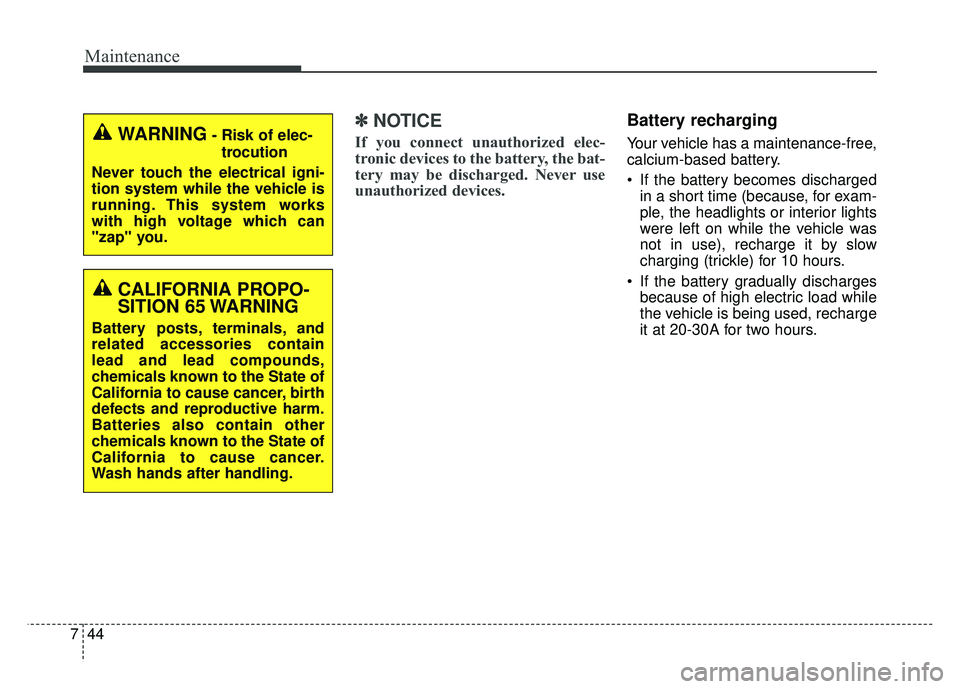
CALIFORNIA PROPO-
SITION 65 WARNING
Battery posts, terminals, and
related accessories contain
lead and lead compounds,
chemicals known to the State of
California to cause cancer, birth
defects and reproductive harm.
Batteries also contain other
chemicals known to the State of
California to cause cancer.
Wash hands after handling.
WARNING- Risk of elec-
trocution
Never touch the electrical igni-
tion system while the vehicle is
running. This system works
with high voltage which can
"zap" you.
Page 465 of 544
745
Maintenance
When recharging the battery,
observe the following precautions:
The battery must be removed fromthe vehicle and placed in an area
with good ventilation.
Do not allow cigarettes, sparks, or flame near the battery.
Watch the battery during charging, and stop or reduce the charging
rate if the battery cells begin
gassing (boiling) violently or if the
temperature of the electrolyte of
any cell exceeds 120°F (49°C).
Wear eye protection when check- ing the battery during charging.
Disconnect the battery charger in the following order. 1.Turn off the battery charger main
switch.
2.Unhook the negative clamp from the negative battery terminal.
3.Unhook the positive clamp from the positive battery terminal.
Before performing maintenance or recharging the battery, turn off all
accessories and stop the engine.
The negative battery cable must be removed first and installed last
when the battery is disconnected.Reset items
Items should be reset after the bat-
tery has been discharged or the bat-
tery has been disconnected.
Auto up/down window (See chapter 4)
Sunroof (See chapter 4)
Trip computer (See chapter 4)
Climate control system (See chapter 4)
Clock (See chapter 4)
Audio (See chapter 4)
Page 481 of 544
761
Maintenance
FUSES
A vehicle’s electrical system is pro-
tected from electrical overload dam-
age by fuses.
This vehicle has 2 (or 3) fuse panels,
one located in the driver’s side panel
bolster, the other in the engine com-
partment near the battery.
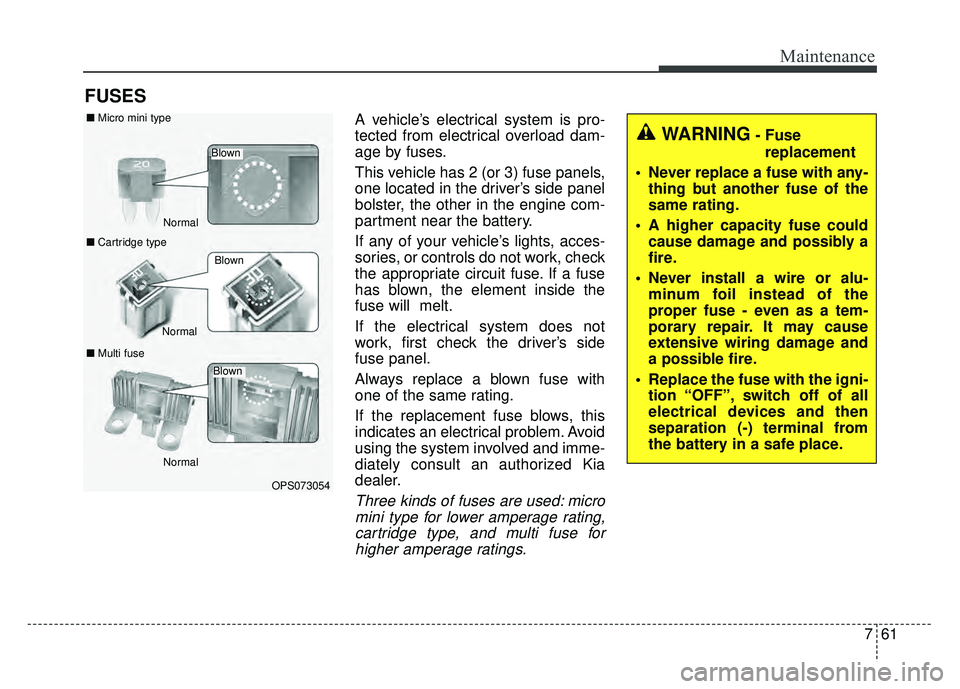
If any of your vehicle’s lights, acces-
sories, or controls do not work, check
the appropriate circuit fuse. If a fuse
has blown, the element inside the
fuse will melt.
If the electrical system does not
work, first check the driver’s side
fuse panel.
Always replace a blown fuse with
one of the same rating.
If the replacement fuse blows, this
indicates an electrical problem. Avoid
using the system involved and imme-
diately consult an authorized Kia
dealer.
Three kinds of fuses are used: micromini type for lower amperage rating,cartridge type, and multi fuse forhigher amperage ratings.
WARNING- Fuse
replacement
Never replace a fuse with any- thing but another fuse of the
same rating.
A higher capacity fuse could cause damage and possibly a
fire.
Never install a wire or alu- minum foil instead of the
proper fuse - even as a tem-
porary repair. It may cause
extensive wiring damage and
a possible fire.
Replace the fuse with the igni- tion “OFF”, switch off of all
electrical devices and then
separation (-) terminal from
the battery in a safe place.
OPS073054
Normal
Normal
■
Micro mini type
■ Cartridge type
■ Multi fuse
Blown
Blown
Normal
Blown
Page 484 of 544
Maintenance
64
7
✽
✽
NOTICE
If you need to park your vehicle for
prolonged periods more than 1
month, move the transportation fuse
switch to the OFF position to pre-
vent the battery being discharged.
Engine compartment fuse
replacement
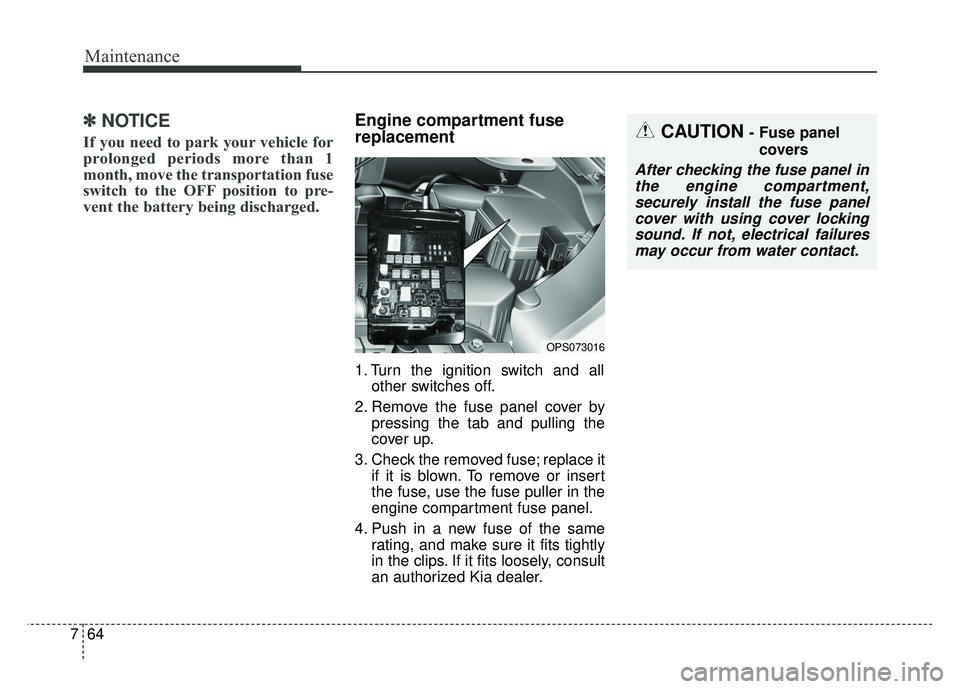
1. Turn the ignition switch and all
other switches off.
2. Remove the fuse panel cover by pressing the tab and pulling the
cover up.
3. Check the removed fuse; replace it if it is blown. To remove or insert
the fuse, use the fuse puller in the
engine compartment fuse panel.
4. Push in a new fuse of the same rating, and make sure it fits tightly
in the clips. If it fits loosely, consult
an authorized Kia dealer.
OPS073016
CAUTION- Fuse panel
covers
After checking the fuse panel inthe engine compartment,securely install the fuse panelcover with using cover lockingsound. If not, electrical failuresmay occur from water contact.
Page 485 of 544
765
Maintenance
Multi fuse
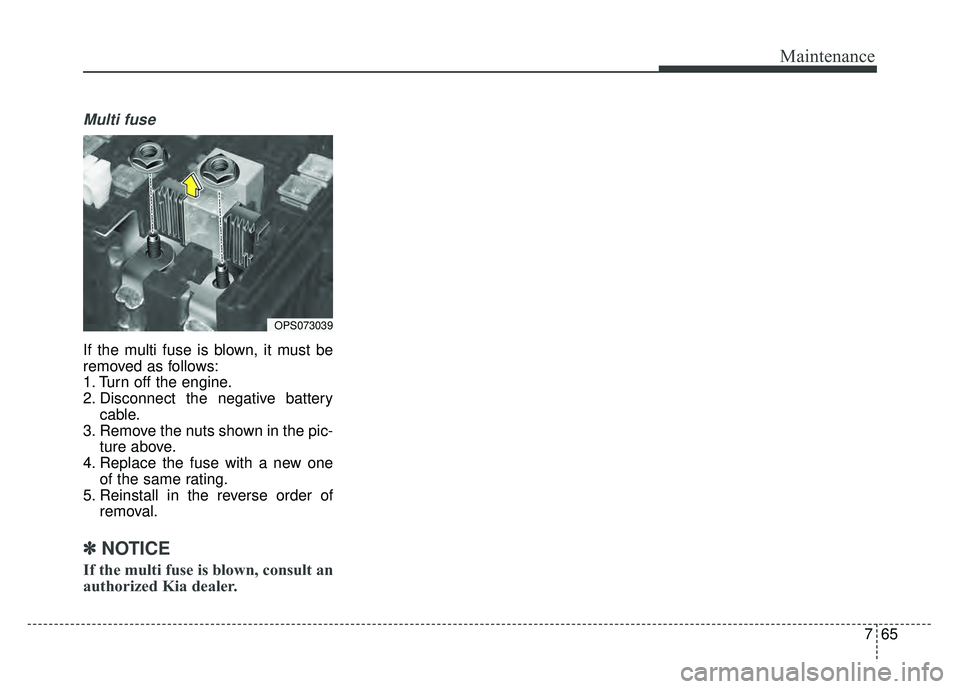
If the multi fuse is blown, it must be
removed as follows:
1. Turn off the engine.
2. Disconnect the negative batterycable.
3. Remove the nuts shown in the pic- ture above.
4. Replace the fuse with a new one of the same rating.
5. Reinstall in the reverse order of removal.
✽ ✽NOTICE
If the multi fuse is blown, consult an
authorized Kia dealer.
OPS073039
Page 497 of 544
777
Maintenance
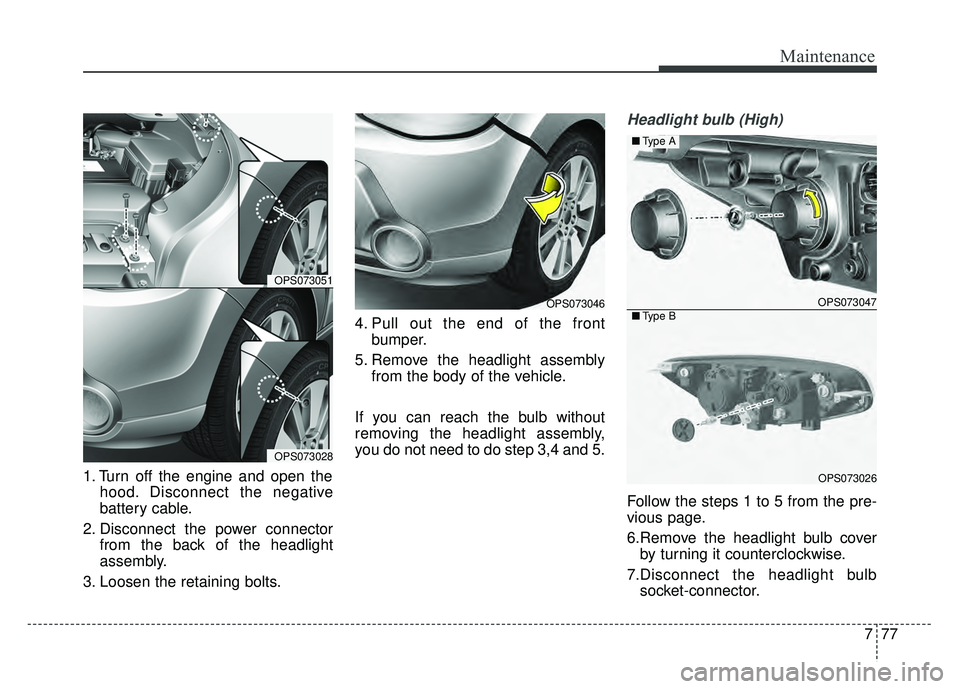
1. Turn off the engine and open thehood. Disconnect the negative
battery cable.
2. Disconnect the power connector from the back of the headlight
assembly.
3. Loosen the retaining bolts. 4. Pull out the end of the front
bumper.
5. Remove the headlight assembly from the body of the vehicle.
If you can reach the bulb without
removing the headlight assembly,
you do not need to do step 3,4 and 5.
Headlight bulb (High)
Follow the steps 1 to 5 from the pre-
vious page.
6.Remove the headlight bulb cover by turning it counterclockwise.
7.Disconnect the headlight bulb socket-connector.
OPS073046
OPS073051
OPS073028
OPS073047
OPS073026
■ Type A
■Type B
Page 514 of 544
Maintenance
94
7
Canister
Fuel vapors generated inside the fuel
tank are absorbed and stored in the
onboard canister. When the engine is
running, the fuel vapors absorbed in
the canister are drawn into the surge
tank through the purge control sole-
noid valve.
Purge Control Solenoid Valve
(PCSV)
The purge control solenoid valve is
controlled by the Engine Control
Module (ECM); when the engine
coolant temperature is low during
idling, the PCSV closes so that evap-
orated fuel is not taken into the
engine. After the engine warms up
during ordinary driving, the PCSV
opens to introduce evaporated fuel to
the engine.
3. Exhaust emission control
system
The Exhaust Emission Control
System is a highly effective system
which controls exhaust emissions
while maintaining good vehicle per-
formance.
Vehicle modifications
This vehicle should not be modified.
Modification of your vehicle could
affect its performance, safety or
durability and may even violate gov-
ernmental safety and emissions reg-
ulations.
In addition, damage or performance
problems resulting from any modifi-
cation may not be covered under
warranty.
If you use unauthorized electronic
devices, it may cause the vehicle to
operate abnormally, wire damage,
battery discharge and fire. For your
safety, do not use unauthorized
electronic devices.
Engine exhaust gas precautions
(carbon monoxide)
Carbon monoxide can be present with other exhaust fumes.
Therefore, if you smell exhaust
fumes of any kind inside your vehi-
cle, have it inspected and repaired
immediately. If you ever suspect
exhaust fumes are coming into
your vehicle, drive it only with all
the windows fully open. Have your
vehicle checked and repaired
immediately.
WARNING - Exhaust
Engine exhaust gases contain
carbon monoxide (CO). Though
colorless and odorless, it is
dangerous and could be lethal if
inhaled. Follow the instructions
on this page to avoid CO poi-
soning.
Page 527 of 544
811
Specifications, Consumer information, Reporting safety defects
Roadside Assistance is provided on all new current
model year Kia Vehicles from the date the vehicle is deliv-
ered to the first retail buyer or otherwise put into use (in-
service date), whichever is earlier, for a period of 60
months or 60,000 miles, whichever is earlier, subject to
the terms, conditions and exclusions set forth in the Kia
Warranty and Consumer Information Manual applicable
to your model year vehicle.
KMA reserves the right to limit or deny services or other
benefits to any owner or driver when, in KMA's judgment,
the claims and/or service requests are excessive in fre-
quency or type of occurrence.
Toll free consumer assistance
Kia's toll-free Consumer Assistance hot line is staffed
from 5:00 AM to 6:00 PM PST, Monday through Friday
and is accessible by dialing 1-800-333-4Kia (4542).
For more information regarding assistance available,
please refer to your Kia Warranty & Consumer
Information Manual.
Emergency roadside assistance
Kia's toll free Roadside Assistance hot line is staffed 24
hours a day, 365 days a year and is accessible by dialing
1-800-333-4Kia (4542).
Please note that you must provide your Vehicle
Identification Number (VIN) to verify coverage at the time
of your call. The VIN can be found on the dash of your
vehicle on the driver’s side, on the door jamb of the dri-
ver’s door, your vehicle’s registration or proof of insur-
ance card.
Kia utilizes a network of over 17,000 roadside assistance
providers. Should you accidentally run out of fuel, require
a battery jump, or need help changing a tire, a Kia
Roadside Assistance Representative will dispatch some-
one to deliver a small quantity of gas, change a flat tire
with your inflated spare, or arrange a battery jump to
allow you to proceed to your destination. We have access
to a network of over 10,000 locksmiths to help you should
you become locked out of your Kia.
In the event that mechanical difficulty renders your vehi-
cle undriveable due to a warranty-related concern, Kia’s
Roadside Assistance Representative will arrange to
transport your vehicle to the nearest Kia dealer or to an
alternative service location.
CONSUMER ASSISTANCE (U.S. ONLY)
Page 534 of 544
I3
Index
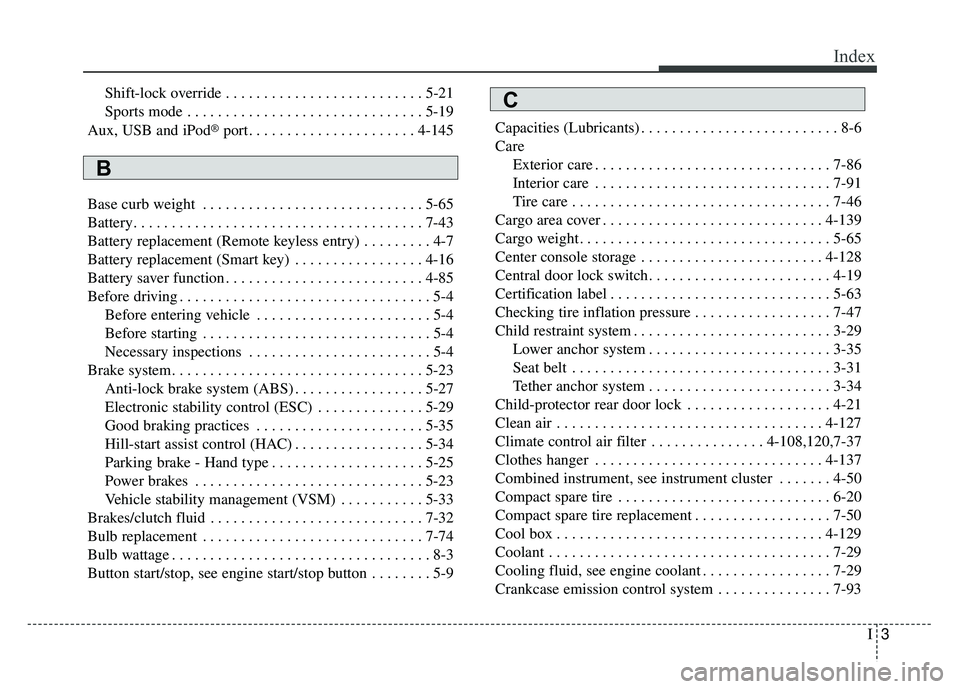
Shift-lock override . . . . . . . . . . . . . . . . . . . . . . . . . . 5-21
Sports mode . . . . . . . . . . . . . . . . . . . . . . . . . . . . . . . 5-19
Aux, USB and iPod
®port. . . . . . . . . . . . . . . . . . . . . . 4-145
Base curb weight . . . . . . . . . . . . . . . . . . . . . . . . . . . . . 5-65
Battery. . . . . . . . . . . . . . . . . . . . . . . . . . . . . . . . . . . . \
. . 7-43
Battery replacement (Remote keyless entry) . . . . . . . . . 4-7
Battery replacement (Smart key) . . . . . . . . . . . . . . . . . 4-16
Battery saver function . . . . . . . . . . . . . . . . . . . . . . . . . . 4-85
Before driving . . . . . . . . . . . . . . . . . . . . . . . . . . . . . . . . . 5-4 Before entering vehicle . . . . . . . . . . . . . . . . . . . . . . . 5-4
Before starting . . . . . . . . . . . . . . . . . . . . . . . . . . . . . . 5-4
Necessary inspections . . . . . . . . . . . . . . . . . . . . . . . . 5-4
Brake system. . . . . . . . . . . . . . . . . . . . . . . . . . . . . . . . . 5-23 Anti-lock brake system (ABS) . . . . . . . . . . . . . . . . . 5-27
Electronic stability control (ESC) . . . . . . . . . . . . . . 5-29
Good braking practices . . . . . . . . . . . . . . . . . . . . . . 5-35
Hill-start assist control (HAC) . . . . . . . . . . . . . . . . . 5-34
Parking brake - Hand type . . . . . . . . . . . . . . . . . . . . 5-25
Power brakes . . . . . . . . . . . . . . . . . . . . . . . . . . . . . . 5-23
Vehicle stability management (VSM) . . . . . . . . . . . 5-33
Brakes/clutch fluid . . . . . . . . . . . . . . . . . . . . . . . . . . . . 7-32
Bulb replacement . . . . . . . . . . . . . . . . . . . . . . . . . . . . . 7-74
Bulb wattage . . . . . . . . . . . . . . . . . . . . . . . . . . . . . . . . . . 8-3
Button start/stop, see engine start/stop button . . . . . . . . 5-9 Capacities (Lubricants) . . . . . . . . . . . . . . . . . . . . . . . . . . 8-6
Care
Exterior care . . . . . . . . . . . . . . . . . . . . . . . . . . . . . . . 7-86
Interior care . . . . . . . . . . . . . . . . . . . . . . . . . . . . . . . 7-91
Tire care . . . . . . . . . . . . . . . . . . . . . . . . . . . . . . . . . . 7-46\
Cargo area cover . . . . . . . . . . . . . . . . . . . . . . . . . . . . . 4-139
Cargo weight . . . . . . . . . . . . . . . . . . . . . . . . . . . . . . . . . 5-65
Center console storage . . . . . . . . . . . . . . . . . . . . . . . . 4-128
Central door lock switch. . . . . . . . . . . . . . . . . . . . . . . . 4-19
Certification label . . . . . . . . . . . . . . . . . . . . . . . . . . . . . 5-63
Checking tire inflation pressure . . . . . . . . . . . . . . . . . . 7-47
Child restraint system . . . . . . . . . . . . . . . . . . . . . . . . . . 3-29 Lower anchor system . . . . . . . . . . . . . . . . . . . . . . . . 3-35
Seat belt . . . . . . . . . . . . . . . . . . . . . . . . . . . . . . . . . . 3-31\
Tether anchor system . . . . . . . . . . . . . . . . . . . . . . . . 3-34
Child-protector rear door lock . . . . . . . . . . . . . . . . . . . 4-21
Clean air . . . . . . . . . . . . . . . . . . . . . . . . . . . . . . . . . . . 4-\
127
Climate control air filter . . . . . . . . . . . . . . . 4-108,120,7-37
Clothes hanger . . . . . . . . . . . . . . . . . . . . . . . . . . . . . . 4-137
Combined instrument, see instrument cluster . . . . . . . 4-50
Compact spare tire . . . . . . . . . . . . . . . . . . . . . . . . . . . . 6-20
Compact spare tire replacement . . . . . . . . . . . . . . . . . . 7-50
Cool box . . . . . . . . . . . . . . . . . . . . . . . . . . . . . . . . . . . 4-\
129
Coolant . . . . . . . . . . . . . . . . . . . . . . . . . . . . . . . . . . . . \
. 7-29
Cooling fluid, see engine coolant . . . . . . . . . . . . . . . . . 7-29
Crankcase emission control system . . . . . . . . . . . . . . . 7-93
B
C
Page 538 of 544
I7
Index
Power outlet . . . . . . . . . . . . . . . . . . . . . . . . . . . . . . 4-136
Rear seat warmer . . . . . . . . . . . . . . . . . . . . . . . . . . 4-135
Seat air ventilation . . . . . . . . . . . . . . . . . . . . . . . . . 4-134
Seat warmer . . . . . . . . . . . . . . . . . . . . . . . . . . . . . . 4-132
Sunvisor . . . . . . . . . . . . . . . . . . . . . . . . . . . . . . . . . 4-132
Interior lamp auto cut . . . . . . . . . . . . . . . . . . . . . . . . . . 4-93
Interior light . . . . . . . . . . . . . . . . . . . . . . . . . . . . . . . . . 4-93 Glove box lamp . . . . . . . . . . . . . . . . . . . . . . . . . . . . 4-97
Interior lamp auto cut . . . . . . . . . . . . . . . . . . . . . . . . 4-93
Luggage room lamp . . . . . . . . . . . . . . . . . . . . . . . . . 4-95
Map lamp . . . . . . . . . . . . . . . . . . . . . . . . . . . . . . . . . 4-93
Portable lamp usage . . . . . . . . . . . . . . . . . . . . . . . . . 4-95
Room lamp . . . . . . . . . . . . . . . . . . . . . . . . . . . . . . . . 4-94
Vanity mirror lamp . . . . . . . . . . . . . . . . . . . . . . . . . . 4-97
Interior overview. . . . . . . . . . . . . . . . . . . . . . . . . . . . . . . 2-4
ISG (Idle Stop and Go) system . . . . . . . . . . . . . . . . . . 5-43 Auto start . . . . . . . . . . . . . . . . . . . . . . . . . . . . . . . . . 5-44
Auto stop . . . . . . . . . . . . . . . . . . . . . . . . . . . . . . . . . 5-43
Condition of ISG system operation . . . . . . . . . . . . . 5-45
ISG system deactivation . . . . . . . . . . . . . . . . . . . . . . 5-46
ISG system malfunction . . . . . . . . . . . . . . . . . . . . . . 5-47
Jack and tools . . . . . . . . . . . . . . . . . . . . . . . . . . . . . . . . 6-13
Jump starting. . . . . . . . . . . . . . . . . . . . . . . . . . . . . . . . . . 6-5 Key . . . . . . . . . . . . . . . . . . . . . . . . . . . . . . . . . . . . \
. . . . . 4-4
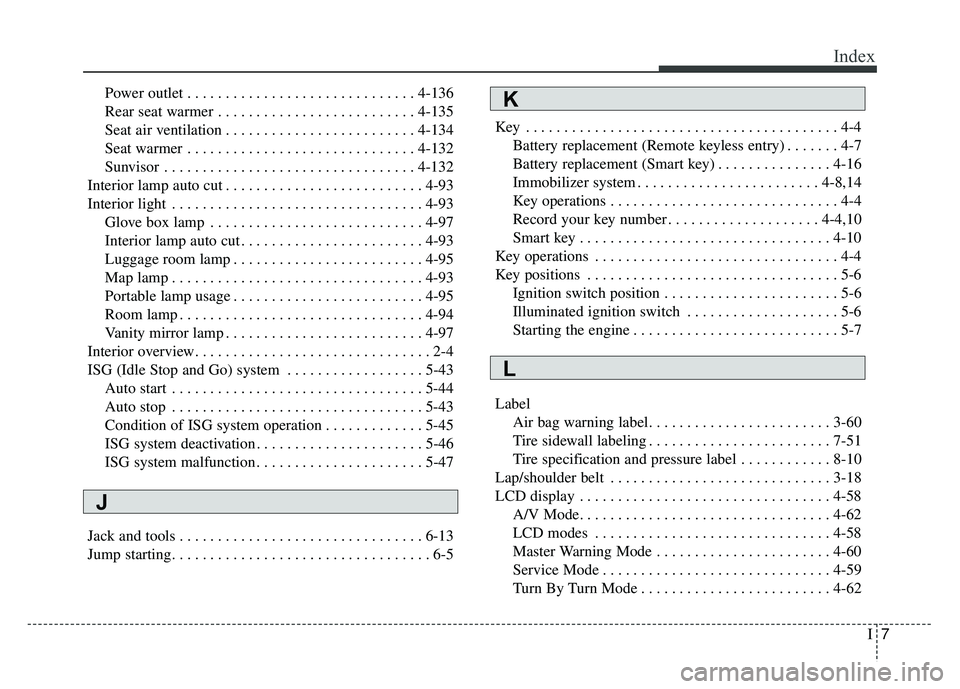
Battery replacement (Remote keyless entry) . . . . . . . 4-7
Battery replacement (Smart key) . . . . . . . . . . . . . . . 4-16
Immobilizer system . . . . . . . . . . . . . . . . . . . . . . . . 4-8,14
Key operations . . . . . . . . . . . . . . . . . . . . . . . . . . . . . . 4-4
Record your key number . . . . . . . . . . . . . . . . . . . . 4-4,10
Smart key . . . . . . . . . . . . . . . . . . . . . . . . . . . . . . . . . 4-10
Key operations . . . . . . . . . . . . . . . . . . . . . . . . . . . . . . . . 4-4
Key positions . . . . . . . . . . . . . . . . . . . . . . . . . . . . . . . . . 5-6 Ignition switch position . . . . . . . . . . . . . . . . . . . . . . . 5-6
Illuminated ignition switch . . . . . . . . . . . . . . . . . . . . 5-6
Starting the engine . . . . . . . . . . . . . . . . . . . . . . . . . . . 5-7
Label Air bag warning label. . . . . . . . . . . . . . . . . . . . . . . . 3-60
Tire sidewall labeling . . . . . . . . . . . . . . . . . . . . . . . . 7-51
Tire specification and pressure label . . . . . . . . . . . . 8-10
Lap/shoulder belt . . . . . . . . . . . . . . . . . . . . . . . . . . . . . 3-18
LCD display . . . . . . . . . . . . . . . . . . . . . . . . . . . . . . . . . 4-58 A/V Mode. . . . . . . . . . . . . . . . . . . . . . . . . . . . . . . . . 4-62
LCD modes . . . . . . . . . . . . . . . . . . . . . . . . . . . . . . . 4-58
Master Warning Mode . . . . . . . . . . . . . . . . . . . . . . . 4-60
Service Mode . . . . . . . . . . . . . . . . . . . . . . . . . . . . . . 4-59
Turn By Turn Mode . . . . . . . . . . . . . . . . . . . . . . . . . 4-62
J
K
L