warning light KIA SOUL 2015 Owners Manual
[x] Cancel search | Manufacturer: KIA, Model Year: 2015, Model line: SOUL, Model: KIA SOUL 2015Pages: 544, PDF Size: 19.81 MB
Page 4 of 544
ii
1
2
3
4
5
6
7
8I
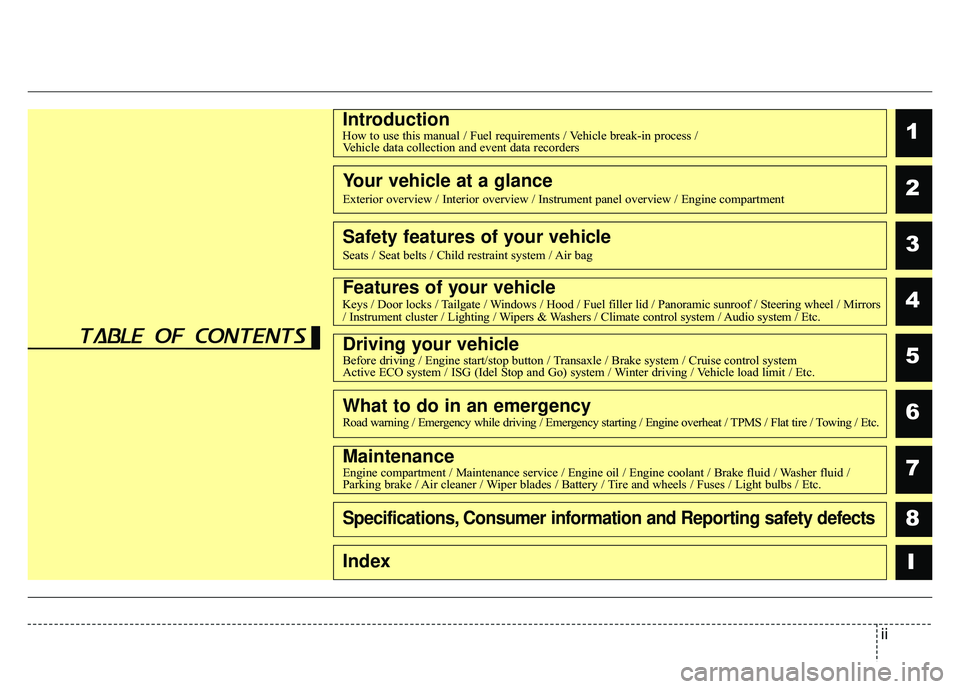
IntroductionHow to use this manual / Fuel requirements / Vehicle break-in process /Vehicle data collection and event data recorders
Your vehicle at a glance
Exterior overview / Interior overview / Instrument panel overview / Engi\
ne compartment
Safety features of your vehicle
Seats / Seat belts / Child restraint system / Air bag
Features of your vehicleKeys / Door locks / Tailgate / Windows / Hood / Fuel filler lid / Panoramic sunroof / Steering wheel / Mirrors
/ Instrument cluster / Lighting / Wipers & Washers / Climate control system / Audio system / Etc.
Driving your vehicleBefore driving / Engine start/stop button / Transaxle / Brake system / Cruise control system
Active ECO system / ISG (Idel Stop and Go) system / Winter driving / Vehicle load limit / Etc.
What to do in an emergencyRoad warning / Emergency while driving / Emergency starting / Engine overheat / TPMS / Flat tire / Towing / Etc.
MaintenanceEngine compartment / Maintenance service / Engine oil / Engine coolant /\
Brake fluid / Washer fluid /
Parking brake / Air cleaner / Wiper blades / Battery / Tire and wheels / Fuses / Light bulbs / Etc.
Specifications, Consumer information and Reporting safety defects
Index
table of contents
Page 7 of 544
13
Introduction
Your new Kia vehicle is designed to
use only unleaded fuel having a
pump octane number ((R+M)/2) of
87 (Research Octane Number 91) or
higher.
Your new vehicle is designed to
obtain maximum performance with
UNLEADED FUEL, as well as mini-
mize exhaust emissions and spark
plug fouling.
Never add any fuel system cleaning
agents to the fuel tank other than
what has been specified. (Consult an
authorized Kia dealer for details.)
✽ ✽
NOTICE
Tighten the cap until it clicks one
time, otherwise the fuel cap open
warning indicator light (or LCD
display) will illuminate.
Gasoline containing alcohol and
methanol
Gasohol, a mixture of gasoline and
ethanol (also known as grain alcohol),
and gasoline or gasohol containing
methanol (also known as wood alco-
hol) are being marketed along with or
instead of leaded or unleaded gaso-
line.
Pursuant to EPA regulations, ethanol
may be used in your vehicle. Do not
use gasohol containing more than
10% ethanol, and do not use gasoline
or gasohol containing any methanol.
Ethanol provides less energy than
gasoline and it attracts water, and it is
thus likely to reduce your fuel efficien-
cy and could lower your MPG results.
Methanol may cause drivability prob-
lems and damage to the fuel system.
Discontinue using gasohol of anykind
if drivability problems occur. Vehicle
damage or drivability problems may
not be covered by the manufacturer's
warranty if they result from the use of:
1. Gasoline or gasohol containing methanol.
2. Leaded fuel or leaded gasohol.
FUEL REQUIREMENTS
WARNING - Refueling
• Do not "top off" after the noz- zle automatically shuts off.
Attempts to force more fuel
into the tank can cause fuel
overflow onto you and the
ground causing a risk of fire.
Always check that the fuel cap is installed securely to pre-
vent fuel spillage, especially
in the event of an accident.
Page 15 of 544
25
Your vehicle at a glance
INSTRUMENT PANEL OVERVIEW
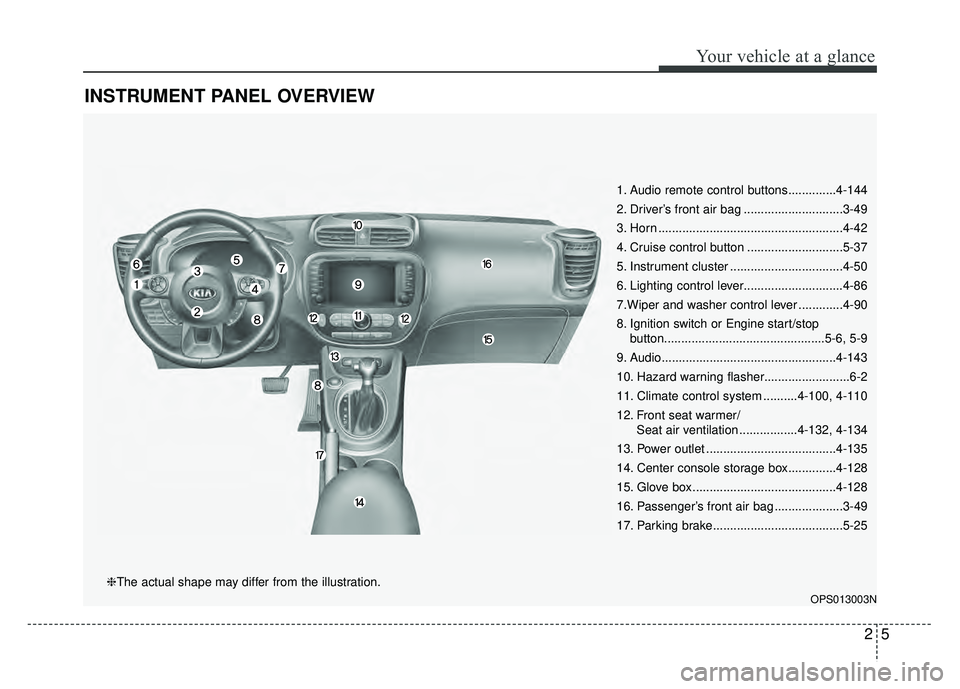
1. Audio remote control buttons..............4-144
2. Driver’s front air bag .............................3-49
3. Horn ......................................................4-42
4. Cruise control button ............................5-37
5. Instrument cluster .................................4-50
6. Lighting control lever.............................4-86
7.Wiper and washer control lever .............4-90
8. Ignition switch or Engine start/stopbutton...............................................5-6, 5-9
9. Audio...................................................4-143
10. Hazard warning flasher.........................6-2
11. Climate control system ..........4-100, 4-110
12. Front seat warmer/ Seat air ventilation .................4-132, 4-134
13. Power outlet ......................................4-135
14. Center console storage box..............4-128
15. Glove box ..........................................4-128
16. Passenger’s front air bag ....................3-49
17. Parking brake......................................5-25
OPS013003N
❈The actual shape may differ from the illustration.
Page 18 of 544

Safety features of your vehicle
Seats . . . . . . . . . . . . . . . . . . . . . . . . . . . . . . . . . . . . \
. . 3-2
• Front seat adjustment - Manual . . . . . . . . . . . . . . . . . 3-5
• Front seat adjustment - Power . . . . . . . . . . . . . . . . . . . 3-6
• Seatback pocket . . . . . . . . . . . . . . . . . . . . . . . . . . . . . . 3-11
• Rear seat adjustment . . . . . . . . . . . . . . . . . . . . . . . . . 3-11
Seat belts . . . . . . . . . . . . . . . . . . . . . . . . . . . . . . . . . 3-16
• Seat belt restraint system . . . . . . . . . . . . . . . . . . . . . . 3-16
• Pre-tensioner seat belt . . . . . . . . . . . . . . . . . . . . . . . . 3-24
• Seat belt precautions . . . . . . . . . . . . . . . . . . . . . . . . . . 3-27
• Care of seat belts . . . . . . . . . . . . . . . . . . . . . . . . . . . . . 3-28
Child restraint system . . . . . . . . . . . . . . . . . . . . . . 3-29
• Using a child restraint system . . . . . . . . . . . . . . . . . . 3-30
• Tether anchor system . . . . . . . . . . . . . . . . . . . . . . . . . 3-34
• Lower anchor system . . . . . . . . . . . . . . . . . . . . . . . . . 3-35
Air bag -
advanced supplemental restraint system . . . . . . 3-37
• How does the air bag system operate . . . . . . . . . . . . 3-38
• Do not Installing a child restraint on a front passenger's seat . . . . . . . . . . . . . . . . . . . . . . . . . . . . . 3-40
• Air bag warning light . . . . . . . . . . . . . . . . . . . . . . . . . 3-40
• SRS components and functions . . . . . . . . . . . . . . . . . 3-41
• Occupant Detection System (ODS) . . . . . . . . . . . . . . 3-44
• Driver's and passenger's front air bag . . . . . . . . . . . 3-49
• Side air bag . . . . . . . . . . . . . . . . . . . . . . . . . . . . . . . . . 3-52
• Curtain air bag . . . . . . . . . . . . . . . . . . . . . . . . . . . . . . 3-53 •
Inflation and non-inflation conditions of the air bag . . 3-54
• SRS care . . . . . . . . . . . . . . . . . . . . . . . . . . . . . . . . . . . . \
3-59
• Adding equipment to or modifying your
air bag-equipped vehicle. . . . . . . . . . . . . . . . . . . . . . 3-60
• Air bag warning label . . . . . . . . . . . . . . . . . . . . . . . . . 3-60
3
Page 34 of 544
317
Safety features of your vehicle
No modifications or additionsshould be made by the user which
will either prevent the seat belt
adjusting devices from operating to
remove slack, or prevent the seat
belt assembly from being adjusted
to remove slack.
When you fasten the seat belt, be careful not to latch the seat belt in
buckles of other seat. It's very dan-
gerous and you may not be pro-
tected by the seat belt properly.
Do not unfasten the seat belt and do not fasten and unfasten the seat
belt repeatedly while driving. This
could result in loss of control, and
an accident causing death, serious
injury, or property damage.
When fastening the seat belt, make sure that the seat belt does
not pass over objects that are hard
or can break easily.Seat belt warning (for driver’s seat)
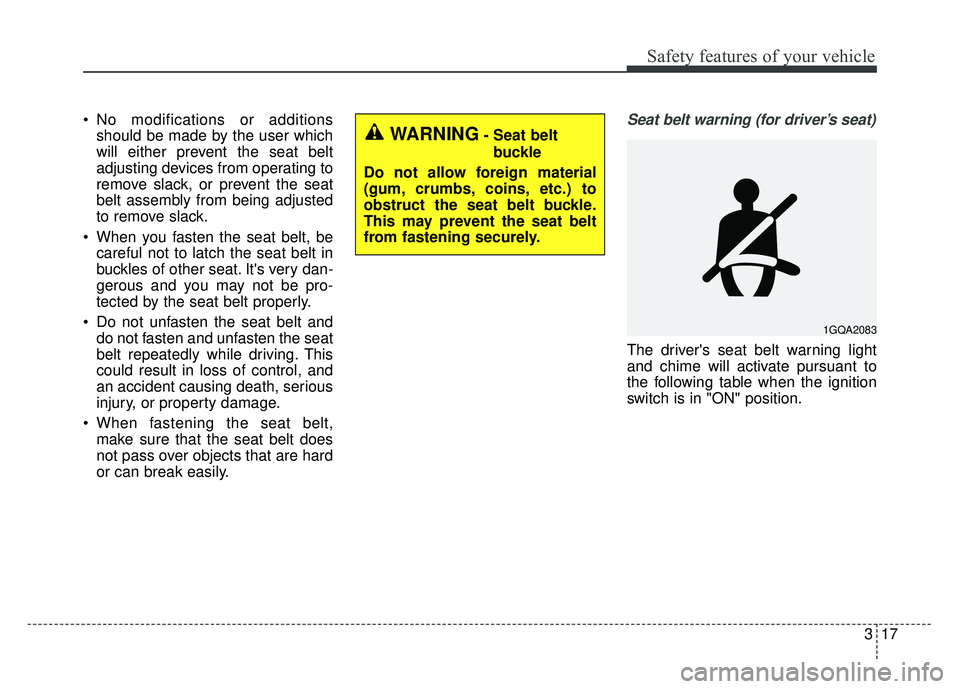
The driver's seat belt warning light
and chime will activate pursuant to
the following table when the ignition
switch is in "ON" position.
1GQA2083
WARNING- Seat belt
buckle
Do not allow foreign material
(gum, crumbs, coins, etc.) to
obstruct the seat belt buckle.
This may prevent the seat belt
from fastening securely.
Page 35 of 544
Safety features of your vehicle
18
3
*1Warning pattern repeats 11 times with
an interval of 24 seconds. If the driver's
seat belt is buckled, the light will stop
within 6 seconds and chime will stop
immediately.
*
2The light will stop within 6 seconds and
chime will stop immediately.
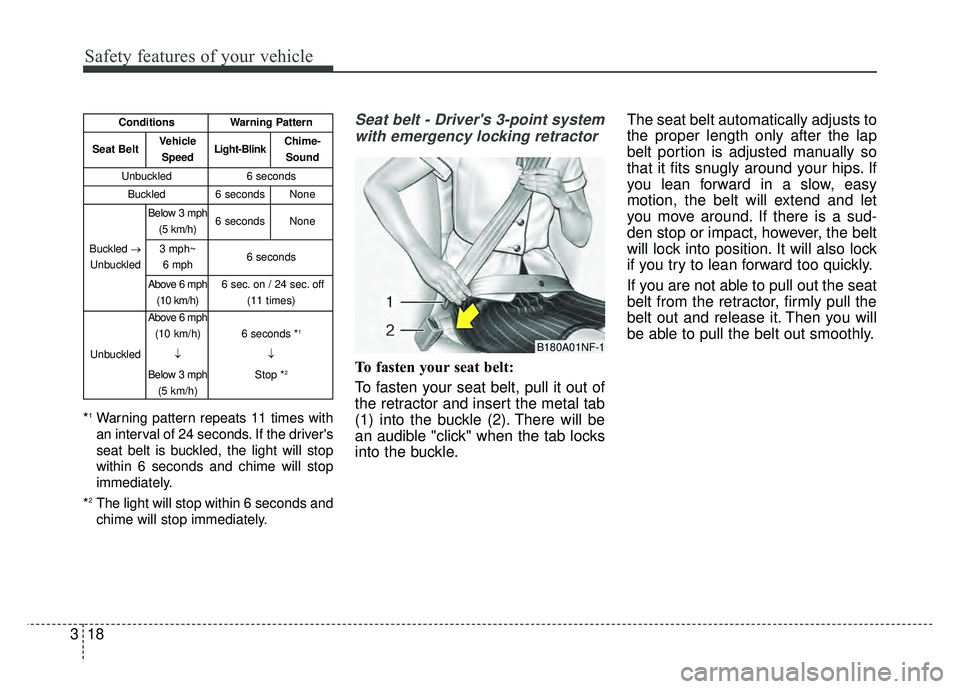
Seat belt - Driver's 3-point system with emergency locking retractor
To fasten your seat belt:
To fasten your seat belt, pull it out of
the retractor and insert the metal tab
(1) into the buckle (2). There will be
an audible "click" when the tab locks
into the buckle. The seat belt automatically adjusts to
the proper length only after the lap
belt portion is adjusted manually so
that it fits snugly around your hips. If
you lean forward in a slow, easy
motion, the belt will extend and let
you move around. If there is a sud-
den stop or impact, however, the belt
will lock into position. It will also lock
if you try to lean forward too quickly.
If you are not able to pull out the seat
belt from the retractor, firmly pull the
belt out and release it. Then you will
be able to pull the belt out smoothly.
B180A01NF-1
ConditionsWarning Pattern
Seat BeltVehicle
SpeedLight-BlinkChime-Sound
Unbuckled6 seconds
Buckled6 secondsNone
Buckled →
Unbuckled
Below 3 mph (5 km/h)6 secondsNone
3 mph~6 mph6 seconds
Above 6 mph (10 km/h)6 sec. on / 24 sec. off (11 times)
Unbuckled
Above 6 mph(10 km/h)
↓
Below 3 mph (5 km/h)
6 seconds *1
↓
Stop *
2
Page 41 of 544
Safety features of your vehicle
24
3
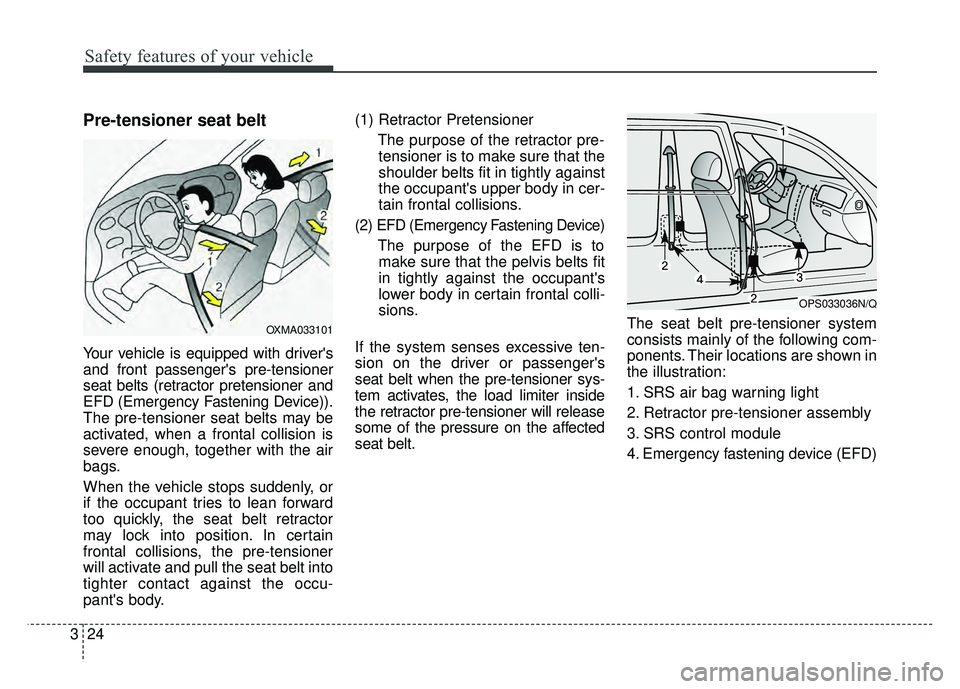
Pre-tensioner seat belt
Your vehicle is equipped with driver's
and front passenger's pre-tensioner
seat belts (retractor pretensioner and
EFD (Emergency Fastening Device)).
The pre-tensioner seat belts may be
activated, when a frontal collision is
severe enough, together with the air
bags.
When the vehicle stops suddenly, or
if the occupant tries to lean forward
too quickly, the seat belt retractor
may lock into position. In certain
frontal collisions, the pre-tensioner
will activate and pull the seat belt into
tighter contact against the occu-
pant's body. (1) Retractor Pretensioner
The purpose of the retractor pre-tensioner is to make sure that the
shoulder belts fit in tightly against
the occupant's upper body in cer-
tain frontal collisions.
(2) EFD (Emergency Fastening Device)
The purpose of the EFD is tomake sure that the pelvis belts fit
in tightly against the occupant's
lower body in certain frontal colli-
sions.
If the system senses excessive ten-
sion on the driver or passenger's
seat belt when the pre-tensioner sys-
tem activates, the load limiter inside
the retractor pre-tensioner will release
some of the pressure on the affected
seat belt. The seat belt pre-tensioner system
consists mainly of the following com-
ponents. Their locations are shown in
the illustration:
1. SRS air bag warning light
2. Retractor pre-tensioner assembly
3. SRS control module
4. Emergency fastening device (EFD)
OXMA033101
OPS033036N/Q
Page 42 of 544
325
Safety features of your vehicle
Both the driver's and front passen-ger's seat belt pre-tensioner sys-
tem may be activated not only in
certain frontal collision but also in
certain side collision or rollover, if
the vehicle is equipped with a side
or curtain air bag.
Because the sensor that activates the SRS air bag is connected with
the pre-tensioner seat belt, the
SRS air bag warning light on
the instrument panel will illuminate
for approximately 6 seconds after
the ignition switch has been turned
to the ON position, and then it
should turn off. If the pre-tensioner seat belt system
are not working properly, this warn-
ing light will illuminate even if there is
no malfunction of the SRS air bag. If
the SRS air bag warning light does
not illuminate when the ignition
switch is turned ON, or if it remains
illuminated after illuminating for
approximately 6 seconds, or if it illu-
minates while the vehicle is being
driven, have an authorized Kia deal-
er inspect the pre-tensioner seat belt
and SRS air bag system as soon as
possible.
Pre-tensioners are designed to oper-
ate only one time. After activation,
pre-tensioner seat belts must be
replaced. If the pre-tensioner must
be replaced, contact an authorized
Kia dealer.
WARNING- Hot preten-
sioner
Do not touch the pre-tensioner
seat belt assemblies for several
minutes after they have been
activated. When the pre-ten-
sioner seat belt mechanism
fires during a collision the pre-
tensioner becomes hot and can
burn you.
Page 44 of 544
327
Safety features of your vehicle
If the shoulder belt portion slightly
touches the child’s neck or face, try
placing the child closer to the center of
the vehicle. If the shoulder belt still
touches their face or neck they need to
be returned to a child restraint system.Restraint of pregnant women
Pregnant women should wear
lap/shoulder belt assemblies when-
ever possible according to specific
recommendations by their doctors.
The lap portion of the belt should be
worn AS SECURELY AND LOW AS
POSSIBLE.
Injured person
A seat belt should be used when an
injured person is being transported.
When this is necessary, you should
consult a physician for recommenda-
tions.
One person per belt
Two people (including children)
should never attempt to use a single
seat belt. This could increase the
severity of injuries in case of an acci-
dent.WARNING- Small children
Do not allow small children to
ride in the vehicle without an
appropriate child restraint sys-
tem. If the shoulder belt comes
in contact with your child's neck
or face your child is too small to
ride in the vehicle. In a crash the
seat belt will inflict injury to your
child's neck, throat and face.
WARNING - Pregnant women
Pregnant women must never
place the lap portion of the seat
belt above or on the abdomen
where the fetus is located. The
force of the seat belt during a
collision will crush the fetus.
Page 57 of 544
Safety features of your vehicle
40
3
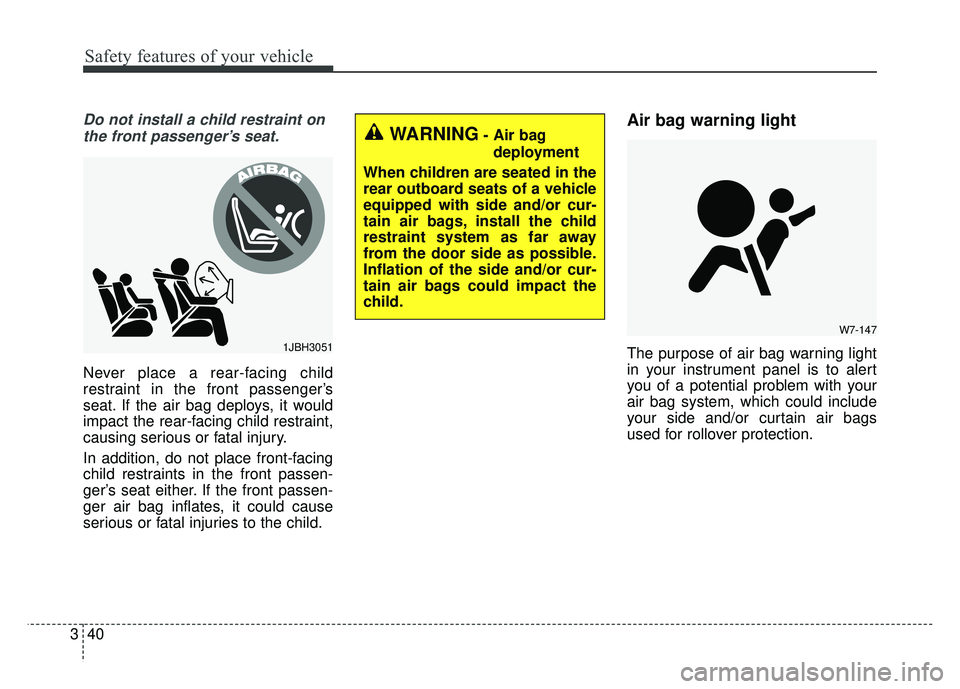
Do not install a child restraint on
the front passenger’s seat.
Never place a rear-facing child
restraint in the front passenger’s
seat. If the air bag deploys, it would
impact the rear-facing child restraint,
causing serious or fatal injury.
In addition, do not place front-facing
child restraints in the front passen-
ger’s seat either. If the front passen-
ger air bag inflates, it could cause
serious or fatal injuries to the child.
Air bag warning light
The purpose of air bag warning light
in your instrument panel is to alert
you of a potential problem with your
air bag system, which could include
your side and/or curtain air bags
used for rollover protection.1JBH3051
W7-147
WARNING- Air bag deployment
When children are seated in the
rear outboard seats of a vehicle
equipped with side and/or cur-
tain air bags, install the child
restraint system as far away
from the door side as possible.
Inflation of the side and/or cur-
tain air bags could impact the
child.