engine coolant KIA Soul 2016 2.G Owner's Guide
[x] Cancel search | Manufacturer: KIA, Model Year: 2016, Model line: Soul, Model: KIA Soul 2016 2.GPages: 556, PDF Size: 21.35 MB
Page 463 of 556
733
Maintenance
Vacuum crankcase ventilation
hoses (if equipped)
Inspect the surface of hoses for evi-
dence of heat and/or mechanical
damage. Hard and brittle rubber,
cracking, tears, cuts, abrasions, and
excessive swelling indicate deterio-
ration. Particular attention should be
paid to examine those hose surfaces
nearest to high heat sources, such
as the exhaust manifold.
Inspect the hose routing to assure
that the hoses do not come in con-
tact with any heat source, sharp
edges or moving components which
might cause heat damage or
mechanical wear. Inspect all hose
connections, such as clamps and
couplings, to make sure they are
secure, and that no leaks are pres-
ent. Hoses should be replaced
immediately if there is any evidence
of deterioration or damage.
Air cleaner filter
A Genuine Kia air cleaner filter is
recommended when the filter is
replaced.
Spark plugs
Make sure to install new spark plugs
of the correct heat range.
Valve clearance (if equipped)
Inspect for excessive valve noise
and/or engine vibration and adjust if
necessary. An authorized Kia dealer
should perform the operation.
Cooling system
Check the cooling system compo-
nents, such as the radiator, coolant
reservoir, hoses and connections for
leakage and damage. Replace any
damaged parts.
Coolant
The coolant should be changed at
the intervals specified in the mainte-
nance schedule.
Page 468 of 556

Maintenance
38
7
ENGINE COOLANT
The high-pressure cooling system
has a reservoir filled with year round
antifreeze coolant. The reservoir is
filled at the factory.
Check the antifreeze protection and
coolant level at least once a year, at
the beginning of the winter season,
and before traveling to a colder cli-
mate.Checking the coolant level
Turn the engine off and wait until it
cools down. Use extreme care when
removing the radiator cap. Wrap a
thick towel around it, and turn it
counterclockwise slowly to the first
stop. Step back while the pressure is
released from the cooling system.
When you are sure all the pressure
has been released, press down on
the cap, using a thick towel, and con-
tinue turning counterclockwise to
remove it.
CAUTION
Never attempt to remove the
radiator cap while the engine isoperating or hot. Doing somight lead to cooling systemand engine damage.
WARNING-Cooling fan
Use caution when
working near the
blade of the cooling
fan. The electric
motor (cooling fan) is
controlled by engine coolant
temperature, refrigerant pres-
sure and vehicle speed. it may
sometimes operate even when
the engine is not running.
Page 469 of 556

739
Maintenance
Check the condition and connections
of all cooling system hoses and
heater hoses. Replace any swollen
or deteriorated hoses.
The coolant level should be filled
between F and L marks on the side
of the coolant reservoir when the
engine is cool.
If the coolant level is low, add enough
specified coolant to provide protec-
tion against freezing and corrosion.
Bring the level to F, but do not over-
fill. If frequent additions are required,
see an authorized Kia dealer for a
cooling system inspection.
Recommended engine coolant
When adding coolant, use onlydeionized water or soft water for
your vehicle and never mix hard
water in the coolant filled at the fac-
tory. An improper coolant mixture
can result in serious malfunction or
engine damage.
The engine in your vehicle has alu- minum engine parts and must be
protected by an ethylene-glycol
with phosphate based coolant to
prevent corrosion and freezing.
DO NOT USE alcohol or methanol coolant or mix them with the spec-
ified coolant.
Do not use a solution that contains more than 60% antifreeze or less
than 35% antifreeze, which would
reduce the effectiveness of the
solution. For mixture percentage, refer to the
following table.
OXM079006
Ambient
Temperature Mixture Percentage
(volume)
Antifreeze Water
-15°C (5°F)35 65
-25°C (-13°F)4060
-35°C (-31°F)5050
-45°C (-49°F)6040
Page 470 of 556
Maintenance
40
7
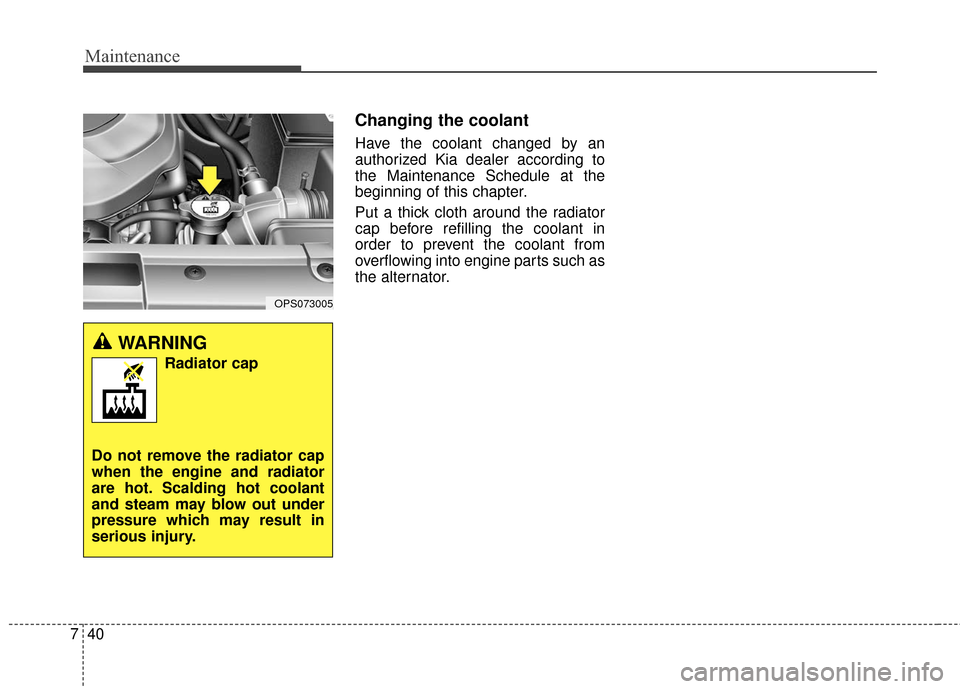
Changing the coolant
Have the coolant changed by an
authorized Kia dealer according to
the Maintenance Schedule at the
beginning of this chapter.
Put a thick cloth around the radiator
cap before refilling the coolant in
order to prevent the coolant from
overflowing into engine parts such as
the alternator.
OPS073005
WARNING
Radiator cap
Do not remove the radiator cap
when the engine and radiator
are hot. Scalding hot coolant
and steam may blow out under
pressure which may result in
serious injury.
Page 535 of 556
7105
Maintenance
Canister
Fuel vapors generated inside the fuel
tank are absorbed and stored in the
onboard canister. When the engine is
running, the fuel vapors absorbed in
the canister are drawn into the surge
tank through the purge control sole-
noid valve.
Purge Control Solenoid Valve(PCSV)
The purge control solenoid valve is
controlled by the Engine Control
Module (ECM); when the engine
coolant temperature is low during
idling, the PCSV closes so that evap-
orated fuel is not taken into the
engine. After the engine warms up
during ordinary driving, the PCSV
opens to introduce evaporated fuel to
the engine.
3. Exhaust emission control system
The Exhaust Emission Control
System is a highly effective system
which controls exhaust emissions
while maintaining good vehicle per-
formance.
Vehicle modifications
This vehicle should not be modified.
Modification of your vehicle could
affect its performance, safety or
durability and may even violate gov-
ernmental safety and emissions reg-
ulations.
In addition, damage or performance
problems resulting from any modifi-
cation may not be covered under
warranty.
If you use unauthorized electronic
devices, it may cause the vehicle to
operate abnormally, wire damage,
battery discharge and fire. For your
safety, do not use unauthorized
electronic devices.
Engine exhaust gas precautions
(carbon monoxide)
Carbon monoxide can be present with other exhaust fumes.
Therefore, if you smell exhaust
fumes of any kind inside your vehi-
cle, have it inspected and repaired
immediately. If you ever suspect
exhaust fumes are coming into
your vehicle, drive it only with all
the windows fully open. Have your
vehicle checked and repaired
immediately.
WARNING - Exhaust
Engine exhaust gases contain
carbon monoxide (CO). Though
colorless and odorless, it is
dangerous and could be lethal if
inhaled. Follow the instructions
on this page to avoid CO poi-
soning.
Page 544 of 556
87
Specifications & Consumer information
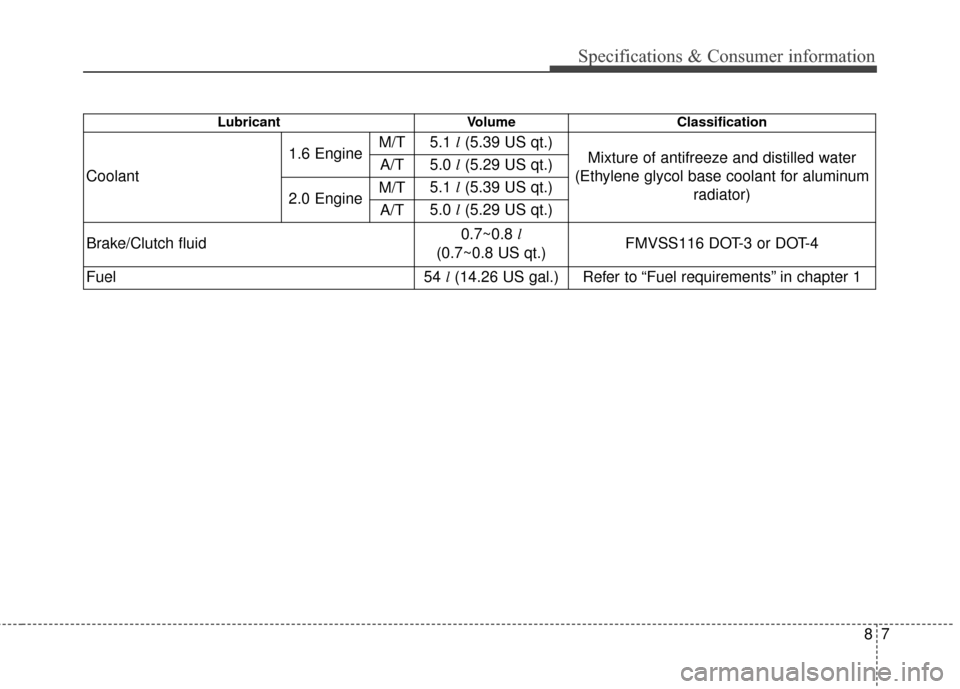
LubricantVolume Classification
Coolant1.6 Engine
M/T
5.1
l(5.39 US qt.)
Mixture of antifreeze and distilled water
(Ethylene glycol base coolant for aluminum radiator)
A/T5.0 l(5.29 US qt.)
2.0 EngineM/T5.1 l(5.39 US qt.)
A/T5.0 l(5.29 US qt.)
Brake/Clutch fluid 0.7~0.8
l
(0.7~0.8 US qt.) FMVSS116 DOT-3 or DOT-4
Fuel 54
l(14.26 US gal.)
Refer to “Fuel requirements” in chapter 1
Page 550 of 556

I3
Index
Electronic stability control (ESC) . . . . . . . . . . . . . . 5-29
Good braking practices . . . . . . . . . . . . . . . . . . . . . . 5-35
Hill-start assist control (HAC) . . . . . . . . . . . . . . . . . 5-34
Parking brake - Hand type . . . . . . . . . . . . . . . . . . . . 5-25
Power brakes . . . . . . . . . . . . . . . . . . . . . . . . . . . . . . 5-23
Vehicle stability management (VSM) . . . . . . . . . . . 5-33
Brake/clutch fluid . . . . . . . . . . . . . . . . . . . . . . . . . . . . . 7-41 Checking the brake/clutch fluid level . . . . . . . . . . . 7-41
Bulb wattage . . . . . . . . . . . . . . . . . . . . . . . . . . . . . . . . . . 8-3
Capacity/Weight . . . . . . . . . . . . . . . . . . . . . . . . . . . . . . . 8-5
Child restraint system . . . . . . . . . . . . . . . . . . . . . . . . . . 3-30 Lower anchor system . . . . . . . . . . . . . . . . . . . . . . . . 3-36
Tether anchor system . . . . . . . . . . . . . . . . . . . . . . . . 3-35
Using a child restraint system . . . . . . . . . . . . . . . . . 3-31
Clean air . . . . . . . . . . . . . . . . . . . . . . . . . . . . . . . . . . . 4-\
131
Climate control air filter . . . . . . . . . . . . . . . . . . . . . . . . 7-47 Filter inspection . . . . . . . . . . . . . . . . . . . . . . . . . . . . 7-47
Filter replacement. . . . . . . . . . . . . . . . . . . . . . . . . . . 7-47
Cruise control system . . . . . . . . . . . . . . . . . . . . . . . . . . 5-37 Cruise control switch . . . . . . . . . . . . . . . . . . . . . . . . 5-38
To cancel cruise control, do one of the following . . 5-40
To decrease the cruising speed . . . . . . . . . . . . . . . . . 5-39
To increase cruise control set speed . . . . . . . . . . . . . 5-39
To resume cruising speed at more thanapproximately 20 mph (30 km/h) . . . . . . . . . . . . . 5-40 To set cruise control speed . . . . . . . . . . . . . . . . . . . . 5-38
To temporarily accelerate with the cruise control on . .
5-39
To turn cruise control off, do one of the following. . 5-41
Defroster . . . . . . . . . . . . . . . . . . . . . . . . . . . . . . . . . . . 4-\
102 Rear window defroster . . . . . . . . . . . . . . . . . . . . . . 4-102
Dimensions . . . . . . . . . . . . . . . . . . . . . . . . . . . . . . . . . . . 8-\
2
Door locks. . . . . . . . . . . . . . . . . . . . . . . . . . . . . . . . . . . 4-\
19 Auto door lock/unlock feature . . . . . . . . . . . . . . . . . 4-22
Child-protector rear door lock . . . . . . . . . . . . . . . . . 4-23
Impact sensing door unlock system . . . . . . . . . . . . . 4-22
Operating door locks from inside the vehicle . . . . . 4-20
Operating door locks from outside the vehicle . . . . 4-19
Speed sensing door lock system . . . . . . . . . . . . . . . 4-22
Economical operation . . . . . . . . . . . . . . . . . . . . . . . . . . 5-56
Emergency starting . . . . . . . . . . . . . . . . . . . . . . . . . . . . . 6-5 Jump starting . . . . . . . . . . . . . . . . . . . . . . . . . . . . . . . 6-5
Push-starting . . . . . . . . . . . . . . . . . . . . . . . . . . . . . . . . 6-7
Emission control system . . . . . . . . . . . . . . . . . . . . . . . 7-104
Engine . . . . . . . . . . . . . . . . . . . . . . . . . . . . . . . . . . . . \
. . . 8-2
Engine compartment. . . . . . . . . . . . . . . . . . . . . . . . . 2-6,7-3
Engine coolant . . . . . . . . . . . . . . . . . . . . . . . . . . . . . . . 7-38 Changing the coolant . . . . . . . . . . . . . . . . . . . . . . . . 7-40
C
D
E
Page 551 of 556
Index
4I
Checking the coolant level . . . . . . . . . . . . . . . . . . . . 7-38
Engine number . . . . . . . . . . . . . . . . . . . . . . . . . . . . . . . 8-10
Engine oil . . . . . . . . . . . . . . . . . . . . . . . . . . . . . . . . . . . 7-\
36 Changing the engine oil and filter . . . . . . . . . . . . . . 7-37
Checking the engine oil level . . . . . . . . . . . . . . . . . . 7-36
Engine start/stop button . . . . . . . . . . . . . . . . . . . . . . . . . 5-9 Engine start/stop button position . . . . . . . . . . . . . . . . 5-9
Illuminated engine start/stop button. . . . . . . . . . . . . . 5-9
Starting the engine with a smart key . . . . . . . . . . . . 5-11
Explanation of scheduled maintenance items . . . . . . . 7-32
Exterior features . . . . . . . . . . . . . . . . . . . . . . . . . . . . . 4-145 Mounting bracket for roof carrier . . . . . . . . . . . . . 4-145
Exterior overview . . . . . . . . . . . . . . . . . . . . . . . . . . . . . . 2-2
Foward collision warning system (FCWS) . . . . . . . . . 5-52
Fuel filler lid . . . . . . . . . . . . . . . . . . . . . . . . . . . . . . . . . 4-34 Closing the fuel filler lid . . . . . . . . . . . . . . . . . . . . . 4-34
Opening the fuel filler lid. . . . . . . . . . . . . . . . . . . . . 4-34
Fuel requirements . . . . . . . . . . . . . . . . . . . . . . . . . . . . . . 1-3 Do not use methanol . . . . . . . . . . . . . . . . . . . . . . . . . 1-4
Fuel Additives . . . . . . . . . . . . . . . . . . . . . . . . . . . . . . 1-5
Gasoline containing alcohol and methanol . . . . . . . . 1-3
Gasoline containing MMT . . . . . . . . . . . . . . . . . . . . . 1-4
Use of MTBE . . . . . . . . . . . . . . . . . . . . . . . . . . . . . . . 1-4
Fuses . . . . . . . . . . . . . . . . . . . . . . . . . . . . . . . . . . . . \
. . . 7-71 Engine compartment fuse replacement . . . . . . . . . . 7-74 Inner panel fuse replacement . . . . . . . . . . . . . . . . . . 7-73
Fuse/relay panel description. . . . . . . . . . . . . . . . . . . 7-76
Hood . . . . . . . . . . . . . . . . . . . . . . . . . . . . . . . . . . . . \
. . . 4-32 Closing the hood . . . . . . . . . . . . . . . . . . . . . . . . . . . 4-32
Opening the hood . . . . . . . . . . . . . . . . . . . . . . . . . . 4-32
How to use this manual . . . . . . . . . . . . . . . . . . . . . . . . . 1-2
If the engine overheats . . . . . . . . . . . . . . . . . . . . . . . . . . 6-8
If the engine will not start . . . . . . . . . . . . . . . . . . . . . . . 6-4 If engine doesn’t turn over or turns over slowly . . . . 6-4
If engine turns over normally but does not start . . . . 6-4
If you have a flat tire (with Spare Tire) . . . . . . . . . . . . . 6-9 Changing tires . . . . . . . . . . . . . . . . . . . . . . . . . . . . . 6-10
Jack and tools . . . . . . . . . . . . . . . . . . . . . . . . . . . . . . . 6-9
Jack label . . . . . . . . . . . . . . . . . . . . . . . . . . . . . . . . . 6-17
Removing and storing the spare tire . . . . . . . . . . . . 6-10
Use of temporary compact spare tire . . . . . . . . . . . . 6-15
If you have a flat tire (with Tire Mobility Kit). . . . . . . 6-18 Checking the tire inflation pressure . . . . . . . . . . . . . 6-23
Components of the Tire Mobility Kit . . . . . . . . . . . 6-20
Distributing the sealant . . . . . . . . . . . . . . . . . . . . . . 6-22
Introduction . . . . . . . . . . . . . . . . . . . . . . . . . . . . . . . 6-18
Notes on the safe use of the Tire Mobility Kit . . . . 6-23
F
H
I