light KIA SOUL EV 2018 User Guide
[x] Cancel search | Manufacturer: KIA, Model Year: 2018, Model line: SOUL EV, Model: KIA SOUL EV 2018Pages: 496, PDF Size: 15.13 MB
Page 60 of 496
55
■
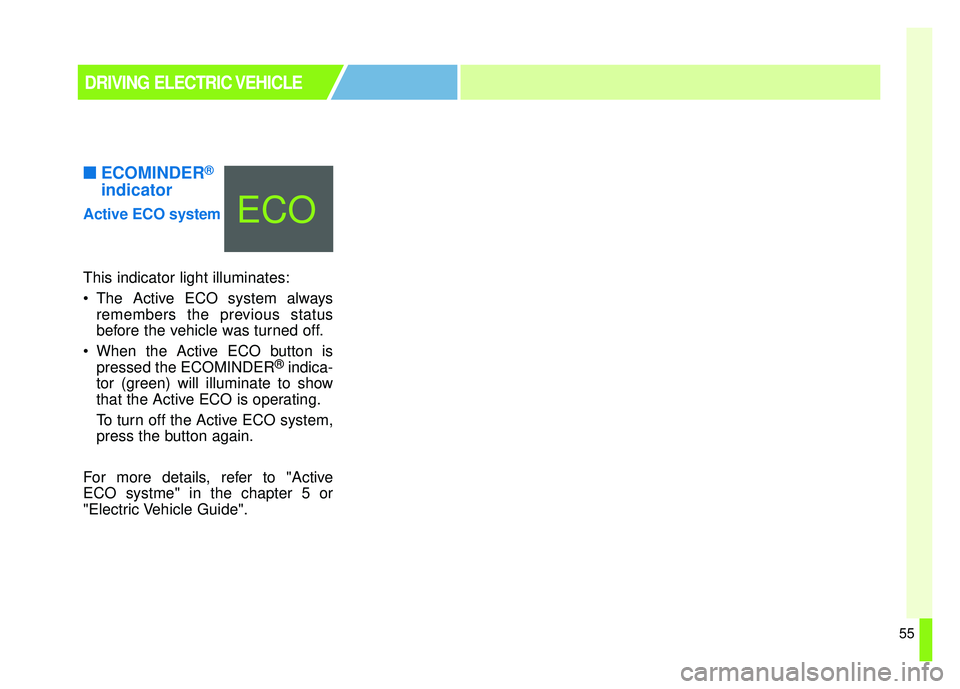
■ECOMINDER®
indicator
Active ECO system
This indicator light illuminates:
The Activ
e ECO system always
remembers the previous status
before the vehicle was turned off.
When the Active ECO button is pressed the ECOMINDER
®indica-
tor (green) will illuminate to show
that the Active ECO is operating.
To turn off the Active ECO system,
press the button again.
For more details, refer to "Active
ECO systme" in the chapter 5 or
"Electric Vehicle Guide".
DRIVING ELECTRIC VEHICLE
ECO
Page 71 of 496
Your vehicle at a glance
42
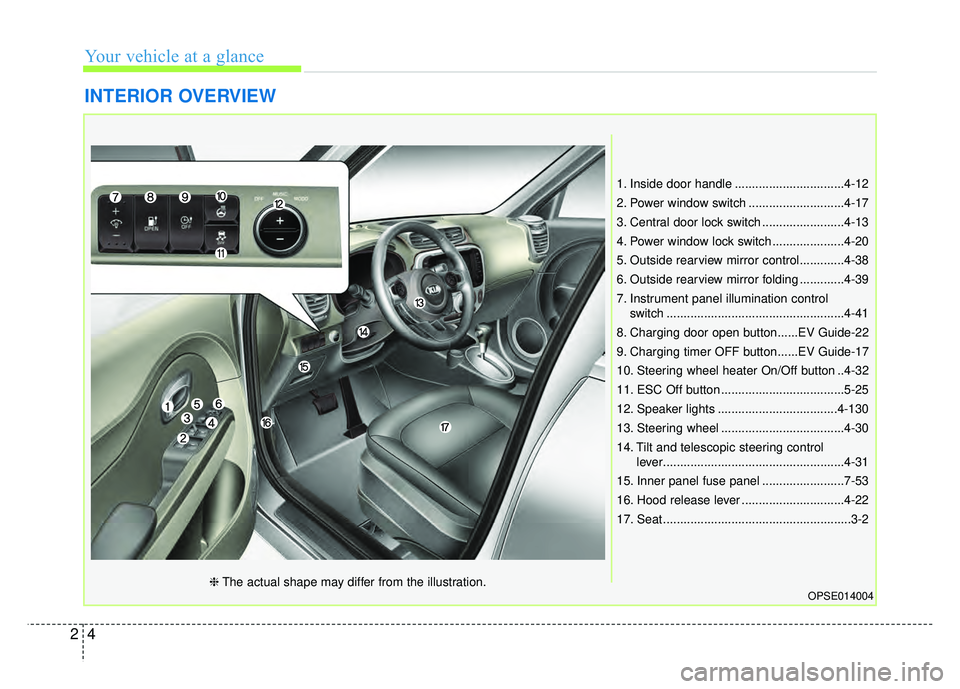
INTERIOR OVERVIEW
1. Inside door handle ................................4-12
2. Power window switch ............................4-17
3. Central door lock switch ........................4-13
4. Power window lock switch .....................4-20
5. Outside rearview mirror control.............4-38
6. Outside rearview mirror folding .............4-39
7. Instrument panel illumination controlswitch ....................................................4-41
8. Charging door open button......EV Guide-22
9. Charging timer OFF button......EV Guide-17
10. Steering wheel heater On/Off button ..4-32
11. ESC Off button ....................................5-25
12. Speaker lights ...................................4-130
13. Steering wheel ....................................4-30
14. Tilt and telescopic steering control lever.....................................................4-31
15. Inner panel fuse panel ........................7-53
16. Hood release lever ..............................4-22
17. Seat .......................................................3-2
OPSE014004❈ The actual shape may differ from the illustration.
Page 79 of 496
Safety features of your vehicle
63
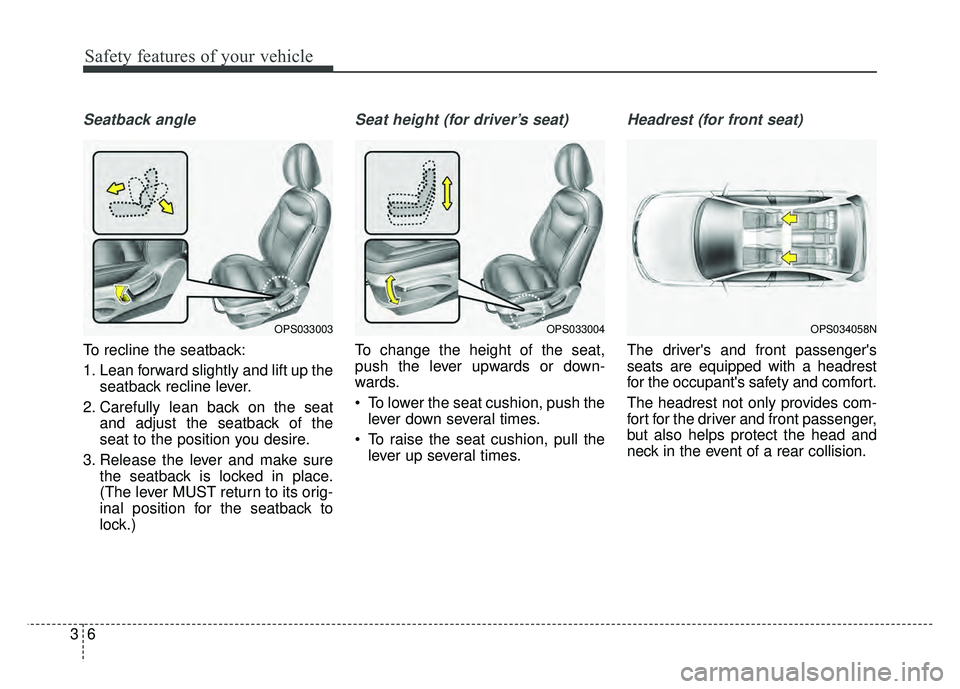
Seatback angle
To recline the seatback:
1. Lean forward slightly and lift up theseatback recline lever.
2. Carefully lean back on the seat and adjust the seatback of the
seat to the position you desire.
3. Release the lever and make sure the seatback is locked in place.
(The lever MUST return to its orig-
inal position for the seatback to
lock.)
Seat height (for driver’s seat)
To change the height of the seat,
push the lever upwards or down-
wards.
To lower the seat cushion, push thelever down several times.
To raise the seat cushion, pull the lever up several times.
Headrest (for front seat)
The driver's and front passenger's
seats are equipped with a headrest
for the occupant's safety and comfort.
The headrest not only provides com-
fort for the driver and front passenger,
but also helps protect the head and
neck in the event of a rear collision.
OPS033003OPS033004OPS034058N
Page 87 of 496
Safety features of your vehicle
14
3
When you fasten the seat belt, be
careful not to latch the seat belt in
buckles of other seat. It's very dan-
gerous and you may not be pro-
tected by the seat belt properly.
Do not unfasten the seat belt and do not fasten and unfasten the seat
belt repeatedly while driving. This
could result in loss of control, and
an accident causing death, serious
injury, or property damage.
When fastening the seat belt, make sure that the seat belt does
not pass over objects that are hard
or can break easily.Seat belt warning
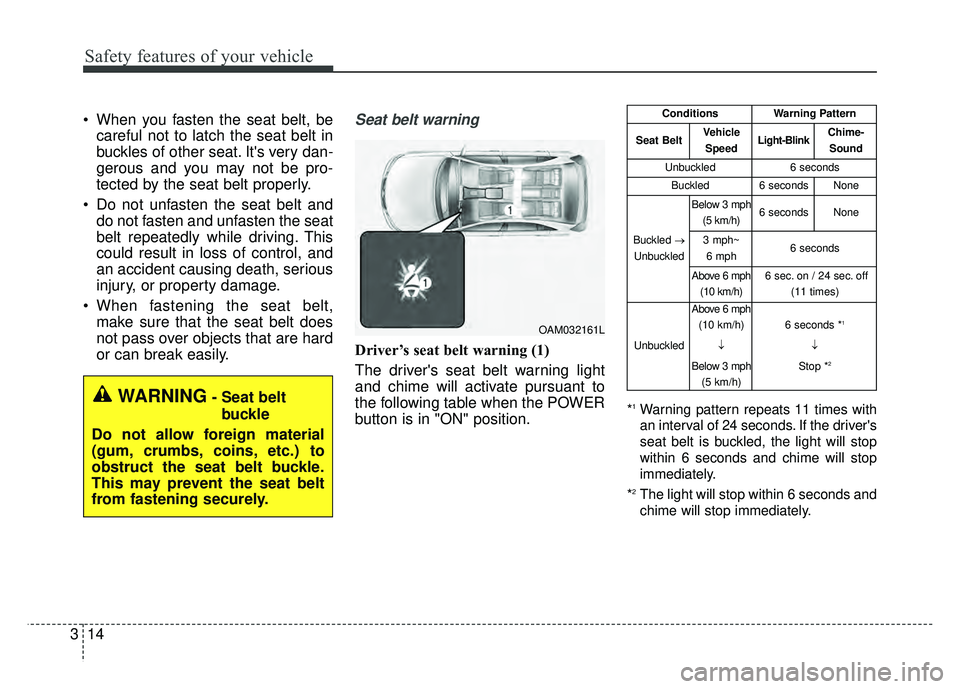
Driver’s seat belt warning (1)
The driver's seat belt warning light
and chime will activate pursuant to
the following table when the POWER
button is in "ON" position.
*1Warning pattern repeats 11 times with
an interval of 24 seconds. If the driver's
seat belt is buckled, the light will stop
within 6 seconds and chime will stop
immediately.
*
2The light will stop within 6 seconds and
chime will stop immediately.
OAM032161L
WARNING- Seat belt buckle
Do not allow foreign material
(gum, crumbs, coins, etc.) to
obstruct the seat belt buckle.
This may prevent the seat belt
from fastening securely.
ConditionsWarning Pattern
Seat BeltVehicle
SpeedLight-BlinkChime-Sound
Unbuckled6 seconds
Buckled6 secondsNone
Buckled →
Unbuckled
Below 3 mph (5 km/h)6 secondsNone
3 mph~6 mph6 seconds
Above 6 mph (10 km/h)6 sec. on / 24 sec. off (11 times)
Unbuckled
Above 6 mph(10 km/h)
↓
Below 3 mph (5 km/h)
6 seconds *1
↓
Stop *
2
Page 88 of 496
315
Safety features of your vehicle
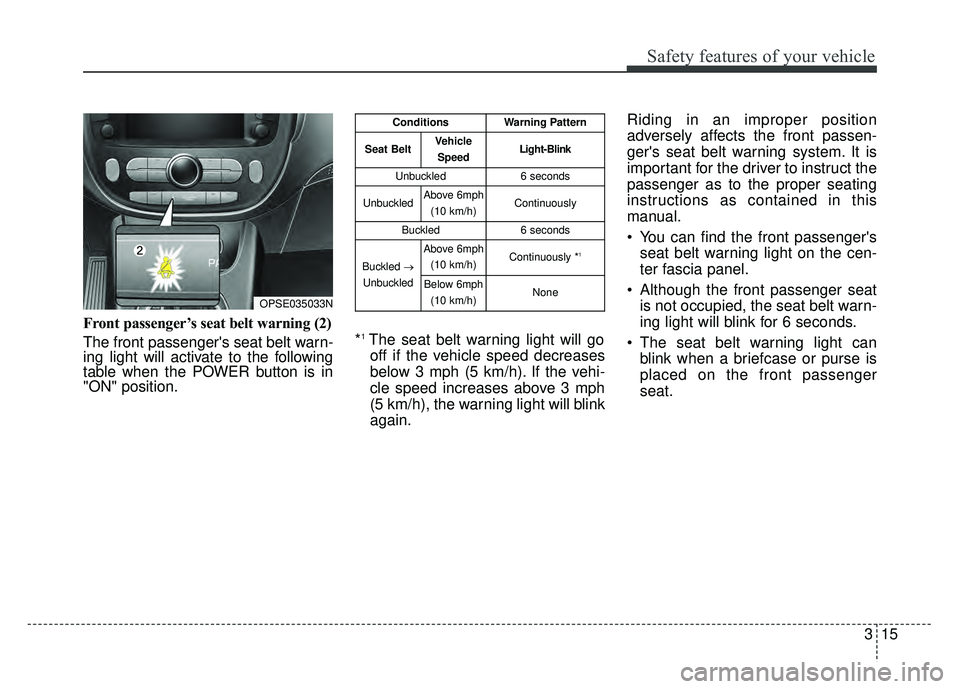
Front passenger’s seat belt warning (2)
The front passenger's seat belt warn-
ing light will activate to the following
table when the POWER button is in
"ON" position.*1The seat belt warning light will go
off if the vehicle speed decreases
below 3 mph (5 km/h). If the vehi-
cle speed increases above 3 mph
(5 km/h), the warning light will blink
again. Riding in an improper position
adversely affects the front passen-
ger's seat belt warning system. It is
important for the driver to instruct the
passenger as to the proper seating
instructions as contained in this
manual.
You can find the front passenger's
seat belt warning light on the cen-
ter fascia panel.
Although the front passenger seat is not occupied, the seat belt warn-
ing light will blink for 6 seconds.
The seat belt warning light can blink when a briefcase or purse is
placed on the front passenger
seat.
OPSE035033N
ConditionsWarning Pattern
Seat BeltVehicle
SpeedLight-Blink
Unbuckled6 seconds
UnbuckledAbove 6mph (10 km/h)Continuously
Buckled6 seconds
Buckled →
Unbuckled
Above 6mph (10 km/h)Continuously *1
Below 6mph(10 km/h)None
Page 94 of 496
321
Safety features of your vehicle
(1) Retractor PretensionerThe purpose of the retractor pre-tensioner is to make sure that the
shoulder belts fit in tightly against
the occupant's upper body in cer-
tain frontal collisions.
(2) EFD (Emergency Fastening Device)
The purpose of the EFD is tomake sure that the pelvis belts fit
in tightly against the occupant's
lower body in certain frontal colli-
sions.
If the system senses excessive ten-
sion on the driver or passenger's
seat belt when the pre-tensioner sys-
tem activates, the load limiter inside
the retractor pre-tensioner will release
some of the pressure on the affected
seat belt. The seat belt pre-tensioner system
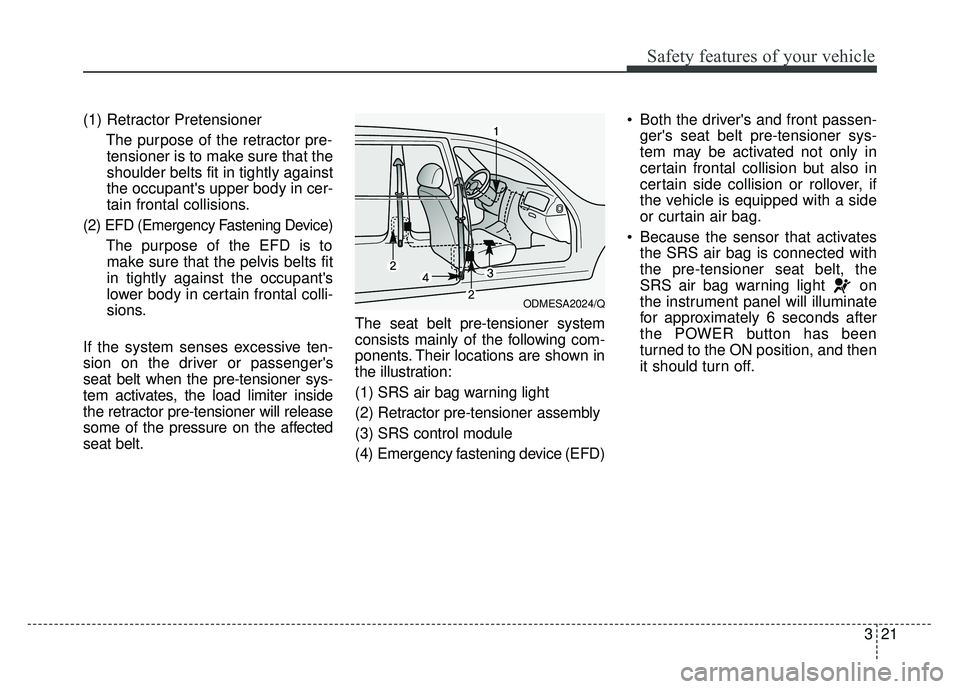
consists mainly of the following com-
ponents. Their locations are shown in
the illustration:
(1) SRS air bag warning light
(2) Retractor pre-tensioner assembly
(3) SRS control module
(4) Emergency fastening device (EFD) Both the driver's and front passen-
ger's seat belt pre-tensioner sys-
tem may be activated not only in
certain frontal collision but also in
certain side collision or rollover, if
the vehicle is equipped with a side
or curtain air bag.
Because the sensor that activates the SRS air bag is connected with
the pre-tensioner seat belt, the
SRS air bag warning light on
the instrument panel will illuminate
for approximately 6 seconds after
the POWER button has been
turned to the ON position, and then
it should turn off.
ODMESA2024/Q
Page 95 of 496
Safety features of your vehicle
22
3
If the pre-tensioner seat belt system
are not working properly, this warn-
ing light will illuminate even if there is
no malfunction of the SRS air bag. If
the SRS air bag warning light does
not illuminate when the POWER but-
ton is turned ON, or if it remains illu-
minated after illuminating for approx-
imately 6 seconds, or if it illuminates
while the vehicle is being driven,
have an authorized Kia dealer
inspect the pre-tensioner seat belt
and SRS air bag system as soon as
possible.
Pre-tensioners are designed to oper-
ate only one time. After activation,
pre-tensioner seat belts must be
replaced. If the pre-tensioner must
be replaced, contact an authorized
Kia dealer.Seat belt precautions
Infant or small child
All 50 states have child restraint
laws. You should be aware of the
specific requirements in your state.
Child and/or infant seats must be
properly placed and installed in the
rear seat. For more information
about the use of these restraints,
refer to “Child restraint system” in this
section.
WARNING- Hot preten-
sioner
Do not touch the pre-tensioner
seat belt assemblies for several
minutes after they have been
activated. When the pre-ten-
sioner seat belt mechanism
fires during a collision the pre-
tensioner becomes hot and can
burn you.
Page 96 of 496
323
Safety features of your vehicle
✽
✽NOTICE
Small children are best protected
from injury in an accident when
properly restrained in the rear seat
by a child restraint system that
meets the requirements of the
Federal Motor Vehicle Safety
Standards. Before buying any child
restraint system, make sure that it
has a label certifying that it meets
Federal Motor Vehicle Safety
Standard 213. The restraint must be
appropriate for your child's height
and weight. Check the label on the
child restraint for this information.
Refer to “Child restraint system” in
this section.
Larger children
Children who are too large for child
restraint systems should always
occupy the rear seat and use the
available lap/shoulder belts. The lap
portion should be fastened and
snugged on the hips and as low as
possible. Check if the belt fits period-
ically. A child's squirming could put
the belt out of position. Children are
given the most safety in the event of
an accident when they are restrained
by a proper restraint system in the
rear seat. If a larger child (over age
12) must be seated in the front seat,
the child should be securely
restrained by the available lap/shoul-
der belt and the seat should be
placed in the rearmost position.
Children age 12 and under should be
restrained securely in the rear seat.
NEVER place a child age 12 and
under in the front seat. NEVER place
a rear facing child seat in the front
seat of a vehicle. If the shoulder belt portion slightly
touches the child’s neck or face, try
placing the child closer to the center of
the vehicle. If the shoulder belt still
touches their face or neck they need to
be returned to a child restraint system.
WARNING- Small children
Do not allow small children to
ride in the vehicle without an
appropriate child restraint sys-
tem. If the shoulder belt comes
in contact with your child's neck
or face your child is too small to
ride in the vehicle. In a crash the
seat belt will inflict injury to your
child's neck, throat and face.
Page 110 of 496
337
Safety features of your vehicle
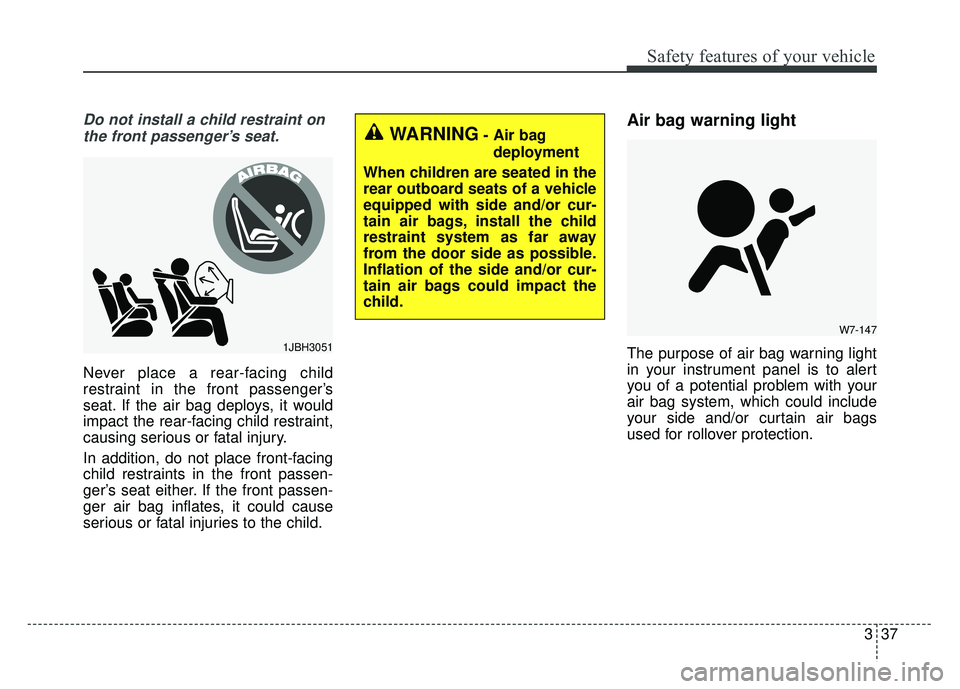
Do not install a child restraint onthe front passenger’s seat.
Never place a rear-facing child
restraint in the front passenger’s
seat. If the air bag deploys, it would
impact the rear-facing child restraint,
causing serious or fatal injury.
In addition, do not place front-facing
child restraints in the front passen-
ger’s seat either. If the front passen-
ger air bag inflates, it could cause
serious or fatal injuries to the child.
Air bag warning light
The purpose of air bag warning light
in your instrument panel is to alert
you of a potential problem with your
air bag system, which could include
your side and/or curtain air bags
used for rollover protection.1JBH3051
W7-147
WARNING- Air bag deployment
When children are seated in the
rear outboard seats of a vehicle
equipped with side and/or cur-
tain air bags, install the child
restraint system as far away
from the door side as possible.
Inflation of the side and/or cur-
tain air bags could impact the
child.
Page 111 of 496
Safety features of your vehicle
38
3
When the POWER button is turned
ON, the warning light should illumi-
nate for approximately 6 seconds,
then go off. Have the system
checked by an authorized Kia dealer-
ship if:
The light does not turn on briefly
when you turn the POWER button
ON.
The light stays on after illuminating for approximately 6 seconds.
The light comes on while the vehi- cle is in motion.
The light blinks when the POWER button is in ON position.SRS components and functions
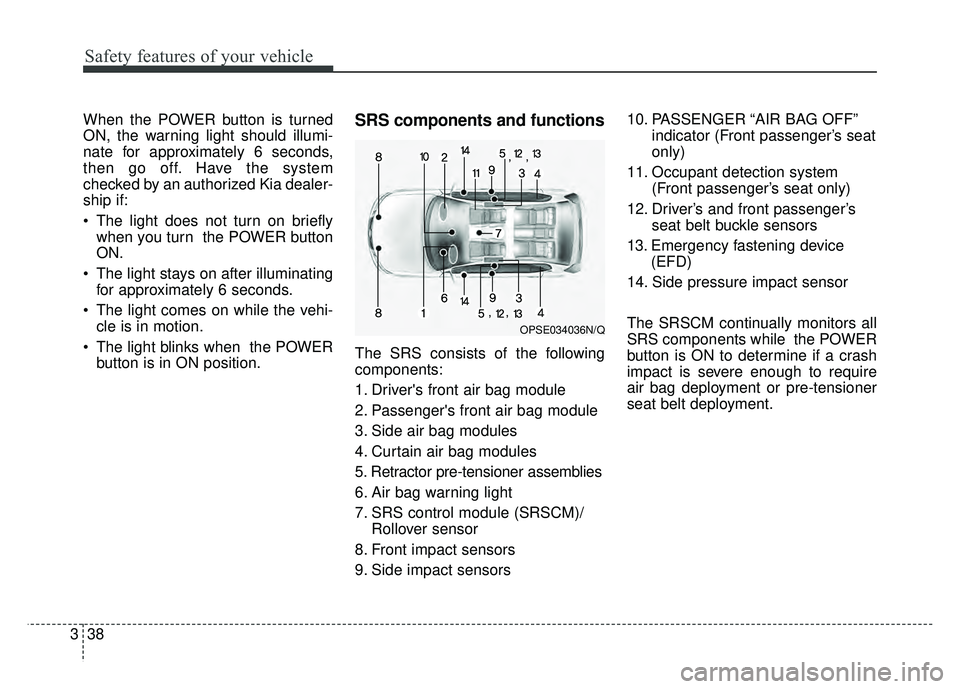
The SRS consists of the following
components:
1. Driver's front air bag module
2. Passenger's front air bag module
3. Side air bag modules
4. Curtain air bag modules
5. Retractor pre-tensioner assemblies
6. Air bag warning light
7. SRS control module (SRSCM)/ Rollover sensor
8. Front impact sensors
9. Side impact sensors 10. PASSENGER “AIR BAG OFF”
indicator (Front passenger’s seat
only)
11. Occupant detection system (Front passenger’s seat only)
12. Driver’s and front passenger’s seat belt buckle sensors
13. Emergency fastening device (EFD)
14. Side pressure impact sensor
The SRSCM continually monitors all
SRS components while the POWER
button is ON to determine if a crash
impact is severe enough to require
air bag deployment or pre-tensioner
seat belt deployment.
,
,,
OPSE034036N/Q
,