boot KIA SOUL EV 2019 Owners Manual
[x] Cancel search | Manufacturer: KIA, Model Year: 2019, Model line: SOUL EV, Model: KIA SOUL EV 2019Pages: 455, PDF Size: 15.52 MB
Page 276 of 455
4139
Features of your vehicle
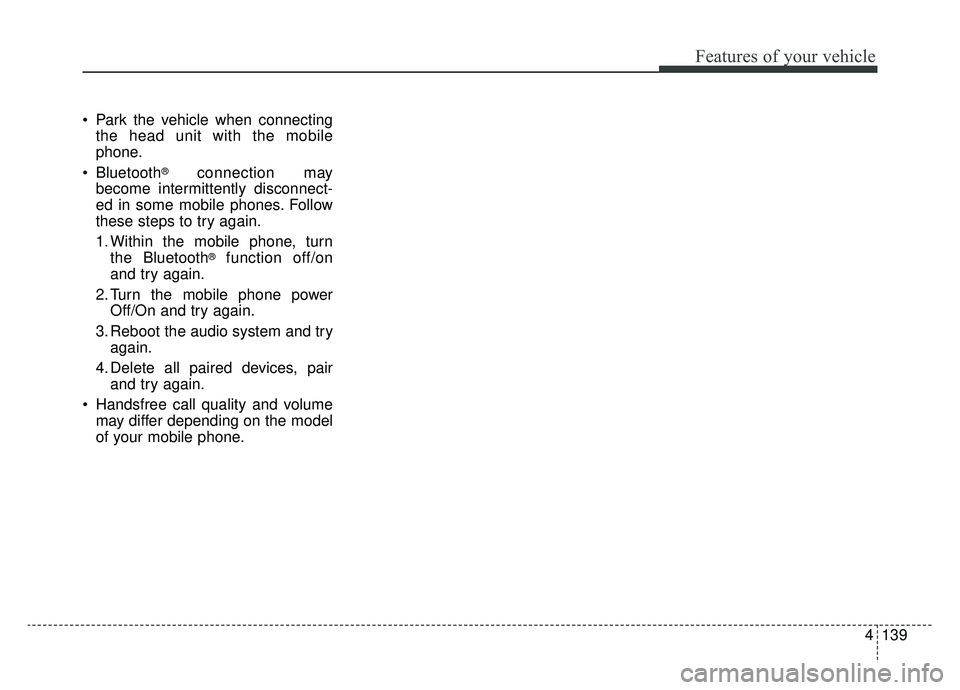
Park the vehicle when connectingthe head unit with the mobile
phone.
Bluetooth
®connection may
become intermittently disconnect-
ed in some mobile phones. Follow
these steps to try again.
1. Within the mobile phone, turn the Bluetooth
®function off/on
and try again.
2. Turn the mobile phone power Off/On and try again.
3. Reboot the audio system and try again.
4. Delete all paired devices, pair and try again.
Handsfree call quality and volume may differ depending on the model
of your mobile phone.
Page 283 of 455
Driving your vehicle
45
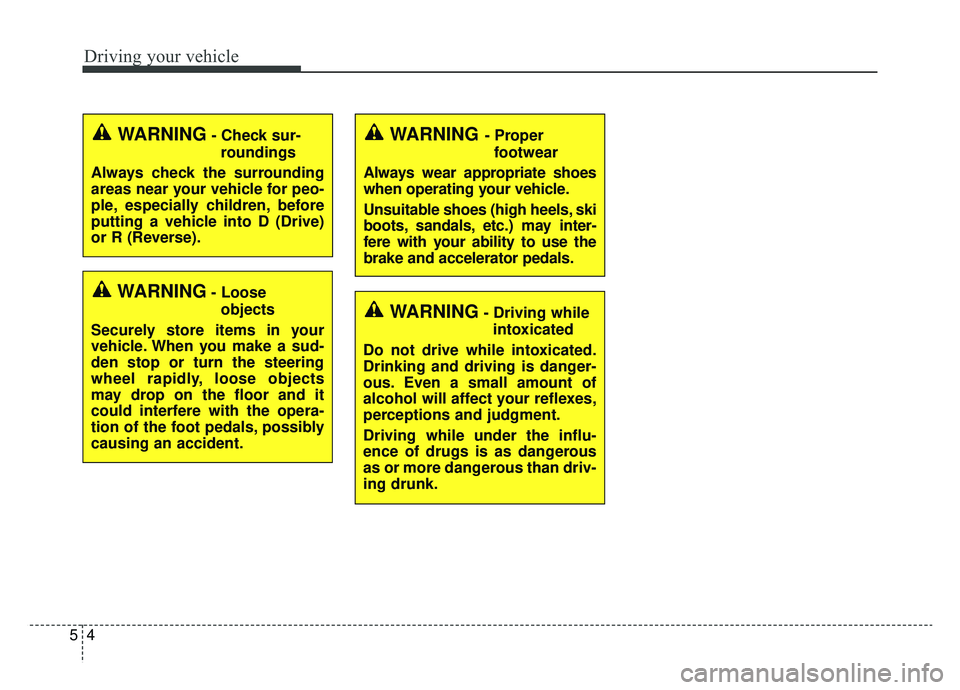
WARNING- Check sur-roundings
Always check the surrounding
areas near your vehicle for peo-
ple, especially children, before
putting a vehicle into D (Drive)
or R (Reverse).
WARNING- Loose objects
Securely store items in your
vehicle. When you make a sud-
den stop or turn the steering
wheel rapidly, loose objects
may drop on the floor and it
could interfere with the opera-
tion of the foot pedals, possibly
causing an accident.
WARNING- Driving while intoxicated
Do not drive while intoxicated.
Drinking and driving is danger-
ous. Even a small amount of
alcohol will affect your reflexes,
perceptions and judgment.
Driving while under the influ-
ence of drugs is as dangerous
as or more dangerous than driv-
ing drunk.
WARNING - Proper footwear
Always wear appropriate shoes
when operating your vehicle.
Unsuitable shoes (high heels, ski
boots, sandals, etc.) may inter-
fere with your ability to use the
brake and accelerator pedals.
Page 286 of 455
57
Driving your vehicle
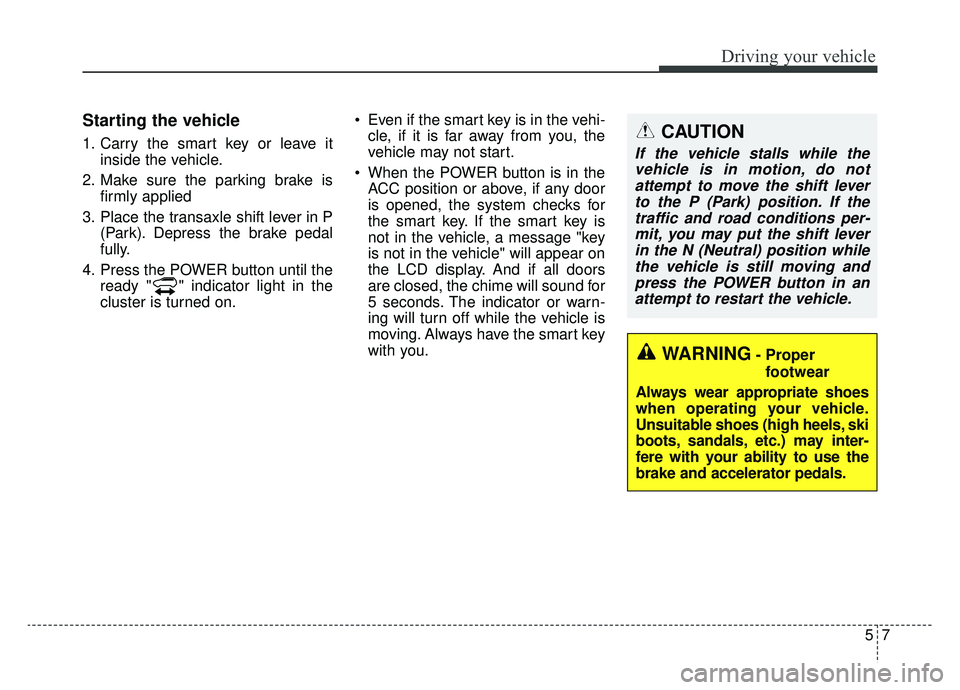
Starting the vehicle
1. Carry the smart key or leave itinside the vehicle.
2. Make sure the parking brake is firmly applied
3. Place the transaxle shift lever in P (Park). Depress the brake pedal
fully.
4. Press the POWER button until the ready " " indicator light in the
cluster is turned on. Even if the smart key is in the vehi-
cle, if it is far away from you, the
vehicle may not start.
When the POWER button is in the ACC position or above, if any door
is opened, the system checks for
the smart key. If the smart key is
not in the vehicle, a message "key
is not in the vehicle" will appear on
the LCD display. And if all doors
are closed, the chime will sound for
5 seconds. The indicator or warn-
ing will turn off while the vehicle is
moving. Always have the smart key
with you.CAUTION
If the vehicle stalls while thevehicle is in motion, do notattempt to move the shift leverto the P (Park) position. If thetraffic and road conditions per-mit, you may put the shift leverin the N (Neutral) position whilethe vehicle is still moving andpress the POWER button in anattempt to restart the vehicle.
WARNING- Proper
footwear
Always wear appropriate shoes
when operating your vehicle.
Unsuitable shoes (high heels, ski
boots, sandals, etc.) may inter-
fere with your ability to use the
brake and accelerator pedals.
Page 367 of 455
79
Maintenance
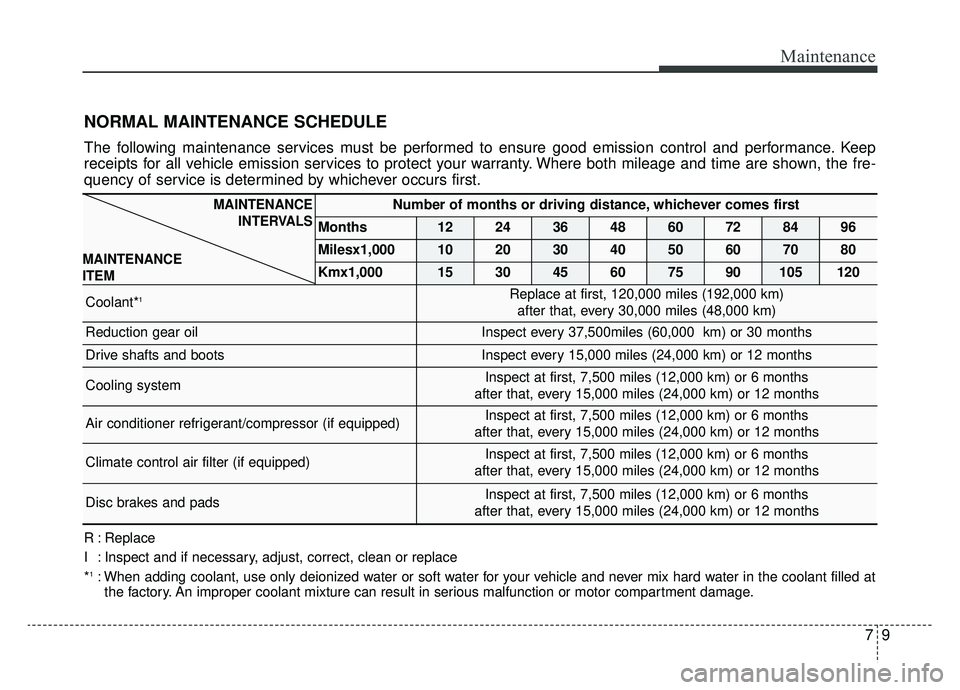
NORMAL MAINTENANCE SCHEDULE
R : Replace
I : Inspect and if necessary, adjust, correct, clean or replace
*
1: When adding coolant, use only deionized water or soft water for your vehicle and never mix hard water in the coolant filled atthe factory. An improper coolant mixture can result in serious malfunction or motor compartment damage.
The following maintenance services must be performed to ensure good emission control and performance. Keep
receipts for all vehicle emission services to protect your warranty. Where both mileage and time are shown, the fre-
quency of service is determined by whichever occurs first.
Number of months or driving distance, whichever comes first
Months1224364860728496
Milesx1,0001020304050607080
Kmx1,000153045607590105120
Coolant*1Replace at first, 120,000 miles (192,000 km)
after that, every 30,000 miles (48,000 km)
Reduction gear oilInspect every 37,500miles (60,000 km) or 30 months
Drive shafts and bootsInspect every 15,000 miles (24,000 km) or 12 months
Cooling systemInspect at first, 7,500 miles (12,000 km) or 6 months
after that, every 15,000 miles (24,000 km) or 12 months
Air conditioner refrigerant/compressor (if equipped)Inspect at first, 7,500 miles (12,000 km) or 6 months
after that, every 15,000 miles (24,000 km) or 12 months
Climate control air filter (if equipped)Inspect at first, 7,500 miles (12,000 km) or 6 months
after that, every 15,000 miles (24,000 km) or 12 months
Disc brakes and padsInspect at first, 7,500 miles (12,000 km) or 6 months
after that, every 15,000 miles (24,000 km) or 12 months
MAINTENANCE INTERVALS
MAINTENANCE
ITEM
Page 368 of 455
Maintenance
10
7
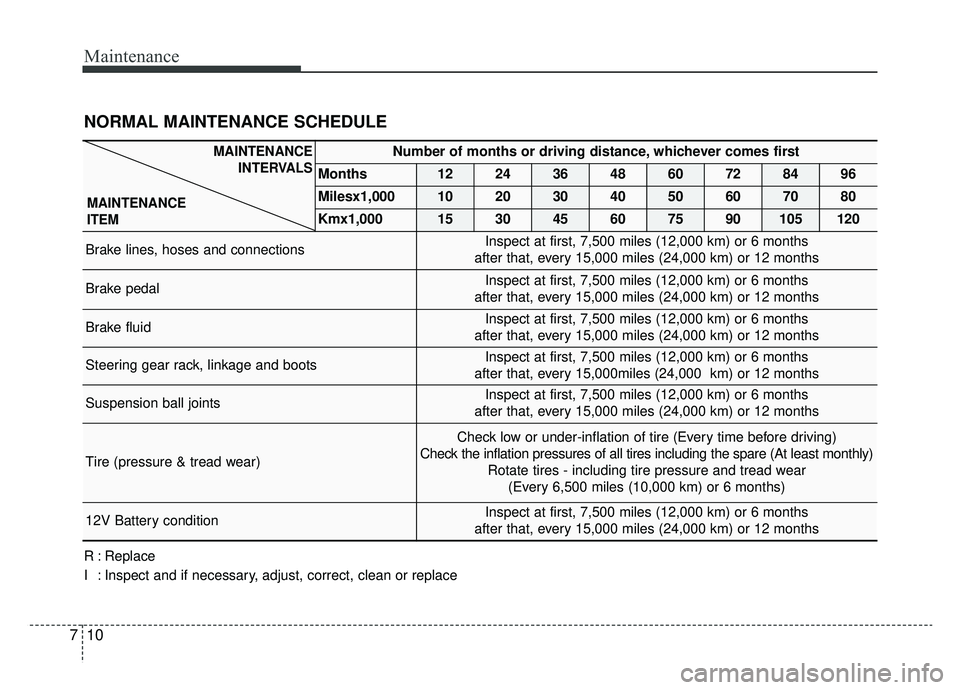
NORMAL MAINTENANCE SCHEDULE
R : Replace
I : Inspect and if necessary, adjust, correct, clean or replace
Number of months or driving distance, whichever comes first
Months1224364860728496
Milesx1,0001020304050607080
Kmx1,000153045607590105120
Brake lines, hoses and connectionsInspect at first, 7,500 miles (12,000 km) or 6 months
after that, every 15,000 miles (24,000 km) or 12 months
Brake pedalInspect at first, 7,500 miles (12,000 km) or 6 months
after that, every 15,000 miles (24,000 km) or 12 months
Brake fluidInspect at first, 7,500 miles (12,000 km) or 6 months
after that, every 15,000 miles (24,000 km) or 12 months
Steering gear rack, linkage and bootsInspect at first, 7,500 miles (12,000 km) or 6 months
after that, every 15,000miles (24,000 km) or 12 months
Suspension ball jointsInspect at first, 7,500 miles (12,000 km) or 6 months
after that, every 15,000 miles (24,000 km) or 12 months
Tire (pressure & tread wear)
Check low or under-inflation of tire (Every time before driving)
Check the inflation pressures of all tires including the spare (At least mo\
nthly) Rotate tires - including tire pressure and tread wear (Every 6,500 miles (10,000 km) or 6 months)
12V Battery conditionInspect at first, 7,500 miles (12,000 km) or 6 months
after that, every 15,000 miles (24,000 km) or 12 months
MAINTENANCE INTERVALS
MAINTENANCE
ITEM
Page 369 of 455
711
Maintenance
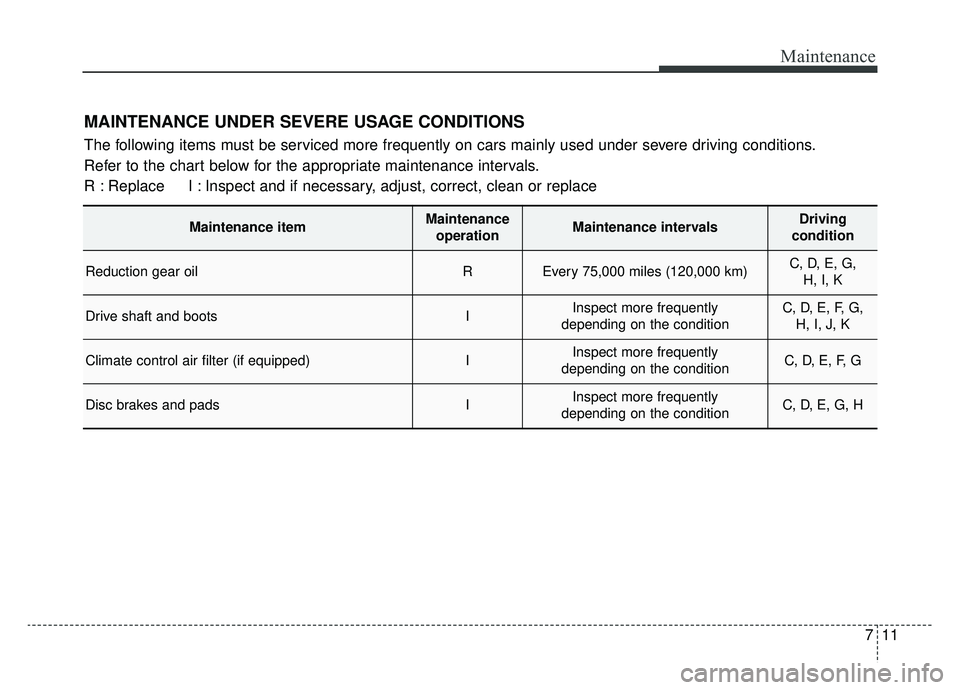
MAINTENANCE UNDER SEVERE USAGE CONDITIONS
The following items must be serviced more frequently on cars mainly used under severe driving conditions.
Refer to the chart below for the appropriate maintenance intervals.
R : Replace I : Inspect and if necessary, adjust, correct, clean or replace
Maintenance itemMaintenanceoperationMaintenance intervalsDriving
condition
Reduction gear oilREvery 75,000 miles (120,000 km)C, D, E, G, H, I, K
Drive shaft and bootsIInspect more frequently
depending on the conditionC, D, E, F, G, H, I, J, K
Climate control air filter (if equipped)IInspect more frequently
depending on the conditionC, D, E, F, G
Disc brakes and padsIInspect more frequently
depending on the conditionC, D, E, G, H
Page 370 of 455
Maintenance
12
7
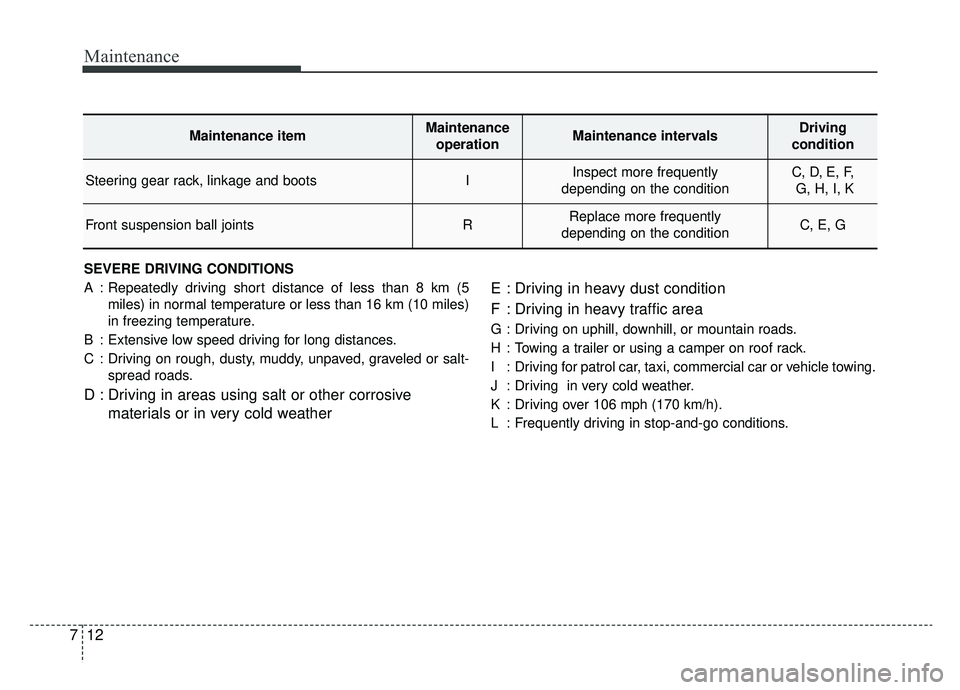
SEVERE DRIVING CONDITIONS
A : Repeatedly driving short distance of less than 8 km (5
miles) in normal temperature or less than 16 km (10 miles)
in freezing temperature.
B : Extensive low speed driving for long distances.
C : Driving on rough, dusty, muddy, unpaved, graveled or salt- spread roads.
D : Driving in areas using salt or other corrosive materials or in very cold weather E : Driving in heavy dust condition
F : Driving in heavy traffic area
G : Driving on uphill, downhill, or mountain roads.
H : Towing a trailer or using a camper on roof rack.
I : Driving for patrol car, taxi, commercial car or vehicle towing.
J : Driving in very cold weather.
K : Driving over 106 mph (170 km/h).
L : Frequently driving in stop-and-go conditions.
Maintenance itemMaintenance
operationMaintenance intervalsDriving
condition
Steering gear rack, linkage and bootsIInspect more frequently
depending on the conditionC, D, E, F, G, H, I, K
Front suspension ball jointsRReplace more frequently
depending on the conditionC, E, G
Page 372 of 455
Maintenance
14
7
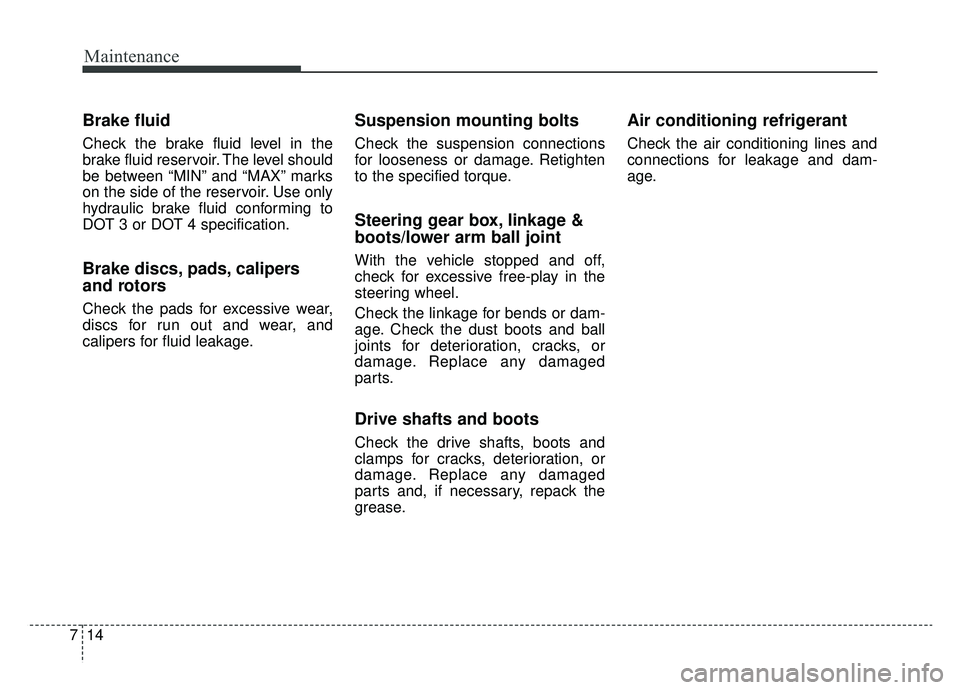
Brake fluid
Check the brake fluid level in the
brake fluid reservoir. The level should
be between “MIN” and “MAX” marks
on the side of the reservoir. Use only
hydraulic brake fluid conforming to
DOT 3 or DOT 4 specification.
Brake discs, pads, calipers
and rotors
Check the pads for excessive wear,
discs for run out and wear, and
calipers for fluid leakage.
Suspension mounting bolts
Check the suspension connections
for looseness or damage. Retighten
to the specified torque.
Steering gear box, linkage &
boots/lower arm ball joint
With the vehicle stopped and off,
check for excessive free-play in the
steering wheel.
Check the linkage for bends or dam-
age. Check the dust boots and ball
joints for deterioration, cracks, or
damage. Replace any damaged
parts.
Drive shafts and boots
Check the drive shafts, boots and
clamps for cracks, deterioration, or
damage. Replace any damaged
parts and, if necessary, repack the
grease.
Air conditioning refrigerant
Check the air conditioning lines and
connections for leakage and dam-
age.
Page 426 of 455
Maintenance
68
7
High-pressure washing
When using high-pressure wash-
ers, make sure to maintain suffi-
cient distance from the vehicle.
Insufficient clearance or excessive
pressure can lead to component
damage or water penetration.
Do not spray the camera, sensors or its surrounding area directly with
a high pressure washer. Shock
applied from high pressure water
may cause the device to not oper-
ate normally.
Do not bring the nozzle tip close to boots (rubber or plastic covers) or
connectors as they may be dam-
aged if they come into contact with
high pressure water. Waxing
Wax the vehicle when water will no
longer bead on the paint.
Always wash and dry the vehicle
before waxing. Use a good quality
liquid or paste wax, and follow the
manufacturer’s instructions. Wax all
metal trim to protect it and to main-
tain its luster.
Removing oil, tar, and similar materi-
als with a spot remover will usually
strip the wax from the finish. Be sure to
re-wax these areas even if the rest of
the vehicle does not yet need waxing.
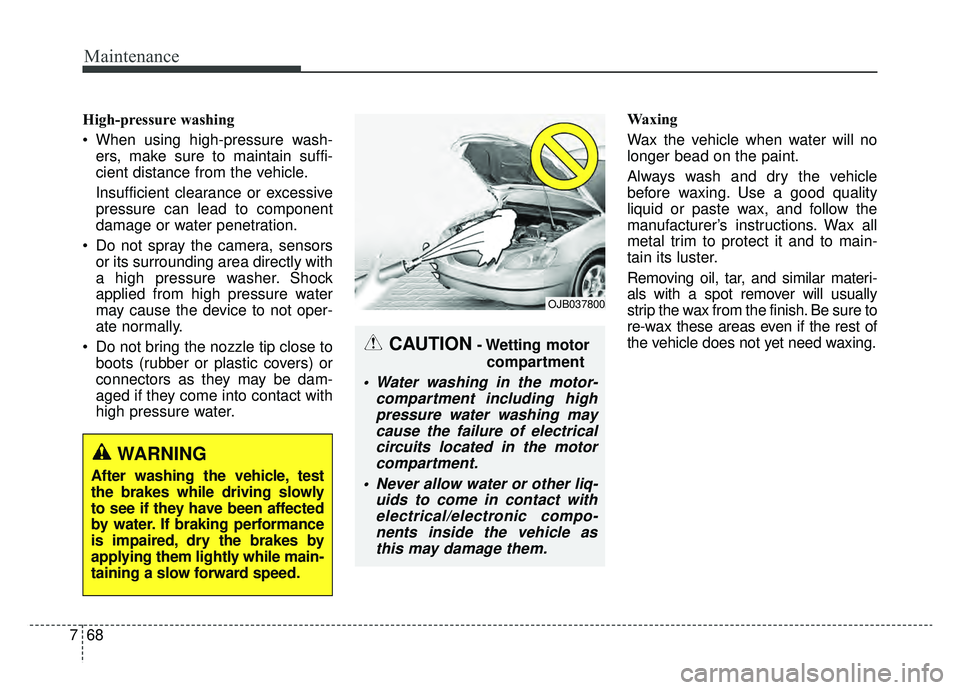
CAUTION- Wetting motor
compartment
Water washing in the motor- compartment including highpressure water washing maycause the failure of electricalcircuits located in the motorcompartment.
Never allow water or other liq- uids to come in contact withelectrical/electronic compo-nents inside the vehicle asthis may damage them.
OJB037800
WARNING
After washing the vehicle, test
the brakes while driving slowly
to see if they have been affected
by water. If braking performance
is impaired, dry the brakes by
applying them lightly while main-
taining a slow forward speed.