belt KIA SPECTRA5 2006 Owner's Manual
[x] Cancel search | Manufacturer: KIA, Model Year: 2006, Model line: SPECTRA5, Model: KIA SPECTRA5 2006Pages: 273, PDF Size: 2.83 MB
Page 54 of 273
343
1
2
3
4
5
6
7
8
9
Knowing your vehicle
To clean the belt webbing, use a
mild soap solution recommended
for cleaning upholstery or carpets.
Follow the instructions provided
with the soap.
Do not make modifications or addi-
tions to the safety belt.
After wearing a safety belt, make
sure it fully retracts to the stowed
position. Do not allow the belt to
get caught in the door when you
close it.
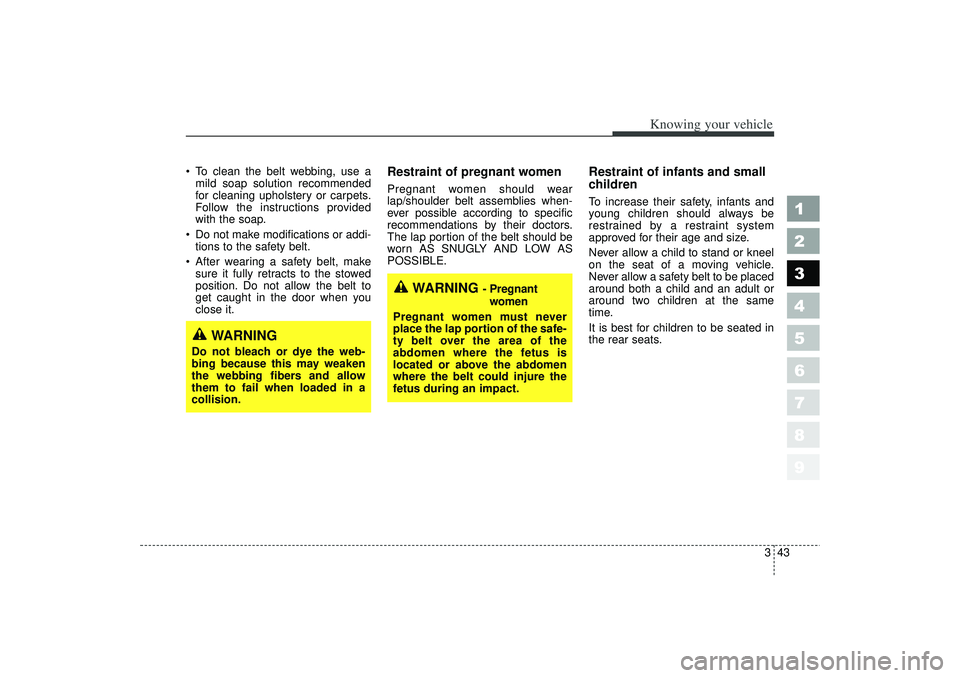
Restraint of pregnant women Pregnant women should wear
lap/shoulder belt assemblies when-
ever possible according to specific
recommendations by their doctors.
The lap portion of the belt should be
worn AS SNUGLY AND LOW AS
POSSIBLE.
Restraint of infants and small
children To increase their safety, infants and
young children should always be
restrained by a restraint system
approved for their age and size.
Never allow a child to stand or kneel
on the seat of a moving vehicle.
Never allow a safety belt to be placed
around both a child and an adult or
around two children at the same
time.
It is best for children to be seated in
the rear seats.
WARNING
- Pregnant
women
Pregnant women must never
place the lap portion of the safe-
ty belt over the area of the
abdomen where the fetus is
located or above the abdomen
where the belt could injure the
fetus during an impact.
WARNING
Do not bleach or dye the web-
bing because this may weaken
the webbing fibers and allow
them to fail when loaded in a
collision.
LD CAN (ENG) new 3-1~.qxd 7/29/05 10:28 AM Page 43
Page 56 of 273
345
1
2
3
4
5
6
7
8
9
Knowing your vehicle
Restraint of larger children As children grow, they may need to
use new child-restraint systems,
including larger child seats or boost-
er seats, which are appropriate for
their increased size.
A child who has outgrown available
child-restraint systems should use
the belts provided in the vehicle.
When seated in the rear outboard
seats, the child should be restrained
by the lap/shoulder belt.
If the shoulder belt portion slightly
touches the child’s neck or face, try
placing the child closer to the center
of the vehicle. If the shoulder belt still
touches their face or neck they may
need to be returned to a child
restraint system. In addition, after-
market devices are available from
independent manufacturers which
help pull the shoulder belt down and
away from the child’ s face or neck.
Larger children should use one of
the seat belts provided.
WARNING
- Shoulder
belts on small children
Never allow a shoulder belt to be in contact with a child’s
neck or face while the vehicle
is in motion.
If safety belts are not properly worn and adjusted, there is a
risk of death or serious injury
to such a child.
CAUTION
- Hot metal
parts
Safety belts and seats can
become hot in a vehicle that has
been closed during warm/hot
weather; they could burn a
child. Check seat covers and
buckles before you place a child
anywhere near them.
LD CAN (ENG) new 3-1~.qxd 7/29/05 10:28 AM Page 45
Page 57 of 273
Knowing your vehicle46
3
1
2
3
4
5
6
7
8
9
Child restraint system
(if equipped)For small children and babies, the
use of a child seat or infant seat is
required by law. This child seat or
infant seat should be of appropriate
size for the child and should be
installed in accordance with the man-
ufacturer's instructions. It is strongly
recommended that the seat be
placed in the vehicle's rear seat
since this can make an important
contribution to safety.
Children riding in the car should sit
on the rear seat and must always be
properly restrained to minimize the
risk of injury in an accident, sudden
stop or sudden maneuver. According
to accident statistics, children are
safer when properly restrained in the
rear seats than in the front seat. You are required by law to use safe-
ty restraints for children. If small chil-
dren ride in your vehicle you must
put them in a child restraint system
(safety seat).
Children could be injured or killed in
a crash if their restraints are not
properly secured. For small children
and babies, a child seat or infant seat
must be used. Before buying a par-
ticular child restraint system, make
sure it fits your car and seat belts,
and fits your child. Follow all the
instructions provided by the manu-
facturer when installing the child
restraint system.
E1BLA204
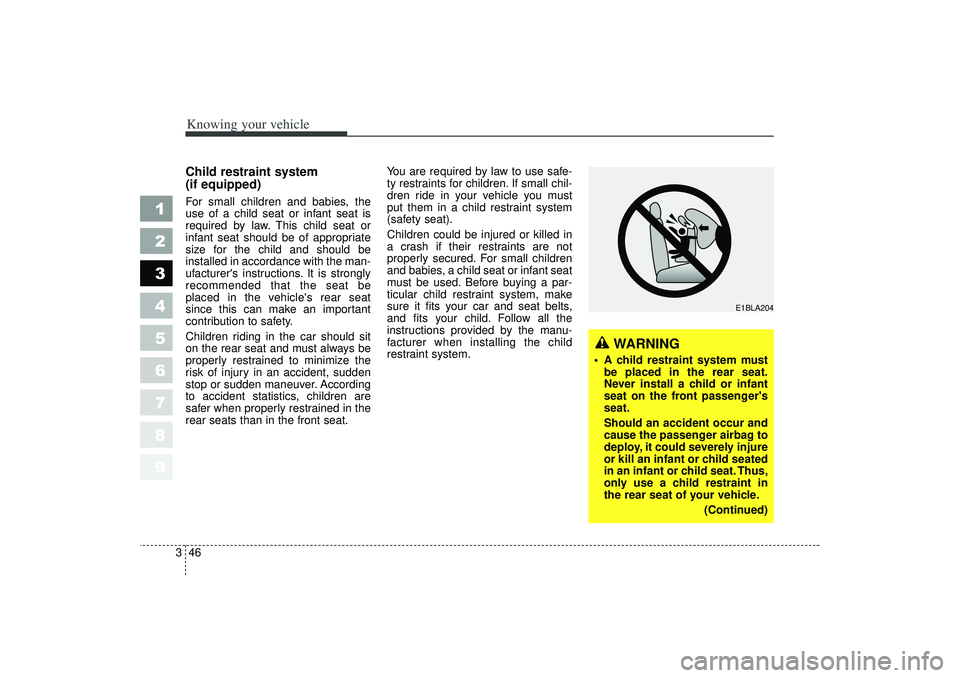
WARNING
A child restraint system must
be placed in the rear seat.
Never install a child or infant
seat on the front passenger's
seat.
Should an accident occur and
cause the passenger airbag to
deploy, it could severely injure
or kill an infant or child seated
in an infant or child seat. Thus,
only use a child restraint in
the rear seat of your vehicle.
(Continued)
LD CAN (ENG) new 3-1~.qxd 7/29/05 10:28 AM Page 46
Page 58 of 273
347
1
2
3
4
5
6
7
8
9
Knowing your vehicle
(Continued)
Always make sure that theshoulder belt portion of the
lap/shoulder belt is positioned
midway over the shoulder,
never across the neck or
behind the back. The lap belt
portion of the lap/shoulder
belt must always be posi-
tioned as low as possible on
the child's hips and as snug
as possible.
If the seat belt will not proper- ly fit the child the use of an
approved booster seat in the
rear seat must be used in
order to raise the child's seat-
ing height so that the seat belt
will properly fit the child.
(Continued)
(Continued)
Never allow a child to stand upor kneel on the seat.
Never use an infant carrier or child safety seat that "hooks"
over a seatback; it may not
provide adequate security in
an accident.
Never allow a child to be held in a person's arms while they
are in a moving vehicle, as
this could result in serious
injury to the child in the event
of an accident or a sudden
stop. Holding a child in a mov-
ing vehicle does not provide
the child with any means of
protection during an accident,
even if the person holding the
child is wearing a seat belt.
(Continued)
Since a safety belt or childrestraint system can become
very hot if it is left in a closed
vehicle, be sure to check the
seat cover and buckles before
placing a child there.
When the child restraint sys- tem is not in use, store it in the
trunk or fasten it with a safety
belt so that it will not be
thrown forward in the case of
a sudden stop or an accident.
Children who are too large to be in a child restraint should
sit in the rear seat and be
restrained with the available
lap/shoulder belts. Never
allow children to ride in the
front passenger seat.
(Continued)
LD CAN (ENG) new 3-1~.qxd 7/29/05 10:28 AM Page 47
Page 59 of 273
Knowing your vehicle48
3
1
2
3
4
5
6
7
8
9
Installing a child restraint system
For safety reasons, we recommend
that the child restraint system be
used in the rear seats.
Never place a rear-facing child
restraint in the front passenger
seat, because of the danger that
an inflating passenger side air bag
could impact the rear-facing child
restraint and kill the child.
Since all passenger’ s (except dri-
ver ’s) safety belts move freely under
normal conditions and only lock
under extreme or emergency condi-
tions (emergency lock mode), you
must manually change these safety
belts to the auto lock mode to secure
a child restraint.✽ ✽ NOTICEThe driver’s safety belt incorporates
the emergency lock mode only.
WARNING
Do not install any child
restraint system in the front
passenger seat. Should an
accident occur and cause the
passenger airbag to deploy, it
could severely injure or kill an
infant or child seated in an
infant or child seat. Therefore,
only use a child restraint sys-
tem in the rear seat of your
vehicle.
If the child restraint seat is not anchored properly, the risk of
a child being seriously injured
or killed in a collision greatly
increases.
WARNING
Before installing the childrestraint system, read the
instructions supplied by the
child restraint system manu-
facturer.
If the seat belt does not oper- ate as described, have the
system checked immediately
by your authorized Kia dealer.
Failure to observe this manual instructions regarding child
restraint system and the
instructions provided with the
child restraint system could
increase the chance and/or
severity of injury in an acci-
dent.
LD CAN (ENG) new 3-1~.qxd 7/29/05 10:28 AM Page 48
Page 60 of 273
349
1
2
3
4
5
6
7
8
9
Knowing your vehicle
Placing a passenger safety
belt into the auto lock modeThe use of the auto lock mode will
ensure that the normal movement of
the child in the vehicle does not
cause the safety belt to be pulled out
and loosen the firmness of its hold
on the child restraint system. To
secure a child restraint system, use
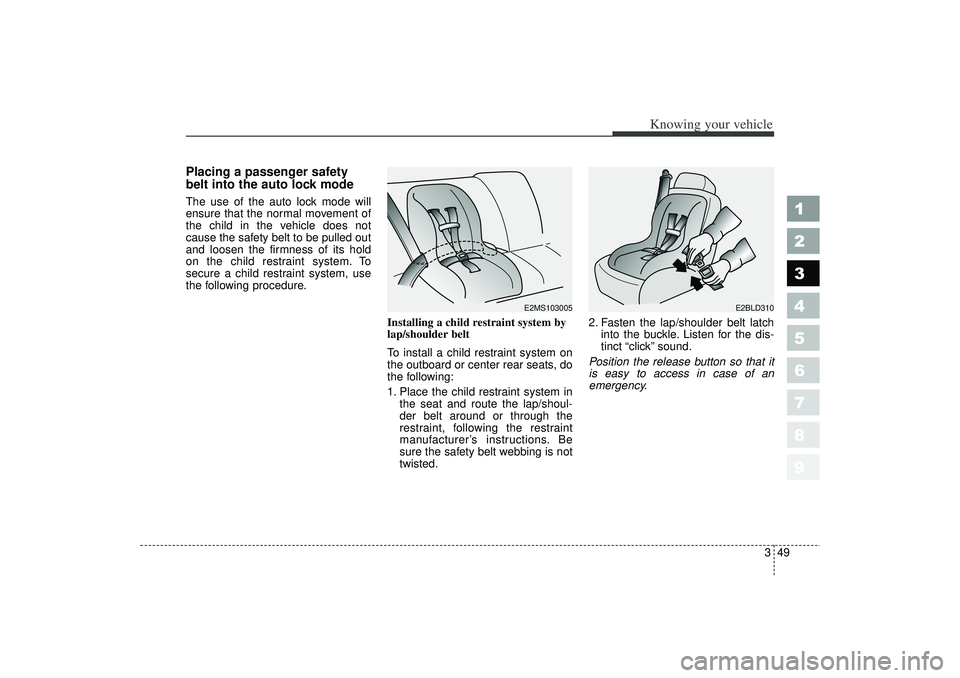
the following procedure.Installing a child restraint system by
lap/shoulder belt
To install a child restraint system on
the outboard or center rear seats, do
the following:
1. Place the child restraint system inthe seat and route the lap/shoul-
der belt around or through the
restraint, following the restraint
manufacturer’ s instructions. Be
sure the safety belt webbing is not
twisted. 2. Fasten the lap/shoulder belt latch
into the buckle. Listen for the dis-
tinct “click” sound.
Position the release button so that it
is easy to access in case of an
emergency.
E2MS103005
E2BLD310
LD CAN (ENG) new 3-1~.qxd 7/29/05 10:28 AM Page 49
Page 61 of 273
Knowing your vehicle50
3
1
2
3
4
5
6
7
8
9
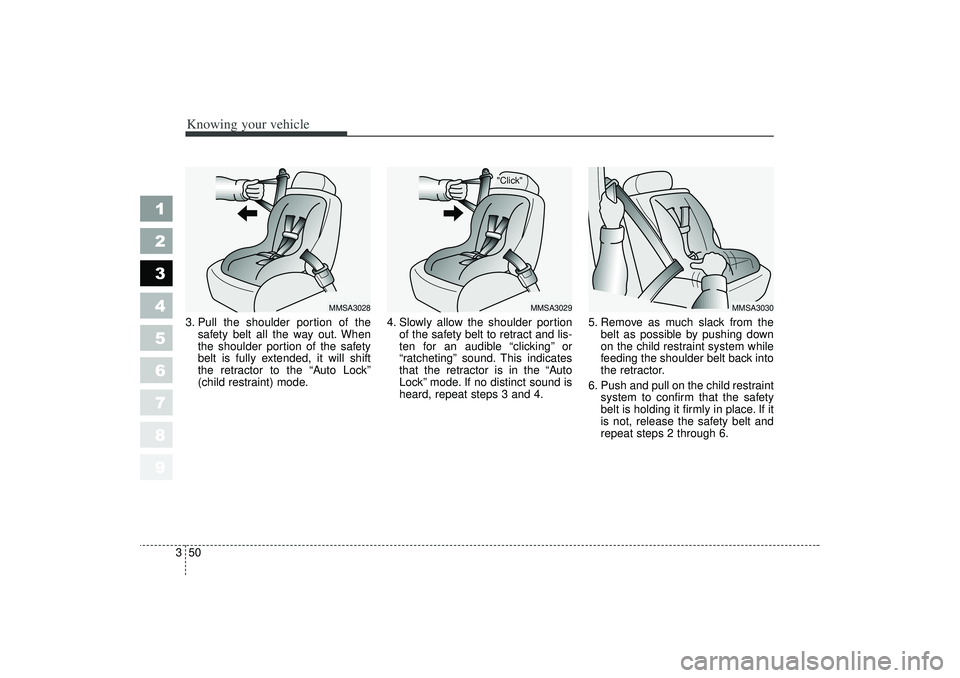
3. Pull the shoulder portion of the
safety belt all the way out. When
the shoulder portion of the safety
belt is fully extended, it will shift
the retractor to the “Auto Lock”
(child restraint) mode. 4. Slowly allow the shoulder portion
of the safety belt to retract and lis-
ten for an audible “clicking” or
“ratcheting” sound. This indicates
that the retractor is in the “Auto
Lock” mode. If no distinct sound is
heard, repeat steps 3 and 4. 5. Remove as much slack from the
belt as possible by pushing down
on the child restraint system while
feeding the shoulder belt back into
the retractor.
6. Push and pull on the child restraint system to confirm that the safety
belt is holding it firmly in place. If it
is not, release the safety belt and
repeat steps 2 through 6.
"Click"
MMSA3029
MMSA3030
MMSA3028
LD CAN (ENG) new 3-1~.qxd 7/29/05 10:28 AM Page 50
Page 62 of 273
351
1
2
3
4
5
6
7
8
9
Knowing your vehicle
7. Double check that the retractor isin the “Auto Lock” mode by
attempting to pull more of the safe-
ty belt out of the retractor. If you
cannot, the retractor is in the “Auto
Lock” mode.
To remove the child restraint, press
the release button on the buckle and
then pull the lap/shoulder belt out of
the restraint and allow the safety belt
to retract fully.
✽ ✽ NOTICEWhen the safety belt is allowed to
retract to its fully stowed position,
the retractor will automatically
switch from the “Auto Lock” mode
to the emergency lock mode for nor-
mal adult usage.
WARNING
- Auto lock
mode
The lap/shoulder belt automati-
cally returns to the “emergency
lock mode” whenever the belt is
allowed to retract fully.
Therefore, the preceding seven
steps must be followed each
time a child restraint is
installed.
If the safety belt is not placed in
the “auto lock” mode, severe
injury or death could occur to
the child and/or other occupants
in the vehicle in a collision,
since the child restraint will not
be effectively held in place.
LD CAN (ENG) new 3-1~.qxd 7/29/05 10:28 AM Page 51
Page 64 of 273
353
1
2
3
4
5
6
7
8
9
Knowing your vehicle
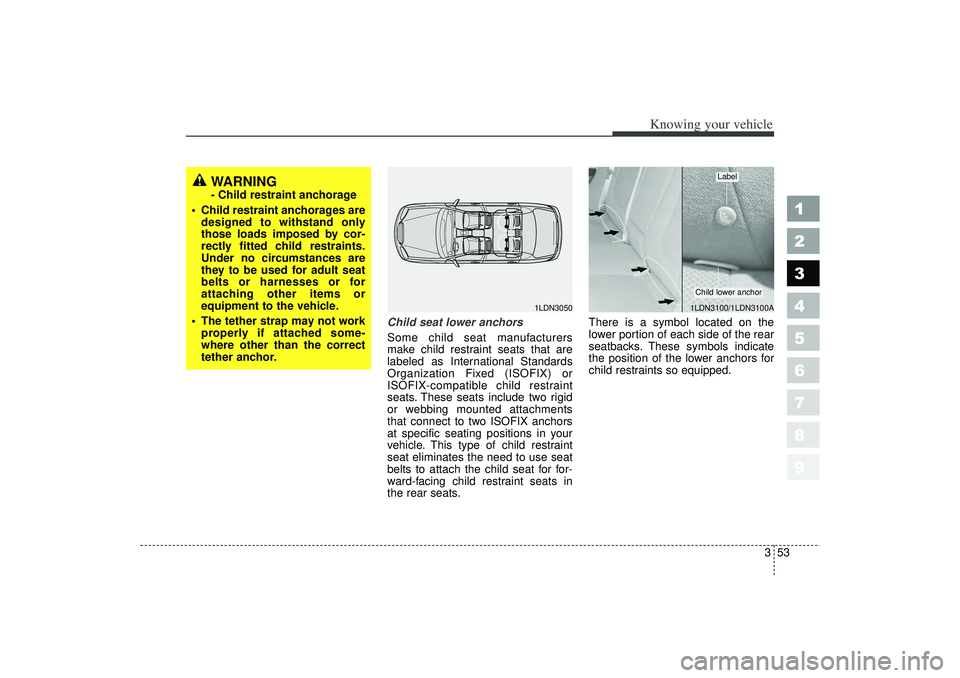
Child seat lower anchors
Some child seat manufacturers
make child restraint seats that are
labeled as International Standards
Organization Fixed (ISOFIX) or
ISOFIX-compatible child restraint
seats. These seats include two rigid
or webbing mounted attachments
that connect to two ISOFIX anchors
at specific seating positions in your
vehicle. This type of child restraint
seat eliminates the need to use seat
belts to attach the child seat for for-
ward-facing child restraint seats in
the rear seats.There is a symbol located on the
lower portion of each side of the rear
seatbacks. These symbols indicate
the position of the lower anchors for
child restraints so equipped.
1LDN3050
WARNING - Child restraint anchorage
Child restraint anchorages are designed to withstand only
those loads imposed by cor-
rectly fitted child restraints.
Under no circumstances are
they to be used for adult seat
belts or harnesses or for
attaching other items or
equipment to the vehicle.
The tether strap may not work properly if attached some-
where other than the correct
tether anchor.
1LDN3100/1LDN3100AChild lower anchor
Label
LD CAN (ENG) new 3-1~.qxd 7/29/05 10:28 AM Page 53
Page 65 of 273
Knowing your vehicle54
3
1
2
3
4
5
6
7
8
9
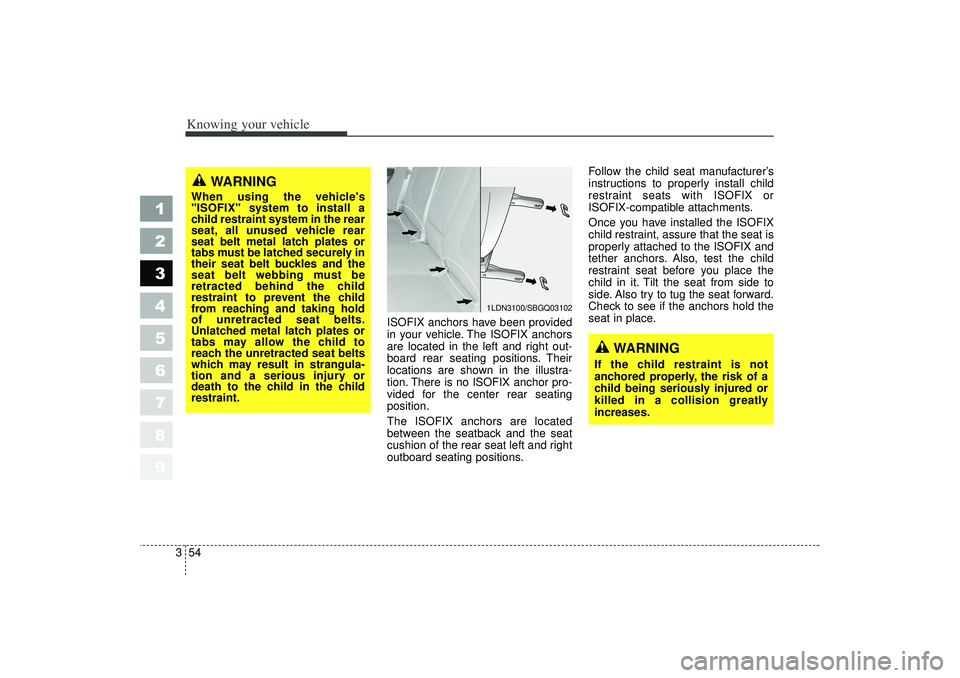
ISOFIX anchors have been provided
in your vehicle. The ISOFIX anchors
are located in the left and right out-
board rear seating positions. Their
locations are shown in the illustra-
tion. There is no ISOFIX anchor pro-
vided for the center rear seating
position.
The ISOFIX anchors are located
between the seatback and the seat
cushion of the rear seat left and right
outboard seating positions. Follow the child seat manufacturer
’s
instructions to properly install child
restraint seats with ISOFIX or
ISOFIX-compatible attachments.
Once you have installed the ISOFIX
child restraint, assure that the seat is
properly attached to the ISOFIX and
tether anchors. Also, test the child
restraint seat before you place the
child in it. Tilt the seat from side to
side. Also try to tug the seat forward.
Check to see if the anchors hold the
seat in place.
WARNING
If the child restraint is not
anchored properly, the risk of a
child being seriously injured or
killed in a collision greatly
increases.
1LDN3100/SBGQ03102
WARNING
When using the vehicle's
"ISOFIX" system to install a
child restraint system in the rear
seat, all unused vehicle rear
seat belt metal latch plates or
tabs must be latched securely in
their seat belt buckles and the
seat belt webbing must be
retracted behind the child
restraint to prevent the child
from reaching and taking hold
of unretracted seat belts.
Unlatched metal latch plates or
tabs may allow the child to
reach the unretracted seat belts
which may result in strangula-
tion and a serious injury or
death to the child in the child
restraint.
LD CAN (ENG) new 3-1~.qxd 7/29/05 10:28 AM Page 54