fuel KIA SPECTRA5 2007 Owner's Manual
[x] Cancel search | Manufacturer: KIA, Model Year: 2007, Model line: SPECTRA5, Model: KIA SPECTRA5 2007Pages: 312, PDF Size: 3.42 MB
Page 234 of 312

In case of an emergency16
6
1
2
3
4
5
6
7
8
910
Description Fuse rating Protected component
ATM 20A Automatic transaxle control
ECU1 10A Engine control unit
STOP 15A Stop light
F/WIPER 20A Front wiper
R/FOG 10A Rear fog light
F/FOG 15A Front fog light
LO HDLP 15A Headlight (low)
HI HDLP 15A Headlight (high)
A/CON 10A Air conditioner
F/PUMP 15A Fuel pump
T/OPEN 10A Trunk lid opener
FOLD 10A Outside rearview mirror folding
HORN 10A Horn
DEICE 15A Deicer
INJ 15A Injection
SNSR 10A O2 sensor
ECU2 30A Engine control unit
SPARE 10A spare fuse
SPARE 15A spare fuse
SPARE 20A spare fuse
SPARE 30A spare fuse
ABS2 30A Anti-lock brake system
ABS1 30A Anti-lock brake system
IP B+ 50A In panel B+
Description Fuse rating Protected component
BLOWER30A Blower
IGN2 30A Ignition
IGN1 30A Ignition
RAD 30A Radiator fan
COND 20A Condenser fan
ALT 120A Alternater
ATM - Automatic transaxle control relay
WIPER - Wiper relay
F/FOG - Front fog light relay
LO HDLP - Headlight relay (low)
HI HDLP - Headlight relay (high)
A/CON - Air conditioner relay
F/PUMP - Fuel pump
DRL - Daytime running light relay
COND2 - Condenser fan relay
HORN - Horn relay
MAIN - Main relay
START - Start motor relay
RAD - Radiator fan relay
COND - Condenser fan relay
Engine compartment
Page 251 of 312
Maintenance47
1
2
3
4
5
6
7
8
910
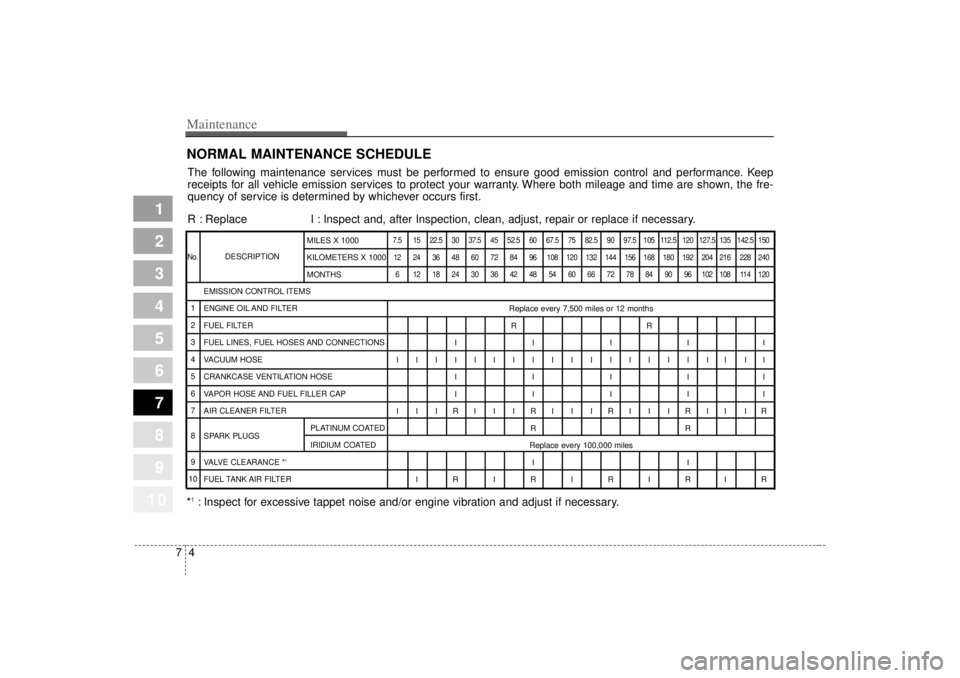
NORMAL MAINTENANCE SCHEDULEThe following maintenance services must be performed to ensure good emission control and performance. Keep
receipts for all vehicle emission services to protect your warranty. Where both mileage and time are shown, the fre-
quency of service is determined by whichever occurs first.
R : Replace I : Inspect and, after Inspection, clean, adjust, repair or replace if neces\
sary.
DESCRIPTION
7.5 15 22.5 30 37.5 45 52.5 60 67.5 75 82.5 90 97.5 105 112.5 120 127.5 135 142.5 15012 24 36 48 60 72 84 96 108 120 132 144 156 168 180 192 204 216 228 240 6 121824303642485460667278849096102108114120
Replace every 7,500 miles or 12 monthsRR
IIIII
IIIIIIIIIIIIIIIIII II IIIII
IIIII
I I IRI I IRI I IRI I IRII IR RR
Replace every 100,000 miles II
IRIRIRIRIR
EMISSION CONTROL ITEMS
ENGINE OIL AND FILTER
FUEL FILTER
FUEL LINES, FUEL HOSES AND CONNECTIONS
VACUUM HOSE
CRANKCASE VENTILATION HOSE
VAPOR HOSE AND FUEL FILLER CAP
AIR CLEANER FILTER
SPARK PLUGS
PLATINUM COATED
IRIDIUM COATED
VALVE CLEARANCE *
1
FUEL TANK AIR FILTER
No.1
2
3
4
5
6
7
8
9
10 MILES X 1000
KILOMETERS X 1000
MONTHS*1: Inspect for excessive tappet noise and/or engine vibration and adjust if necessary.
Page 255 of 312
Maintenance87
1
2
3
4
5
6
7
8
910
OWNER MAINTENANCE Owner maintenance schedule The following lists are vehicle checks
and inspections that should be per-
formed by the owner or an
Authorized Kia Dealer at the fre-
quencies indicated to help ensure
safe, dependable operation of your
vehicle.
Any adverse conditions should be
brought to the attention of your deal-
er as soon as possible.
These Owner Maintenance Checks
are generally not covered by war-
ranties and you may be charged for
labor, parts and lubricants used.
When you stop for fuel: Check the engine oil level.
Check coolant level in coolantreservoir.
Check the windshield washer fluid level.
Look for low or under-inflated tires.
While operating your vehicle: Note any changes in the sound of the exhaust or any smell of
exhaust fumes in the vehicle.
Check for vibrations in the steering wheel. Notice any increased steer-
ing effort or looseness in the steer-
ing wheel, or change in its straight-
ahead position.
Notice if your vehicle constantly turns slightly or “pulls” to one side
when traveling on smooth, level
road.
When stopping, listen and check for strange sounds, pulling to one
side, increased brake pedal travel
or “hard-to-push” brake pedal.
If any slipping or changes in the operation of your transaxle occurs,
check the transaxle fluid level.
Check automatic transaxle P (Park) function.
Check parking brake.
Check for fluid leaks under your vehicle (water dripping from the air
conditioning system after use is
normal).
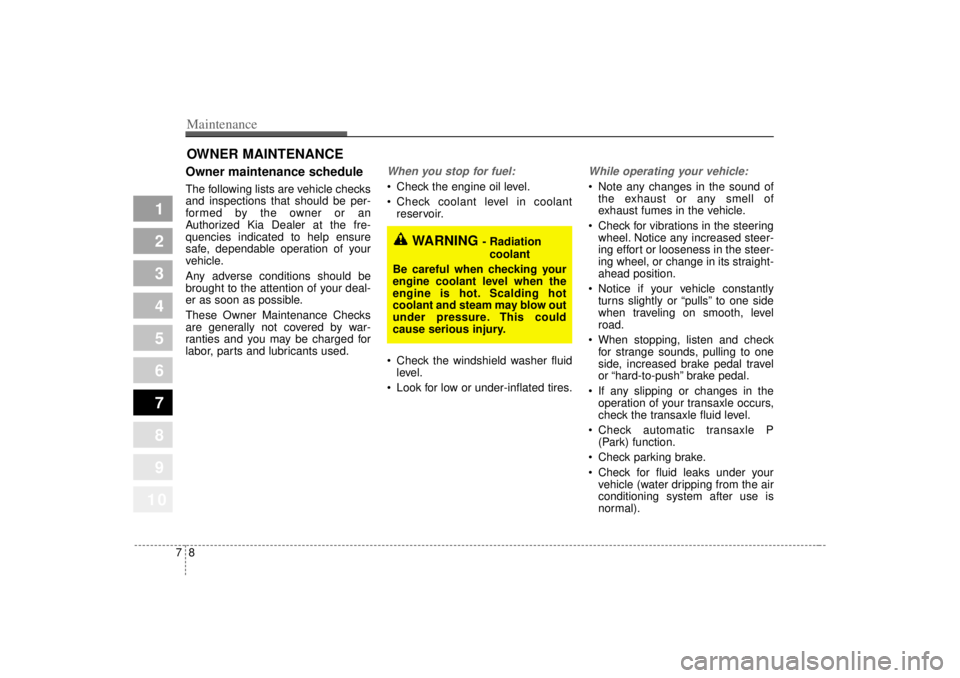
WARNING
- Radiation
coolant
Be careful when checking your
engine coolant level when the
engine is hot. Scalding hot
coolant and steam may blow out
under pressure. This could
cause serious injury.
Page 278 of 312
731
Maintenance
1
2
3
4
5
6
7
8
910
TIRES AND WHEELS Tire care For proper maintenance, safety, and
maximum fuel economy, you must
always maintain recommended tire
inflation pressures and stay within
the load limits and weight distribution
recommended for your vehicle.Recommended cold tire infla-
tion pressures All tire pressures (including the
spare) should be checked every day
when the tires are cold. “Cold Tires”
means the vehicle has not been driv-
en for at least three hours or driven
less than one mile (1.6 km).
Recommended pressures must be
maintained for the best ride, top vehi-
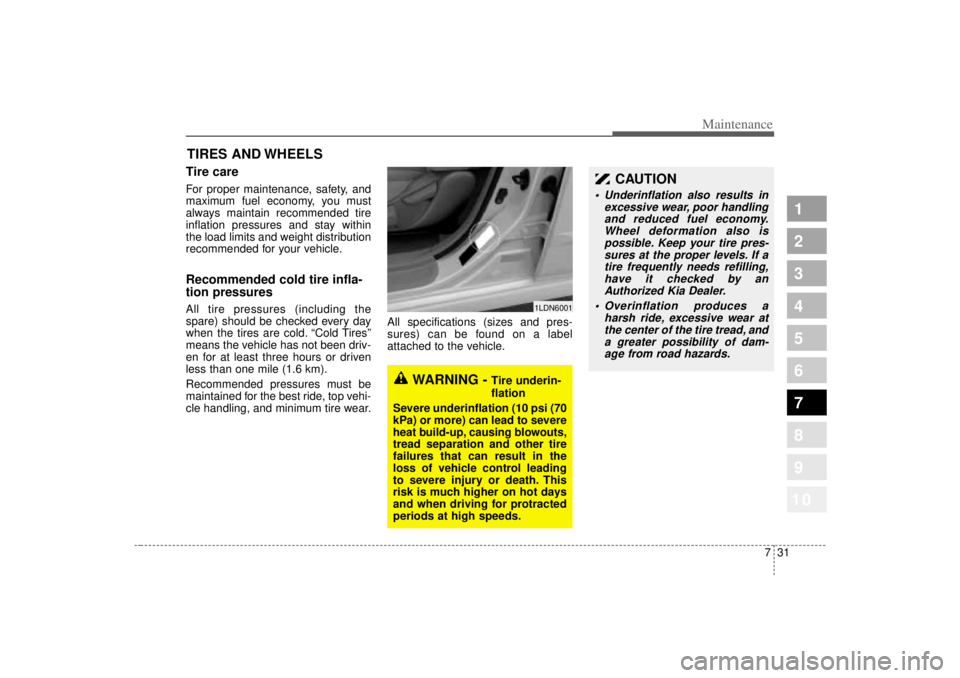
cle handling, and minimum tire wear.All specifications (sizes and pres-
sures) can be found on a label
attached to the vehicle.
1LDN6001
WARNING -
Tire underin-
flation
Severe underinflation (10 psi (70
kPa) or more) can lead to severe
heat build-up, causing blowouts,
tread separation and other tire
failures that can result in the
loss of vehicle control leading
to severe injury or death. This
risk is much higher on hot days
and when driving for protracted
periods at high speeds.
CAUTION
Underinflation also results in excessive wear, poor handlingand reduced fuel economy.Wheel deformation also ispossible. Keep your tire pres-sures at the proper levels. If atire frequently needs refilling,have it checked by anAuthorized Kia Dealer.
Overinflation produces a harsh ride, excessive wear atthe center of the tire tread, anda greater possibility of dam-age from road hazards.
Page 287 of 312

Maintenance40
7
1
2
3
4
5
6
7
8
910
Cold Tire Pressure: The amount of
air pressure in a tire, measured in
pounds per square inch (psi) or kilo-
pascals (kPa) before a tire has built
up heat from driving.
Curb Weight: This means the weight
of a motor vehicle with standard and
optional equipment including the
maximum capacity of fuel, oil and
coolant, but without passengers and
cargo.
DOT Markings: A code molded into
the sidewall of a tire signifying that
the tire is in compliance with the U.S.
Department of Transportation motor
vehicle safety standards. The DOT
code includes the Tire Identification
Number (TIN), an alphanumeric des-
ignator which can also identify the
tire manufacturer, production plant,
brand and date of production.
GVWR: Gross Vehicle Weight Rating
GAWR FRT: Gross Axle Weight
Rating for the front Axle.
GAWR RR: Gross Axle Weight
Rating for the rear axle. Intended Outboard Sidewall
:The
side of an asymmetrical tire, that
must always face outward when
mounted on a vehicle.
Kilopascal (kPa): The metric unit for
air pressure.
Load Index: An assigned number
ranging from 1 to 279 that corre-
sponds to the load carrying capacity
of a tire.
Maximum Inflation Pressure :The
maximum air pressure to which a
cold tire may be inflated. The maxi-
mum air pressure is molded onto the
sidewall.
Maximum Load Rating : The load
rating for a tire at the maximum per-
missible inflation pressure for that
tire.
Maximum Loaded Vehicle Weight :
The sum of curb weight; accessory
weight; vehicle capacity weight; and
production options weight.
Normal Occupant Weight: The
number of occupants a vehicle is
designed to seat multiplied by 150
pounds (68 kg). Occupant Distribution
: Designated
seating positions.
Outward Facing Sidewall: The side
of a asymmetrical tire that has a par-
ticular side that faces outward when
mounted on a vehicle. The outward
facing sidewall bears white lettering
or bears manufacturer, brand, and/or
model name molding that is higher or
deeper than the same moldings on
the inner facing sidewall.
Passenger (P-Metric) Tire : A tire
used on passenger cars and some
light duty trucks and multipurpose
vehicles.
Recommended Inflation Pressure :
Vehicle manufacturer's recommend-
ed tire inflation pressure and shown
on the tire placard.
Radial Ply tire: A pneumatic tire in
which the ply cords that extend to the
beads are laid at 90 degrees to the
centerline of the tread.
Rim: A metal support for a tire and
upon which the tire beads are seat-
ed.
Sidewall: The portion of a tire
between the tread and the bead.
Page 299 of 312

Maintenance52
7
1
2
3
4
5
6
7
8
910
Bright-metal maintenance To remove road tar and insects,
use a tar remover, not a scraper or
other sharp object.
To protect the surfaces of bright- metal parts from corrosion, apply a
coating of wax or chrome preser-
vative and rub to a high luster.
During winter weather or in coastal areas, cover the bright metal parts
with a heavier coating of wax or
preservative. If necessary, coat the
parts with non-corrosive petroleum
jelly or other protective compound.
Underbody maintenanceCorrosive materials used for ice and
snow removal and dust control may
collect on the underbody. If these
materials are not removed, acceler-
ated rusting can occur on underbody
parts such as the fuel lines, frame,
floor pan and exhaust system, even
though they have been treated with
rust protection.
Thoroughly flush the vehicle under-
body and wheel openings with luke-
warm or cold water once a month,
after off-road driving and at the end
of each winter. Pay special attention
to these areas because it is difficult
to see all the mud and dirt. It will do
more harm than good to wet down
the road grime without removing it.
The lower edges of doors, rocker
panels, and frame members have
drain holes that should not be
allowed to clog with dirt; trapped
water in these areas can cause rust-
ing.
WARNING
After washing the vehicle, test
the brakes while driving slowly
to see if they have been affected
by water. If braking performance
is impaired, dry the brakes by
applying them lightly while
maintaining a slow forward
speed.
Page 305 of 312

Specifications4 8
1
2
3
4
5
6
7
8
910
RECOMMENDED LUBRICANTS AND CAPACITIES To help achieve proper engine and powertrain performance and durability, use only lubricants of the proper quality.
The correct lubricants also help promote engine efficiency that results in improved fuel economy.These lubricants and fluids are recommended for use in your vehicle.*1Refer to the recommended SAE viscosity numbers on the next page.
*2Engine oils labeled Energy Conserving Oil are now available. Along with other additional benefits, they contribute to fuel economy by reducing the amount of fuel nec-
essary to overcome engine friction. Often, these improvements are difficult to measure in everyday driving, but in a year’s time, they can offer significant cost and
energy savings.Lubricant Volume Classification
Engine oil
*1 *2
4.23 US qt. (4.0 l)
(drain and refill)
Manual transaxle fluid 2.11 US qt. (2.0 l)
Automatic transaxle fluid 6.97 US qt. (6.6 l)
Power steering fluid 0.85 US qt. (0.8 l)
Coolant 6.97 US qt. (6.6 l)
Brake/Clutch fluid0.7~0.8 US qt.
(0.7~0.8 l)
Fuel 14.5 US gal. (55 l)-
API Service SJ, SL or above,
ILSAC GF-3 or above
API Service GL-4 (SAE 75W-85, fill for-life)
DIAMOND ATF SP-III,
SK ATF SP-III or other brands meeting the SP-III specifi-
cation approved by Kia Motors Corp.
PSF-III
FMVSS116 DOT-3 or DOT-4 MIXTURE, Antifreeze with water
(Ethylene glycol base coolant for aluminum radiator)
Page 306 of 312

85
1
2
3
4
5
6
7
8
910
Specifications
Recommended SAE viscosity
number ✽ ✽
NOTICEAlways be sure to clean the area
around any filler plug, drain plug,
or dipstick before checking or drain-
ing any lubricant. This is especially
important in dusty or sandy areas
and when the vehicle is used on
unpaved roads. Cleaning the plug
and dipstick areas will prevent dirt
and grit from entering the engine
and other mechanisms that could be
damaged.
Temperature Range for SAE Viscosity Numbers
Temperature
Engine Oil *
1°C
(°F)
-30 -20 -10 0 10 20 30 40 50
-10 0 20 40 60 80 100 120
1. For better fuel economy, it is recommended to use the engine oil of a viscosity grade SAE 5W-
20,5W-30 (API SJ, SL / ILSAC GF-3). However, if the engine oil is not available in your coun-
try, select the proper engine oil using the engine oil viscosity chart.
10W-30
5W-20, 5W-30
Engine oil viscosity (thickness) has an effect on fuel economy and cold
weather operating (starting and oil flow). Lower viscosity engine oils can pro-
vide better fuel economy and cold weather performance, however, higher vis-
cosity engine oils are required for satisfactory lubrication in hot weather.
Using oils of any viscosity other than those recommended could result in
engine damage.
When choosing an oil, consider the range of temperature your vehicle will be
operated in before the next oil change. Proceed to select the recommended
oil viscosity from the chart.
Page 308 of 312
Consumer assistance2 9CONSUMER ASSISTANCE (U.S. ONLY)Roadside Assistance is provided on all new current
model year Kia Vehicles from the date the vehicle is deliv-
ered to the first retail buyer or otherwise put into use (in-
service date), whichever is earlier, for a period of 60
months or 60,000 miles, whichever is earlier, subject to
the terms, conditions and exclusions set forth in the Kia
Warranty and Consumer Information Guide applicable to
your model year vehicle.
KMA reserves the right to limit or deny services or other
benefits to any owner or driver when, in KMA's judgment,
the claims and/or service requests are excessive in fre-
quency or type of occurrence.Toll Free AssistanceKia's toll-free Consumer Assistance hot line is staffed
from 5:00 AM to 6:00 PM PST, Monday through Friday
and is accessible by dialing 1-800-333-4Kia (4542).
For more information regarding assistance available,
please refer to your Kia Warranty & Consumer
Information Manual.Emergency Roadside AssistanceKia's toll free Roadside Assistance hot line is staffed 24
hours a day, 365 days a year and is accessible by dialing 1-
800-333-4Kia (4542).
Please note that you must provide your Vehicle
Identification Number (VIN) to verify coverage at the time of
your call. The VIN can be found on the dash of your vehi-
cle on the driver’s side, on the door jamb of the driver’s
door, your vehicle’s registration or proof of insurance card.Kia utilizes a network of over 17,000 roadside assistance
providers. Should you accidentally run out of fuel, require a
battery jump, or need help changing a tire, a Kia Roadside
Assistance Representative will dispatch someone to deliv-
er a small quantity of gas, change a flat tire with your inflat-
ed spare, or arrange a battery jump to allow you to proceed
to your destination. We have access to a network of over
10,000 locksmiths to help you should you become locked
out of your Kia.
In the event that mechanical difficulty renders your vehicle
undriveable due to a warranty-related concern, Kia’s
Roadside Assistance Representative will arrange to trans-
port your vehicle to the nearest Kia dealer or to an alterna-
tive service location.
Your vehicle must be accessible to our dispatch transport
vehicle, as determined by our driver, to receive this service.
In the event that Kia does not have a dealer or an alterna-
tive service location available in a particular location, Kia
will work with a reputable local service facility to ensure that
you receive prompt service. Warranty repairs are performed
at no cost.
✽ ✽
NOTICERoadside Assistance benefits are not available for any
Kia vehicle that has ever been or should be issued a “sal-
vage” title or similar “branded” title under any state’s
law or has been declared a “total loss” or equivalent by
a financial institution or insurance company.
1
2
3
4
5
6
7
8
910
Page 309 of 312

93
Consumer assistance
Trip InterruptionTrip interruption expense benefits are provided in the
event that a warranty-related disablement occurs more
than 150 miles from your home, and the repairs require
more than 24 hours to complete. Reasonable reimburse-
ment is included for meals, lodging, or rental car expens-
es. Trip interruption coverage is limited to $100 per day
subject to a three day maximum limit per incident. You
must contact the Kia Roadside Assistance Center to
obtain pre-authorization of expenses. Once the Kia
Roadside Assistance Center gives authorization for trip
interruption benefits, they will assist you in making the
necessary arrangements. Insurance deductibles,
expenses, and claims paid by your insurance company or
other providers are not eligible for reimbursement.
Fleet vehicles are excluded from reimbursement under
Kia’s Trip Interruption Policy.Registering Your Vehicle in a Foreign CountryIf you plan to register your vehicle in a foreign country,
you should confirm that it conforms to the regulations in
that country. Even if you successfully register the vehicle
in a foreign country, you may experience the following
problems and should therefore consider the possibility of
having to deal with them:1. The fuel specified for your vehicle may be unavailable.
If other than the specified fuel is used, it could cause
damage to the engine, the fuel injection system, and
other fuel-related parts which may not be covered
under your New Vehicle Emissions Limited Warranty.
2. We must, therefore, clearly state that when you leave
the country in which you purchased your Kia as new
and register it in another country, problems arising
from the use of fuel other than the specified fuel are
not subject to manufacturer’s warranty. Because vehi-
cles like yours may not be marketed in the new coun-
try of registration, parts, servicing techniques and
tools necessary to maintain and repair your vehicle
may be unavailable.
Even if vehicles like yours are sold there, mechanical
specifications required by the government may vary
enough from the country of purchase to cause addi-
tional problems.
3. There may not be an Authorized Kia Dealer in the area
in which you plan to register your vehicle. You may
additionally experience difficulty in obtaining services
in a foreign country for any number of reasons.
Further, we cannot assume any responsibility for prob-
lems that result from unsatisfactory service or lack of
service outside of the United States.
1
2
3
4
5
6
7
8
910