warning KIA SPECTRA5 2008 Owners Manual
[x] Cancel search | Manufacturer: KIA, Model Year: 2008, Model line: SPECTRA5, Model: KIA SPECTRA5 2008Pages: 298, PDF Size: 5.38 MB
Page 198 of 298

Driving tips
8 5
Driving at night
Because night driving presents more
hazards than driving in the daylight,
here are some important tips to
remember:
• Slow down and keep more dis-
tance between you and other vehi-
cles, as it may be more difficult to
see at night, especially in areas
where there may not be any street
lights.
• Adjust your mirrors to reduce the
glare from other driver's head-
lights.
• Keep your headlights clean and
properly aimed on vehicles not
equipped with the automatic head-
light aiming feature. Dirty or
improperly aimed headlights will
make it much more difficult to see
at night.
• Avoid staring directly at the head-
lights of oncoming vehicles. You
could be temporarily blinded, and it
will take several seconds for your
eyes to readjust to the darkness.
Driving in the rain
Rain and wet roads can make driving
dangerous, especially if you’re not
prepared for the slick pavement.
Here are a few things to consider
when driving in the rain:
• A heavy rainfall will make it harder
to see and will increase the dis-
tance needed to stop your vehicle,
so slow down.
• Keep your windshield wiping
equipment in good shape. Replace
your windshield wiper blades when
they show signs of streaking or
missing areas on the windshield.
• If your tires are not in good condi-
tion, making a quick stop on wet
pavement can cause a skid and
possibly lead to an accident. Be
sure your tires are in good shape.
• Turn on your headlights to make it
easier for others to see you.
1
2
3
4
5
6
7
8
9
WARNING- Spinning tires
Do not spin the wheels, espe-
cially at speeds more than 56
km/h (35 mph). Spinning the
wheels at high speeds when the
vehicle is stationary could
cause a tire to overheat, explode
and injure bystanders.
CAUTION
The TCS system (if equipped)
should be turned OFF prior to
rocking the vehicle.
Page 200 of 298

Driving tips
10 5
Snow tires
If you mount snow tires on your vehi-
cle, make sure they are radial tires of
the same size and load range as the
original tires. Mount snow tires on all
four wheels to balance your vehicle’s
handling in all weather conditions.
Keep in mind that the traction provid-
ed by snow tires on dry roads may
not be as high as your vehicle's orig-
inal equipment tires. You should drive
cautiously even when the roads are
clear. Check with the tire dealer for
maximum speed recommendations.
Do not install studded tires without
first checking local and provincipal
regulations for possible restrictions
against their use.
Driving in flooded areas
Avoid driving through flooded areas
unless you are sure the water is no
higher than the bottom of the wheel
hub. Drive through any water slowly.
Allow adequate stopping distance
because brake performance may be
affected.
After driving through water, dry the
brakes by gently applying them sev-
eral times while the vehicle is moving
slowly.
1
2
3
4
5
6
7
8
9
WARNING- Snow tire
size
Snow tires should be equivalent
in size and type to the vehicle's
standard tires. Otherwise, the
safety and handling of your
vehicle may be adversely affect-
ed.
Page 202 of 298
Driving tips
12 5
1
2
3
4
5
6
7
8
9
Steps for determining correct
load limit
1. Locate the statement "The com-
bined weight of occupants and
cargo should never exceed XXX
kg or XXX lbs.'' on your vehicle's
placard.
2. Determine the combined weight of
the driver and passengers that will
be riding in your vehicle.
3. Subtract the combined weight of
the driver and passengers from
XXX kg or XXX lbs.
4. The resulting figure equals the
available amount of cargo and lug-
gage load capacity. For example, if
the "XXX" amount equals 635 kg
(1400 lbs.), and there will be five
68 kg (150 lbs.) passengers in
your vehicle, the amount of avail-
able cargo and luggage load
capacity is 295 kg (650 lbs.).
(635-340 (5 x 68) = 295 kg or
1400-750 (5 x 150) = 650 lbs.)5. Determine the combined weight of
luggage and cargo being loaded
on the vehicle. That weight may
not safely exceed the available
cargo and luggage load capacity
calculated in Step 4.
6. If your vehicle will be towing a trail-
er, load from your trailer will be
transferred to your vehicle. Consult
this manual to determine how this
reduces the available cargo and
luggage load capacity of your
vehicle.
WARNING- Load distribu-
tor
Your vehicle may become unsta-
ble while towing if your vehicle is
overloaded to one side. Make
sure that the load in the vehicle is
distributed equally to each side
of the centerline.
Page 205 of 298

515
Driving tips
1
2
3
4
5
6
7
8
9
The label will help you decide how
much cargo and installed equipment
your vehicle can carry.
If you carry items inside your vehicle
- like suitcases, tools, packages, or
anything else - they are moving as
fast as the vehicle. If you have to stop
or turn quickly, or if there is a crash,
the items will keep going and can
cause an injury if they strike the driv-
er or a passenger.
WARNING - Over loading
• Never exceed the GVWR for
your vehicle, the GAWR for
either the front or rear axle
and vehicle capacity weight.
Exceeding these ratings can
cause an accident or vehicle
damage. You can calculate the
weight of your load by weigh-
ing the items (or people)
before putting them in the
vehicle. Be careful not to over-
load your vehicle.
• If you overload your vehicle,
the tires can suddenly and
without warning fail. The over-
loading can also make your
vehicle unstable and dramati-
cally increase braking dis-
tance. This could cause you to
lose control and crash.WARNING - Loose cargo
Items you carry inside your
vehicle can strike and injure
occupants in a sudden stop or
sharp turn, or in a crash.
• Put items in the trunk of your
vehicle. Try to spread the
weight evenly.
• Never stack items, like suit-
cases, inside the occupant
compartment.
• Do not leave an unsecured
child restraint in your vehicle,
since it can injure occupants
in a crash.
• When you carry something
inside the vehicle, secure it.CAUTION
• Overloading your vehicle may
cause damage. Repairs would
not be covered by your war-
ranty. Do not overload your
vehicle.
• Using heavier suspension
components to get added
durability might not change
your weight ratings. Ask your
dealer to help you load your
vehicle the right way.ignored.
Page 207 of 298

517
Driving tips
1
2
3
4
5
6
7
8
9
Calculating the load your vehicle
can tow
1. Use the appropriate maximum
GCWR chart (in the Weight of the
Trailer section in this chapter) for
your type of drive system and
transmission.
2. Weigh your vehicle.
3. Subtract the weight of your vehicle
from the maximum GCWR in the
chart. This is the maximum trailer
weight your vehicle can tow. It
must be below the maximum trail-
er weight shown in the chart. Note
that the maximum trailer weight
your vehicle can tow depends on
the total weight of any cargo, pas-
sengers and available equipment
in the vehicle.To identify what the vehicle trailering
capacity is for your vehicle, you
should read the information in
“Weight of the Trailer” that appears
later in this section. Remember that
trailering is different than just driving
your vehicle by itself. Trailering caus-
es major changes in handling, dura-
bility, and fuel economy. Successful,
safe trailering requires correct equip-
ment, and cautious driving.
WARNING- Towing a
trailer
If you don't use the correct
equipment or you drive improp-
erly, you can lose control when
you pull a trailer. For example, if
the trailer is too heavy, the
brakes may fail, and would at
least be ineffective to promptly
stop the vehicle. You and your
passenger could be seriously or
fatally injured. We do not recom-
mend towing a trailer. However,
in the event there is a need to
tow a trailer, such as in an emer-
gency, follow all the steps in this
section.
Item Specification
Maximum trailer Without trailer brakes 340 (750)
weight kg (lbs.) With trailer brakes 680 (1500)
TRAILER TOWING
CAUTION
Pulling a trailer improperly can
damage your vehicle and result
in costly repairs not covered by
your warranty.
Page 209 of 298
519
Driving tips
1
2
3
4
5
6
7
8
9
Weight of the trailer tongue
The tongue load of any trailer is an
important weight to measure
because it affects the total gross
vehicle weight (GVW) of your vehicle
since that is the trailer weight push-
ing down on the hitch on your vehi-
cle. The rest of the trailer weight is
sitting on the trailer's wheels.
The trailer tongue should weigh a
maximum of 10% of the total loaded
trailer weight.
After you've loaded the trailer, go to a
Weigh Station and weigh the trailer
and then the tongue, separately, to
see if the weights are proper. If they
aren’t, you may be able to correct
them simply by moving some items
around in the trailer.Hitches
It's important to have the correct
hitch equipment. Crosswinds, large
trucks going by, and rough roads are
a few reasons why you’ll need the
right hitch. Here are some rules to
follow:
• Do not attach a trailer hitch which
requires you to alter other parts on
your vehicle.
• Never make a hole in your vehicle
to accommodate a hitch.
• The bumpers on your vehicle are
not intended for hitches. Do not
attach rental hitches or other
bumper-type hitches to them. Use
only a frame-mounted hitch that
does not attach to the bumper.WARNING - Trailer bal-
ance
• Never load a trailer with more
weight in the rear than in the
front. The front should be
loaded with approximately
60% of the total trailer load;
the rear should be loaded with
approximately 40% of the total
trailer load.
• Never exceed the maximum
weight limits of the trailer or
trailer towing equipment.
Improper loading can result in
damage to your vehicle and/or
personal injury. Check weights
and loading at a commercial
scale or highway patrol office
equipped with scales.
• An improperly loaded trailer
can cause loss of vehicle con-
trol.
Page 210 of 298

Driving tips
20 5
1
2
3
4
5
6
7
8
9
Safety chains
You should always attach chains
between your vehicle and your trail-
er. Cross the safety chains under the
tongue of the trailer so that the
tongue will not drop to the road if it
becomes separated from the hitch.
Instructions about safety chains may
be provided by the hitch manufactur-
er or by the trailer manufacturer.
Follow the manufacturer’s recom-
mendation for attaching safety
chains. Always leave just enough
slack so you can turn with your trail-
er. And, never allow safety chains to
drag on the ground.
Trailer brakes
If your trailer weighs more than the
maximum weight for a trailer without
brakes, then the trailer needs its own
brakes. You must consult with a
knowledgeable and reputable trailer
vendor to determine which brake
equipped trailer is right for your
needs. Be sure to read and follow the
instructions for the trailer brakes so
you’ll be able to install, adjust and
maintain them properly.
Driving with a trailer
Towing a trailer requires experience.
You must gain that experience slow-
ly and carefully which practicing with
an unloaded or lightly loaded trailer.
Before setting out for the open road,
you must get to know your trailer.
Acquaint yourself with the feel of
handling and braking with the trailer.
And always keep in mind that the
vehicle you are driving is now a good
deal longer and not nearly so
responsive as your vehicle is by
itself.
Before you start, check the trailer
hitch and platform, safety chains,
electrical connector(s), lights, tires
and mirror adjustment. If the trailer
has electric brakes, start your vehicle
and trailer moving and then apply the
trailer brake controller by hand to be
sure the brakes are working. This lets
you check your electrical connection
at the same time.
During your trip, check occasionally
to be sure that the load is secure,
and that the lights and any trailer
brakes are still working.
WARNING
Do not use a trailer with its own
brakes unless you are absolute-
ly certain that you have properly
set up the brake system. This is
not a task for amateurs. Use an
experienced, competent trailer
shop for this work.
Page 212 of 298
Driving tips
22 5
1
2
3
4
5
6
7
8
9
Do not connect a trailer lighting sys-
tem directly to your vehicle’s lighting
system. Use only an approved trailer
wiring harness.
Your Authorized Kia Dealer can
assist you in installing the wiring har-
ness.Driving on grades
Reduce speed and shift to a lower
gear before you start down a long or
steep downgrade. If you don’t shift
down, you might have to use your
brakes so much that they would get
hot and no longer operate efficiently.
On a long uphill grade, shift down
and reduce your speed to around 70
km/h (45 mph) to reduce the possi-
bility of engine and transaxle over-
heating.
Operating your vehicle in D (Drive)
when towing a trailer will minimize
heat buildup and extend the life of
your transaxle.
WARNING - Trailer wiring
harness
Failure to use an approved trail-
er wiring harness could result in
damage to the vehicle's electri-
cal system, there by disabling
the brake light system resulting
in an accident.
CAUTION
When towing a trailer on steep
grades especially (in excess of
6%) pay close attention to the
engine coolant temperature
gauge to ensure the engine
does not overheat. If the needle
of the coolant temperature
gauge moves across the dial
towards “H” (HOT), pull over and
stop as soon as it is safe to do
so, and allow the engine to idle
until it cools down. You may pro-
ceed once the engine has
cooled sufficiently.
Page 213 of 298
523
Driving tips
1
2
3
4
5
6
7
8
9
Parking on hills
Generally, you should not park your
vehicle, with a trailer attached, on a
hill. People can be seriously or fatal-
ly injured, and both your vehicle and
the trailer can be damaged if they
begin to move downhill.However, if you ever have to park
your trailer on a hill, here’s how to do
it:
1. Apply your brakes, but don’t shift
into gear.
2. Have someone place chocks
(blocks of wood or metal intended
for this purpose) under the down-
hill sides of the trailer wheels.
3. When the wheel chocks are in
place, release the brakes until the
chocks absorb the load.
4. Reapply the brakes. Apply your
parking brake, and then shift to R
(Reverse) for a manual transaxle
or P (Park) for an automatic
transaxle.
5. Release the brakes.
When you are ready to leave after
parking on a hill
1. With the manual transaxle in
Neutral or automatic transaxle in P
(Park), apply your brakes and hold
the brake pedal down while you:
• Start your engine;
• Shift into gear; and
• Release the parking brake.
2. Slowly remove your foot from the
brake pedal.
3. Drive slowly forward until the trail-
er is clear of the chocks.
4. Stop and have someone pick up
and store the chocks.
WARNING- Parking brake
It can be dangerous to get out of
your vehicle if the parking brake
is not firmly set or if the engine
is still running. In either case
the vehicle can move suddenly.
You or others could be serious-
ly or fatally injured.
WARNING- Parking on a
hill
Parking your vehicle on a hill
with a trailer attached is danger-
ous. It could cause serious
injury or death, should the trail-
er break lose, or should the trail-
er drag the vehicle downhill.
Page 217 of 298
1
2
3
4
5
6
7
8
91
2
3
4
5
6
7
8
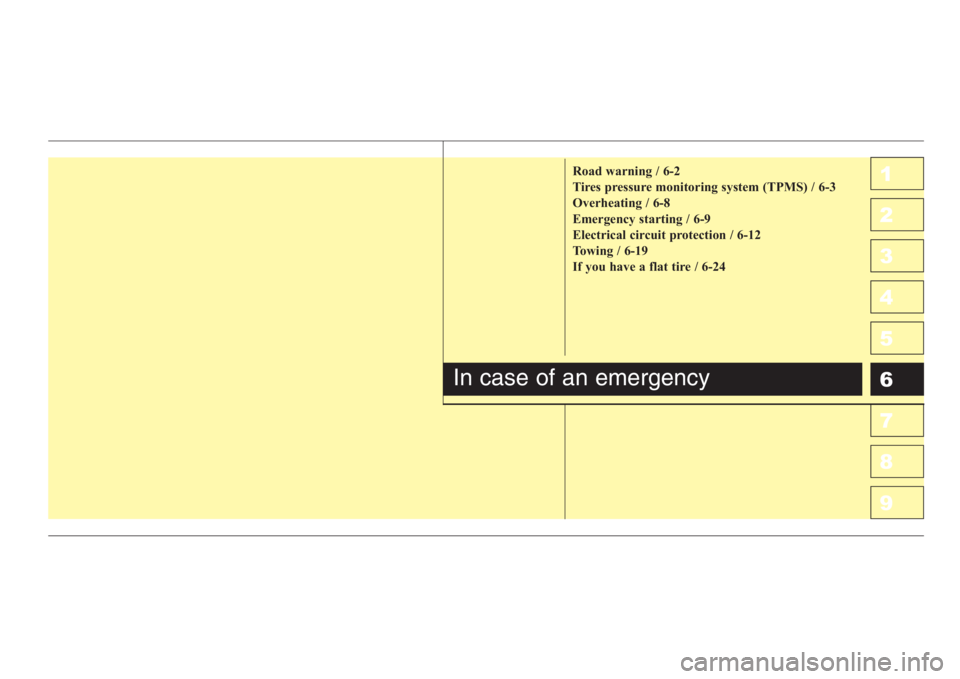
9Road warning / 6-2
Tires pressure monitoring system (TPMS) / 6-3
Overheating / 6-8
Emergency starting / 6-9
Electrical circuit protection / 6-12
Towing / 6-19
If you have a flat tire / 6-24
In case of an emergency