light KIA SPECTRA5 2008 User Guide
[x] Cancel search | Manufacturer: KIA, Model Year: 2008, Model line: SPECTRA5, Model: KIA SPECTRA5 2008Pages: 298, PDF Size: 5.38 MB
Page 50 of 298

Knowing your vehicle
40 3
1
2
3
4
5
6
7
8
9
Restraint of larger children
As children grow, they may need to
use new child-restraint systems,
including larger child seats or boost-
er seats, which are appropriate for
their increased size.
A child who has outgrown available
child-restraint systems should use
the belts provided in the vehicle.
When seated in the rear outboard
seats, the child should be restrained
by the lap/shoulder belt.
If the shoulder belt portion slightly
touches the child’s neck or face, try
placing the child closer to the center
of the vehicle. If the shoulder belt still
touches their face or neck they may
need to be returned to a child
restraint system. In addition, after-
market devices are available from
independent manufacturers which
help pull the shoulder belt down and
away from the child’s face or neck.
Larger children should use one of
the seat belts provided.WARNING- Shoulder
belts on small children
• Never allow a shoulder belt to
be in contact with a child’s
neck or face while the vehicle
is in motion.
• If safety belts are not properly
worn and adjusted, there is a
risk of death or serious injury
to such a child.WARNING- Hot metal
parts
Safety belts and seats can
become hot in a vehicle that has
been closed during warm/hot
weather; they could burn a
child. Check seat covers and
buckles before you place a child
anywhere near them.
Page 63 of 298
353
1
2
3
4
5
6
7
8
9
Knowing your vehicle
Air bag system components
The main components of your SRS
are:
• To indicate that your vehicle is
equipped with air bags, the corre-
sponding air bag covers are
marked with “SRS AIR BAG”.
- Driver’s air bag
- Passenger’s air bag
- Side air bag
- Curtain air bag
• A diagnostic system that continual-
ly monitors the system operation.
• An indicator light to warn you of a
possible problem with the system.
• Emergency power backup in case
your car’s electrical system is dis-
connected in a crash.The SRS uses a collection of sen-
sors to gather information about the
driver’s and front passenger’s seat
position, the driver’s and front pas-
senger’s safety belt usage and
impact severity.
The driver’s and front passenger’s
seat position sensors, which are
installed on the seat track, determine
if the seats are fore or aft of a refer-
ence position. Similarly, the safety
belt usage sensors determine if the
driver and front passenger’s safety
belts are fastened. These sensors
provide the ability to control the SRS
deployment based on how close the
driver’s seat is to the steering wheel,
how close the passenger’s seat is to
the instrument panel, whether or not
the safety belts are fastened, and
how severe is the impact.The advanced SRS offers the ability
to control the air bag inflation with
two levels. A first stage level is pro-
vided for moderate-severity impacts.
A second stage level is provided for
more severe impacts.
The SRSCM (SRS Control Module)
controls the air bag inflation in accor-
dance with impact severity, seating
position and safety belt usage.
Additionally, your SRS is equipped
with an occupant classification sys-
tem in the front passenger’s seat.
The occupant classification system
detects the presence of a passenger
in the front passenger’s seat and will
turn off the front passenger’s air bag
under certain conditions. For more
detail, see “Occupant Classification
System” later in this section.
Page 64 of 298
Knowing your vehicle
54 3
1
2
3
4
5
6
7
8
9
CAUTION
If the seat position sensor is not
working properly, the SRS air
bag warning light ( ) on the
instrument panel will illuminate
even if there is no malfunction
of the SRS air bag system,
because the SRS air bag warn-
ing light is connected with the
seat position sensor. If the SRS
air bag warning light does not
illuminate when the ignition key
is turned to the "ON" position, if
it remains illuminated after
blinking for approximately 6
seconds, or if it illuminates
while the vehicle is being driv-
en, have an authorized Kia deal-
er inspect the seat position sen-
sor and the advanced SRS air
bag system as soon as possi-
ble.
WARNING
• Modification to the seat struc-
ture can adversely affect the
seat position sensor and
cause the air bag to deploy at
a different level than should
be provided.
• Failure to properly wear safety
belts can increase the risk or
severity of injury by causing
the air bags to deploy at a dif-
ferent level than should be
provided.
• Do not place any objects
underneath the front seats
which could damage the seat
position sensor or interfere
with the occupant classifica-
tion system.
• Do not place any objects that
may cause magnetic fields
near the front seat. These may
cause a malfunction of the
seat position sensor.
(Continued)
(Continued)
• Ignoring the SRS indicator
light (air bag indicator and
passenger air bag off indica-
tor) can result in serious or
fatal injury if the air bags
occupant classification sys-
tem or pretensioners do not
work properly. Have your car
checked by a dealer as soon
as possible if the SRS warning
light alerts you to a potential
problem.
• Sitting improperly or out of
position can result in serious
or fatal injury in a crash. All
occupants should sit upright
in their seats with their feet on
the floor until the vehicle is
parked and the ignition key is
removed.
Page 66 of 298
Knowing your vehicle
56 3
1
2
3
4
5
6
7
8
9
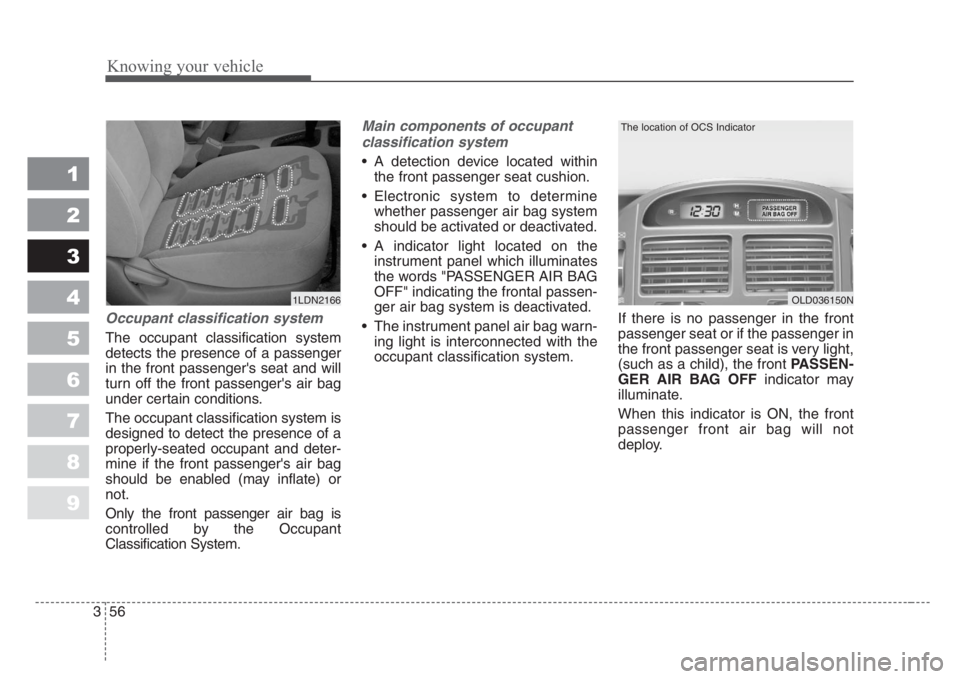
Occupant classification system
The occupant classification system
detects the presence of a passenger
in the front passenger's seat and will
turn off the front passenger's air bag
under certain conditions.
The occupant classification system is
designed to detect the presence of a
properly-seated occupant and deter-
mine if the front passenger's air bag
should be enabled (may inflate) or
not.
Only the front passenger air bag is
controlled by the Occupant
Classification System.
Main components of occupant
classification system
• A detection device located within
the front passenger seat cushion.
• Electronic system to determine
whether passenger air bag system
should be activated or deactivated.
• A indicator light located on the
instrument panel which illuminates
the words "PASSENGER AIR BAG
OFF" indicating the frontal passen-
ger air bag system is deactivated.
• The instrument panel air bag warn-
ing light is interconnected with the
occupant classification system.If there is no passenger in the front
passenger seat or if the passenger in
the front passenger seat is very light,
(such as a child), the front PASSEN-
GER AIR BAG OFFindicator may
illuminate.
When this indicator is ON, the front
passenger front air bag will not
deploy.
1LDN2166OLD036150N The location of OCS Indicator
Page 67 of 298

357
1
2
3
4
5
6
7
8
9
Knowing your vehicle
Always be sure that you and all vehi-
cle occupants are seated and
restrained properly (sitting upright
with the seat in an upright position,
centered on the seat cushion, with
the person's legs comfortably
extended, feet on the floor, and wear-
ing the safety belt properly) for the
most effective protection by the air
bag and the safety belt.
• The OCS may not function proper-
ly if the passenger takes actions
which can defeat the detection sys-
tem. These include:
(1) Failing to sit in an upright posi-
tion.
(2) Leaning against the door or cen-
ter console.
(3) Sitting towards the sides or the
front of the seat.
(4) Putting legs on the dashboard or
resting them on other locations
which reduce the passenger
weight on the front seat.
(5) Improperly wearing the safety
belt.
(6) Reclining the seat back.• The “PASSENGER AIR BAG OFF”
indicator illuminates after the igni-
tion key is turned to the “ON” posi-
tion or after the engine is started. If
the front passenger's seat is occu-
pied by a very small person or is
occupied by someone who is
improperly seated, the “PASSEN-
GER AIR BAG OFF” indicator will
remain illuminated and the front
passenger air bag will not deploy in
frontal crashes. If the front passen-
ger’s seat is occupied by an adult
size person seated properly, the
“PASSENGER AIR BAG OFF” indi-
cator will turn off after approxi-
mately 4 seconds and the front
passenger's air bag will deploy in
frontal collision.
CAUTION
If the occupant classification
system is not working properly,
the air bag warning light ( ) on
the instrument panel will illumi-
nate. If there is a malfunction of
the occupant classification sys-
tem, the "PASSENGER AIR BAG
OFF" indicator will not illumi-
nate and the front passenger's
air bag will deploy in frontal
crashes even if there is child or
no occupant in the front pas-
senger’s seat. If the SRS air bag
warning light does not illumi-
nate when the ignition key is
turned to "ON" position, if it
remains illuminated after blink-
ing for approximately six sec-
onds, or if it illuminates while
the vehicle is being driven, have
an authorized Kia dealer inspect
the occupant classification sys-
tem with the SRS air bag system
as soon as possible.
Page 68 of 298
Knowing your vehicle
58 3
1
2
3
4
5
6
7
8
9
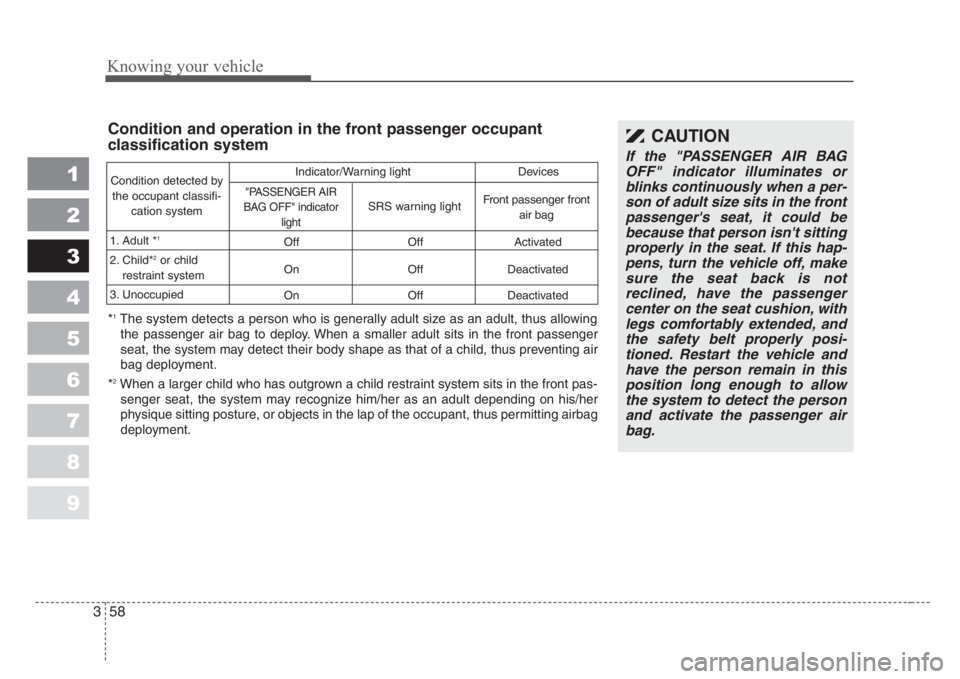
Condition and operation in the front passenger occupant
classification system
Condition detected by
the occupant classifi-
cation system
1. Adult *
1
2. Child*2or child
restraint system
3. Unoccupied Off
On
OnOff
Off
OffActivated
Deactivated
Deactivated
"PASSENGER AIR
BAG OFF" indicator
light
SRS warning lightFront passenger front
air bag Indicator/Warning light Devices
*1The system detects a person who is generally adult size as an adult, thus allowing
the passenger air bag to deploy. When a smaller adult sits in the front passenger
seat, the system may detect their body shape as that of a child, thus preventing air
bag deployment.
*
2When a larger child who has outgrown a child restraint system sits in the front pas-
senger seat, the system may recognize him/her as an adult depending on his/her
physique sitting posture, or objects in the lap of the occupant, thus permitting airbag
deployment.
CAUTION
If the "PASSENGER AIR BAG
OFF" indicator illuminates or
blinks continuously when a per-
son of adult size sits in the front
passenger's seat, it could be
because that person isn't sitting
properly in the seat. If this hap-
pens, turn the vehicle off, make
sure the seat back is not
reclined, have the passenger
center on the seat cushion, with
legs comfortably extended, and
the safety belt properly posi-
tioned. Restart the vehicle and
have the person remain in this
position long enough to allow
the system to detect the person
and activate the passenger air
bag.
Page 78 of 298

Knowing your vehicle
68 3
1
2
3
4
5
6
7
8
9
Air bag non-inflation conditions
• In certain collisions, the vehicle
safety belts are sufficient to protect
the vehicle occupants and the air
bags may not deploy. In some
cases, deploying air bags in low-
speed collisions can cause a sec-
ondary impact to the occupants
(light abrasions, cuts, burns, etc.),
or loss of vehicle control.• Frontal air bags are not designed
to inflate in rear collisions, because
occupants are moved backward by
the force of the impact. In this case,
the air bags do not provide proper
protection.• Front air bags may not inflate in
side impact collision, because
occupants move to the direction of
the collision, and thus in side
impacts, frontal air bag deployment
does not provide occupant protec-
tion.
However, side or curtain air bags
may inflate depending on the inten-
sity, vehicle speed and angles of
impact.
1GHA22731LDA20611JBA3516
Page 83 of 298

373
1
2
3
4
5
6
7
8
9
Knowing your vehicle
Air bag warning light
The purpose of air bag warning light
in your instrument panel is to alert
you of a potential problem with your
air bag - Supplemental Restraint
System (SRS).When the ignition switch is turned
ON, the indicator light should blink or
illuminate for approximately 6 sec-
onds, then go off.
Have the system checked if:
• The light does not turn on briefly
when you turn the ignition ON.
• The light stays on after the engine
starts.
• The light comes on while the vehi-
cle is in motion.
Air bag (Supplemental
Restraint System) service
Your Supplemental Restraint System
is virtually maintenance-free. There
are no parts which you can service.
You must have the system serviced
under the following circumstances:
• If an air bag ever inflates, the air
bag must be replaced. Do not try to
remove or discard the air bag by
yourself. This must be done by an
authorized Kia dealer.
• If the air bag warning indicator light
alerts you to a problem, have the
air bag system checked as soon as
possible. Otherwise, your air bag
system may be ineffective.
A-BAG-W
Page 88 of 298

Knowing your vehicle
78 3
1
2
3
4
5
6
7
8
9
Opening the hood:
1. Pull the release lever on the lower
left side of the instrument panel to
unlatch the hood. The hood should
pop open slightly.2. Go to the front of the vehicle,
slightly raise the hood, push the
secondary latch (
1) inside of the
hood center and lift (
2) the hood.
WARNING
• If a person is locked in the
trunk, they can pull the emer-
gency release to open the
trunk lid.
• We recommend that cars be
kept locked and keys be kept
out of the reach of children,
and that parents teach their
children about the dangers of
playing in trunks.
HOOD
1LDA2020OLD026023
Page 90 of 298

Knowing your vehicle
80 3
1
2
3
4
5
6
7
8
9
WARNING
If pressurized fuel sprays out, it
can cause serious injuries.
Always remove the fuel cap
carefully and slowly. If the cap is
venting fuel or if you hear a
hissing sound, wait until the
condition stops before com-
pletely removing the cap.
1. Stop the engine.
2. To open the fuel filler lid, pull the
release lever.3. Pull the fuel filler lid out to open.
4. To remove the cap, turn the fuel
tank cap counterclockwise.
5. Refuel as needed.
6. To install the cap, turn it clockwise
until it “clicks”. This indicates that
the cap is securely tightened.
7. Close the fuel filler lid and push it
lightly and make sure that it is
securely closed.
FUEL FILLER LID
1LDA2019OLD026018
WARNING
To avoid injury from sharp
edges, it is recommended that
protective gloves be worn if
there is a need to open the fuel
filler door manually.
WARNING
Automotive fuels are flamma-
ble/explosive materials. When
refueling, please note the fol-
lowing guidelines carefully.
Failure to follow these guide-
lines may result in severe per-
sonal injury,severe burns or
death by fire or explosion.
• Before refueling always note
the location of the Emergency
Gasoline Shut-Off, if available,
at the gas station facility.
(Continued)