height KIA SPECTRA5 2008 Owners Manual
[x] Cancel search | Manufacturer: KIA, Model Year: 2008, Model line: SPECTRA5, Model: KIA SPECTRA5 2008Pages: 298, PDF Size: 5.38 MB
Page 26 of 298
Knowing your vehicle
16 3
1
2
3
4
5
6
7
8
9
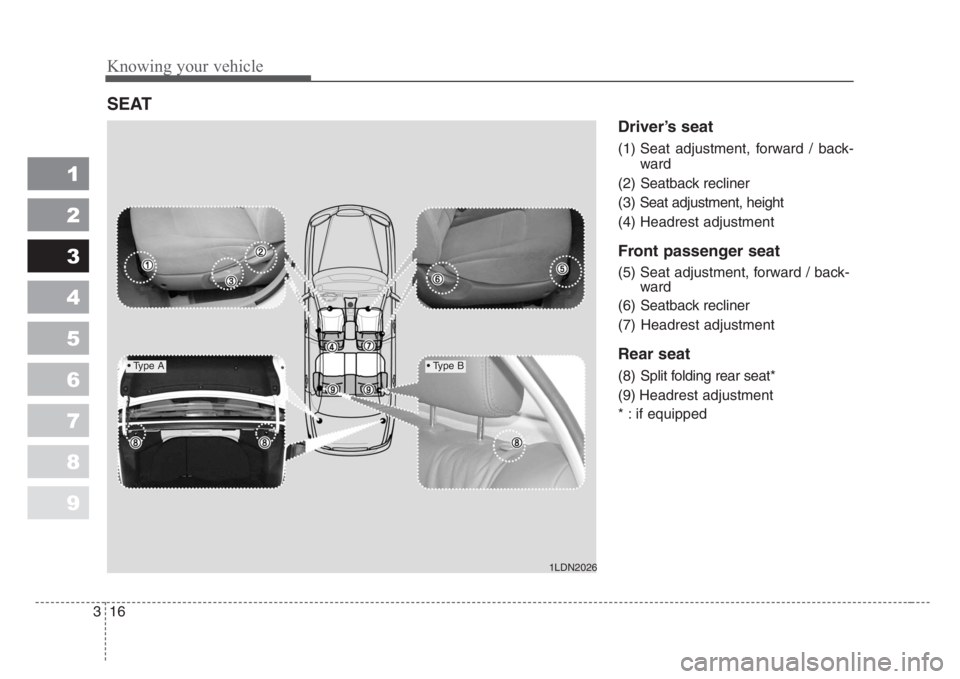
Driver’s seat
(1) Seat adjustment, forward / back-
ward
(2) Seatback recliner
(3) Seat adjustment, height
(4) Headrest adjustment
Front passenger seat
(5) Seat adjustment, forward / back-
ward
(6) Seatback recliner
(7) Headrest adjustment
Rear seat
(8) Split folding rear seat*
(9) Headrest adjustment
* : if equipped
SEAT
1LDN2026
• Type A• Type B
Page 28 of 298
Knowing your vehicle
18 3
1
2
3
4
5
6
7
8
9
Driver’s seat adjustment
Adjusting the seat forward and
backward
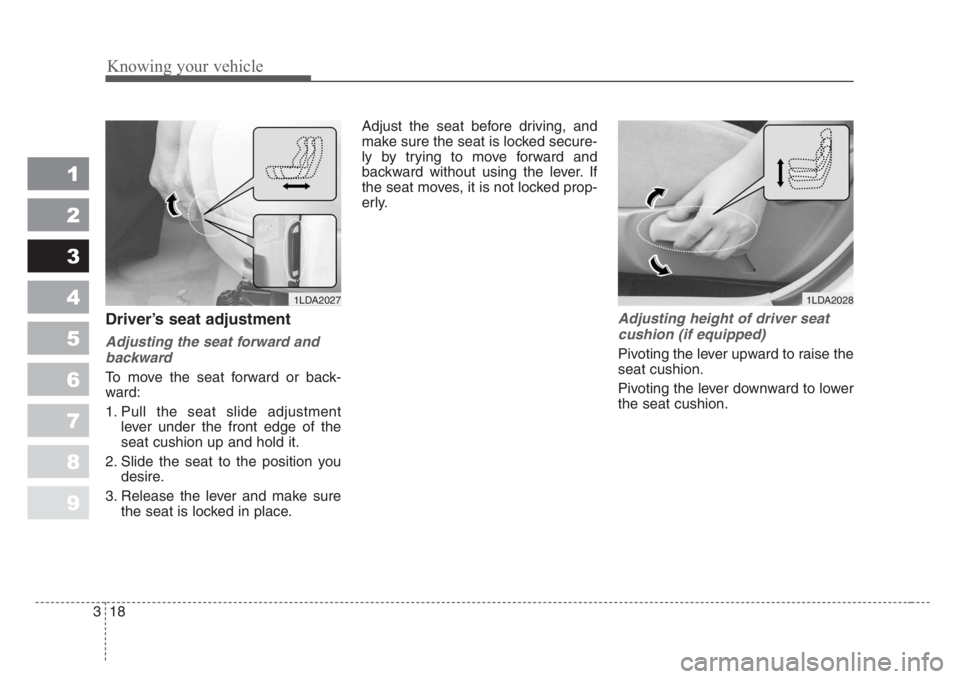
To move the seat forward or back-
ward:
1. Pull the seat slide adjustment
lever under the front edge of the
seat cushion up and hold it.
2. Slide the seat to the position you
desire.
3. Release the lever and make sure
the seat is locked in place.Adjust the seat before driving, and
make sure the seat is locked secure-
ly by trying to move forward and
backward without using the lever. If
the seat moves, it is not locked prop-
erly.
Adjusting height of driver seat
cushion (if equipped)
Pivoting the lever upward to raise the
seat cushion.
Pivoting the lever downward to lower
the seat cushion.
1LDA20271LDA2028
Page 30 of 298
Knowing your vehicle
20 3
1
2
3
4
5
6
7
8
9
Headrest adjustment
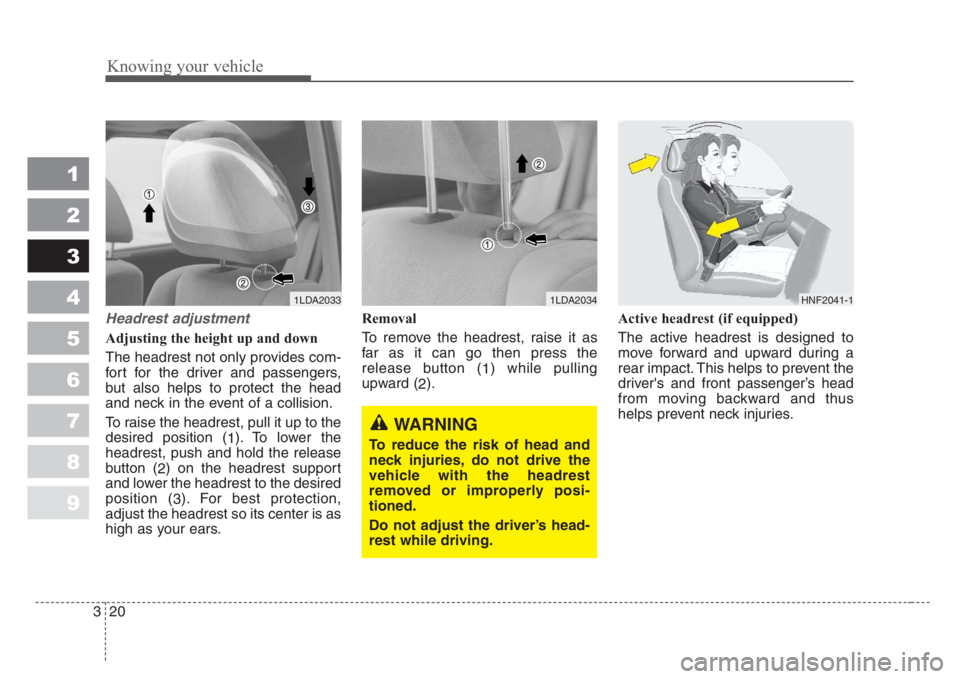
Adjusting the height up and down
The headrest not only provides com-
fort for the driver and passengers,
but also helps to protect the head
and neck in the event of a collision.
To raise the headrest, pull it up to the
desired position (
1). To lower the
headrest, push and hold the release
button (
2) on the headrest support
and lower the headrest to the desired
position (
3). For best protection,
adjust the headrest so its center is as
high as your ears.Removal
To remove the headrest, raise it as
far as it can go then press the
release button (
1) while pulling
upward (
2).Active headrest (if equipped)
The active headrest is designed to
move forward and upward during a
rear impact. This helps to prevent the
driver's and front passenger’s head
from moving backward and thus
helps prevent neck injuries.
1LDA20331LDA2034
WARNING
To reduce the risk of head and
neck injuries, do not drive the
vehicle with the headrest
removed or improperly posi-
tioned.
Do not adjust the driver’s head-
rest while driving.
HNF2041-1
Page 32 of 298

Knowing your vehicle
22 3
1
2
3
4
5
6
7
8
9
Headrest adjustment
Adjusting the height up and down
The headrest not only provides com-
fort for the driver and passengers,
but also helps to protect the head
and neck in the event of a collision.
To raise the headrest, pull it up to the
desired position (
1). To lower the
headrest, push and hold the release
button (
2) on the headrest support
and lower the headrest to the desired
position (
3). For best protection,
adjust the headrest so its center is as
high as your ears.Removal
To remove the headrest, raise it as
far as it can go then press the
release button (
1) while pulling
upward (
2).
WARNING-Driver
responsibility for front seat
passenger
Driving or riding in a vehicle
with a front seatback reclined
could lead to serious or fatal
injury in an accident. If a front
seat is reclined, the occupant’s
hips may slide under the lap
portion of the safety belt apply-
ing great force to the unprotect-
ed abdomen. Serious or fatal
internal injuries could result.
Keep the seatbacks in a com-
fortably upright position when-
ever the vehicle is in motion.
1LDA2033A1LDA2034A
WARNING
To reduce the risk of head and
neck injuries, do not drive the
vehicle with the headrest
removed or improperly posi-
tioned.
Page 36 of 298

Knowing your vehicle
26 3
1
2
3
4
5
6
7
8
9
Headrest adjustment
Adjusting the height up and down
The headrest not only provides com-
fort for the driver and passengers,
but also helps to protect the head
and neck in the event of a collision.
To raise the headrest, pull it up to the
desired position (
1). To lower the
headrest, push and hold the release
button (
2) on the headrest support
and lower the headrest to the desired
position (
3). For best protection,
adjust the headrest so its center is as
high as your ears.Removal
To remove the headrest, raise it as
far as it can go then press the
release button (
1) while pulling
upward (
2).
1LDA2042
WARNING
To reduce the risk of head and
neck injuries, do not drive the
vehicle with the headrest
removed or improperly posi-
tioned.
1LDA2043
CAUTION - Loading pro-
cedure
Make sure the engine is off, the
transaxle is in P and the parking
brake is applied whenever load-
ing or unloading cargo. Vehicle
may move if shift lever is inad-
vertently moved to another
position.
Page 44 of 298

Knowing your vehicle
34 3
1
2
3
4
5
6
7
8
9
4. Position the lap portion of the belt
across your lap as LOW ON THE
HIPS as possible to reduce the
risk of sliding under it during an
accident. Adjust the belt to a
SNUG FIT by pulling up on the
shoulder portion of the safety belt.
The belt retractor is designed to
take up excess webbing automati-
cally and to maintain tension on
the belt. For your safety, do not put
any excess slack into the safety
belt at any location.5. Adjust the shoulder anchor posi-
tion to your size. To raise the
anchor position, push the anchor
up (
1). To lower the anchor posi-
tion, press (
2) the button and slide
the anchor down (
3). After adjust-
ment, make sure the anchor is
locked in position.
If the height of the adjusting seat belt
is too near your neck, you will not be
getting the most effective protection.
The shoulder portion should be
adjusted so that it lies across your
chest and midway over your shoulder
nearest the door and not your neck.
B200A02NFOUN026100
WARNING - Beld adjust
• The height adjuster must be in
the locked position when the
vehicle is moving.
• The misadjustment of height
of the shoulder belt could
reduce the effectiveness of
the seat belt in a crash.
Page 52 of 298

Knowing your vehicle
42 3
1
2
3
4
5
6
7
8
9
(Continued)
•Always make sure that the
shoulder belt portion of the
lap/shoulder belt is positioned
midway over the shoulder,
never across the neck or
behind the back. The lap belt
portion of the lap/shoulder
belt must always be posi-
tioned as low as possible on
the child's hips and as snug
as possible.
• If the seat belt will not proper-
ly fit the child the use of an
approved booster seat in the
rear seat must be used in
order to raise the child's seat-
ing height so that the seat belt
will properly fit the child.
(Continued)(Continued)
• Never allow a child to stand up
or kneel on the seat.
• Never use an infant carrier or
child seat that "hooks" over a
seatback. It will not provide
adequate protection in an
accident.
• Never allow a child to be held
while they are in a moving
vehicle, as this could result in
serious injury or death to the
child in the event of an acci-
dent or sudden stop. Holding
a child in a moving vehicle
does not provide the child
with any protection during an
accident, even if the person
holding the child is wearing a
seat belt.(Continued)
• Since a safety belt or child
restraint system can become
very hot if it is left in a closed
vehicle, be sure to check the
seat cover and buckles before
placing a child there.
• When the child restraint sys-
tem is not in use,store it in the
trunk or fasten it with a safety
belt so that it will not be
thrown forward in the case of
a sudden stop or an accident.
• Children who are too large to
be in a child restraint should
sit in the rear seat and be
restrained with the available
lap/shoulder belts. Never
allow children to ride in the
front passenger seat.
(Continued)
Page 89 of 298

379
1
2
3
4
5
6
7
8
9
Knowing your vehicle
3. Lift the hood and hold it open with
the prop rod by inserting the free
end of the rod into the slot in the
hood.
Closing the hood
1. Before closing the hood, check the
following:
• All filler caps in engine compart-
ment must be correctly installed.
• Gloves, rags or any other com-
bustible material must be
removed from the engine com-
partment.
2. Secure the support rod in its clip.
3. Lower the hood to about 30 cm
(12 inches) height and then let it
drop to properly lock in place.
Make sure the hood is properly
locked before driving.
1LDA2166
WARNING
Handle the support rod in the
area wrapped in rubber. The rub-
ber will help prevent you from
being burned by hot metal when
the engine is hot.
WARNING
• Before closing the hood, make
sure that all engine parts and
tools have been removed from
the engine area and that no
one’s hands are near the hood
opening.
• Do not leave gloves,rags or
any other combustible materi-
al in the engine compartment.
Doing so may cause a heat-
induced fire.
Page 277 of 298

Maintenance
32 7
1
2
3
4
5
6
7
8
9
Compact spare tire replace-
ment (if equipped)
A compact spare tire has a shorter
tread life than a regular size tire.
Replace it when you can see the
tread wear indicator bars on the tire.
The replacement compact spare tire
should be the same size and design
tire as the one provided with your
new Kia and should be mounted on
the same compact spare tire wheel.
The compact spare tire is not
designed to be mounted on a regular
size wheel, and the compact spare
tire wheel is not designed for mount-
ing a regular size tire.
Wheel alignment and tire
balance
The wheels on your vehicle were
aligned and balanced carefully at the
factory to give you the longest tire life
and best overall performance.
In most cases, you will not need to
have your wheels aligned again.
However, if you notice unusual tire
wear or your vehicle pulling one way
or the other, the alignment may need
to be reset.
If you notice your vehicle vibrating
when driving on a smooth road, your
wheels may need to be rebalanced.
Wheel replacement
When replacing the metal wheels for
any reason, make sure the new
wheels are equivalent to the original
factory units in diameter, rim width
and offset.
WARNING
A wheel that is not the correct
size may adversely affect wheel
and bearing life, braking and
stopping abilities, handling char-
acteristics, ground clearance,
body-to-tire clearance,snow
chain clearance,speedometer
calibration, headlight aim and
bumper height.
CAUTION
Improper wheel weights can
damage your vehicle's alu-
minum wheels.Use only
approved wheel weights.
Page 278 of 298

733
Maintenance
1
2
3
4
5
6
7
8
9
Tire maintenance
In addition to proper inflation, correct
wheel alignment helps to decrease
tire wear. If you find a tire is worn
unevenly, have your dealer check the
wheel alignement.
When you have new tires installed,
make sure they are balanced. This
will increase vehicle ride comfort and
tire life. Additionally, a tire should
always be rebalanced if it is removed
from the wheel.
Tire traction
Tire traction can be reduced if you
drive on worn tires, tires that are
improperly inflated or on slippery
road surfaces. Tires should be
replaced when tread wear indicators
appear. To reduce the possiblity of
losing control, slow down whenever
there is rain, snow or ice on the road.
Tire sidewall labeling
This information identifies and
describes the fundamental charac-
teristics of the tire and also provides
the tire identification number (TIN)
for safety standard certification. The
TIN can be used to identify the tire in
case of a recall.
1. Manufacturer or brand name
Manufacturer or Brand name is
shown.
2. Tire size designation
A tire’s sidewall is marked with a tire
size designation. You will need this
information when selecting replace-
ment tires for your car. The following
explains what the letters and num-
bers in the tire size designation
mean.
Example tire size designation:
(These numbers are provided as an
example only; your tire size designa-
tor could vary depending on your
vehicle.)
P195/60R15 87H
P - Applicable vehicle type (tires
marked with the prefix “P’’ are
intended for use on passenger
cars or light trucks; however, not
all tires have this marking).
195 - Tire width in millimeters.
60 - Aspect ratio. The tire’s section
height as a percentage of its
width.
R - Tire construction code (Radial).
15 - Rim diameter in inches.
I030B04JM
1
1
23
4
5,6
7