ECU KIA SPECTRA5 2009 User Guide
[x] Cancel search | Manufacturer: KIA, Model Year: 2009, Model line: SPECTRA5, Model: KIA SPECTRA5 2009Pages: 291, PDF Size: 2.63 MB
Page 58 of 291
Knowing your vehicle48
3
1
2
3
4
5
6
7
8
9
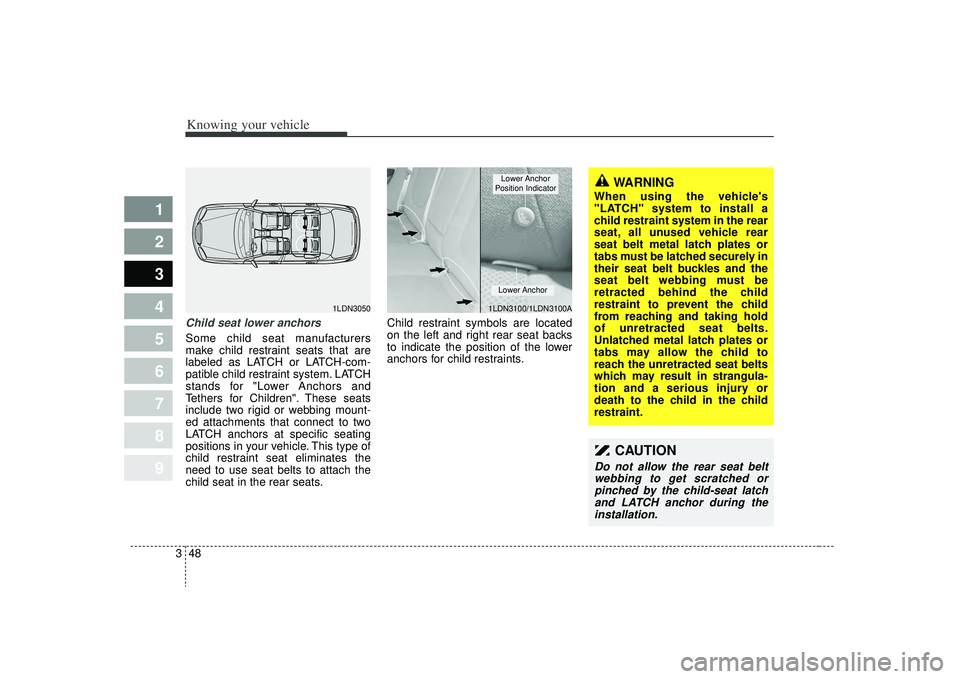
Child seat lower anchorsSome child seat manufacturers
make child restraint seats that are
labeled as LATCH or LATCH-com-
patible child restraint system. LATCH
stands for "Lower Anchors and
Tethers for Children". These seats
include two rigid or webbing mount-
ed attachments that connect to two
LATCH anchors at specific seating
positions in your vehicle. This type of
child restraint seat eliminates the
need to use seat belts to attach the
child seat in the rear seats. Child restraint symbols are located
on the left and right rear seat backs
to indicate the position of the lower
anchors for child restraints.
1LDN3050
WARNING
When using the vehicle's
"LATCH" system to install a
child restraint system in the rear
seat, all unused vehicle rear
seat belt metal latch plates or
tabs must be latched securely in
their seat belt buckles and the
seat belt webbing must be
retracted behind the child
restraint to prevent the child
from reaching and taking hold
of unretracted seat belts.
Unlatched metal latch plates or
tabs may allow the child to
reach the unretracted seat belts
which may result in strangula-
tion and a serious injury or
death to the child in the child
restraint.
CAUTION
Do not allow the rear seat belt
webbing to get scratched orpinched by the child-seat latchand LATCH anchor during theinstallation.
1LDN3100/1LDN3100ALower AnchorLower Anchor
Position Indicator
Page 59 of 291
349
1
2
3
4
5
6
7
8
9
Knowing your vehicle
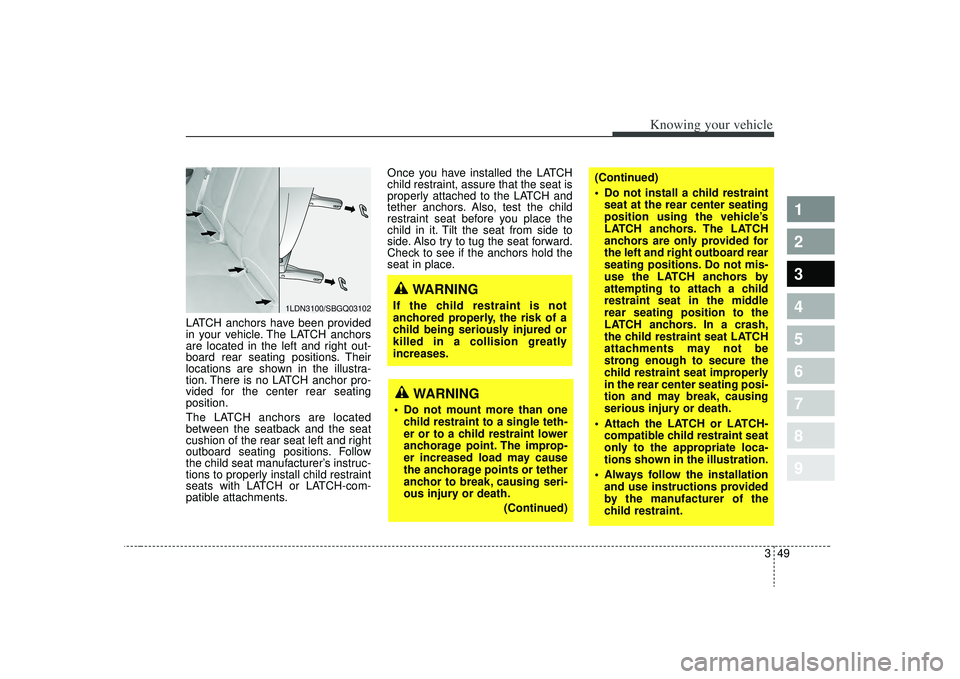
LATCH anchors have been provided
in your vehicle. The LATCH anchors
are located in the left and right out-
board rear seating positions. Their
locations are shown in the illustra-
tion. There is no LATCH anchor pro-
vided for the center rear seating
position.
The LATCH anchors are located
between the seatback and the seat
cushion of the rear seat left and right
outboard seating positions. Follow
the child seat manufacturer’s instruc-
tions to properly install child restraint
seats with LATCH or LATCH-com-
patible attachments.Once you have installed the LATCH
child restraint, assure that the seat is
properly attached to the LATCH and
tether anchors. Also, test the child
restraint seat before you place the
child in it. Tilt the seat from side to
side. Also try to tug the seat forward.
Check to see if the anchors hold the
seat in place.
WARNING
If the child restraint is not
anchored properly, the risk of a
child being seriously injured or
killed in a collision greatly
increases.
1LDN3100/SBGQ03102
WARNING
Do not mount more than one
child restraint to a single teth-
er or to a child restraint lower
anchorage point. The improp-
er increased load may cause
the anchorage points or tether
anchor to break, causing seri-
ous injury or death.
(Continued)
(Continued)
Do not install a child restraintseat at the rear center seating
position using the vehicle’s
LATCH anchors. The LATCH
anchors are only provided for
the left and right outboard rear
seating positions. Do not mis-
use the LATCH anchors by
attempting to attach a child
restraint seat in the middle
rear seating position to the
LATCH anchors. In a crash,
the child restraint seat LATCH
attachments may not be
strong enough to secure the
child restraint seat improperly
in the rear center seating posi-
tion and may break, causing
serious injury or death.
Attach the LATCH or LATCH- compatible child restraint seat
only to the appropriate loca-
tions shown in the illustration.
Always follow the installation and use instructions provided
by the manufacturer of the
child restraint.
Page 67 of 291
357
1
2
3
4
5
6
7
8
9
Knowing your vehicle
WARNING
- Side and cur-tain air bags
In order for side and curtain air bags to provide the best
protection, both front seat
occupants and both outboard
rear occupants should sit in
an upright position with the
safety belts properly fastened.
Importantly, children should
sit in a proper child restraint
system in the rear seat.
When children are seated in the rear outboard seats, they
must be seated in the proper
child restraint system. Make
sure to put the child restraint
system as far away from the
door side as possible, and
secure the child restraint sys-
tem in a locked position.
(Continued)
(Continued)
If a small child is seated onthe rear outboard seat cush-
ion, it is probable that they will
below the deployment level of
the side curtain airbag and
thus not protected by that
airbag.
Do not allow the passengers to lean their heads or bodies
onto doors, put their arms on
the doors, stretch their arms
out of the window, or place
objects between the doors
and passengers when they are
seated on seats equipped with
side air bags.
Never try to open or repair any components of the side cur-
tain air bag system. This
should only be done by an
authorized Kia dealer.
Failure to follow the above men-
tioned instructions can result in
severe injury or death to the
vehicle occupants in an acci-
dent.
The curtain air bag deployment
occurs only on the side of the vehi-
cle affected by the impact.
The side air bags (side and curtain air bags) are not designed to
deploy during collisions from the
front or rear of the vehicle or in
most rollover situations.
The curtain air bags are designed to deploy only during certain side-
impact collisions, depending on the
crash severity, angle, speed and
impact.
Page 75 of 291
365
1
2
3
4
5
6
7
8
9
Knowing your vehicle
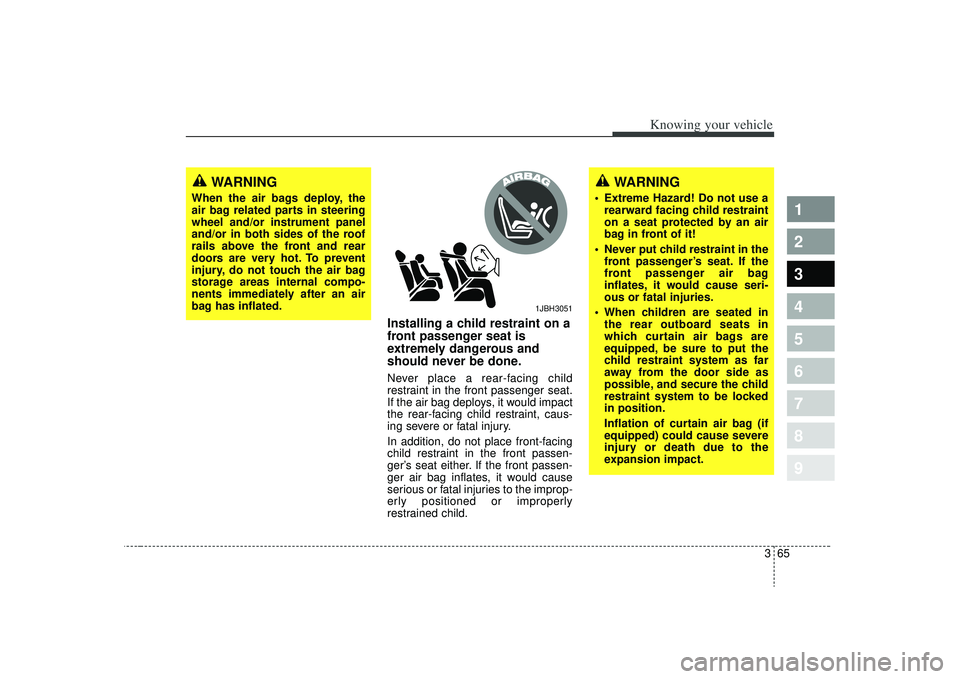
Installing a child restraint on a
front passenger seat is
extremely dangerous and
should never be done.Never place a rear-facing child
restraint in the front passenger seat.
If the air bag deploys, it would impact
the rear-facing child restraint, caus-
ing severe or fatal injury.
In addition, do not place front-facing
child restraint in the front passen-
ger’s seat either. If the front passen-
ger air bag inflates, it would cause
serious or fatal injuries to the improp-
erly positioned or improperly
restrained child.
WARNING
Extreme Hazard! Do not use arearward facing child restraint
on a seat protected by an air
bag in front of it!
Never put child restraint in the front passenger’s seat. If the
front passenger air bag
inflates, it would cause seri-
ous or fatal injuries.
When children are seated in the rear outboard seats in
which curtain air bags are
equipped, be sure to put the
child restraint system as far
away from the door side as
possible, and secure the child
restraint system to be locked
in position.
Inflation of curtain air bag (if
equipped) could cause severe
injury or death due to the
expansion impact.
WARNING
When the air bags deploy, the
air bag related parts in steering
wheel and/or instrument panel
and/or in both sides of the roof
rails above the front and rear
doors are very hot. To prevent
injury, do not touch the air bag
storage areas internal compo-
nents immediately after an air
bag has inflated.
1JBH3051
Page 79 of 291

369
1
2
3
4
5
6
7
8
9
Knowing your vehicle
Outside the vehicle To open the trunk, insert the keyinto the lock and turn it clockwise
(1 ).
To close the trunk, use both hands to push the trunk lid down. Check
to see if the trunk is completely
shut.
Trunk can be opened with transmit- ter (if equipped).
Trunk room lampTrunk room lamp turns on when the
trunk is opened. It remains on until
the trunk is securely closed.
Inside the vehicleTo open the trunk from inside the
vehicle push trunk lid release switch.
TRUNK (IF EQUIPPED)
1LDA2015
OLD026014
CAUTION
Make sure to close the trunksecurely. If it remains openwhile engine is not running, itmay cause battery dischargebecause trunk room lampremains on.
OLD026016N
Page 82 of 291

Knowing your vehicle72
3
1
2
3
4
5
6
7
8
9
3. Lift the hood and hold it open with
the prop rod by inserting the free
end of the rod into the slot in the
hood.
Closing the hood1. Before closing the hood, check thefollowing:
ment must be correctly installed.
bustible material must be
removed from the engine com-
partment.
2. Secure the support rod in its clip.
3. Lower the hood to about 30 cm (12 inches) height and then let it
drop to properly lock in place.
Make sure the hood is properly
locked before driving.
1LDA2166
WARNING
Handle the support rod in the
area wrapped in rubber. The rub-
ber will help prevent you from
being burned by hot metal when
the engine is hot.
WARNING
Before closing the hood, make sure that all engine parts and
tools have been removed from
the engine area and that no
one’s hands are near the hood
opening.
Do not leave gloves, rags or any other combustible materi-
al in the engine compartment.
Doing so may cause a heat-
induced fire.
Page 83 of 291
373
1
2
3
4
5
6
7
8
9
Knowing your vehicle
WARNING
If pressurized fuel sprays out, it
can cause serious injuries.
Always remove the fuel cap
carefully and slowly. If the cap is
venting fuel or if you hear a
hissing sound, wait until the
condition stops before com-
pletely removing the cap.
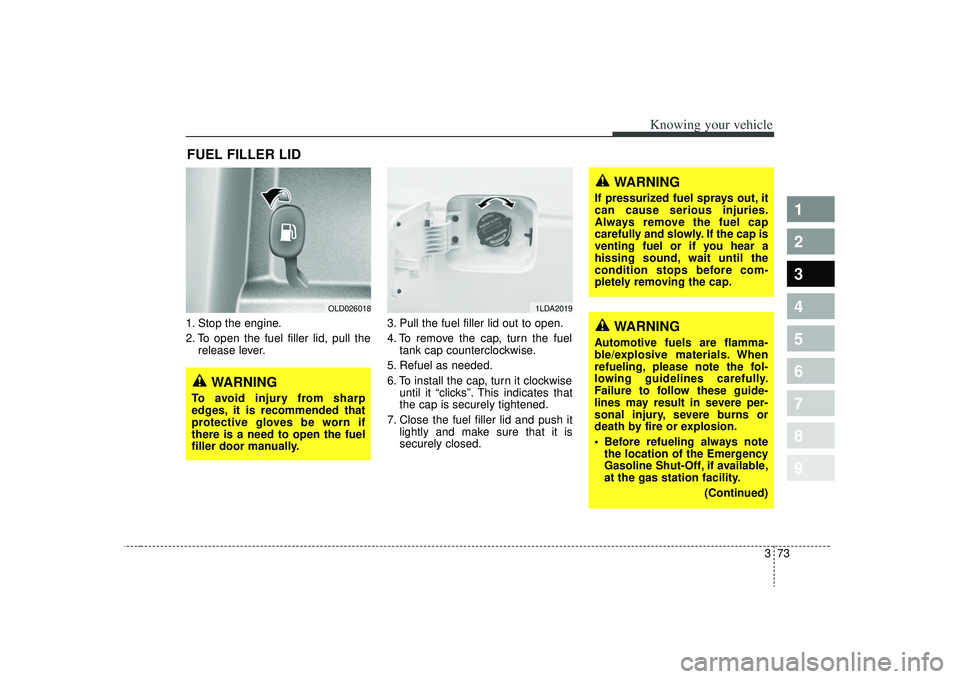
1. Stop the engine.
2. To open the fuel filler lid, pull therelease lever. 3. Pull the fuel filler lid out to open.
4. To remove the cap, turn the fuel
tank cap counterclockwise.
5. Refuel as needed.
6. To install the cap, turn it clockwise until it “clicks”. This indicates that
the cap is securely tightened.
7. Close the fuel filler lid and push it lightly and make sure that it is
securely closed.FUEL FILLER LID
1LDA2019
OLD026018
WARNING
To avoid injury from sharp
edges, it is recommended that
protective gloves be worn if
there is a need to open the fuel
filler door manually.
WARNING
Automotive fuels are flamma-
ble/explosive materials. When
refueling, please note the fol-
lowing guidelines carefully.
Failure to follow these guide-
lines may result in severe per-
sonal injury, severe burns or
death by fire or explosion.
Before refueling always notethe location of the Emergency
Gasoline Shut-Off, if available,
at the gas station facility.
(Continued)
Page 84 of 291

Knowing your vehicle74
3
1
2
3
4
5
6
7
8
9
(Continued)
Before touching the fuel noz-
zle or fuel filler cap, you
should eliminate potentially
dangerous static electricity
discharge by touching anoth-
er metal part of the front of the
vehicle, a safe distance away
from the fuel filler neck, noz-
zle, or other gas source.
Do not get back into a vehicle once you have begun refuel-
ing. Do not touch, rub or slide
against any item or fabric
(polyester, satin, nylon, etc.)
capable of producing static
electricity. Static electricity
discharge can ignite fuel
vapors resulting in explosion.
If you must re-enter the vehi-
cle, you should once again
eliminate potentially danger-
ous static electricity dis-
charge by touching a metal
part of the vehicle, away from
the fuel filler neck, nozzle or
other gasoline source.
(Continued)
(Continued)
When using a portable fuelcontainer be sure to place the
container on the ground prior
to refueling. Static electricity
discharge from the container
can ignite fuel vapors causing
a fire. Once refueling has
begun, contact with the vehi-
cle should be maintained until
the filling is complete. Use
only portable fuel containers
designed to carry and store
gasoline.
Do not use cellular phones around a gas station or while
refueling any vehicle. Electric
current and/or electronic
interference from cellular
phones can potentially ignite
fuel vapors causing a fire. If
you must use your cellular
phone, use it in a place away
from the gas station.
(Continued)
(Continued)
When refueling always shutthe engine off. Sparks pro-
duced by electrical compo-
nents related to the engine
can ignite fuel vapors causing
a fire. Always insure that the
engine is OFF before and dur-
ing refueling. Once refueling
is complete, check to make
sure the fuel filler cap and
door are securely closed,
before starting the engine.
Do not light any fire around a gas station. DO NOT use
matches or a lighter and DO
NOT SMOKE or leave a lit cig-
arette in your vehicle while at
a gas station especially during
refueling. Automotive fuel is
highly flammable and can,
when ignited, result in explo-
sion by flames.
(Continued)
Page 85 of 291

375
1
2
3
4
5
6
7
8
9
Knowing your vehicle
(Continued)
If a fire breaks out during refu-eling, leave the vicinity of the
vehicle, and immediately con-
tact the manager of the gas
station or contact the police
and local fire department.
Follow any safety instructions
they provide.
(Continued)
If the fuel filler cap requires replacement, use only a gen-uine Kia cap or the equivalentspecified for your vehicle. Anincorrect fuel filler cap canresult in a serious malfunctionof the fuel system or emissioncontrol system. Correctreplacement caps are avail-able at authorized Kia dealers.
Do not spill fuel on the exteri- or surfaces of the vehicle. Anytype of fuel spilled on paintedsurfaces may damage thepaint.
A loose fuel filler cap may cause the “Check Engine”(Malfunction Indicator) light inthe instrument panel to illumi-nate unnecessarily.
If the fuel filler lid will not open in cold weather because thearea around it is frozen, pushor lightly tap the lid.
CAUTION
Make sure to refuel with gaso- line (unleaded fuel) only forthe gasoline engine vehicles.
Check to make sure the fuel filler cap is securely closedafter refueling.
(Continued)
Page 91 of 291
381
1
2
3
4
5
6
7
8
9
Knowing your vehicle
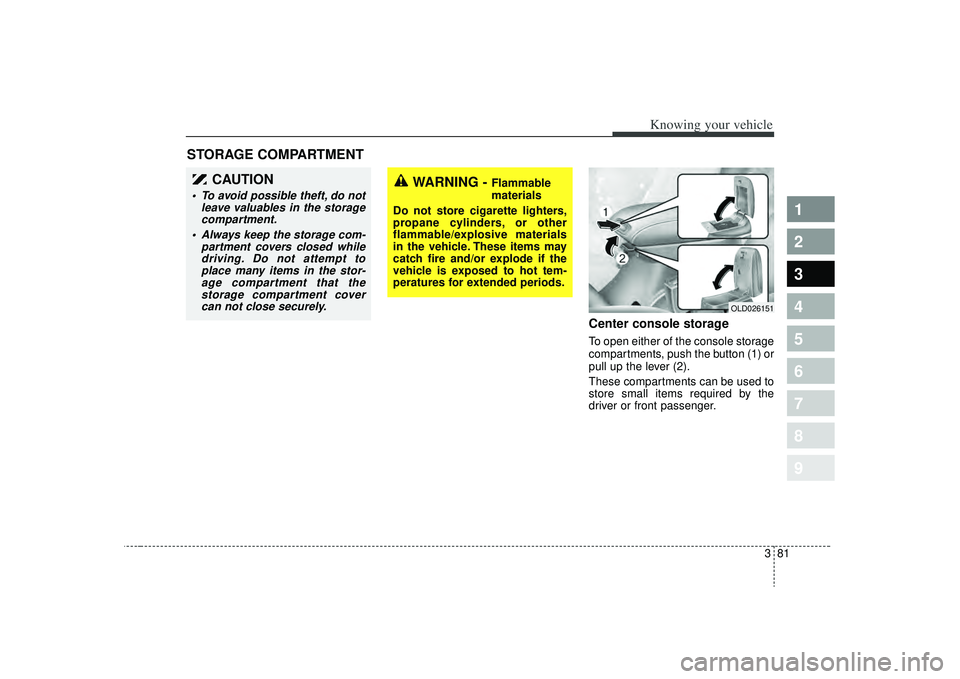
Center console storageTo open either of the console storage
compartments, push the button (1) or
pull up the lever (2).
These compartments can be used to
store small items required by the
driver or front passenger.
STORAGE COMPARTMENT
WARNING -
Flammable
materials
Do not store cigarette lighters,
propane cylinders, or other
flammable/explosive materials
in the vehicle. These items may
catch fire and/or explode if the
vehicle is exposed to hot tem-
peratures for extended periods.
OLD026151
CAUTION
• To avoid possible theft, do not leave valuables in the storagecompartment.
Always keep the storage com- partment covers closed whiledriving. Do not attempt toplace many items in the stor-age compartment that thestorage compartment covercan not close securely.