brake KIA Sportage 2005 JE_ / 2.G Service Manual
[x] Cancel search | Manufacturer: KIA, Model Year: 2005, Model line: Sportage, Model: KIA Sportage 2005 JE_ / 2.GPages: 354, PDF Size: 2.78 MB
Page 239 of 354
Driving tips22 5
1
2
3
4
5
6
7
8
9
Stalled on a steep uphillIf your vehicle stalls and you can’t
back down the hill, try this: Set the
parking brake, put your transaxle in 1
(First) gear or P (Park), and turn the
engine off. Leave the vehicle and get
some help. If your vehicle is at an
angle to the slope of the hill, exit the
vehicle on the uphill side and stay
clear of the path the vehicle would
take if it rolled downhill. Leave it in 1
(First) gear for manual transaxle or P
(Park) for automatic transaxle.
CAUTION
Never attempt to turn around if
you are about to stall when
going up a hill. If the hill is steep
enough to stall your vehicle, it’s
steep enough to cause you to
roll over if you turn around. If
you can’t make it up, you must
back down the hill.
WARNING
- Exiting vehicle
Getting out on the downhill
(low) side of a vehicle stopped
across an incline is dangerous.
If the vehicle rolls over, you
could be crushed or fatally
injured. Always get out on the
uphill (high) side of the vehicle
and stay well clear of the
rollover path.
KM CAN (ENG) 5.qxd 9/13/2004 4:48 PM Page 22
Page 240 of 354
523
Driving tips
1
2
3
4
5
6
7
8
9
Driving downhillWhen off-roading takes you downhill,
you’ll want to consider many of the
same things you thought about
before you went uphill. As a brief
reminder, those include:
How steep is the downhill? Will I be
able to maintain vehicle control?
What’s the surface like? Smooth?
Rough? Slippery? Hard-packed
dirt? Gravel?
Are there hidden surface obsta-
cles? Ruts? Logs? Boulders?
What’s at the bottom of the hill? Is
there a hidden creek bank or even
a river bottom with large rocks?
Have changes in the weather con-
ditions and their effect on the ter-
rain since you went uphill made
your task more difficult?Once you have decided that you can
go down a hill safely, try to keep your
vehicle headed straight down, and
use a low gear. This way, engine
braking can help your brakes so they
won’t have to do all the work.
Descend slowly, keeping your vehi-
cle under control at all times.
WARNING
- Leaving vehi-
cle
If you are going to leave your
vehicle, set the parking brake
and shift a manual transaxle to
1(First), or an automatic
transaxle to P (Park).
KM CAN (ENG) 5.qxd 9/13/2004 4:48 PM Page 23
Page 241 of 354
Driving tips24 5
1
2
3
4
5
6
7
8
9
Avoid turns that take you across the
incline of the hill. A hill that’s not too
steep to drive down may be too
steep to drive across. You could roll
over if you don’t drive straight down.
Never go downhill with the clutch
pedal depressed. This is called “free-
wheeling.” Your brakes will have to do
all the work and could overheat and
fade.If your wheels lock up during down-
hill braking, you may feel the vehicle
starting to slide sideways. To regain
your direction, just ease off the
brakes and steer to keep the front of
the vehicle pointing straight downhill.
CAUTION
Before beginning to go down-
hill, it is critical that you ensure
that no cargo can shift forward
while you are heading downhill.
Such shifting could either
endanger you and your occu-
pants, or interfere with your
ability to control the vehicle.
WARNING
- Braking
Heavy braking when going
down a hill can cause your
brakes to overheat and fade.
This could cause loss of control
and a serious accident. Apply
the brakes lightly when
descending a hill and use a low
gear to keep vehicle speed
under control.
CAUTION
Avoid braking so hard that you
lock the wheels when going
downhill. If your front wheels
are locked, you can’t steer your
vehicle.
KM CAN (ENG) 5.qxd 9/13/2004 4:48 PM Page 24
Page 242 of 354
525
Driving tips
1
2
3
4
5
6
7
8
9
Stalling downhillStalling is much more likely to hap-
pen going uphill. But if it happens
going downhill, here’s what to do.
Stop your vehicle by applying the
brakes. Then apply the parking
brake.
Move the shift lever to P (Park) in
automatic transaxle or shift to N
(Neutral) in manual transaxle and,
while still braking, restart the
engine.
Shift back to a low gear, release
the parking brake, and drive
straight down.
If the engine won’t start, get out
and seek help. Exit on the uphill
side of the vehicle and stay clear of
the path the vehicle would take if it
rolled downhill.
Driving across an inclineSooner or later, an off-road trail will
probably go across the incline of a
hill. If this happens, you have to
decide whether or not to try to drive
across the incline. Here are some
things to consider:
A hill that can be driven straight up
or down may be too steep to drive
across. When you go straight up or
down a hill, the length of the wheel
base (the distance from the front
wheels to the rear wheels) reduces
the likelihood the vehicle will tum-
ble end over end. But when you
drive across an incline, the much
narrower track width (the distance
between the left and right wheels)
may not prevent the vehicle from
tilting and rolling over. Also, driving
across an incline puts more weight
on the downhill wheels. This could
cause a downhill slide or a rollover. Surface conditions can be a prob-
lem when you drive across a hill.
Loose gravel, muddy spots, or
even wet grass can cause your
tires to slip sideways. If the vehicle
slips sideways, it can hit something
that will tip it (a rock, a rut, etc.) and
cause it to roll over.
Hidden obstacles can make the
steepness of the incline even
worse. If you drive across a rock
with the uphill wheels, or if the
downhill wheels drop into a rut or
depression, your vehicle can tilt
even more.
For reasons like these, you need to
decide carefully whether or not to try
to drive across an incline. Just
because the trail goes across the
incline doesn’t mean you have to
drive it.
KM CAN (ENG) 5.qxd 9/13/2004 4:48 PM Page 25
Page 245 of 354
Driving tips28 5
1
2
3
4
5
6
7
8
9
Hard-packed snow and ice offer the
worst tire traction. On these surfaces,
it’s very easy to lose control. On wet
ice, for example, the traction is so
poor that you will even have difficulty
accelerating. And if you do get mov-
ing, poor steering and difficult brak-
ing can easily cause you to slide out
of control.
Driving in waterLight rain causes no special off-road
driving problems. However, heavy
rain can cause flash flooding, and
flood waters demand extreme cau-
tion.
Find out how deep the water is
before you drive through it. If it’s
deep enough to cover your wheel
bearing hubs, axles, or exhaust pipe,
don’t try it, You probably won’t get
through. Also, water that deep can
damage your axle and other vehicle
parts.
If the water isn’t too deep, then drive
through slowly. At fast speeds, water
can splash on your ignition system
and your vehicle can stall. Stalling
can also occur if your tailpipe goes
underwater. As long as your tailpipe
is underwater, you will not be able to
start your engine. When you go
through water, remember that it may
take you longer to stop when your
brakes are wet.If you have driven through water that
was deep enough to cover your
wheel bearing hubs, it may be a
good idea to have an Authorized Kia
dealer or other competent service
center repack your front wheel bear-
ings and examine your rear-end fluid
for evidence of water.
WARNING
- Frozen sur-
faces
Driving on frozen lakes, ponds
or rivers can be dangerous.
Underwater springs, currents
under the ice, or sudden thaws
can weaken the ice. Your vehicle
could fall through the ice and
you and your passengers could
drown. Drive your vehicle on
safe surfaces only.
KM CAN (ENG) 5.qxd 9/13/2004 4:48 PM Page 28
Page 246 of 354
529
Driving tips
1
2
3
4
5
6
7
8
9
After off-road drivingRemove any brush or debris that has
collected on the underbody, chassis
or under the hood. These accumula-
tions can be a fire hazard.
After driving in mud or sand, clean
and check the brake linings.
Accumulation of mud or sand can
cause glazing and uneven braking.
Check the body structure, steering,
suspension, wheels, tires, and
exhaust system for damage. Also,
check the fuel lines and cooling sys-
tem for any leakage. Your vehicle will
also require more frequent service
due to off-road use.
WARNING
- Water
Driving through rushing water
can be dangerous. Deep water
can sweep your vehicle down-
stream and you and your pas-
sengers could drown. If it’s only
inches deep, it can still wash
away the ground from under
your tires, and you could lose
traction and roll the vehicle.
Never drive through rushing
water.
KM CAN (ENG) 5.qxd 9/13/2004 4:48 PM Page 29
Page 248 of 354
531
Driving tips
1
2
3
4
5
6
7
8
9
GCW (Gross combined weight)This is the weight of the loaded vehi-
cle (GVW) plus the weight of the fully
loaded trailer.GCWR (Gross combined
weight rating)This is the maximum allowable
weight of the vehicle and the loaded
trailer - including all cargo and pas-
sengers - that the vehicle can handle
without risking damage. (Important :
The towing vehicle's braking system
is rated for operation at GVWR, not
GCWR. Separate functional brakes
should be used for safe control of
towed vehicles and for trailers weigh-
ing an 454 kg (1,000 lbs).) The GCW
must never exceed the GCWR.
Maximum trailer weightThis is the highest possible weight of
a fully loaded trailer the vehicle can
tow. It assumes a vehicle with only
mandatory options, no cargo, and a
driver. The weight of other optional
equipment, passengers and cargo in
your vehicle will reduce the maxi-
mum trailer weight your vehicle can
tow.
Calculating the load your vehi-
cle can tow1. Use the appropriate maximum
GCWR chart (in the Weight of the
Trailer section in this chapter) for
your type of drive system and
transmission.
2. Weigh your vehicle.
3. Subtract the weight of your vehicle
from the maximum GCWR in the
chart. This is the maximum trailer
weight your vehicle can tow. It
must be below the maximum trail-
er weight shown in the chart. Note
that the maximum trailer weight
your vehicle can tow depends on
the total weight of any cargo, pas-
sengers and available equipment
in the vehicle.
KM CAN (ENG) 5.qxd 9/13/2004 4:48 PM Page 31
Page 250 of 354
533
Driving tips
1
2
3
4
5
6
7
8
9
Weight of the trailer
How heavy can a trailer safely be? It
should never weigh more than the
maximum trailer weight with trailer
brakes. But even that can be too
heavy.
It depends on how you plan to use
your trailer. For example, speed, alti-
tude, road grades, outside tempera-
ture and how much your vehicle is
used to pull a trailer are all important.
The ideal trailer weight can also
depend on any special equipment
that you have on your vehicle.
✽ ✽
NOTICE• For definitions of terms used in this table and instructions on how to cal-
culate your vehicle load, refer to Weight of the Vehicle in this chapter.
• The combined weight of the completed towing vehicle and the loaded
trailer must not exceed the GCWR.
• When towing maximum loads under high outside temperatures and/or on
steep grades, the A/C system may cycle on and off to protect the engine
from overheating. This may result in a temporary increase of interior tem-
perature.
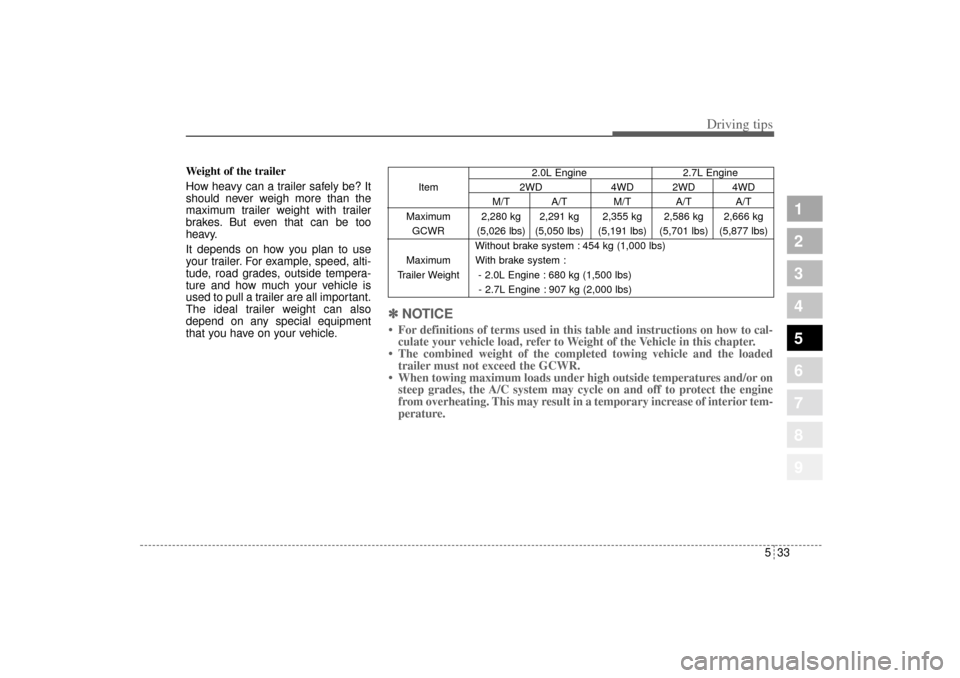
2.0L Engine 2.7L Engine
Item 2WD 4WD 2WD 4WD
M/T A/T M/T A/T A/T
Maximum 2,280 kg 2,291 kg 2,355 kg 2,586 kg 2,666 kg
GCWR (5,026 lbs) (5,050 lbs) (5,191 lbs) (5,701 lbs) (5,877 lbs)
Without brake system : 454 kg (1,000 lbs)
Maximum With brake system :
Trailer Weight - 2.0L Engine : 680 kg (1,500 lbs)
- 2.7L Engine : 907 kg (2,000 lbs)
KM CAN (ENG) 5.qxd 9/13/2004 4:48 PM Page 33
Page 252 of 354
535
Driving tips
1
2
3
4
5
6
7
8
9
Safety chains You should always attach chains
between your vehicle and your trail-
er. Cross the safety chains under the
tongue of the trailer so that the
tongue will not drop to the road if it
becomes separated from the hitch.
Instructions about safety chains may
be provided by the hitch manufactur-
er or by the trailer manufacturer.
Follow the manufacturer’s recom-
mendation for attaching safety
chains. Always leave just enough
slack so you can turn with your trail-
er. And, never allow safety chains to
drag on the ground.
Trailer brakes If your trailer weighs more than the
maximum trailer weight without trail-
er brakes loaded, then it needs its
own brakes and they must be ade-
quate. Be sure to read and follow the
instructions for the trailer brakes so
you’ll be able to install, adjust and
maintain them properly.
Don’t tap into your vehicle's brake
system.
Driving with a trailer Towing a trailer requires a certain
amount of experience. Before setting
out for the open road, you must get
to know your trailer. Acquaint your-
self with the feel of handling and
braking with the added weight of the
trailer. And always keep in mind that
the vehicle you are driving is now a
good deal longer and not nearly so
responsive as your vehicle is by
itself.
Before you start, check the trailer
hitch and platform, safety chains,
electrical connector(s), lights, tires
and mirror adjustment. If the trailer
has electric brakes, start your vehicle
and trailer moving and then apply the
trailer brake controller by hand to be
sure the brakes are working. This lets
you check your electrical connection
at the same time.
During your trip, check occasionally
to be sure that the load is secure,
and that the lights and any trailer
brakes are still working.
WARNING
Do not use a trailer with its own
brakes unless you are absolute-
ly certain that you have properly
set up the brake system. This is
not a task for amateurs. Use an
experienced, competent trailer
shop for this work.
KM CAN (ENG) 5.qxd 9/13/2004 4:48 PM Page 35
Page 254 of 354
537
Driving tips
1
2
3
4
5
6
7
8
9
Do not connect a trailer lighting sys-
tem directly to your vehicle’s lighting
system. Use only an approved trailer
wiring harness.
Your Authorized Kia Dealer can
assist you in installing the wiring har-
ness.
Driving on grades Reduce speed and shift to a lower
gear before you start down a long or
steep downgrade. If you don’t shift
down, you might have to use your
brakes so much that they would get
hot and no longer operate efficiently.
On a long uphill grade, shift down
and reduce your speed to around 70
km/h (45 mph) to reduce the possi-
bility of engine and transaxle over-
heating.
If your trailer weighs more than the
maximum trailer weight without trail-
er brakes and you have an automat-
ic transaxle, you should drive in D
(Drive) when towing a trailer.
Operating your vehicle in D (Drive)
when towing a trailer will minimize
heat build up and extend the life of
your transaxle.
✽ ✽
NOTICE• When towing a trailer on steep
grades (in excess of 12%) pay close
attention to the engine coolant
temperature gauge to ensure the
engine does not overheat. If the
needle of the coolant temperature
gauge moves across the dial
towards “H” (HOT), pull over and
stop as soon as it is safe to do so,
and allow the engine to idle until it
cools down. You may proceed once
the engine has cooled sufficiently.
• You must decide driving speed
depending on trailer weight and
uphill grade to reduce the possibil-
ity of engine and transaxle over-
heating.
CAUTION
Failure to use an approved trail-
er wiring harness could result in
damage to the vehicle electrical
system and/or personal injury.
KM CAN (ENG) 5.qxd 9/13/2004 4:48 PM Page 37