brake KIA Sportage 2005 JE_ / 2.G Workshop Manual
[x] Cancel search | Manufacturer: KIA, Model Year: 2005, Model line: Sportage, Model: KIA Sportage 2005 JE_ / 2.GPages: 354, PDF Size: 2.78 MB
Page 255 of 354
Driving tips38 5
1
2
3
4
5
6
7
8
9
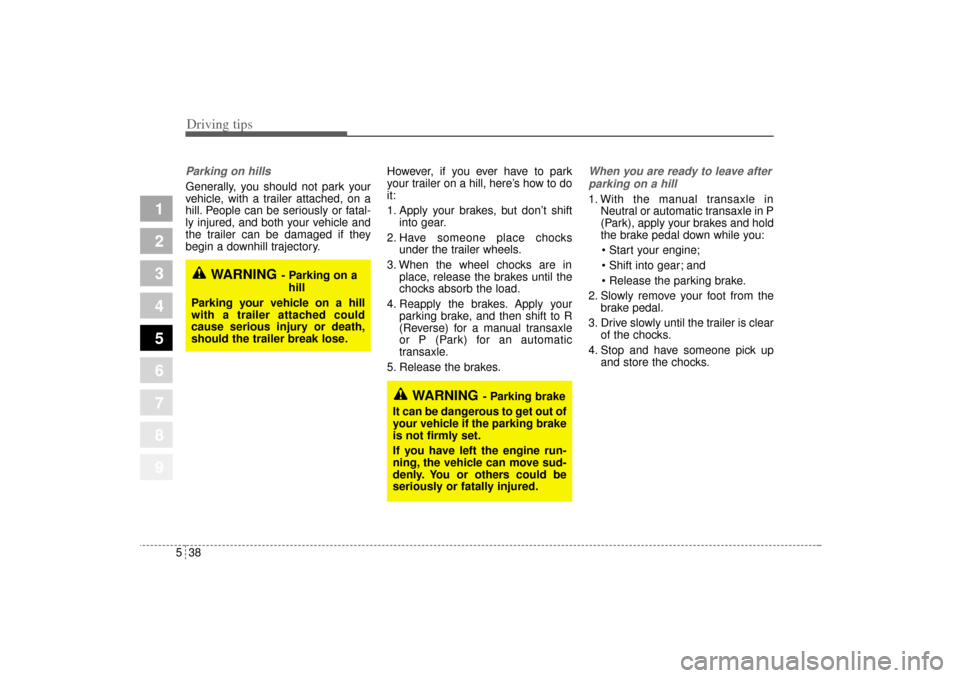
Parking on hills Generally, you should not park your
vehicle, with a trailer attached, on a
hill. People can be seriously or fatal-
ly injured, and both your vehicle and
the trailer can be damaged if they
begin a downhill trajectory.However, if you ever have to park
your trailer on a hill, here’s how to do
it:
1. Apply your brakes, but don’t shift
into gear.
2. Have someone place chocks
under the trailer wheels.
3. When the wheel chocks are in
place, release the brakes until the
chocks absorb the load.
4. Reapply the brakes. Apply your
parking brake, and then shift to R
(Reverse) for a manual transaxle
or P (Park) for an automatic
transaxle.
5. Release the brakes.
When you are ready to leave after
parking on a hill 1. With the manual transaxle in
Neutral or automatic transaxle in P
(Park), apply your brakes and hold
the brake pedal down while you:
Start your engine;
Shift into gear; and
Release the parking brake.
2. Slowly remove your foot from the
brake pedal.
3. Drive slowly until the trailer is clear
of the chocks.
4. Stop and have someone pick up
and store the chocks.
WARNING
- Parking brake
It can be dangerous to get out of
your vehicle if the parking brake
is not firmly set.
If you have left the engine run-
ning, the vehicle can move sud-
denly. You or others could be
seriously or fatally injured.
WARNING
- Parking on a
hill
Parking your vehicle on a hill
with a trailer attached could
cause serious injury or death,
should the trailer break lose.
KM CAN (ENG) 5.qxd 9/13/2004 4:48 PM Page 38
Page 256 of 354
539
Driving tips
1
2
3
4
5
6
7
8
9
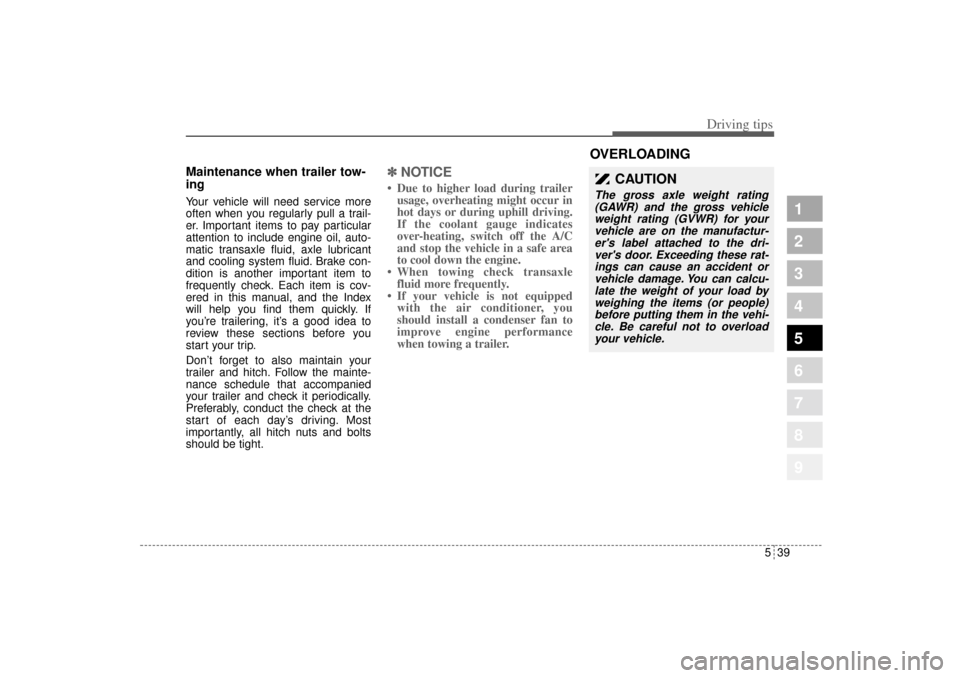
Maintenance when trailer tow-
ing Your vehicle will need service more
often when you regularly pull a trail-
er. Important items to pay particular
attention to include engine oil, auto-
matic transaxle fluid, axle lubricant
and cooling system fluid. Brake con-
dition is another important item to
frequently check. Each item is cov-
ered in this manual, and the Index
will help you find them quickly. If
you’re trailering, it’s a good idea to
review these sections before you
start your trip.
Don’t forget to also maintain your
trailer and hitch. Follow the mainte-
nance schedule that accompanied
your trailer and check it periodically.
Preferably, conduct the check at the
start of each day’s driving. Most
importantly, all hitch nuts and bolts
should be tight.
✽ ✽
NOTICE• Due to higher load during trailer
usage, overheating might occur in
hot days or during uphill driving.
If the coolant gauge indicates
over-heating, switch off the A/C
and stop the vehicle in a safe area
to cool down the engine.
• When towing check transaxle
fluid more frequently.
• If your vehicle is not equipped
with the air conditioner, you
should install a condenser fan to
improve engine performance
when towing a trailer.
OVERLOADING
CAUTION
The gross axle weight rating
(GAWR) and the gross vehicle
weight rating (GVWR) for your
vehicle are on the manufactur-
er's label attached to the dri-
ver's door. Exceeding these rat-
ings can cause an accident or
vehicle damage. You can calcu-
late the weight of your load by
weighing the items (or people)
before putting them in the vehi-
cle. Be careful not to overload
your vehicle.
KM CAN (ENG) 5.qxd 9/13/2004 4:48 PM Page 39
Page 271 of 354
63
In case of an emergency
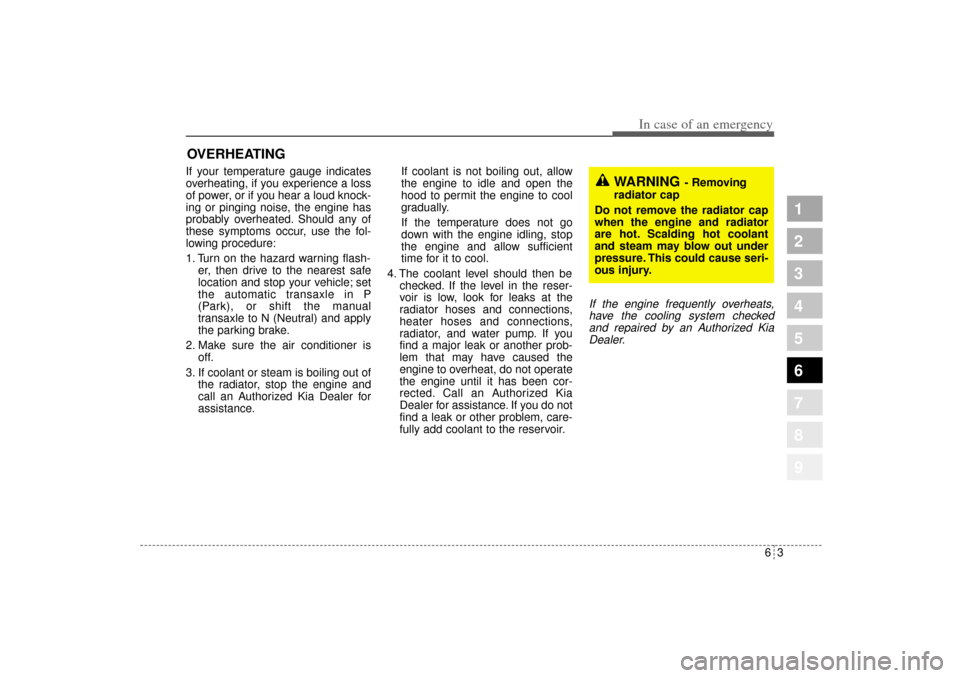
OVERHEATING If your temperature gauge indicates
overheating, if you experience a loss
of power, or if you hear a loud knock-
ing or pinging noise, the engine has
probably overheated. Should any of
these symptoms occur, use the fol-
lowing procedure:
1. Turn on the hazard warning flash-
er, then drive to the nearest safe
location and stop your vehicle; set
the automatic transaxle in P
(Park), or shift the manual
transaxle to N (Neutral) and apply
the parking brake.
2. Make sure the air conditioner is
off.
3. If coolant or steam is boiling out of
the radiator, stop the engine and
call an Authorized Kia Dealer for
assistance.If coolant is not boiling out, allow
the engine to idle and open the
hood to permit the engine to cool
gradually.
If the temperature does not go
down with the engine idling, stop
the engine and allow sufficient
time for it to cool.
4. The coolant level should then be
checked. If the level in the reser-
voir is low, look for leaks at the
radiator hoses and connections,
heater hoses and connections,
radiator, and water pump. If you
find a major leak or another prob-
lem that may have caused the
engine to overheat, do not operate
the engine until it has been cor-
rected. Call an Authorized Kia
Dealer for assistance. If you do not
find a leak or other problem, care-
fully add coolant to the reservoir.
If the engine frequently overheats,
have the cooling system checked
and repaired by an Authorized Kia
Dealer.
1
2
3
4
5
6
7
8
9
WARNING
- Removing
radiator cap
Do not remove the radiator cap
when the engine and radiator
are hot. Scalding hot coolant
and steam may blow out under
pressure. This could cause seri-
ous injury.
KM CAN (ENG) 6.qxd 9/13/2004 4:47 PM Page 3
Page 279 of 354
611
In case of an emergency
1
2
3
4
5
6
7
8
9
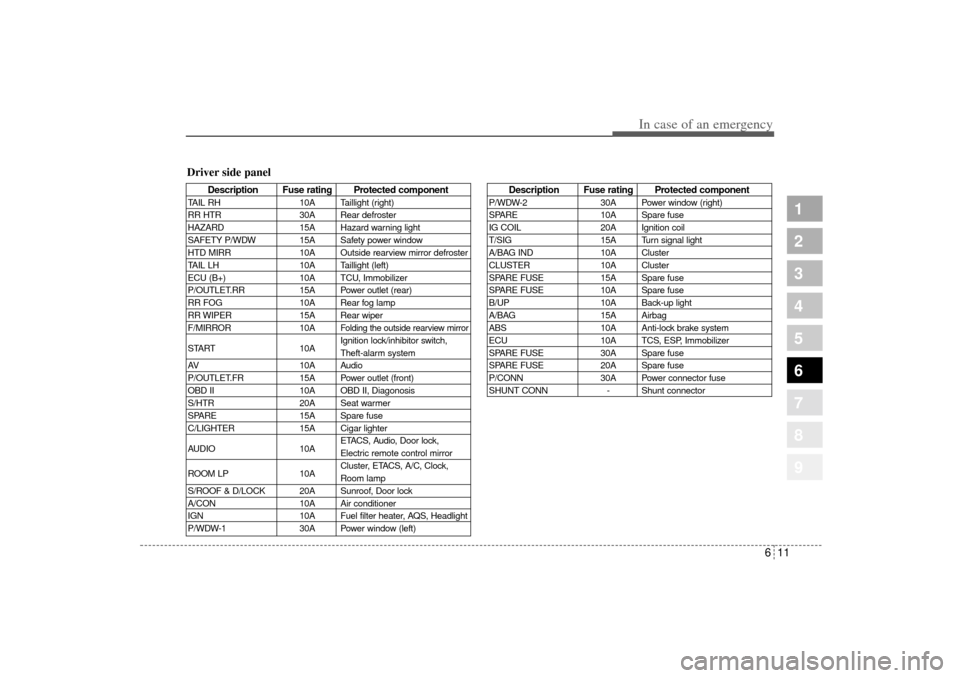
Description Fuse rating Protected component
TAIL RH 10A Taillight (right)
RR HTR 30A Rear defroster
HAZARD 15A Hazard warning light
SAFETY P/WDW 15A Safety power window
HTD MIRR 10A Outside rearview mirror defroster
TAIL LH 10A Taillight (left)
ECU (B+) 10A TCU, Immobilizer
P/OUTLET.RR 15A Power outlet (rear)
RR FOG 10A Rear fog lamp
RR WIPER 15A Rear wiper
F/MIRROR 10A
Folding the outside rearview mirror
START 10AIgnition lock/inhibitor switch,
Theft-alarm system
AV 10A Audio
P/OUTLET.FR 15A Power outlet (front)
OBD II 10A OBD II, Diagonosis
S/HTR 20A Seat warmer
SPARE 15A Spare fuse
C/LIGHTER 15A Cigar lighter
AUDIO 10AETACS, Audio, Door lock,
Electric remote control mirror
ROOM LP 10ACluster, ETACS, A/C, Clock,
Room lamp
S/ROOF & D/LOCK 20A Sunroof, Door lock
A/CON 10A Air conditioner
IGN 10A Fuel filter heater, AQS, Headlight
P/WDW-1 30A Power window (left)
Description Fuse rating Protected component
P/WDW-2 30A Power window (right)
SPARE 10A Spare fuse
IG COIL 20A Ignition coil
T/SIG 15A Turn signal light
A/BAG IND 10A Cluster
CLUSTER 10A Cluster
SPARE FUSE 15A Spare fuse
SPARE FUSE 10A Spare fuse
B/UP 10A Back-up light
A/BAG 15A Airbag
ABS 10A Anti-lock brake system
ECU 10A TCS, ESP, Immobilizer
SPARE FUSE 30A Spare fuse
SPARE FUSE 20A Spare fuse
P/CONN 30A Power connector fuse
SHUNT CONN - Shunt connector
Driver side panel
KM CAN (ENG) 6.qxd 9/13/2004 4:47 PM Page 11
Page 283 of 354
615
In case of an emergency
1
2
3
4
5
6
7
8
9
✽ ✽
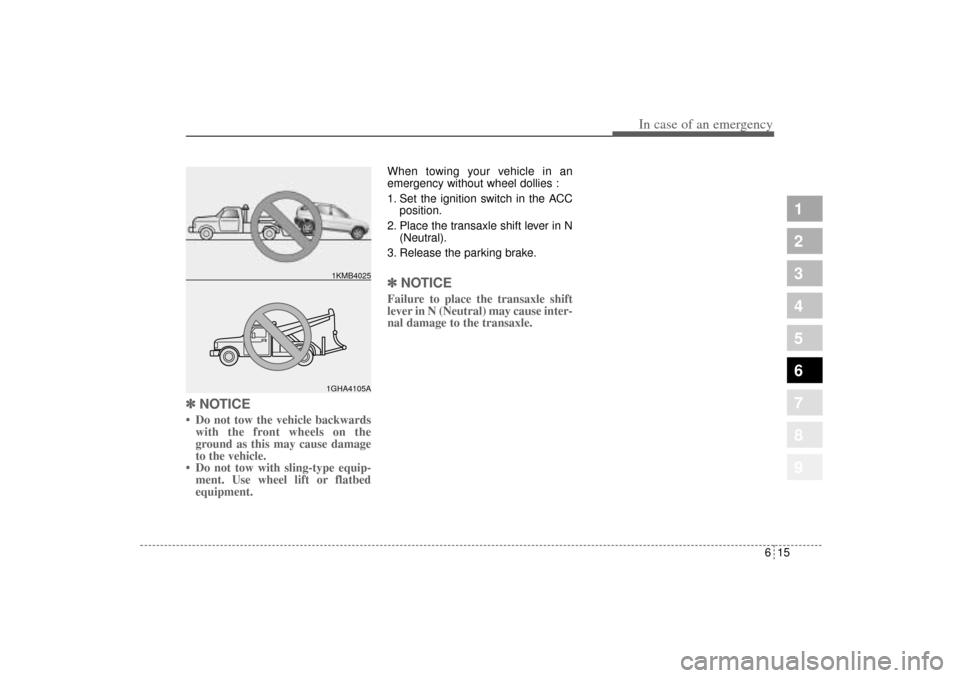
NOTICE• Do not tow the vehicle backwards
with the front wheels on the
ground as this may cause damage
to the vehicle.
• Do not tow with sling-type equip-
ment. Use wheel lift or flatbed
equipment.
When towing your vehicle in an
emergency without wheel dollies :
1. Set the ignition switch in the ACC
position.
2. Place the transaxle shift lever in N
(Neutral).
3. Release the parking brake.✽ ✽
NOTICEFailure to place the transaxle shift
lever in N (Neutral) may cause inter-
nal damage to the transaxle.
1GHA4105A1KMB4025
KM CAN (ENG) 6.qxd 9/13/2004 4:47 PM Page 15
Page 284 of 354
In case of an emergency16 6
1
2
3
4
5
6
7
8
9
Towing with a vehicle other
than a tow truck If towing is necessary, we recom-
mend you to have it done by an
Authorized Kia dealer or a commer-
cial tow truck service.
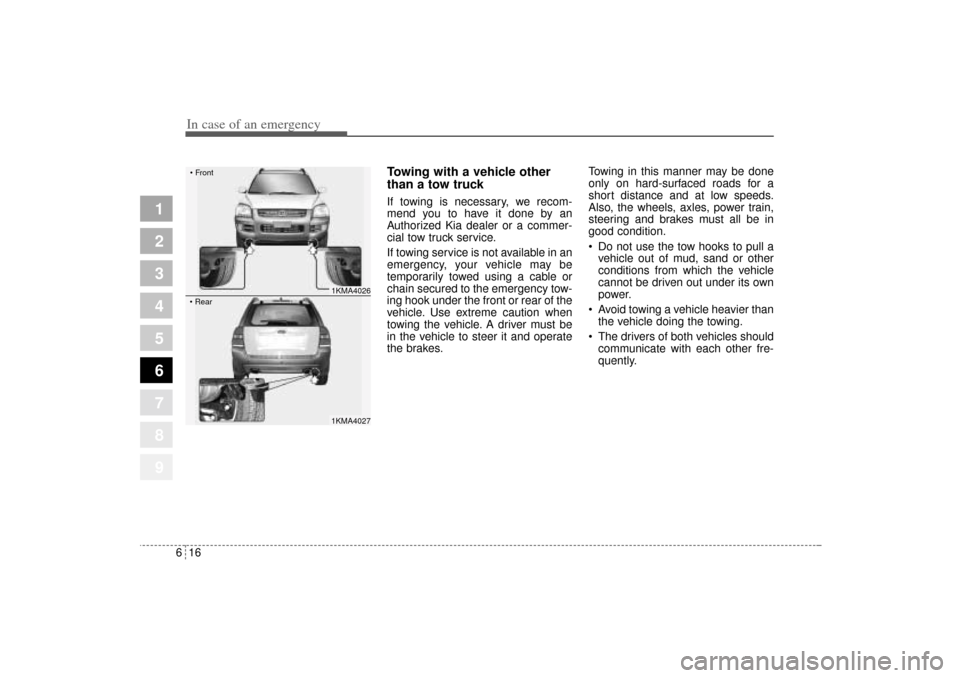
If towing service is not available in an
emergency, your vehicle may be
temporarily towed using a cable or
chain secured to the emergency tow-
ing hook under the front or rear of the
vehicle. Use extreme caution when
towing the vehicle. A driver must be
in the vehicle to steer it and operate
the brakes.Towing in this manner may be done
only on hard-surfaced roads for a
short distance and at low speeds.
Also, the wheels, axles, power train,
steering and brakes must all be in
good condition.
Do not use the tow hooks to pull a
vehicle out of mud, sand or other
conditions from which the vehicle
cannot be driven out under its own
power.
Avoid towing a vehicle heavier than
the vehicle doing the towing.
The drivers of both vehicles should
communicate with each other fre-
quently.
1KMA4026 Front1KMA4027 Rear
KM CAN (ENG) 6.qxd 9/13/2004 4:47 PM Page 16
Page 286 of 354
In case of an emergency18 6
1
2
3
4
5
6
7
8
9
When your vehicle is being
towed by another vehicle
other than a tow truck (in case
of an emergency) Turn the ignition switch to ACC so
the steering wheel isn’t locked.
Place the transaxle shift lever in N
(Neutral).
Release the parking bake.
Vehicles equipped with automatic
transaxles should not exceed 45
km/h (28 mph) and should not be
towed more than 80 km (50 miles).
Vehicles equipped with manual
transaxle should not be towed in
excess of 88 km/h (55 mph) and
should not be towed more than
645 km (400 miles). Press the brake pedal with more
force than normal since you will
have reduced brake performance.
More steering effort will be
required because the power steer-
ing system will be disabled.
If you are driving down a long hill,
the brakes may overheat and brake
performance will be reduced. Stop
often and let the brakes cool off.
✽ ✽
NOTICETo prevent internal damage to the
transaxle, never tow your vehicle
from the rear (backwards) with all
four tires in contact with the sur-
face.
Tips for towing a stuck vehicleThe following methods are effective
when your vehicle is stuck in mud,
sand or similar substances that pre-
vent the vehicle from being driven
out under its own power.
Remove the soil and sand, etc.
from the front and the back of the
tires.
Place a stone or wood under the
tires.
KM CAN (ENG) 6.qxd 9/13/2004 4:47 PM Page 18
Page 290 of 354
In case of an emergency22 6
1
2
3
4
5
6
7
8
9
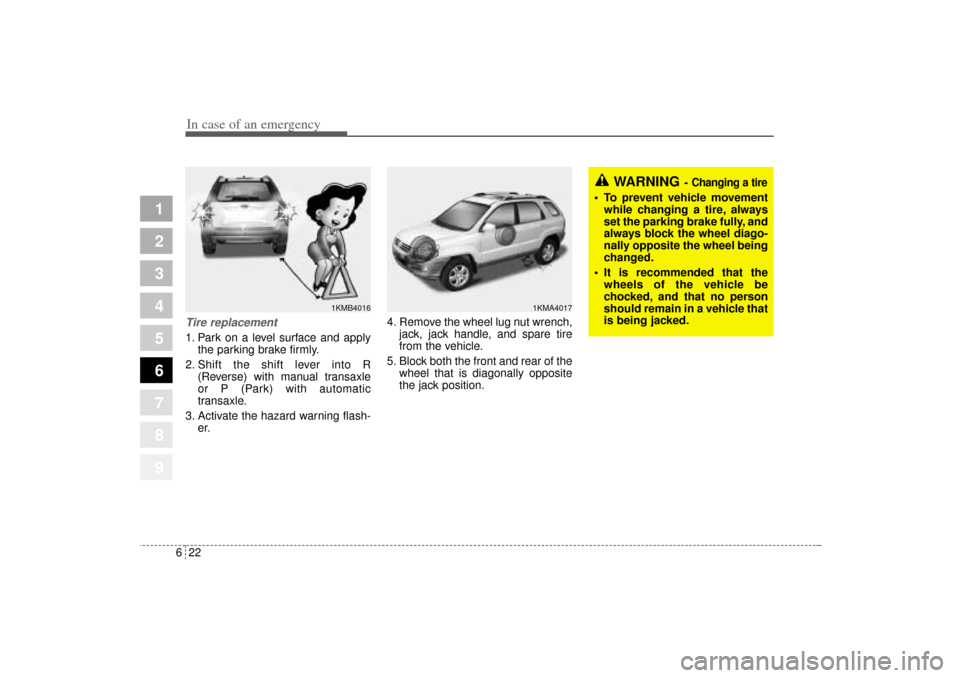
Tire replacement 1. Park on a level surface and apply
the parking brake firmly.
2. Shift the shift lever into R
(Reverse) with manual transaxle
or P (Park) with automatic
transaxle.
3. Activate the hazard warning flash-
er.4. Remove the wheel lug nut wrench,
jack, jack handle, and spare tire
from the vehicle.
5. Block both the front and rear of the
wheel that is diagonally opposite
the jack position.
WARNING
- Changing a tire
To prevent vehicle movement
while changing a tire, always
set the parking brake fully, and
always block the wheel diago-
nally opposite the wheel being
changed.
It is recommended that the
wheels of the vehicle be
chocked, and that no person
should remain in a vehicle that
is being jacked.
1KMB4016
1KMA4017
KM CAN (ENG) 6.qxd 9/13/2004 4:47 PM Page 22
Page 292 of 354
In case of an emergency24 6
1
2
3
4
5
6
7
8
9
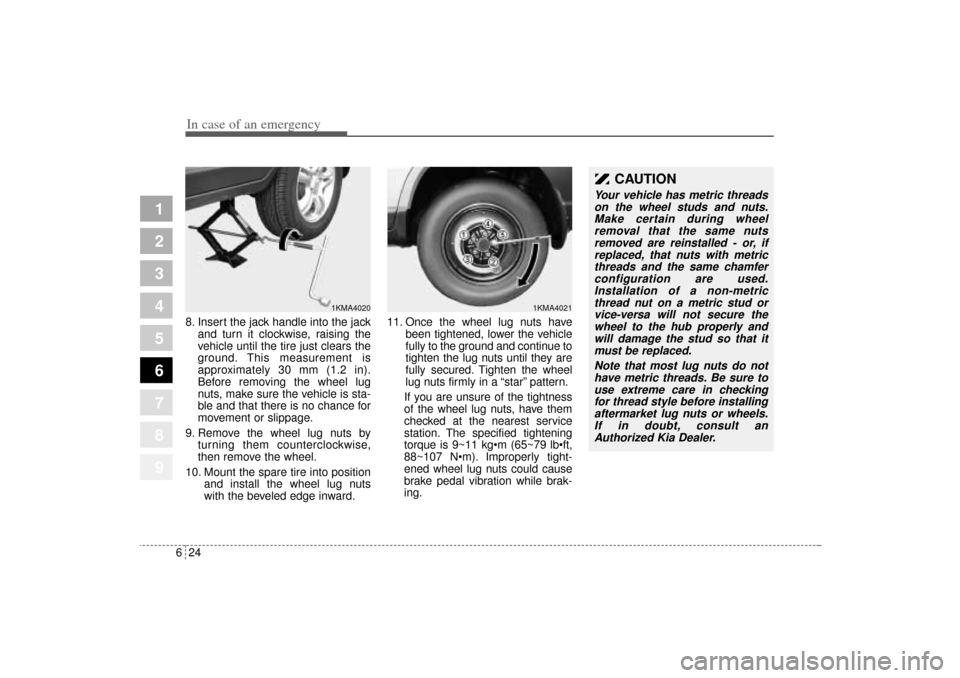
8. Insert the jack handle into the jack
and turn it clockwise, raising the
vehicle until the tire just clears the
ground. This measurement is
approximately 30 mm (1.2 in).
Before removing the wheel lug
nuts, make sure the vehicle is sta-
ble and that there is no chance for
movement or slippage.
9. Remove the wheel lug nuts by
turning them counterclockwise,
then remove the wheel.
10. Mount the spare tire into position
and install the wheel lug nuts
with the beveled edge inward.11. Once the wheel lug nuts have
been tightened, lower the vehicle
fully to the ground and continue to
tighten the lug nuts until they are
fully secured. Tighten the wheel
lug nuts firmly in a “star” pattern.
If you are unsure of the tightness
of the wheel lug nuts, have them
checked at the nearest service
station. The specified tightening
torque is 9~11 kgm (65~79 lbft,
88~107 Nm). Improperly tight-
ened wheel lug nuts could cause
brake pedal vibration while brak-
ing.
1KMA4020
1KMA4021
CAUTION
Your vehicle has metric threads
on the wheel studs and nuts.
Make certain during wheel
removal that the same nuts
removed are reinstalled - or, if
replaced, that nuts with metric
threads and the same chamfer
configuration are used.
Installation of a non-metric
thread nut on a metric stud or
vice-versa will not secure the
wheel to the hub properly and
will damage the stud so that it
must be replaced.
Note that most lug nuts do not
have metric threads. Be sure to
use extreme care in checking
for thread style before installing
aftermarket lug nuts or wheels.
If in doubt, consult an
Authorized Kia Dealer.
KM CAN (ENG) 6.qxd 9/13/2004 4:47 PM Page 24
Page 294 of 354
1
2
3
4
5
6
7
8
9
Maintenance services / 7-3
Maintenance schedule / 7-4
Owner maintenance / 7-8
Engine compartment / 7-11
Engine oil and oil filter / 7-13
Engine cooling system / 7-15
Brakes and clutch / 7-18
Parking brake / 7-19
Drive belts / 7-20
Power steering / 7-21
Steering wheel / 7-22
Automatic transaxle / 7-23
Manual transaxle / 7-25
Rear differential (4WD) / 7-25
Transfer case (4WD) / 7-25
Lubricants and fluids / 7-26
Air cleaner / 7-27
Air conditioner air filter / 7-28
Wiper blades / 7-29
Maintenance
KM CAN (ENG) 7.qxd 9/13/2004 4:47 PM Page 1