4WD KIA Sportage 2005 JE_ / 2.G Owner's Manual
[x] Cancel search | Manufacturer: KIA, Model Year: 2005, Model line: Sportage, Model: KIA Sportage 2005 JE_ / 2.GPages: 354, PDF Size: 2.78 MB
Page 10 of 354
Your vehicle at a glance4 2
1
2
3
4
5
6
7
8
9
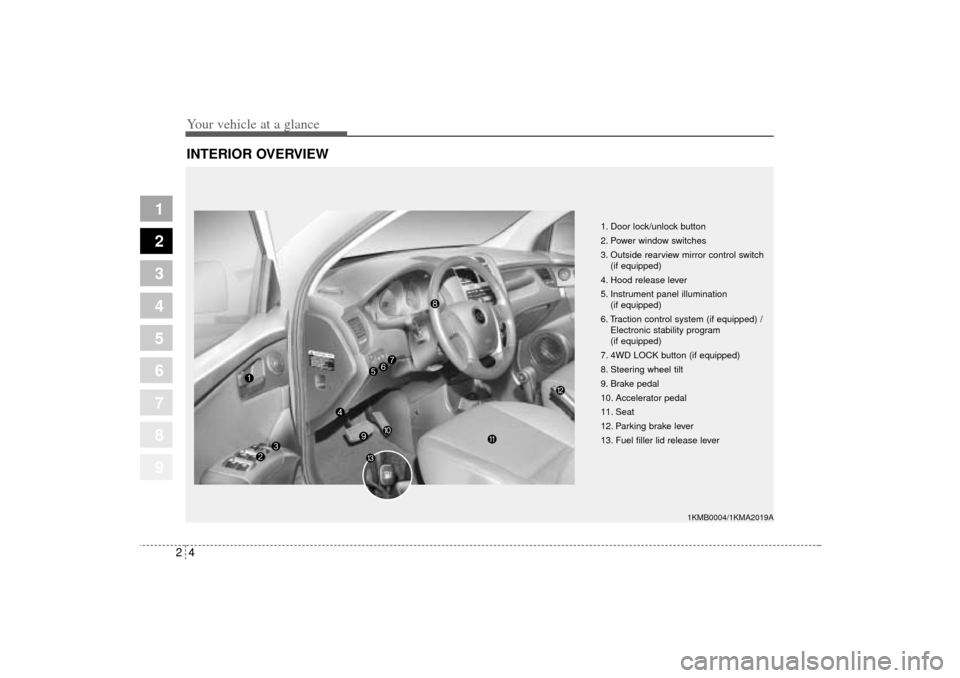
INTERIOR OVERVIEW
1. Door lock/unlock button
2. Power window switches
3. Outside rearview mirror control switch
(if equipped)
4. Hood release lever
5. Instrument panel illumination
(if equipped)
6. Traction control system (if equipped) /
Electronic stability program
(if equipped)
7. 4WD LOCK button (if equipped)
8. Steering wheel tilt
9. Brake pedal
10. Accelerator pedal
11. Seat
12. Parking brake lever
13. Fuel filler lid release lever
1KMB0004/1KMA2019A
KM CAN (ENG) 2.qxd 9/13/2004 4:51 PM Page 4
Page 124 of 354
1
2
3
4
5
6
7
8
9
Ignition switch / 4-2
Starting the engine / 4-4
Manual transaxle / 4-5
Automatic transaxle / 4-6
Four wheel drive (4WD) / 4-12
Brake system / 4-18
Steering wheel / 4-25
Cruise control / 4-28
Traction control system / 4-33
Electronic stability program / 4-36
Instrument cluster / 4-39
Gauges / 4-40
Warnings and indicators / 4-46
Tires pressure monitoring system (TPMS) / 4-54
Compass / 4-56
Lighting / 4-59
Wipers and washers / 4-63
Defroster / 4-66
Driving your vehicle
KM CAN (ENG) 4.qxd 9/13/2004 4:48 PM Page 1
Page 135 of 354
Driving your vehicle12 4
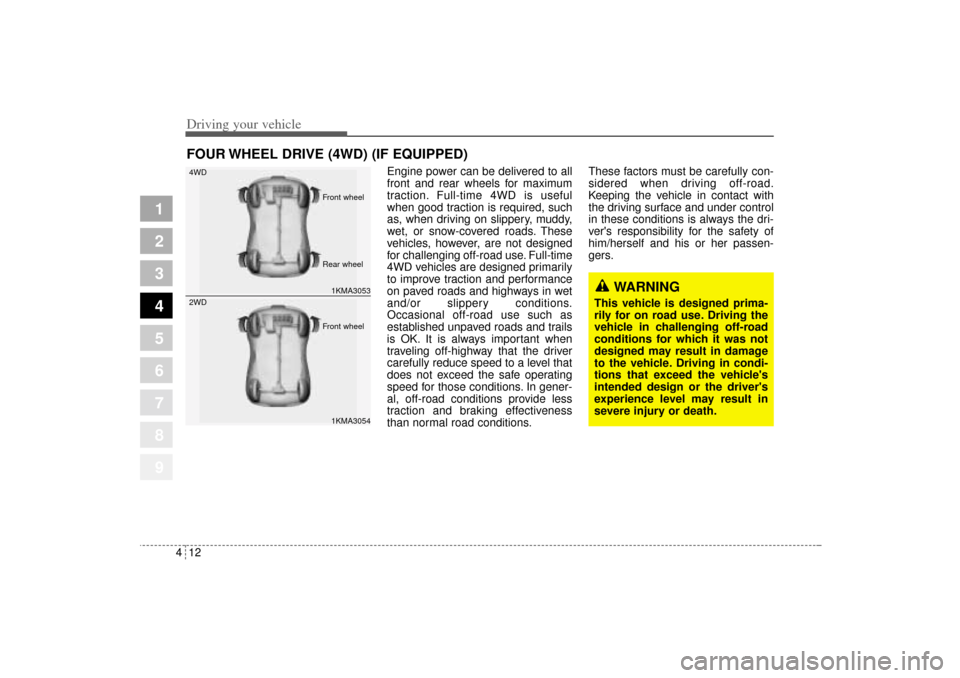
Engine power can be delivered to all
front and rear wheels for maximum
traction. Full-time 4WD is useful
when good traction is required, such
as, when driving on slippery, muddy,
wet, or snow-covered roads. These
vehicles, however, are not designed
for challenging off-road use. Full-time
4WD vehicles are designed primarily
to improve traction and performance
on paved roads and highways in wet
and/or slippery conditions.
Occasional off-road use such as
established unpaved roads and trails
is OK. It is always important when
traveling off-highway that the driver
carefully reduce speed to a level that
does not exceed the safe operating
speed for those conditions. In gener-
al, off-road conditions provide less
traction and braking effectiveness
than normal road conditions.These factors must be carefully con-
sidered when driving off-road.
Keeping the vehicle in contact with
the driving surface and under control
in these conditions is always the dri-
ver's responsibility for the safety of
him/herself and his or her passen-
gers.
FOUR WHEEL DRIVE (4WD) (IF EQUIPPED)
1
2
3
4
5
6
7
8
9
WARNING
This vehicle is designed prima-
rily for on road use. Driving the
vehicle in challenging off-road
conditions for which it was not
designed may result in damage
to the vehicle. Driving in condi-
tions that exceed the vehicle's
intended design or the driver's
experience level may result in
severe injury or death.
1KMA3053 4WD1KMA3054
2WDFront wheel
Front wheel Rear wheel
KM CAN (ENG) 4.qxd 9/13/2004 4:48 PM Page 12
Page 136 of 354
413
Driving your vehicle
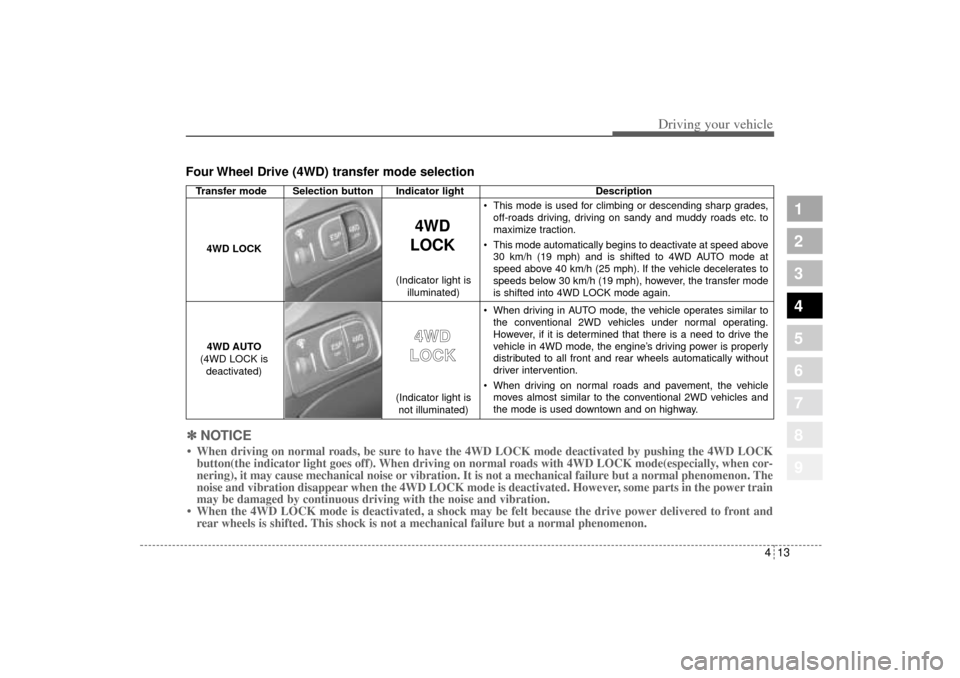
Four Wheel Drive (4WD) transfer mode selection
1
2
3
4
5
6
7
8
9
Transfer mode Selection button Indicator light Description
This mode is used for climbing or descending sharp grades,
off-roads driving, driving on sandy and muddy roads etc. to
maximize traction.
This mode automatically begins to deactivate at speed above
30 km/h (19 mph) and is shifted to 4WD AUTO mode at
speed above 40 km/h (25 mph). If the vehicle decelerates to
speeds below 30 km/h (19 mph), however, the transfer mode
is shifted into 4WD LOCK mode again.
When driving in AUTO mode, the vehicle operates similar to
the conventional 2WD vehicles under normal operating.
However, if it is determined that there is a need to drive the
vehicle in 4WD mode, the engine’s driving power is properly
distributed to all front and rear wheels automatically without
driver intervention.
When driving on normal roads and pavement, the vehicle
moves almost similar to the conventional 2WD vehicles and
the mode is used downtown and on highway.
4WD
LOCK
4WD LOCK
4WD AUTO
(4WD LOCK is
deactivated)
4 4W
WD
D
L LO
OC
CK
K
(Indicator light is
not illuminated) (Indicator light is
illuminated)
✽ ✽
NOTICE• When driving on normal roads, be sure to have the 4WD LOCK mode deactivated by pushing the 4WD LOCK
button(the indicator light goes off). When driving on normal roads with 4WD LOCK mode(especially, when cor-
nering), it may cause mechanical noise or vibration. It is not a mechanical failure but a normal phenomenon. The
noise and vibration disappear when the 4WD LOCK mode is deactivated. However, some parts in the power train
may be damaged by continuous driving with the noise and vibration.
• When the 4WD LOCK mode is deactivated, a shock may be felt because the drive power delivered to front and
rear wheels is shifted. This shock is not a mechanical failure but a normal phenomenon.
KM CAN (ENG) 4.qxd 9/13/2004 4:48 PM Page 13
Page 138 of 354
415
Driving your vehicle
You must learn how to corner in a
4WD vehicle as soon as possible.
Do not rely on your experience in
conventional 2WD vehicles in
choosing safe cornering speed.
You must drive more slowly. Drive off-road carefully because
your vehicle may be damaged by
rocks or roots of trees. Become
familiar with the off-road conditions
you are going to drive before you
start.
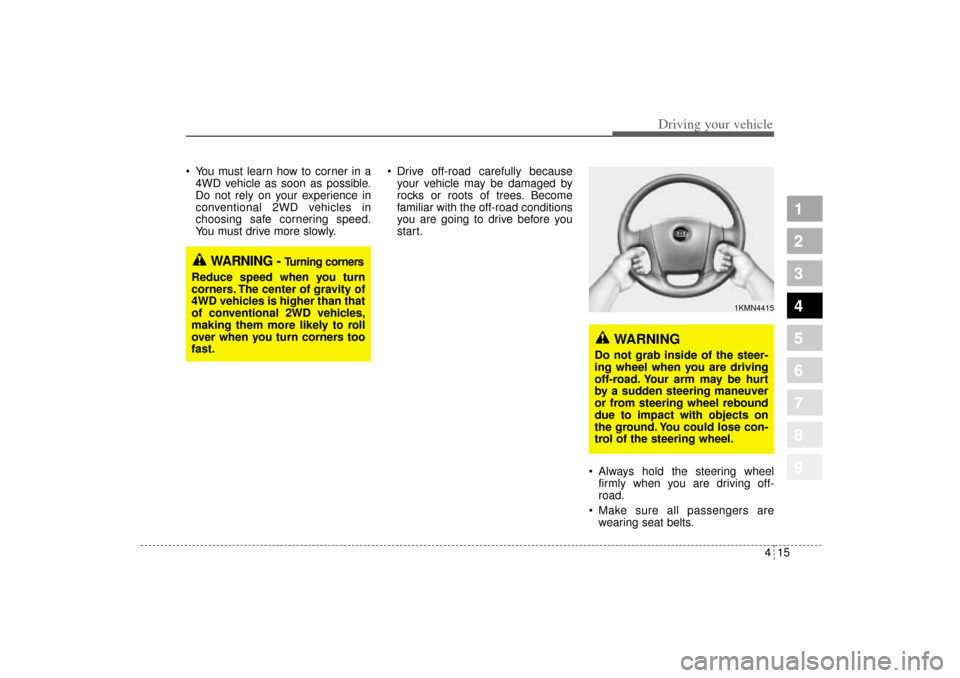
Always hold the steering wheel
firmly when you are driving off-
road.
Make sure all passengers are
wearing seat belts.
1
2
3
4
5
6
7
8
9
WARNING -
Turning corners
Reduce speed when you turn
corners. The center of gravity of
4WD vehicles is higher than that
of conventional 2WD vehicles,
making them more likely to roll
over when you turn corners too
fast.
WARNING
Do not grab inside of the steer-
ing wheel when you are driving
off-road. Your arm may be hurt
by a sudden steering maneuver
or from steering wheel rebound
due to impact with objects on
the ground. You could lose con-
trol of the steering wheel.
1KMN4415
KM CAN (ENG) 4.qxd 9/13/2004 4:48 PM Page 15
Page 139 of 354
Driving your vehicle16 4
1
2
3
4
5
6
7
8
9
If you need to drive in water, stop
your vehicle, set your transfer to
“4WD LOCK” and drive at less than
8 km/h (5 mph).
✽ ✽
NOTICE• Do not drive in water if the level is
higher than the bottom of the vehi-
cle.
• Check your brake condition once
you are out of mud or water. Press
the brake pedal several times as
you move slowly until you feel nor-
mal braking forces return.
• Shorten your scheduled mainte-
nance interval if you drive in off-
road conditions such as sand,
mud or water (see “Maintenance
Services” in the Index). Always
wash you car thoroughly.
• Since the driving torque is always
applied to the 4 wheels the per-
formance of the 4WD vehicle is
greatly affected by the condition of
the tires. Be sure to equip them
with all four tires with same size
and type.
• The full time four wheel drive
vehicle cannot be towed by an
ordinary tow truck. Make sure
that the vehicle is towed with its
four wheels raised off the ground.
WARNING
While the full-time 4WD vehicle
is being raised on a jack, never
start the engine or cause the
tires to rotate.
There is the danger that rotating
tires touching the ground could
cause the vehicle to go off the
jack and to jump forward.
CAUTION
If one of the front or rear wheels
begins to spin in mud, snow,
etc. the vehicle can sometimes
be driven out by depressing the
accelerator pedal further; how-
ever avoid running the engine
continuously at high rpm
because doing so could dam-
age the 4WD system.
WARNING
If you are driving in heavy wind,
the vehicle's higher center of
gravity decreases your steering
control capacity and requires
you to drive more slowly.
WARNING -
Driving
through water
If you are driving too fast in
water, the water spray can get
into the engine compartment
and wet the ignition system,
causing your vehicle to sudden-
ly stall. If this happens and your
vehicle is in a tilted position,
your vehicle may roll over.
KM CAN (ENG) 4.qxd 9/13/2004 4:48 PM Page 16
Page 175 of 354
Driving your vehicle52 4
1
2
3
4
5
6
7
8
9
ESP OFF indicator
(if equipped)The ESP OFF indicator will illumi-
nate when the ignition switch is
turned ON, but should go off after
approximately 3 seconds. To switch
to ESP OFF mode, press the ESP
OFF button. The ESP OFF indicator
will illuminate indicating the ESP is
deactivated. If this indicator stays on
in the ESP ON mode, the ESP may
have a malfunction. Take your car to
the authorized Kia dealer and have
the system checked.
Low washer fluid level
warning indicator
(If equipped) This warning light indicates the
washer fluid reservoir is near empty.
Refill the washer fluid as soon as
possible.
4WD system warning
(if equipped) When the key is turned to the “ON”
position, the 4WD system warning
light will come on and then go off in a
few seconds.
ESP
OFF
CAUTION
If the 4WD system warning light ()
blinks, this indicates that
there is a malfunction in the
4WD system. If this occurs, have
your vehicle checked by an
Authorized Kia Dealer as soon
as possible.
KM CAN (ENG) 4.qxd 9/13/2004 4:48 PM Page 52
Page 176 of 354
453
Driving your vehicle
1
2
3
4
5
6
7
8
9
4WD LOCK indicator
light (if equipped) 4WD LOCK indicator light is illumi-
nated when the 4WD LOCK button is
pushed. The purpose of this 4WD
LOCK mode is to increase the drive
power when driving on dry road sur-
face, wet pavement, snow-covered
roads and/or off-road. 4WD LOCK
indicator light is turned off by push-
ing the button once again
Low tire pressure
warningThis warning light indicates one or
more of your tires is significantly
under-inflated. You should stop and
check your tires as soon as possible.
If the warning light illuminates while
driving, reduce vehicle speed imme-
diately and stop the vehicle. Avoid
hard braking and overcorrecting at
the steering wheel. Inflate the tires to
the proper pressure as indicated on
the vehicle's tire information placard.TPMS warning The warning light comes on and
stays on when there is a problem
with the Tire Pressure Monitoring
System. If this happens, the system
will shut off and no longer monitor
tire pressures. Have the system
checked by an authorized Kia dealer
as soon as possible.
Safety belt warning chime If the driver's safety belt is not fas-
tened when the ignition key is turned
ON or if it is unfastened after the key
is ON, the safety belt warning chime
will sound for approximately 6 sec-
onds. At this time, if the safety belt is
fastened, the chime will stop at once.Parking start warning chimeIf you drive over 10 km/h (6.2 mph)
with the parking brake applied, the
parking start warning chime will
sound.Key reminder warning chimeIf the driver’s door is opened while
the ignition key is left in the ignition
switch, the key reminder warning
chime will sound. This is to prevent
you from locking your keys in the
vehicle.
4WD
LOCK
CAUTION
Do not use 4WD LOCK mode on
dry paved roads or highway, it
can cause noise, vibration or
damage of 4WD related parts.
TPMS
KM CAN (ENG) 4.qxd 9/13/2004 4:48 PM Page 53
Page 229 of 354
Driving tips12 5
1
2
3
4
5
6
7
8
9
USING FOUR-WHEEL DRIVEDriving on snow- or Ice-cov-
ered roads (“4WD LOCK” for
full-time 4WD operation) Use snow tires. See “Tires” in this
section for more information.
Keep an adequate distance
between yourself and other vehi-
cles.
Avoid sudden braking, acceleration
or steering. These actions can
cause your vehicle to lose traction.
Driving in sand or mud (“4WD
LOCK” for full-time 4WD opera-
tion) Avoid sudden braking, acceleration
or steering. These actions can
cause your vehicle to get stuck in
the sand or mud.
Drive at low speeds whenever pos-
sible.
You may need to get out of your
vehicle at times to check road con-
ditions.
If you get stuck in the sand or mud,
try placing stones, wood or other
similar materials under the tires to
get traction, or move forward and
backward repeatedly to get
unstuck.
✽ ✽
NOTICEProlonged rocking may cause engine
damage, overheating, transaxle dif-
ferential or transfer case damage or
failure and tire damage.
WARNING
- Traction
Make sure that no one stands in
front of or behind the tires when
materials are placed under the
tires to get more traction. The
tires may cause loose materials
to fly out from under the vehicle,
potentially causing serious bod-
ily injury or death.
KM CAN (ENG) 5.qxd 9/13/2004 4:48 PM Page 12
Page 230 of 354
513
Driving tips
1
2
3
4
5
6
7
8
9
Driving on a hill (“4WD LOCK”
for full-time 4WD operation) Use low gear when going uphill or
downhill and avoid sudden braking.
Do not shift gears or use your
clutch when going downhill. Do not
coast downhill in Neutral.
Crossing a ditch (“4WD LOCK”
for full-time 4WD operation) Avoid driving through ditches if
possible, especially if there is
water in the ditch. Your vehicle may
stall if the electrical system gets
wet. If you must cross a ditch,
select 4WD LOCK mode.
Avoid driving where the water level
is higher than the bottom of the
wheel hub. If the water level rises
above this mark, your vehicle will
need to be serviced.
Tap lightly on the brake pedal dur-
ing and after driving through water.
This will help keep the brakes dry
and in proper working order.
Do not shift gears while crossing a
ditch.
Tight corner brake effectThis is called tight corner brake
effect. Tight corner brake effect is a
unique characteristic of four-wheel
drive vehicles caused by the differ-
ence in tire rotation at the four
wheels and the zero-degree align-
ment of the front wheels and sus-
pension.
Sharp turns at low speeds should be
carried out with caution.
CAUTION
When turning sharply on a
paved road at low speed while
in four-wheel drive, steering
control will be difficult.
KM CAN (ENG) 5.qxd 9/13/2004 4:48 PM Page 13