tire pressure KIA Sportage 2005 JE_ / 2.G Owner's Manual
[x] Cancel search | Manufacturer: KIA, Model Year: 2005, Model line: Sportage, Model: KIA Sportage 2005 JE_ / 2.GPages: 354, PDF Size: 2.78 MB
Page 124 of 354
1
2
3
4
5
6
7
8
9
Ignition switch / 4-2
Starting the engine / 4-4
Manual transaxle / 4-5
Automatic transaxle / 4-6
Four wheel drive (4WD) / 4-12
Brake system / 4-18
Steering wheel / 4-25
Cruise control / 4-28
Traction control system / 4-33
Electronic stability program / 4-36
Instrument cluster / 4-39
Gauges / 4-40
Warnings and indicators / 4-46
Tires pressure monitoring system (TPMS) / 4-54
Compass / 4-56
Lighting / 4-59
Wipers and washers / 4-63
Defroster / 4-66
Driving your vehicle
KM CAN (ENG) 4.qxd 9/13/2004 4:48 PM Page 1
Page 176 of 354
453
Driving your vehicle
1
2
3
4
5
6
7
8
9
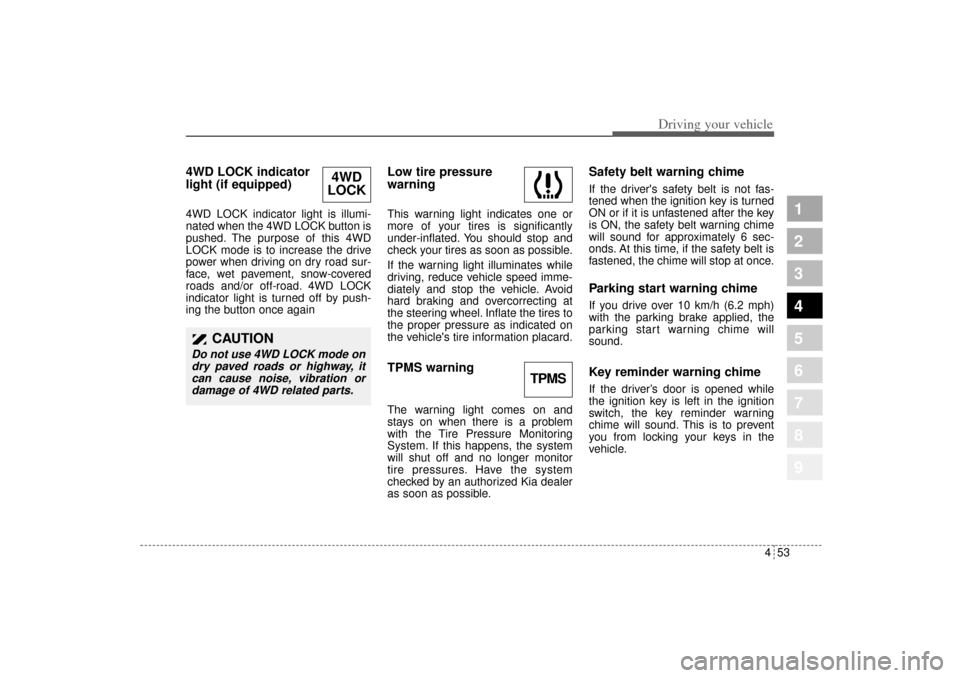
4WD LOCK indicator
light (if equipped) 4WD LOCK indicator light is illumi-
nated when the 4WD LOCK button is
pushed. The purpose of this 4WD
LOCK mode is to increase the drive
power when driving on dry road sur-
face, wet pavement, snow-covered
roads and/or off-road. 4WD LOCK
indicator light is turned off by push-
ing the button once again
Low tire pressure
warningThis warning light indicates one or
more of your tires is significantly
under-inflated. You should stop and
check your tires as soon as possible.
If the warning light illuminates while
driving, reduce vehicle speed imme-
diately and stop the vehicle. Avoid
hard braking and overcorrecting at
the steering wheel. Inflate the tires to
the proper pressure as indicated on
the vehicle's tire information placard.TPMS warning The warning light comes on and
stays on when there is a problem
with the Tire Pressure Monitoring
System. If this happens, the system
will shut off and no longer monitor
tire pressures. Have the system
checked by an authorized Kia dealer
as soon as possible.
Safety belt warning chime If the driver's safety belt is not fas-
tened when the ignition key is turned
ON or if it is unfastened after the key
is ON, the safety belt warning chime
will sound for approximately 6 sec-
onds. At this time, if the safety belt is
fastened, the chime will stop at once.Parking start warning chimeIf you drive over 10 km/h (6.2 mph)
with the parking brake applied, the
parking start warning chime will
sound.Key reminder warning chimeIf the driver’s door is opened while
the ignition key is left in the ignition
switch, the key reminder warning
chime will sound. This is to prevent
you from locking your keys in the
vehicle.
4WD
LOCK
CAUTION
Do not use 4WD LOCK mode on
dry paved roads or highway, it
can cause noise, vibration or
damage of 4WD related parts.
TPMS
KM CAN (ENG) 4.qxd 9/13/2004 4:48 PM Page 53
Page 177 of 354
Driving your vehicle54 4
1
2
3
4
5
6
7
8
9
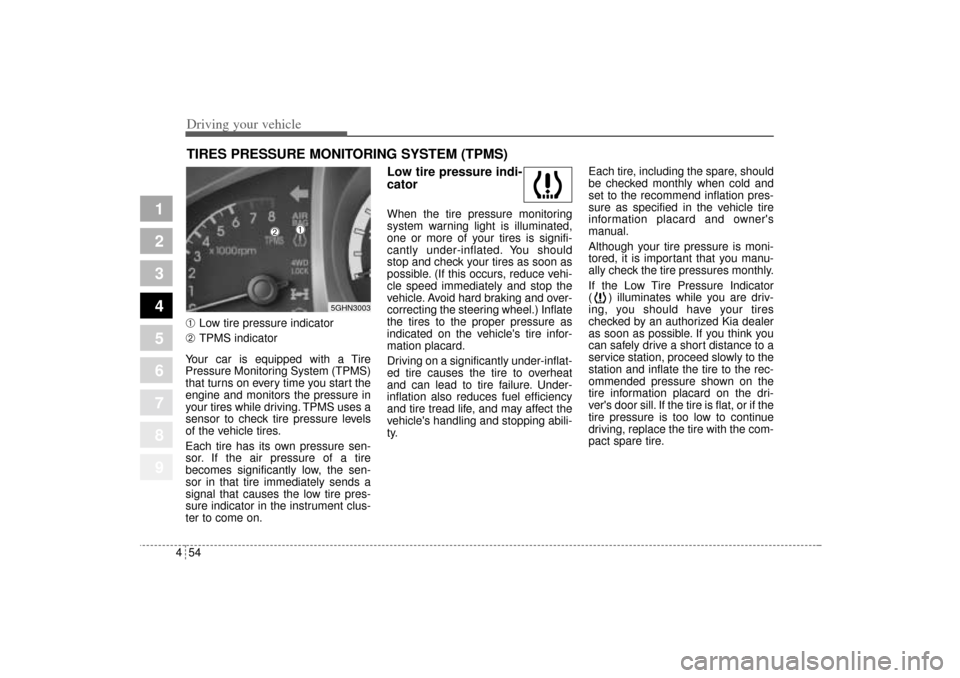
➀
Low tire pressure indicator
➁
TPMS indicator
Your car is equipped with a Tire
Pressure Monitoring System (TPMS)
that turns on every time you start the
engine and monitors the pressure in
your tires while driving. TPMS uses a
sensor to check tire pressure levels
of the vehicle tires.
Each tire has its own pressure sen-
sor. If the air pressure of a tire
becomes significantly low, the sen-
sor in that tire immediately sends a
signal that causes the low tire pres-
sure indicator in the instrument clus-
ter to come on.
Low tire pressure indi-
catorWhen the tire pressure monitoring
system warning light is illuminated,
one or more of your tires is signifi-
cantly under-inflated. You should
stop and check your tires as soon as
possible. (If this occurs, reduce vehi-
cle speed immediately and stop the
vehicle. Avoid hard braking and over-
correcting the steering wheel.) Inflate
the tires to the proper pressure as
indicated on the vehicle's tire infor-
mation placard.
Driving on a significantly under-inflat-
ed tire causes the tire to overheat
and can lead to tire failure. Under-
inflation also reduces fuel efficiency
and tire tread life, and may affect the
vehicle's handling and stopping abili-
ty.Each tire, including the spare, should
be checked monthly when cold and
set to the recommend inflation pres-
sure as specified in the vehicle tire
information placard and owner's
manual.
Although your tire pressure is moni-
tored, it is important that you manu-
ally check the tire pressures monthly.
If the Low Tire Pressure Indicator
( ) illuminates while you are driv-
ing, you should have your tires
checked by an authorized Kia dealer
as soon as possible. If you think you
can safely drive a short distance to a
service station, proceed slowly to the
station and inflate the tire to the rec-
ommended pressure shown on the
tire information placard on the dri-
ver's door sill. If the tire is flat, or if the
tire pressure is too low to continue
driving, replace the tire with the com-
pact spare tire.
TIRES PRESSURE MONITORING SYSTEM (TPMS)
5GHN3003
➀
➁
KM CAN (ENG) 4.qxd 9/13/2004 4:48 PM Page 54
Page 178 of 354
455
Driving your vehicle
1
2
3
4
5
6
7
8
9
TPMS indicator The TPMS indicator comes on and
stays on when there is a problem
with the Tire Pressure Monitoring
System. If this happens, the system
will shut off and no longer monitor
tire pressures. Have the system
checked by an authorized Kia dealer
as soon as possible.
Changing the tire with TPMSIf you have a flat tire, the Low Tire
Pressure indicator will come on.
Replace the flat tire with the compact
spare tire.
Each wheel is equipped with a tire
pressure sensor mounted inside the
tire behind the valve stem. You must
use TPMS specific wheels. It is rec-
ommended that you always have
your tires serviced by an authorized
Kia dealer.
After you replace the flat tire, the Low
Tire Pressure indicator ( ) in the
instrument cluster will stay on. This is
normal; however it is important to
remember that the system is not
monitoring the pressure of the spare
tire. Remember to manually check
the spare tire pressure including
other tires pressure for proper infla-
tion.
Never use a puncture-repairing
agent in a flat tire. If used, you will
have to replace the tire pressure
sensor. Have the flat tire repaired by
an authorized Kia dealer as soon as
possible.
✽ ✽
NOTICE• Do not use any tire sealant if your
vehicle is equipped with Tire
Pressure Monitors. The liquid
sealant can damage the tire pres-
sure monitor sensors.
• The TPMS cannot alert you to
severe and sudden tire damage
caused by external factors. This device complies with Industry
Canada Standard RSS-210.
Operation is subject to the following
two conditions:
1. This device may not cause inter-
ference, and
2. This device must accept any inter-
ference, including interference that
may cause undesired operation of
the device.
TPMS
KM CAN (ENG) 4.qxd 9/13/2004 4:48 PM Page 55
Page 244 of 354
527
Driving tips
1
2
3
4
5
6
7
8
9
Driving in mud, sand, snow, or
iceWhen you drive in mud, sand, snow,
or ice, your wheels won’t get good
traction. You can’t accelerate as
quickly, turning is more difficult, and
you’ll need longer braking distances.
It’s best to use a low gear when
you’re in mud, the deeper the mud,
the lower the gear. In extremely deep
mud, the idea is to keep your vehicle
moving so you don’t get stuck.
When you drive on sand, you’ll
sense a change in wheel traction.
But it will depend upon how loosely
packed the sand is. On loosely
packed sand (as on beaches or sand
dunes) your tires will tend to sink into
the sand. This has an effect on steer-
ing, accelerating, and braking. You
may want to reduce the air pressure
in your tires slightly when driving on
sand. This will improve traction.
Remember to re-inflate them the first
chance that you have after you leave
the loosely packed sand.
✽ ✽
NOTICE• In case of loss of traction in mud,
loose soil, or sand, turn the steer-
ing wheel rapidly from side-to-
side. This can help generate addi-
tional traction.
• Do not gun the engine. This will
cause the tires to spin and dig
down, not forward, and could
bury the vehicle to the frame.
Smooth, easy power is better than
too much power.
WARNING
- Exiting vehi-
cle
Getting out on the downhill
(low) side of a vehicle stopped
across an incline is dangerous.
If the vehicle rolls over, you
could be crushed or fatally
injured. Always get out on the
uphill (high) side of the vehicle
and stay well clear of the
rollover path.
KM CAN (ENG) 5.qxd 9/13/2004 4:48 PM Page 27
Page 257 of 354
Driving tips40 5
1
2
3
4
5
6
7
8
9
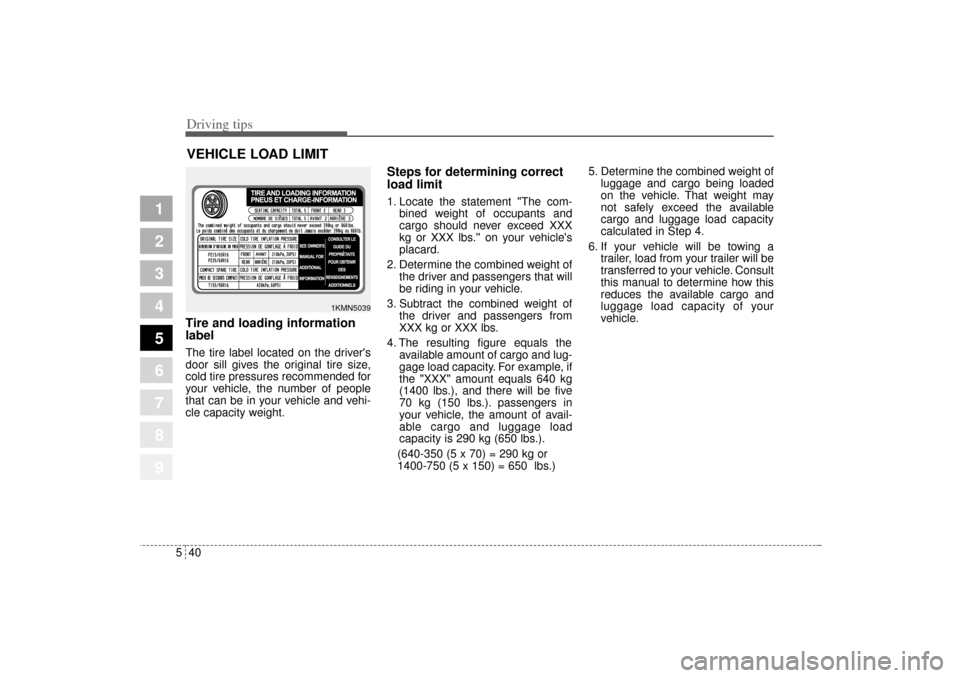
VEHICLE LOAD LIMITTire and loading information
labelThe tire label located on the driver's
door sill gives the original tire size,
cold tire pressures recommended for
your vehicle, the number of people
that can be in your vehicle and vehi-
cle capacity weight.
Steps for determining correct
load limit1. Locate the statement "The com-
bined weight of occupants and
cargo should never exceed XXX
kg or XXX lbs.'' on your vehicle's
placard.
2. Determine the combined weight of
the driver and passengers that will
be riding in your vehicle.
3. Subtract the combined weight of
the driver and passengers from
XXX kg or XXX lbs.
4. The resulting figure equals the
available amount of cargo and lug-
gage load capacity. For example, if
the "XXX" amount equals 640 kg
(1400 lbs.), and there will be five
70 kg (150 lbs.). passengers in
your vehicle, the amount of avail-
able cargo and luggage load
capacity is 290 kg (650 lbs.).
(640-350 (5 x 70) = 290 kg or
1400-750 (5 x 150) = 650 lbs.)5. Determine the combined weight of
luggage and cargo being loaded
on the vehicle. That weight may
not safely exceed the available
cargo and luggage load capacity
calculated in Step 4.
6. If your vehicle will be towing a
trailer, load from your trailer will be
transferred to your vehicle. Consult
this manual to determine how this
reduces the available cargo and
luggage load capacity of your
vehicle.
1KMN5039
KM CAN (ENG) 5.qxd 9/13/2004 4:48 PM Page 40
Page 259 of 354
Driving tips42 5
1
2
3
4
5
6
7
8
9
Refer to your vehicle's tire and load-
ing information label for specific
information about your vehicle's
capacity weight and seating posi-
tions. The combined weight of the
driver, passengers and cargo should
never exceed your vehicle's capacity
weight.
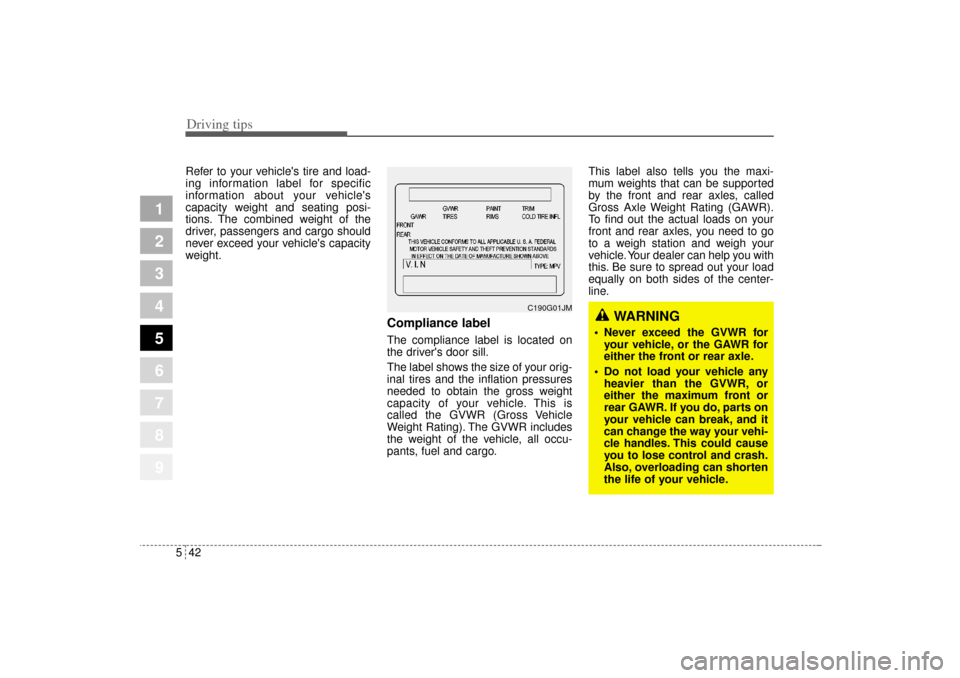
Compliance labelThe compliance label is located on
the driver's door sill.
The label shows the size of your orig-
inal tires and the inflation pressures
needed to obtain the gross weight
capacity of your vehicle. This is
called the GVWR (Gross Vehicle
Weight Rating). The GVWR includes
the weight of the vehicle, all occu-
pants, fuel and cargo.This label also tells you the maxi-
mum weights that can be supported
by the front and rear axles, called
Gross Axle Weight Rating (GAWR).
To find out the actual loads on your
front and rear axles, you need to go
to a weigh station and weigh your
vehicle. Your dealer can help you with
this. Be sure to spread out your load
equally on both sides of the center-
line.
WARNING
Never exceed the GVWR for
your vehicle, or the GAWR for
either the front or rear axle.
Do not load your vehicle any
heavier than the GVWR, or
either the maximum front or
rear GAWR. If you do, parts on
your vehicle can break, and it
can change the way your vehi-
cle handles. This could cause
you to lose control and crash.
Also, overloading can shorten
the life of your vehicle.
C190G01JM
KM CAN (ENG) 5.qxd 9/13/2004 4:48 PM Page 42
Page 268 of 354
551
Driving tips
1
2
3
4
5
6
7
8
9
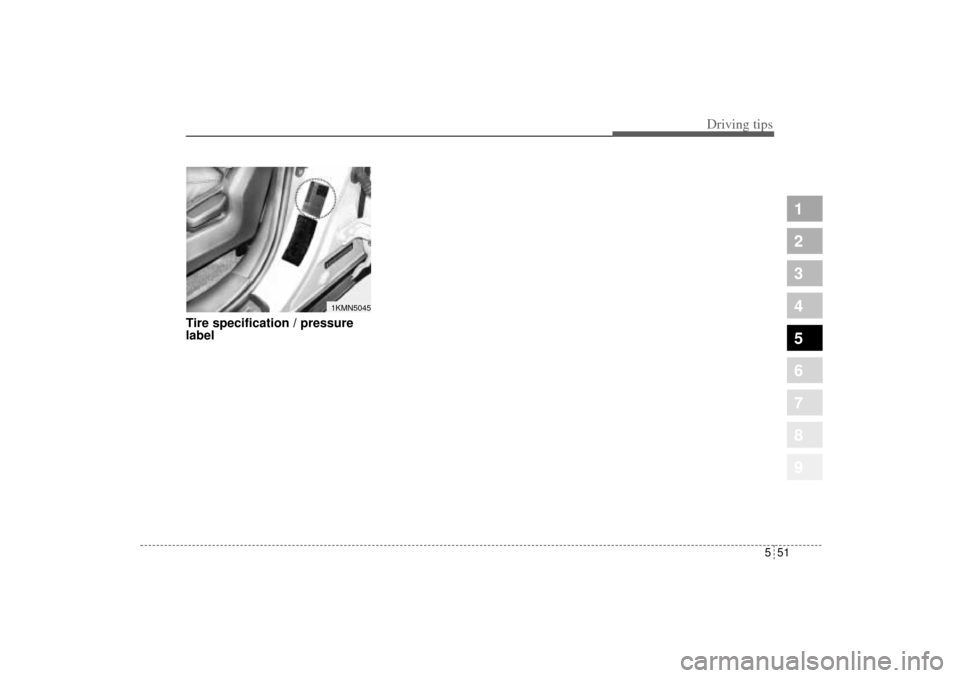
Tire specification / pressure
label
1KMN5045
KM CAN (ENG) 5.qxd 9/13/2004 4:48 PM Page 51
Page 288 of 354
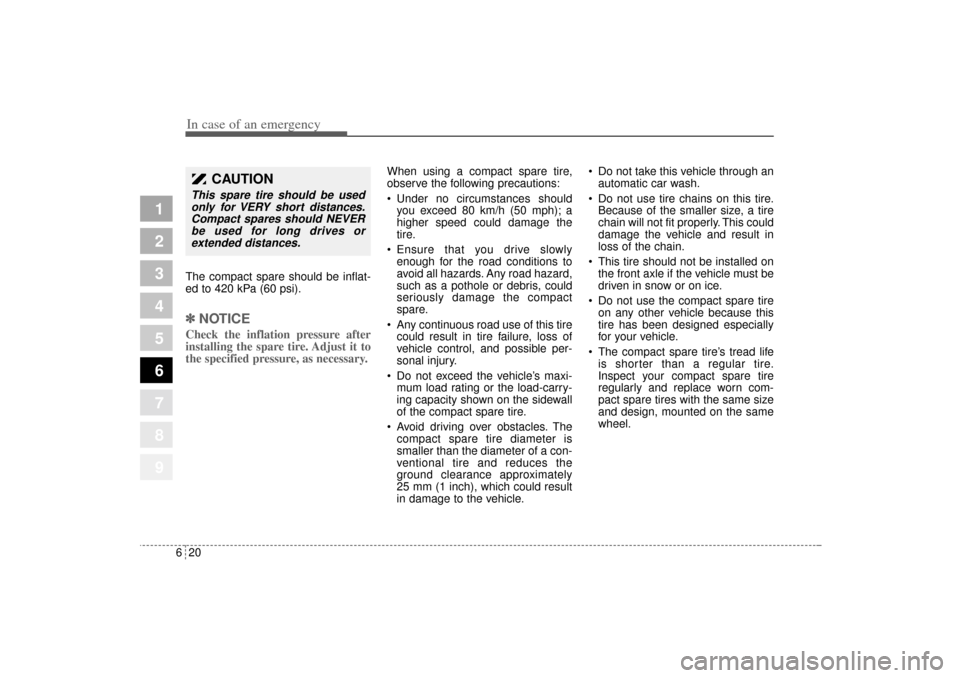
In case of an emergency20 6The compact spare should be inflat-
ed to 420 kPa (60 psi).✽ ✽
NOTICECheck the inflation pressure after
installing the spare tire. Adjust it to
the specified pressure, as necessary.
When using a compact spare tire,
observe the following precautions:
Under no circumstances should
you exceed 80 km/h (50 mph); a
higher speed could damage the
tire.
Ensure that you drive slowly
enough for the road conditions to
avoid all hazards. Any road hazard,
such as a pothole or debris, could
seriously damage the compact
spare.
Any continuous road use of this tire
could result in tire failure, loss of
vehicle control, and possible per-
sonal injury.
Do not exceed the vehicle’s maxi-
mum load rating or the load-carry-
ing capacity shown on the sidewall
of the compact spare tire.
Avoid driving over obstacles. The
compact spare tire diameter is
smaller than the diameter of a con-
ventional tire and reduces the
ground clearance approximately
25 mm (1 inch), which could result
in damage to the vehicle. Do not take this vehicle through an
automatic car wash.
Do not use tire chains on this tire.
Because of the smaller size, a tire
chain will not fit properly. This could
damage the vehicle and result in
loss of the chain.
This tire should not be installed on
the front axle if the vehicle must be
driven in snow or on ice.
Do not use the compact spare tire
on any other vehicle because this
tire has been designed especially
for your vehicle.
The compact spare tire’s tread life
is shorter than a regular tire.
Inspect your compact spare tire
regularly and replace worn com-
pact spare tires with the same size
and design, mounted on the same
wheel.
1
2
3
4
5
6
7
8
9
CAUTION
This spare tire should be used
only for VERY short distances.
Compact spares should NEVER
be used for long drives or
extended distances.
KM CAN (ENG) 6.qxd 9/13/2004 4:47 PM Page 20
Page 293 of 354
625
In case of an emergency
1
2
3
4
5
6
7
8
9
To prevent the jack, jack handle,
wheel lug nut wrench and spare tire
from rattling while the vehicle is in
motion, store them properly.
WARNING
- Wheel studs
If the studs are damaged, they
may lose their ability to retain
the wheel. This could lead to the
loss of the wheel and a colli-
sion.
WARNING
Check the inflation pressures as
soon as possible after installing
the spare tire. Adjust it to the
specified pressure, if necessary.
Refer to Section 8, Specifications.
KM CAN (ENG) 6.qxd 9/13/2004 4:47 PM Page 25